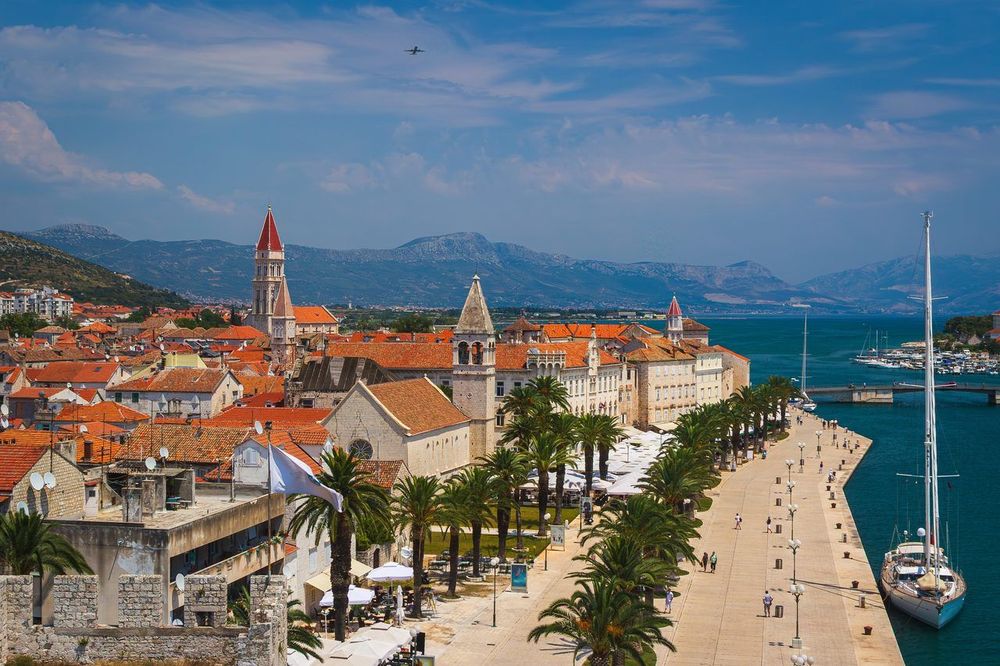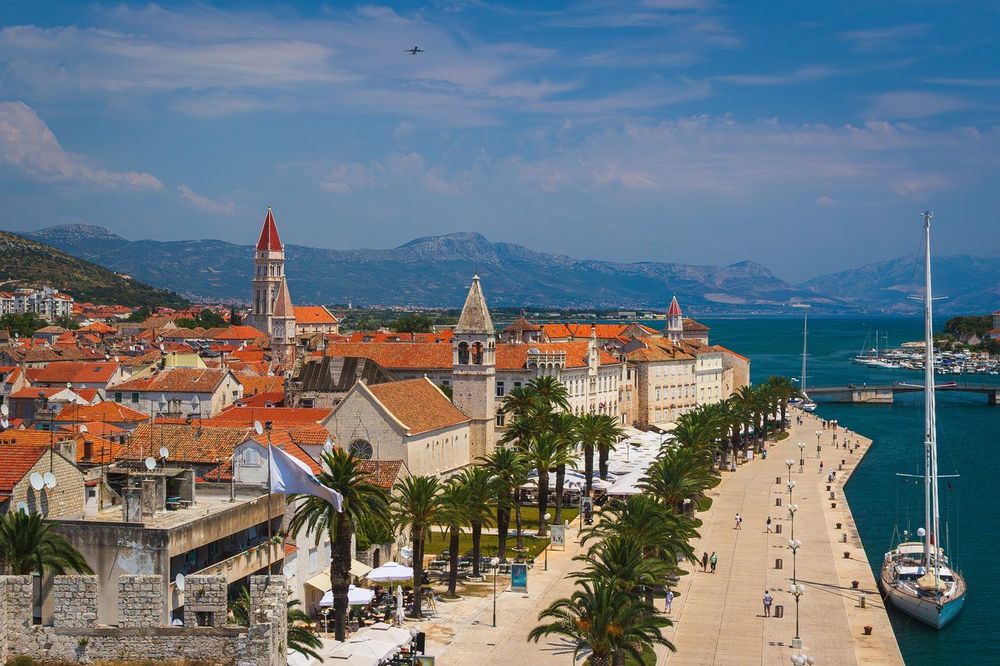
© Shutterstock
 Votre guide Ryo
Free Trogir: 15 100% Free Activities to Enjoy in 2026
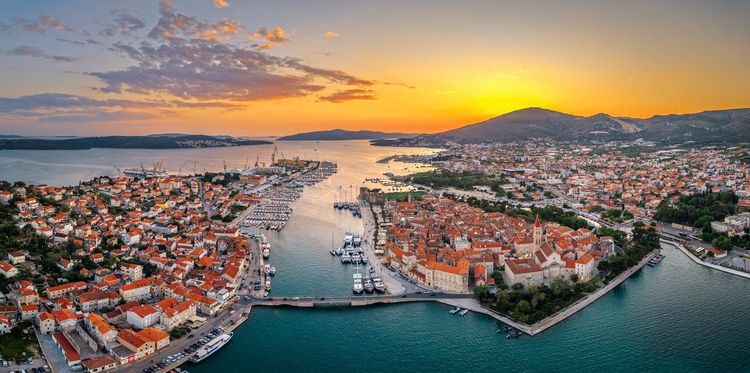
Finding free things to do in Trogir takes little effort: the line between a paid visit and a free stroll often comes down to a simple wooden door, the one separating the street from a palace's inner courtyard. The entire old town, a UNESCO World Heritage Site since 1997, can be explored on foot without spending a cent, alley after alley, all the way to the tip of the islet where the Kamerlengo ramparts face the Adriatic. To guide your walk without getting lost between two Gothic façades, the Ryo audio-guided tour of Trogir follows this route from start to finish, from the old town's entrance bridge to the waterfront.
In the pages that follow, you will walk alongside Venetian ramparts without going through a ticket booth, understand why the cathedral took more than three centuries to reach its final form, cross a bridge to an island that looks back at the town from the opposite shore, and spot six public beaches reachable on foot or by bus. Practical information (getting there from the airport, accommodation budget, best season) follows the list. Finally, a few paid excursions (Blue Lagoon, Krka, Šibenik) are reviewed for those who want to extend their stay in the region.
1. Get Lost in Trogir's UNESCO-Listed Old Town
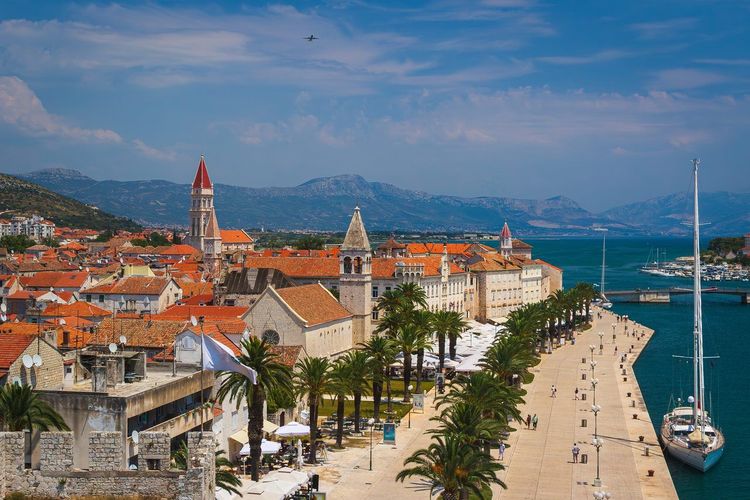
Trogir's old town (Trogir, 21220 Trogir, Croatia, rated 4.8/5 on Google from 13,432 reviews) occupies a tiny islet a few hundred meters long, connected to the mainland by a small bridge to the north and to the island of Čiovo (Čiovo, 21220 Trogir, Croatia) by another bridge to the south. Listed as a UNESCO World Heritage Site since 1997, it has preserved the layout inherited from Tragurion, the colony founded by Greeks from the island of Vis around the 3rd century BC, later overlaid with Roman, medieval and Venetian layers. This stacking of eras can be read in every façade along Gradska ulica, the main artery that crosses the islet from the north gate to the Riva.
The town's history fits into a few key dates. A free town in the Middle Ages, it was razed by the Saracens in 1123 and then rebuilt, before being taken by Venice in 1420 after a siege. The Venetians held it until 1797, nearly four centuries that explain the winged lions, loggias and fortifications you will come across everywhere. Austria then took over, with a brief Napoleonic interlude.
The western quarter, the oldest, is worth getting lost in on purpose. The alleys there are so narrow that two passersby sometimes have to press against a wall to pass each other. No ticket is required to walk through: this is not a museum under glass but a lived-in neighborhood, with laundry drying at the windows and cats sleeping on steps worn smooth by eight centuries of footfall.
For a first orientation, follow Augustina Kažotića Street, which runs along the side of the cathedral before reaching the main square. It is named after a Dominican bishop born in Trogir in the 13th century and beatified by the Church. Along the way you will spot several reliefs carved directly into the façades: grotesque heads and noble family coats of arms, sometimes accompanied by Latin inscriptions half erased by sea salt. Look up. Most of these details sit above eye level and go unnoticed when you walk with your head down over the cobblestones.
A planning tip: arrive before 9 a.m. or after 6 p.m. in July and August. Between those hours, groups landing from excursion boats from Split fill the main alleys and the medieval atmosphere quickly dissolves into the ice cream shop queues. Early in the morning, you will have Gradska ulica almost to yourself, with the sound of shutters opening and the smell of bread coming out of neighborhood bakeries.
The Ryo audio-guided sub-tour dedicated to the museum-town comments façade by façade on the reliefs you would miss without a guide. You listen to the story of each stone just as you walk past it, without hunting for explanatory plaques that, in Trogir, barely exist anywhere.
2. Admire St. Lawrence Cathedral and Ivana Pavla II Square
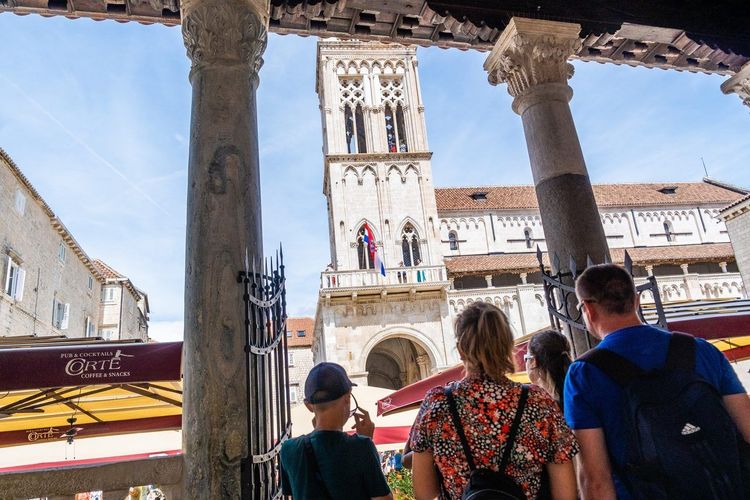
The St. Lawrence Cathedral (Trg Ivana Pavla II, 21220 Trogir, Croatia, rated 4.6/5 on Google from 3,640 reviews) (Katedrala sv. Lovre) towers over Ivana Pavla II Square, Trogir's civic heart since the Middle Ages. Its construction began in 1213 and stretched over more than three centuries: the Romanesque base first, then the portal sculpted by Master Radovan in 1240, and finally the bell tower, whose levels move from Gothic to Renaissance and whose top level was only completed in the late 16th century.
Linger in front of Radovan's portal. Adam and Eve stand on either side of the entrance, perched on lions, while the jambs unfold the calendar of the labors of the months: a peasant killing the pig in winter, another pruning the vines in spring, scenes of Dalmatian rural life frozen in stone nearly eight hundred years ago. It is one of the major works of Romanesque sculpture in Croatia, and it can be admired from under the porch, without any ticket.
Also look for the Latin inscription carved above the door: it names Radovan, describes him as the most excellent in his art and gives the year 1240. A rare signature for the period, when sculptors mostly remained anonymous. In the tympanum, the Nativity occupies the center of the composition, surrounded by shepherds and the Magi, while fantastic creatures, centaurs, sirens and exotic animals, slip into the colonnettes. Allow a good quarter of an hour to take it all in: each pass reveals a scene you had not seen at first glance.
The square itself can be crossed freely at any hour. At the end of the day, when the heat eases, the surrounding terraces fill up and neighborhood children play ball a few meters from the portal. No rope separates residents from visitors photographing the same stone, and that may be what strikes you most here.
Opposite the cathedral, the 15th-century town loggia, open to the square, houses a relief by Nikola Firentinac and a bas-relief by Ivan Meštrović dedicated to Ban Petar Berislavić. It once served as a courtroom and a place for public announcements; today, klapa singers (the Dalmatian polyphonic singing tradition) sometimes give short improvised concerts here on summer evenings, taking advantage of the natural acoustics of the arcades.
To enter the nave, see the chapel of Blessed John of Trogir (a Renaissance masterpiece by Nikola Firentinac and Andrea Alessi) and climb the bell tower, however, you need to buy a ticket. The museum of sacred art, housed in an 18th-century Baroque building on the same square, also charges admission. If your budget is tight, the exterior is enough to grasp the scale of the monument.
The Ryo audio guide marks a stop on this square to tell the story of the cathedral's three centuries of construction: enough to understand, without reading a single sign, why the bell tower changes style at every level.
3. Explore Kamerlengo Fortress and St. Mark's Tower
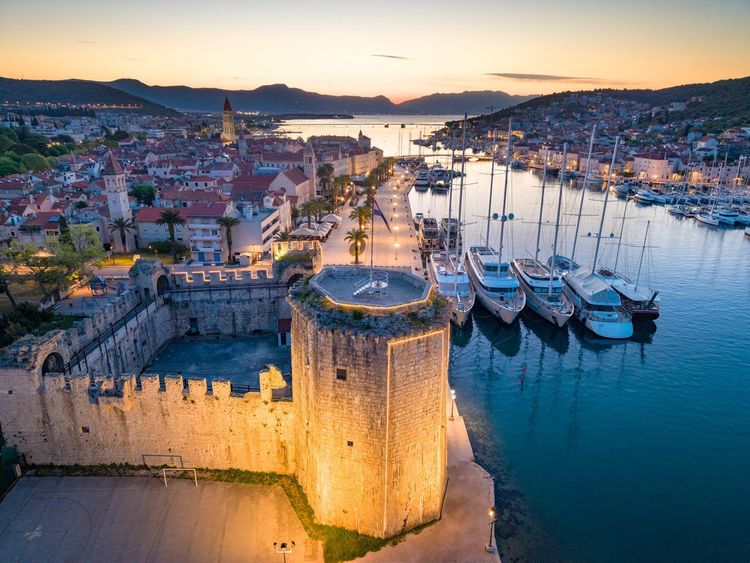
The Kamerlengo Fortress (Obala kralja Zvonimira, 21220 Trogir, Croatia, rated 4.5/5 on Google from 6,148 reviews) closes off the southwestern end of the islet. The Venetians built it in the 15th century, between roughly 1420 and 1437, incorporating an older tower, to control the channel between Trogir and Čiovo. It takes its name from the camerlengo, the Venetian official in charge of the town's finances, who had his residence there.
The outer ramparts and the path running along the sea can be walked without a ticket. You can go around the walls, photograph the battlements from several angles and watch the sailboats moored just below, without passing through the ticket booth. If you then feel like climbing onto the wall walk, entry costs a few euros, about the price of a coffee on a terrace. At sunset, the blond stone takes on a coppery hue that amateur photographers wait for every evening from the promenade.
A little further on, St. Mark's Tower (Gradska ulica, 21220 Trogir, Croatia, rated 4.3/5 on Google from 23 reviews) (Kula sv. Marka), a round 15th-century tower, completed the defensive system. The two structures are now separated by a football pitch, one of the town's most unexpected contrasts: players from the local club train between two Venetian monuments. You can still make out the arrow slits on the tower, designed to cover the channel entrance in case of a naval attack.
In summer, the fortress becomes the stage of the Trogir festival: concerts, theater and open-air screenings within the ramparts. The Ryo audio-guided tour lingers on the quays in front of Kamerlengo to explain how a military bastion became the most photogenic concert hall in Dalmatia. On performance nights, you can enjoy the musical atmosphere from the quay without taking a seat.
4. Spot the Ćipiko Palace and Trogir's Town Hall
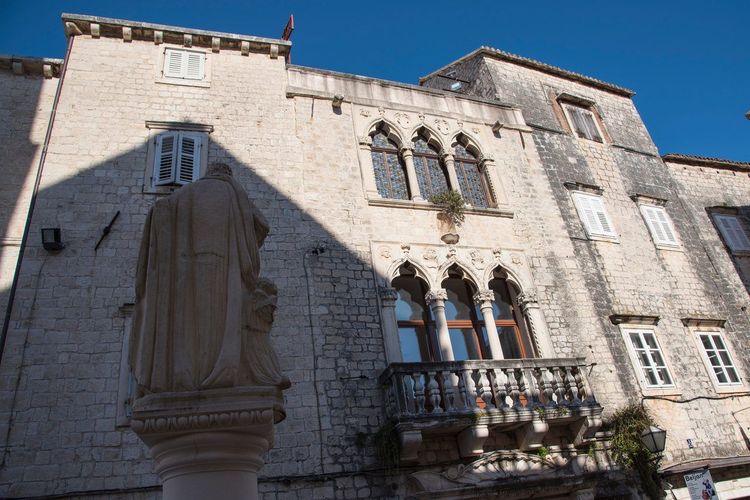
The Ćipiko Palace, on Gradska ulica facing the side of the cathedral, belonged to one of Trogir's most influential noble families. It actually consists of two 15th-century buildings, the large and the small palace, whose finely openwork Gothic windows are among the most elegant on the Dalmatian coast.
The interior cannot be visited, but the façade reads like an architecture textbook on its own: slow down to spot the carved window frames and the coats of arms that signal the family's rank. Among its members, the humanist Koriolan Ćipiko fought in the Venetian fleet against the Ottomans in the late 15th century and wrote a Latin account of it, one of the best-known historical texts of the Dalmatian Renaissance. Local tradition also links the Ćipiko family to a wooden rooster, the figurehead of an Ottoman galley brought back from the Battle of Lepanto in 1571.
What makes Trogir so special is this density of noble palaces in such a small area. Between the 13th and 16th centuries, a handful of families (Ćipiko, Sobota, Andreis, Lucić) competed with carved façades and private chapels to display their rank. You can see the result at every street corner: stone coats of arms above ordinary doors, twin windows on the second floor of buildings that have become apartments.
Two minutes' walk away, Trogir Town Hall (Trg Ivana Pavla II 1, 21220 Trogir, Croatia, rated 4.4/5 on Google from 489 reviews) borders Ivana Pavla II Square. Remodeled in the 15th century, it conceals an inner courtyard decorated with an exterior stone staircase and carved coats of arms, which the gateway often lets you glimpse during the day.
Municipal services still operate there, making it one of the few medieval buildings in town to have remained true to its original purpose. If the gateway is open, take a discreet look into the courtyard: it is a workplace, not an exhibition hall, but no one will mind you looking at the staircase from the threshold.
5. Look Up at the St. Sebastian Clock Tower and the Medieval Gates
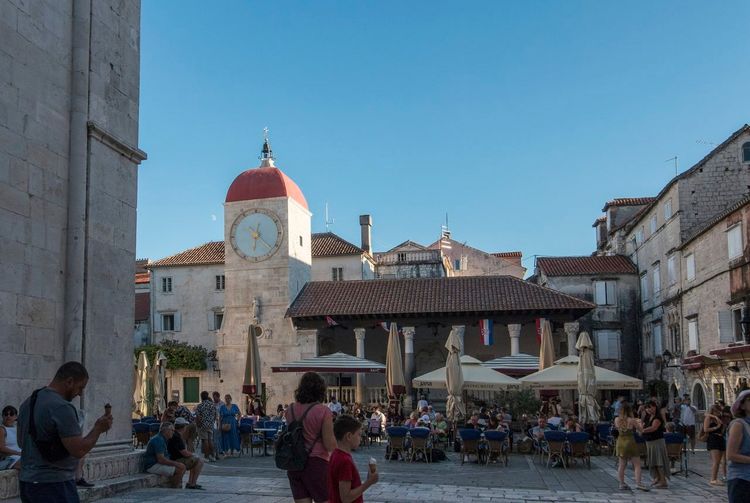
The clock tower tops the small Church of St. Sebastian, attached to the loggia on the main square. The large dial and the dome above it serve as a landmark for everyone arranging to meet in the old town.
The church was built in 1476 as a votive sanctuary, in thanks after a plague epidemic that had struck the Dalmatian coast. More modest than the neighboring cathedral, it is best admired from the outside: its sober Renaissance façade and its tower form, together with the loggia, one of the most harmonious ensembles on the square. Stand in the opposite corner of the square to frame the three monuments together; it is the postcard photo everyone brings back from Trogir.
Before leaving the center, look for the medieval gates that once pierced the islet's ramparts. The Land Gate, to the north, is topped by a statue of Blessed John of Trogir, the town's patron saint, and marks the historic entrance from the mainland. On the Riva side, the Sea Gate opens onto the quay, next to the old fish market. These two passages, accessible at any hour, are crossed every day by thousands of visitors who do not always look up.
Take five minutes to also walk along the fragments of wall still standing on the north side. The town lost part of its fortifications in the 19th century, when the ramparts were demolished to open the islet to the sea, and what remains helps you imagine the closed, fortified Trogir of the Venetian era.
6. Stroll Along Trogir's Waterfront Promenade (the Riva)
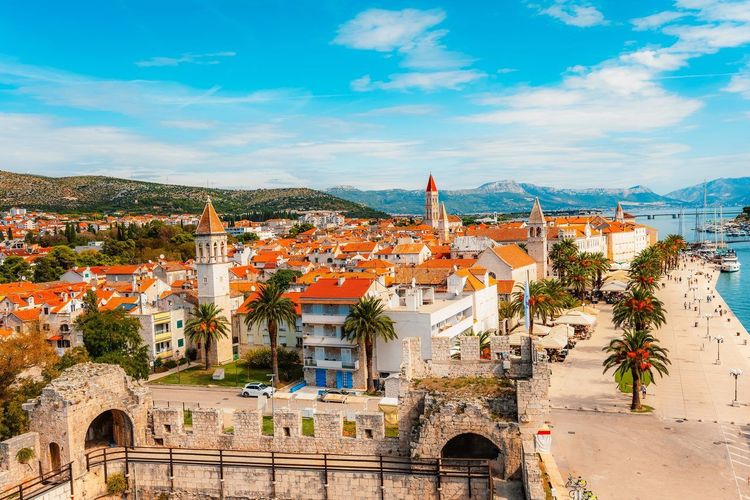
The Riva, the waterfront running along the entire southern side of the old town facing Čiovo, concentrates most of Trogir's life at the end of the day. Lined with palm trees, it serves as a marina, a promenade and an open-air living room for residents.
In the early morning, before the groups arrive, the Riva belongs to fishermen bringing in their nets and retirees playing cards on the benches. At noon, the terraces overflow and sailboats maneuver for a spot at the quay. Two faces of the same place, depending on the hour you choose.
Walking along the Riva to Kamerlengo, then returning through the inner alleys, lets you complete a full loop of the old town in under an hour. For a guided version with no fixed fee, several operators offer free walking tours in English, sometimes in French in high season: the guide lives solely on tips left at the end of the tour, so count on about ten euros per person if you enjoyed it.
If you prefer to go at your own pace, the Ryo audio-guided tour of Trogir also accompanies you along the waterfront: it tells the town's maritime history, from Venetian galleys to 20th-century shipyards, while you walk by the water.
7. Browse the Local Market and the Shopping Alleys
Every morning, a small market sets up just outside the north gate, on the other side of the bridge linking the islet to the mainland. Seasonal fruit, dried figs, sheep's cheese, honey from the hinterland and lavender fill the stalls until late morning.
Entry is free and nobody forces you to buy. Arrive around 8 a.m.: it is when residents do their shopping, when you mostly hear Croatian, and when vendors readily offer you a taste of a fig before you fill your picnic basket.
8. Visit St. Dominic's Church and the Old Town Convents
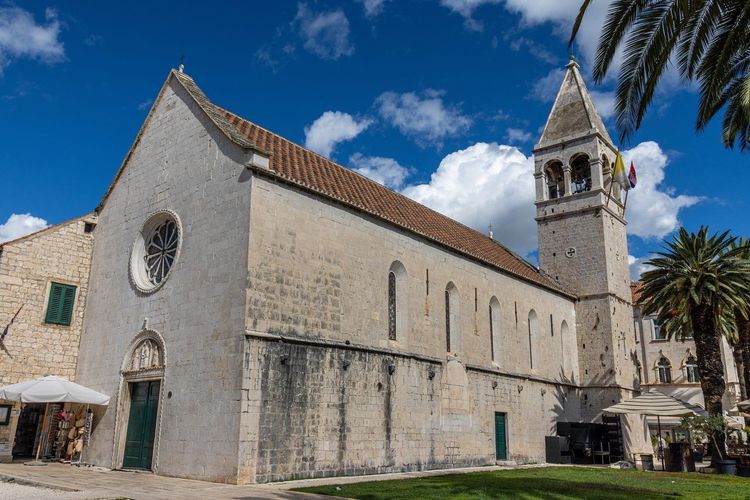
The Gothic Church of St. Dominic (Obala bana Berislavića, 21220 Trogir, Croatia, rated 4.7/5 on Google from 218 reviews) stands on the Riva, south of the old town, a few steps from the Sea Gate. Its sober façade contrasts with the interior, where the tomb of the Sobota family, sculpted by Nikola Firentinac in the 15th century, recalls the importance of the Dominican order in the medieval town.
A few streets away, the Benedictine Convent of St. Nicholas holds one of Trogir's most surprising pieces: a Greek marble relief depicting Kairos, the god of the opportune moment, dating from the Hellenistic period and found beneath the town. The figure, with hair falling over the forehead and a shaved nape, illustrates a proverb the nuns like to explain to visitors: opportunity must be seized by the hair when it arrives, afterwards it is too late.
St. Dominic's Church opens during worship hours. The convent, however, charges a ticket of a few euros to fund the upkeep of its collection: an exception in this list, amply justified by the rarity of the piece on display.
Nearby, the Trogir City Museum, housed in the Garagnin-Fanfogna Palace, presents archaeological objects, documents from the Venetian era and a lapidarium. Add the Church of St. Peter, more modest and often open only in high season. Paid admissions remain modest, and each visit takes under half an hour, handy between two walks.
9. Cross the Bridge to the Island of Čiovo
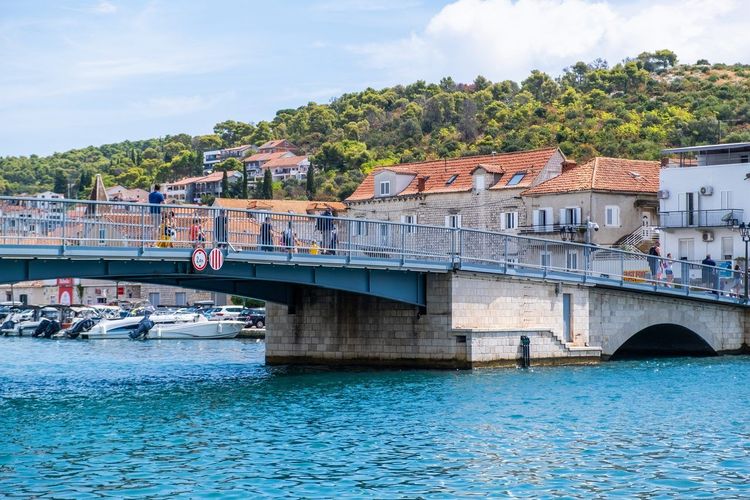
A bridge connects Trogir's old town to the island of Čiovo, much larger than the historic islet. Crossing on foot takes two minutes and costs nothing, but it completely changes the perspective on the town.
From the Čiovo shore, Trogir's skyline can be taken in at a single glance: the cathedral bell tower, the Kamerlengo ramparts and the tiled roofs lined up along the channel. It is the most photogenic viewpoint over the town, and one of the least crowded. Go at the end of the day, just before sunset, when the low light illuminates the seaside façades.
If you have an hour to spare, follow the coastal road east to the Dominican Convent of the Holy Cross, about two kilometers from the bridge. Founded in the 15th century at the water's edge, it preserves a Gothic-Renaissance cloister and a church where monastic life continues. Tourists are rare, the view over Kaštela Bay is superb, and access to the exterior of the convent requires nothing more than a little walking.
The most motivated can climb the heights of the island, covered in pines and scrubland, via the small roads winding above the villages. The panorama then takes in the whole bay, Trogir below, and the islands of Šolta and Brač on the horizon. Set off early in the morning in summer and bring water: shade becomes scarce as soon as you leave the coast.
Many visitors never cross this bridge, in a hurry to tick off the monuments of the center. The cafés along the channel on the Čiovo side nevertheless enjoy the same view as the Riva, often at gentler prices.
10. Catch Your Breath in Garagnin-Fanfogna Park, a Free Green Corner
Near the north gate, Garagnin-Fanfogna Park (Kohan 1, 21220 Trogir, Croatia, rated 4/5 on Google from 148 reviews) occupies the former garden of a noble Trogir family, laid out in the early 19th century by Ivan Luka Garagnin. It is one of the only sizable green spaces in the old town.
Shaded paths, fragments of carved stone among the flowerbeds, benches sheltered from the sun: after an hour on the scorching cobblestones, you will find coolness and calm here, rarely more than a few locals reading on a bench. Plan your market picnic here.
11. Swim at the Best Free Beaches Around Trogir
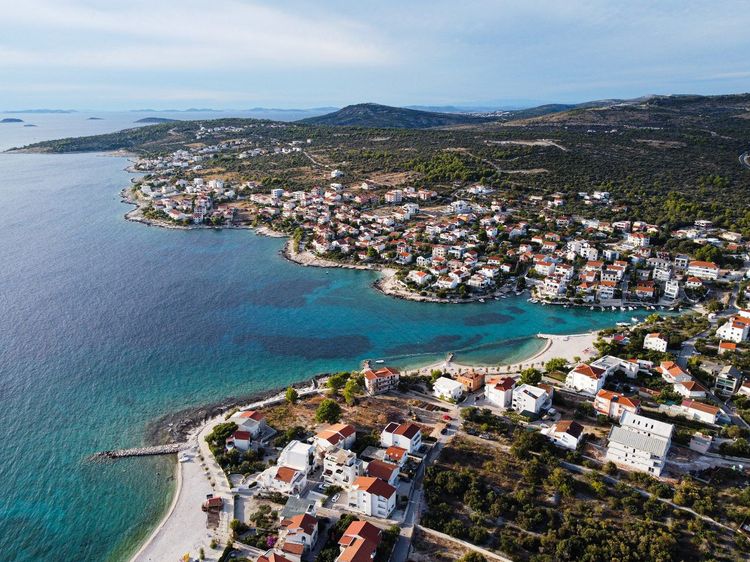
Trogir has no big sandy beach beneath its ramparts, but the town is surrounded by half a dozen public beaches reachable on foot, by bike or by bus. Access to the water is free everywhere in Croatia, as the law guarantees the public nature of the coastline: only sunbeds and umbrellas are rented, and nothing prevents you from laying your towel next to them.
On the mainland side, east of the town, Pantan Beach borders a small nature reserve crossed by the Pantan River, where herons and wild ducks nest. Sand alternates with fine pebbles, and the shallow waters suit children well. Allow about twenty minutes by bike or a short drive from the center. If you have time, follow the path along the river: it passes an old stone mill and offers a pastoral break just steps from the sea.
On the island of Čiovo, Okrug Gornji Beach, about a kilometer and a half long, works as a summer extension of Trogir's nightlife: beach bars, paid sunbeds but free access to the water, and music late into the evening on certain weekends. Fine pebbles mix with a little sand, and the water remains among the clearest in the area. The beach is about four kilometers from the bridge: an hour's walk, or a few minutes by local bus, frequent in high season. Stay until evening: facing west, it offers one of the region's most beautiful sunsets, when the sun sinks behind the islands.
Closer to the historic center, Plaža Rožac and Gradska plaža can be reached on foot from the Riva by crossing the bridge to Čiovo and then following the coast westward. These are pebble beaches typical of the Dalmatian coast, where the turquoise water lets you see the bottom several meters down even without a mask. Gradska plaža, the busier of the two, has a small snack bar and a few shaded areas under the pines. With just a mask and snorkel, you can watch sea bream, colorful wrasse and starfish along the rocks.
To escape the crowds, two options require a bit more effort. Saldun Beach, at the end of a sheltered bay on Čiovo, mainly attracts local families on weekdays. Marinova Draga Beach (Arbanija, 21220 Trogir, Croatia, rated 4.4/5 on Google from 129 reviews), a more intimate cove near the village of Arbanija, is lined with pines that provide rare natural shade on this coast and stays surprisingly quiet even in August.
Bring water, sunscreen and beach shoes: the pebbles heat up quickly and sea urchins are not rare near the rocks. On-site kiosks rarely sell for less than in town, and shade remains limited on most of these beaches, with the notable exception of Marinova Draga. In July and August, arrive before 10 a.m. to find a spot in the shade of the pines, or after 5 p.m., when families pack up and the light becomes softer.
One last tip: most villages on Čiovo have no sidewalk along the main road, which is narrow and very busy in summer. To reach the remote coves, prefer the bus or a rental bike rather than walking along the roadway.
12. Walk the Coast to Seget Donji at Sunset
West of the old town, a seaside promenade runs to the village of Seget Donji, about three kilometers away. It is the locals' favorite evening stroll: flat, partly shaded by pines, dotted with small coves where you can take a quick dip.
Set off an hour before sunset. On the way back, Trogir's silhouette stands out against the water, cathedral bell tower first, and you return to town just as the terraces light up.
13. How Much Time to Allow and How to Get to Trogir
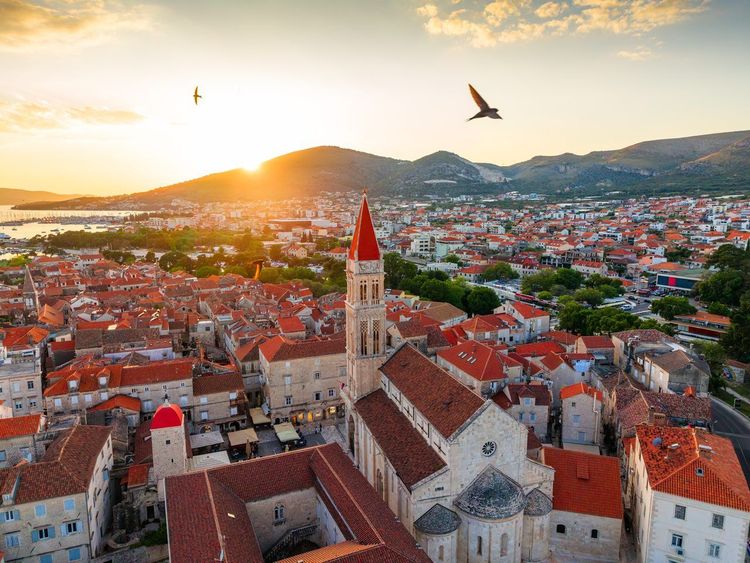
To string together the essentials of this list (old town, cathedral seen from the porch, fortress, Riva, a round trip to Čiovo), allow a well-filled half day, five to six hours of relaxed walking with coffee breaks. To add a beach and the lesser religious buildings, plan a full day instead. Spreading your free activities in Trogir over two days lets you keep mornings for monuments and afternoons for swimming.
Split Airport, located in Kaštel Štafilić, is about 6 kilometers from Trogir: it is one of the shortest airport-to-town transfers on the coast, about ten minutes by taxi. Bus line 37, which connects Split to Trogir, stops in front of the airport. From the center of Split, 27 kilometers away, the same bus takes between 45 minutes and an hour depending on traffic. In summer, shuttle boats also link Split to Trogir, a slower but much more pleasant option.
On site, the currency has been the euro since 2023, and bank cards are accepted almost everywhere. Still, keep a few coins for public toilets, the free walking tour tip and the small market stalls.
The weather in Trogir follows the Mediterranean pattern: hot, dry summers from June to September (25-32 °C), mild and rainy winters. May, June and September remain the most comfortable months for long walks in the old town without enduring the heat or the July-August crowds. Sea temperatures generally exceed 22 °C from June to September.
To avoid wasting time looking for each monument, the Ryo audio guide to Trogir lays out a continuous itinerary between the main stops of this article, with commentary that starts automatically as you approach each stage: handy for fitting in a half day without unfolding a map at every intersection.
14. Where to Stay and Eat on a Budget in Trogir
To sleep on a budget, look at Čiovo and the mainland districts of Trogir: hostels, private rooms (the famous sobe) and small family-run hotels offer rates well below those of the old town, where every historic square meter comes at a high price.
Booking in May, June or September can often halve the price compared with July and August. Campsites around Okrug and Seget Donji, a few kilometers away, remain the most economical option for van or tent travelers. Also check the tourist tax, rarely included in the prices shown on booking platforms.
To eat without breaking the bank, look for konobas (family taverns) set back from the Riva. A fish dish of the day, a black cuttlefish ink risotto or a pašticada (beef marinated in wine) cost noticeably less there than on a terrace facing the marina, for often comparable quality. At lunchtime, several places offer a marenda, a simple and hearty meal of the day at a gentle price.
The cheapest option remains the picnic: the morning market supplies everything you need, to be topped off with a burek (a pastry filled with cheese or meat) bought at a neighborhood bakery. Then settle on a bench on the Riva or in Garagnin-Fanfogna Park. Tap water is drinkable in Croatia, and a few public fountains let you refill a water bottle.
For a sunset drink, the Riva bars are the most popular, but a beer bought at the grocery store and enjoyed on the quay steps facing Čiovo offers exactly the same view.
15. Bonus: Paid Excursions Not to Miss Around Trogir
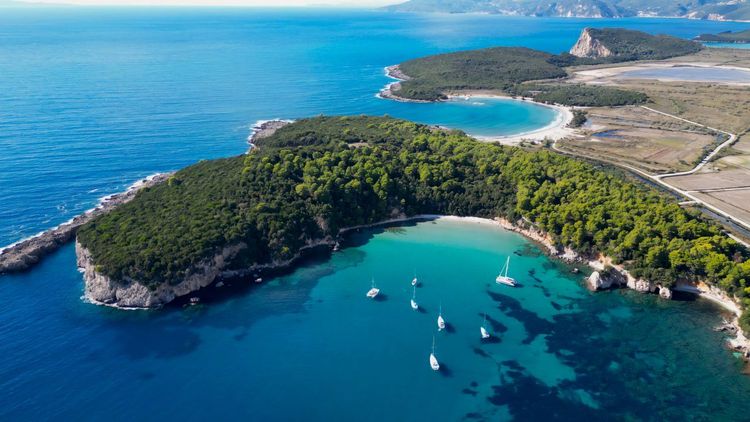
To extend your stay, several paid excursions are worth the detour. The Blue Lagoon, a sheltered turquoise cove between the island of Drvenik Veli and the Krknjaši islets, is reached by boat on a day trip, with swimming stops and often a meal included. Departures are directly from the Riva: compare the offers posted on the quays the day before, as prices often drop at the start and end of the season.
Split, less than an hour away by bus, offers with Diocletian's Palace an old town just as rich as Trogir's, in XXL version; its alleys can also be explored without a ticket. Šibenik, about an hour's drive to the north, is home to St. James Cathedral, also UNESCO-listed, and serves as a gateway to Krka National Park, known for its travertine waterfalls and its entrance fee of several dozen euros in high season. Swimming is no longer allowed at the foot of the Skradinski buk falls, but the wooden walkways winding above the water are worth the trip on their own.
For diving enthusiasts, several clubs based in Trogir and on Čiovo organize outings to wrecks and rocky drop-offs. On the food side, a meal cooked under the peka (a cast-iron bell in which meat and vegetables simmer under embers) is often ordered the day before in the konobas of the hinterland: a paid experience, but one of the most authentic in the region.

FAQ
How long does it take to visit Trogir?
Half a day (5-6 hours) is enough to cover the essentials: the old town, the cathedral seen from its porch, Kamerlengo Fortress and the Riva. Allow a full day if you want to add a beach, the island of Čiovo and the lesser religious buildings without rushing.
Is entry to the cathedral and Kamerlengo Fortress free?
The exteriors of both monuments, Radovan's portal and Ivana Pavla II Square are free to access. The cathedral interior, the bell tower climb, the museum of sacred art and the inside of Kamerlengo Fortress require a ticket.
Trogir or Split: which should I visit first?
Trogir can be visited in half a day, while Split needs at least a full day for Diocletian's Palace. Since the two cities are only 27 kilometers apart, it is easy to combine both in a single trip.
Visit Trogir or Šibenik: which one should I choose?
Trogir charms with its miniature old town and its concentration of monuments on a small islet, while Šibenik offers its St. James Cathedral and its proximity to Krka National Park. With a bit of time, the two complement each other rather than compete.
How do I get to Trogir from Split or the airport?
Split Airport is about 6 kilometers from Trogir, roughly ten minutes by taxi or bus 37. From the center of Split, bus 37 connects the two cities in 45 minutes to an hour, and shuttle boats run in summer.
What is the best time to visit Trogir?
May, June and September offer the best compromise between pleasant weather (22-28 °C) and moderate crowds. July and August remain the hottest and busiest months, especially on the Riva and the beaches of Čiovo.
Is Trogir an easy city to explore on foot?
Yes: the old town can be covered entirely on foot in a few hours, with no significant elevation changes. Only the more distant beaches and certain excursions require a bus, a bike or a short drive.
Conclusion
Trogir fits in the palm of a hand, making it one of the few Croatian towns where almost all the heritage can be discovered without opening your wallet: medieval alleys, carved façades, Venetian ramparts and waterfront are all explored at walking pace. Free activities in Trogir thus cover most of a stay, and the few paid exceptions (bell tower, museums, fortress interior) remain a complement rather than a must.
To enjoy this walk without hunting for information as you go, download the app before leaving: the Ryo audio-guided tour of Trogir follows the route described in this article and triggers each commentary as you approach the right spot, from the north gate bridge to the Kamerlengo ramparts facing the sea.