© Shutterstock
 Votre guide Ryo
Wallenstein Gardens in Prague: Complete Guide for Your 2026 Visit
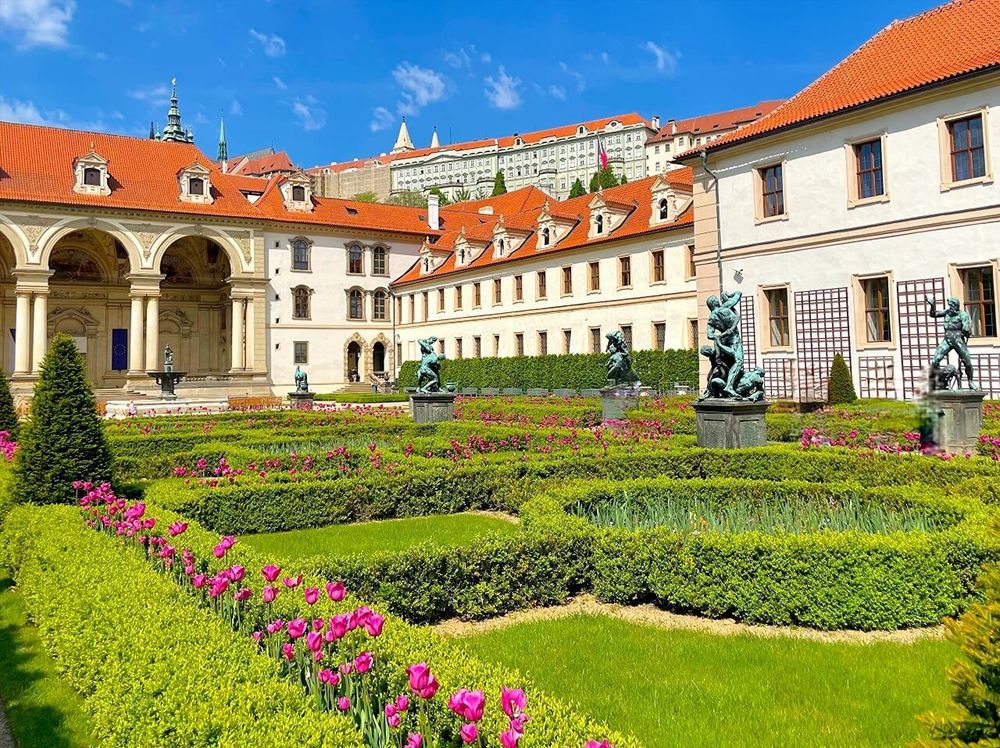
The Wallenstein Garden in Prague is one of those places the city hides behind its stone gateways. It is a baroque space of around 1.7 hectares, tucked at the foot of the castle, which thousands of tourists walk past every day without ever pushing the gate open. Yet the moment you cross the threshold from Letenská Street, the noise of the trams disappears. White peacocks roam freely among bronze statues, a Renaissance loggia opens onto a central pool, and the orange rooftops of Malá Strana close off the horizon.
This garden is part of one of the most ambitious baroque complexes in the Czech capital: Wallenstein Palace, whose construction in the 17th century required the demolition of twenty-six houses, three gardens and a brickworks in the neighbourhood. Before you go, explore the Ryo Prague audio tour: it will guide you through Malá Strana, the castle and the other historic neighbourhoods, giving you all the context you need to understand what you see. This guide details the history of the site, its architecture, its statues, its 2026 opening hours and everything you need to know to make the most of your visit.
The Rise of Albrecht von Wallenstein: How a General Had a Palace Built for Himself
To understand these gardens, you first need to understand the man who commissioned them. Albrecht von Wallenstein (1583–1634) was not simply a brilliant military commander: he was a figure of absolute power in Thirty Years' War Europe, a war entrepreneur who financed his own armies by mortgaging land and speculating on estates confiscated from Protestant nobles after the Battle of White Mountain in 1620.
In less than ten years, Wallenstein established himself as the wealthiest man in Bohemia after the Habsburgs. And like any man who accumulates such a fortune, he wanted to display it. As early as 1623, he launched the construction of what would become Prague's largest baroque architectural complex, engaging Italian architects Giovanni Pieroni and Andrea Spezza. To clear the necessary space, he had twenty-six houses, three gardens and a brewery demolished or bought out in the Malá Strana neighbourhood — a land operation of cold-blooded brutality, characteristic of the man.
The construction site mobilised hundreds of craftsmen for a decade. The palace was completed around 1630, with its five inner courtyards, stables and riding hall — an architectural programme that deliberately eclipsed the residences of the local Habsburg nobility. Wallenstein was not a man for modesty: he had himself depicted as the god Mars on the ceiling of the main hall.
His reign came to an abrupt end. Accused of high treason against Emperor Ferdinand II, Wallenstein was assassinated in Cheb in February 1634 by his own officers, on imperial orders. The palace was confiscated and passed through the hands of several noble families before being acquired by the Czechoslovak state in 1945. Since 1993, the complex has housed the Senate of the Czech Republic, making this baroque monument a seat of power in the 17th century as much as in the 21st.
The garden, conceived in the same spirit of display as the palace, perfectly reflects the ambitions of its patron: a space for representation before it was a space for strolling.
The Garden Today: First Impressions
The site covers around 1.7 hectares to the north of the palace, between the enclosure walls of Malá Strana and the castle hill. It is a French-style baroque garden — geometric and axial — very different from the romantic landscape parks found in other European capitals. The paths are straight, the flowerbeds clipped, the perspectives calculated to guide the eye towards precise focal points: the sala terrena, the pools, the statues.
The main entrance is on Letenská Street, accessible from Malostranská metro station (Line A). A second entrance opens onto Valdštejnské náměstí, Wallenstein Square. Both gateways are open during the same hours, but the entrance from the square offers a more striking overall view of the palace façade.
As soon as you enter, a few elements immediately demand your attention. To the left, the long wall of artificial stalactites stretches the full length of the garden, blackened by the centuries. Straight ahead, the sala terrena closes off the main perspective with its painted arcaded façade. Along the centre of the main avenue, a row of pedestals supports bronze copies of mythological statues. And all around, white and grey peacocks wander freely, utterly indifferent to visitors.
Entry is free and requires no reservation. It is one of the rare high-quality discoveries in Prague that demands no logistical preparation whatsoever. Allow between 45 minutes and 1h30 depending on your pace and appetite for architectural detail.
The Sala Terrena: The Garden's Architectural Jewel
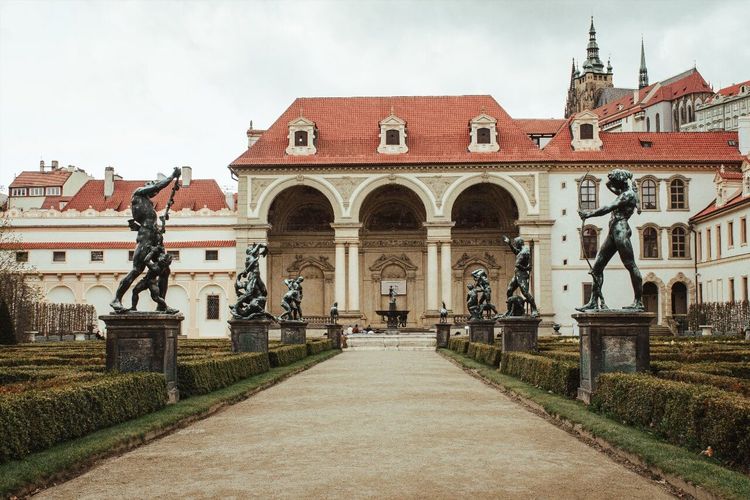
At the far end of the garden, the sala terrena is the most remarkable architectural element on the site. This open-arched hall — an Italian loggia transplanted to the heart of Bohemia — was built between 1623 and 1627 by architect Giovanni Pieroni. It marks the northern boundary of the garden and serves as the backdrop to the entire composition.
The façade is divided into three bays by round arches resting on Tuscan columns. The interior is covered with mythological frescoes depicting scenes from the Trojan War and the labours of Hercules — a classical iconographic programme typical of the first half of the 17th century, blending antique references with the implicit glorification of the patron. The murals are in varying states of preservation: some sections were restored in the 19th and 20th centuries, while others retain their original patina.
If you have an interest in baroque painting, visiting the interior of the sala terrena is well worth the effort. Check the palace opening days in advance, as the interior is not always accessible from the garden alone.
In front of the sala terrena, a rectangular pool with a central fountain creates a mirror effect on calm days. It is the most photographed spot on the site, especially in the early morning when the light strikes the frescoes at an oblique angle. If you are a photographer, arrive at opening time at 7am on weekdays: you will have the sala terrena to yourself for a good hour.
The Statues by Adriaen de Vries: Bronzes with a Turbulent History
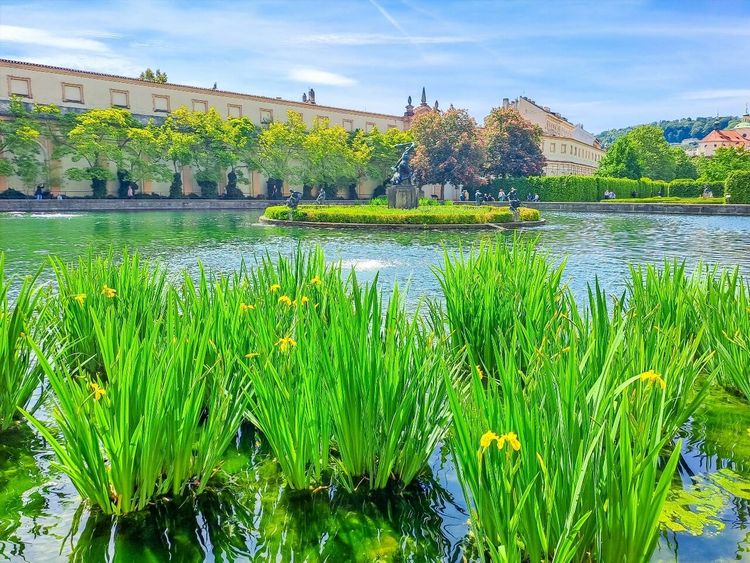
Along the central avenue, a series of stone pedestals supports bronze figures representing gods and heroes from ancient mythology: Hercules, Neptune, Bacchus, Venus and Cupid, the Laocoön group, rearing horses. These sculptures are one of the main attractions of the Wallenstein Garden — but what you see are not the originals.
Adriaen de Vries (1556–1626), a Dutch sculptor attached to the imperial court of Rudolf II in Prague, worked for Wallenstein from 1622 until his death in 1626. His style is recognisable: elongated figures in dynamic, twisting poses, heirs to Flemish Mannerism yet adapted to the emerging baroque taste.
In 1648, during the looting of Prague by Swedish troops at the very end of the Thirty Years' War, the statues were dismantled and carried off as war booty. They now stand at Drottningholm Castle, the official residence of the Swedish royal family, a UNESCO World Heritage Site. It is one of history's ironies: the bronzes that adorned a warlord's garden were taken away by another war, and they have never been returned (only one Venus came back to Prague at the end of the 19th century).
The copies you see today were cast between 1913 and 1918 from the Swedish originals, on the commission of Karl Ernst von Wallenstein. They are of excellent quality and faithfully render de Vries's aesthetic, even if the patina is less pronounced than on the Drottningholm pieces.
The Aviary, the Peacocks and the Pond
One of the surprises of the place, for those who do not expect it, is the animal activity. A wooden aviary, partially reconstructed in its original location, houses exotic birds. Wallenstein was a collector of natural curiosities, in the tradition of the cabinets of curiosities of the era, and the aviary was part of the original programme alongside the fountains and statues.
But it is above all the peacocks that draw the eye. Several individuals — white and coloured — roam freely along the paths. They climb onto benches, inspect the clipped flowerbeds and sometimes settle at the foot of the statues in an involuntary yet perfect tableau. Male peacocks display their tail feathers in the warmer months, generally from April to July, turning a simple stroll into a spectacle. A word of caution: keep a reasonable distance — these are not domestic animals despite their apparent tameness.
Nearby, a pond stocked with carp, featuring a central sculpture, completes the garden's aquatic vocabulary. Water was an essential element in the baroque conception of gardens: it reflected, cooled and symbolised abundance. The fountains and pools are still functioning today — a feat of technical conservation on 17th-century installations.
The Artificial Stalactite Wall: A Baroque Curiosity
Along the western wall stretches one of the strangest creations of Prague's baroque: an artificial stalactite wall around 50 metres long, covered in a crust of blackened calcareous tufa and riddled with niches. This type of ornament, known as "rustic work" in the architectural vocabulary of the Renaissance, was highly prized in Italian gardens of the 16th century; in Prague, it is one of the rare surviving examples of this fashion.
The wall houses a series of small niches that originally held sculptures. Some are empty, others have received copies. The raw, almost lunar texture contrasts sharply with the geometric rigour of the paths and flowerbeds — intentionally so. This wall symbolically represents the chaos of wild nature that the domestic garden holds at bay.
At the end of the wall, an artificial grotto carved into the masonry once housed a fountain. The interior, accessible through a low opening, is lined with the same tufa stalactites. Little light enters, and the atmosphere is deliberately mysterious — it served as a place of coolness and retreat in baroque gardens, the opposite of the open representational spaces.
Wallenstein Palace: Seat of the Czech Senate
The palace itself is closed to the public most of the time, but it opens during Czech open days (Dny otevřených dveří), generally organised in spring and autumn. It is during these openings that you can access the main reception hall (the Knights' Hall), the ceiling depicting Wallenstein as Mars, and the interior of the sala terrena.
On a day-to-day basis, the palace functions as the upper chamber of the Czech Parliament. The Czech Senate moved in in 1993, upon the creation of the independent Czech Republic. The buildings have been carefully restored to reconcile their parliamentary use with the preservation of the baroque heritage.
The Ryo audio tour Back to Prague's Roots passes through the Malá Strana neighbourhood and will give you an in-depth insight into the historical context in which the palace sits, from the post-Battle of White Mountain transformations to the baroque urban planning of the 17th century. An excellent complement to the visit.
Opening Hours and Access to the Wallenstein Garden in 2026
The Wallenstein Garden in Prague is free and open without prior reservation. It is a seasonal site: it reopens on 1 April 2026 and remains accessible until the end of October.
Official opening hours for the 2026 season:
- Weekdays (Monday–Friday): 7am to 7pm
- Weekends and public holidays: 9am to 7pm
- November to March: garden closed for the winter season
In the event of heavy rain, the garden may be closed for safety reasons. Check the official Senate website (senat.cz) before your visit.
The palace's main hall (Knights' Hall) and the interior rooms open during the annual open days, generally in spring and autumn; consult senat.cz for exact dates. There is no shop or refreshment point on site. Benches are available but limited in number.
How to Reach the Wallenstein Garden from Central Prague
The site is located in the Malá Strana neighbourhood, on the left bank of the Vltava, a few hundred metres from Charles Bridge.
By metro: Malostranská station (Line A, the green line) is the nearest stop. From the main exit, head up Letenská Street northwards and you will reach the garden entrance in less than 5 minutes on foot.
By tram: lines 12, 15, 20, 22 and 23 serve the Malostranské náměstí stop. From there, walk northwards alongside Wallenstein Palace.
On foot from Charles Bridge: allow around 8 to 10 minutes heading up Mostecká Street and then Letenská Street. This is the natural route for anyone exploring the Malá Strana neighbourhood.
By car: strongly discouraged. Parking is very limited and paid throughout Malá Strana. Park-and-ride facilities on the outskirts combined with public transport are far more practical. On foot it is far better: the audio-guided tour runs right past Wallenstein Palace.
What to See near the Wallenstein Garden: The Must-Sees of Malá Strana
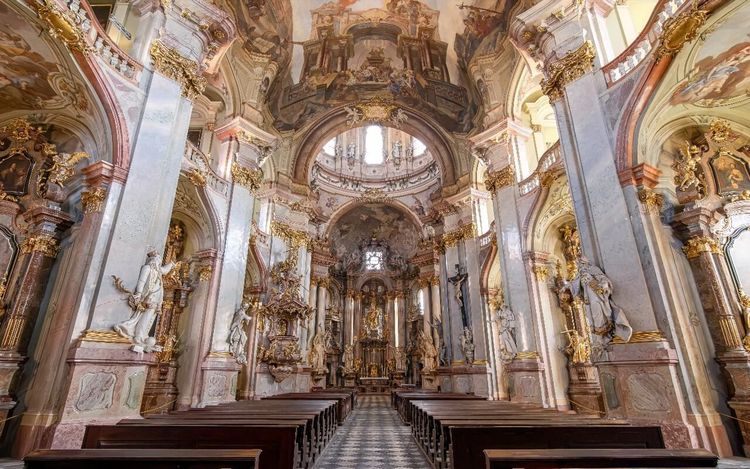
The site sits within a neighbourhood dense with monuments. Two minutes' walk away, St Nicholas Church in Malá Strana is the centrepiece of Prague's baroque. Its green dome dominates the rooftops and its interior is of staggering decorative richness: frescoes covering 1,500 m² of ceiling, pink marble columns, a ceremonial organ. Evening concerts in this church are an experience in their own right. Allow 30 to 45 minutes for a visit.
Charles Bridge (Karlův most), an 8-minute walk to the south, links Malá Strana to the Old Town. The 30 baroque statues lining the bridge date mostly from the 17th and 18th centuries — an open-air gallery. Avoid it between 10am and 3pm in summer (peak tourist congestion); opt for sunrise instead.
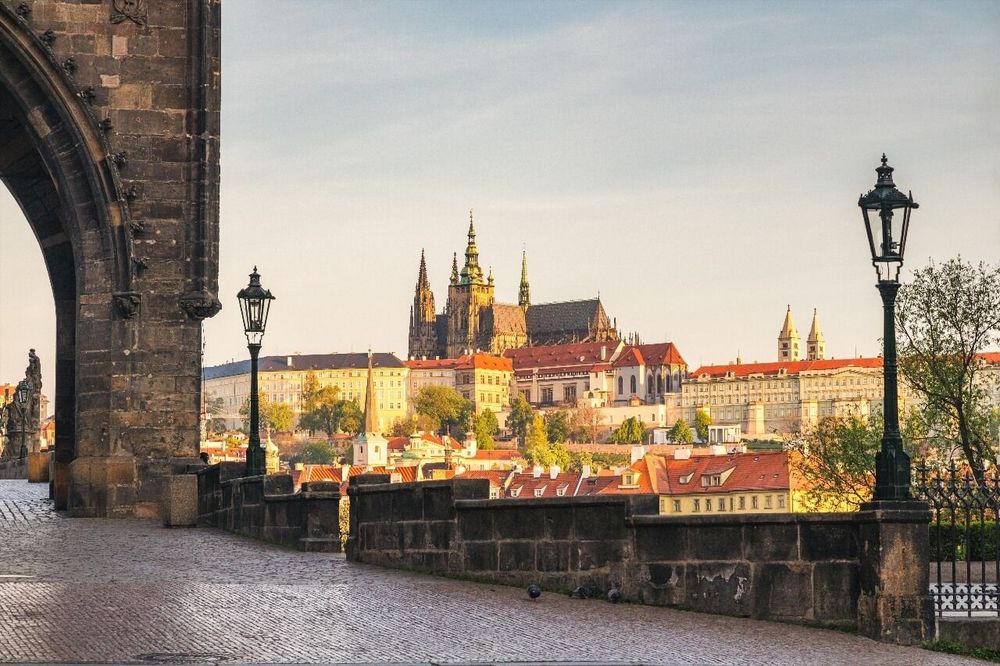
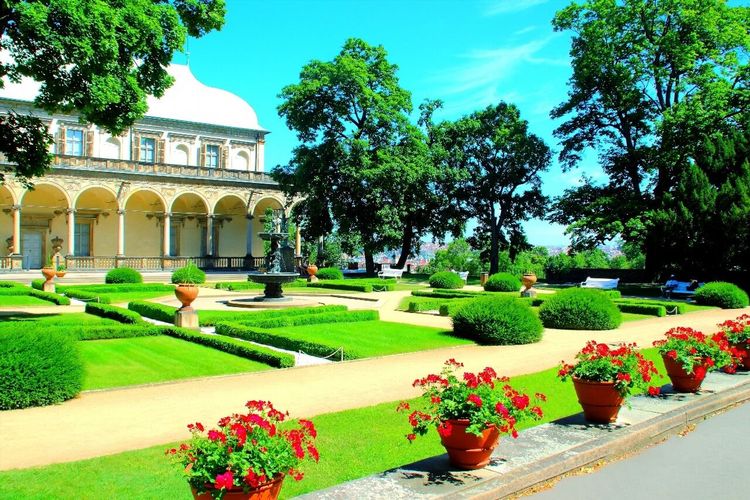
Prague Castle, visible from everywhere in Malá Strana, rises 10–15 minutes away on foot via the stepped alleyways. St Vitus Cathedral, the Royal Gardens and the Royal Palace together make for a minimum half-day visit. Buy your tickets online in advance during high season. And if you want to go further, our article on discovering Prague Castle gives you all the details.
The terraced gardens below the castle: little known, the Ledeburský, Palffy and Kolowrat gardens form a series of baroque terraces stepping up between Malá Strana and the castle ramparts. Same geometric style, but with breathtaking views over the city. Paid entry (combined ticket available).
To discover the whole neighbourhood with historical context at every step, the Ryo Prague audio guide accompanies you from Prague Castle and St Vitus Cathedral down to Charles Bridge, with detailed stories about each site.



FAQ
Is the Wallenstein Garden really free?
Yes, entirely. Entry is free with no reservation required, no ticket, no queue. One nuance: the interior of the palace (main hall, sala terrena) requires attending special open days, which are also generally free but limited to certain weekends throughout the year.
What is the best time to visit the Wallenstein Garden?
The garden is open from April to October. Spring (April–May) and autumn (September–October) are the best seasons: spring brings flowers in the flowerbeds and the first peacock displays, while autumn offers warm colours and far fewer visitors than summer. Summer is pleasant but busier. In winter the garden is closed; focus instead on Prague's indoor museums.
Can you enter Wallenstein Palace?
Not on a daily basis. The palace is the seat of the Czech Senate and operates as a parliamentary venue. Open days (Dny otevřených dveří) are however organised several times a year, usually in spring and autumn. These days allow access to the decorated main hall, the committee rooms and the interior of the sala terrena. Dates are published on the official website senat.cz. Entry is free on these days.
How long does a visit to the Wallenstein Garden take?
Allow 45 minutes to 1 hour for a relaxed visit of the garden alone. If you take the time to examine each element — the stalactite wall, the sala terrena, the statues, the aviary, the pond — you can easily spend 1h30. The visit combines naturally with the nearby St Nicholas Church to make up a packed half-day in Malá Strana.
Are the statues in the garden original?
No. The original bronzes by Adriaen de Vries were looted by Swedish troops in 1648 during the capture of Prague at the end of the Thirty Years' War. They are now at Drottningholm Castle in Sweden, a UNESCO World Heritage Site. The statues on display are copies cast between 1913 and 1918 from the Swedish originals. They faithfully reproduce de Vries's works, but the patina and historical authenticity remain at Drottningholm.
Can you combine the visit with other sites in Prague?
Absolutely — it is even recommended. The garden is an 8-minute walk from Charles Bridge, 10 minutes from Prague Castle and 2 minutes from St Nicholas Church in Malá Strana. A full day can easily be built around these four sites without ever using public transport. For the historical context connecting these places, the Ryo Prague audio tour is a valuable resource throughout the day.
Conclusion
The Wallenstein Garden is one of those places where Prague reveals an unexpected face: baroque, serene, almost forgotten at the foot of the castle. Free, accessible from the metro in five minutes, rarely overcrowded, it ticks every box of a great visit without any compromise on historical and architectural quality. Whether you come for the walk, for Adriaen de Vries's statues, for the strange stalactite wall or to understand who Albrecht von Wallenstein really was, the place will reward you for the detour.
To explore Prague and its historic neighbourhoods further, Ryo's Prague audio-guided tour accompanies you at every step with audio commentary crafted by people passionate about the city.