© Shutterstock
 Votre guide Ryo
Prague Castle: Complete Guide for an Unforgettable Visit in 2026
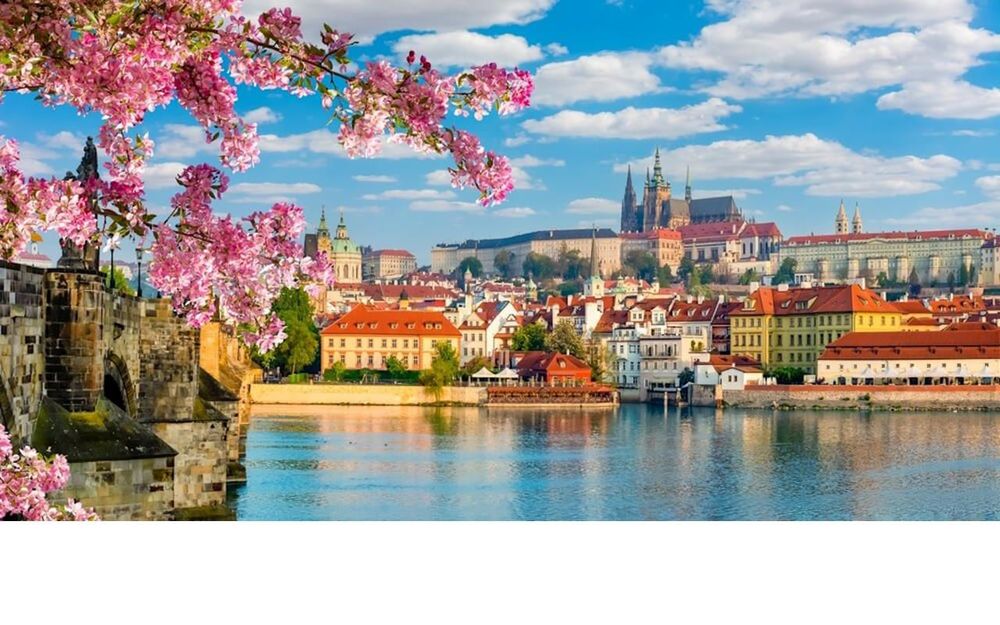
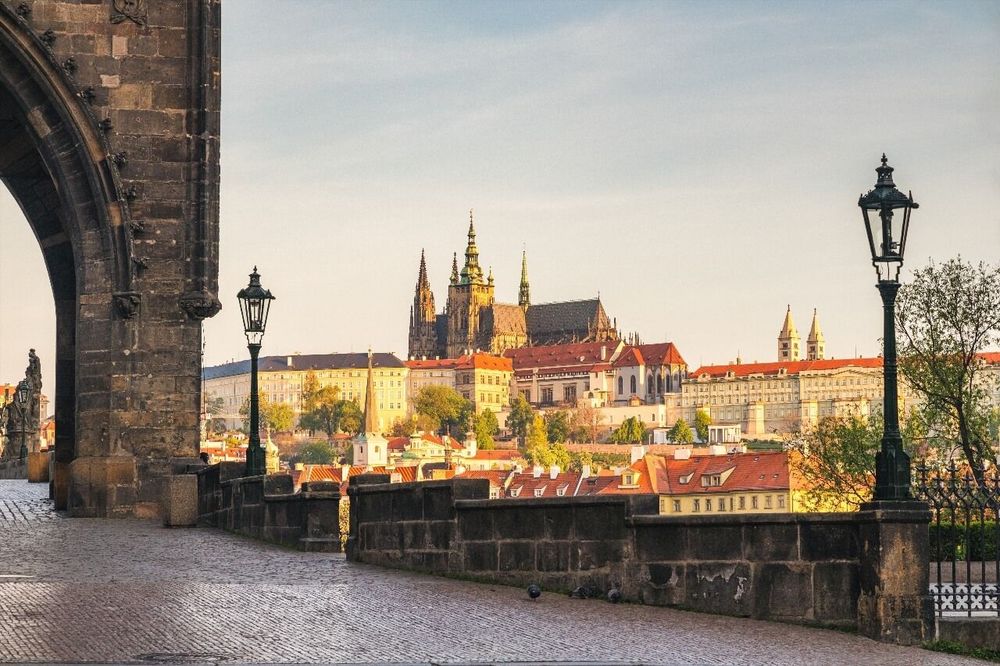
Before entering Prague Castle, most travelers expect a medieval fortress perched on a hill. What they discover upon crossing the first courtyard is an entire city within a city: palaces, cathedrals, terraced gardens, and colorful alleyways spread across 70,000 m² in the Hradčany district. Officially certified as the largest ancient castle complex in the world by the Guinness Book of Records, it has overlooked the Vltava and its bridges for more than eleven centuries.
This guide takes you through every essential space for a visit in 2026: St. Vitus Cathedral and its Art Nouveau stained glass windows by Alfons Mucha, the Vladislav Hall of the Royal Palace where armed horsemen once competed in jousting tournaments, the Golden Lane where Franz Kafka once lived at number 22, St. George's Basilica — the oldest in the complex — and the terraced gardens with their panoramic views over the red rooftops of Prague. You will also find exact ticket prices, season-by-season opening hours, strategies for avoiding queues, transport options from the city center, and the best places to eat after your visit. To explore Prague beyond the castle walls, the Ryo audio guide to Prague offers tours through all the historic neighborhoods of the Czech capital, with St. Vitus Cathedral and the Golden Lane among its commented stops.
History of Prague Castle: Eleven Centuries at the Heart of Europe
The castle's foundation dates back to around 870, when Prince Bořivoj of the Přemyslid dynasty chose the rocky promontory overlooking the Vltava as his residence. The Hradčany hill offered every strategic advantage of an emerging capital: naturally defensible, visible from afar, and positioned at the crossroads of Bohemia's trade routes. The earliest structures were built in wood, then in stone, typical of Moravian-Slavic pre-Romanesque architecture.
The following centuries transformed the site, accumulating architectural styles like geological strata. In the 10th century, Vratislaus I had St. George's Basilica built — the first stone religious structure within the enclosure. Around 973, his daughter Mlada founded the first convent for women in Bohemia there, under Benedictine rule. St. Vitus Cathedral was born in 929 in a far more modest form: a simple rotunda dedicated by Wenceslaus I before being enlarged into a Romanesque basilica. It was under Charles IV in the 14th century that the castle took on its monumental ambition: in 1344, architect Matthias of Arras laid the first stone of the Gothic cathedral we know today.
The Hussite period of the 15th century left the castle scarred and rebuilt. The Vladislav Hall, commissioned by Vladislaus II Jagiellon at the end of the 15th century and designed by architect Benedikt Ried, was an extraordinary technical achievement for its time: its star-vaulted ceiling rising 13 meters high is one of the most daring late Gothic creations in Central Europe. Mounted horsemen could enter on horseback for tournaments via an exterior staircase whose ramp is still visible today.
It is the Defenestration of Prague on 23 May 1618 that left the most dramatic mark on collective memory. From a window of the Bohemian Chancellery, three Catholic representatives of the Habsburg Emperor were thrown into the moat by Protestant leaders. They survived: according to Catholics, by a miracle; according to Protestants, thanks to the pile of rubbish that cushioned their seventeen-meter fall. This incident directly triggered the Thirty Years' War, one of the most devastating conflicts in European history.
The Habsburgs then transformed the castle according to Renaissance and later Baroque principles, adding wings and courtyards. Empress Maria Theresa in the 18th century unified the exterior facades in a classical Baroque style, giving the castle the appearance it still presents on the street side. In 1918, with the creation of Czechoslovakia, the castle became the official residence of the first president, Tomáš Masaryk. Slovenian architect Josip Plečnik was commissioned to modernize and embellish the spaces, leaving a discreet but recognizable imprint on the courtyards, gardens, and monumental staircases.
Today, the castle serves as both the seat of the Czech presidency and a multifaceted museum, welcoming more than two million visitors a year. Part of the buildings remains closed (presidential apartments, active state rooms), but most of the heritage is accessible to ticket-holding visitors. This sweeping history of conquests and reconstructions can still be read in every stone of the three inner courtyards, from the ramparts to the terraced gardens that cascade down toward Malá Strana.
St. Vitus Cathedral: Legendary Stained Glass and the Royal Crypt
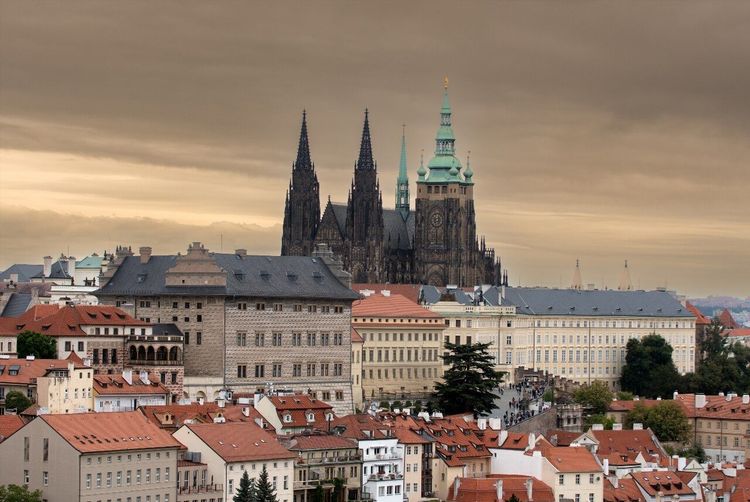
It is worth pausing for a moment in the third courtyard before entering St. Vitus Cathedral (III. nádvoří 48/2, 119 01 Praha 1 - Hradčany, rated 4.8/5 on Google with 94,482 reviews), just to look up and take in the building's ambition. Its two towers standing 96.6 meters tall dominate every rooftop in Prague, and the western facade blends darkened patinated stone with flamboyant Gothic ornamentation that gives it an almost menacing air on overcast days. Construction lasted nearly 600 years: the foundations were laid in 1344 at the initiative of Charles IV, and the cathedral was only officially consecrated in 1929 — a record of architectural longevity that gives this building an absolute uniqueness.
The interior is dizzying in a different way: it is the stained glass windows that first capture the attention. Twenty-seven large lateral bays, in various styles and from different periods, create a colored light that moves across the pillars throughout the day. The most famous is the stained glass window designed in 1931 by Alfons Mucha, master of Czech Art Nouveau, for the archbishops' chapel: his biblical figures in deep blue and gold look as much like illustrations from a fairy tale as from a religious building. Opposite, more austere medieval windows recall the building's Gothic origins.
The St. Wenceslas Chapel (Václavská kaple) is, for many, the most striking space in the entire cathedral. Founded in 1344 on the very site of the original 9th-century rotunda, it houses the relics of Bohemia's patron saint, murdered by his own brother in 935. Its walls are covered with 1,345 semi-precious stones — amethysts, jaspers, and chalcedonies — set into gilded plaster, and the Passion scenes painted on the upper registers date from the 14th and 16th centuries. A door with seven locks gives access to the chamber housing the Crown Jewels: the Bohemian royal jewels are only put on public display on exceptional occasions.
The royal crypt, accessible from the nave, contains the sarcophagi of several Bohemian kings including Charles IV himself, who died in 1378. Other Holy Roman rulers rest here in a contemplative atmosphere reinforced by the low vaults and subdued lighting. Take time to descend: it is one of the least crowded spaces in the cathedral, even in high season.
The great rose window on the western facade, created in the 20th century in a Neo-Gothic style, depicts the Creation of the World in nineteen concentric medallions. It coexists with the gargoyles and pinnacles in a form of deliberate syncretism that reflects the very history of the building: the choir, completed in the 14th century, is one of the finest examples of Rayonnant Gothic in Central Europe; the nave, finished in the 20th century, is its carefully studied continuation.
Practical note: entry to the cathedral is included in the 'Main Circuit' ticket. The lateral porticos of the nave allow a partial free visit, but the St. Wenceslas Chapel, the crypt, and the towers require a ticket. The south tower (96 meters, 287 steps) offers the most breathtaking panorama of the castle and Prague. Allow at least 45 minutes for the cathedral alone, one hour if you climb the tower. Crowds are heaviest between 10 a.m. and 2 p.m. in summer: arriving at opening time (9 a.m.) lets you walk through the nave in an unforgettable morning light.
The Royal Palace: Thrones, Defenestrations, and the Knights' Hall
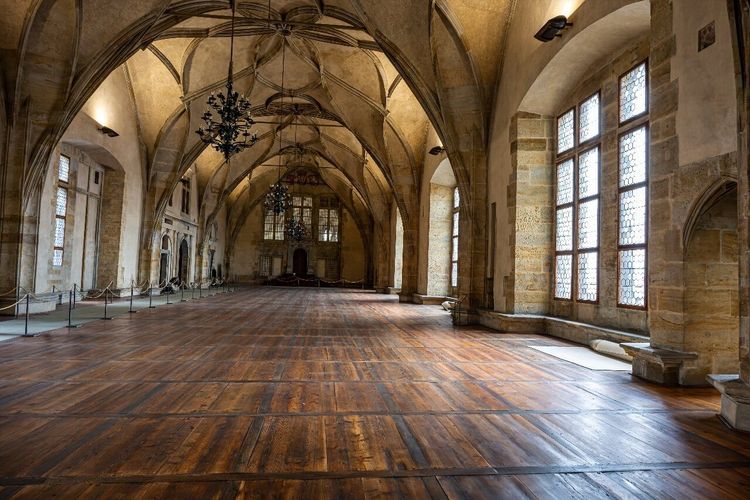
The Royal Palace (Starý královský palác) is a natural next stop after the cathedral, but its interior holds surprises that many visitors do not anticipate. The centerpiece is the Vladislav Hall (Vladislavský sál), built between 1493 and 1502 on the orders of Vladislaus II Jagiellon by architect Benedikt Ried. Its dimensions are staggering: 62 meters long, 16 meters wide, 13 meters high under the vault. What impresses even more is the form of this vault: a proliferation of star-shaped ribs interlaced like stone lacework, created at the very end of the Gothic period, at the boundary with the Renaissance.
The hall served very concrete functions: coronations, royal receptions, but also indoor equestrian tournaments. Armored horsemen would enter via a wide exterior staircase (still visible from the courtyard) to take part in jousts. Today, the space hosts Czech presidential elections and state receptions — a remarkable continuity with its medieval role as a seat of power.
A discreet door on the side leads to the old Diet Hall (Stará sněmovna), where the Estates of the Kingdom of Bohemia used to meet. The royal throne, the prelates' gallery, and the knights' gallery are still in place, as are the upper galleries reserved for the bourgeoisie. This hall, less spectacular than the Vladislav Hall, gives a very concrete sense of how medieval Bohemia functioned politically.
What deserves your full attention is the Bohemian Chancellery, accessible via a side corridor. This is where the famous Defenestration of Prague on 23 May 1618 took place: two Catholic governors and their secretary were thrown from the eastern windows by Bohemian Protestant leaders. The seventeen-meter fall did not kill them. You can see today the windows from which they were thrown, marked with a simple commemorative plaque. The event directly triggered the Thirty Years' War.
Descending from the Vladislav Hall, a vaulted passage leads to the All Saints' Chapel, dating back to the 14th century, whose frescoes have been restored several times and are now used for concerts and temporary exhibitions. In the lower levels of the palace, galleries display archaeological remains discovered during 19th- and 20th-century excavations: sections of 10th-century Romanesque walls and foundations of successive palaces. These basements help explain how the current castle was built up in layers over older structures.
Allow 40 to 60 minutes for the Royal Palace, longer if you are interested in the temporary exhibitions that regularly occupy the Vladislav Hall. This monument is included in the 'Main Circuit' ticket.
The Golden Lane: Between Alchemical Legend and Historical Reality
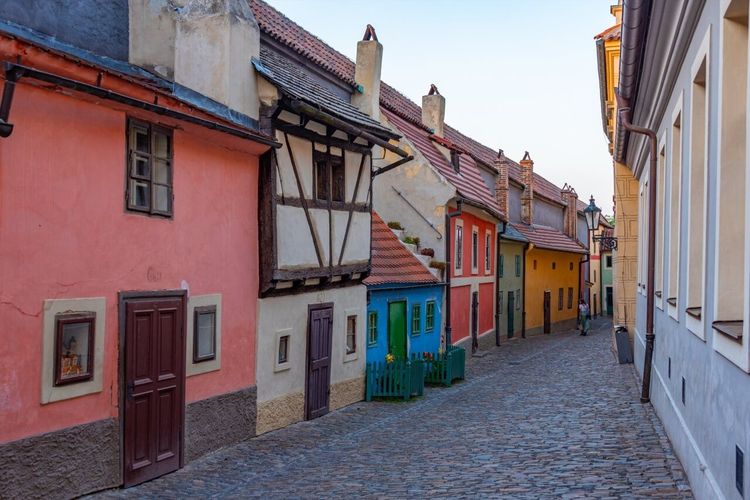
The Golden Lane (Zlatá ulička) is probably the most photographed space in the castle, and also the most frequently misunderstood. This row of small colorful houses — red, yellow, blue, green — huddled against the north rampart looks like a fairy-tale backdrop. Yet the history of these dwellings is as practical as it is poetic.
Built in the 16th century to house castle guards and their families, these houses also sheltered goldsmiths (zlatníci in Czech, hence the name) and various craftsmen. The legend of alchemists working for Emperor Rudolf II in search of the philosopher's stone was grafted onto the site later, blending truth and fiction. Rudolf II was indeed passionate about esotericism and brought alchemists to Prague, but their laboratories were located in other parts of the castle. The persistent confusion between the two stories contributes to the charm of the place without either being entirely false.
What is historically established is that Franz Kafka stayed in house number 22 on the Golden Lane from November 1916 to May 1917. The Prague writer came there to write in relative peace, his sister Ottla having rented the small house. It was during this period that he composed several short stories later collected in A Country Doctor. The house has since been converted into a bookshop specializing in Czech literature — a pointed but charming nod.
The houses along the lane have been transformed into themed shops and small museums following restorations carried out between the 1950s and 1990s. On the ground floor, each house illustrates a different trade or use: reconstructed goldsmith's workshop, medieval armory with helmets and chain mail, exhibition on daily life at the castle. On the rampart level above, a gallery runs the full length of the lane and displays suits of armor, antique weapons, and some medieval instruments. The collection is more spectacular than educational, but it is a big hit with children.
Outside peak hours (between 10 a.m. and 2 p.m. in high season), the Golden Lane recovers a less saturated atmosphere that allows you to appreciate the architecture at its true worth. Entry is included in the 'Main Circuit' ticket. The rampart walkway is also accessible from the Daliborka tower to the east — a medieval prison tower whose first prisoner, knight Dalibor of Kozojedy, incarcerated in 1498, entered legend through an opera by Bedřich Smetana.
St. George's Basilica: Romanesque Meets Gothic
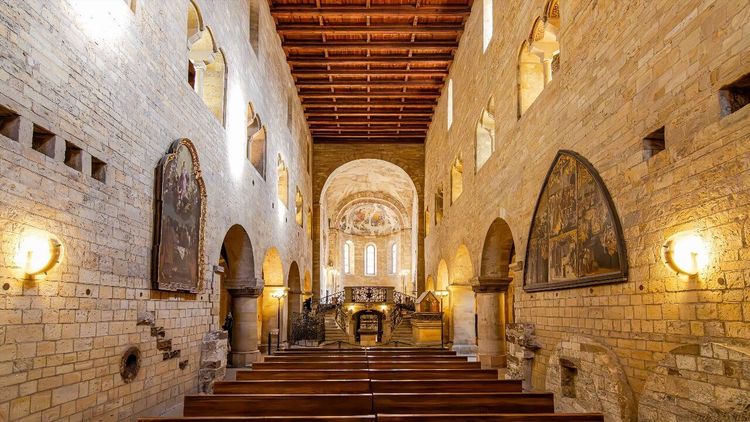
Standing in front of St. George's Basilica (Bazilika svatého Jiří), one is immediately struck by the contrast with the nearby St. Vitus Cathedral. Here, there are no Gothic soaring arches or slender spires: the basilica adopts the horizontal lines, thick walls, and narrow bays of the Romanesque style — a sober, massive aesthetic that gives the building the air of a fortress as much as a church.
Founded around 920 by Vratislaus I and rebuilt after a fire in 1142, the basilica is the oldest preserved religious building in the castle. Its red and cream facade, added in the 17th century in a Baroque style, contrasts with the preserved Romanesque interior. Upon entering, the eye settles on two round towers flanking the apse and a semi-sunken crypt visible from the nave through grilles. The columns with carved capitals featuring plant motifs and geometric interlacing recall Romanesque models from Central Europe.
The crypt contains the sarcophagi of several Přemyslid rulers, including Boleslaus II. Above, a group of 17th-century painted wooden sculptures depicts St. Ludmila of Bohemia, grandmother of St. Wenceslas. The ensemble has a moving simplicity, particularly notable after the ornamental profusion of the cathedral.
The adjacent Benedictine convent, founded in 973 at the initiative of Princess Mlada, is the oldest convent in Bohemia. Closed to religious life since the 18th century, it now houses a permanent collection of Czech Baroque art: paintings and sculptures from the 17th and 18th centuries, including works by Petr Brandl and Jan Kupecký. The collection serves as a useful introduction to Bohemian Baroque art, which is often less documented than its Italian or Austrian counterparts. St. George's Basilica is included in the 'Main Circuit' ticket; the convent and its Baroque art collection, managed by the National Gallery, require separate admission. Allow 20 to 30 minutes for the basilica alone, one hour if you go through the full collection.
The Castle Gardens: Terraces, Panoramas, and Botany
Prague Castle is not all stone and vaulted ceilings: its terraced gardens form one of the most remarkable settings of the visit — and one of the least crowded. Three main gardens are accessible on the southern slopes: the Rampart Gardens (Zahrada Na valech), the Hartig Garden, and the Paradise Garden (Rajská zahrada), forming a multi-hectare ensemble overlooking Malá Strana and the bridges of Prague.
The Rampart Gardens follow the old medieval ramparts for more than 200 meters. At their eastern end, the belvedere of the Eagle Roundel offers one of the most comprehensive panoramas over the city: the dome of St. Nicholas in Malá Strana, the towers of Charles Bridge, Kampa Island, and the meander of the Vltava are all visible at once. In the late afternoon, when the light takes on a warm hue over the red rooftops, the spot becomes simply unforgettable.
The Paradise Garden takes its name from the medieval tradition of representing paradisiacal enclosures in monastic architecture. It features an entrance via a monumental early 20th-century staircase — the signature of Josip Plečnik, who was redesigning the castle grounds for the fledgling Czechoslovak government.
To the north of the castle, accessible on the other side of the Stag Moat, the Royal Garden (Královská zahrada) is home to the Royal Summer Palace (Letohrádek královny Anny): considered one of the finest examples of pure Renaissance architecture outside Italy, its marble arcades and green copper roof date from the 16th century. The Ball Game Hall (Míčovna), in the same garden, is another Renaissance hall adorned with a facade of geometric sgraffito. The south gardens are open from April to October with varying hours, and admission is free during the open season. From November to March, they are closed.
Tickets, Prices, and Opening Hours in 2026: The Complete Guide
Prague Castle's ticketing has been simplified: since 2025, the old circuit A, B, and C system has been replaced by a single ticket called the 'Main Circuit', which gives access to the must-see monuments. The prices listed here reflect those in effect in 2026, but check for any adjustments on the official website hrad.cz before your trip.
The 'Main Circuit' Ticket
This single ticket includes the four major monuments: St. Vitus Cathedral (full interior), the old Royal Palace with the Vladislav Hall, St. George's Basilica, and the Golden Lane with the Daliborka Tower. Adult price: approximately 450 CZK (~€18). Reduced price (children aged 6 to 16, students up to 26, seniors over 65): approximately 300 CZK. Family ticket (2 adults and 1 to 5 children under 16): approximately 950 CZK. Children under 6: free. The ticket is valid for two consecutive days — an often underestimated advantage that allows you to split your visit without stress, though each monument can only be visited once.
Climbing the Cathedral's South Tower
Climbing the great south tower of St. Vitus Cathedral (96 meters, 287 steps) requires a separate ticket of approximately 250 CZK, payable directly at the tower entrance. On a clear day, the panorama over the castle and across Prague more than justifies the effort.
Free Access and No-Ticket Areas
The castle grounds (the three courtyards, the exteriors of the monuments, the walkways) are accessible free of charge, without a ticket, every day. The Changing of the Presidential Guard takes place every hour; the main ceremony at noon is free and open to all. It takes place in the first courtyard with military music and lasts approximately 20 minutes. St. Vitus Cathedral is partially accessible without a ticket: the first bays of the nave are open to visitors, but the St. Wenceslas Chapel, the crypt, and the tower are reserved for ticket holders.
Opening Hours
Hours vary by season:
- April to October: monuments open from 9 a.m. to 5 p.m.; castle grounds from 6 a.m. to 10 p.m.
- November to March: monuments open from 9 a.m. to 4 p.m.; castle grounds from 6 a.m. to 10 p.m.
- Rampart Gardens and Paradise Garden: open from April to October, with specific hours depending on the month
- Royal Garden: seasonal, from April to October
Last entry to the monuments is accepted approximately 30 minutes before closing. Note that certain spaces may be closed during official events of the Czech presidency, which occur several times a year and can affect access to the Vladislav Hall in particular.
Buying Your Tickets
Tickets are sold online at hrad.cz (via the Ticketportal platform) and at three on-site ticket offices: the second courtyard, the third courtyard, and the Golden Lane entrance. In high season (June–August), queues at the ticket offices can exceed 30 minutes: buying online is strongly recommended to save time. Major international bank cards are accepted. Once your ticket is booked, our audio-guided tour picks up the story at St. George's Basilica and the Old Royal Palace as you climb.
How to Get to the Castle from the City Center
Prague Castle requires a little effort to reach: no metro line goes directly up to Hradčany, and the final stretch always involves walking on cobblestones. Several options, however, allow you to reduce the effort depending on your starting point.
By tram: this is the most practical and least expensive option. Line 22 serves two strategic stops: Pražský hrad (directly in front of the castle's north entrance) and Pohořelec (access via the square of the same name, slightly more lively). Line 22 departs from the lower old town via the Mánes Bridge and passes through Malostranské náměstí. A single ticket costs 30 CZK (~€1.20), valid for 30 minutes with unlimited transfers.
By taxi or Uber: from Old Town Square, allow 10 to 15 minutes depending on traffic, for a fare of 120 to 200 CZK. Cars cannot stop directly in front of the castle's main entrance; the driver will drop you off near Hradčanské náměstí.
On foot from Malá Strana: this is the most enjoyable route. From the Malá Strana end of the bridge, two options: climb Nerudova Street (a steep incline, about 15 minutes) or take the New Castle Steps (Nové zámecké schody) from Malostranské náměstí. The climb is physically demanding but lined with Baroque buildings and partial views that make the journey memorable.
Via Petřín: less direct but original, the Petřín funicular climbs from the Újezd station to Petřín, from where a path leads to the castle in 15 minutes through the gardens. This option uses the same transport ticket as the tram.
In all cases, wear comfortable shoes: the castle's cobblestones are uneven and the gardens involve frequent changes in elevation.
Practical Tips for a Successful Visit in 2026
Prague Castle is one of the most visited sites in Central Europe, with peaks that can exceed 10,000 visitors per day in July and August. A few simple strategies allow you to enjoy it in much better conditions.
Arrive early — really early. The opening of the monuments at 9 a.m. is an exceptional window: in the first hours, St. Vitus Cathedral is still relatively uncrowded, the guards change in a relaxed atmosphere, and the morning light passes through the stained glass at an angle you won't find again after 10 a.m. If you arrive at 8:30 a.m., you can photograph the cobbled courtyards with almost no one in frame. Tour buses start unloading their groups from 10 a.m. onwards.
Split your visit into two sessions. The castle ticket is valid for two consecutive days. Spend the first morning on the cathedral and the Royal Palace, then return the next day for the Golden Lane, the basilica, and the gardens. This approach avoids mental fatigue and lets you move at a slower pace through each space. Many visitors are unaware of this option and rush to see everything in a single day.
Avoid Wednesdays and Thursdays in summer. These two days see the highest concentration of organized groups, particularly in the Golden Lane and the cathedral. Monday mornings, by contrast, are often quiet.
Allow at least half a day. A quick visit to the cathedral and the Royal Palace takes 2 hours 30 minutes. To cover all the monuments plus the gardens, allow 5 to 6 hours. If you add a walk down to Malá Strana, you can easily fill a full day.
Clothing and weather. Monument interiors are noticeably cooler than the outer courtyards, even in summer. A light layer in your bag is advisable. In winter, the monuments are modestly heated: dress as you would for a cold museum.
Photography — no drones. Drones are strictly prohibited within the castle grounds and its immediate airspace. For exterior shots, three viewpoints work particularly well: Charles Bridge for a three-quarter view, the banks of the Vltava on the Kampa Island side for an upward-angled silhouette shot, and Petřín Hill for an unobstructed view of the entire complex.
The Changing of the Guard takes place every hour daily, with a more elaborate musical ceremony at noon in the first courtyard. To avoid being squeezed in the crowd, position yourself by 11:45 a.m. along the sides of the courtyard rather than directly in front of the main gate.
To extend your visit with audio stories about the places you pass through on the way back to the old town, the Ryo audio tour Back to Prague's Roots descends from Hradčany toward Malá Strana and the banks of the Vltava, all the way to Charles Bridge.
Where to Eat near Prague Castle
Eating within the castle grounds is possible but expensive: the interior cafeterias and kiosks charge tourist prices without much to show for it. For better value, it is worth stepping outside the enclosure.
Inside the castle, the Lobkowicz Palace café is an exception. Located in the Lobkowicz Palace (a private museum at the eastern end of the grounds), it offers a terrace with views over the gardens and surrounding hills. The menu is simple — sandwiches, soups, cakes — but the view justifies the stop.
In Hradčany, immediately around the castle, the restaurant U Zlaté studně (At the Golden Well) is renowned for having one of the finest terraces in Prague, perched above the rooftops of Malá Strana. The cuisine is modern Czech: venison chop, Bohemian-style carp, knedlíky alongside slow-cooked dishes. Fine dining category — reservations are essential in high season.
For something simpler and more affordable, Hradčanské náměstí (in front of the castle's main entrance) is surrounded by Baroque palaces, several of which have terrace restaurants well-suited to a quick lunch. Heading down toward Malá Strana after your visit, Nerudova Street and its side lanes offer traditional Czech restaurants at more reasonable prices than inside the castle grounds. For Prague's culinary specialties such as svíčková (braised beef with cream sauce) or dark beer goulash, our guide to Prague's culinary specialties lists the restaurants and dishes you should know before you order.
Beyond the Castle: Malá Strana and Hradčany to Explore
A visit to Prague Castle cannot be separated from its surrounding neighborhoods. Hradčany and Malá Strana together with the castle grounds form a coherent whole that can be explored on foot, and whose richness goes far beyond what half a day allows you to take in.
Hradčany, the neighborhood directly adjacent to the castle, is one of the best-preserved in Prague. Hradčanské náměstí is surrounded by aristocratic palaces from the 16th to 18th centuries, now housing embassies or museums. Schwarzenberg Palace (Military History Museum) and Sternberg Palace (National Gallery of Old European Art) are particularly worth mentioning. A few minutes' walk to the west from the castle's first courtyard, Strahov Monastery (Strahovský klášter) houses a 17th-century Baroque library with absolutely remarkable trompe-l'œil painted ceilings.
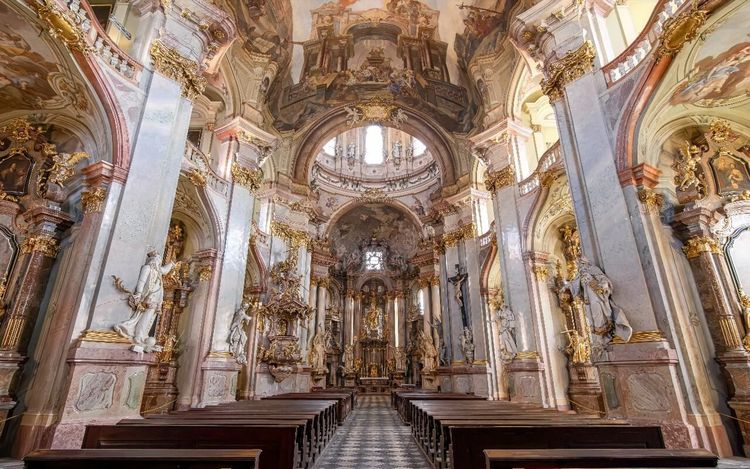
Malá Strana (the Lesser Town) stretches below the castle between the ramparts and the Vltava. An independent town until the late 18th century, it retains an extraordinarily intact Baroque fabric. Malostranské náměstí (Malá Strana, 118 00 Praha 1, rated 4.7/5 on Google with 10K reviews) is dominated by the church of St. Nicholas, a masterpiece of Jesuit Baroque whose green dome is visible from most of Prague's heights. The interior, with its gilding and monumental frescoes by the painter Kracker, ranks among the most impressive in the entire city.
The Wallenstein Gardens (Valdštejnská zahrada), two minutes' walk from the square, are one of Malá Strana's best-kept secrets: a French-style Baroque garden featuring a stalactite colonnade, peacocks, and bronze statues, open free of charge from March to October. Our article on the Wallenstein Gardens in Prague details the history of the place and the best times to visit.
Charles Bridge (Karlův most) provides the natural transition between Malá Strana and the old town. Its 30 Baroque statues lined along the parapets (17th–18th centuries) make it a permanent open-air museum. Crossing it early in the morning, before the vendors and tour groups arrive, is one of the simplest and most rewarding experiences Prague has to offer.



FAQ
How Much Time Should I Plan to Visit Prague Castle?
You need at least 2 hours 30 minutes for a quick visit covering St. Vitus Cathedral and the Vladislav Hall in the Royal Palace. If you also want to explore the Golden Lane, St. George's Basilica, and the Rampart Gardens, allow 4 to 5 hours. To visit all the monuments including the cathedral tower and temporary exhibitions, a full day is more realistic. The castle ticket is valid for two consecutive days — an advantage that many visitors overlook and which allows you to explore without rushing.
What Are the Ticket Prices for Prague Castle in 2026?
In 2026, the castle operates with a single 'Main Circuit' ticket that replaced the old circuits A, B, and C. Adult price: approximately 450 CZK (~€18). Reduced price (children aged 6 to 16, students up to 26, seniors over 65): approximately 300 CZK. Family ticket (2 adults and up to 5 children under 16): approximately 950 CZK. Children under 6 enter free. Climbing the cathedral's south tower requires a separate ticket (approximately 250 CZK). Access to the outer courtyards and the Changing of the Guard is completely free. Check exact prices at hrad.cz before your visit.
What Time Does Prague Castle Open?
The castle courtyards and outer grounds are accessible year-round from 6 a.m. to 10 p.m. The interior monuments — cathedral, Royal Palace, basilica, Golden Lane — open at 9 a.m. They close at 5 p.m. from April to October and at 4 p.m. from November to March. Last entry is generally accepted 30 minutes before closing. The Rampart Gardens and Paradise Garden have their own seasonal hours and are closed from November to March.
Can You Visit Prague Castle for Free?
Yes, partially. Access to the three inner courtyards, the outer walkways, and the first bay of St. Vitus Cathedral's nave requires no ticket. The Changing of the Presidential Guard, with its daily musical ceremony at noon, is also free. It is the interior monuments — Royal Palace, St. Wenceslas Chapel, crypt, cathedral tower, Golden Lane, basilica — that require the 'Main Circuit' ticket. The South Gardens are free to enter during their open season, from April to October.
How Can I Avoid the Crowds at Prague Castle?
Peak attendance is between 10 a.m. and 2 p.m., particularly on Wednesdays and Thursdays in July and August. To avoid queues and organized groups, two time slots work well: opening time at 9 a.m. and mid-afternoon from 3 p.m. onwards, when groups start to leave. Off-season (November to March), the castle is noticeably less crowded — it is colder but the monuments are almost deserted. Buying tickets online at hrad.cz avoids the ticket office queue, which can mean 20 to 30 minutes in peak summer.
What Are the Must-See Monuments at Prague Castle?
If your time is limited, four spaces are top priority: St. Vitus Cathedral (stained glass, St. Wenceslas Chapel, royal crypt), the Vladislav Hall in the Royal Palace (Gothic vault and Defenestration windows), the Golden Lane (colorful houses and Kafka's house no. 22), and the Rampart Gardens with the belvedere overlooking Malá Strana. St. George's Basilica is recommended for fans of Romanesque architecture. The Royal Garden, to the north of the castle, is best visited in the morning before the monuments open.
Can You Enter Prague Castle with Young Children?
Yes, the castle regularly welcomes families with young children. Strollers can move through most of the outer courtyards, but the crypt stairs and some passages in the Golden Lane are difficult to navigate with a pram. Free entry for children under 6 and reduced rates for ages 6–16 make the visit financially accessible. The permanent exhibition 'The History of Prague Castle,' with its models and reconstructions, is often more appealing to young children than a detailed tour of the major monuments.
Conclusion
Prague Castle is one of those monuments that does not disappoint. Not because reality is less impressive than the promise, but because the diversity of what it contains exceeds initial expectations. Eleven centuries of layered architecture, a cathedral consecrated in 1929 on 9th-century foundations, a lane where Franz Kafka wrote his short stories in the evening after work, gardens overlooking a UNESCO World Heritage city: few sites in Europe condense so many stories into such a small area.
Organize your visit over two half-days if your stay in Prague allows, buy your tickets online, and arrive before 9:30 a.m. on the first morning. The rest reveals itself naturally, at your own pace. To explore the neighborhoods around the castle with audio stories about each place you pass through, the Prague audio walking tour guides you through Malá Strana, Hradčany, and the other hidden gems of the Czech capital.
Enjoy your visit to Prague.