© Shutterstock
 Votre guide Ryo
Things to Do in Bonifacio in 2026: Citadel, Lavezzi Islands, and Best Beaches
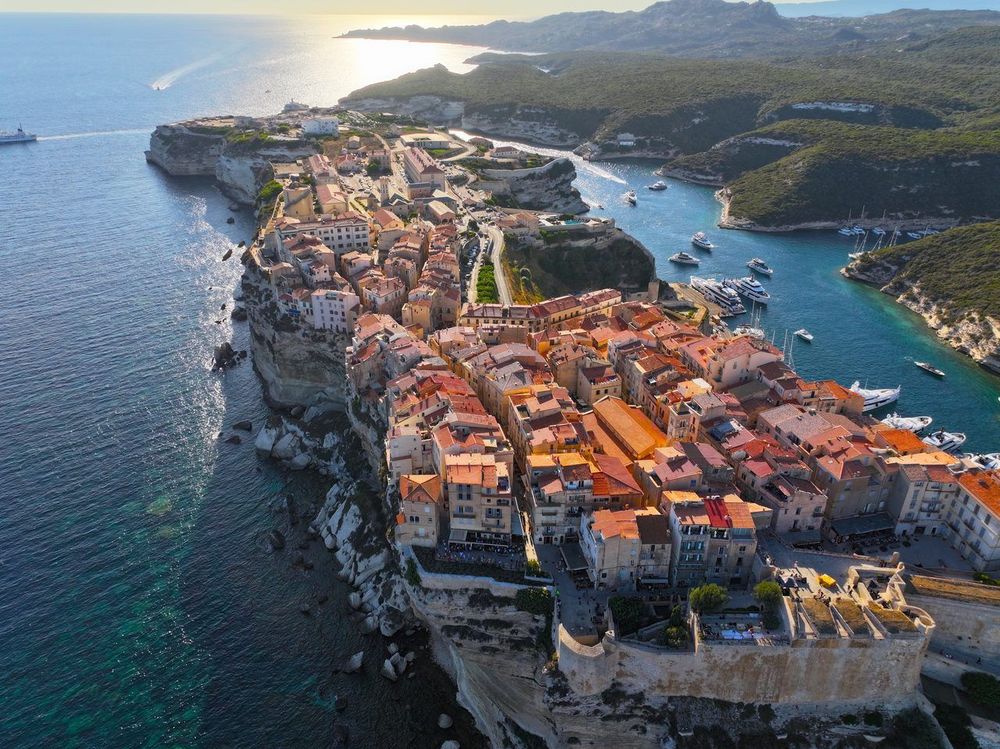
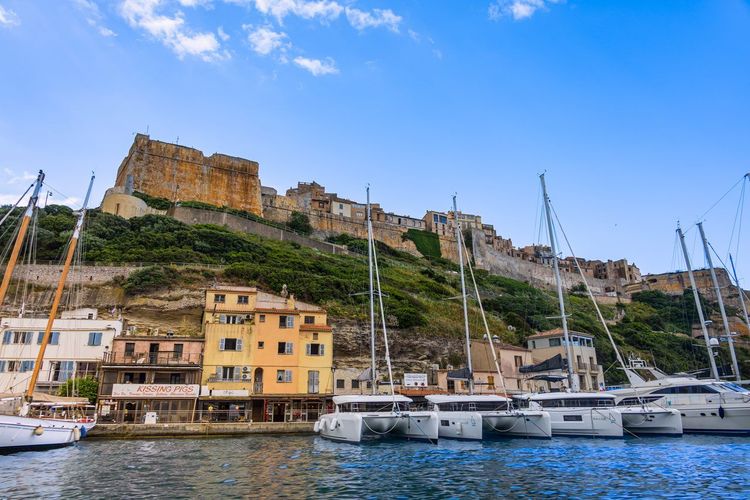
Perched nearly 70 meters above the Mediterranean, the citadel of Bonifacio seems to rise directly from the white limestone cliff that has supported it since the 9th century. What is there to do in Bonifacio with a single day, a weekend, or a full week? Seen from a boat making its way up the inlet, the town gives the impression that its houses are about to topple into the void, yet they have stood for centuries thanks to a defensive site once considered impregnable. The question is worth asking before you set off, as this Corsican town packs a remarkable range of experiences into a compact area: a medieval citadel, a staircase carved into the rock, coastal trails, sea caves, and turquoise lagoons, all within just a few kilometers of each other.
This guide covers the must-sees in the order a visitor naturally encounters them: the 187 steps of the Staircase of the King of Aragon, said to have been carved in a single night; the Pertusato lighthouse, set on the southernmost tip of Corsica, a dozen or so kilometers from the Sardinian coast visible on clear days; a sea cave whose opening traces a silhouette remarkably close to the shape of Corsica itself; and a series of beaches that rival the Caribbean, from the near-perfect horseshoe bay of Rondinara to the shallow lagoon of Piantarella. We also cover possible day trips to Sartène and the Bavella needles, the best spots to eat at the harbor or in the citadel, and practical information on coming without a car, sleeping on-site, or choosing the right season.
1. Exploring the Upper Town and the Medieval Citadel of Bonifacio
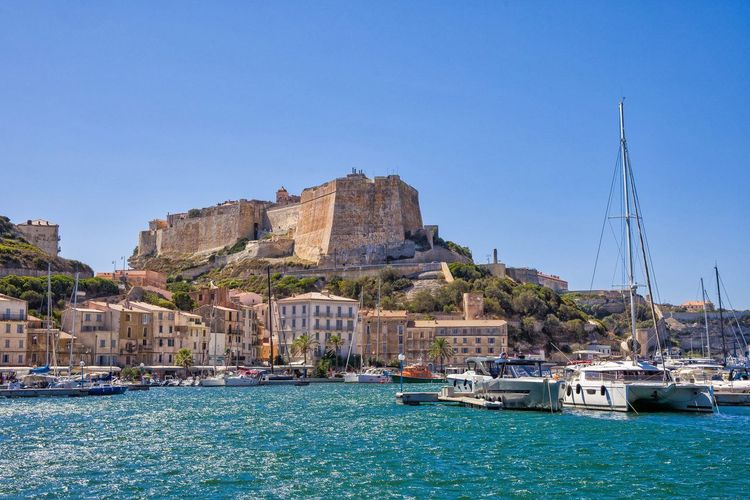
The Upper Town holds the bulk of Bonifacio's historical interest. Built on a limestone plateau enclosed by ramparts remodeled between the 12th and 16th centuries, it withstood several celebrated sieges, most notably the one led by Aragonese troops in 1420, which gave its name to the nearby staircase. The citadel has retained its medieval layout almost entirely intact: winding alleyways, tall houses pressed tightly together to shield against wind and projectiles, and flying buttresses thrown from one facade to another. Allow an hour and a half to two hours to explore it at a leisurely pace, starting at the Porte de Gênes.
The Bastion de l'Étendard and the Porte de Gênes
The Bastion de l'Étendard is the logical starting point for any visit. Rebuilt by the Genoese after the Franco-Turkish siege of 1553, it now houses the Memorial of Bonifacio's Past, a series of reconstructions tracing the town's greatest moments, and provides access to the ruins garden. Its terrace serves primarily as a viewpoint: in a single glance you take in the inlet, the marina below, and the Sardinian coast on clear days. The site is included in the Monuments Pass offered by the tourist office, which bundles several paid attractions at a reduced rate.
Right next to it, the Porte de Gênes remained the only entrance to the citadel until the 19th century. Its drawbridge operated via a counterweight-and-pulley system installed in 1598; the one you cross today dates from 1830. This is also where the tourist train stops on its shuttle run between the harbor and the citadel, a useful option if climbing on foot with children or in the August heat gives you pause.
Arrive early in the morning, before 10 a.m.: the alleyway connecting the Bastion to the Porte de Gênes turns into a bottleneck as soon as cruise-ship groups disembark, typically between 10:30 a.m. and 4 p.m. in high season.
The Saint-Dominique Church and the Fortified Alleyways
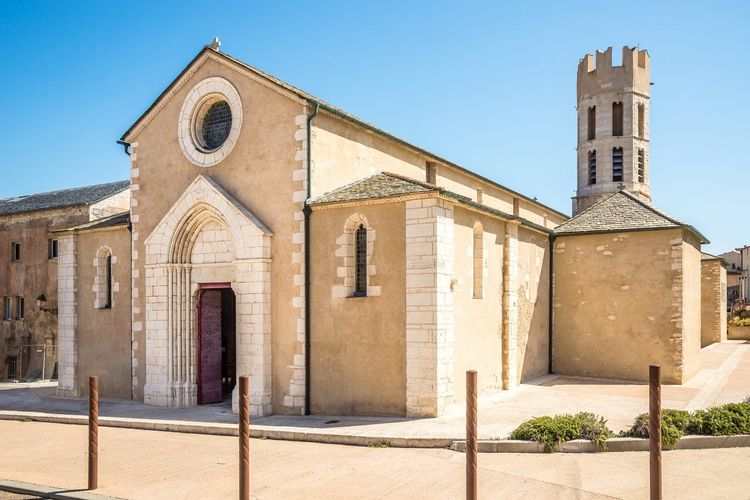
Further west, the Saint-Dominique Church (Rue Saint-Dominique, 20169 Bonifacio, rated 4.4/5 on Google from 157 reviews) surprises with its Gothic architecture, an extreme rarity in Corsica where Baroque predominates. Built by the Dominicans on a former Templar site and completed around 1343, it retains an octagonal crenellated bell tower that speaks as much to its defensive role as to its religious one. The interior houses the heavy processional statues carried by confraternities each year during Holy Week, one of the major religious events in southern Corsica. In summer, polyphonic choral concerts are sometimes held here in the evenings: check with the tourist office, as dates are announced only a few days in advance.
Beyond the church, the Upper Town is best discovered by getting deliberately lost. The fortified alleyways tumble downhill one after another, punctuated by arches linking facades and supporting houses that are sometimes six centuries old. Look up at the lintels: many still bear carved inscriptions or dates. Rue Doria and Rue des Deux-Empereurs are among the most photogenic; the latter takes its name from two illustrious guests who stayed there, Charles V in 1541 and then Napoleon Bonaparte in 1793. You will also come across the marine cemetery at the tip of the plateau, which we will return to later.
2. Descending the Staircase of the King of Aragon to the Sea
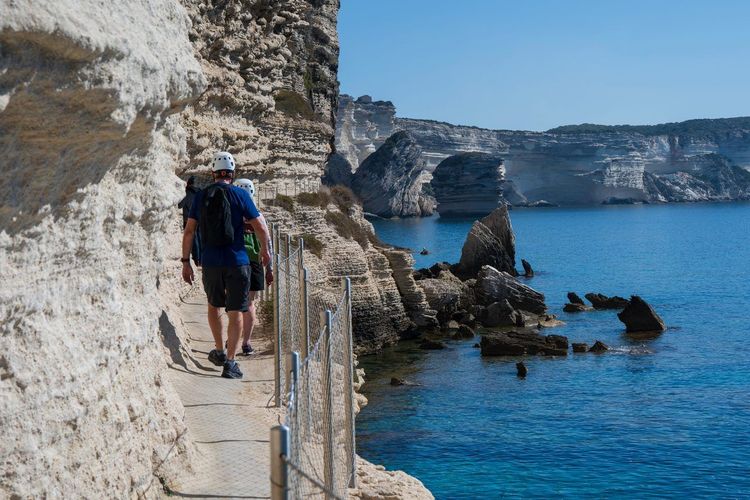
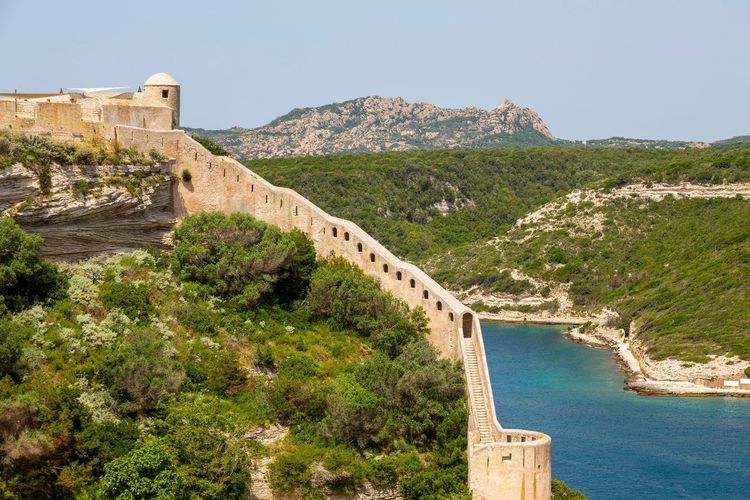
Cut directly into the cliff face between the citadel and the sea, the Staircase of the King of Aragon (Bonifacio, rated 4.5/5 on Google from 12,554 reviews) counts 187 irregular steps plunging almost vertically down to the waterline. Local legend holds that the troops of King Alfonso V of Aragon carved it in a single night during the 1420 siege in order to surprise the garrison. Historians more likely see it as an ancient access route to a freshwater spring at the base of the cliff, used by the townspeople long before the siege, but the anecdote remains the most-told story on site.
Entry is from the Upper Town and is ticketed: €5 for adults and €2 for children in 2026, a contribution toward the upkeep of this listed monument. Wearing the helmet provided on-site is mandatory, and entry is refused in flip-flops or heels: bring flat, closed-toe shoes. Opening hours vary considerably by season, with continuous access from June to September and only limited slots in winter.
The descent itself takes five to ten minutes; the climb back up takes considerably longer if the heat kicks in. Bring water, especially between June and September, when the white limestone reflects intense heat in the middle of the day. At the bottom, a maintained path runs along the base of the cliff and offers a rare angle on the citadel as seen from sea level.
3. Strolling the Harbor and Marina of Bonifacio
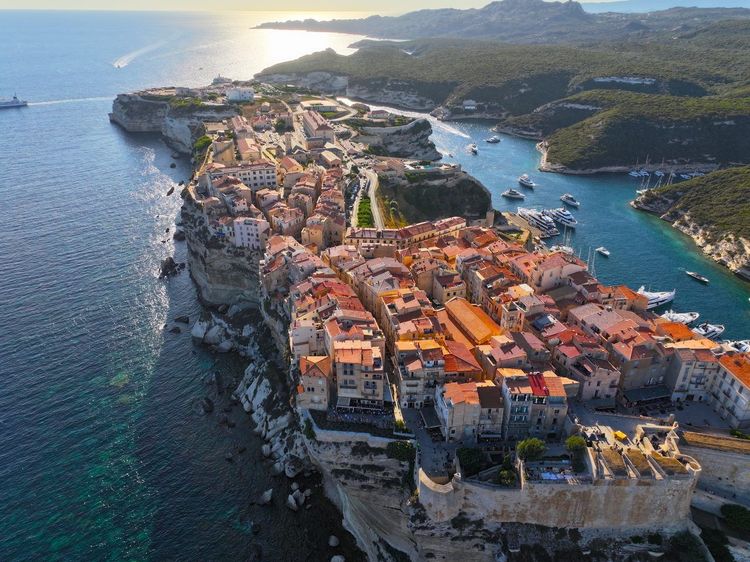
At the foot of the citadel, the pleasure harbor is where most of Bonifacio's evening activity is concentrated. Yachts dozens of meters long and traditional fishing boats coexist here, separated by a few hundred meters of quayside lined with terraces.
The Old Harbor, Its Terraces, and Its Fishing Life
The marina of Bonifacio (Quai Jérôme Comparetti, 20169 Bonifacio, rated 3.7/5 on Google from 323 reviews) stretches along the innermost part of the inlet, sheltered from the wind by cliffs that almost entirely surround it. In the morning, a few fishermen still unload the night's catch here — mainly lobster and rock fish — before the terraces take over around noon. In the afternoon, the scene shifts: cruising sailboats, catamarans, and excursion launches follow one another in a continuous ballet, as the marina is one of the few naturally sheltered anchorages along this stretch of coast.
You can stroll the harbor of Bonifacio at any time of day, but the best moment is late afternoon, when raking light illuminates the cliff and the citadel from the terraces. The sea-excursion companies have their ticket booths on the quay, making it the natural departure point for trips to the sea caves or the Lavezzi Islands.
The Marine Cemetery at the Tip of the Plateau
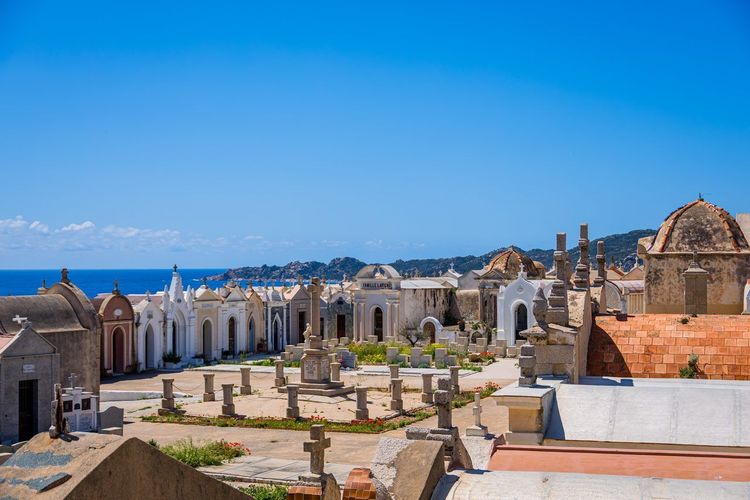
At the western end of the Upper Town, on the Bosco plateau, lies the marine cemetery of Bonifacio. Contrary to what its name might suggest, it is not a submerged graveyard but a necropolis organized into small family chapels, in the manner of the Ligurian towns whose funerary culture Bonifacio partly inherited. Some are decorated with ceramic photographs and sculptures, giving the place the feel of a miniature village.
A stop at the marine cemetery takes about twenty minutes, but the viewpoint alone justifies the detour: the cliff drops straight into turquoise water, and the view stretches all the way to Sardinia. Entry is free. Avoid visiting in beach attire, out of respect for a space that remains an active place of mourning.
4. Admiring the Limestone Cliffs of Bonifacio and Their Sunset
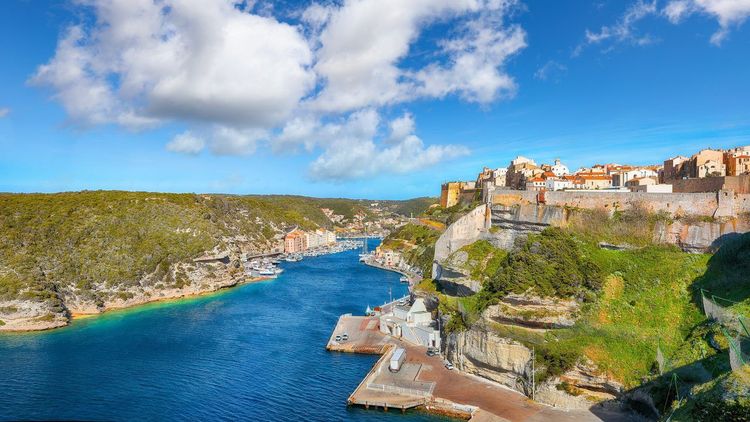
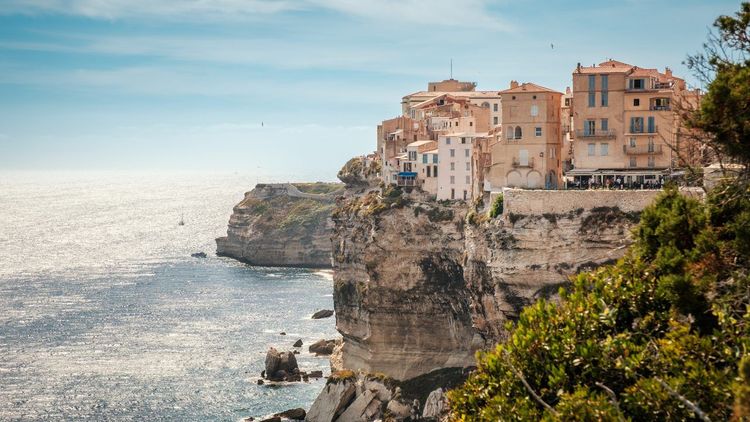
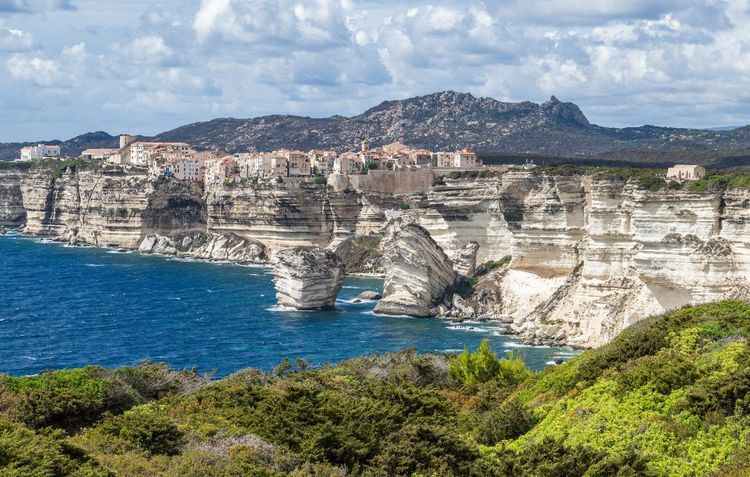
The limestone cliffs that carry Bonifacio's citadel rank among the most photographed geological formations in the Mediterranean. Rising 60 to 70 meters in places, they have been sculpted over millions of years by marine erosion and wind, carving overhangs so pronounced that some houses appear to hang in mid-air.
Several viewpoints complement one another: the Bastion de l'Étendard for a close-up view of the ramparts, the marine cemetery for a bird's-eye angle, or a boat offshore to grasp the true scale of the formation, which is invisible from land. Many visitors underestimate how fragile the rock is: entire sections still collapse, which explains the restricted-access zones along certain stretches of the coastal path.
Sunset over the cliffs of Bonifacio remains one of the summer's most sought-after experiences. The area around the Saint-Roch Chapel and the start of the cliff path offer the best panoramas without needing to book a boat trip. Arrive thirty minutes before the announced sunset time: the low-angled light that gilds the rock begins well before the sun touches the horizon. And keep your distance from the edge — the absence of guardrails is not an oversight.
5. Hiking the Coastal Path from Campu Rumanilu to the Pertusato Lighthouse
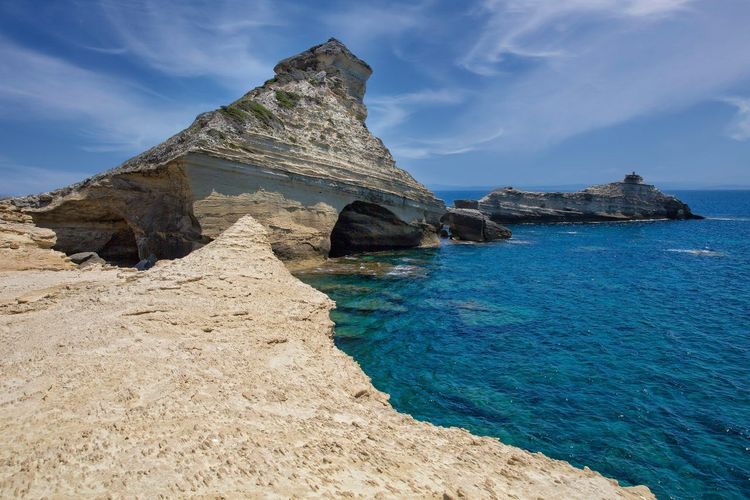
At the foot of the citadel, a marked trail climbs to the top of the cliffs and follows them for several kilometers, offering another way to discover Bonifacio — on foot, away from the crowds. Allow around four hours there and back for the full route to the lighthouse.
The Campu Rumanilu Trail
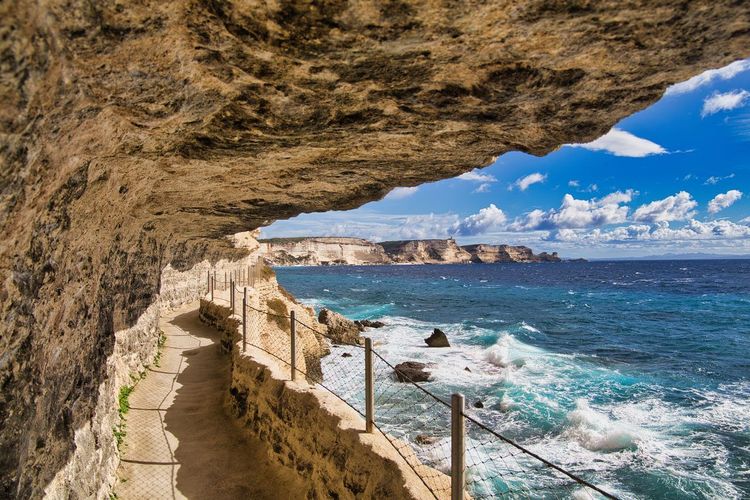
The Bonifacio coastal trail starts near the Saint-Roch Chapel, between the harbor and the Upper Town, then climbs to the Campu Rumanilu plateau, a natural area protected by the Coastal Conservation Agency. The Campu Rumanilu trail winds through low scrubland and limestone outcrops, with the sea below for its entire length. It presents no technical difficulty, but the terrain is uneven and completely exposed: no shade at any point along the route, a detail worth planning for between June and September.
You will pass several viewpoints that are often deserted outside of midday, from which you can observe the cliffs from an angle boat passengers never see: from above, nearly at the top of the rock face. Bring a hat and at least one and a half liters of water per person — there is no resupply point anywhere along the way.
The scrubland bordering the path is home to flora typical of the Corsican coast — mastic trees, cistus, and everlastings that scent the air from May onward. Several seabird species nest on the nearby cliffs, which accounts for some access restrictions in spring.
The Pertusato Lighthouse and the Southernmost Point of Corsica
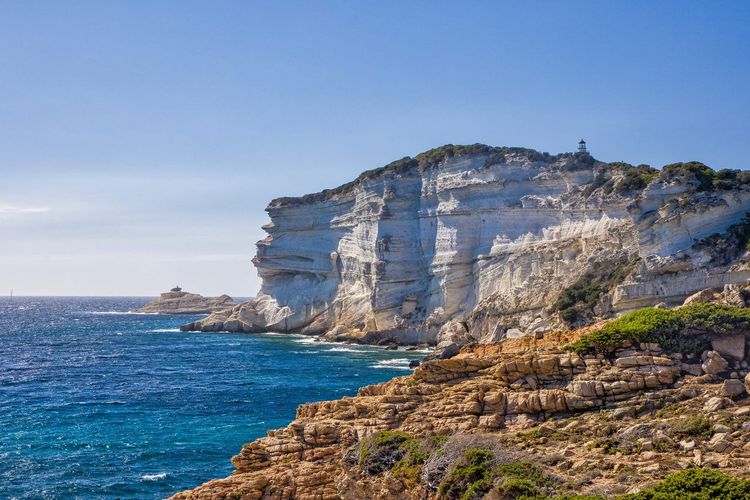
At the end of the trail, the Pertusato lighthouse (Bonifacio, rated 4.7/5 on Google from 528 reviews) marks the southernmost tip of Corsica. Built in the 19th century, it remains operational with a now-automated lamp. On clear days, the northern coast of Sardinia is clearly visible, just over a dozen kilometers away across the Strait of Bonifacio, one of the most challenging passages in the Mediterranean for navigation.
Reaching the Pertusato lighthouse takes about two hours one way from town, more if you stop frequently for photographs. The lighthouse itself is not open to visitors, but its surroundings offer a panorama of the strait, the Lavezzi Islands, and — looking back — the citadel, tiny on its limestone plateau.
Skip the walk in strong wind, which is common here: gusts can make hiking along the cliff edge genuinely dangerous. The return is by the same path.
6. Exploring the Sea Caves and the Bouches de Bonifacio Nature Reserve by Boat
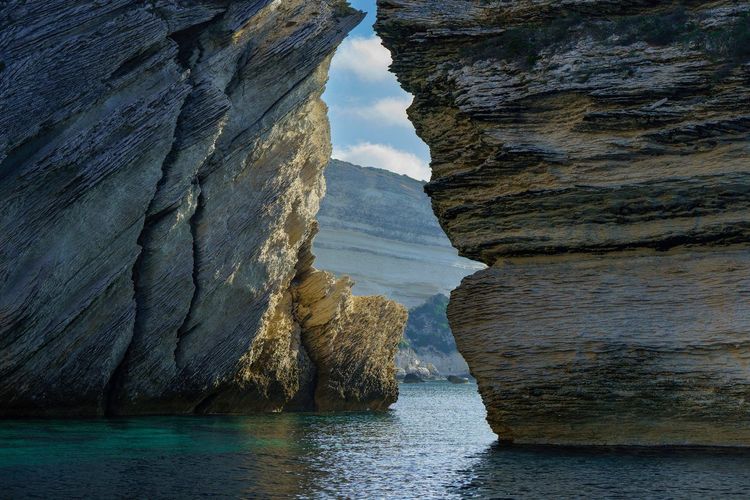
Much of Bonifacio's coastline remains inaccessible on foot, hidden beneath the cliffs themselves. To discover it, a boat trip is practically essential.
The Boat Trip into the Sea Caves
Several local operators — among them the SPMB, Vedettes Thalassa, and semi-rigid rental companies such as Corse Nautic Escape — offer departures directly from the marina, often without advance booking outside the height of summer. A boat trip gives access to the sea caves carved into the base of the cliffs, the most famous of which, the Grotte du Sdragonato (Bonifacio, rated 5/5 on Google from 5 reviews), is entered through a fissure in the ceiling that, seen from inside, traces a silhouette remarkably close to the shape of Corsica.
A boat trip through the sea caves lasts around one hour for the shortest circuit, priced at around €20 per adult, up to a full day for combined tours that include the Lavezzi Islands. Morning departures offer calmer water and light that penetrates the cavities more effectively; in the afternoon, chop can make reaching the caves trickier for smaller vessels.
The Nature Reserve and the View toward Sardinia
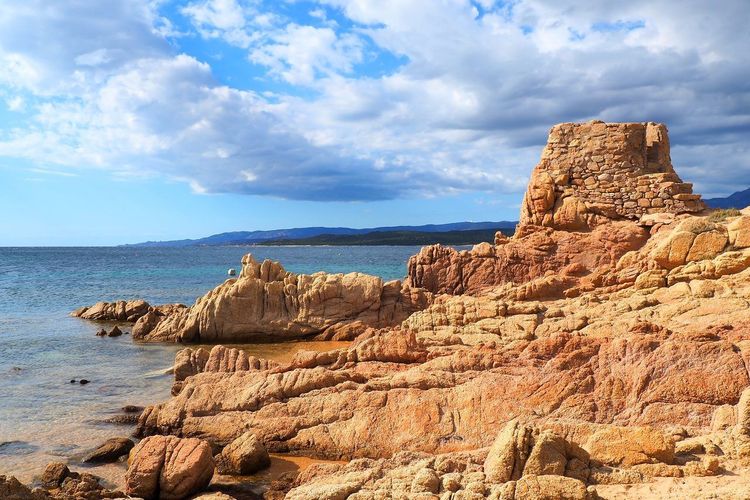
Offshore, the Bouches de Bonifacio Nature Reserve, established in 1999, protects one of the most biodiverse straits in the western Mediterranean. Together with the Sardinian national park of the La Maddalena archipelago, it forms an international marine park. By boat, you may spot, depending on the season, shags, Audouin's gulls, and, with some luck, common bottlenose dolphins.
Once offshore, Sardinia comes into sharp focus: the hills of the Gallura stand out clearly as soon as the boat moves a few hundred meters from the Corsican coast. Many skippers cut the engine at mid-crossing, a moment that numerous visitors cite as among the most memorable of their stay. In July–August, book the day before; out of season, stopping by the quay mid-morning is often enough. If you are unsure whether to opt for a simple cave circuit or a full day on the archipelago, the Ryo guide dedicated to the Lavezzi Islands compares the options available from the harbor.
7. Taking a Day Trip to the Lavezzi Islands
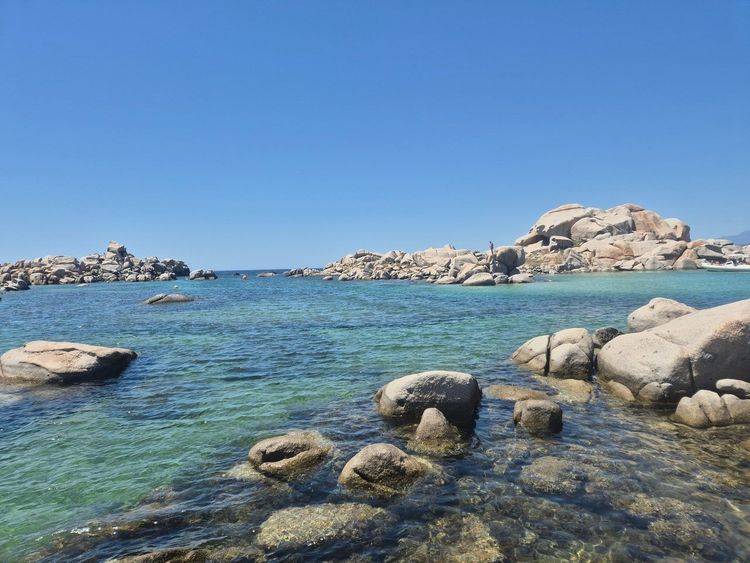
The Lavezzi Islands form an archipelago of granite islets, classified as a nature reserve, about ten kilometers from Bonifacio by sea. Exploring the Lavezzi Islands is the most popular excursion from the town, and for good reason: the waters surrounding the archipelago are among the most transparent in the Mediterranean.
Visiting the Lavezzi Islands from Bonifacio is done exclusively by boat, as no regular service links the archipelago to the mainland. Once ashore, only the marked trails are accessible: the reserve prohibits camping, lighting fires, and leaving the paths in order to protect a particularly fragile low-lying flora.
How to get there? In season, shuttles leave Bonifacio marina at regular intervals throughout the morning, with a return in the late afternoon; most include a pass along the cliffs and caves. Book the day before in high season. Bring a mask and snorkel: Cala Lazarina, the most accessible cove from the landing point, lends itself well to snorkeling around the submerged granite boulders.
The archipelago owes part of its fame to a maritime tragedy: in February 1855, the frigate La Sémillante, bound for Crimea, was wrecked here during a storm with no survivors among the hundreds of men on board. Two small cemeteries pay tribute to those lost and remain among the few structures visible on the main island.
On the island there is no restaurant or drinking water: bring your own picnic and plenty of water, especially as shade is scarce on these almost bare islets. Feeding fish and collecting shells are prohibited.
To plan this day in detail — shuttle timetables, comparative fares, and an itinerary once you have landed — our guide to visiting the Lavezzi Islands by boat from Bonifacio covers every step of the crossing.
8. The Most Beautiful Beaches Around Bonifacio
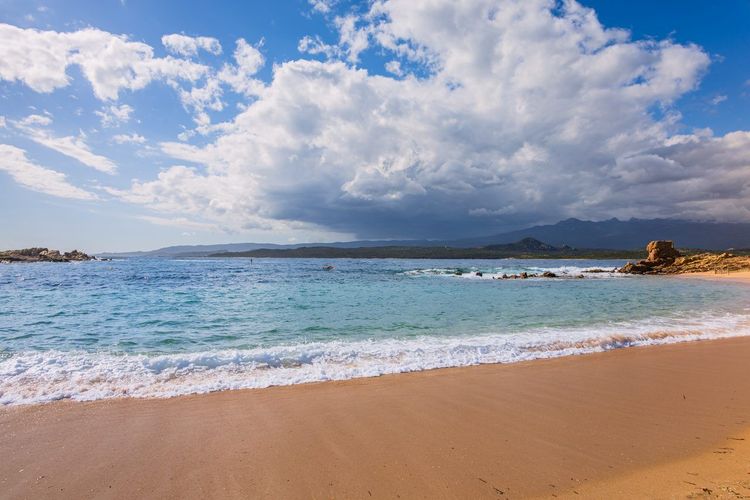
Relaxing on dream beaches is also part of the appeal of Bonifacio, provided you know where to look: the finest beaches are almost all outside the town itself, spread between the Pertusato peninsula, the approaches to the inlet, and the Sant'Amanza bay.
Piantarella and Its Lagoon, Petit and Grand Spérone
The Piantarella beach, about fifteen minutes' drive southeast of Bonifacio, forms a shallow lagoon facing the islet of Piana and the island of Cavallo. The water stays low for several dozen meters, making it particularly well suited to families with young children. The site also draws kitesurfers and windsurfers thanks to a reliable wind.
Immediately nearby, the Petit and Grand Spérone beaches offer finer sand at the edge of a renowned golf course. Petit Spérone can be reached on foot from Piantarella via a coastal path. The turquoise water and white sandy bottom make it one of the most photographed beaches in the region, despite noticeably increasing visitor numbers.
Paragan, Fazzio, and Saint-Antoine
On the other side of the inlet, northwest of town, Paragan beach occupies a small sheltered cove with fine sand, ideal for swimming. Its neighbor, the Fazzio cove, is a fifteen-minute walk away: nestled at the end of a narrow limestone inlet between large boulders, it is one of the most picturesque spots in the area.
The Saint-Antoine beach, smaller and wedged between two rocky outcrops, appeals above all for its tranquility: limited nearby parking keeps crowds away even in August. Bring water shoes — the seabed is rockier here, which also explains why the water is often exceptionally clear for spotting fish.
None of these three beaches is supervised: caution is essential, especially with children.
Sant'Amanza Bay (Capicciolu) and Rondinara Bay
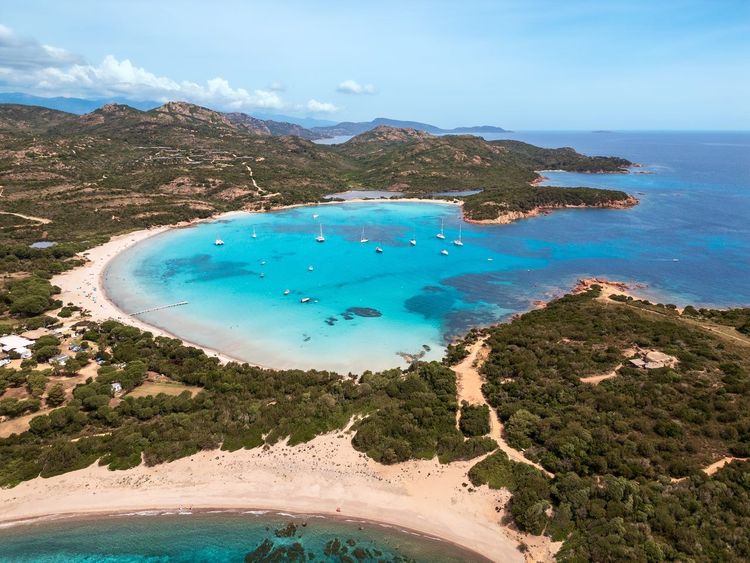
On the east coast, Capicciolu beach, in Sant'Amanza bay, stands out for its shallow water over a long stretch. The sand is coarser than at the southern tip beaches, but the bay is well sheltered from the westerly wind — a real advantage on blustery days.
A little further along, about twenty minutes' drive toward Porto-Vecchio, Rondinara bay (Bonifacio, rated 4.4/5 on Google from 6,411 reviews) closes the list in style: its almost perfect horseshoe shape, rimmed with white sand and shallow turquoise water, regularly earns it a place among the most beautiful beaches in France. The paid parking lot frequently fills up by 10:30 a.m. in July–August: arrive before 9 a.m. or opt for the end of the day.
None of these beaches is really accessible on foot from the citadel: a rental car or scooter is needed to reach them.
9. Climbing to the Saint-Roch Chapel for a Panoramic View of the Citadel
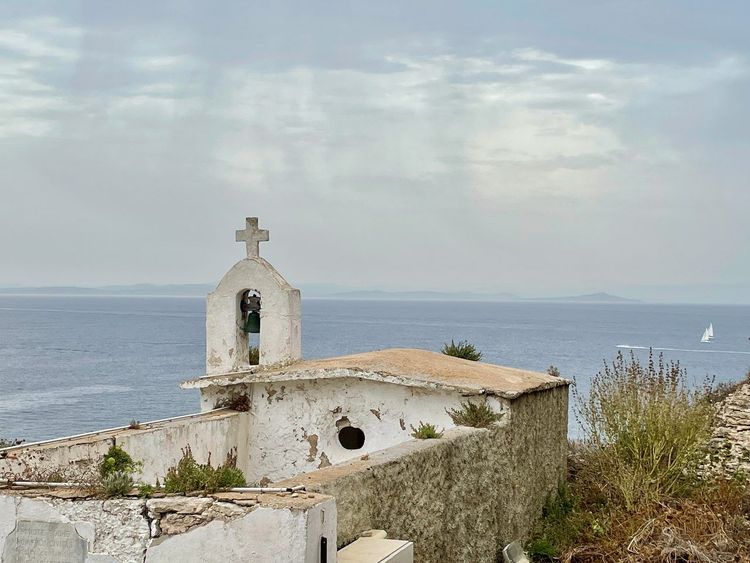
Between the harbor and the Upper Town, at the foot of the cliff and in the shadow of the prison bastion, the Saint-Roch Chapel (Bonifacio, rated 4.3/5 on Google from 29 reviews) stands on a promontory overlooking the sea and the mouth of the inlet. It is reached in just a few minutes from the quay via the Montée Rastello, the paved ramp connecting the harbor to the citadel.
This small single-nave chapel, simply whitewashed, recalls one of the darkest episodes in local history: it was built on the spot where the last victim of the plague of 1528 died — a doctor who had tended the sick. The epidemic had carried off the vast majority of the population, with only around 700 of the town's 5,000 inhabitants surviving. Beyond its historical interest, it is the viewpoint that justifies stopping here: the citadel appears in profile, ramparts and cliffs merging into one, with the harbor, the Pointe Saint-Antoine, and Sardinia on the horizon. This is also where the cliff path toward Pertusato begins.
10. What to Do Around Bonifacio: Day Trips in Southern Corsica
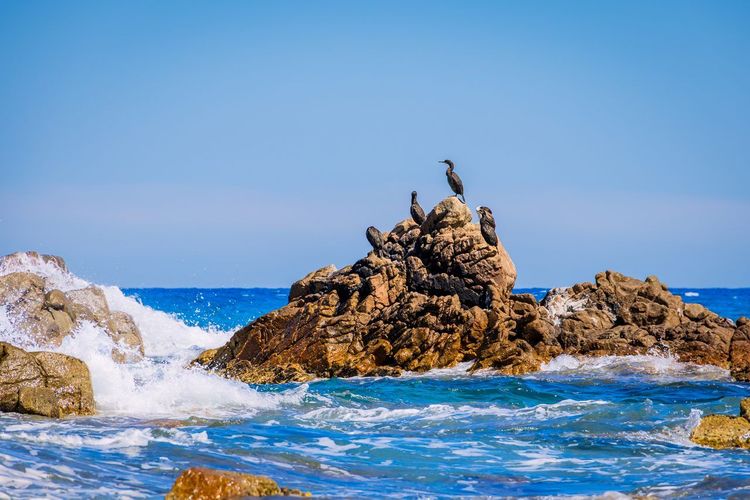
Once the town itself has been covered in one or two days, southern Corsica offers plenty of material for several full-day excursions, often overlooked by guides focused solely on the fortified citadel.
Sartène, the Granite Town
About fifty minutes' drive to the northwest, Sartène was described by Prosper Mérimée as "the most Corsican of all Corsican towns," a label that still sticks. Built in grey granite, the old town is organized around narrow alleyways leading to the Place Porta, flanked by the former Genoese governors' palace, now the town hall. Sartène is best known for its Catenacciu, a Good Friday penitential procession in which a hooded penitent drags a heavy chain through the streets.
Allow half a day to stroll through the old town and head out to the megalithic alignments at Cauria, one of Corsica's most important prehistoric sites, with its Stantari and Rinaghju menhirs.
Porto-Vecchio and the Bavella Massif
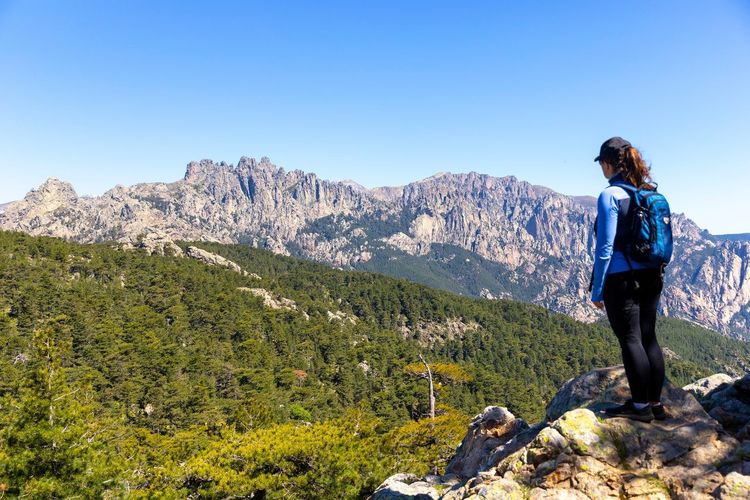
To the north, Porto-Vecchio is about 45 minutes by road and gives access to some of the island's most celebrated beaches — Palombaggia and Santa Giulia leading the list. The upper town deserves a detour for its Genoese ramparts and lively evening terraces.
Further inland, about an hour and a half by road, the Bavella massif reveals an entirely different face of Corsica: pink granite needles, centenarian laricio pine forests, and some of the island's finest trails. The Trou de la Bombe, an easy walk of about two hours there and back from the pass, leads to a natural opening in the rock that frames the sky like a giant peephole.
If your Corsican road trip also takes you through Ajaccio, the Ryo audio-guided tour of Ajaccio takes you in the footsteps of Bonaparte through the imperial city: 18 audio tracks, 2.5 hours, and 6 km of walking, to follow at your own pace on your smartphone.
11. Where to Eat and Taste Bonifacio's Cuisine
Bonifacio's cuisine, shaped by Genoese and Sardinian influences as much as Corsican ones, naturally rounds off a day of sightseeing. The choice essentially comes down to two areas: the harbor, right at the water's edge, or the citadel, with views to match.
Southern Corsica also produces wines that pair beautifully with this seafood-forward cuisine: the Figari and Sartène appellations, both nearby, appear on most menus and are often available by the glass.
At the Old Harbor: Fish and Ice Cream
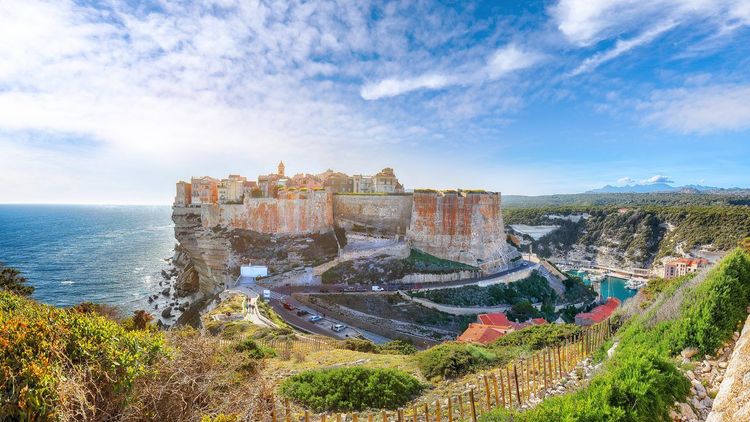
Almost all the terraces lining the quay serve fresh fish and lobster, which at the most popular spots should be reserved several hours in advance during high season. Prices here are noticeably higher than in the citadel, with the view over the boats and the cliff partly justifying the bill. Make sure to try the stuffed aubergines bonifaciennes, gratinéed and baked, the town's emblematic specialty.
Fancy an ice cream? Several artisan gelato makers have set up along the quay, offering local flavors such as chestnut, myrtle, and brocciu — Corsican fresh whey cheese. A welcome cool-down before heading back up to the citadel for sunset.
In the Citadel: View Bars and Local Tables
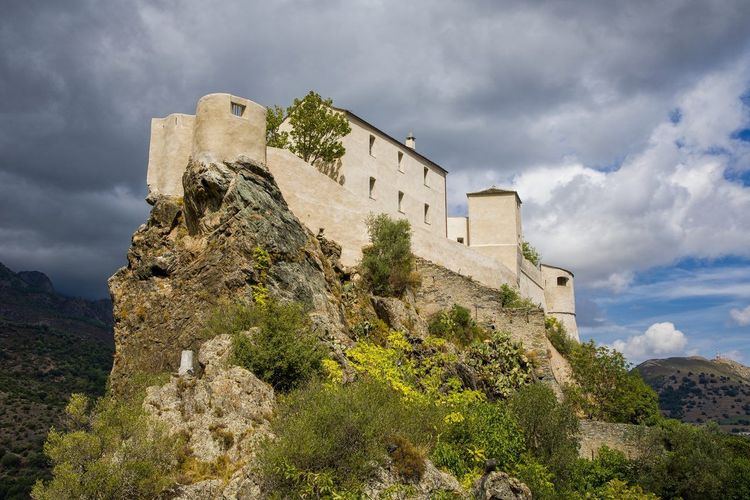
Up here, tables are generally more affordable than at the harbor, with perched terraces that sometimes offer a direct view over the cliffs, particularly around the market square and the alleyways running along the ramparts. There is also plenty to snack on mid-visit: grilled figatellu, brocciu fritters, or Corsican charcuterie by the slice from the delicatessens.
For a more intimate dinner, opt for tables on the cliff side rather than those on the main street, which are livelier but also noisier once night falls. Book ahead in July–August, even at the most modest spots: the town has few tables to meet summer demand.
12. Where to Stay in Bonifacio and Its Surroundings
It all depends on the kind of stay you have in mind. In the citadel, the options are limited to a few guesthouses and small boutique hotels, with rooms that are sometimes attic-style but offer views over the sea or the historic alleyways. The advantage: everything is within walking distance, with no need to get back in the car.
At the harbor and its surroundings, hotels are more numerous and often more modern, some with a pool. This is the most convenient option if you plan to combine boat trips with terrace dinners.
Where to stay when the town is fully booked — which happens frequently in July–August? The surrounding area, toward the Porto-Vecchio road or the Sant'Amanza countryside, offers guesthouses and campsites at more affordable rates, just five to fifteen minutes' drive away. A good option if you plan to spend more time on the beaches than in the citadel.
Outside of high season, between October and April, rates drop considerably and the town regains a quietness that few summer visitors can imagine. Check for air conditioning before booking in the Upper Town: some attic rooms become difficult to bear in the height of summer. With young children, prefer accommodation accessible by car, as the steep, cobbled alleyways quickly become a challenge with a pushchair or luggage.
13. How to Get to Bonifacio and Get Around Once You Are There
Two questions come up before every visit: how to get there, and how to get around without spending an hour looking for a parking space.
By Plane, Ferry, or Car to Bonifacio
The nearest airport, Figari–Sud Corse, is about 20 kilometers away — roughly 25 minutes by road — with direct services from several French cities and a handful of European capitals in season. Car rental or a taxi are the most reliable options for reaching the town.
From Sardinia, ferries connect Santa Teresa Gallura to Bonifacio in just under an hour, several times a day in season — a practical option for combining both islands. From the rest of Corsica, allow around 2.5 to 3 hours by road from Ajaccio and less than an hour from Porto-Vecchio. Landing at Ajaccio is also a good opportunity to spend half a day in Napoleon's birthplace with the Ryo audio-guided tour of Ajaccio before heading south.
Getting Around: on Foot, by Tourist Train, or by Bus
Visiting Bonifacio on foot is perfectly feasible for the historic center, provided you are comfortable with steep, cobbled streets that are poorly suited to visitors with reduced mobility. Parking is mainly available outside the citadel, in the harbor or plateau car parks, which are paid in high season.
Can you visit Bonifacio without a car? Yes for the town center and citadel, less easily for the beaches, which are several kilometers away. The tourist train, which links the harbor to the citadel with commentary, is a practical alternative if you prefer not to tackle the climb on foot. A few seasonal shuttles serve certain beaches in summer: check the current offering with the tourist office.
Arriving before 9:30 a.m. remains the best way to avoid the parking crunch closest to the center, a recurring problem from June onward.
14. When to Go and How Long to Spend in Bonifacio
May–June and September offer the best compromise for southern Corsica: water that is already pleasant from mid-June, significantly smaller crowds than in July–August, and accommodation prices that are still reasonable.
As for how long to stay, one day is enough for the essentials: the citadel, the Staircase of the King of Aragon, and lunch at the harbor. Two days allow you to add a boat trip to the sea caves or the Lavezzi Islands. To also enjoy the beaches and a day trip to Sartène or Bavella, spending three days in Bonifacio is the most comfortable format.
No day of the week is officially quieter than another, but cruise-ship calls can cause significant fluctuations in citadel crowds during summer. Checking the scheduled arrivals the evening before allows you to avoid the busiest hours.
Only have one day? Arrive before 9 a.m. to enjoy the citadel before the first groups arrive, book your boat trip for late morning, and save the late afternoon for the Saint-Roch Chapel and sunset over the cliffs.
15. What to Do in Bonifacio Based on Your Profile and the Weather
Your interests, the ages of your travel companions, and the day's weather can significantly change what the ideal itinerary looks like.
With Kids or as a Couple
With children, focus on the tourist train, the shallow lagoon at Piantarella, and a short boat trip into the sea caves — an experience that appeals to all ages without requiring a long walk. In the citadel, plan for frequent shade breaks, as the alleyways face directly south. The Staircase of the King of Aragon is best reserved for children who are comfortable with irregular steps.
As a couple, watching the sunset from the Saint-Roch Chapel or the marine cemetery, followed by dinner on a citadel terrace, is the most popular choice. A late-afternoon boat trip, offered by several local operators, provides a more original variation for admiring the cliffs in golden light.
Rainy Days: Museums, Shopping, and Indoor Spots
Rainy days are rare but possible, especially in spring and autumn. The Memorial of Bonifacio's Past, housed in the Bastion de l'Étendard, allows you to discover the town's history under cover, as does the Sainte-Marie-Majeure church in the heart of the citadel.
The shops of the Upper Town are full of artisan Corsican knives, charcuterie, and products made from myrtle or strawberry tree fruit to take home. In summer evenings, the harbor and citadel terraces stay lively late into the night; out of season, nightlife is mainly limited to a few bars and restaurants at the harbor.
On the events calendar, Festi Bocca, Bonifacio's food festival, takes over the Pisan quarter of the citadel for two days each spring with a producers' market, chef demonstrations, and workshops; its third edition is scheduled for 24 and 25 April 2027. Holy Week, with its confraternity processions, is the other major annual event.

FAQ
How Many Days Do You Need to Visit Bonifacio?
One day is enough to see the highlights: the citadel, the Staircase of the King of Aragon, and the harbor. Allow two days to add a boat trip to the sea caves or the Lavezzi Islands, and three days to also enjoy the beaches and a day trip to Sartène or the Bavella massif.
What Is the Best Time to Visit Bonifacio?
May–June and September offer the best balance between pleasant weather, swimmable sea from mid-June onward, and smaller crowds than in July–August. High season remains very busy, with higher accommodation prices and parking lots filling up by morning.
Can You Visit Bonifacio without a Car?
Yes for the citadel and town center, which are accessible on foot from the harbor or via the tourist train. The beaches and excursions to Sartène or Porto-Vecchio, however, require a rental car.
What Is There to Do in Bonifacio with Kids?
The tourist train, a boat trip into the sea caves, and the shallow lagoon at Piantarella are all great for children. Plan for shade breaks in the citadel, which faces directly south.
What Is There to Do in Bonifacio as a Couple?
Watching the sunset from the Saint-Roch Chapel or the marine cemetery, followed by dinner on a terrace, is the most popular choice. A late-afternoon boat trip offers a different perspective on the cliffs.
What Can You Do in Bonifacio When It Rains?
The Memorial of Bonifacio's Past in the Bastion de l'Étendard, the citadel churches, and the artisan shops allow you to continue exploring under cover. Rainy days are rare outside of spring and autumn.
What Is There to Do in Bonifacio in the Evening?
In summer, the terraces at the harbor and in the citadel stay lively late into the night, sometimes with Corsican singing at the Saint-Dominique church. Out of season, nightlife is limited to a few bars and restaurants at the harbor.
Bonifacio, a Town to Discover at Your Own Pace
Between a medieval citadel, a staircase carved into the rock, a cliff path, and beaches that rival the finest bays in the Mediterranean, Bonifacio packs enough into a few kilometers to fill a stay of several days. The challenge is not finding things to do, but choosing — the program overflows a simple stopover all too quickly.
For the day at sea, the Ryo guide to the Lavezzi Islands helps you choose the right crossing. And if your Corsican road trip takes you all the way to Ajaccio, the Ryo audio-guided tour of the imperial city will extend the discovery, headphones on, between the Maison Bonaparte and the old harbor.
À lire également