© Shutterstock
 Votre guide Ryo
Activities in Chambéry and Surroundings: The Complete 2026 Guide
Chambéry is a city that surprises. Activities in Chambéry and surroundings cover such a dense territory that most visitors only scratch the surface, too eager to reach the ski resorts or Lac d'Annecy to realise that the city itself deserves two full days on its own. At 570 metres above sea level, wedged between the Chartreuse massif and the Bauges, the former capital of the Duchy of Savoy boasts an intact medieval centre, covered arcades dating from the 14th century, and a mountain gastronomy rooted in AOP products found nowhere else.
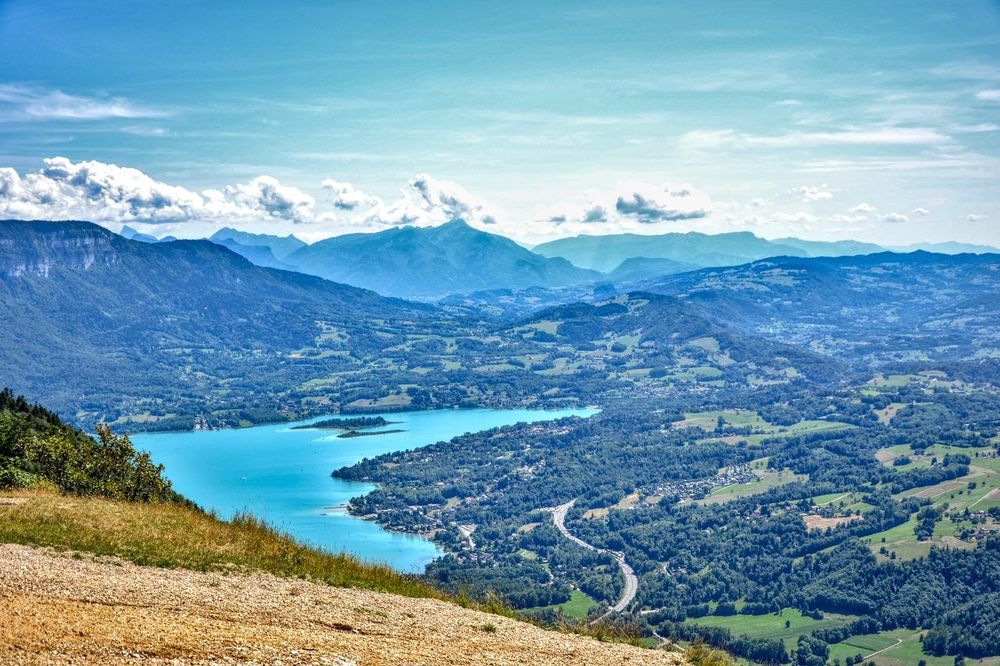
But Chambéry is not just a city to visit: it is a strategic base for exploring one of the most varied alpine territories in France. Just 15 km away, Lac du Bourget — France's largest natural lake at 44.5 km² — awaits with its free beaches and a Cistercian abbey clinging to the cliff face. 45 minutes away, Annecy and its canals form an animated postcard. And for those who prefer altitude, the peaks around the city offer hikes at 2,000 metres without ever straying more than an hour's drive away. This guide covers everything: the historic centre (which the Ryo audio guide of the historic capital of Savoy covers in 23 stops), excursions within thirty minutes, mountain sports in every season, and the addresses where you can eat genuinely Savoyard food.
Exploring Old Chambéry: Castle, Cathedral, and the Fontaine des Éléphants
Old Chambéry is visited on foot, and only on foot. The medieval centre is so compact that a visitor in a hurry can tick off its landmark monuments in two hours — provided they do not linger in the covered arcades that have woven through the urban fabric since the Middle Ages. Practical tip: start at the fountain, follow the arcades eastward to the castle, come back down via the cathedral, then lose yourself in the hidden inner courtyards. It is in this last exercise that Chambéry truly reveals its character.
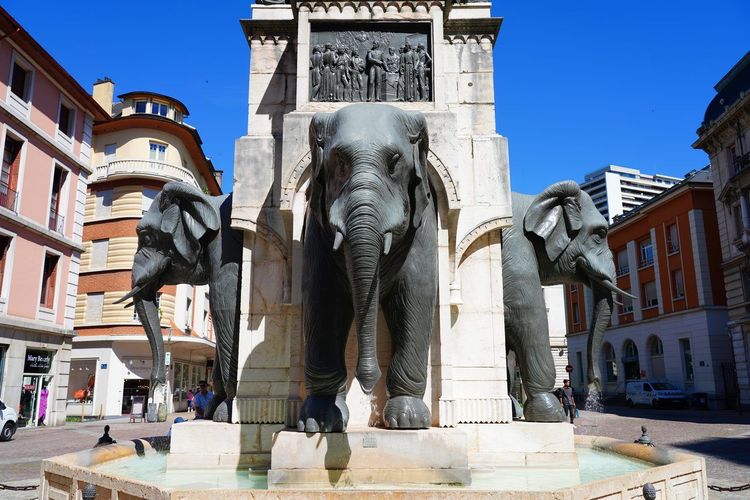
The visit begins at the Fontaine des Éléphants, erected in 1838 in honour of Count Benoît de Boigne, a Savoyard general who made his fortune in India. Four cast-iron elephants support an obelisk: the ensemble is at once kitsch and elegant, perfectly chambérien. The locals nicknamed it « Les Quatre Sans Cul » (The Four Without a Backside) — the elephants have no hindquarters, as funding ran out before the original sculpture could be completed. This capacity for self-deprecating humour says a great deal about the spirit of the city.
Five minutes' walk eastward, the Château des Ducs de Savoie has dominated the city since the 13th century. The residence of the Dukes of Savoy before the duchy's capital was transferred to Turin in 1563, it today houses the offices of the Savoie department, without this preventing its towers and courtyard from being open to the public. The guided tour of the Sainte-Chapelle deserves particular attention: built in 1408 to house the Holy Shroud (before its transfer to Turin in 1578), it retains 15th-century stained-glass windows and a remarkably well-preserved Flamboyant Gothic façade. The carillon bells, installed in 1993, are the most extensive in France with 70 bells.
The Cathédrale Saint-François-de-Sales, immediately nearby, holds an unexpected surprise for visitors: its 17th-century trompe-l'œil interiors. The marble columns, sculpted capitals, and gilding you see are in fact painted on flat surfaces — a masterpiece of Baroque illusion executed by Piedmontese artists. The effect is striking: even knowing that everything is painted, the eye continues to be deceived. The Ryo guide details this episode during its tour of the historic Savoyard capital.
The covered arcades then deserve an hour of aimless wandering. These vaulted galleries, simply called « allées » by the people of Chambéry, date from the Middle Ages and allowed merchants to protect their goods from the elements. Twenty-four still exist in the centre, some opening onto private inner courtyards where gardens grow and families have lived for generations. Rue Basse-du-Château and place Saint-Léger contain the finest examples. Take the time to push open the carriage gates: you may stumble upon Romanesque staircases, hidden fountains, or simply the unexpected silence of a neighbourhood that is nonetheless central.
East of the castle, the Musée Savoisien (Square de Lannoy de Bissy, 73000 Chambéry, rated 4.7/5 on Google from 499 reviews) is one of the city's great cultural surprises. Housed in a former Franciscan convent, it traces the natural and cultural history of Savoy from prehistory to the Revolution. The section devoted to medieval mural paintings — removed from their original walls and reconstituted here in context — constitutes one of the rarest collections in France. A minimum of one hour is needed to explore it properly.
To structure a visit to the historic centre and miss none of the architectural details that escape the untrained eye, the Ryo audio guide of the historic capital of Savoy covers 23 points of interest in 1h30 over 3.4 km. It is the most efficient way to understand why Chambéry was, for two centuries, the capital of a state that stretched from the Alps to the Tyrrhenian Sea.
Allow a minimum of half a day for the historic centre alone, and a full day if you add the museums.
Lac du Bourget: Beaches, Water Sports, and the Abbaye de Hautecombe
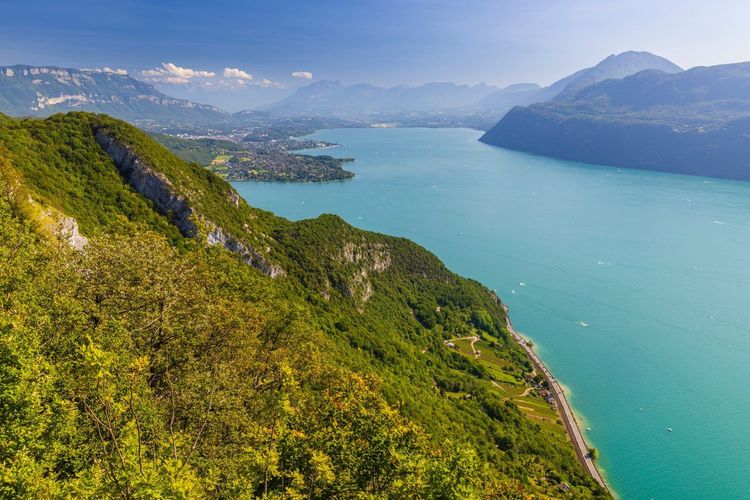
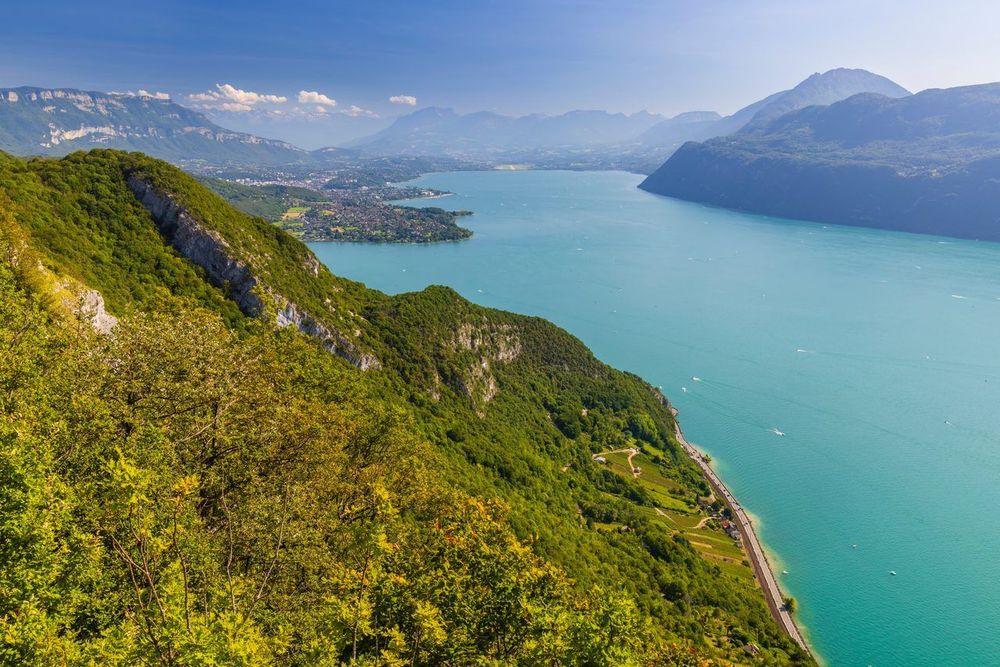
Lac du Bourget is Chambéry's strongest geographical asset. France's largest natural lake — the title is uncontested, as Lac Léman is Franco-Swiss — it stretches 18 km long and 3 km wide less than 15 km from the city. The water remains cool even in August (between 20 and 22°C at the surface), and a maximum depth of 145 metres gives it a deep blue-green colour that sets it apart from smaller mountain lakes. Lamartine dedicated his most famous poem, « Le Lac », to it — a literary detail that says something about the power of the place.
The eastern shore of the lake, reachable from Chambéry in 20 minutes via the D1504, concentrates most of the summer activities. Le Bourget-du-Lac has several free supervised beaches in July and August, a marina, and a water-sports base where you can hire kayaks, pedal boats, and windsurfing boards. Sailing clubs along the shore offer introductory sessions on weekends from June to September, suitable for beginners and experienced sailors alike.
Further north, Aix-les-Bains has the most developed lakeside infrastructure. The Grand Port d'Aix is the departure point for lake cruises run by several operators between May and September. These cruises last between 1h30 and 3h depending on the option, and allow you to glimpse the Abbaye de Hautecombe (Saint-Pierre-de-Curtille, 73310 Hautecombe, rated 4.4/5 on Google from 4,494 reviews) from the water before docking — an experience with few equivalents in France.
The Abbaye de Hautecombe is the highlight of any visit to Lac du Bourget. Clinging to the limestone cliff of the western shore, this Cistercian abbey founded in the 12th century served as the necropolis of the princes and kings of Savoy for seven centuries: it houses more than 40 royal tombs. It can be reached by road (a car park is 200 metres from the entrance), but arriving by boat from the Grand Port d'Aix remains the most spectacular approach: you discover the tower and façade from the water before docking, giving the visit a unique atmosphere. The interior, restored in the 19th century in an exuberant neo-Gothic style at the instigation of King Charles-Felix of Sardinia, blends coloured marbles, gilding, and monumental sculptures. The monastic community that still inhabits it offers free guided tours several times a day.
For those who enjoy gentle outdoor activities, the voie verte du Canal de Savières — the lake's natural outlet to the Rhône — follows a wild corridor ideal for birdwatching: grey herons, great crested grebes, kingfishers. The canal, just 4 km long, is classified as a nature reserve and is one of the few preserved wetland areas in the region.
In winter, water activities stop in October, but walking and cycling remain pleasant. The low December light on the grey waters of the lake creates photographic atmospheres that summer, with its crowds and overhead glare, makes impossible.
Practically speaking, the lake is accessible by TER from Chambéry (Aix-les-Bains stop, 15 minutes). The beaches closest to Aix station are ten minutes' walk from the platform, making the excursion perfectly doable without a car.
Aix-les-Bains: Thermal Baths, Casino, and Lakeside Promenade
Aix-les-Bains deserves a section of its own. Just 15 km north of Chambéry, often reduced to the role of a lakeside annexe, it is in fact the region's largest thermal resort and one of the most visited in France, with more than 40,000 spa guests per year. Its Belle Époque architecture, well-maintained gardens, and lakefront have an aesthetic coherence that many larger cities would envy.
The Thermes Chevalley offer thermal and balneotherapy treatments accessible without a prescription for day wellness stays. Several packages include thermal baths, water jets, a hammam, and massages. It is a particularly coherent option for a rainy day or as a break between demanding hikes.
The Musée Faure is Aix's cultural surprise. This Belle Époque villa houses an impressive collection of Rodin sculptures — several original bronzes, not casts — Impressionist paintings by Degas, Corot, and Constable, and late-19th-century decorative arts. The whole is presented in the intimacy of the family villa, without the queues or excessive museification of the great national museums.
The lakeside promenade, which runs along the shore for several kilometres from the Grand Port to the casino, is the heart of Aix's summer life. The Casino Grand Cercle, in neo-classical style, dates from 1849 and is one of the finest examples of thermal architecture in the region. It now hosts table games, slot machines, and shows, while retaining its ornate period salons.
Allow half a day for Aix-les-Bains, or a full day if you combine the thermal baths, museum, promenade, and a lake cruise. The TER from Chambéry takes 15 minutes with trains running approximately every hour.
Les Charmettes and the Museums: Culture and Heritage in Chambéry
About fifteen minutes' walk from the centre, the Maison des Charmettes occupies a unique place in French literary history. It was in this country house that Jean-Jacques Rousseau stayed between 1736 and 1742 with Françoise-Louise de Warens, his patron and first great intellectual influence. The years he spent there directly informed the « Confessions » and « Reveries of a Solitary Walker ». The house has remained close to its period state: 18th-century furniture, a French formal garden, an orchard. The visit lasts 45 minutes — brief, but striking for anyone familiar with Rousseau's work.
The Musée des Beaux-Arts de Chambéry (Place du Palais de Justice, 73000 Chambéry, rated 4.3/5 on Google from 616 reviews), housed in a converted former market hall, holds a remarkable collection of Italian paintings from the 15th to 17th centuries for a city of this size. Works by Bellini, Tiepolo, and Magnasco sit alongside Tuscan primitives rarely exhibited outside Italy. Admission is free on the first Sunday of each month — useful information if you plan your stay accordingly.
Chocolate lovers will note that Chambéry's confectionery tradition predates the Swiss reputation in the region. Several artisan chocolatiers in the centre offer informal tastings, particularly around the festive season, when shop windows compete in creativity. The Chocolaterie Cluizel and a few addresses along rue de Boigne make up an original gourmet trail that can be slotted between two museum visits.
Hiking Around Chambéry: Nivolet, Dent du Chat, and the Bauges Massif
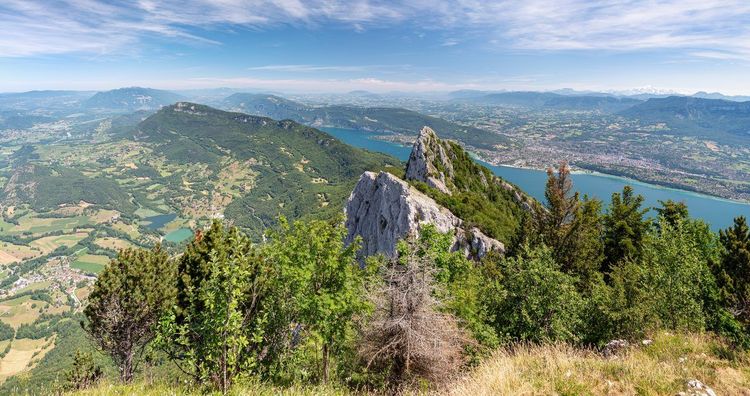
The immediate surroundings of Chambéry offer a remarkable density of hiking trails, with ascents accessible from the city and panoramas spanning several alpine ranges simultaneously. Three massifs structure the offer: Chartreuse to the west, the Bauges to the east, and the Nivolet massif directly above the city.
The Croix du Nivolet is the emblematic summit for the people of Chambéry. Visible from across the city at 1,548 metres altitude, it can be reached from the Challes-les-Eaux neighbourhood or from Chambéry-le-Haut in two to three hours' ascent depending on pace. The panorama at the summit takes in Lac du Bourget, the Bauges and Belledonne massifs, and on a clear day Mont-Blanc to the east. The descent can be made via an alternative route through the combes de Savoie, avoiding retracing the same path.
The Dent du Chat (1,390 m), on the western shore of Lac du Bourget, offers a shorter but more technical hike, with an exposed ridge section that provides a vertical drop down to the blue waters of the lake. The trailhead is at the Col du Chat, reachable by car from Chambéry in 30 minutes. This is not a hike to attempt in rain or fog: the ridge sections can become slippery and zero visibility nullifies the point of the panorama.
The Bauges massif, classified as a Parc Naturel Régional since 1995, extends east of Chambéry across 85,000 hectares. It is one of the rare areas of the French Alps where you can observe ibex, chamois, and griffon vultures from waymarked trails accessible to intermediate-level hikers. The La Féclaz plateau (La Féclaz, 73230 Saint-Jean-d'Arvey, rated 4.7/5 on Google from 29 reviews), 25 km from Chambéry, is the starting point for numerous itineraries in all seasons: summer hikes, cross-country skiing and snowshoeing in winter, mountain biking from late May to late September.
For hikers seeking wilder, less-frequented terrain, the Désert de Lémenc area in the eastern Bauges offers paths through beech forests and alpine meadows, with staffed mountain refuges in summer. The Tour Percée and the gorges of the Chéran are two particularly photogenic hiking destinations in autumn, when the beeches turn to copper tones.
In autumn particularly, the Bauges forests become one of the most beautiful natural spectacles in the region. It is also hunting season — visitors should wear bright clothing and observe any trail closures posted at the local town hall.
Several local companies offer guided hikes departing from Chambéry into the Bauges, with state-qualified guides. A relevant option if you are unfamiliar with alpine terrain or uncertain about the weather. Prices range from €30 to €60 per person depending on duration and package.
Annecy from Chambéry: A Day Trip to the Pearl of the Alps
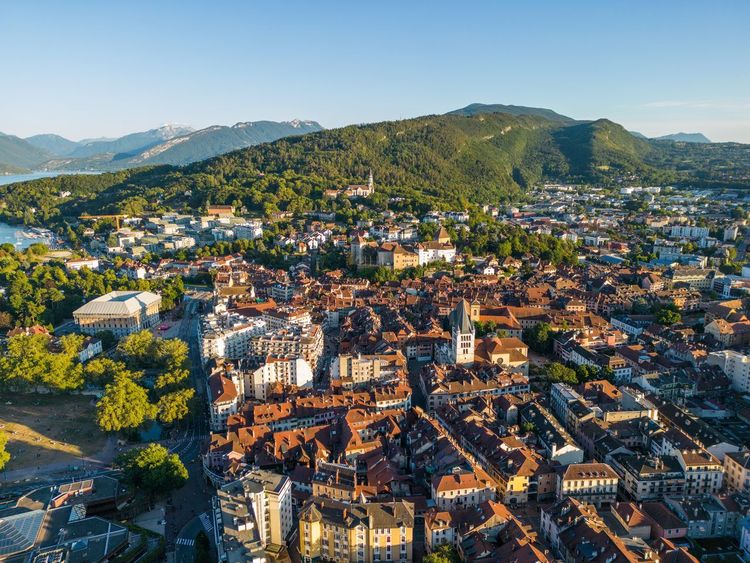
Annecy is the most popular day trip from Chambéry, and for good reason. Annecy's old town is one of the best-preserved in the French Alps, and the lake that borders it boasts exceptionally clear water, ranked among the purest in Europe. From Chambéry: 45 minutes by car via the A41, or 1 hour by TER via Aix-les-Bains.
The Palais de l'Île is the city's photographic symbol — a small 12th-century medieval castle built on an islet in the middle of the Thiou, a waterway linking the lake to the canal. It served successively as a courthouse, prison, and palace of justice before being converted into a local history museum. The morning light on its ochre facades and the reflections in the canal make it one of the most-photographed subjects in the Alps.
The old town is best discovered on foot without a fixed plan. The colourful arcades, porticoed houses, and cobbled streets have largely resisted the transformations of the 20th century. The Château d'Annecy (Rampe du Château, 74000 Annecy, rated 4.1/5 on Google from 5,717 reviews), which overlooks the city from a hill, houses a museum devoted to regional history and alpine decorative arts — less well-known than the palace, but often more interesting for those with an interest in Savoyard art.
Lac d'Annecy can be cycled in full on a 42 km cycle path that goes all the way around. The stretch between Annecy and Talloires on the eastern shore is particularly spectacular, with views across to the Aravis peaks. Bicycle and e-bike hire shops are located right next to the station and the lakefront.
In July and August, Annecy is very busy and parking becomes problematic. Weekday visits, or the months of May–June and September, offer a crowd-free experience. The train remains by far the best logistical option for this excursion from Chambéry.
Grenoble and the Grésivaudan Valley in Under an Hour
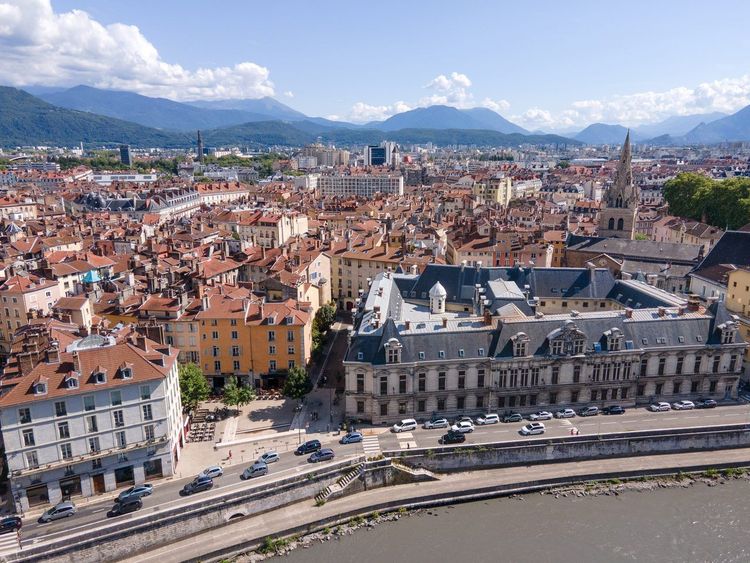
Grenoble is 55 minutes from Chambéry via the A41 — an excursion of a completely different register. A university, scientific, and industrial city, it has a cultural and museum offer that far exceeds what its size might suggest.
The Musées de Grenoble house one of the most important fine arts collections in France outside Paris: 900 works on display across four floors, from Italian primitives to 20th-century avant-gardes, with pieces by Rubens, Monet, Matisse, Ernst, and Picasso. Admission is €8; the museum closes on Tuesdays.
The Bastille de Grenoble is accessible by cable car from the banks of the Isère; the spherical glass cabins climbing the hill (nicknamed « les bulles » — the bubbles) have become the city's most photographed attraction. At the top, the view over the confluence of the alpine valleys (Chartreuse, Vercors, Belledonne, Taillefer) is breathtaking on a clear day. The ascent on foot via the trails through Parc Guy Pape remains possible in one hour of brisk walking.
On the road between Chambéry and Grenoble, the Grésivaudan valley is worth a stop. The village of Pontcharra and its Château de Bayard — legendary birthplace of the Knight Without Fear and Without Reproach — offer a pleasant historical pause. Further south, Uriage-les-Bains is a small, elegant thermal resort at the foot of the Belledonne massif, with a park open to walkers and a preserved Belle Époque thermal architecture.
Grenoble bears no resemblance to Chambéry: more urban, younger, more international in feel. It is precisely this complementarity that makes the excursion worthwhile — two alpine cities less than an hour apart, with entirely distinct identities.
The Most Beautiful Savoyard Villages Around Chambéry
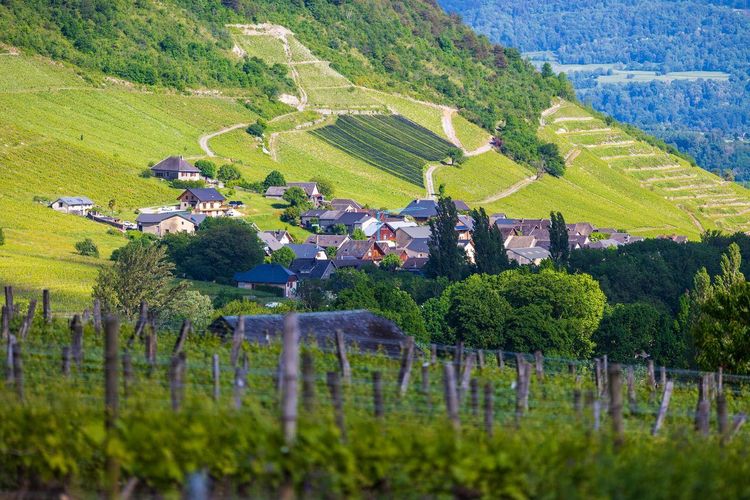
Savoy has a remarkably well-preserved network of villages, and several are less than an hour from Chambéry. Our Ryo guide to the most beautiful villages to discover in Savoy lists detailed itineraries; here are the essentials to keep in mind based on your starting point.
Yenne (30 km to the west) is the capital of the Yenne-Jongieux wine-growing area, one of the region's rare AOC crus. The village retains a 12th-century Romanesque church and wine cellars open for tastings year-round. Autumn, during the harvest (late September to mid-October), is the best time to go — winemakers open their estates and the atmosphere is relaxed.
Saint-Pierre-de-Curtille, 25 km to the north, is the gateway village to the Abbaye de Hautecombe by road — the only way to approach it overland. Perched above Lac du Bourget, it offers sweeping downward views over the blue waters from its cobbled lanes.
In the Bauges massif, Saint-Pierre-d'Albigny and the Château de Miolans (Route du Château, 73250 Saint-Pierre-d'Albigny, rated 4.5/5 on Google from 1,394 reviews) are well worth the detour. This 11th-century medieval fortress dominated the Combe de Savoie from a rocky spur 450 metres above the valley, serving as a state prison for the Dukes of Savoy until the Revolution. The Marquis de Sade, who made a spectacular escape from it in 1773, was its most famous prisoner.
The Route des Vins de Savoie links several of these villages in a one-day itinerary: head from Chambéry towards Montmélian, drive up the Combe de Savoie to Cruet and Arbin, then return via the heights of the Bauges. Savoyard grape varieties — Jacquère, Altesse, Mondeuse rouge — are little known outside the region and offer interesting discoveries for lovers of distinctive wines, far removed from Bordeaux or Burgundy standards.
To explore the territory even further, the article Around Chambéry: 14 Tourist Gems According to Ryo details lesser-visited sites beyond the classic must-sees, with precise information on access and opening hours. In the city itself, our audio-guided tour covers the historic centre in about an hour and a half.
Skiing, Mountain Biking, and Mountain Sports Around Chambéry
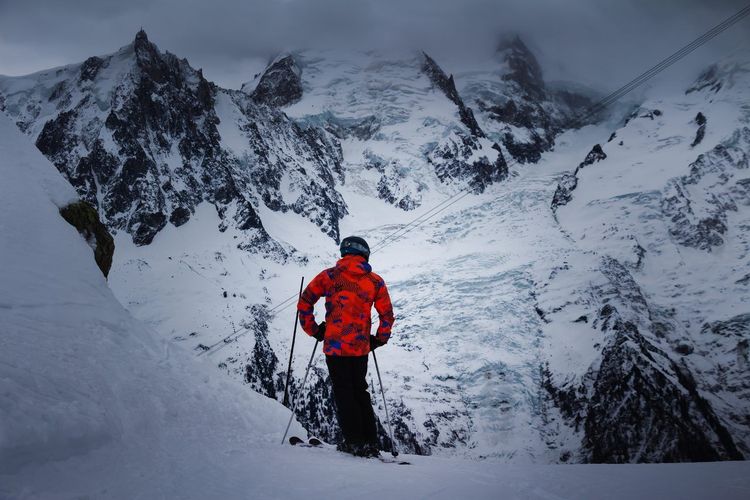
Chambéry is surrounded by ski resorts reachable in under an hour and a half, making it one of the rare French cities where you can come back to sleep in town after a full day on the slopes. The choice depends on your level and how far you are willing to drive.
At 45 minutes, Aillons-Margériaz (Bauges massif) offers a family ski area reaching 2,000 metres with 25 km of pistes suited to beginners and families. It is also one of the region's best cross-country skiing and snowshoeing destinations, with waymarked circuits in the Parc Naturel Régional des Bauges.
At 1h10, Chamrousse (Belledonne massif, Grenoble side) offers a larger ski area (90 km of pistes) and was the venue for the alpine skiing events at the 1968 Grenoble Winter Olympics. The original Olympic race courses are still marked, an added attraction for fans of competitive ski history.
For high-mountain skiing, Courchevel, Méribel, and the Trois Vallées are reachable from Chambéry in 1h15: the world's largest linked ski area with 600 km of interconnected pistes less than 80 km from the city.
In summer, mountain biking takes over. La Féclaz has a bike park open from June to September, with downhill trails laid out for different levels and a chairlift. For road cyclists, the ascent to the Col de la Croix-de-Fer or the Col du Glandon from Chambéry are classic, gruelling routes on the French alpine roads.
The via ferrata du Nivolet, above Chambéry, is suited to those seeking a vertical thrill without climbing experience. Progress on fixed cables and rungs, a 500-metre elevation gain, and spectacular views over the Chambéry plain and the lakes. Hire equipment is available from sports shops in the city centre.
Also in summer, tandem paragliding is practised from several sites around Lac du Bourget and Chartreuse. Introductory flights are available from €80–90 per session, with landing possible on the lake shores or in the Chambéry plain.
What to Do in Chambéry When It Rains?
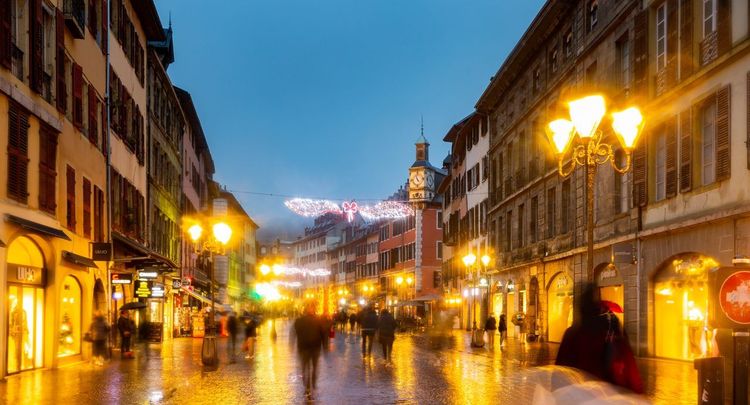
Alpine weather is not always kind. Chambéry receives a fair share of showers, particularly in May–June and in autumn. Here are the options that hold up perfectly in the rain.
The museums are the most obvious and most rewarding answer. The Musée Savoisien, the Musée des Beaux-Arts, and the Maison des Charmettes make up a coherent cultural programme for an entire day without venturing outside for more than a few minutes. Combining all three, starting at 9am, is perfectly feasible.
The thermal baths of Aix-les-Bains are an excellent option 20 minutes away by TER. The Thermes Chevalley offer day wellness packages without prior medical booking, with access to indoor thermal pools, a hammam, and a relaxation area. A day at the baths in rainy weather is one of the simple but genuine pleasures of a stay in Chambéry.
The Bol d'Air, a complex with bowling, indoor karting, and arcade games, is particularly well-suited to families with children aged 5 to 14. No cultural pretensions, but effective when the clouds settle in for several hours.
For food lovers, a rainy day is the ideal opportunity to explore Chambéry's covered markets. The market on place de Genève runs on Tuesday, Thursday, and Saturday mornings: affineur cheesemongers, Savoyard charcutiers, market gardeners from the neighbouring valleys. The atmosphere is genuinely local, far from any tourist market.
Finally, a rainy day is the best excuse to settle into a good Savoyard brasserie, order a fondue, and explore the local wine list — Apremont, Jongieux, Mondeuse — rarely savoured outside the region. Pleasures all the more enjoyable when rain is falling on the cobblestones outside.
Savoyard Gastronomy: Specialities, Restaurants, and Markets
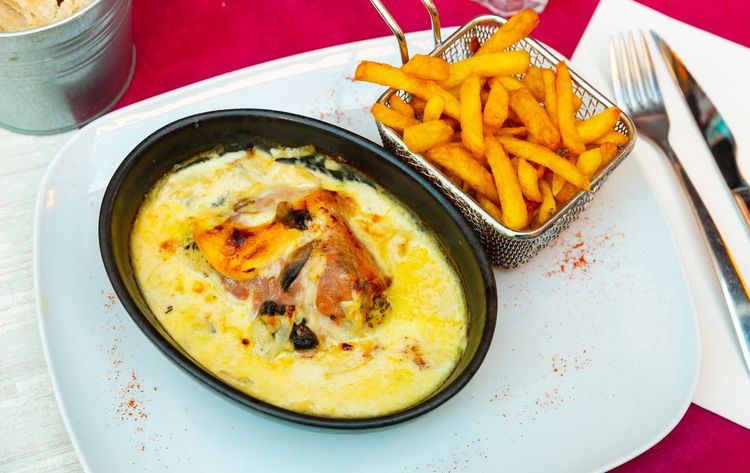
Chambéry is a city where you eat well, without the prices of top-tier tourist destinations. Savoyard cuisine is one of the most coherent in France — rooted in identifiable local produce, driven by local artisans, defended by a generation of restaurateurs who refuse to compromise on quality.
The signature dishes: fondue savoyarde (a blend of Beaufort, Comté, and Savoyard Emmental melted in Apremont white wine, served with country bread for dipping), raclette (melted cheese grilled over slices of steamed potatoes), and tartiflette (potatoes, Reblochon, lardons, and onions baked in the oven). These three dishes share a common logic: Savoyard cheese as the main protagonist, not a side.
The local cheeses deserve their own trail. Tome des Bauges AOP, produced exclusively in the Bauges massif, has a pressed texture and a characteristic slight bitterness impossible to confuse with imitations. Beaufort (known as « the prince of gruyères »), Reblochon, and Chevrotin des Aravis complete a cheese board that needs no envy of more widely publicised dairy regions.
For tastings and purchases, the Saturday morning market on place de Genève remains the most complete and most authentic. Affineur cheesemongers, charcutiers who smoke their own ham, market gardeners from the neighbouring valleys. Our Ryo guide to Chambéry's culinary specialities lists the best addresses by category and by neighbourhood for those who want to go further.
On the spirits side, génépi is the emblematic drink of the Savoyard Alps — an alpine plant distilled in limited quantities by artisan producers. To be enjoyed as a digestif, in moderation. Several producers from the Chambéry area sell their génépi directly at the end-of-year markets. Local wines — particularly the dry white Apremont and the tannic red Mondeuse — also deserve attention that their commercial discretion does not justify.
Getting Around and Planning Your Stay in Chambéry
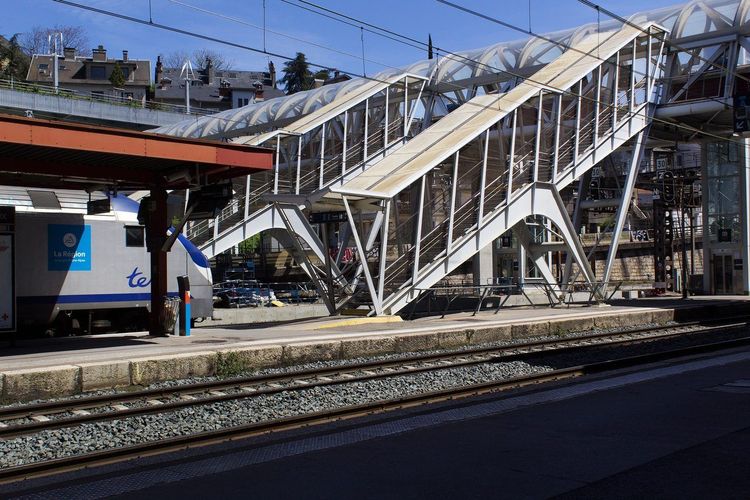
Chambéry is well served by public transport, and a car-free visit is perfectly feasible for the city centre and rail excursions.
By train: Chambéry is an important rail hub in the Alps. Direct TGV trains connect Paris Gare de Lyon in 3h10 and Lyon Part-Dieu in 1h. From Chambéry, TER regional trains serve Aix-les-Bains (15 min), Annecy (1h), Grenoble (1h), Modane, and the Maurienne valley. For the vast majority of excursions mentioned in this guide, the train is as fast as a car and avoids parking hassles.
By car: the A43 motorway connects Chambéry to Lyon (1h30) and Turin (2h30). The A41 leads to Grenoble (55 min) and Annecy (45 min). City-centre parking is paid but accessible: €1.50 to €2/hour in covered car parks. A full day rarely exceeds €12 in the place de Genève or Halles car parks.
By bus: the Synchro'bus network covers the Chambéry agglomeration and serves La Motte-Servolex, Aix-les-Bains, and several surrounding villages. Services are regular on weekdays, significantly less frequent on Sundays — plan accordingly.
Accommodation: Chambéry offers options across all price ranges. The historic centre concentrates boutique hotels and charming bed-and-breakfasts (expect €80–150 per night for a double room). For families or longer stays, rural gîtes in the Bauges villages and around Lac du Bourget offer more space and an immediate natural setting, often at more competitive rates than the city centre.
Daily budget: a day in Chambéry can remain very affordable. Museums: free to €8 per entry. Sainte-Chapelle: €6 on a guided tour. Meal at a Savoyard brasserie: €15–25 per person for a full menu. Lake cruise on Lac du Bourget: €15–22 depending on duration.



FAQ
What Can You Do in Chambéry in a Single Day?
A day in Chambéry should start with the Fontaine des Éléphants and the covered arcades (1h30), then continue to the Château des Ducs de Savoie and the Sainte-Chapelle (1h30), before spending the afternoon at the Musée Savoisien or the Beaux-Arts. A lunch break at the brasseries on place Saint-Léger, then, if energy allows, a half-hour drive to Lac du Bourget for a swim or a late-afternoon stroll. The day is packed but perfectly manageable.
Can You Visit Chambéry and Its Surroundings Without a Car?
Yes, to a large extent. Chambéry's city centre is entirely walkable. Aix-les-Bains and Lac du Bourget are accessible by TER (15 min). Annecy can be reached by train (1h). So can Grenoble (1h). Hikes in the Bauges and excursions to backcountry villages do require a car or taxi service, as bus lines serve these areas too infrequently to be reliable for tourist stays.
What Is the Best Season to Visit Chambéry?
Chambéry can be visited year-round, but each season has its own logic. June to September for hiking, the lake, and outdoor terraces. December to March for skiing at nearby resorts. May and October are the quietest months, with lower accommodation rates and very few tourists — paradoxically, as the weather is often pleasant. Chambéry's Christmas markets in December are among the best-stocked with artisan Savoyard products in the region.
How Much Time Do You Need to Visit Chambéry?
Two days are enough for the historic centre and the immediate surroundings (Lac du Bourget, Aix-les-Bains). Allow four to five days if you want to add a day trip to Annecy, hikes in the Bauges, and exploration of Savoyard villages. A full week allows you to include a day's skiing at a resort, a visit to Grenoble, and a road trip between the mountain ranges.
Are There Free Activities in Chambéry?
Several. The exterior visit of the Château des Ducs de Savoie and a stroll through the covered arcades are free. The beaches at Lac du Bourget are free. The Musée des Beaux-Arts is free on the first Sunday of each month. The city-centre markets — Tuesdays, Thursdays, Saturdays — cost nothing to browse. And hikes in the surrounding massifs require no entry fee or access pass.
Is Chambéry a Good Base for Exploring the Alps?
It is one of the best alpine bases in France. From Chambéry, you can reach Annecy in 45 min, Grenoble in 55 min, the Trois Vallées in 1h15, the Parc des Bauges in 30 min, and Turin in 2h30. No other city of comparable size in Savoie has such a complete rail and motorway network, making it an ideal logistical base for an itinerant alpine stay.
Where Can You Find Lesser-Known Outing Ideas Around Chambéry?
The article Around Chambéry: 14 Tourist Gems According to Ryo details sites off the beaten track, with precise access information and practical tips. The Office de Tourisme Chambéry Montagnes, located opposite the Fontaine des Éléphants, also distributes free maps and can offer guidance based on your interests and fitness level.
Conclusion
Chambéry resembles no other city in the French Alps. Too large to be a postcard village, too human to resemble the artificial resorts of the high valleys, it has preserved a distinct identity forged over fifteen centuries of Savoyard history. The old centre alone would justify the journey. But it is the territory as a whole — Lac du Bourget, the Bauges and Chartreuse massifs, the wine-growing villages, the resorts reachable in under an hour and a half — that transforms a brief visit into a memorable stay.
To discover the historic centre without missing any of the architectural details and the stories that connect Chambéry to the history of France and Europe, the Ryo audio guide of the historic capital of Savoy covers 23 stops in 1h30: the Château des Ducs, Sainte-Chapelle, covered arcades, Fontaine des Éléphants, and the forgotten stories that make this city far more than an alpine stopover. A solid starting point before widening the circle to all the surrounding area.
À lire également