© Shutterstock
 Votre guide Ryo
16 Free Activities in Le Havre in 2026: Hanging Gardens and UNESCO Heritage
Looking for free activities in Le Havre? The city has a rare quality: its most spectacular sights come at no cost — 17 hectares of gardens perched on a Second Empire fort, an entire city centre listed as UNESCO World Heritage, a seafront facing due west where you walk with the English Channel ahead of you. To understand the logic of the district rebuilt by Auguste Perret before setting off on foot, many visitors start with the Ryo audio-guided tour of Le Havre, 18 audio stops over 6.2 km that put into context what the eye alone does not always perceive.
Here, no ticket is needed to be amazed: the Jardins Suspendus overlook the estuary from about a hundred metres above sea level, and only their collection greenhouses cost €2. Le Volcan, designed by Oscar Niemeyer, houses a library with free access. The MuMa, France's second-largest Impressionist collection after Orsay, never charges under-26s for entry, and opens its doors to everyone on the first Saturday of each month. Between the lower and upper city, flights of public steps offer viewpoints that postcards tend to overlook. From the beach to neighbourhood media libraries, here is enough to fill several days without reaching for your wallet.
1. The Jardins Suspendus, Le Havre's Must-See
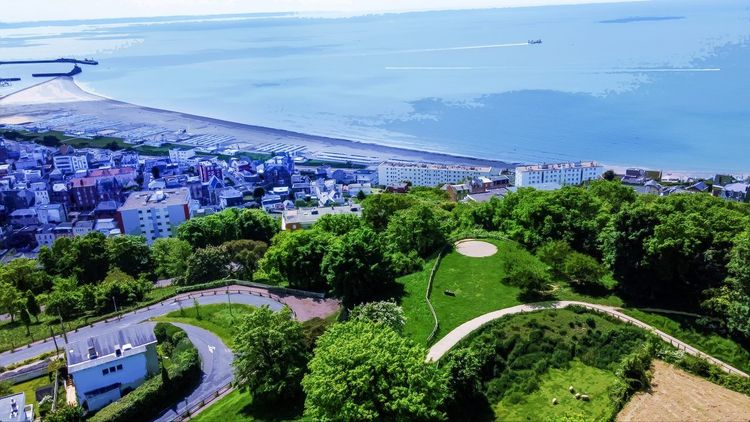
The Jardins Suspendus (Rue du Fort, 76620 Le Havre, rated 4.5/5 on Google from 5,178 reviews) occupy the former fort of Sainte-Adresse, a military structure built between 1854 and 1858 under the Second Empire, decommissioned in 1979 and then converted into a landscaped park of 17 hectares, opened to the public in September 2008. Entry to the site is free year-round, despite what its lofty estate appearance might suggest: only the collection greenhouses, with their orchids, begonias and succulents, require a ticket at €2, and children under 12 enter free.
People come here first for the panorama. From the old ramparts, at around 100 metres above sea level, the view takes in the working port with its gantry cranes and container ships waiting at anchor, the horizon of the English Channel, and on a clear day the Seine estuary all the way to the Pont de Normandie. The contrast between the military stonework and the flower beds often surprises those expecting a simple park.
Each bastion has its own botanical theme, inspired by explorers and navigators who set sail from the port: you move from American flora to Asian species within a few dozen metres. Try to visit on a weekday morning: the site fills up quickly at weekends. The paths are pushchair-friendly, but getting there from the lower city involves a steep climb, whether on foot or by car.
The Ryo audio-guided tour route climbs all the way up to the fort: one full stop is dedicated to the history of the fortifications and the way the estuary shaped the city's defences, with the panorama as the highlight of the listening experience.
2. Le Havre Beach and the Seafront
The Plage du Havre (Boulevard Albert 1er, 76600 Le Havre, rated 4.3/5 on Google from 8,431 reviews) stretches for about two kilometres of pebbles between the northern breakwater and the neighbouring town of Sainte-Adresse. It is recognisable by its beach huts lined up facing the sea and a fully developed seafront promenade, with a cycle path running the length of the urban shoreline.
On the promenade you will find fishermen set up on the breakwater, early-morning joggers, and in summer, beach volleyball games. What stands out above all is the light: facing due west, the beach offers sunsets over the sea just ten minutes' walk from the town hall — a rare angle on the Normandy coast.
The pebbles are not for everyone: bring water shoes if you plan to swim, and settle on the raised lawns near the play areas if you are visiting with children. In season, lifeguard posts supervise swimming in the afternoon. Out of season, the beach takes on a different charm — almost wild on stormy days, when the waves crash against the breakwater and only a few walkers brave the wind.
3. The City Centre Rebuilt by Auguste Perret, a UNESCO-Listed Gem
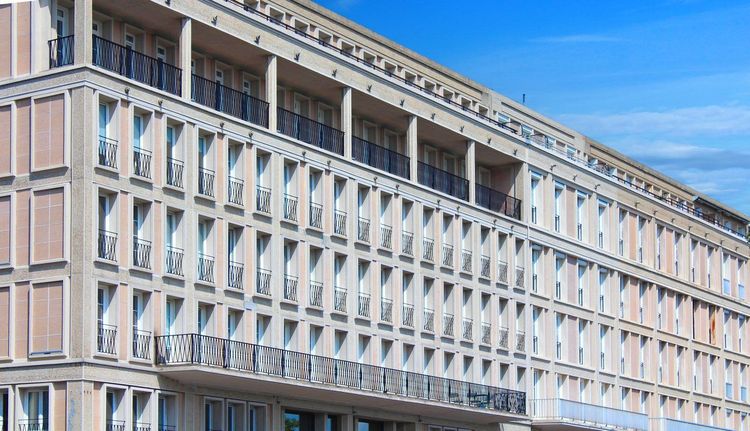
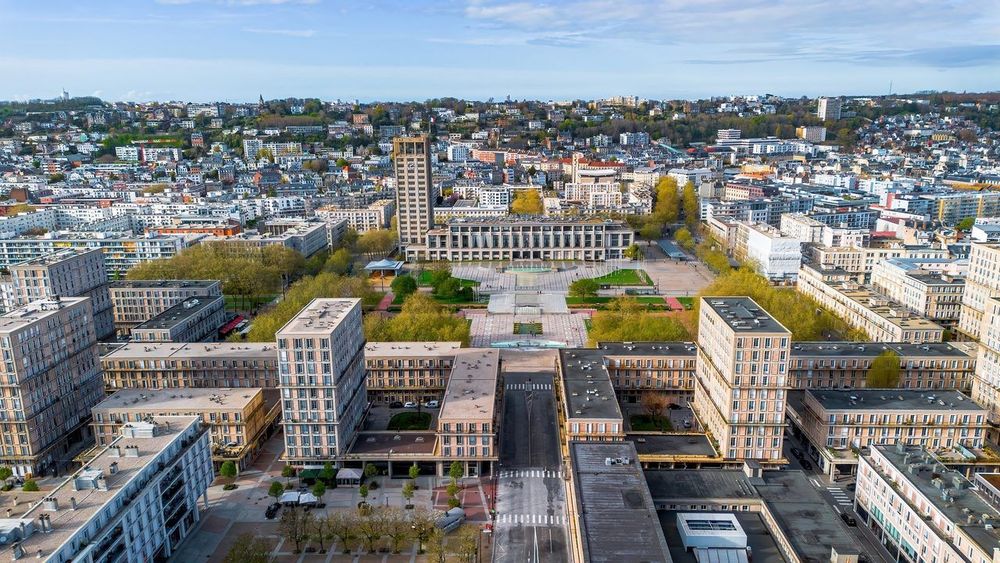
After the bombing raids of September 1944, which razed most of the old city centre and claimed thousands of civilian lives, the architect Auguste Perret and his studio directed the reconstruction of Le Havre between 1945 and 1964. The result — a coherent urban ensemble in reinforced concrete laid out on a regular grid — was inscribed on the UNESCO World Heritage List in 2005, a rare distinction for twentieth-century architecture.
The Place de l'Hôtel de Ville (Place de l'Hôtel de Ville, 76600 Le Havre, rated 4.5/5 on Google from 3K reviews), one of the largest squares in Europe, structures the entire district. Walking among its buildings — all built on the same 6.24-metre module yet never identical in detail — allows you to understand in an hour what architecture books explain in a hundred pages.
Look closely at the concrete itself: Perret refused to conceal it and played with aggregates (pink sandstone, Seine gravel, crushed chippings) to achieve different hues across the façades. Avenue Foch, conceived as a Champs-Élysées facing the sea, links the square to the Porte Océane — two symmetrical towers framing the view of the English Channel. The Rue de Paris, with its arcades, leads towards the port and the Saint-François district.
To go further, the Auguste Perret show apartment (181 Rue de Paris, 76600 Le Havre) recreates a 1950s flat furnished to the modern comfort standards of the era: central heating, rubbish chute, fitted kitchen. This guided visit is ticketed, but strolling through the surrounding streets remains entirely free.
The Ryo audio guide devotes several stops to this reconstruction, with anecdotes about the standard building types and the way the Place de l'Hôtel de Ville was conceived as a vast urban void rather than a simple crossroads — enough to make you look differently at façades you might wrongly assume are all the same.
4. The Église Saint-Joseph, the City Centre's Landmark
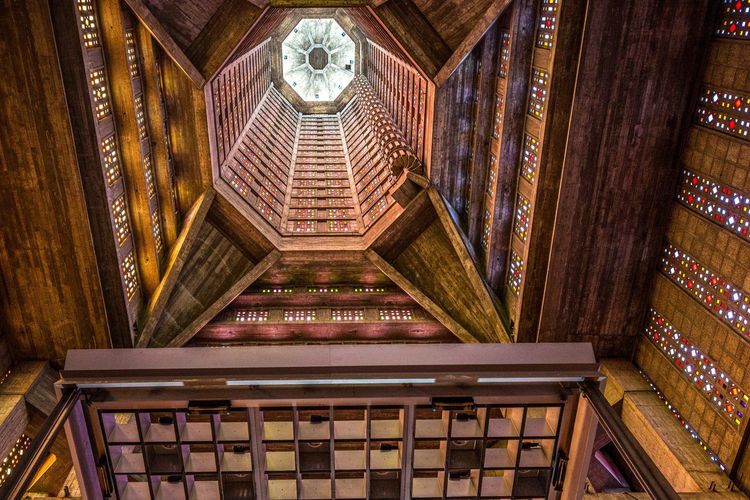
The Église Saint-Joseph (Boulevard François 1er, 76600 Le Havre, rated 4.7/5 on Google from 4,953 reviews), also designed by Auguste Perret and completed after his death, serves as a landmark across the entire city thanks to its 107-metre lantern tower, visible from out at sea and conceived as a seamark for sailors as much as a memorial to the victims of 1944.
Entry is free year-round. The interior surprises more than the exterior, which is massive and austere: the tower, pierced by more than 12,000 pieces of coloured glass designed by master glassmaker Marguerite Huré, casts ever-changing light depending on the time of day and the weather, from deep blue to orange-red. Sit for a few minutes in the centre, beneath the lantern, gazing upwards — it is the best way to grasp the effect the architect intended.
The plan is centralised, with the altar placed in the middle of the square nave: no worshipper sits far from the celebration — a liturgical boldness for the time. Come back if possible on a sunny late afternoon, when the west-facing glass blazes with light.
5. Le Volcan and the Oscar Niemeyer Library, Futurism with Free Access
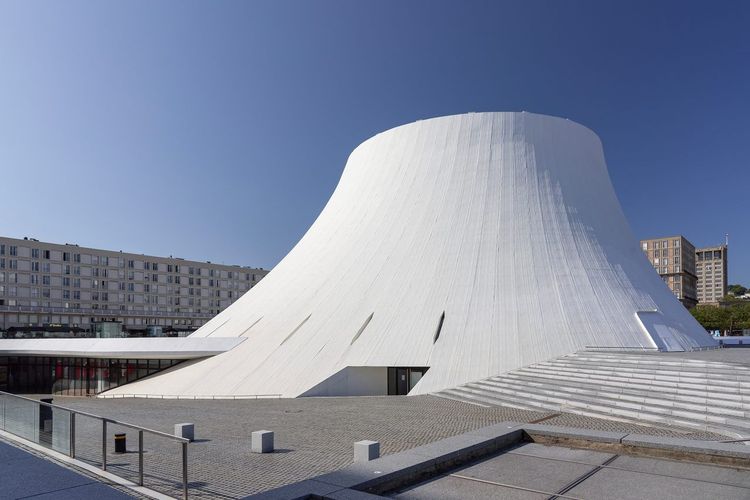
Le Volcan is a national theatre designed by Brazilian architect Oscar Niemeyer and inaugurated in 1982. Its white truncated-cone silhouette, set at the edge of the bassin du Commerce below the square, contrasts sharply with the regular concrete of the neighbouring Perret centre. The locals quickly nicknamed it "le pot de yaourt" — the yoghurt pot.
The theatre's programme is ticketed, but the neighbouring "petit Volcan" houses the Bibliothèque Oscar Niemeyer (Place Oscar Niemeyer, 76600 Le Havre, rated 4.6/5 on Google from 482 reviews), freely accessible during opening hours. You can step inside simply to take in the curved volumes and skylights, without borrowing a single book. It makes a good refuge on a rainy day, with armchairs facing the large windows.
6. The Bassin du Commerce and Le Havre Port, a Maritime Walk
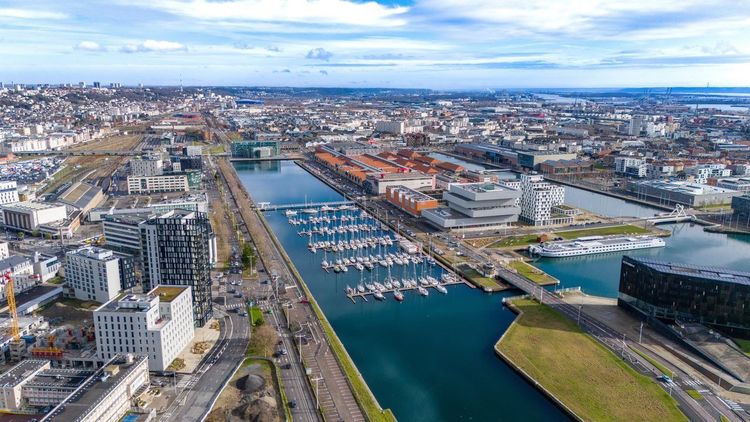
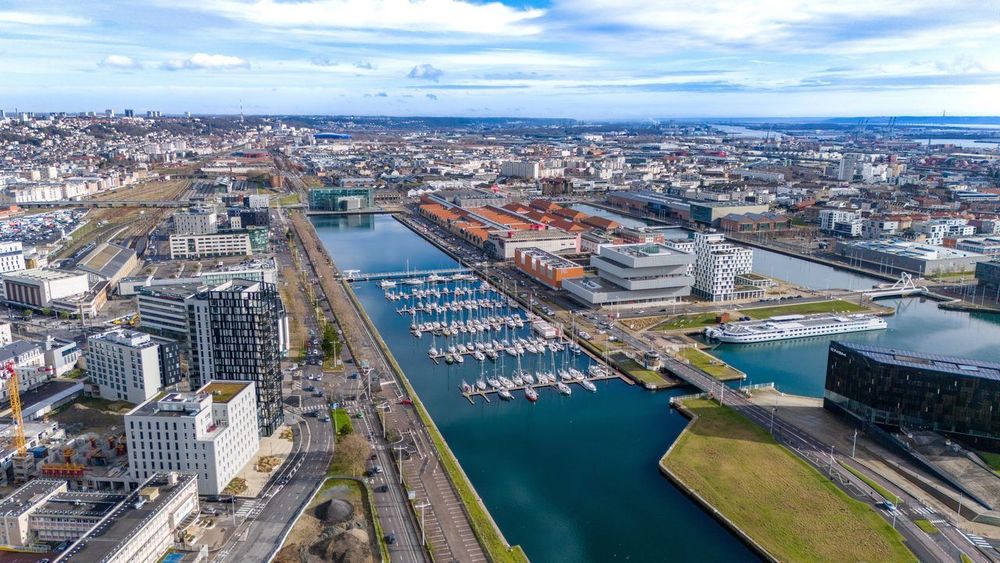
The Bassin du Commerce (76600 Le Havre, rated 4.5/5 on Google from 68 reviews), dug in the nineteenth century for merchant vessels, now serves as an urban stretch of water between Le Volcan and the Perret district. Its footbridge and public quays allow you to walk around it in about twenty minutes, with a few sailing boats moored there permanently.
The port of Le Havre, France's leading container port and now integrated into HAROPA alongside Rouen and Paris, can be observed from several public vantage points: the northern breakwater at the end of the beach, the edges of the Saint-François district, or the quays near the Docks Vauban — former brick warehouses converted into a shopping centre. From these spots you can grasp the scale of the site without paying for a boat excursion.
To experience Le Havre from the water's edge at no cost, the simplest option is to watch ships entering the port from the jetty — especially at high tide, when 400-metre giants manoeuvre just a few hundred metres from the shore. Some sailing associations occasionally organise outings open to the public: the tourist office will have the dates.
The main audio guide route follows the bassin du Commerce all the way to the port basins: one of its 18 stops is dedicated to maritime history, from the first nineteenth-century docks to the current terminals. You walk, and the port takes on a new depth.
7. The Museums: MuMa and the Natural History Museum
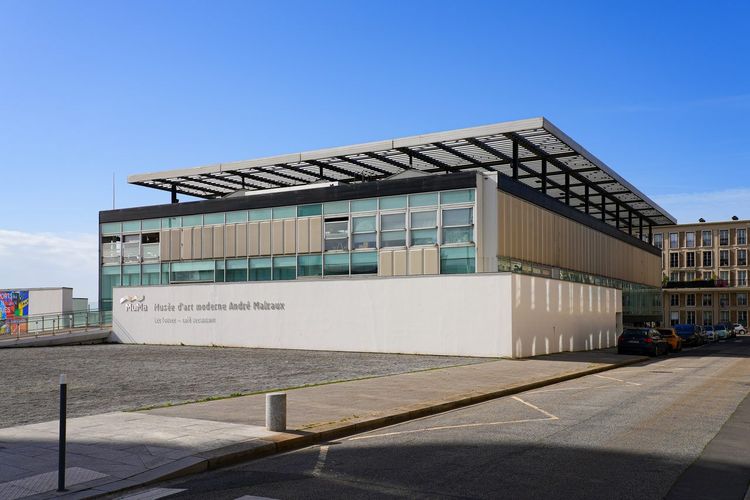
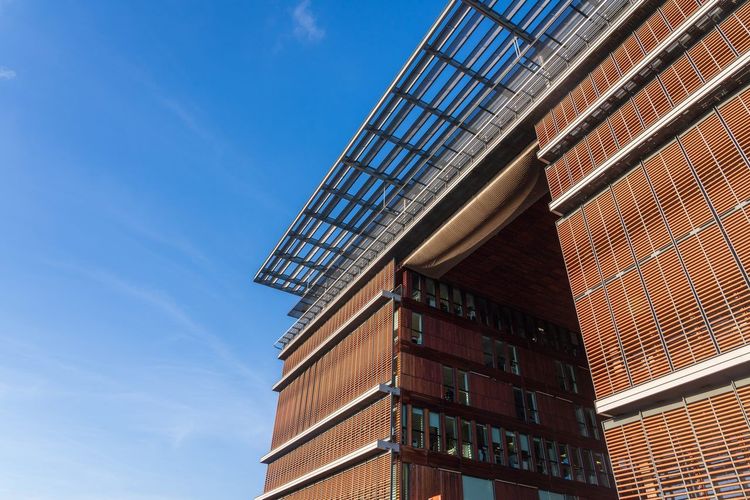
Two of the city's institutions stand out for their generous pricing policy. The MuMa, the Musée d'Art Moderne André Malraux, holds France's second-largest Impressionist collection after the Musée d'Orsay, with works by Monet, Boudin, Pissarro, and Dufy — the latter a native of Le Havre. The glass-and-steel building, opened in 1961 facing the port entrance, is worth the visit for its overhead light alone.
The Muséum d'Histoire Naturelle du Havre (Place du Vieux Marché, 76600 Le Havre, rated 4.3/5 on Google from 731 reviews) occupies a building dating from 1760, the former courthouse, converted into a museum in 1846. Its south wing, destroyed in 1944, was never rebuilt. Its collections owe much to Le Havre naturalist Charles-Alexandre Lesueur, who served as its curator: palaeontology, prehistory, zoology, and a collection of some 8,000 drawings and manuscripts brought back from his expeditions.
Why do under-26s never pay at these two museums? The City of Le Havre applies free admission for visitors under 26 in its municipal museums, with no residency requirement: a photo ID at the reception desk is all that is needed. For all other visitors, note the first Saturday of each month, when entry is free for everyone. Note that the Natural History Museum is closed on Mondays and Thursday mornings.
What about the Le Havre Museum Pass? It is a combined pass giving access to several municipal institutions, designed for visitors over 26 who want to explore multiple collections. As the terms change from season to season, check the current conditions before your visit.
8. The Abbaye de Graville and the Maison de l'Armateur, Open-Air Heritage
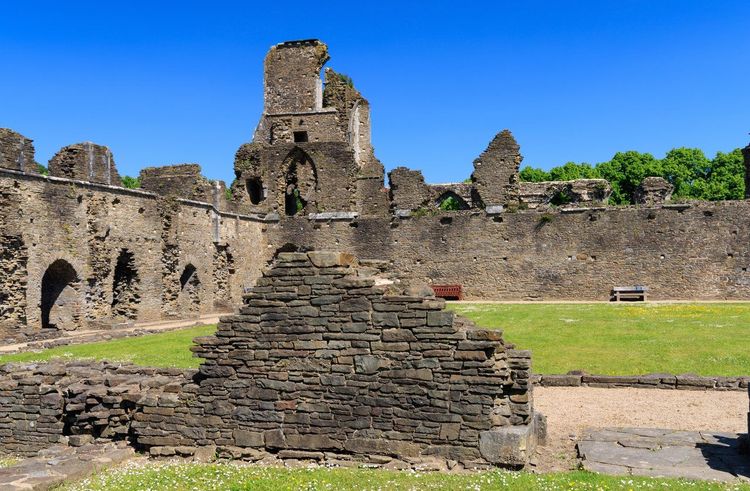
The Abbaye de Graville stands on a dead cliff overlooking the Seine estuary, to the east of the city. The priory was founded in 1203 by Guillaume Malet on the site of a much older collegiate church; its Romanesque church, protected as a listed historic monument since 1875, is the oldest building in the urban area.
The abbey today houses a municipal museum of sculptures and scale models, subject to the same rules as the MuMa: free entry for under-26s and for everyone on the first Saturday of the month. The forecourt and surroundings remain freely accessible and offer one of the finest bird's-eye views over the port and basins — a vantage point often missed by visitors who head straight for the Perret centre.
In a very different district, near the bassin du Roy and Saint-François, the Maison de l'Armateur (Quai de l'Île, 76600 Le Havre, rated 4.5/5 on Google from 575 reviews) recreates the interior of a late-eighteenth-century merchant's residence, arranged around a central skylight across five floors. It belongs to the same network of municipal museums, with the same access conditions.
Allow about fifteen minutes by bus or tram between the two sites. If you prefer to walk, the climb up to Graville via the hillside steps gives you a clear sense of Le Havre's two-level topography.
9. The Parc de Rouelles and the Montgeon Forest, Nature with Free Access
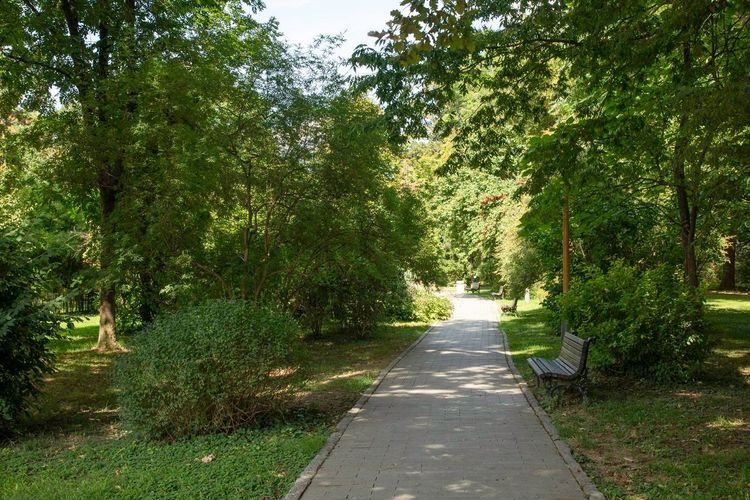
The Parc de Rouelles covers around 160 hectares to the north-east of the city, criss-crossed by some twenty kilometres of paths for walkers, horse riders and cyclists. Its built heritage comes as a surprise: the Manoir de la Bouteillerie and a dovecote built in 1631 by the Le Roux family, witnesses to the rural past of the Caux plateau.
Botany enthusiasts will find an arboretum of deciduous trees dedicated to the Ardennes plateau, featuring 259 tree varieties. Families come for the picnic-friendly lawns and the play areas, free to access year-round.
On the other side of the city, the Forêt de Montgeon (Allée Antoine de Saint-Exupéry, 76620 Le Havre, rated 4.5/5 on Google from 403 reviews) spreads across 270 hectares of woodland, ponds and trails: it is the city's largest green space, a remnant of the ancient forest that once covered the Caux country. Excavations have uncovered Neolithic tools and Roman burials here. Today it offers a bird enclosure, a conifer arboretum created in 1993, play areas and sports grounds, all free to enter every day. In summer, a leisure hub hires out bicycles and pedal boats in the afternoon.
A tip if you are visiting with young children: stick to the areas around the ponds, which are more shaded in summer, and bear in mind that some paths become muddy after a few days of Norman rain. Runners will appreciate the orienteering courses and cross-country loops that make Montgeon the favourite training ground for Le Havre's athletics clubs.
10. The Square Saint-Roch and Family Play Areas
The Square Saint-Roch (Rue Victor Hugo, 76600 Le Havre, rated 4.5/5 on Google from 2,810 reviews), a small neighbourhood garden in the city centre, stands out for its well-maintained play areas and shaded benches. Toddlers have their own equipment separate from that of older children.
It is the ideal break between two visits in the Perret district, just a few minutes' walk from the town hall.
11. Le Havre's Libraries and Media Libraries, Places to Live In
Few guides think to mention them, yet they rank among the city's most underrated addresses — especially on rainy or very windy days.
The Maison à Jouer d'Aplemont welcomes children under 6 accompanied by a parent, with free play and early-learning workshops.
The Médiathèque Léopold Sédar Senghor, in the Caucriauville district, offers a children's area and a piano available for free use, open to anyone who wants to play for a few minutes.
At the Médiathèque Martin Luther King, story hours and digital workshops punctuate the week, particularly on Wednesday afternoons.
Finally, the Bibliothèque Anne de Graville (Rue Louis Philippe, 76600 Le Havre, rated 4.9/5 on Google from 15 reviews) is distinguished by its garden reading hut and its seed library, where visitors can freely drop off or take away vegetable and flower seeds.
Good to know: on-site consultation is open to everyone across the entire municipal library network, and borrowing membership is free for Le Havre residents. Wi-Fi, power sockets and work tables also make them appreciated refuges for travellers who need to charge their phone or plan the next leg of their trip.
12. The Skatepark and the "Le Havre en Forme" Programme, Sport without a Subscription
The seafront skatepark, located near the beach, features bowls and concrete modules accessible free of charge year-round, with no registration or set hours. Beginners and experienced riders share the space, with the English Channel as a backdrop.
Alongside this free practice, the City offers during the warmer months the "Le Havre en Forme" programme — a series of supervised, free sports sessions spread across different neighbourhoods: outdoor yoga, strength training, and introduction to running.
Some slots fill up quickly; book as soon as the programme is published if a class interests you. No specialist kit is required. And if you prefer to go it alone, the outdoor fitness equipment installed along the seafront promenade lets you train at any hour, facing the open sea.
13. Un Été Au Havre, Urban Art in the Streets
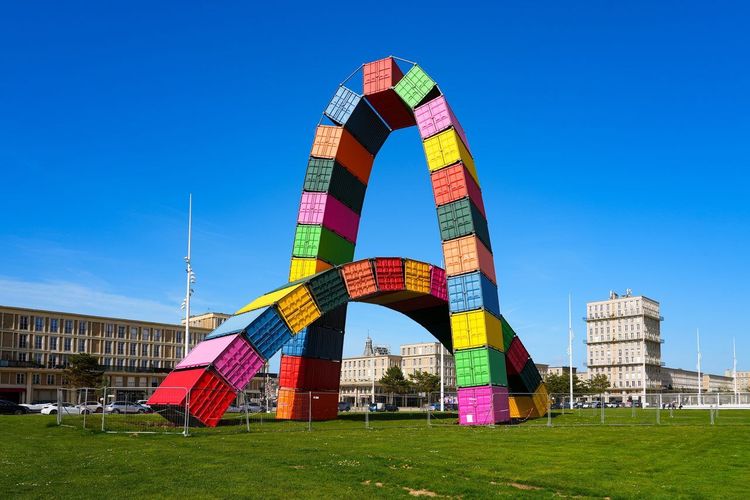
Every year since 2017, between June and September, Un Été Au Havre transforms the city's squares, quays and sometimes rooftops into backdrops for contemporary artworks, visible at any hour. Several installations have become permanent over successive editions, such as the "Catène de containers" by Vincent Ganivet — two arches of colourful containers erected at the edge of the basin, which has become one of the most photographed images of the city.
Murals, light installations and ephemeral sculptures can be discovered by wandering through the Perret district and along the quays, with no ticket or visiting hours required. Alongside these, open-air concerts and music festivals liven up public squares during the summer: check the tourist office programme for dates.
The short version of the Ryo audio-guided tour focuses on the reconstructed centre and its most visible artworks — handy if you only have a window between two trains and want to discover this street art without planning a route.
14. Hikes, the Staircase Circuit, and Visiting Apps
Le Havre exists on two levels: the flat lower city, rebuilt by Perret, and the upper city on the hillside, connected by a series of public stairways. Using them is the finest urban hike available, requiring no special equipment.
The staircase circuit strings together these historic flights of steps between the centre, the Sanvic district and the plateau, with a different view of the port at every landing. A few signs mark the route, but no commentary accompanies the walk. Wear sturdy shoes and allow about an hour for the shortest loop.
To go further, three itineraries combine well:
- The coastline: from the northern breakwater to the cap de la Hève via the beach and Sainte-Adresse, around 5 km one way.
- The hillside: from the Jardins Suspendus to the Abbaye de Graville via the steps and belvedere streets.
- The forest: the waymarked loops of Montgeon, accessible by tram from the city centre.
Would you prefer a narrated framework? The Ryo audio guide downloads to a smartphone and works offline: 18 audio tracks, 2h30 and 6.2 km of walking from the Perret centre to the seafront — an alternative to standard circuit apps when you want to both walk and understand what you are looking at.
15. The Pain de Sucre, the Chapelle Notre-Dame-des-Flots, and the Best Views
On the heights of Sainte-Adresse, the Pain de Sucre is a white cone-shaped mausoleum erected by Stéphanie Rollier, a cousin of Napoleon I, in memory of her husband, General Charles Lefebvre-Desnouettes, who perished in a shipwreck in 1822. Visible from the sea, it long served as a landmark for sailors.
Just beside it, the Chapelle Notre-Dame-des-Flots (76310 Sainte-Adresse, rated 4.7/5 on Google from 247 reviews), built in 1857 to designs by architect Théodore Huchon, remains a place of pilgrimage for sailors' families. Its interior, adorned with ex-votos and model ships, can be visited freely during opening hours, in an atmosphere that contrasts sharply with the bustle of the seafront below.
To see Le Havre as if from the air without boarding a plane, these heights offer one of the finest urban panoramas in Normandy: the entire city unfolds from the port to the tower of Saint-Joseph, with the Seine estuary as a backdrop. Continue to the cap de la Hève to see the cliffs plunge into the English Channel — this is where the Alabaster Coast begins.
Sainte-Adresse also inspired painters: Claude Monet, who spent several summers here with his family, painted the famous "Terrasse à Sainte-Adresse" here. Following the promenade, you will recognise the viewpoints that fed the emerging Impressionist movement, before descending back to the beach through the winding streets.
16. Practical Tips: Where to Stay, Visiting in a Day, and Extending Your Trip
Where to stay? The central Perret district lets you reach most of the sites on this list on foot. The beach area is better suited to a stay focused on the seaside.
In one day, combine the Perret district and the église Saint-Joseph in the morning, lunch near the bassin du Commerce, then the Jardins Suspendus in the late afternoon for the light over the estuary.
With family, the Parc de Rouelles, the Square Saint-Roch and the neighbourhood media libraries can be easily combined depending on the weather. As a couple, a sunset on the beach followed by a stroll through the illuminated Perret district, ending up on the heights of Sainte-Adresse.
Getting around: the tram connects the train station, the Perret centre, the beach and the plateau, sparing you the uphill walk to the upper city on tired days. The bicycle is an excellent option along the seafront and in the lower city — far less so on the hillside.
To extend your stay in Seine-Maritime, Étretat and its cliffs are less than an hour's drive away, and Honfleur is just on the other side of the Pont de Normandie.
For budget-friendly leisure, the Bains des Docks (Quai de la Réunion, 76600 Le Havre, rated 3.8/5 on Google from 1,556 reviews), an aquatic complex designed by Jean Nouvel and opened in 2008, are not free but offer modest children's rates — a good option on rainy days, if only to admire the interior architecture inspired by Roman baths.
One last tip before you set off: the Ryo audio-guided tour can be used offline, a useful safety net on days when the mobile signal plays hard to get on the hillside.
FAQ
What can you do for free in Le Havre?
The Jardins Suspendus, the UNESCO-listed Perret district, the église Saint-Joseph, the seafront, the port area, and the parks of Rouelles and Montgeon are all free to visit year-round. Add the municipal museums on the first Saturday of each month.
Are Le Havre's museums free for children?
Yes: the MuMa, the Natural History Museum, and the other municipal museums are free for visitors under 26, and free for everyone on the first Saturday of each month.
What is the Le Havre Museum Pass?
It is a combined pass giving access to several municipal museums, useful for visitors over 26 who want to explore multiple collections without buying a separate ticket at each venue.
How do you visit Le Havre in one day?
The Perret district and Saint-Joseph in the morning, the bassin du Commerce at midday, then the Jardins Suspendus and the estuary view at the end of the afternoon: one day is enough to take in the essentials.
Where should you stay in Le Havre to do everything on foot?
The central Perret district is the most practical choice for visiting the city-centre sites on foot; the beach area is better suited to a seaside-focused stay.
Is Le Havre suitable for a budget-friendly family day out?
Yes: the Parc de Rouelles, the Montgeon forest, the Square Saint-Roch, the Maison à Jouer d'Aplemont, and the local media libraries all offer family outings year-round, both indoors and outdoors.
Can you visit the Jardins Suspendus and their greenhouses for free?
Access to the gardens is free. Only the collection greenhouses require a ticket, priced at €2 and free for children under 12.
From the military stonework of the Jardins Suspendus to Perret's signature concrete, Le Havre offers a heritage that few Norman cities can claim at this scale, and almost all of it can be explored on foot. To connect these neighbourhoods while following the thread of their shared history, the Ryo audio-guided tour of Le Havre is the simplest companion: 18 stories, 2h30 of walking, and the city comes alive.