© Shutterstock
 Votre guide Ryo
Unusual Visit to Quimper: Street Art, Mont Frugy, and Old Quarters in 2026
In Quimper, 15th-century half-timbered alleyways meet murals several meters high painted on blank gable walls. Behind the label 'unusual visit to Quimper', the capital of Cornouaille conceals an open-air street art trail, a wooded hill from which you can look down on the granite spires, and faience workshops where craftspeople still throw clay on the wheel as they did in the 17th century. The Ryo audio-guided tour of Quimper lets you connect these places without passing through the same square twice.
In the pages that follow, you will find plenty to take you off the beaten track: the murals of the Street Art Trail spread from the centre to Locmaria, the ascent of Mont Frugy and its view over the Odet, the lesser-known lanes of old Quimper, a real-life riddle hunt, faience workshops where you can paint your own plate, the former bishop's palace transformed into a museum, and the descent of the Odet towards Bénodet aboard a river boat. Two to three days are enough to combine everything, with a boat trip to Concarneau thrown in. One piece of advice before you set off: wear trainers — most of these experiences are best explored on foot. Ryo's audio-guided tour of Quimper rounds out this list nicely, a good way to get your bearings before venturing further.
The Quimper Street Art Trail, Under Open Skies
The Street Art Trail of Quimper is nothing like a circuit marked out by arrows on the ground: it brings together dozens of works painted over the years on gable walls, hoardings, and electrical substations by Breton and guest artists. The route is self-guided, covering around 5 kilometres, from the historic centre to the Kermoysan and Locmaria districts, with no fixed timetable or booking required.
It is hard to miss the large figurative murals adorning the buildings of Kermoysan, or the more discreet ones painted on electrical substations near the banks of the Odet, which playfully rework the motifs of Quimper faience. To find them, use the participatory map of Quimper street art works, created by Gabrielle Lesage with the Maison du Patrimoine and promoted by the Quimper tourist office (8 Rue Élie Fréron, 29000 Quimper, rated 4.4/5 on Google from 441 reviews): it is updated as new murals appear, something no printed leaflet can do.
Allow an hour and a half on foot to see the highlights, longer if you stop to photograph every gable. Some works change from one year to the next: check the updated map before you leave, as several murals mentioned in older articles have already been painted over.
The Quimper audio-guided tour dedicates several stops to this contemporary art, with commentary on the artists and techniques used — stencil, spray paint, or paste-up. It is a way of understanding why a city listed as a Ville et Pays d'art et d'histoire also embraces an ephemeral mural heritage, without setting the two in opposition.
Climbing Mont Frugy for a Different View of the City
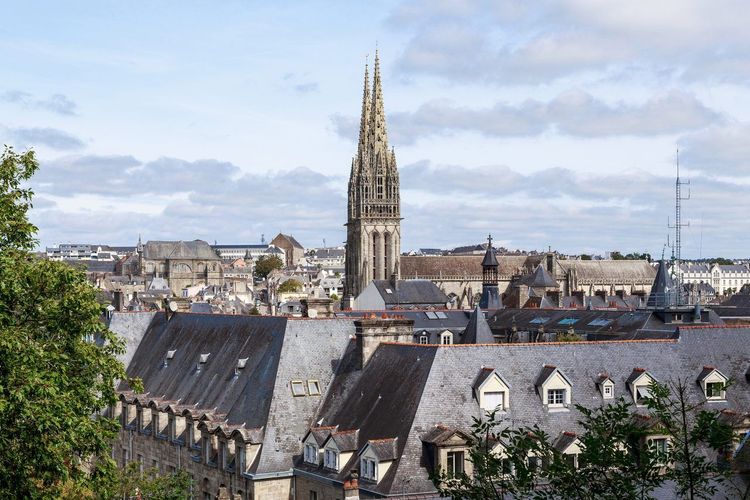
Mont Frugy rises 70 metres above the centre of Quimper, directly opposite the prefecture on the left bank of the Odet. It is often called the city's green lung, but its woodland cover is more recent than it appears: the October 1987 hurricane flattened most of its trees, and the hill took years to regrow its beeches and oaks.
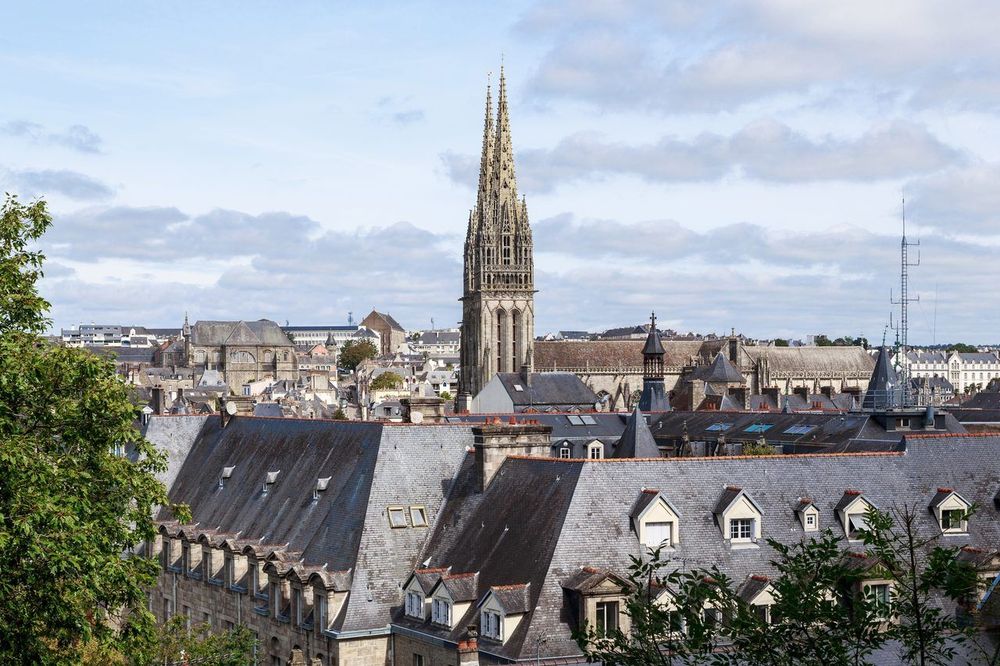
Several paths climb from the boulevard de Kerguelen or from the tree-lined avenues bordering the Odet; allow about ten minutes to reach the top, a little more if you take the steepest stairway. At the summit, a gap in the canopy frames the two granite spires of cathédrale Saint-Corentin, with the Odet winding below and the slate rooftops of old Quimper stepping down to the river. It is the only spot in the city where you can grasp at a single glance how Quimper nestled into the confluence of three waterways.
The best time to go up is late afternoon, when the low light grazes the rooftops and groups from the historic centre head back down to the terraces. Wear shoes with some grip: the dirt paths become slippery after rain, which is frequent in this Breton climate.
Old Quimper Off the Beaten Track: Lanes, Half-Timbered Houses, and Legends
On tourist maps, old Quimper is often reduced to three names: the cathedral, the rue Kéréon, the place au Beurre. This triangle is worth the detour, but it conceals a network of lanes and inner courtyards that most visitors pass through without noticing.
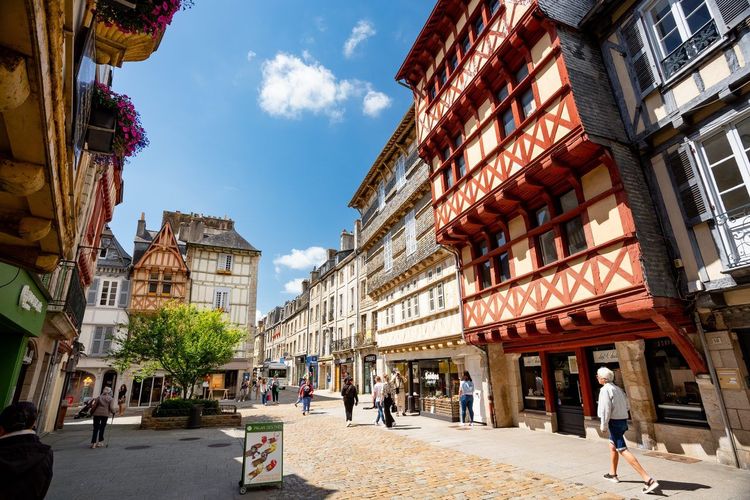
A visit to old Quimper almost always begins with the rue Kéréon, the former cobblers' street, where the half-timbered houses lean slightly over the roadway. This overhang is no flaw: the jettying allowed builders to gain usable floor space on the upper storeys without encroaching further on scarce ground when the city still stood within its ramparts. Look above the shop fronts — several facades retain carved bressummers and half-erased coats of arms that no plaque explains.
The place au Beurre, just next door, owes its name to the butter market once held there. Its half-timbered houses now shelter the highest concentration of crêperies in the city, but the most interesting things are hidden behind them: step into one of the lanes that open between two facades and they lead to paved courtyards invisible from the street, remnants of Quimper's old artisan back yards.
In front of cathédrale Saint-Corentin (Place Saint-Corentin, 29000 Quimper, rated 4.6/5 on Google from 6,912 reviews), look for the equestrian statue placed between the two granite spires: it depicts King Gradlon, the legendary ruler of the sunken city of Ys, and was reinstated in the mid-19th century after the original was destroyed during the Revolution. The story goes that Gradlon, fleeing the drowned city on the orders of Saint Guénolé, was forced to throw his daughter Dahut into the sea so that his horse could keep galloping. True or not, the tale explains why the king faces west, towards the bay where Ys is said to have sunk.
For a broader reading of the historic centre, the old Quimper map available from the tourist office indicates the lanes open to the public, several of which do not appear on mainstream mapping apps. This is also one of the sections where the Quimper audio-guided tour comes into its own: the audio commentary places each facade in context as you walk, without having to stop and read a panel.
Riddle Hunts and Treasure Trails in Old Quimper
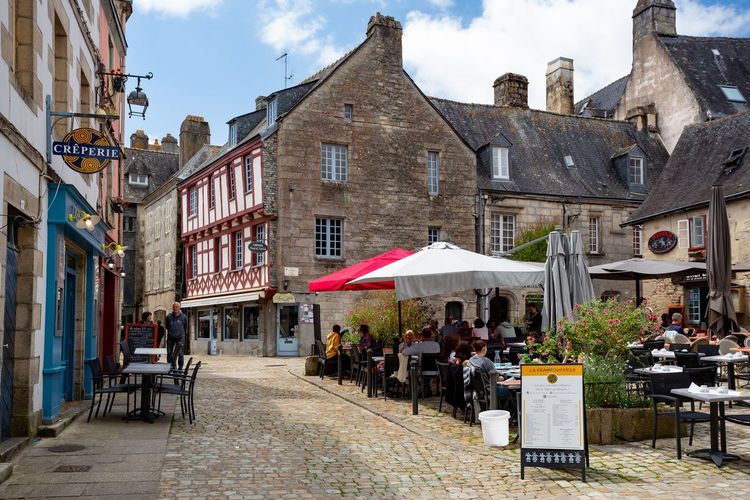
Several game formats turn exploring the city centre into an investigation. The Kuriosités hunt, offered by a national network of urban games, guides participants from clue to clue through old Quimper — paper booklet or app in hand, with no set timetable and no human guide.
The concept appeals particularly to families with children aged 7 to 12: each clue points to an architectural detail — a gargoyle, a coat of arms, an old shop front — that must be spotted before the next question unlocks. Allow between 1h30 and 2h30 depending on the age of the participants and how long they want to linger. The price is around 12 to 18 euros per team, equipment included, making it one of the least expensive activities in the city compared with conventional guided tours.
Another format, this time without a reservation: the Escapade Game mystery box, promoted by the tourist office, sends players in search of a painting stolen from the fine arts museum. Riddles, documents to decode, and walks around the city centre — available 24/7, which can save a rainy evening or a Sunday when everything is closed.
Other local operators offer seasonal versions, notably themed around faience or the legends of the city of Ys. These games should be booked online a few days ahead in high season, as the number of kits available is limited.
Workshops and Visits Around Quimper Faience
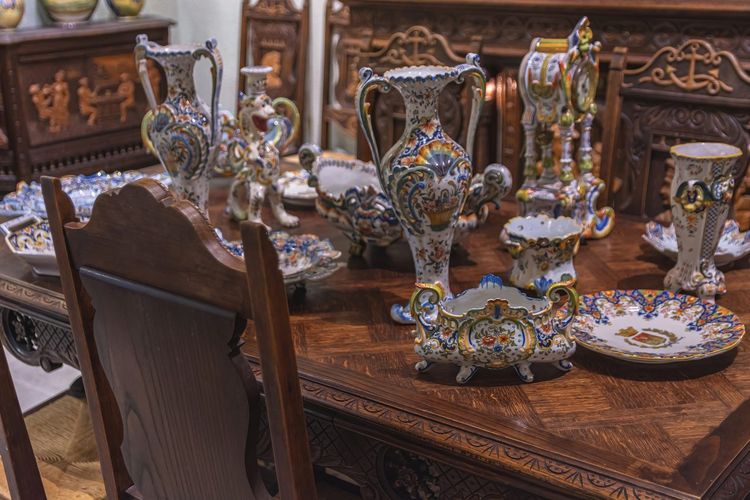
Quimper has been producing hand-painted faience since 1690, making it one of the rare French cities where this tradition has never truly ceased. The Locmaria district, downstream from the cathedral on the left bank of the Odet, is where this history is concentrated: this is where the first manufactory was established, making use of locally extracted clay and the river to transport raw materials and finished goods.
The HB-Henriot faience factory still opens its workshops to visitors. You can watch potters shape a plate in just a few movements, then painters apply the characteristic Breton motifs freehand — the cockerel, the bigoudène figure, the stylised flowers — without a tracing or stencil. The guided visit lasts about three quarters of an hour and ends in the adjoining shop.
For a more hands-on experience, workshops in the district offer the chance to paint your own bisque piece, which is then fired and collected or sent to you a few weeks later. Allow 1h to 1h30, with materials provided — an activity enjoyed by children and adults alike looking for a souvenir that is more than a fridge magnet.
The Musée de la Faïence (14 Rue Jean-Baptiste Bousquet, 29000 Quimper, rated 4.5/5 on Google from 330 reviews), housed a short walk away in a former factory, rounds off the visit with antique pieces and works by 20th-century artists. Note the season: it only opens from spring to the end of September, Tuesday to Saturday, with admission at 6 euros for adults and 3 euros for 7–17 year-olds. Outside season, only groups of around ten people can book a visit.
The district is also worth visiting for its own sake: the Romanesque church of Notre-Dame de Locmaria is among the oldest in Quimper and retains a discreet cloister that hurried visitors — heading straight for the cathedral — never see. Our Ryo app dedicates an audio section to this suburb, which was only incorporated into the city at a late stage.
The Musée Départemental Breton, in the Former Bishop's Palace
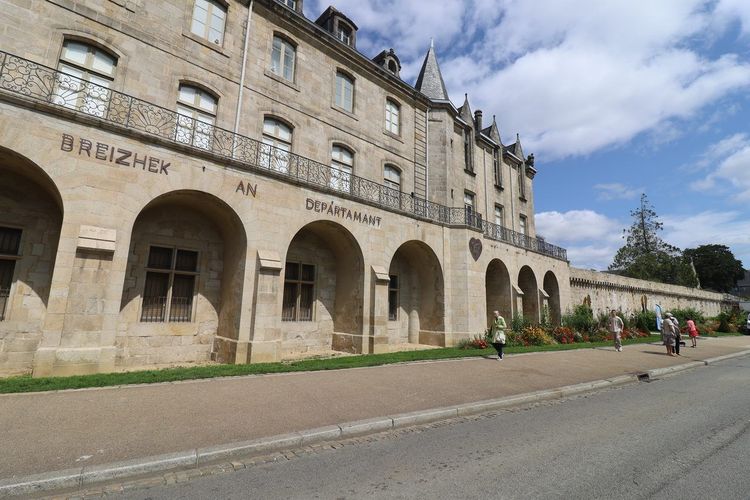
Adjoining the cathedral, the musée départemental breton (1 Rue du Roi Gradlon, 29000 Quimper, rated 4.6/5 on Google from 792 reviews) occupies the former palace of the bishops of Cornouaille. The building alone is worth the entrance fee: its Renaissance tower houses a granite spiral staircase whose sculpted balustrade is among the finest in Brittany, and you move without transition from a medieval hall to a costume gallery.
Inside, the collections tell the story of Cornouaille through its objects: box-bed furniture, embroidered headdresses, polychrome wooden religious statuary, and Quimper faience from the three major manufactories. The section on Bigouden costumes explains in passing why the headdresses grew from ten to thirty centimetres in height over half a century — a detail most visitors do not know before they enter.
Just opposite, on the place Saint-Corentin, the fine arts museum rounds out the picture with a collection focused on the Pont-Aven school and a room dedicated to Max Jacob, the poet born in Quimper in 1876 whose family ran an antique shop a few streets away. Both museums can be visited in the same half-day, provided you do not linger too long in the first.
Descending the Odet to Bénodet, by River Boat or Kayak
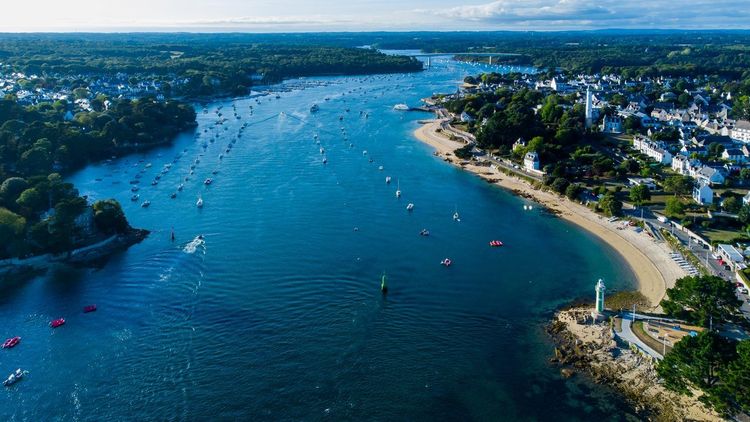
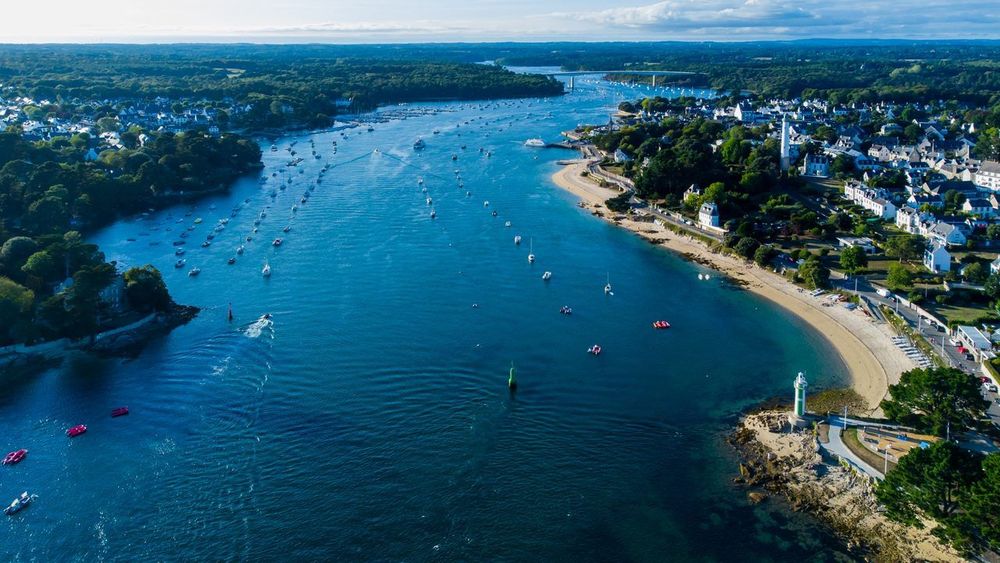
It is easy to forget that Quimper is a river port. The Odet, reputed to be one of the most beautiful coastal rivers in France, links the city to the sea over roughly twenty kilometres, and river boats run the descent to Bénodet between spring and autumn.
The crossing takes around 1h15 and follows the tide timetable: departure times change every day, which surprises visitors accustomed to fixed schedules. The most spectacular stretch is called the Vire-Court, a series of tight meanders between two wooded hillsides, where legend places the Saut de la Pucelle and the Chaise de l'Évêque. The on-board commentary also points out the private manor houses hidden in the vegetation, invisible from the road.
For a more active experience, several leisure centres hire out kayaks and paddleboards for exploring a stretch of the river at your own pace. A visit around Quimper seen from the water completely changes your perception of the city, especially on the return, when the steeples reappear above the trees.
Excursions Around Quimper: Sea, Sailing, and Adventure
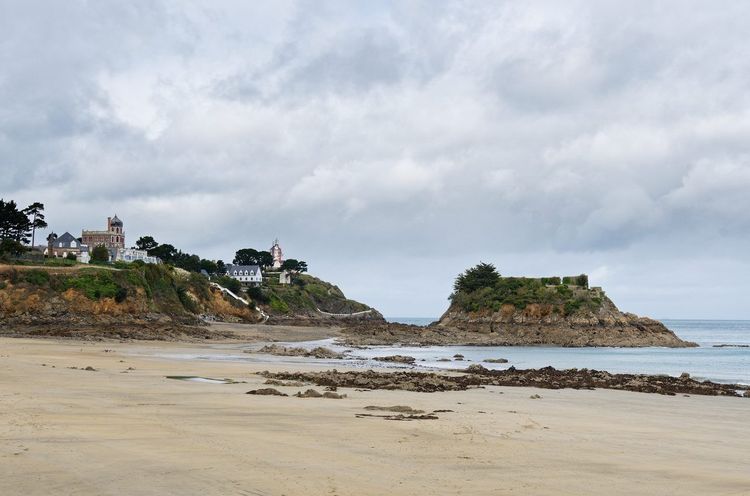
Quimper is only about twenty minutes by car from the sea, which opens up a whole range of activities that the city itself does not offer. The day can easily extend towards the coast without giving up the comfort of an urban base.
At Concarneau, about 25 minutes away, catamaran and sailing boat trips depart from the marina for one-and-a-half to two-hour outings in the bay, passing offshore of the Glénan islands in fine weather. Some skippers also offer evening outings, when the raking light on the Ville Close (29900 Concarneau, rated 4.7/5 on Google from 18,308 reviews) is worth the trip in itself.
Further south, Bénodet is all about sailing: supervised day outings or full weekends with a skipper, departing from the mouth of the Odet. The resort, known for its sandy beaches, lends itself equally to a two-hour outing or a proper multi-day introduction to sailing.
Over towards Audierne, to the west, big-game fishing trips are the draw, with the chance to hunt tuna or blue shark depending on the season, a few miles off the Pointe du Raz. These trips can be booked for a half-day or a full day, with equipment provided.
For a more cultural than sporting excursion, Pont-l'Abbé and the Bigouden country, half an hour from Quimper, are worth the trip on market day: headdresses on display at the local museum, traditional costumes, and a still-active fishing harbour, far from the summer bustle of the nearby seaside resorts.
These towns combine easily with a return to Quimper on the same day, provided you choose just one nautical activity to avoid turning the excursion into a road marathon. Allow between 35 and 90 euros per person depending on the option and duration; booking is advisable at least a week in advance in July and August.
Quimper on Foot: Walks Along the Odet and Authentic Markets
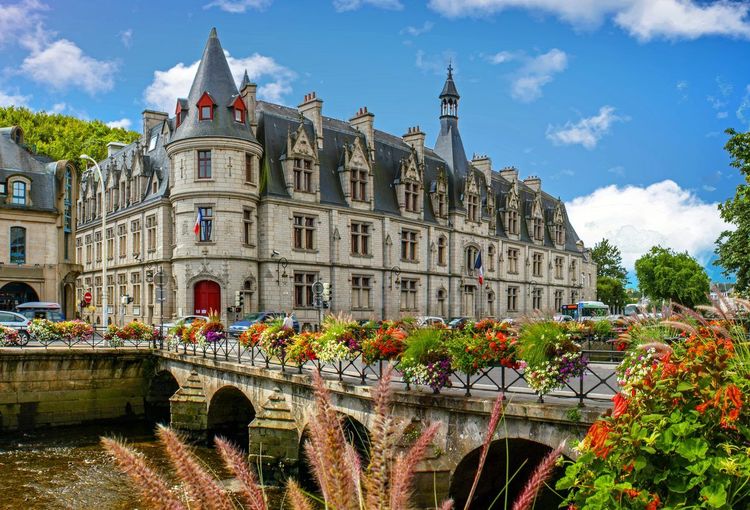
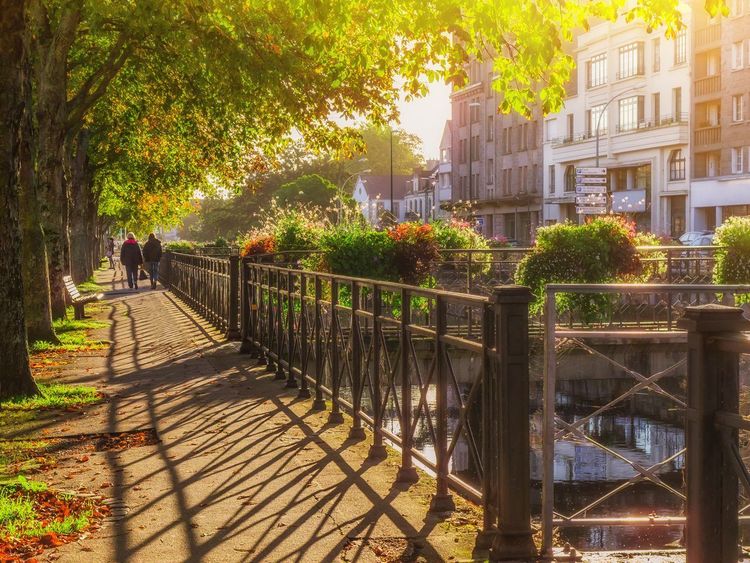
The Odet flows through the heart of the city for just over a kilometre, lined with flower-filled quays that have earned the town its reputation as a floral city. Following the river on foot, from the jardins de l'Évêché to the footbridges in the centre, offers a reading of the city that runs counter to the shopping streets.
The jardin de l'Évêché, laid out in terraces behind the cathedral, overlooks the river and serves as a discreet shortcut between old Quimper and the quays. Few visitors stay more than ten minutes, which makes it a good place to catch your breath between two visits, with a close-up view of the cathedral chevet that nobody photographs. The flower-covered footbridges spanning the Odet are replanted each spring by the municipal gardeners: spectacular from April to September, considerably starker in winter.
For the market, head to the Halles Saint-François (Rue Astor, 29000 Quimper, rated 4/5 on Google from 1,088 reviews), rebuilt after the 1979 fire and now a Saturday morning institution. You will find produce from the nearby fish market, kouign-amann sold by the slice, and sometimes kig ha farz prepared on site. It is also where the people of Quimper do their shopping, far from the tourist-facing stalls.
Allow a good hour for a complete walking loop linking the Odet, the market halls, and the return via the place au Beurre — enough to extend your visit to old Quimper without retracing your steps. If the market stop has whetted your appetite, our Ryo article on Quimper's culinary specialities details where to try kouign-amann and kig ha farz in the city.
The Festival de Cornouaille, When the City Changes Its Rhythm
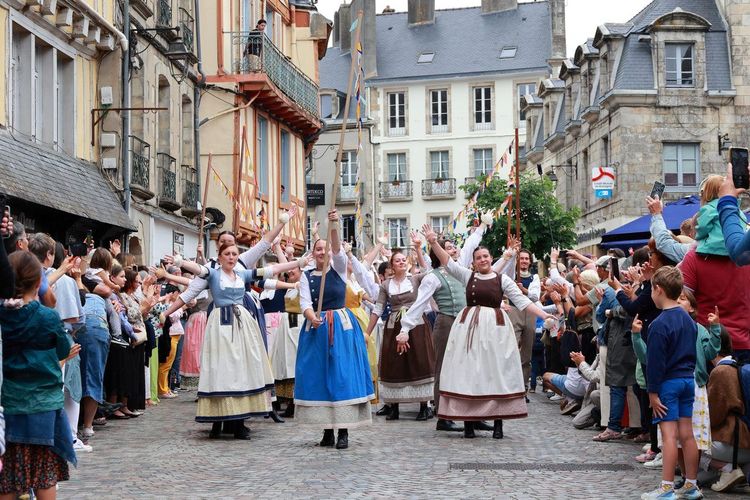
If your stay falls in late July, be prepared: the Festival de Cornouaille, founded in 1923, fills the city with Celtic dance groups, bagadoù, and concerts for nearly a week. The grand Sunday parade brings together thousands of dancers in costume, bigoudène headdresses included.
Book your accommodation well in advance — city-centre hotels fill up months ahead. And if you prefer peace and quiet, simply shift your visit by a week.
Practical Information for an Unusual Visit to Quimper
Allow a full day for the essentials — street art, Mont Frugy, and old Quimper — and a second day if you add the Locmaria faience workshops, the museums, and a trip on the Odet. A weekend is feasible, provided you start early to enjoy Mont Frugy before the crowds arrive.
Spring and early autumn offer the best compromise: fewer people than in July and August, weather still mild enough for walking, and the flower-lined quays at their best. In summer, most of the footfall concentrates around the cathedral and the rue Kéréon in the middle of the day.
Quimper is entirely walkable from the centre; the station, a ten-minute walk from old Quimper, is served by TGV from Paris. By car, several covered car parks surround the historic centre, with a daily rate of around ten euros.
Budget: free for the street art and Mont Frugy, 12 to 18 euros per team for the riddle hunt, around twenty euros for a faience painting workshop, museum admission around 5 to 8 euros (6 euros at the Musée de la Faïence). Among the beautiful villages near Quimper, Locronan (Place de l'Église, 29180 Locronan, rated 4.7/5 on Google from 2K reviews), listed among the most beautiful villages in France about twenty minutes away by road, is an ideal complement to the programme with its 16th- and 17th-century granite houses.
FAQ
What is the Quimper Street Art Trail?
It is a free-form itinerary, self-guided, among dozens of mural works painted on gable walls and hoardings across the city, from the historic centre to the Kermoysan and Locmaria districts. A participatory map lists the murals, with no reservation or set timetable required, for a walk of around 1h30.
How do you climb Mont Frugy in Quimper?
Several paths lead up from the boulevard de Kerguelen, opposite the prefecture, or from the tree-lined avenues bordering the Odet. The climb takes about ten minutes on foot, with no special equipment, and opens onto an unobstructed viewpoint over the cathedral and the valley.
How much time should you allow for an unusual visit to Quimper?
One day is enough for the essentials: street art, Mont Frugy, and old Quimper. Allow two days to add the faience workshops of Locmaria, the museums, and a trip out to sea towards Concarneau or Bénodet, or three days to include a nearby village such as Locronan.
What is the best time to visit Quimper off the beaten track?
Spring and early autumn offer the best balance between moderate crowds and pleasant weather for walking. In late July, the Festival de Cornouaille completely changes the atmosphere of the city, but accommodation books up months in advance.
Where should you start a visit to old Quimper?
A visit to old Quimper revolves around the cathédrale Saint-Corentin, between the rue Kéréon and the place au Beurre. Beyond the half-timbered facades, take the time to explore the lanes and inner courtyards marked on the map available from the tourist office.
Can you visit a faience workshop in Quimper?
Yes. The HB-Henriot faience factory, in the Locmaria district, opens its workshops for guided visits and lets you watch potters and painters at work. Neighbouring workshops also offer the chance to decorate your own piece, which is then fired and collected a few weeks later.
Which beautiful villages near Quimper are worth adding to the itinerary?
Locronan, listed among the most beautiful villages in France, is about twenty minutes away by road. Concarneau and its Ville Close, Bénodet by the sea, and Pont-l'Abbé in the Bigouden country all complement a two-to-three-day stay.
Are there treasure hunts or riddle trails in Quimper?
Yes, several formats exist, including the Kuriosités hunt, which guides participants through old Quimper using riddles linked to architectural details. Allow 1h30 to 2h30 depending on the age of the participants, for a price generally between 12 and 18 euros per team.
Quimper is not limited to its postcard image of a cathedral and half-timbered houses, even if that foundation remains the best entry point for situating everything else. Between the murals of the Street Art Trail, the panorama from Mont Frugy, the faience workshops of Locmaria, the former bishop's palace turned museum, and the descent of the Odet towards the sea, the city lends itself to a programme that changes entirely depending on whether you explore it on foot, as a family with a riddle hunt, or as a couple on a nautical getaway.
To plan everything without retracing your steps, the Ryo audio-guided tour of Quimper links these stops, from the cathedral square up to Mont Frugy, at a walking pace, with commentary that places each site in its historical context — enough to turn a simple stopover in Brittany into an exploration that truly goes off the beaten track.