© Shutterstock
 Votre guide Ryo
Beaches of Concarneau: The Complete 2026 Guide, from Sables Blancs to the Coves of Cabellou
Finding the right beach in Concarneau depends largely on what you're looking for: the Ville Close as a backdrop, quiet dunes, or a cove only accessible at low tide. Behind the search query "beach Concarneau" lie twelve beaches officially listed by the town, spread across less than ten kilometres of coastline — a rare concentration for a town of 20,000 inhabitants — ranging from the pale sand of Sables Blancs to the secluded coves of the Cabellou neighbourhood. Many visitors stop at the first beach they come across after leaving the harbour, unaware that about twenty minutes away by road, the audio-guided tour of Quimper lets you extend your exploration of Cornouaille with a further Ryo-guided walk through the region's historic capital.
This guide covers the beaches that truly matter around Concarneau, from the only supervised beach in the commune to the unequipped coves: the popular Sables Blancs beach with its sailing club, the discreet Rödel beach accessible only on foot from the Cabellou, the Belle Étoile beach favoured by families for its shallow waters at low tide, and the coves of Trégunc and Névez where the famous Tahiti beach hides. We also address the most frequently asked questions: water quality, access with a dog, parking at Sables Blancs, holiday rentals in the right location, and a little-known local bylaw that bans swimwear outside designated beach areas.
Town-Centre Beaches: Sables Blancs and Cornouaille
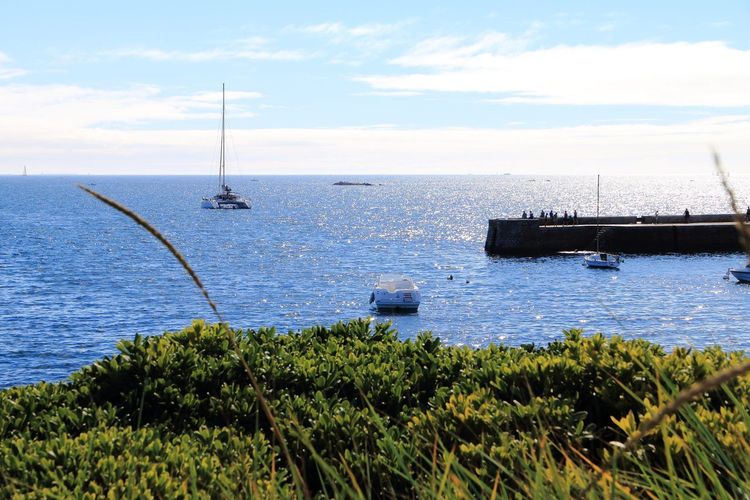
Concarneau's historic seafront stretches across ten minutes' walk from the Ville Close, between two beaches with quite different atmospheres. This is where most visitors lay their towels, and for good reason: pale sand, direct access from the town centre, shops nearby. It is also the best-equipped stretch of the town's coastline, and the only one where you will find a lifeguard post in summer.
Sables Blancs Beach, the Most Popular in Concarneau
The Sables Blancs beach owes its name to its particularly pale sand, almost white at low tide when the sun is strong. It is the most frequented beach in town, fifteen minutes on foot from the Ville Close ramparts, and above all the only beach in Concarneau with lifeguard supervision in summer: the lifeguard post also provides two beach wheelchairs for people with reduced mobility, a rare facility along the southern Finistère coast.
The spot is particularly well suited to families with young children: the slope is gentle, the sheltered bay limits swell, and a playground sits just behind the promenade seawall. The Cercle Nautique de Concarneau, based on this stretch of coast, offers dinghy sailing and catamaran sessions for much of the year, keeping the beach lively even outside the tourist season. You will also find showers, public toilets and a paid car park in summer, which is often full by 11am at weekends.
What truly sets Sables Blancs apart from Concarneau's other beaches is the view: from the sand, you can see the Ville Close ramparts silhouetted against the water — a setting few Breton beaches offer so directly from your towel. To avoid the crowds, it is best to arrive before 10am or opt for late afternoon, when the low-angle light over the bay compensates for the chill that sets in.
Cornouaille Beach, a Convivial Atmosphere
Less well known among passing visitors, Cornouaille beach (Boulevard Katherine Wylie, 29900 Concarneau, rated 4.4/5 on Google from 65 reviews) extends just beyond the marina, towards the Kerouel neighbourhood. Bordered by Boulevard Katherine-Wylie, it has a more local feel, with a mix of Concarneau families, early-morning joggers and retirees strolling the adjacent coastal path.
The sand is slightly coarser than at Sables Blancs, but the water is just as clear, and the beach benefits from an aspect that shields it from the prevailing westerly winds. It is easy to reach by bicycle from the town centre, a real advantage on a busy summer day. A few cafés and crêperies line the boulevard just above, handy for a quick lunch without leaving the seafront. To round off the day with heritage rather than sand, the Ryo audio-guided tour of Quimper is the easiest excursion to combine from this part of the coast.
The Corniche: Dames Beach and Grand Large
The Corniche links the town centre to the Cabellou neighbourhood along a winding coastal road, dotted with two beaches appreciated by locals for their relative tranquillity and views over the bay.
Dames Beach, an Urban Hidden Gem
The Dames beach nestles below the Corniche, reached by a staircase from the boulevard. Its modest size — a few dozen metres of sand at low tide — makes it a beach that groups tend to overlook, which explains its quieter atmosphere even in the height of August.
The rocky surroundings create small rock pools as the tide goes out, ideal for spotting crabs and anemones with children. There is no lifeguard post or nearby shop, however: it is best to bring something to drink and snack on before heading down.
Grand Large Beach, Wide Open Spaces
By contrast, Grand Large beach (La Corniche, 29900 Concarneau, rated 4.6/5 on Google from 419 reviews) (often simply called plage du Large) stretches across a much wider expanse, open to the sea towards the Glénan archipelago on clear days. This is the beach to choose for outdoor activities: beach volleyball, pétanque on the packed sand, or a family picnic on the grassy area alongside.
Roadside parking along the Corniche is usually available even in high season, unlike at Sables Blancs — a significant advantage if you are travelling with bulky beach equipment. It is also one of the few spots in Concarneau where large groups can spread out without getting in each other's way, a point appreciated by extended families who return year after year.
The Secret Beaches of the Cabellou Neighbourhood
The residential Cabellou neighbourhood, at the southern tip of Concarneau, hides three beaches that most tourist guides skim over. Long the preserve of early twentieth-century seaside villas, this wooded area retains a preserved character that contrasts sharply with the bustle of the harbour. Visitors come on foot or by car, rarely in groups.
Kernous Beach, an Intimate Spot
Tucked between two rocky headlands, Kernous beach is a small pocket beach, but it makes up for its size with an unspoilt, almost wild setting and views towards the Glénan archipelago on fine days.
Fine sand and a gently sloping seabed make it a good compromise between swimming and relaxing. Access is via the coastal path from the Cabellou, a few minutes' walk through maritime pines. There is no supervision or shop on site, which is why it remains largely frequented by local residents rather than passing tourists.
The lack of facilities takes nothing away from the charm of the place — quite the contrary: it is precisely the absence of rows of sun loungers and beach music that wins over those who know it. Simply bring your own shade and water; there are no shops anywhere nearby.
Rödel Beach and Porzou Beach, Far from the Crowds
Even more secluded, Rödel beach and Porzou beach (Chemin du Porzou, 29900 Concarneau, rated 4.2/5 on Google from 91 reviews) follow one another along the coastal path on the Cabellou peninsula. Both are tiny — a few dozen metres of sand wedged between rocks and maritime pines — and never truly fill up, even in the height of summer.
People come here mainly for the walk: the path linking them offers one of the finest views over the bay of Concarneau and, on clear days, towards the Glénan islands on the horizon. Allow a good hour for the round trip from the Cabellou if you stop at both beaches. Wear sturdy footwear — the path is stony in places — and watch out for nettles along some of the shadier sections.
Belle Étoile Beach, the Family-Friendly Choice
The Belle Étoile beach (Route de la Belle Étoile, 29900 Concarneau, rated 4.3/5 on Google from 673 reviews) stands out for an asset that few other Concarneau beaches can offer: a very wide expanse of sand that opens up at low tide, turning the bay into a natural paddling pool several hundred metres across.
It is unsurprisingly one of the most popular beaches in the area for families with young children, even more so than the more central Sables Blancs. The water stays shallow over a long distance, reassuring for parents, and the sandy seabed holds no unpleasant surprises underfoot. A seasonal snack bar generally opens in July and August, with a few tables in the shade of the pines that border the site.
The main drawback is its relative distance from the town centre — about ten minutes by car — which limits passing tourist footfall in favour of a more local clientele. Parking is on a free gravel car park, generally adequate except during high-coefficient tides, which draw large numbers of shellfish gatherers to collect cockles and clams from the exposed foreshore.
Kerleven Beach, on the Doorstep of Fouesnant
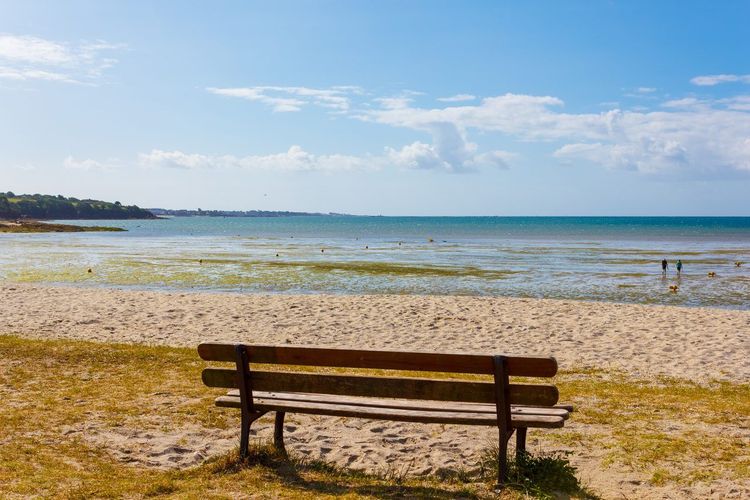
Technically located in the neighbouring commune of La Forêt-Fouesnant, Kerleven beach (Kerleven, 29940 La Forêt-Fouesnant, rated 4.5/5 on Google from 229 reviews) nonetheless appears consistently in searches related to Concarneau — and for good reason: it is only about fifteen minutes by road from the town centre, along the coastal road towards Beg-Meil.
This fine-sand beach extends several hundred metres, bordered by a dune system that remains relatively unspoilt by the urbanisation that has crept along parts of the Fouesnant coastline. It attracts a more sports-minded crowd than average, with stand-up paddle and kayak rentals as soon as the season begins, and a good wind exposure that appeals to watersports enthusiasts.
Unlike the beaches in Concarneau's town centre, Kerleven has a large car park that rarely fills up, even at the height of summer. It is often the smart fallback option for those who find the Sables Blancs car park full on a Saturday in July.
Nearby Beaches Not to Miss: Trégunc, Névez and Tahiti Beach
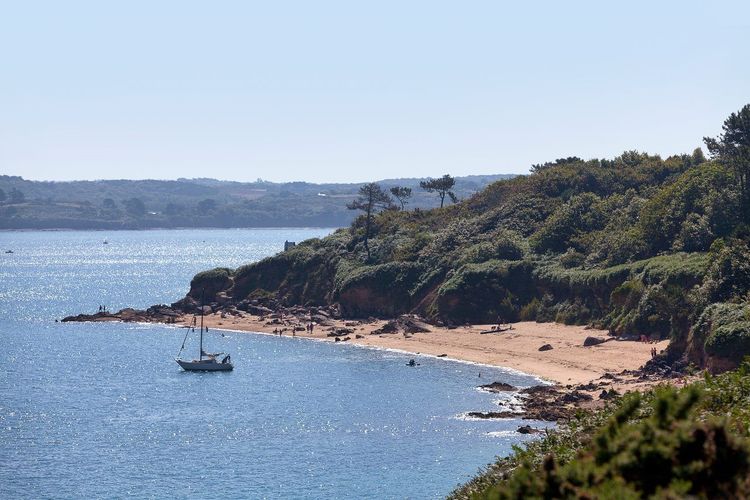
Widening the search beyond Concarneau's municipal boundaries opens up around fifteen additional beaches, spread across the neighbouring communes of Trégunc and Névez. Many are well worth the detour — fifteen to twenty minutes by car — and remain far less crowded than Concarneau's seafront.
Trégunc's Beaches: Kersidan, Trévignon and Pen Loc'h
Trégunc lines up around ten beaches along its indented maritime facade, from the sporty Kersidan beach, exposed to the swell and popular with watersports enthusiasts, to the small fishing port of Trévignon, where the beach runs directly alongside the huts and boats moored at the quay.
More rugged, Pen Loc'h beach requires a short walk along an unpaved coastal path, but rewards the effort with near-total seclusion outside July and August. Trégunc also counts the beaches of Don, Trescao, Feunteun Aodou, La Baleine and Kerouini — a string of small coves that deserves a full day's exploration by campervan or bicycle rather than a simple stop on the way to a holiday destination.
Névez's Beaches: Tahiti and Saint-Nicolas
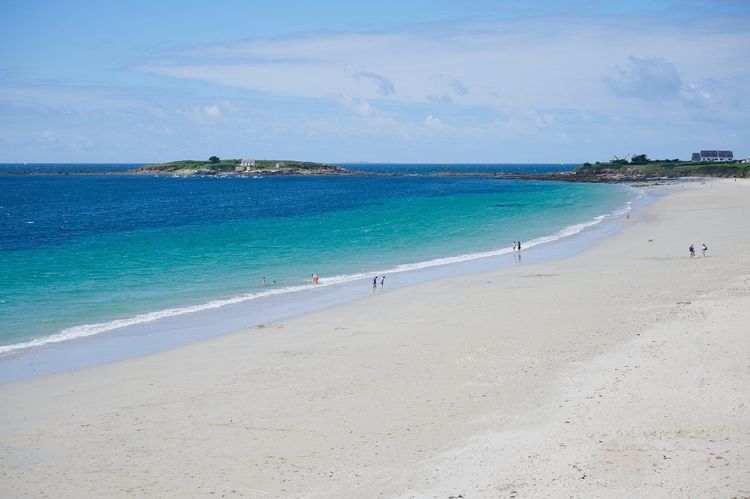
No discussion of the beaches around Concarneau would be complete without mentioning Tahiti beach, in the commune of Névez, whose exotic name consistently intrigues internet users searching for "concarneau plage tahiti". Located near the hamlet of Raguénez, facing the island of the same name, it owes its reputation to a surprisingly turquoise sea on fine days and very fine sand, almost reminiscent of some beaches in the south of France.
Nearby, Saint-Nicolas beach (Port Manec'h, 29920 Névez, rated 4.7/5 on Google from 18 reviews), at the mouth of the small harbour of Port-Manec'h, ideally completes the visit with a more authentic setting, between fishermen's cottages and the estuary of the Aven river meeting the ocean just alongside.
Névez has more to offer: the long, windswept Dourveil beach delights walkers and kite flyers out of season; Porz Kercanic has the feel of a picture-postcard cove, with its stone houses standing just metres from the sand; and Rospico, wedged between two rocky headlands, is one of the most photogenic spots in the area at low tide. Three sites that almost never appear in guides dedicated to Concarneau, yet are less than twenty-five minutes from the harbour.
On the question of a possible nudist beach near Concarneau, the reality is more nuanced than some search results suggest: Concarneau itself has no officially designated nudist beach within its municipal boundaries. However, certain isolated coves along the coast between Trégunc and Névez, difficult to access and unsupervised, are traditionally used in that spirit, without any official regulation or signage — as is often the case along this type of indented Breton coastline. To extend your exploration of Finistère beyond the coast alone, our Ryo article on the must-see places in Finistère lists other unmissable stops in the region, spanning maritime heritage and the inland countryside.
Safety, Water Quality and Practical Information for Swimming
The town of Concarneau publishes the results of bathing water quality analyses every year: eleven sites in the commune are monitored as part of the health inspectorate carried out by the Bretagne Regional Health Agency, with samples taken throughout the season. Sables Blancs, Cornouaille, Kernous and Belle Étoile are among the monitored beaches, with results consistently rated "good" to "excellent". The town's official list counts twelve beaches in total, including a few names that even regular visitors rarely mention: les Bouchers, Kermingham, le Minaouët and Fort-Tinou complete the picture alongside the sites described above.
One point that many holidaymakers only discover on arrival: Sables Blancs is the only supervised beach in Concarneau during summer. All the others, including Cornouaille and Belle Étoile, operate without a lifeguard. At Sables Blancs, swimming flags — green, orange or red — are hoisted daily according to sea and current conditions, and two beach wheelchairs are available for people with reduced mobility. A glance at the notice board at the beach entrance will tell you whether the post is staffed that day.
At all other sites — including the Cabellou coves and the beaches of Trégunc and Névez — swimming is at your own risk, with no supervision or rescue post. One simple piece of advice before setting out: check the marine weather forecast and tide times, as several of these beaches open up considerably at low tide and shrink to almost nothing at high tide, a detail that catches out poorly informed holidaymakers every year. Back in Quimper, the audio-guided tour makes for a good weather-proof fallback.
Dogs and Pets on the Beach: What You Need to Know
Concarneau's rules are stricter than most visitors expect, and allow for no geographical exceptions: dogs are banned from all beaches in Concarneau between 15 March and 15 November. Neither the Cabellou, nor Belle Étoile, nor the most secluded coves are exempt.
Outside that period — from 15 November to 15 March — dogs are allowed on the beaches provided they are kept on a lead. In other words, walking your dog on Concarneau's sand is an autumn and winter pleasure, which is no bad thing: that is the season when Sables Blancs and Grand Large are at their most beautiful, with low-angled light and a deserted foreshore.
Between March and November, you need to look towards the neighbouring communes: Trégunc and Névez apply their own bylaws, often more lenient at less frequented sites such as Pen Loc'h, but always check the sign at the entrance — it is the authoritative reference. Two practical habits: a lead remains compulsory near coastal nesting areas, and fresh water is not always available at these unequipped beaches, so bring a bottle for your pet.
Beach Dress Code: What the Town's Regulations Say
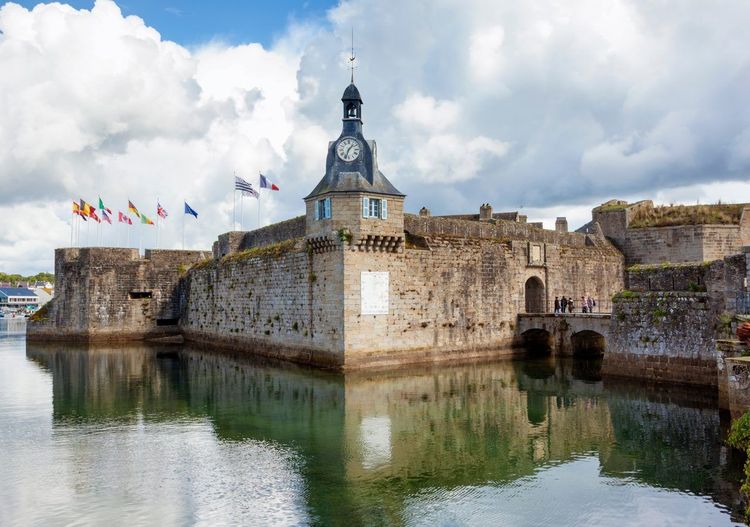
A little-known detail that often surprises visitors: Concarneau's municipal regulations govern dress outside the beach areas themselves. In practice, walking through the town centre and the Ville Close in a swimsuit, bare-chested or barefoot is not permitted — in the same way as in many other Breton coastal towns that are mindful of preserving a certain quality of life for year-round residents.
The rule is simple to follow: keep a T-shirt and sandals within reach in your beach bag before heading back towards the harbour's shops or restaurants. Enforcement is rare, but the rule is genuine and is regularly reiterated by the town hall during the summer season.
Where to Stay near Concarneau's Beaches
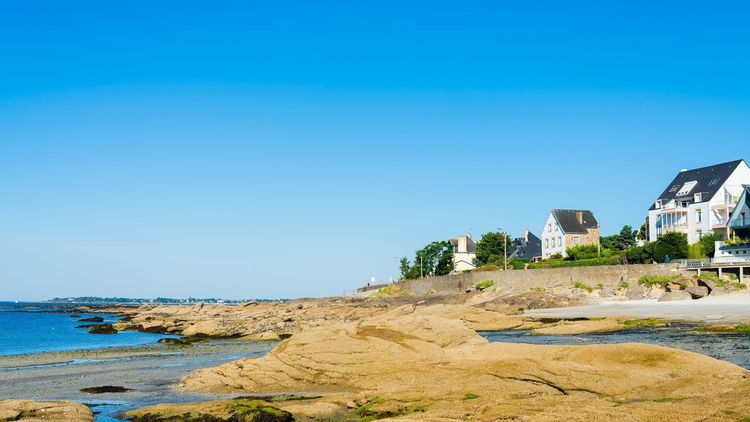
The choice of accommodation depends largely on which beach you plan to prioritise. For Sables Blancs and Cornouaille, it is best to look for lodging in the town centre or in Kerouel, within walking distance of both sites. Around the Cabellou, private holiday rentals dominate the offer, in a quiet residential neighbourhood that is less well served by local shops.
For holiday rentals, the local reality will surprise no one: seafront properties are booked from winter for July and August, and the Concarneau Cornouaille tourist office lists furnished rentals, bed and breakfasts and rated campsites each season — a more reliable starting point than booking platforms alone. If you are aiming for a week in August, accommodation in Trégunc or Névez, fifteen minutes by car, often works out cheaper than an address in Concarneau within walking distance of the beach.
For a stay that goes beyond a simple beach weekend, the audio-guided tour of Quimper, about twenty minutes away by road, lets you combine seaside and heritage: the Gothic cathedral, historic quarter and museums can all be visited comfortably in a day using this same tour of the capital of Cornouaille.
On the budget front, local campsites remain the most economical option in high season, while the harbour hotels offer the advantage of being right next to the Ville Close, at the cost of heavier tourist footfall and rates that rise sharply in July and August.

FAQ
What is the most beautiful beach in Concarneau?
Rankings remain subjective, but Sables Blancs beach attracts the most votes for its proximity to the Ville Close and the quality of its sand. For a wilder setting, the coves of Cabellou — Kernous and Rödel in particular — appeal more to regulars seeking peace and quiet.
How many beaches are there in Concarneau?
The town lists twelve: Sables Blancs, Cornouaille, Dames, Grand Large, Belle Étoile, Kernous, Rödel, Porzou, les Bouchers, Kermingham, le Minaouët and Fort-Tinou. Extending to the neighbouring communes of Trégunc and Névez adds around twenty more sites.
Where can you swim with your dog in Concarneau?
Nowhere in the commune between 15 March and 15 November: the ban applies to all beaches in Concarneau, including the Cabellou coves. From 15 November to 15 March, dogs are allowed on all beaches if kept on a lead. During peak season, you need to head to the neighbouring communes of Trégunc or Névez, subject to their own bylaws.
Is there a nudist beach in Concarneau?
No nudist beach is officially designated within the commune of Concarneau itself. Some isolated coves between Trégunc and Névez are traditionally used in that spirit, without any official regulation or signage.
Which beach in Concarneau is most suitable for families?
Belle Étoile beach comes out on top thanks to its shallow waters that extend far at low tide. Sables Blancs is a close second, with one decisive argument for anxious parents: it is the only supervised beach in Concarneau during summer.
Where can you park to go to Sables Blancs beach?
A car park runs alongside the beach, but it fills up quickly on summer weekends by 11am. The surrounding streets in the neighbourhood offer spaces if you arrive early, or you can walk from the town centre — barely fifteen minutes on foot.
Is the water quality good at Concarneau's beaches?
Yes. Eleven of the commune's beaches are monitored each season by the health inspectorate of the Bretagne Regional Health Agency, with results consistently rated good to excellent. The analyses are published by the town throughout the sampling period and displayed at the entrance to each site.
Concarneau, Far More Than Just One Beach
Concarneau is not just about Sables Blancs, however central and convenient that beach may be. The real appeal of the Concarneau coastline lies in its variety: the wide sands of Belle Étoile for family days out, the secluded coves of the Cabellou for a quiet swim, Grand Large when you need space, and the escapes to Trégunc and Névez once you are willing to drive twenty minutes. A week on site is barely enough to take it all in.
That said, a Breton summer is not always generous, and a drizzly day can easily turn into a heritage day out. That is where the audio-guided tour of Quimper steps in: its Ryo audio guide traces the history of the capital of Cornouaille — cathedral and old town included — about twenty minutes' drive from the beaches. Enough to turn a simple seaside break into a well-rounded stay in the south of Finistère.