© Shutterstock
 Votre guide Ryo
Sarlat-la-Canéda for Couples: A Romantic 2026 Guide to a Stay in the Périgord Noir
It is 7 p.m. on place de la Liberté, the gas lamps crackle and light up one by one on the honey-colored stone facades, and the whole town seems to hold its breath for one more couple. Visiting Sarlat-la-Canéda as a couple means agreeing to slow down: here, the pace is set by the cobbled lanes, not by a list of monuments to tick off. The Ryo audio guide tour of Sarlat-la-Canéda traces exactly that tempo, between place de la Liberté and the half-timbered houses, so that the visit becomes a conversation rather than a race.
In the pages that follow: a panoramic elevator hidden in a former church, a market that turns la Grande Rue into a stall of foie gras and walnuts from the early morning, a troglodyte village clinging to the Dordogne cliff, and cabins with private hot tubs tucked away in the Périgord Noir forest. Between the castles of Beynac and Castelnaud, the hanging gardens of Marqueyssac and a gabare cruise along the water, the Périgord Noir is among the most generous French destinations for a weekend for two.
The Medieval Town of Sarlat, the Perfect Setting for a Getaway for Two
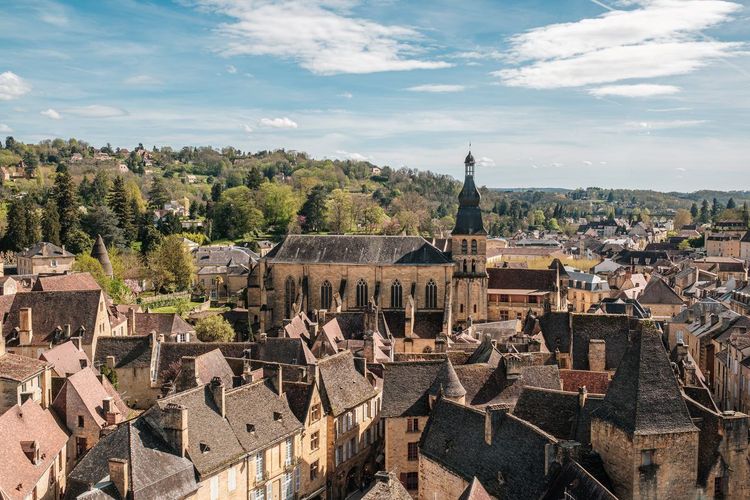
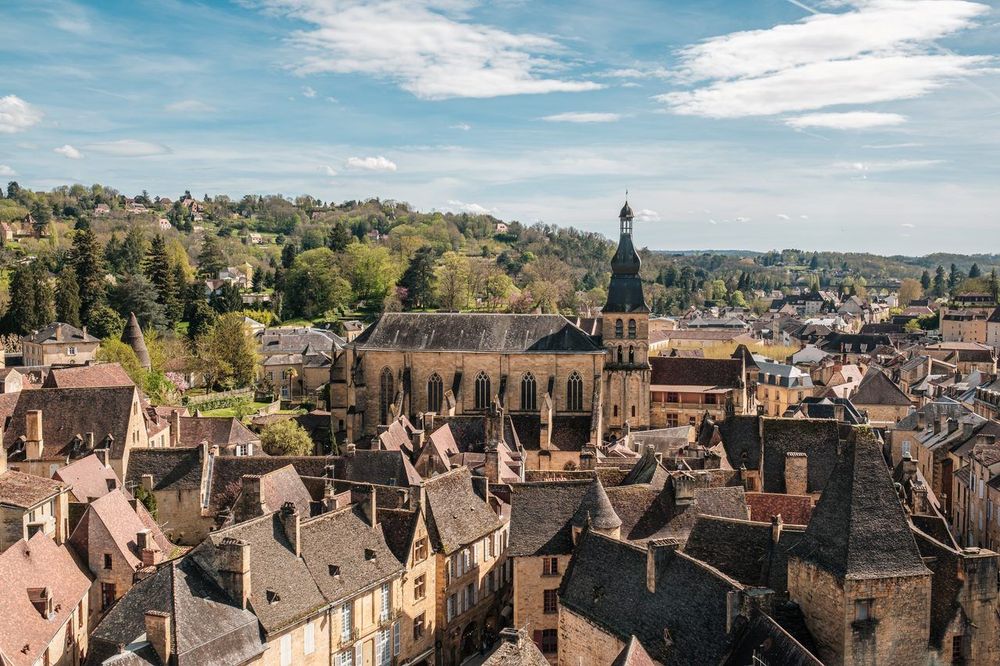
Sarlat-la-Canéda escaped the outrages of the 20th century almost intact, and that is no accident: among the very first towns protected by the Malraux Law of 1962, it was given a protected sector as early as 1964 and has kept its town mansions in honey-colored stone and its maze of medieval lanes almost untouched. For a couple, this wealth of heritage translates very concretely: you can do everything on foot, without ever getting back into a car, deliberately losing yourselves from one secret courtyard to the next.
Place de la Liberté and the Cobbled Lanes to Stroll Hand in Hand
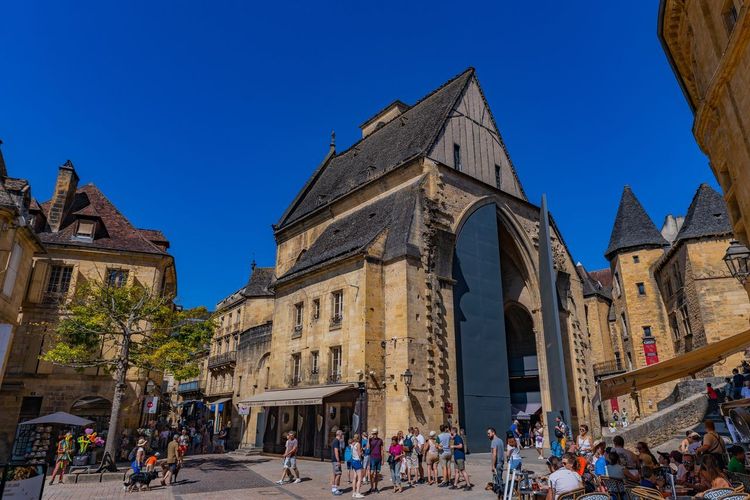
The Place de la Liberté (Place de la Liberté, 24200 Sarlat-la-Caneda, rated 4.7/5 on Google from 8K reviews) is the beating heart of the town, lined by the former Sainte-Marie church and the 17th-century town hall. Almost every visit converges here, and it is also the best starting point to escape from it.
Heading into the rue des Consuls, then the rue de la Liberté, you discover Renaissance mansions with stair turrets, inner courtyards glimpsed behind half-open gates, and antique dealers set up in vaulted cellars. You can easily spend an hour doing nothing but looking up at the lauze stone roofs and carved dormer windows.
Come preferably early in the morning or late in the afternoon: the flow of group tours is concentrated between 11 a.m. and 3 p.m., and it is the quiet hours that make the lanes truly intimate, without the crowd of guides' umbrellas.
In the Footsteps of Étienne de la Boétie, the Local Son
A discreet but central figure in Sarlat's history, Étienne de La Boétie was born in 1530 in a Renaissance house facing the Saint-Sacerdos cathedral. A humanist, Montaigne's closest friend, and at a very young age the author of the Discourse on Voluntary Servitude, a political text still found in bookshops, he embodies this other Sarlat, less medieval and more literary, which long nourished the elites of the Périgord.
The Ryo audio guide sub-tour "Whispers of the Middle Ages" takes you across place de la Liberté and these lanes in 15 audio stops, for a loop of about one hour over 1.1 km. The story of Étienne de La Boétie is told in front of his birthplace, headphones on, right at the right spot: a simple way to turn a stroll into a real story for two.
Rising Above It All: The Panoramic Elevator at Sainte-Marie Church
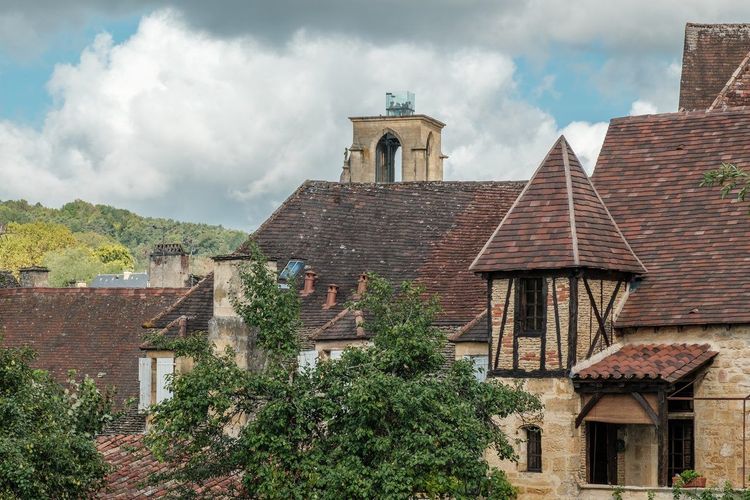
The former Sainte-Marie church, deconsecrated since the Revolution, now houses the covered market and a glass panoramic elevator, designed by architect Jean Nouvel, which climbs to the top of the bell tower. The ride lasts less than a minute, but the view that awaits, an ocean of gray-blue lauze roofs and stone chimneys, more than justifies the detour.
Allow a few euros per person and plan for late afternoon, when the low light catches the roofs. No wonder the Ryo audio guide makes it a stop in its own right: it is the ideal opportunity for a photo break for two, high above the crowd in the lanes.
Sarlat at Nightfall: Strolling Beneath the Gas Lamps
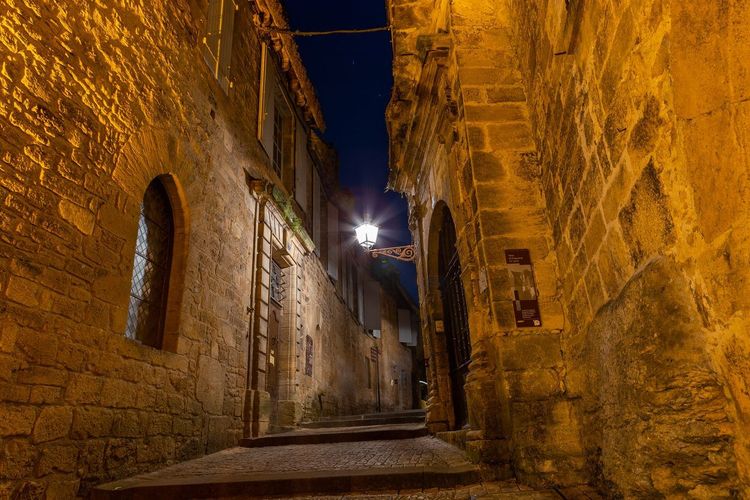
Sarlat is one of the few French towns to have kept gas street lighting in its historic center: lamps that are still lit at dusk, by flame, without the harshness of LED lighting. The result completely changes how you perceive the old town.
The honey-colored stones, which look almost yellow in broad daylight, take on an amber, almost golden hue as soon as the sun disappears behind the roofs. Shadows lengthen in the lanes deserted by the day's groups, restaurant terraces light up one by one, and often all that remains on place de la Liberté is a handful of couples dining in silence. It is a free spectacle that asks for nothing more than being there at the right moment.
At that hour, nothing stops you from starting the Ryo audio guide tour again with your headphones, as the flames light up one by one on the facades: a different way to rediscover a route you may already have walked in the afternoon, under entirely different lighting.
The Traditional Market and the Flavors of the Périgord to Share
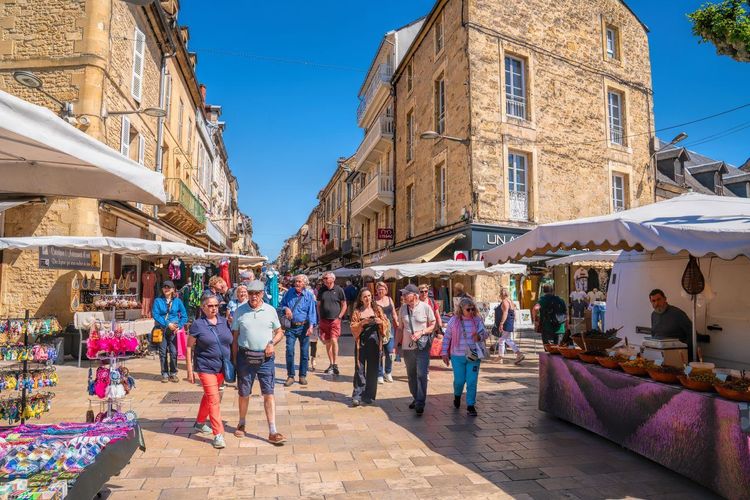
Sarlat's market is not a folklore staged for tourists: it is still where the locals do their shopping, mingling with visitors with no apparent distinction, and it has been so for centuries.
The Market on Place de la Liberté and the Grande Rue
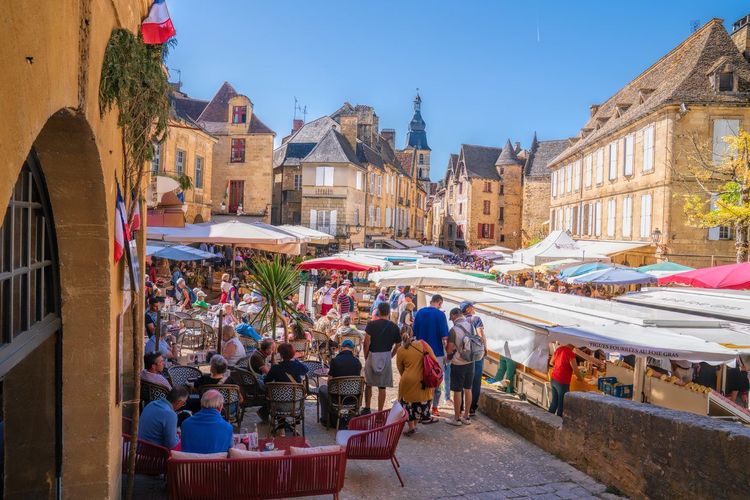
On Saturdays all day, and on Wednesday mornings, the stalls take over the Place de la Liberté, the Grande Rue and the adjacent lanes. Goat cheeses, porcini mushrooms in season, wicker baskets, confits, a whole little world of local producers sets up under parasols from 8 a.m. The rest of the week, the covered market in the former Sainte-Marie church (Place de la Liberté, 24200 Sarlat-la-Caneda, rated 4.3/5 on Google from 1,362 reviews) takes over, and in winter, on Saturday mornings, the truffle and fatted-poultry markets are added.
Arrive before 9:30 a.m. if you still want to move around together without elbowing your way through: after 10 a.m., the Grande Rue becomes hard to cross in high season. And share a single shopping basket rather than two; it is often the best excuse to taste three or four specialties together before choosing.
Foie Gras, Truffle and Wine: A Tasting for Two
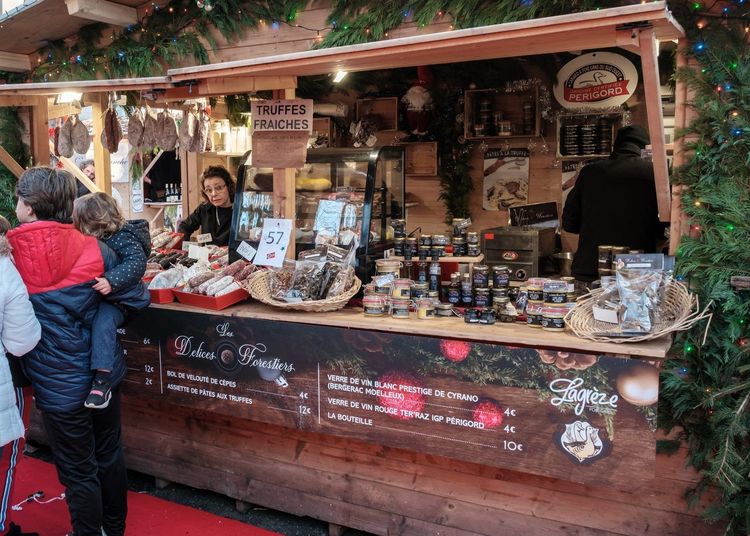
The Périgord Noir has lived for generations on three flagship products: foie gras, Périgord walnuts (PDO) and, in winter, the black truffle. Many merchants offer a tasting before you buy, and it is one of the small pleasures of traveling as a couple: taste, compare, get it wrong, start again.
As for wine, Sarlat's wine cellars readily offer tastings of red Bergerac or Monbazillac, the local sweet wine that traditionally accompanies foie gras. Some even organize food and wine pairing workshops for two, by reservation.
If your stay falls in winter, the Truffle Festival brings together the truffle growers of the Périgord Noir every year in mid-January. Sarlat Fest'Oie, in early March, celebrates the fattened goose throughout the old town with bandas and tastings, and the Journées du terroir, in May, showcase all the local producers. Three events to add to your calendar if the dates coincide.
One audio stop of the Ryo audio guide tour of Sarlat-la-Canéda tells the story of this very market on place de la Liberté: worth listening to just before strolling among the stalls, to understand what you are looking at rather than simply photographing it.
A Getaway to La Roque-Gageac and Beynac-et-Cazenac, Villages on the Banks of the Dordogne
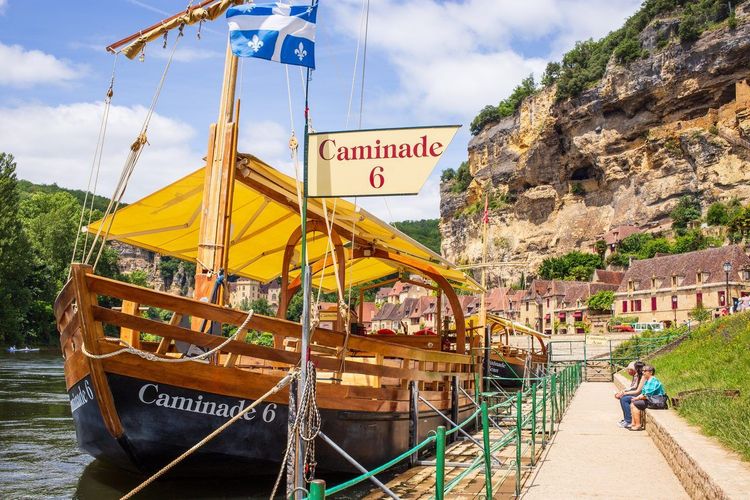
Visiting Sarlat-la-Canéda as a couple without going down to the river would be a shame. About fifteen minutes by car south of the town, the Dordogne valley lines up a handful of villages that are among the most photographed in France. Many couples start their morning with the audio walk in the old town before hitting the road late in the morning, splitting the day into two very distinct atmospheres.
La Roque-Gageac, a Troglodyte Village by the Water
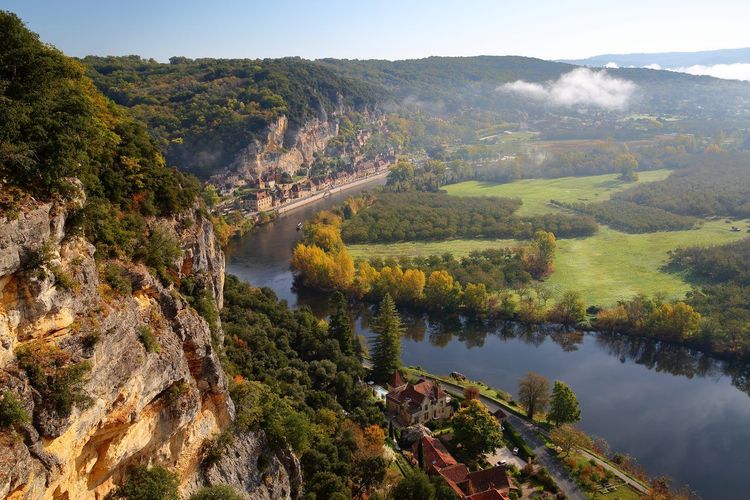
La Roque-Gageac literally clings to a limestone cliff overlooking the Dordogne, with houses and exotic gardens set into the rock, sometimes halfway up the cliff. The troglodyte fort, perched at the very top, can be visited in a short half-hour.
The village is best seen from the water, by gabare or canoe: it is from the river, not from the quay, that you truly sense the sheer scale of this stone facade suspended above the current.
Beynac-et-Cazenac and Its Fortified Castle
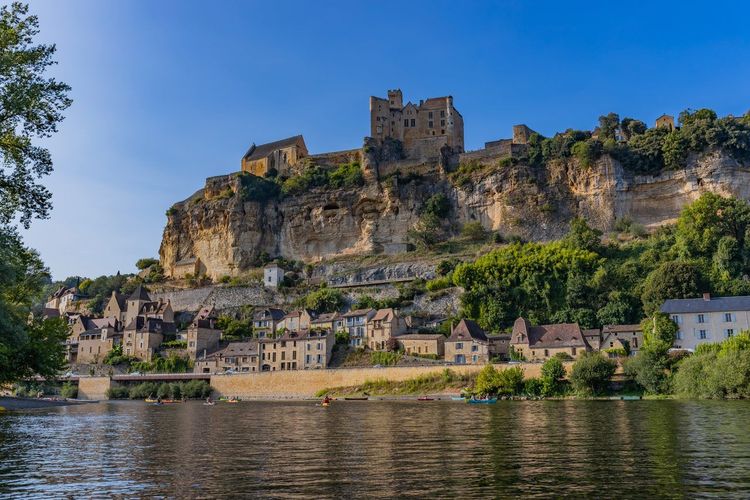
Ten minutes away, Beynac-et-Cazenac lines up its stone houses beneath a 12th-century fortified castle set on a rocky promontory about 150 meters above the river. The village has served as a setting for several historical films, and it is not hard to see why: the silhouette of the keep above the roofs is one of the most recognizable images of the Périgord.
Walk up to the castle in the late afternoon: the low light on the stone and the panorama over the bend of the Dordogne, visible from the ramparts, are well worth the effort of the sloping lanes.
Domme, the Finest Balcony over the Dordogne Valley
A royal bastide founded in 1281, Domme sits on a promontory that overlooks the Dordogne valley for several kilometers around. The Belvédère de la Barre, on the edge of the village, offers one of the most complete panoramas in the entire Périgord Noir: the winding river, the walnut groves, the roofs of La Roque-Gageac in the distance.
Come an hour before sunset: the crowds of tour buses are already heading back down, and the golden light over the valley makes this moment one of the most memorable of the stay.
The Gardens of Marqueyssac in Vézac, a Walk Suspended Above the Valley
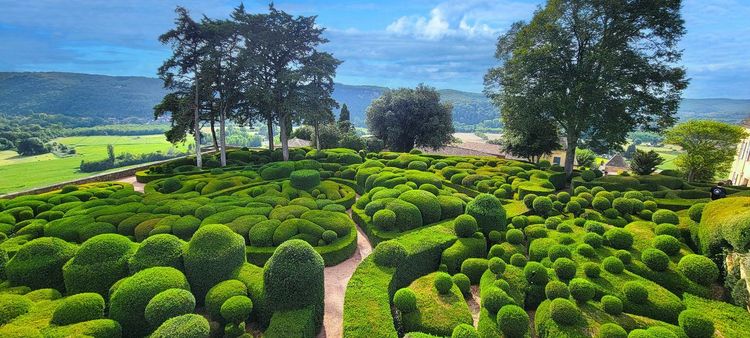
In Vézac, a few minutes from Beynac, the Gardens of Marqueyssac (24220 Vezac, rated 4.6/5 on Google from 15,282 reviews) unfold about 6 kilometers of paths lined with centuries-old boxwoods trimmed into waves, around a 17th-century castle overlooking the Dordogne. The gardens as we walk them today were designed in the 19th century by Julien de Cerval, and they have kept the spirit of a dreamy stroll.
In summer, the Thursday candlelit evenings illuminate the paths with thousands of candles: probably the most magical moment in the whole Périgord Noir for a couple, and it is best to book early.
Outside the evening openings, favor early morning: the boxwoods still cast long shadows, and the viewpoints over the valley are free of crowds.
Gabare Cruise and Canoe Trip on the Dordogne
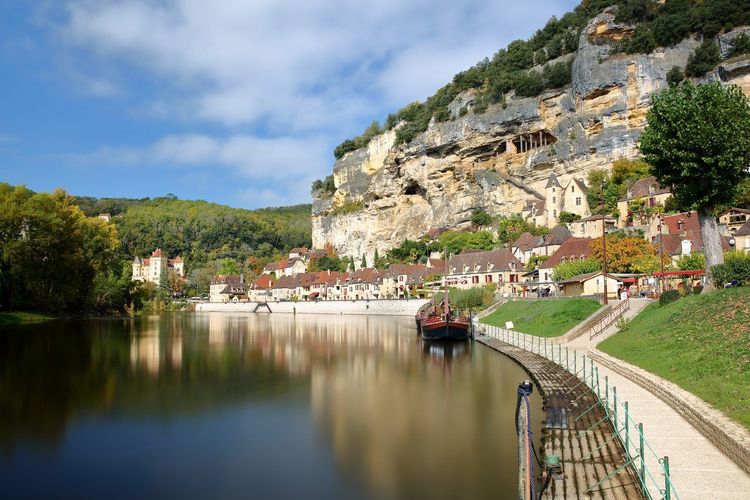
The gabare was once the flat-bottomed boat that carried wood, wine and goods down to Bordeaux. Now repurposed for tourism, these traditional boats offer guided cruises of about an hour departing from La Roque-Gageac or Beynac.
For couples who prefer to paddle rather than be guided, the canoe remains the freest option: half-day or full-day rental, a leisurely descent with the current between cliffs and castles, with the chance to stop on a pebble beach for an impromptu picnic. Allow about 2 hours to paddle from La Roque-Gageac to Beynac at an unhurried pace, return shuttle included with most rental companies.
Castles, Caves and Unusual Experiences for Two in the Périgord Noir
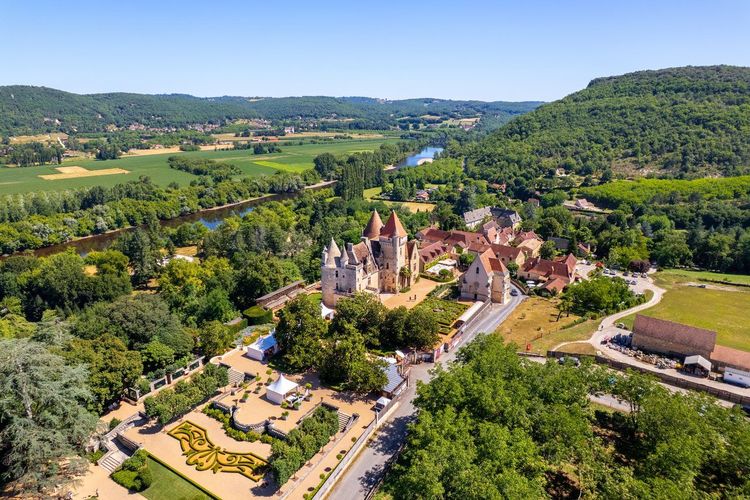
The Périgord readily claims the title of the land of "1001 castles", and while the number is an image, reality is not far off: it is hard to drive for ten minutes in the valley without spotting a turret or a keep.
Iconic Castles: Castelnaud and Beynac
Facing each other on the two banks of the Dordogne, the Castelnaud castle and the Beynac castle watched one another for a long time during the Hundred Years' War, one held by the English, the other by the French. Castelnaud today houses a particularly well-designed museum of medieval warfare, with life-size trebuchets and siege machines.
The keep at Beynac, for its part, is visited for its architecture more than for its collections: the almost bare medieval rooms make it easier to imagine the daily life of a fortified castle.
Combine the two on the same day: the short drive across between the two banks makes a welcome breather midway.
Hot-Air Balloon, Caves and the Voie Verte by Bike
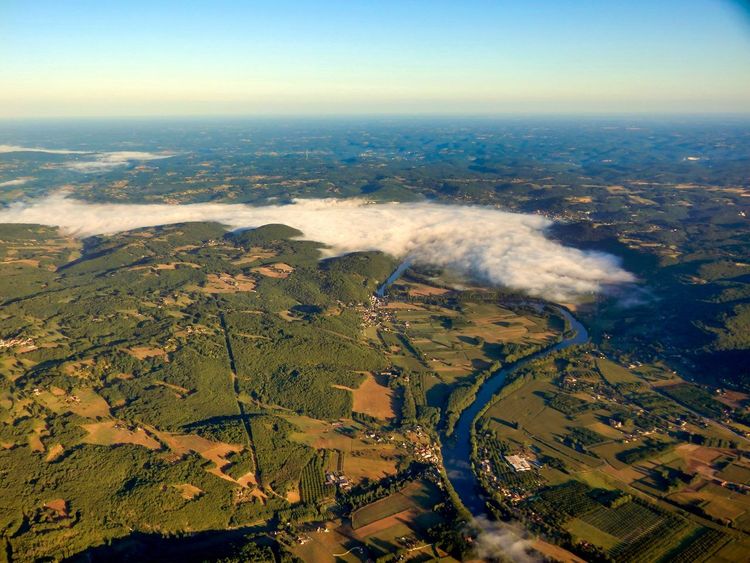
For a truly extraordinary experience, a hot-air balloon flight at sunrise flies over the Dordogne valley, the castles and the villages still asleep in the morning mist. Flights last about an hour and traditionally end with a toast on landing.
Underground, Lascaux IV (Avenue de Lascaux, 24290 Montignac-Lascaux, rated 4.4/5 on Google from 22,344 reviews), in Montignac, faithfully reproduces the prehistoric paintings of the original cave through an immersive visit of about two hours.
Closer to Sarlat, the Proumeyssac chasm, nicknamed the "crystal cathedral", can also be discovered in a gondola suspended above its rock formations. For more active days, the Voie verte follows the former Sarlat railway line toward Cazoulès, in the direction of Souillac: a flat, shaded path, ideal by bike for two, far from traffic. If you prefer walking, our selection of hikes around Sarlat offers loops to do as a couple. And on rainy days, an escape game in the town center remains the best offbeat alternative to keep playing together under cover.
Where to Stay in Sarlat as a Couple: Cabins with Hot Tubs, Lodges and Boutique Hotels
The choice of accommodation completely changes the tone of a stay for two in Sarlat, and the local offering covers just about every taste, from the boutique hotel in the old town to the secluded lodge deep in the forest.
The cabins with private hot tubs and the lodges scattered through the woods around Sarlat bank on complete seclusion: no neighbors, a private terrace, sometimes a wood stove, and the Périgord Noir forest as the only horizon. It is the most requested option for a two- or three-night getaway, and it generally needs to be booked several weeks ahead in high season.
In a completely different register, the hotels with pools on the outskirts of the old town, such as the Hôtel de Selves or the Relais de Moussidière, offer more services (spa, restaurant, breakfast on the terrace) while remaining within a ten-minute walk of the historic center.
For a special occasion, the valley also has several castle-hotels, such as the Château de la Treyne in Lacave, set on the banks of the Dordogne about forty minutes from Sarlat. And if you prefer to sleep in the very heart of the lanes, several mansions converted into guesthouses occupy the old town: waking up to a view of a lauze roof more than makes up for the lack of private parking, which you will then have to look for on the outskirts.
Where to Dine for Two: The Best Tables in Sarlat
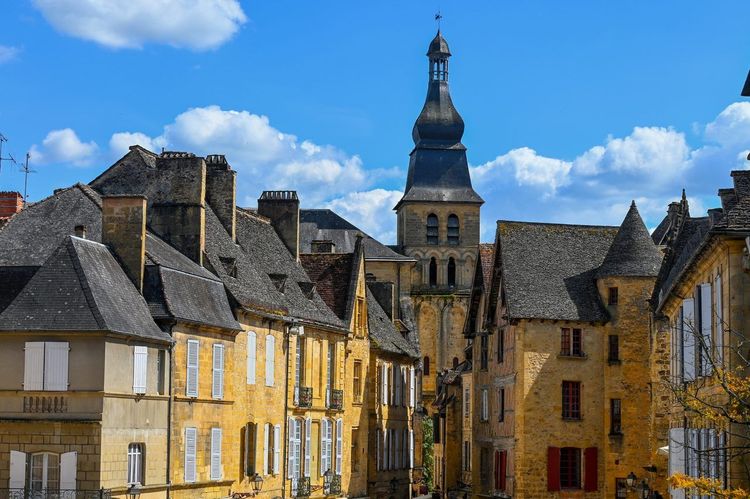
Sarlat has a density of good restaurants that is quite rare for a town of this size, driven by the richness of local products: foie gras, porcini mushrooms, truffle, duck in all its forms.
At the top, Le Grand Bleu offers fine-dining cuisine recognized by the Michelin Guide, in a discreet setting, for an exceptional dinner. In the old town, several restaurants set in vaulted rooms or on small cobbled squares serve updated Périgord cuisine at gentler prices: preferably choose a place with a short menu and seasonal products, a sign of cooking made on site.
Book a terrace table if the weather allows: Sarlat's small inner squares, lit by flame in the evening, offer a setting that no ordinary dining room can really reproduce. In July and August, book in the morning, as the best terraces are full well before 8 p.m.
When to Go and How Long to Plan for a Stay for Two in Sarlat
To visit Sarlat-la-Canéda as a couple without rushing, two full days are enough to cover the essentials of the town and an excursion to the Dordogne valley, but three days let you add a castle, a cave, and above all never rush from one spot to the next.
May, June and September offer the best compromise between mild weather and reasonable crowds. July and August remain magnificent but clearly busier, especially around the Saturday market and the best-known sites such as Marqueyssac or Beynac. Winter, quieter, has the truffle markets and gentler accommodation rates in its favor.
Sarlat is explored entirely on foot once you have parked: several car parks right on the edge of the old town (some free in low season) save you from circling the narrow lanes, which are largely closed to cars. For excursions to La Roque-Gageac, Beynac or Domme, a car remains essential, as distances easily exceed ten kilometers between villages.
Good news for tight budgets: strolling through the medieval town, the market, the viewpoints of Domme and the climb to Beynac castle from the village all remain entirely free. Only the entrance fees to paid sites (elevator, castles, caves, gardens) add to the trip budget.
Extending the Getaway: Bergerac and the Rest of the Périgord Noir
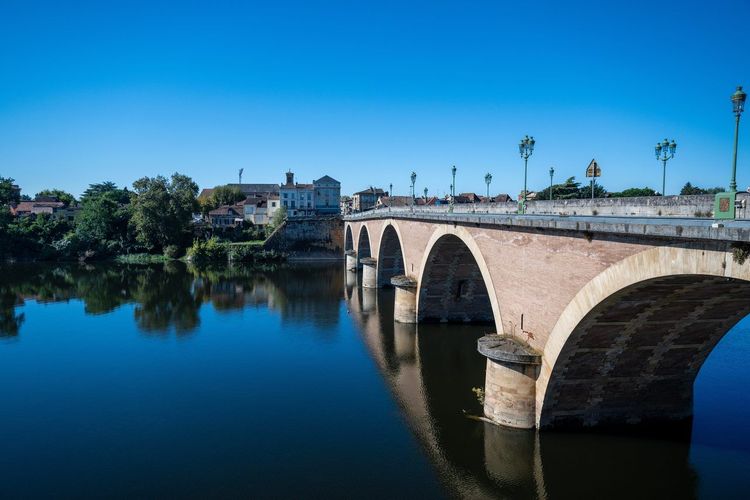
If your stay exceeds three days, Bergerac and its vineyards are about 1h15 by road from Sarlat, and make a logical follow-up to the Périgord getaway: a half-timbered old town, merchants' houses, and Dordogne banks that are much calmer than Sarlat in high season. Our guide to visiting Bergerac for the first time details a complementary itinerary.
Beyond that, the Périgord Noir still has dozens of villages full of character, caves and viewpoints that do not fit into a two- or three-day stay: enough to justify, for many couples, a return the following year.



FAQ
How long does it take to visit Sarlat?
One day is enough to see the essentials of the medieval town, but two to three days are recommended for a stay for two that includes a leisurely excursion to the Dordogne valley (La Roque-Gageac, Beynac, Marqueyssac).
What can couples do and see in Sarlat?
Strolling through the lanes of the medieval town, riding the panoramic elevator at Sainte-Marie church, the Saturday market, a night walk beneath the gas lamps, and excursions to La Roque-Gageac, Beynac, Domme or the Gardens of Marqueyssac.
What can you visit on foot in Sarlat?
The whole medieval town, largely pedestrian, can be explored on foot: place de la Liberté, rue des Consuls, Étienne de La Boétie's house, the Sainte-Marie covered market and its panoramic elevator.
What is the prettiest village near Sarlat for a getaway for two?
La Roque-Gageac, with its troglodyte houses clinging to the cliff, and Beynac-et-Cazenac, overlooked by its fortified castle, often share this title according to visitors. Both can be visited in the same half-day.
What is the best time of year for a couple's stay in Sarlat?
May, June and September offer the best balance between pleasant weather and moderate crowds. July and August remain an option for enjoying the candlelit evenings at Marqueyssac, despite larger crowds; winter charms with the Truffle Festival.
Are there any free things to do in Sarlat?
Yes: strolling through the medieval town, the market, the viewpoints of Domme and the climb to Beynac castle from the village cost nothing. Only the panoramic elevator and the paid sites (castles, caves, gardens) need to be budgeted for.
Sarlat for Two, at the Pace of the Honey-Colored Stone
Sarlat-la-Canéda needs no artifice to be romantic: the honey-colored stone, the lanes deserted at dusk and the Dordogne valley do the job very well all by themselves. Visiting Sarlat-la-Canéda as a couple is first of all about choosing the right hours: the market early in the morning, the elevator in the late afternoon, the gas lamps at nightfall.
Whether you stay focused on the medieval town or venture out to Beynac and Marqueyssac, the Ryo audio guide tour of Sarlat-la-Canéda remains the best way not to miss the story hidden behind every facade, at your own pace, headphones on and hand in hand.