© Shutterstock
 Votre guide Ryo
Weekend in Bamberg: The Complete 2026 Itinerary for the UNESCO Old Town and Its Rauchbier Breweries
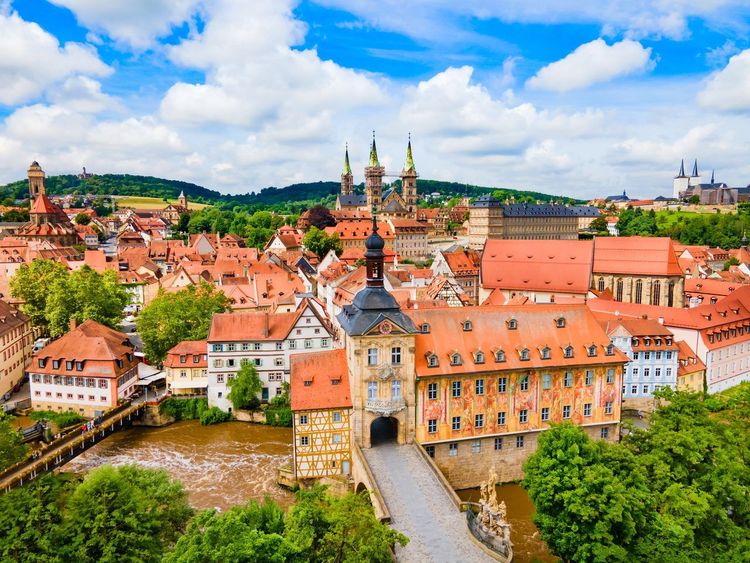
In Bamberg's old town, seven hills hide a four-towered cathedral, a town hall planted right in the middle of a river, and a dozen breweries that fill the cobbled lanes with the sweet smell of smoke. Spending a weekend in Bamberg means slipping into a Franconian postcard that UNESCO listed in 1993 without ever turning it into an open-air museum: people still drink the neighborhood beer here, still shop at the Grüner Markt, and the cathedral bells still mark the days for locals as much as for visitors. To connect it all without unfolding a map at every junction, a Ryo audio guide tour of Bamberg offers twenty commented stops over four kilometers — one hour and forty minutes of walking.
In two days, you'll have time to cross the Altes Rathaus perched on its island, climb up to the cathedral and its four towers, stroll along the colourful fishermen's houses of Klein Venedig, and taste the famous Rauchbier, the smoked beer that made the local breweries' reputation. If you stay a third day, the Altenburg perched on its hill and less-visited neighborhoods such as the area around Villa Concordia make a useful addition to the programme. This guide details a day-by-day itinerary, an option for a third day, where to eat, where to sleep, how to get there from France, and which excursions to take toward Nuremberg, Würzburg, or Regensburg.
Why Spend a Weekend in Bamberg
Bamberg fits into two days without feeling rushed. The old town listed as a World Heritage Site ranks among the best-preserved historic centres in Germany: unlike Nuremberg or Würzburg, it came through the Second World War almost intact. The 1993 UNESCO listing actually covers the urban ensemble itself — the episcopal town on the hills, the bourgeois town on the island, and the market-gardeners' quarter — a fairly rare case that recognises the medieval street layout as much as individual monuments.
It is an ideal destination if you enjoy medieval and Baroque architecture, craft beer, or human-scale cities rather than overcrowded capitals. It suits less those looking for a dense nightlife or modern attractions: Bamberg is visited at the pace of bells and the smell of malt, not at that of a metropolis buzzing until dawn.
Among the must-sees, four places appear in every travel journal: the Altes Rathaus on its island, the imperial cathedral, the Rose Garden of the Neue Residenz, and at least one brewery serving Rauchbier. Add to that, if you have a little more time, the history museum housed in the former episcopal court and the Michaelsberg, whose church reopened in May 2026 after fourteen years of restoration work and whose terrace offers one of the finest panoramic views of the city.
Day 1: The Historic Old Town and the Banks of the Regnitz
The first day focuses on the historic heart of Bamberg, where the Regnitz symbolically separates the episcopal town from the bourgeois town. Everything is done on foot, within a compact perimeter that can be covered without ever needing public transport.
The Altes Rathaus and the Bridge over the Regnitz
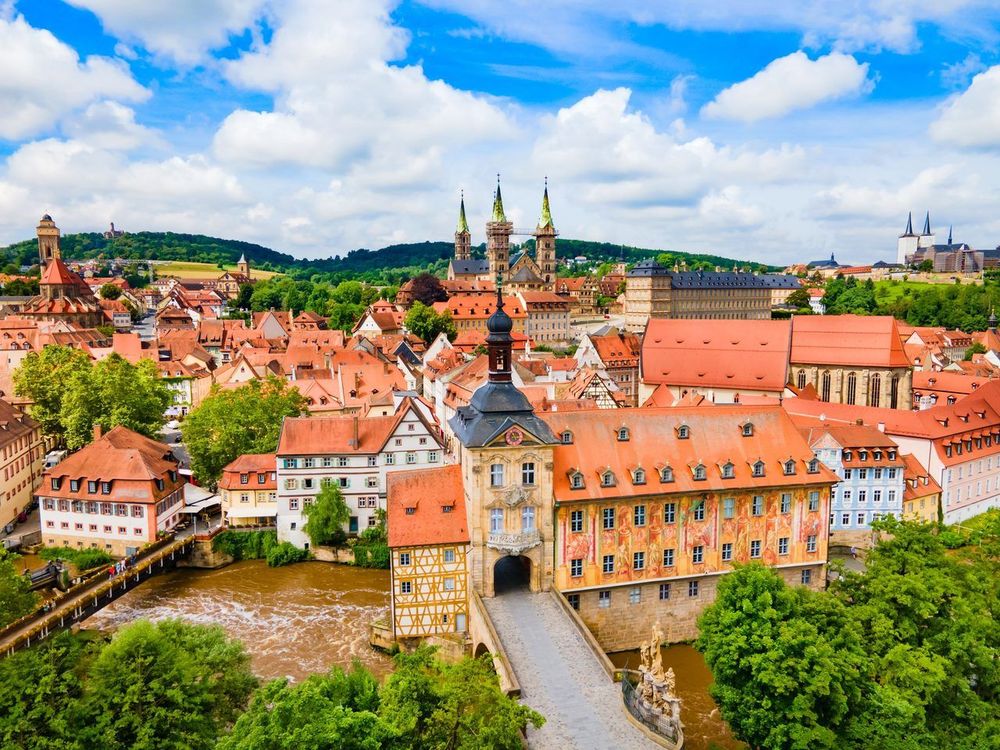
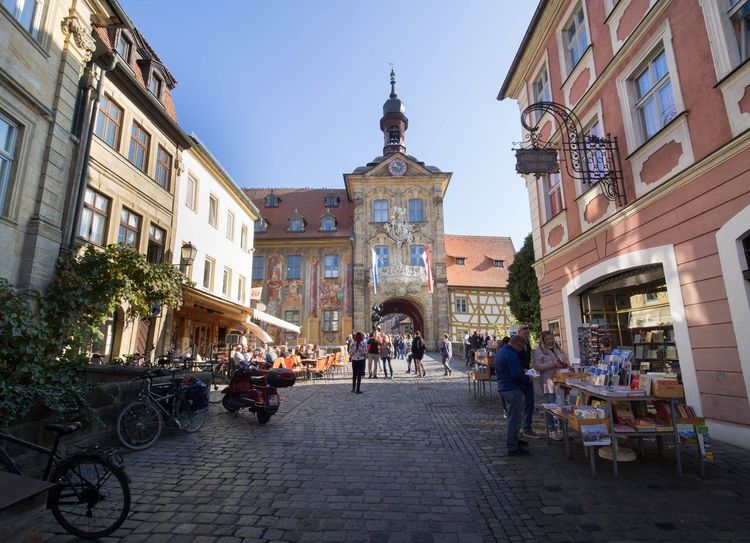
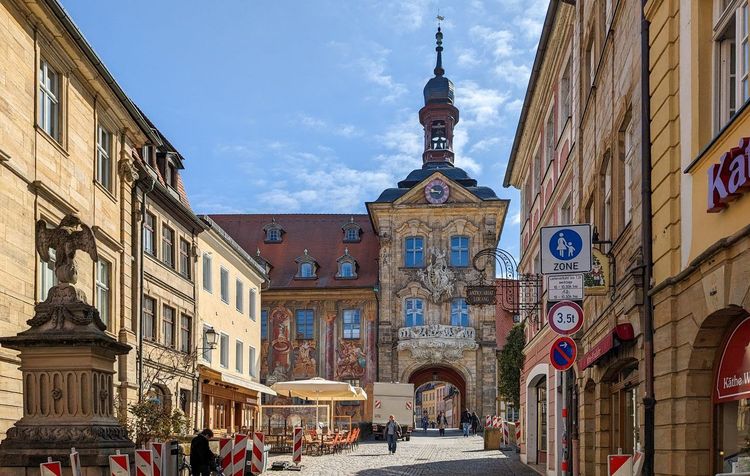
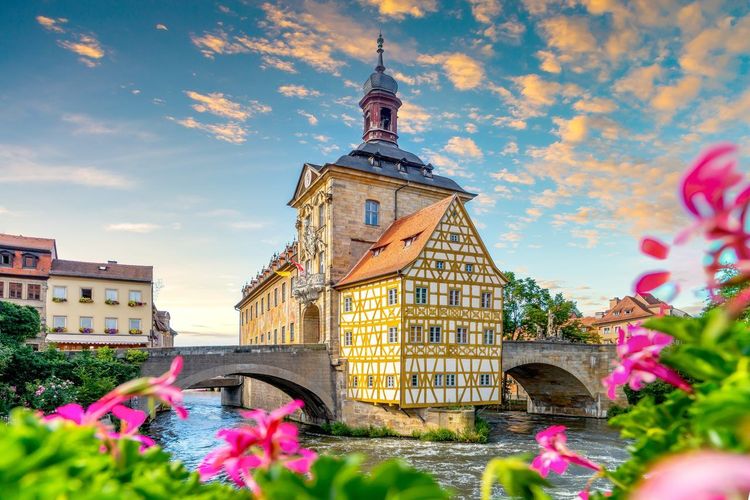
Start the morning at the Altes Rathaus, the old town hall, one of the most photographed images in Franconia. Mentioned as early as the 14th century and remodelled in the Baroque style in the mid-18th century, it stands on a small island in the middle of the river. Legend has it that the bishop refused to grant the townspeople land on which to build their town hall, so they created their own plot by driving piles into the bed of the Regnitz. The story, unverifiable, sums up rather well the long-standing rivalry between religious and bourgeois power in this city long divided between the two.
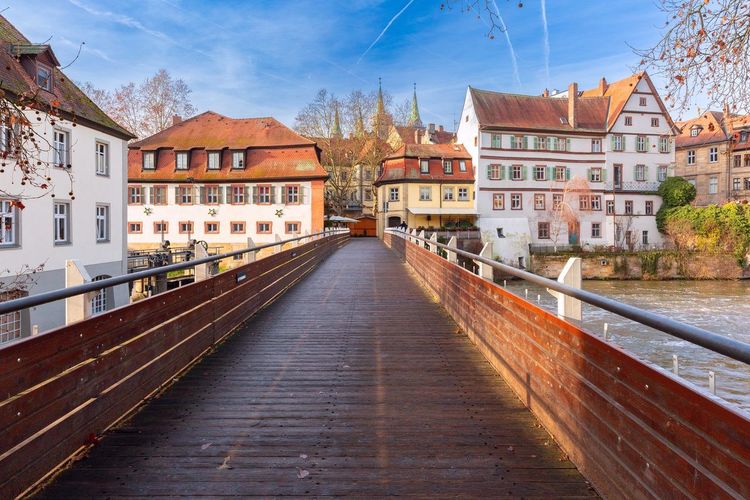
The building is literally crossed: the Obere Brücke (Obere Brücke, 96047 Bamberg), the upper bridge, passes beneath an arch of the central tower, and the trompe-l'œil fresco-covered facades extend the painted architecture. Stop on the east side: you'll spot a sculpted cherub's leg that deliberately breaks out of the painted frame, a detail most hurried visitors never notice.
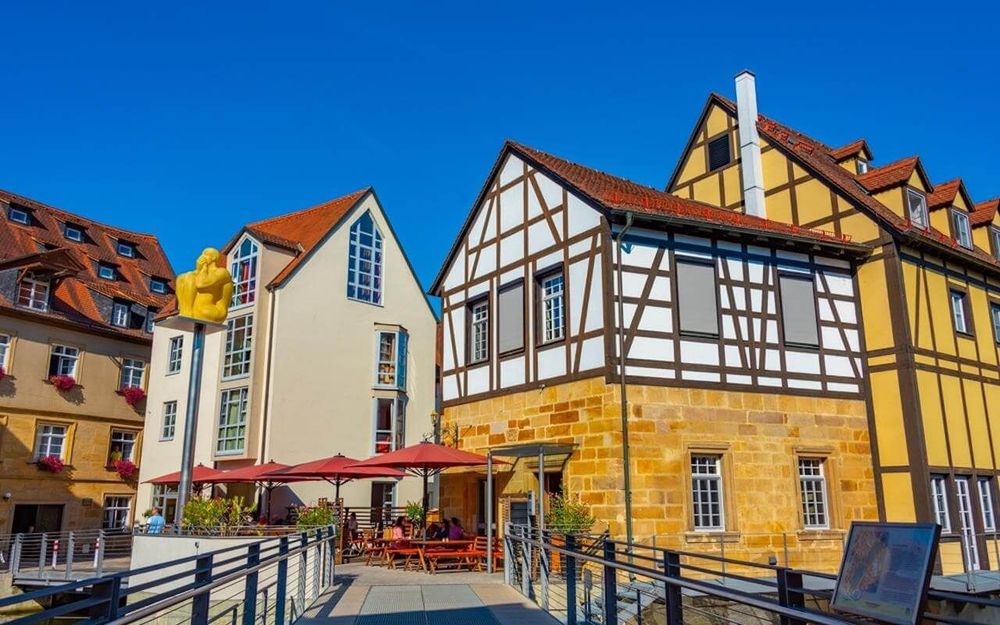
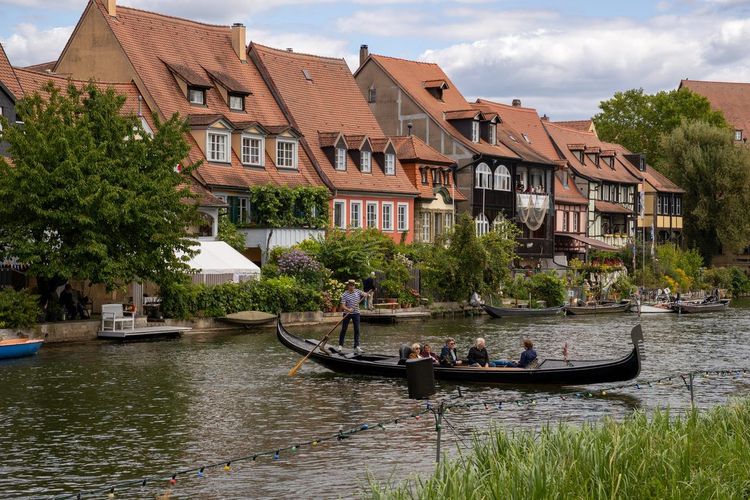
From the bridge, head downstream to reach the viewpoint over Klein Venedig, Little Venice. This row of fishermen's and boatmen's houses with narrow facades and flower-filled balconies plunges almost into the water; the neighbourhood dates back to the Middle Ages, even if most of the current houses were rebuilt or altered much later. The best photographs are taken from the opposite bank, on Markusplatz and along the Am Leinritt embankment, early in the morning when the raking light catches the facades and the groups have not yet arrived.
Grüner Markt and the Bamberg History Museum
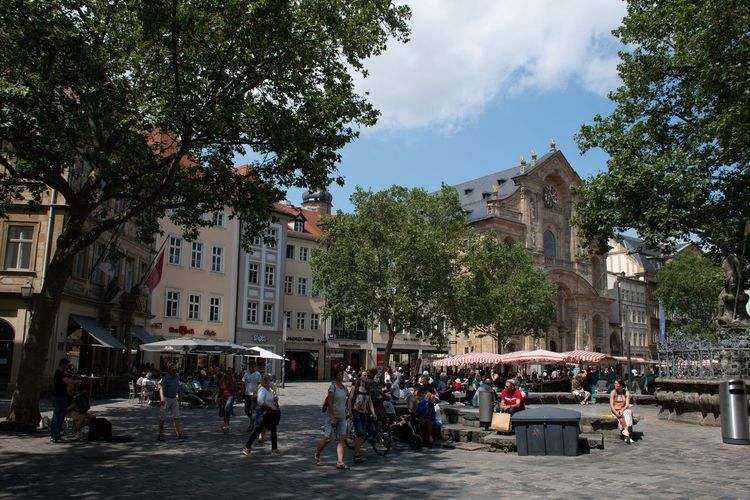
Heading back toward the centre, you pass through the Grüner Markt, a long pedestrian square lined with Baroque houses and adorned with a Neptune fountain that locals nickname "Gabelmann" — the man with the pitchfork. A fruit and vegetable market takes place there Monday to Saturday, a good spot for a quick lunch or to pick up some Bamberger Hörnla if your accommodation has a kitchen. The Baroque church of St Martin, built by the Jesuits, closes the perspective.
Spend the afternoon at the Bamberg History Museum, housed in the Alte Hofhaltung, the former court of the prince-bishops before the construction of the Neue Residenz. The collections trace the city's history from the founding of the bishopric in 1007 by Emperor Henry II through to the modern era. Allow about an hour and a half, a little more if you linger over the scale models that help you understand the hilly topography before heading back out on foot. Note that the museum is closed on Mondays.
Below, the Residenzschloss Geyerswörth (Geyerswörthstraße 5, 96047 Bamberg, rated 4.6/5 on Google from 57 reviews), a late-16th-century Renaissance castle built on an island in the Regnitz, now houses the tourist office. Take the opportunity to ask for the key to its tower: 132 steps separate you from a view over the Altes Rathaus, the two bridges, the cathedral hill, and, on a clear day, the Michaelsberg. It is little known, and it is the best way to take in the two-day itinerary at a single glance.
An Evening by the Regnitz
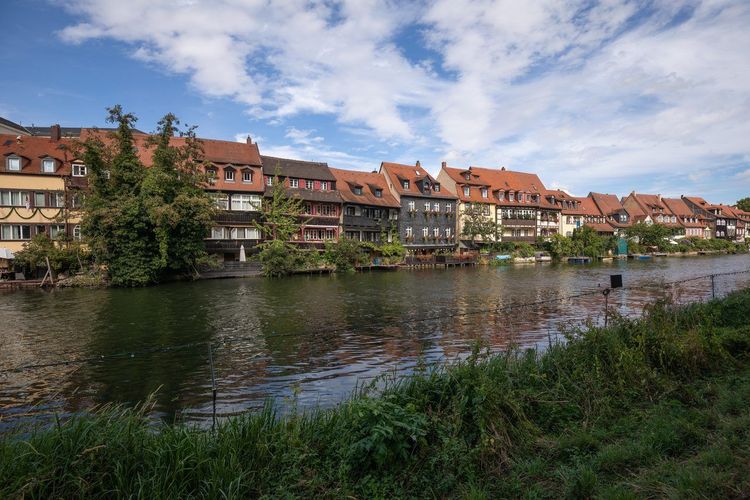
End the day along the Lebensader Regnitz, the "vital artery" of Bamberg. The riverbanks between the upper bridge and Geyerswörth Island concentrate most of the evening life: terraces, benches facing the water, small groups meeting up after work with a drink in hand.
This is a good moment to try a first brewery without committing to a full meal, just to get acquainted with Rauchbier before the following evening's dinner. If you'd like someone to tell you about what you've just seen, the Ryo audio guide tour of Bamberg passes right by the Altes Rathaus, the Klein Venedig viewpoint, and the cobbled lanes of the island, with an audio anecdote at every stop.
Day 2: The Cathedral Hill and the Rose Garden
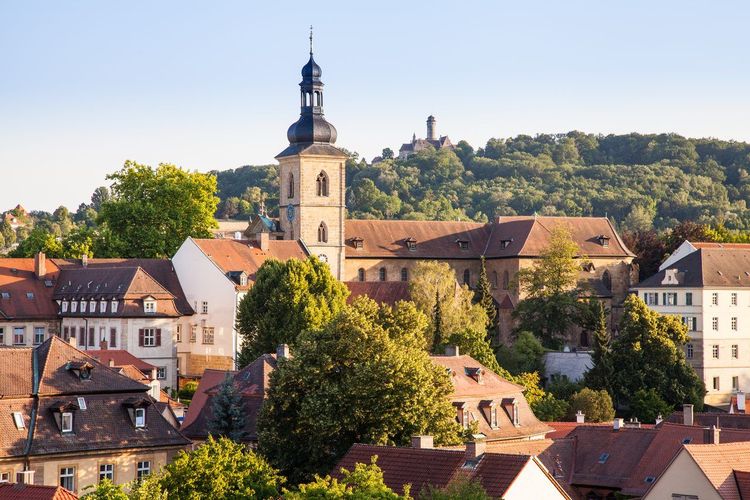
The second day gains altitude in the literal sense: head for the Domberg, the episcopal hill, which is considerably denser in monuments within a small area than the bourgeois quarter visited the day before.
Bamberg Cathedral and the Domplatz
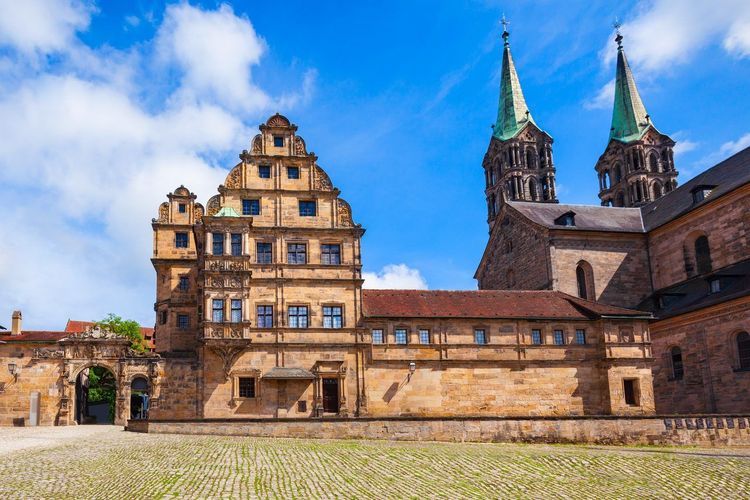
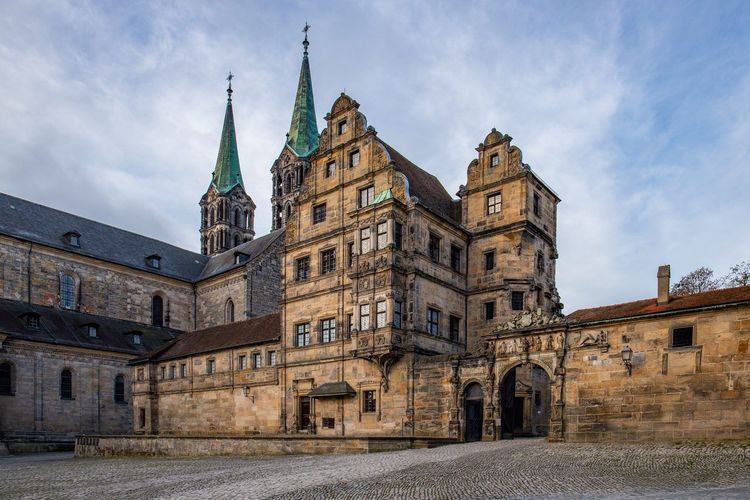
The morning opens with Bamberg Cathedral, one of the major monuments of northern Bavaria. The first building, commissioned by Henry II, was consecrated in 1012; after two fires, the current cathedral, transitional between Romanesque and Gothic, was consecrated in 1237. Its four towers make it recognisable from afar. Inside, don't miss the tomb of Emperor Henry II and his wife Cunigunde, sculpted by Tilman Riemenschneider between 1499 and 1513, nor the famous Bamberg Rider, an equestrian statue from the 13th century whose identity remains debated: emperor, king, or idealised saint — no one has ever settled the question.
The cathedral faces the Domplatz, surrounded by the city's densest architectural ensemble: the old court, the new residence, and the diocesan museum all face each other within a few dozen metres — a condensed eight centuries of ecclesiastical power on a single cobbled square.
On the side of the square, the Old Court (Alte Hofhaltung) presents a Renaissance facade whose sculpted portal is worth a look upward. Step through the gate: the inner courtyard, lined with late-medieval half-timbered galleries, is one of the most photogenic corners of the Domberg, and hosts open-air theatre performances in summer.
The Neue Residenz and the Rose Garden
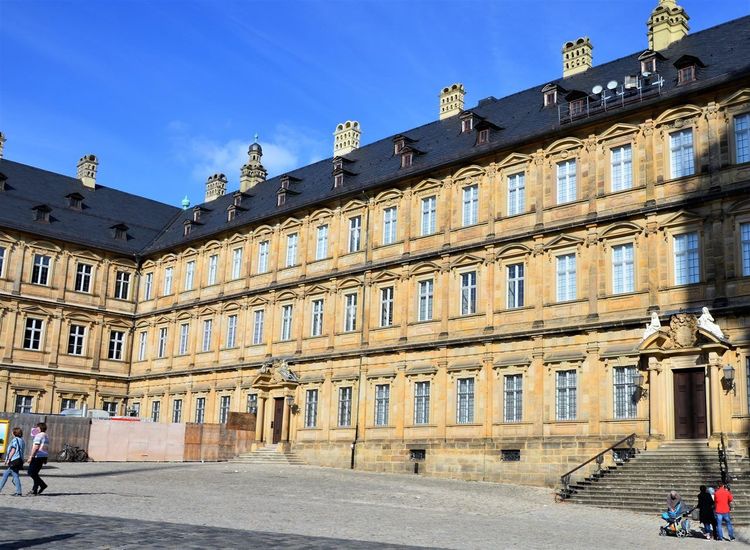
On the other side of the Domplatz, enter the Neue Residenz Bamberg (Domplatz 8, 96049 Bamberg, rated 4.6/5 on Google from 1,017 reviews), the residence of the prince-bishops built at the turn of the 18th century by Leonhard Dientzenhofer. Its state apartments, furnished and decorated with Baroque stucco, can be visited in a guided tour of about one hour. The Imperial Hall, with its portraits of Holy Roman Empire rulers, gives a vivid sense of the splendour these prince-prelates were able to display.
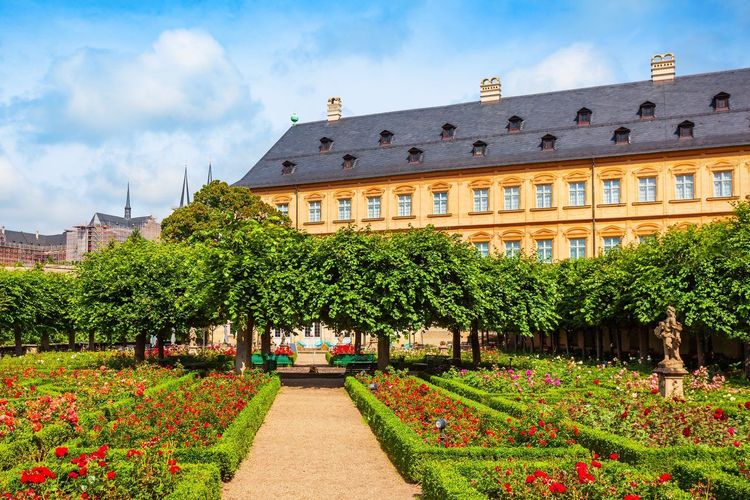
In the inner courtyard stretches the Rose Garden, laid out according to plans by Balthasar Neumann for Prince-Bishop Friedrich Karl von Schönborn. Each summer, around 4,500 rose bushes bloom between trimmed linden trees and a small pavilion, but the view over the city's red rooftops and the Michaelsberg is worth the detour even outside the flowering season. In summer, the Rosengartenserenaden offer evening concerts there: check the programme with the tourist office if you visit in July.
Before leaving the neighbourhood, stop at the Bamberg Diocesan Museum, which holds among other things the star-studded mantle of Emperor Henry II, a remarkably well-preserved medieval textile, as well as sculptures from the cathedral. The residential complex of the Domplatz, sometimes called the Palace of the Prince-Bishops of Bamberg, is a reminder that the city was for nearly eight centuries the seat of an ecclesiastical principality, until its annexation by Bavaria in 1802.
Michelsberg Monastery at Sunset
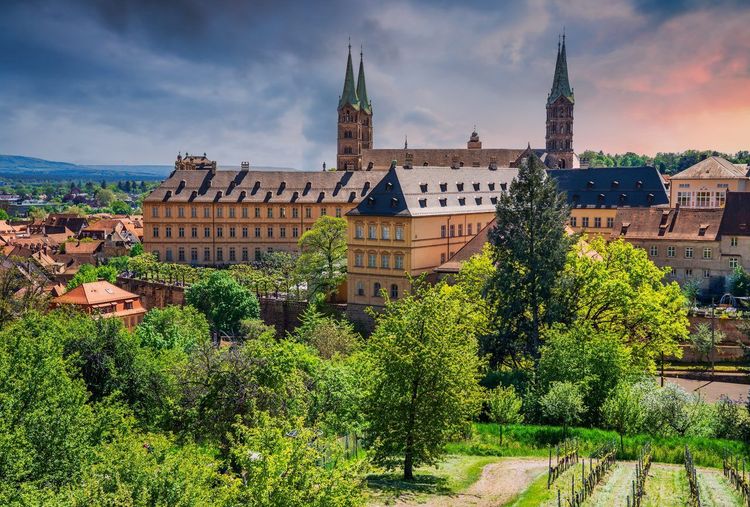
End the day by climbing up to Michelsberg Monastery, a former Benedictine abbey set on the hill neighbouring the Domberg. The walk from the Domplatz takes only about fifteen minutes along sloping lanes. Good news for 2026: St Michael's Church, closed in late 2012 after a stone fell from the vault, reopened on 1 May 2026. Look up at its "Himmelsgarten", a painted ceiling completed in 1617 depicting more than 580 plants, from medicinal herbs to pineapples and pomegranates. The church is open Friday to Sunday, and admission is free.
The Michaelsberg fountain on the garden terrace offers one of the finest panoramas in Bamberg, with the old town and its rooftops spread out below. It is the ideal spot to wait for sunset, especially as the former monastery also houses the Franconian Brewery Museum. The audio tour from the previous day continues across these hills too: the story of the cathedral's four towers, the imperial tomb, and a commented view from the rose garden — no need to look any of it up in a paper guide.
If You Stay an Extra Day: Altenburg and the Outlying Neighborhoods
A third day shifts the perspective: you leave the postcards behind for the city as lived daily by its nearly 80,000 inhabitants.
Altenburg, Villa Concordia, and the Green Outskirts
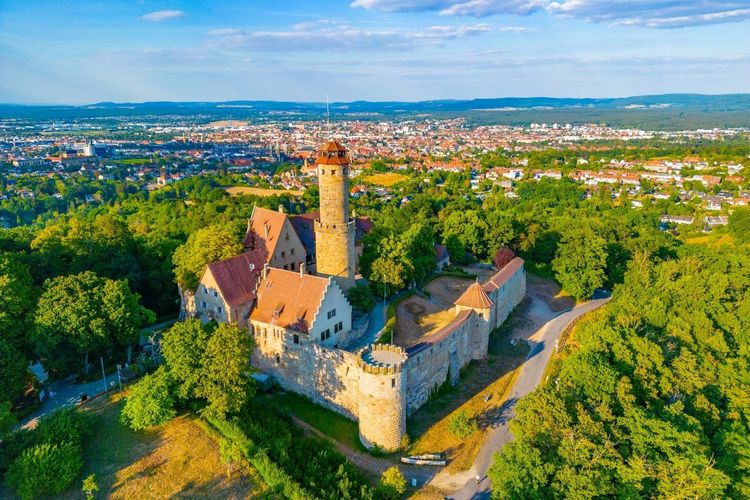
Start by climbing up to the Altenburg, a medieval castle perched on the highest of the seven hills at around 386 metres above sea level. A refuge for the bishops from the 13th century before being left to fall into disrepair, it was restored in a Romantic spirit in the 19th century. The walk on foot, along wooded paths, takes a good half-hour from the centre; the castle restaurant and the view over the valley reward the effort. If you prefer to save your legs, a bus line comes close.
Head back down toward the Erbainsel, the island of the former ERBA spinning mill transformed into a waterside park during the 2012 horticultural exhibition, before making your way to Villa Concordia (Concordiastraße 28, 96047 Bamberg, rated 4.4/5 on Google from 87 reviews), a Baroque palace built in the early 18th century for councillor Böttinger and now an international artists' residence. You won't visit the studios, but the facade reflected in the Regnitz, seen from the opposite bank, is worth the detour on its own.
Finish at the Hainpark, the large landscaped park laid out in the 19th century between the two arms of the Regnitz, appreciated by locals for its shaded paths and lawns — a welcome contrast after two days of cobblestones and climbs.
Karolinenstraße, Dominikanerstraße, and Maximiliansplatz
Later in the day, wander through the shopping streets without leaving the heritage atmosphere: Karolinenstraße, which climbs toward the cathedral, and Dominikanerstraße, where the Schlenkerla is located, are lined with independent shops, cafés, and old houses — less photographed than Klein Venedig but just as representative of the city.
The Maximiliansplatz, known to locals as Maxplatz, is dominated by the new town hall, housed in a former Baroque seminary by Balthasar Neumann. It hosts markets throughout the year and, in December, the Christmas market. Extending the weekend? The same audio tour can be listened to again in these less touristy neighbourhoods, with no extra itinerary to plan.
Other things to do in Bamberg if time allows: a boat trip on the Regnitz from the Kettenbrücke quay, the market-gardeners' quarter and its dedicated museum, or, during Advent, the nativity trail that links around forty sites in the old town.
Where to Eat and Drink in Bamberg: Breweries and Rauchbier
Bamberg still has around a dozen active breweries within the city — a rare density for a town of this size, and arguably the best culinary reason to come.
Visiting a Bavarian Brewery and the Famous Rauchbier
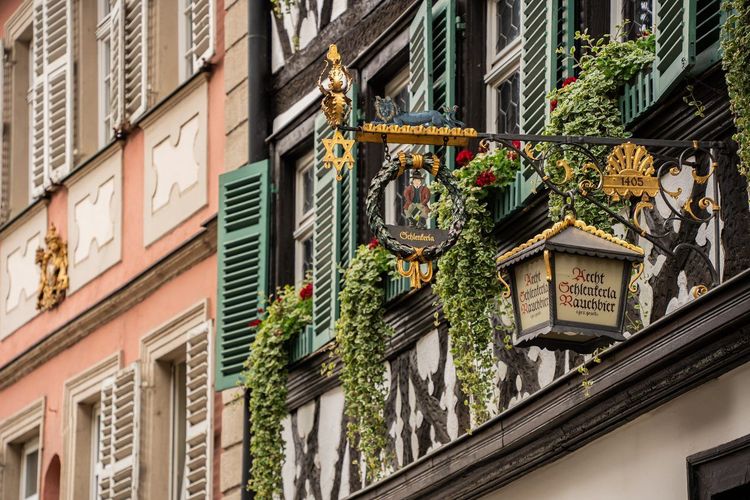
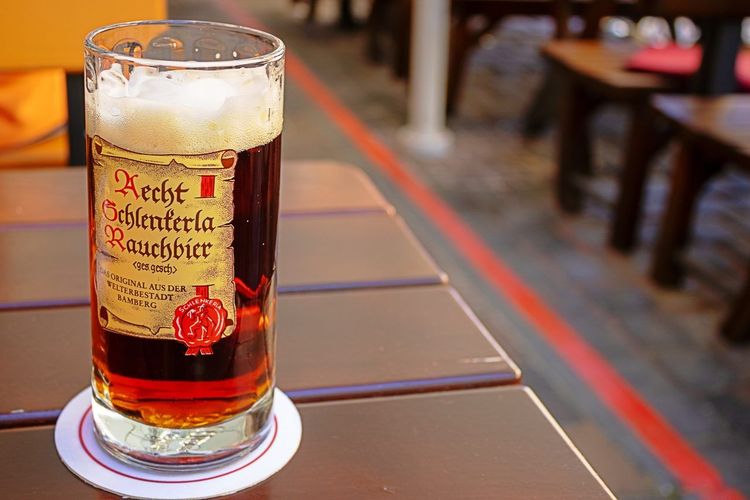
The Schlenkerla, a tavern mentioned as far back as 1405, serves the city's best-known Rauchbier, a dark beer whose malt is dried over a beech wood fire, giving it a pronounced smoky flavour reminiscent of smoked ham for the uninitiated. It is drawn directly from wooden barrels, in the wood-panelled rooms or in the courtyard, and queues on Friday evenings are not unusual given how popular the place is.
Another option greatly favoured by locals, the Spezial-Keller (Sternwartstraße 8, 96049 Bamberg, rated 4.3/5 on Google from 3,293 reviews), the Spezial brewery's beer garden perched on the Stephansberg, offers a milder Rauchbier and above all a view over the entire old town and cathedral from its outdoor tables. Many Bamberg residents prefer it to the Schlenkerla, which they consider more touristy, and the climb from the centre already gives you a taste of the city's hilly geography.
If you only have time for one or two addresses, bear in mind that each brewery has its own recipe and its own regulars: Fässla, Mahrs Bräu, and Klosterbräu are all worth a visit too. To avoid missing out on their history, the audio stop dedicated to smoked beer in the Ryo audio guide tour of Bamberg tells the story of how Rauchbier survived the centuries. For more, our selection of the best things to do in Bamberg lists other addresses less known to passing visitors.
Local Dishes You Must Try

On the food side, the emblematic speciality remains the Bamberger Hörnla, small horn-shaped potatoes grown locally with a slightly nutty flavour, served as a warm salad or as a side to a roast. Some restaurateurs make them a selling point in their own right.
Other classics worth trying: Schäufele, roast pork shoulder with crispy skin served with a Kloß (potato dumpling), Sauerbraten, pot roast marinated for several days in vinegar and spices, and the Bamberger Zwiebel, a whole onion stuffed with minced meat and doused in a Rauchbier sauce — far more filling than it looks. On the drinks side, also try an unfiltered cellar beer (Kellerbier) and, in season, Franconian wines in the Bocksbeutel, the distinctive round flat bottle typical of the region.
Where to Stay in Bamberg: Neighborhoods and Budget
As the old town is compact, almost all accommodation is within twenty minutes' walk of everything else, which makes your choice much simpler.
The Best Neighborhoods to Stay In
The historic centre, between the Grüner Markt and the Domplatz, remains the most comfortable for a weekend: you are within walking distance of everything, at the cost of paying slightly more and putting up with terrace noise on Friday and Saturday evenings. The Sand quarter, at the foot of the Domberg and by the river, offers characterful addresses five minutes from the upper bridge, with small family-run guesthouses.
For a tighter budget, hotels near the station, about fifteen minutes' walk from the centre, are generally 20 to 30% cheaper without significantly lengthening your days.
Accommodation Budget: Budget, Mid-Range, Luxury
On a budget, expect around €60 to €90 per night for a double room in a guesthouse or simple hotel, often slightly out of the centre. For a mid-range budget, around €100 to €160 per night, you can access 3–4 star establishments right in the centre, sometimes in listed buildings with exposed beams. Luxury options start from around €200 per night, with a few charming addresses in former patrician residences, some with views of the cathedral.
Book three to four weeks in advance in high season (May to September), and much earlier for the Sandkerwa weekend at the end of August or during the Christmas market, otherwise the best central addresses will be fully booked. Staying near the town hall island also places you at the natural starting point for most walking tours.
How to Get to and Get Around Bamberg
Bamberg has no commercial airport, which means going through a neighbouring city to reach Franconia from France.
From the Airport and Nearby Major Cities
The nearest airport is Nuremberg, about sixty kilometres away: allow roughly one hour combining the metro to the central station and a train to Bamberg, or 45 minutes by car via the A73. Direct flights from France to Nuremberg are rare; most itineraries connect through Frankfurt or Munich, for a total flight time of 3 to 4h30 including the layover. Without a stopover, Paris–Frankfurt or Paris–Munich takes about 1h15 to 1h30.
Other ways to arrive: the train is often the most practical option once in Germany. The direct ICE links Munich to Bamberg in about 1h50 on the fast Munich–Berlin line, and Frankfurt is just over two hours away, generally with a connection at Würzburg or Nuremberg. By car from Paris, allow 7 to 8 hours via Strasbourg and Würzburg, a journey that lends itself well to a stopover if you want to turn the weekend into a road trip.
Getting Around Bamberg Once You're There
Once in the city, walking is sufficient for the entire weekend: the old town can be crossed end to end in under an hour. Urban buses, converging at the central bus station (ZOB) near the Promenade, are mainly useful for reaching the station with luggage or heading up to the Altenburg. Wear comfortable shoes: the cobblestones and slopes of the Domberg and Michaelsberg are hard on thin soles.
There is no time difference between France and Germany, as both countries share the same time zone (UTC+1, UTC+2 in summer).
When to Go: The Best Time for a Weekend in Bamberg
Spring, from April to June, remains the most pleasant period: temperatures hover between 12 and 20°C, the rose garden begins to bloom toward the end of the season, and crowds remain manageable compared to the height of summer.
Summer (July–August) brings temperatures around 22–25°C, perfect for evening beer gardens, but also the highest visitor numbers — especially during the Sandkerwa, the big popular festival in the Sand quarter, scheduled for 20 to 24 August 2026, which draws over 200,000 visitors. Autumn (September–October) offers very photogenic light on the Baroque facades, with temperatures dropping back to 10–15°C and quieter crowds.
Winter is still possible, especially for the Maxplatz Christmas market and the nativity trail during Advent, but temperatures hover around 0 to 5°C and the rose garden loses its appeal. For a first weekend in Bamberg, May–June or September remain the safest choices.
Day Trips from Bamberg: Nuremberg, Regensburg, and the Romantic Road
Bamberg lends itself well to day trips, its position in Franconia placing it within reasonable distance of several major historic cities.
Nuremberg and Regensburg, the Two Great Neighbours
Nürnberg (Nuremberg), 25 to 45 minutes away by train depending on the service, offers an interesting contrast with Bamberg: an old town largely rebuilt after the war, but equally rich in heritage, with its imperial castle dominating the city and its Christkindlesmarkt renowned throughout Germany.
Regensburg (Ratisbonne), about two hours by train with a connection at Nuremberg, is the other major UNESCO historic centre in the region, built around a 12th-century stone bridge and a Gothic cathedral with soaring spires. A day trip there and back is feasible but tight; Regensburg is better worth an overnight stay if you have an extra day.
Würzburg and the Romantic Road
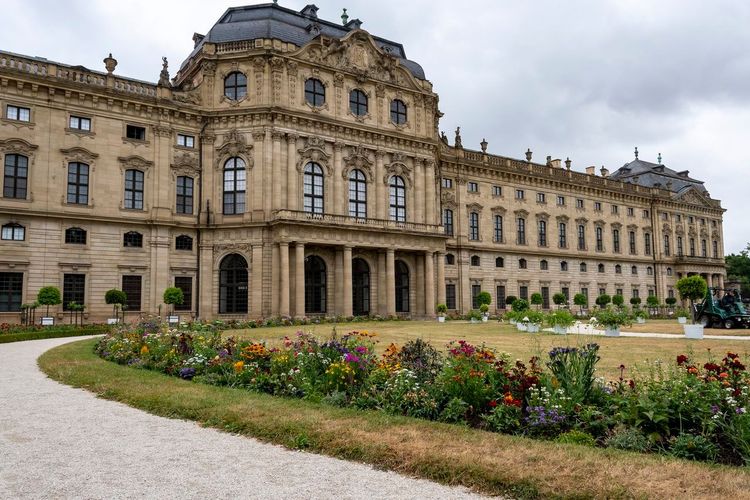
Würzburg, about an hour by train, marks the starting point of the Romantic Road, a tourist route of around 460 km that heads south to Füssen and Neuschwanstein Castle, passing through Rothenburg ob der Tauber. The Residence of the prince-bishops of Würzburg, UNESCO-listed and decorated with Tiepolo frescoes, makes for a useful comparison with the Neue Residenz in Bamberg.
Toward Lake Constance and the Bavarian Alps
For a longer stay, Lindau am Bodensee, on Lake Constance, and the German Alpine Road are natural extensions southward into Bavaria, as is a detour through Ottobeuren and its Baroque abbey renowned for its organs. The Munich area, less than two hours away by ICE, makes it easy to combine Bamberg with the Bavarian capital if the trip extends beyond three or four days. What to discover around Bamberg depends mainly on your time: a day is enough for Nuremberg or Würzburg, but allow at least two extra days for southern Bavaria.
Practical Information for Your Weekend in Bamberg
A few points to check before you leave, often overlooked when planning a short trip where every hour counts.
Money, Language, and Connectivity
Germany uses the euro. However, several traditional breweries and small shops in Bamberg still prefer cash or the German debit card (Girocard): keep some cash on you, especially for small bills.
On the language front, English is well understood in central hotels and restaurants, somewhat less so in neighbourhood breweries. A few words of German (bitte, danke, ein Rauchbier bitte) are always appreciated. Mobile coverage is good throughout the old town and roaming is included in European plans, allowing you to follow an audio itinerary without fear of losing signal between two lanes.
Local Culture and Practical Tips
On the formalities side, no visa is required for European Union citizens: a valid identity card is sufficient. In breweries, sharing large tables with strangers is common practice; simply ask if the seat is free. Also watch out for tables marked "Stammtisch" — reserved for regulars.
For solo female travellers, Bamberg is considered a safe city, including in the evenings in the historic centre. Good to know: several museums are closed on Mondays and many shops on Sundays — worth bearing in mind if you only have a short weekend.



FAQ
How Many Days Do You Need to Visit Bamberg?
Two full days are enough for the essentials: the Altes Rathaus, the cathedral, the rose garden, and the Michaelsberg. A third day lets you explore the Altenburg and the more outlying neighbourhoods, and try several breweries at a relaxed pace.
What Is the Best Time for a Weekend in Bamberg?
May–June and September offer the best balance between pleasant weather and manageable crowds. Summer is warmer but busier, especially during the Sandkerwa at the end of August, while winter is cold but lively with the Christmas market.
How Do You Get to Bamberg from Nuremberg or Munich?
From Nuremberg, allow 25 to 45 minutes on a direct train. From Munich, the direct ICE takes about 1h50. Bamberg station is around fifteen minutes' walk from the old town.
Where Should You Stay in Bamberg to Make the Most of the Old Town?
The area between the Grüner Markt and the Domplatz is the most convenient, within walking distance of all the main sights. For a tighter budget, hotels near the station are often 20 to 30% cheaper.
What Must You Absolutely Taste in Bamberg?
Rauchbier, the smoked beer served notably at the Schlenkerla, ideally paired with a Bamberger Zwiebel or a Schäufele with Bamberger Hörnla.
Is Bamberg Worth the Trip Compared to Nuremberg or Regensburg?
The three cities complement rather than compete with each other. Bamberg stands out for its density of historic breweries, its compact size, and an old town almost untouched by the war, making it the easiest to discover in a single weekend.
What Budget Should You Plan for a Weekend in Bamberg?
Including accommodation, meals at a brewery, and a few museum admissions, a budget of €150 to €250 per person for two days is realistic for a comfortable stay, excluding transport from France.
Bamberg in Two Days: The Key Takeaways
Bamberg doesn't need a long stay to win you over: two days are enough to understand why UNESCO listed its almost intact old town, and why its breweries attract beer lovers from around the world just as much as its monuments draw architecture enthusiasts. To organise this weekend without spending hours on an itinerary, simply launch the Ryo audio guide tour of Bamberg and connect its twenty stops at your own pace, headphones on.