© Shutterstock
 Votre guide Ryo
15 Must-Do Things in Lucca in 2026
Lucca resists the mass tourism trend. Wondering what to do in Lucca to experience authentic Tuscany, away from the crowds? While Florence buckles under its visitors and Pisa is reduced for many to its leaning tower alone, this Tuscan city of 90,000 inhabitants retains a striking historical density within a pedestrian perimeter of just a few square kilometers. Its Renaissance walls, built between 1504 and 1645, encircle a center where cars are not allowed, where you can cycle freely and stroll without jostling. To explore the city with stories in your ears from the very first steps, the Ryo audio-guided tour of Lucca offers a narrated walk covering the historic districts at your own pace.
Beyond the postcards, Lucca holds some factual surprises: the Piazza dell'Anfiteatro rests on the tiers of a 2nd-century Roman amphitheater whose walls now form the facades of the surrounding houses; the Torre Guinigi bears seven living holm oaks at a height of 44 meters, planted there since the 14th century; and the basilica of San Frediano displays on its facade a Byzantine mosaic eight centuries old that most French-language guidebooks overlook. These fifteen experiences define what it truly means to visit Lucca.
1. Walking along the City Walls
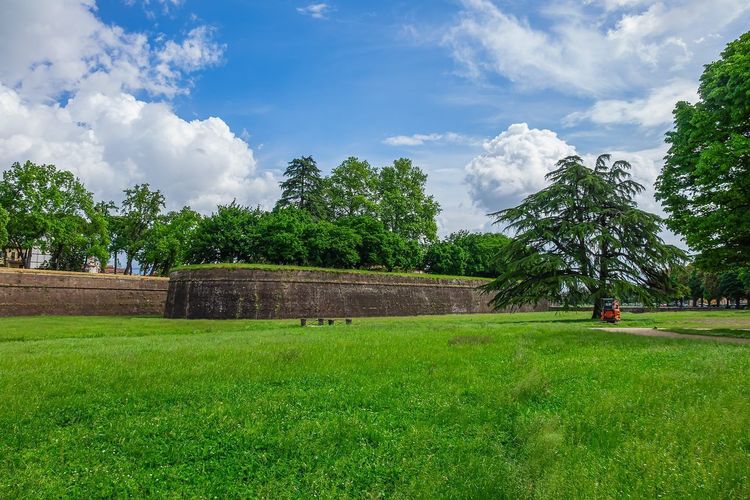
The Lucca city walls rank among the best-preserved Renaissance fortifications in Europe. Built between 1504 and 1645 on the remains of medieval ramparts, they encircle the entire historic center over a length of 4.2 kilometers. What sets them apart from all other Tuscan walls: the top of the rampart walk reaches a width of about 30 meters, wide enough to accommodate a double row of century-old plane trees, lawns, benches and improvised play areas. Eleven bastions mark the route, each bearing a proper name inherited from the saints and the communal history: Baluardo San Regolo, Baluardo San Paolino, Baluardo San Salvatore...
The construction of these walls was a response to a defensive emergency. The 16th century saw Italy torn by conflicts between great powers, and Lucca, the only Tuscan city to have resisted absorption by Florence, invested heavily in modern fortifications adapted to artillery. The old medieval walls, designed against archers and cavalry, were no longer sufficient. Low, broad bastions were built to absorb cannonballs without shattering. The result is a military work that never faced a major assault and has passed through the centuries intact.
What visitors discover the first time they climb up is a park suspended above the rooftops. The people of Lucca picnic here on weekends, retirees gather in late morning, families cycle after school. This dual function — between a living public space and a major military remnant — gives the walls an atmosphere impossible to replicate anywhere else.
The full circuit on foot takes about one hour without stopping. By bike, twenty minutes are enough to complete the loop. Ramps allow you to climb from the center every 400 to 500 meters. You can split the route into segments according to your itinerary: descend at the level of the basilica of San Frediano, explore the neighborhood, climb back up 300 meters further along. Most visitors start from Porta San Pietro, to the southeast, or from Porta Santa Maria, on the north side, but no direction is required.
The light changes dramatically depending on the time of day. In the morning, a light mist often obscures the Tuscan hills to the west and the bell towers stand out against a still-pale sky. In the late afternoon, the orange light brings out the terracotta-colored roof tiles and the dozens of bell towers breaking the skyline. From Baluardo San Frediano, on the north side, the mosaic facade of the basilica is directly visible. From Baluardo San Martino, to the east, the Monte Pisano is visible on clear days.
Access is completely free, open every day from sunrise to sunset. No reservation, no ticket. In July and August, prefer the slots before 9am or after 6pm to avoid the day-trip groups coming from Pisa. Remember to bring water: the western side of the walls is exposed to the sun in the afternoon for several hours at a stretch in summer.
2. Climbing the Torre Guinigi
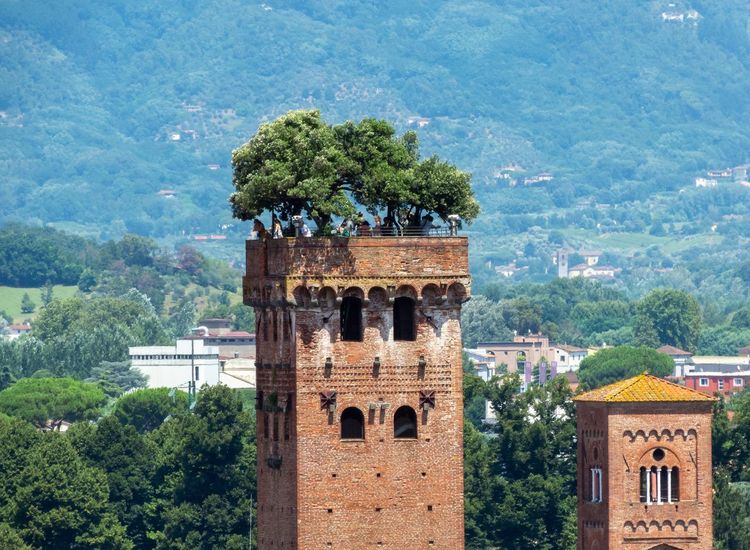
The Torre Guinigi (Via Sant'Andrea 45, 55100 Lucca, rated 4.6/5 on Google with 11,492 reviews) is the most immediately recognizable image of Lucca, for a singular reason: seven holm oaks (Quercus ilex) have been growing at the top since the 14th century, 44 meters above the ground. The Guinigi family, who politically dominated the city at the time, had this tower built as a sign of power. It was not unusual for Tuscan noble families to own their own tower in an urban setting — Bologna had hundreds, San Gimignano still retains fourteen. But planting trees at the top remained a singular gesture, whose exact symbolism has never been fully decoded.
The 230 steps of the spiral staircase lead to a panoramic terrace where the centuries-old oaks cast unexpected shade. The view takes in the entire historic center, the walls forming a green crown, and the hills of the Garfagnana to the north. On clear days, the Monte Pisano to the east and the coastal plain toward the Tyrrhenian Sea to the west complete the panorama.
The ticket costs €5 per person (combined ticket with the Torre delle Ore: €8). The tower is open every day, with hours that vary by season: generally from 9:30am to 5:30pm in low season, until 7:30pm in summer. Children under 6 enter free. The staircase is narrow and spiral-shaped; you may need to stop occasionally to let descending visitors pass.
Arrive early in the morning to avoid the concentration of visitors between 11am and 2pm. The terrace at the top is small and can quickly become overcrowded when a group climbs up. The morning light is also more favorable for photography toward the west.
3. Exploring the Piazza dell'Anfiteatro
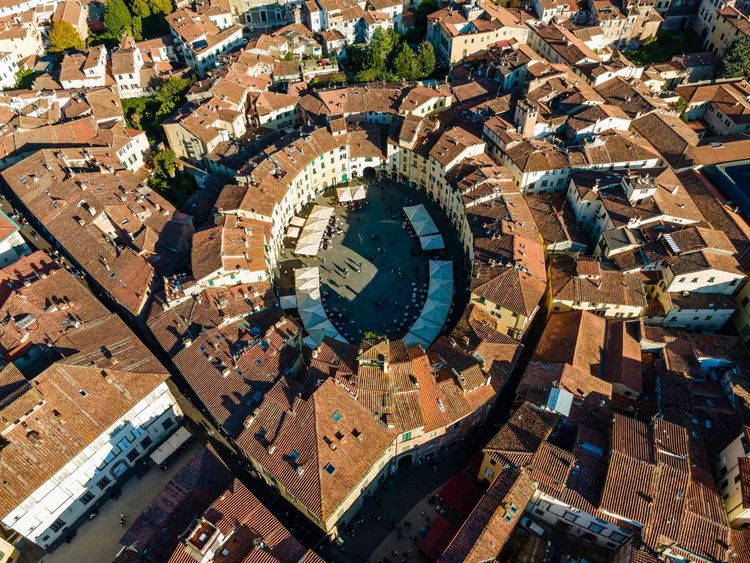
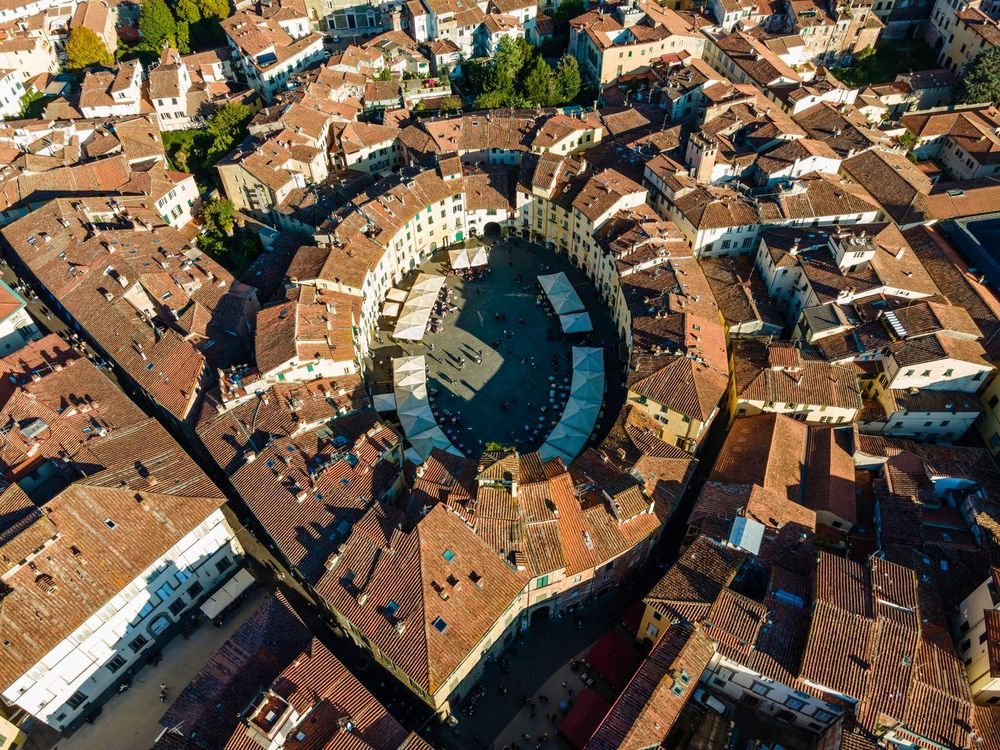
The Piazza dell'Anfiteatro (Piazza dell'Anfiteatro, 55100 Lucca, rated 4.6/5 on Google with 33,434 reviews) is a fascinating urban anomaly. At first glance, nothing betrays its origins: medieval facades in pink, ochre and terracotta that delimit an elliptical space dotted with bustling café terraces. But the ellipse itself is the first clue. This shape owes nothing to chance — it reproduces exactly the plan of a Roman amphitheater from the 2nd century AD, whose tiers and outer walls today form the foundations of the surrounding buildings.
In Roman times, the amphitheater could hold about 10,000 spectators. It survived the centuries in fragmented form: in the Middle Ages, its stones were salvaged for other buildings, its arches were bricked up or converted into housing, and its tiers disappeared under successive accumulations. What endured was the outline, fossilized in the fabric of the medieval city. In 1830, the ducal architect Lorenzo Nottolini cleared the central square by demolishing the parasitic structures inside, revealing the circular space that the people of Lucca use today as an open-air living room.
Four vaulted passages provide access to the piazza from the surrounding streets, reproducing the entrances of the original amphitheater. Enter preferably via Via Fillungo, the main shopping street: the element of surprise when you emerge onto the oval square is at its greatest. In the evening, when the terraces come alive and the light warms the facades, the piazza becomes the natural gathering place of Lucca's social life. Craft markets are regularly held here on weekends.
Access is free and permanent. If you want to understand the historical layering, look for the bricked-up Roman arches at ground-floor level in the facades — some buildings retain traces of walled arcades visible from the outside. A walk around the outer perimeter of the square reveals the changes in level that betray the different phases of construction. The square is one of the 17 stops on our audio walking tour, which reaches it along Via Fillungo.
4. The Cathedral of San Martino, the Duomo of Lucca
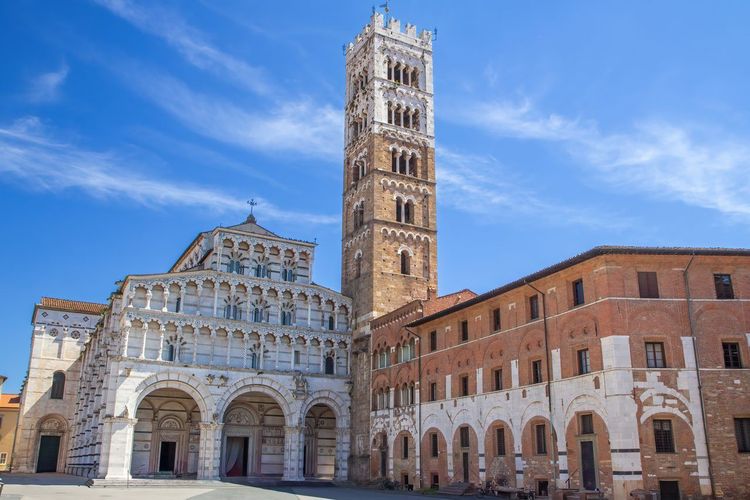
The Cathedral of San Martino (Piazza San Martino, 55100 Lucca, rated 4.6/5 on Google with 12,591 reviews), the Duomo di Lucca, was founded in the 6th century, but the current building is the product of a Gothic reconstruction begun in the 13th century and continued until the 15th. The facade, in green and white marble in the Pisan Romanesque style, is striking for its deliberate asymmetry: the bell tower occupies such a large portion of the right side that the central porch is shifted to the left. This imbalance is explained by the chronology of the construction — the bell tower existed before the facade, and the architects had to work around it.
Inside, two treasures justify the visit on their own. The first is the Volto Santo, a cedar wood crucifix housed in a marble tempietto at the center of the nave. Tradition attributes this sculpture to Nicodemus, the disciple of Christ who witnessed the Crucifixion, though historians date it more to the 11th or 12th century. The Volto Santo has been the object of intense devotion in Lucca since the Middle Ages: a torchlit procession is dedicated to it every year on 13 September at nightfall.
The second treasure is the tomb of Ilaria del Carretto, a masterpiece by Jacopo della Quercia sculpted between 1405 and 1406. The marble effigy represents the young wife of Paolo Guinigi, who died at the age of 26, with a dog lying at her feet as a symbol of fidelity. The serenity of the face and the softness of the drapery inspired many artists; John Ruskin cited it as one of the most beautiful sculptures in Italy in the 19th century.
Access to the nave is free. The adjoining museum, which houses the tomb of Ilaria and other treasury works, is paid (€3). The Duomo is closed on Sunday mornings during services.
5. The Church of San Michele in Foro
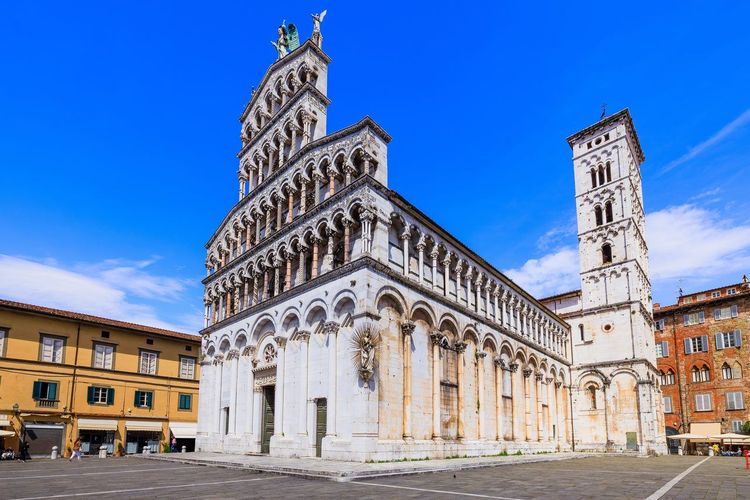
The Church of San Michele in Foro (Piazza San Michele, 55100 Lucca, rated 4.6/5 on Google with 5,410 reviews) takes its name from its location on the site of the city's ancient Roman forum. The facade is one of the most spectacular in all of Tuscan Romanesque architecture: four tiers of superimposed galleries, each decorated with sculpted colonnettes, none of which is identical to its neighbor. Some are twisted, others are diamond-patterned, others still feature geometric motifs inlaid with polychrome marble. The ensemble is surmounted by a porch covered with sculptures of beasts, acrobats and biblical scenes. At the top of the facade, the statue of Saint Michael the Archangel with outstretched wings presides over the square.
Construction began in the 11th century and stretched over several centuries, which explains the stylistic diversity that makes the facade so fascinating to analyze up close. Each tier of galleries was executed by different sculptors; the materials vary slightly from decade to decade. Take the time to scan the galleries column by column to perceive these variations.
Inside, the church is sober compared to the exuberance of its facade. It houses a painting by Filippino Lippi, Saints Helena, Jerome, Sebastian and Roch (1483), in the right transept. The atmosphere is peaceful and visitors are few — it is one of the rare places in Lucca where you can sit for a few minutes in near-perfect silence. Entry is free. As you leave the Piazza San Michele, you will pass the famous Taddeucci shop, founded in 1881, to pick up a buccellato to take away.
To explore this part of the old town with commentary on the history of the Roman forum and the merchant families who prospered here, the Ryo audio guide for Lucca covers this neighborhood around the ancient public square.
6. The Basilica of San Frediano
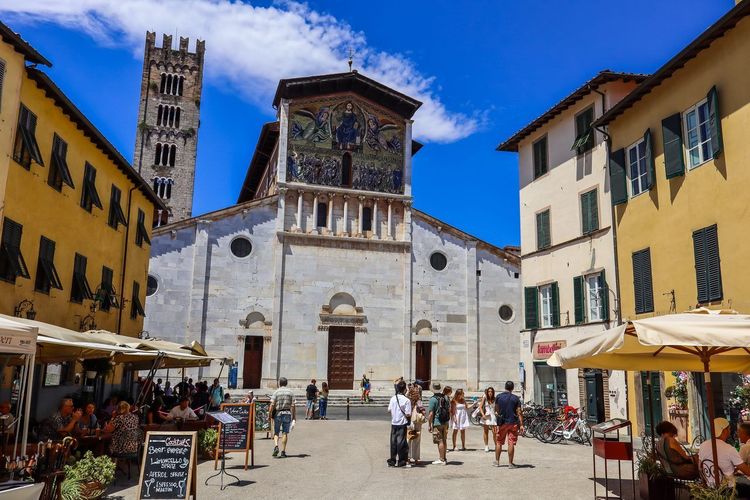
The Basilica of San Frediano surprises with its exterior. Where San Michele in Foro spreads a repertoire of colonnettes and sculptures, San Frediano relies on a single effect: a mosaic in gold and colored glass tesserae depicting the Ascension of Christ, framed by the apostles on a gold background, set on the upper facade above a plain stone cladding. This Byzantine mosaic, executed in the 13th century under the influence of Roman workshops, measures 8 meters in height. Most comparable mosaics in central Italy have disappeared; San Frediano's is one of the few to have survived in this condition.
Inside, the basilica is organized into three naves separated by Roman columns salvaged from ancient buildings. The baptismal font from the 12th century is a masterpiece of Romanesque sculpture: a circular basin surrounded by reliefs depicting scenes from the life of Moses and the Good Shepherd. In a side chapel rests the mummified body of Santa Zita, patron saint of servants, who died in 1278. Tradition attributes to her the miracle of the roses: flowers are said to have replaced the bread she secretly carried to the poor.
Entry is free. The basilica is open throughout the day outside of service hours. It is less visited than the Duomo or San Michele, which gives it a more contemplative atmosphere.
7. The Torre delle Ore
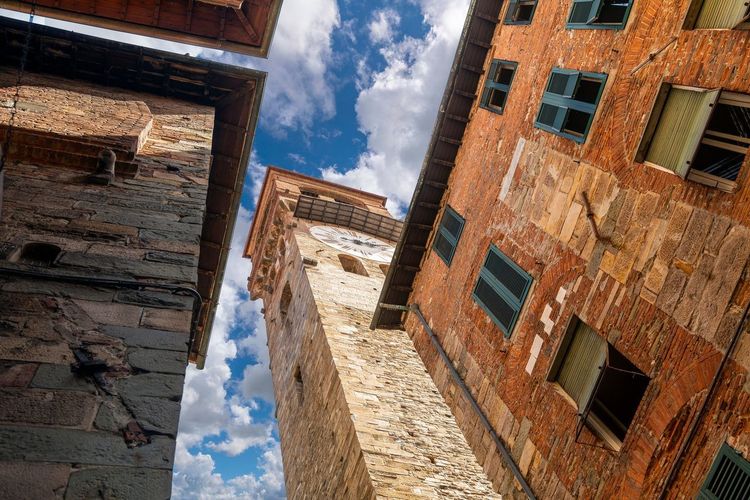
The Torre delle Ore is the tallest tower in Lucca: 50 meters high with 207 steps to the top. Its name comes from the mechanical clock installed at its summit, which has been in operation since 1390 — the current mechanism dates from a restoration in 1752. The tower is located on Via Fillungo, the main shopping street, making it a natural stop if you are browsing the boutiques of the center.
The ticket costs €5 (or €8 combined with the Torre Guinigi). The view from the top offers a different angle from that of the Torre Guinigi: you can see the layout of Via Fillungo and the rooftops of the northern districts more clearly. Clock mechanism enthusiasts will appreciate the clockwork displayed halfway up the staircase. Via Fillungo, at the foot of the tower, is where our commented loop through Lucca picks up again.
8. The Palazzo Pfanner
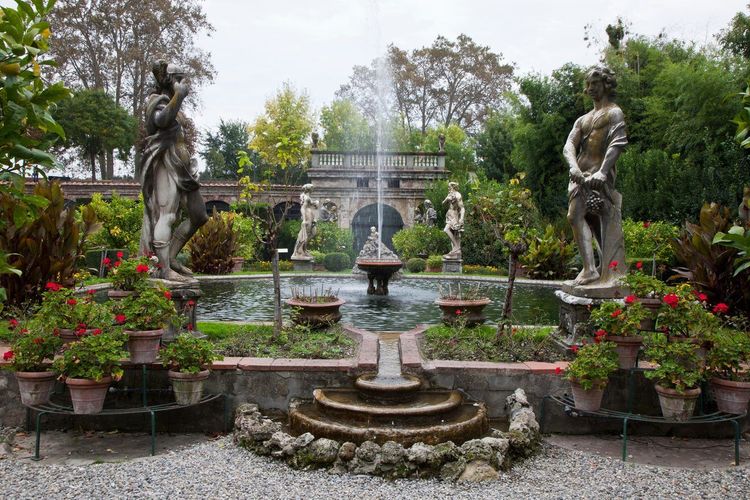
The Palazzo Pfanner (Via degli Asili 33, 55100 Lucca, rated 4.4/5 on Google with 2,471 reviews) is an anomaly in the dense urban fabric of Lucca: a 17th-century palace with a vast Baroque open-air garden, visible from the city walls. Built in 1667 for the Moriconi family, it was acquired in 1860 by Felix Pfanner, an Austrian brewer who set up an artisan brewery here that remained in operation until 1929. The Pfanner family still lives on the premises today, making it one of the few private residences in Lucca open to the public.
The garden is the main attraction. Laid out in the Tuscan Baroque style, it is organized around a central axis leading from a basin fountain to a nymphaeum at the far end. Stone statues of Greek and Roman deities in Carrara marble line the pathways: Bacchus, Diana, Venus, Apollo... Each statue is framed by clipped boxwood hedges and potted orange trees. In spring, magnolias and lemon trees bloom. The garden is also partly visible from the city walls: at the level of Baluardo San Paolino, look inward to catch a glimpse of the statues and alleys between the rooftops.
The palazzo's apartments are also worth visiting. The rooms on the first floor are decorated with 18th-century frescoes depicting mythological scenes and landscapes of the Lucca countryside. Period furnishings are in place: family portraits, musical instruments, a library, crockery. The atmosphere is that of a lived-in home rather than a reconstructed museum — the contrast with the national collections in nearby museums is striking.
Jane Campion filmed scenes from The Portrait of a Lady (1996, with Nicole Kidman) in the gardens of the Palazzo Pfanner. An anecdote that has brought the place to the attention of an international audience ever since.
Admission: €6 for the garden only, €9.50 for the garden and the apartments. Open daily from 10am to 6pm from April to November.
9. The Museums of Lucca
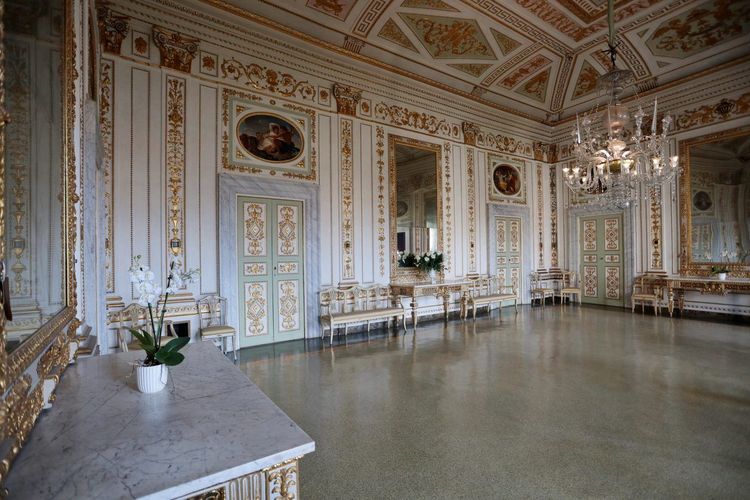
When wondering what to do in Lucca on a rainy day, the answer lies in two complementary national museums, often overlooked in favor of the outdoor monuments.
The Palazzo Mansi (Via Galli Tassi) houses the Museo Nazionale di Palazzo Mansi, installed in a 17th-century noble palace whose apartments are themselves remarkable. The ballroom and the camera degli sposi, the bridal chamber with its embroidered velvet hangings and monumental candelabras, provide an exceptional testament to the lifestyle of Tuscan elites under the duchy. The painting collection spans the 15th to 18th centuries and includes works by Tintoretto, Pontormo and Andrea del Sarto, as well as Flemish Renaissance paintings. Admission: €4.
The Villa Guinigi (Via della Quarquonia 4, 55100 Lucca, rated 4.4/5 on Google with 339 reviews) (Via della Quarquonia), a 15-minute walk east of the center, is a 15th-century villa built by Paolo Guinigi, the lord whose late wife Ilaria del Carretto rests at the Duomo. It houses the Museo Nazionale di Villa Guinigi, which brings together the city's archaeological and medieval collections. These include Roman mosaics from local excavations, medieval sculptures, painted panels from the 14th to 16th centuries, liturgical objects and a rare Romanesque ivory head of Nicodemus. Admission: €4.
To put these collections into context with stories about the great dynasties that shaped Lucca — the Guinigi, the would-be Medici, the Bonapartes — the Ryo audio-guided tour of Lucca includes audio commentary on the city's political and artistic history.
10. The Botanical Garden
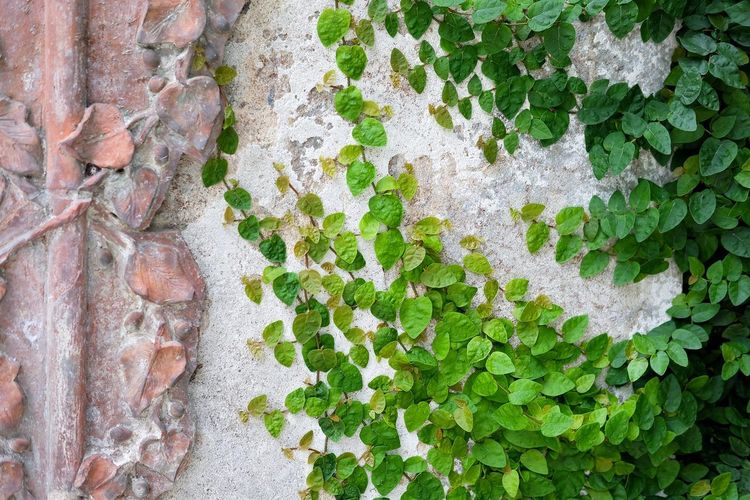
The Orto Botanico di Lucca is one of the oldest botanical gardens in Tuscany, founded in 1820 by Marie-Louise de Bourbon, Duchess of Lucca, on approximately 2 hectares within the city walls. It is home to more than 300 plant species arranged according to Linnaean classification: medicinal plants, remarkable trees, orchid collections and succulents.
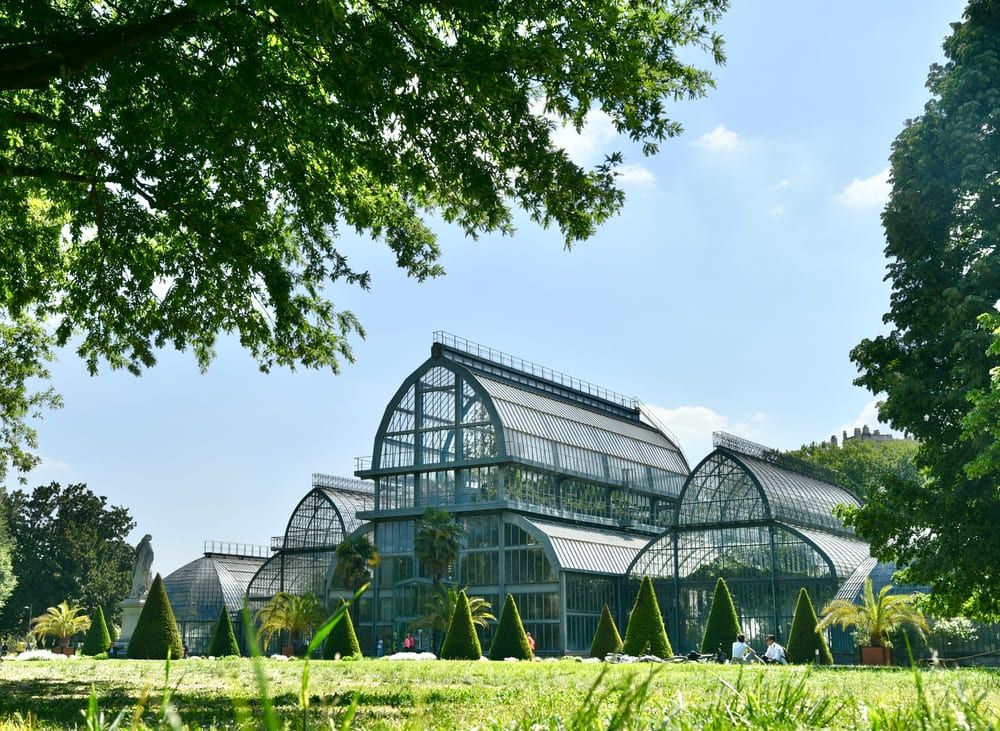
Its shaded paths and ponds make it a popular refuge for locals on hot days. For children, the carnivorous plant section and the giant water lily pond regularly generate enthusiasm. The old greenhouse, built in the 19th century, houses tropical species and a collection of cacti.
Admission: €4 for adults, €3 for ages 6–14, free for children under 6. Open Monday to Sunday from 10am to 6pm (hours vary by season). The vast majority of pathways are wheelchair accessible.
11. The Piazza Napoleone
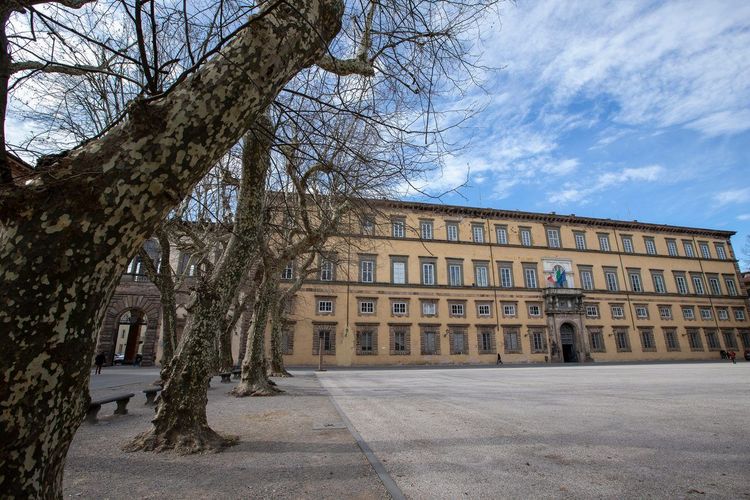
The Piazza Napoleone (Piazza Napoleone, 55100 Lucca, rated 4.5/5 on Google with 5K reviews), also called Piazza Grande by locals, is the main square of Lucca, bordered by the Palazzo della Provincia, the former ducal palace. Its name commemorates the Napoleonic occupation: Elisa Bonaparte, Napoleon's sister, governed Lucca from 1805 to 1814 as princess and had the square redesigned along classical lines. A statue of Marie-Louise de Bourbon has stood at its center since the 19th century — a slight historical paradox, as the two women succeeded each other in power.
It is the ideal spot to sit at a terrace café after a morning of sightseeing. The square regularly hosts craft markets, open-air concerts and, in December, a Christmas market that transforms the center into a prelude to the winter atmosphere of Lucca.
12. The Nottolini Aqueduct
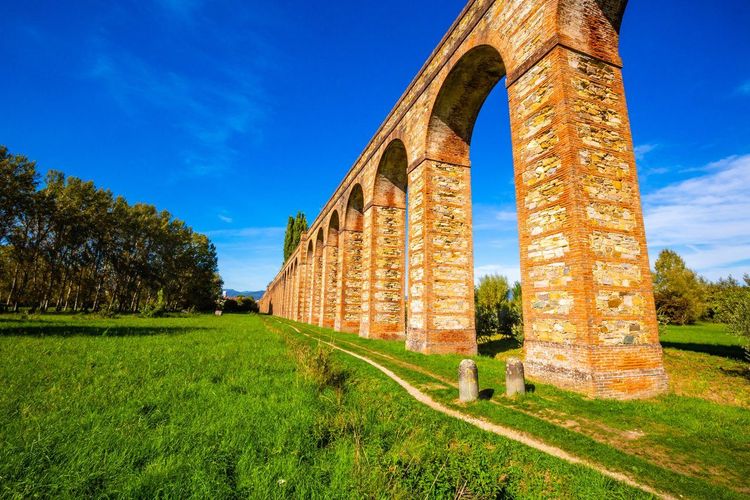
A few minutes' walk from Porta Elisa, on the southeastern side of the city walls, an unexpected sight awaits those who venture away from the center: the Nottolini Aqueduct (Via dell'Acquedotto, 55100 Lucca, rated 4.4/5 on Google with 767 reviews), a series of red brick arches stretching across the Tuscan countryside for nearly 18.5 kilometers. Commissioned by Marie-Louise de Bourbon and designed by the ducal architect Lorenzo Nottolini, it was built between 1823 and 1851 to bring spring water from the hills of Guamo into the city.
The structure has 459 arches of varying height, ranging from 3 to 17 meters depending on the terrain. The most impressive section, visible from Via dell'Acquedotto, runs along a tree-lined boulevard and is illuminated in the evening. It is a daily walking route for the people of Lucca, and far less frequented by tourists.
Access is entirely free. Allow about twenty minutes on foot from Porta Elisa to reach the most photogenic section. The best time to admire it is in the late afternoon, when the low-angled light turns the arches a deep red.
13. In the Footsteps of Giacomo Puccini
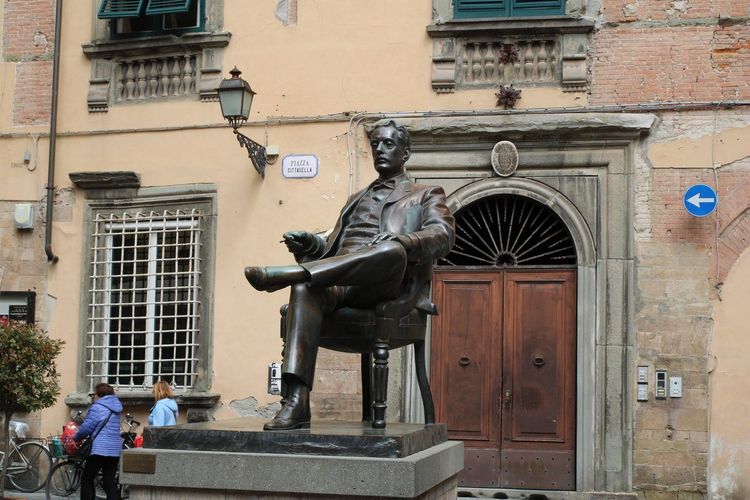
Lucca is the birthplace of Giacomo Puccini, born here on 22 December 1858 at number 9 in the Corte San Lorenzo, and one of the most performed opera composers in the world since his death in 1924. La Bohème, Tosca, Madama Butterfly and Turandot are performed every year on hundreds of stages around the world. Yet the city carries this legacy with characteristic discretion: no excessive museification, but a constant presence in street names, building facades and the cultural calendar.
The Casa Natale di Puccini (Corte San Lorenzo 9, 55100 Lucca, rated 4.5/5 on Google with 1,838 reviews) is a museum installed in the original family home, preserving manuscript scores, letters, the composer's working piano and period stage costumes. Admission costs approximately €7. The museum organizes chamber concerts on certain evenings in summer.
The Teatro del Giglio (Piazza del Giglio 13), a renovated 17th-century opera house, regularly programs Puccini operas. In summer, the schedule of the Puccini e la sua Lucca Festival offers performances in the theater and in the churches of the old town, practically every evening from June to September. To hear stories about Puccini, his relationship with the city and his dealings with the musical institutions of his time, our Ryo app includes audio commentary on this chapter of Lucca's history.
14. Lucca's Local Gastronomy
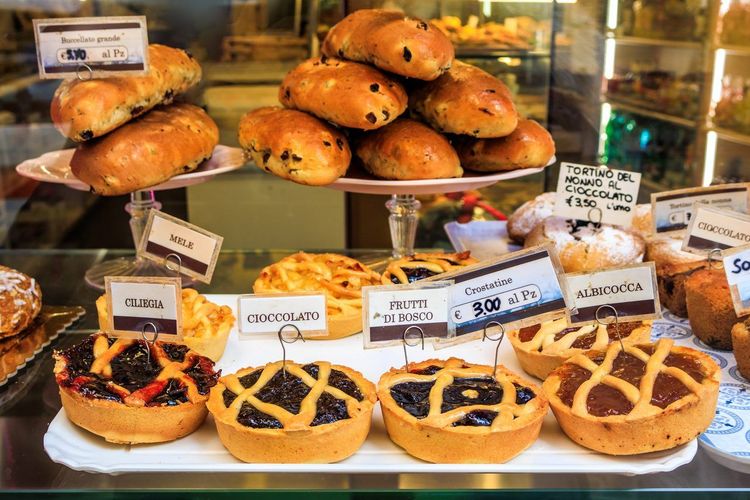
Thinking about what to do in Lucca without sitting down to eat would be a mistake: this is a food-loving city, with specialties very much its own that are best enjoyed on the spot rather than in a jar brought home.
The buccellato is the city's emblematic cake: a sweet crown-shaped bread flavored with anise and filled with raisins. The Taddeucci shop, founded in 1881 on the Piazza San Michele, is the undisputed reference — the morning queue betrays its popularity among locals and tourists alike. A portion costs about €3. Local tradition has it that the buccellato is eaten at any time of day, from breakfast to afternoon tea.
The tordelli lucchesi are the quintessential local pasta: large ravioli filled with a mixture of minced meat, ricotta and aromatic herbs, served with a braised meat ragù. The recipe is jealously guarded by each trattoria, and the proportion of herbs varies noticeably from one kitchen to the next. They are found in almost every establishment in the center.
The olive oil from the Lucca countryside holds the DOP Terre di Lucca designation. Harvested in November and cold-pressed, it is recognized for its low acidity and fruity aromas with slightly peppery notes. Fine food shops in the center sell vintage-dated bottles, ideal to take home.
On the wine front, the Colline Lucchesi DOC and Montecarlo DOC appellations are little known internationally but well worth exploring: fresh whites based on Trebbiano, structured reds based on Sangiovese. Several trattorias offer them by the glass at reasonable prices. The zuppa di farro, a spelt soup from the Garfagnana, rounds out this culinary panorama with a comforting rustic note.
15. Renting a Bike to Explore the City
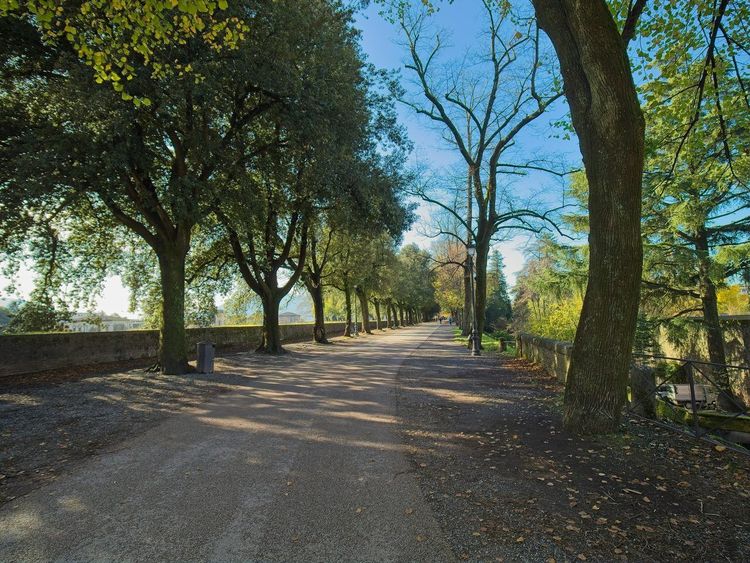
Lucca is one of Italy's most bike-friendly cities. The ban on cars in the historic center, the perfectly flat terrain and the city walls that can be cycled make the bicycle the most natural way to get from one site to another.
Several rental shops are located near the main gates. Expect to pay €3 to €5 per hour, or €10 to €15 for the day depending on the type of bike (standard, electric, cargo for families). Cicli Bizzarri (Piazza Santa Maria 32, 55100 Lucca, rated 4.1/5 on Google with 83 reviews) is one of the long-established rental shops, offering various models for several decades.
A day by bike can include a circuit of the city walls in the morning, a ride through the center to the Orto Botanico, then a round trip to the Nottolini Aqueduct in the mid-afternoon. The city is compact enough to link everything in a single loop without ever pushing hard.
FAQ
How much time do you need to visit Lucca?
To decide what to do in Lucca based on your available time: one full day is enough to walk the city walls, visit the Torre Guinigi, the Piazza dell'Anfiteatro, the Duomo and two or three churches. Two days allow you to include the museums, the Palazzo Pfanner, the aqueduct and enjoy the local gastronomy at a leisurely pace. Some travelers opt for three days to combine the old town with an excursion into the surrounding countryside, toward the Garfagnana or the thermal baths of Bagni di Lucca.
Is access to the Lucca city walls free?
Yes, entirely. The walls are accessible without a ticket or reservation, every day from sunrise to sunset. It is one of the few major sites in the city that costs nothing. However, the Torre Guinigi (€5), the Torre delle Ore (€5) and the Palazzo Pfanner (€6 for the garden) are paid attractions.
How do you get to Lucca from Florence or Pisa?
From Florence, the Intercity or Regionale train serves Lucca Centrale in approximately 1h20 to 1h30, with a change in Pisa depending on the schedule. From Pisa Centrale, the train is direct and takes 25 to 30 minutes for less than €4. By car from Florence, allow about 1 hour on the A11 motorway. Lucca has paid car parks outside the city walls (Piazzale Boccherini, Viale Europa); there is no need to drive into the historic center.
What is the best time to visit Lucca?
To know what to do in Lucca at the best time, spring (April–May) and autumn (September–October) are the ideal seasons: pleasant temperatures, moderate tourist flows and exceptional photographic light. In July and August, heat can reach 35–38°C and day-trip groups from Pisa and Florence crowd the sites between 10am and 4pm. December is worth a visit for the Christmas market on the Piazza Napoleone.
Can you visit Lucca on a day trip?
Yes, Lucca is very well suited to a day trip from Pisa (30 min by train), Florence (1h30) or even Genoa (about 2 hours). Arriving at 9am and leaving at 6pm gives you plenty of time to walk the walls, see the Torre Guinigi, stroll around the Piazza dell'Anfiteatro and have lunch with a plate of tordelli lucchesi. The ideal, however, is to stay overnight to enjoy the evening atmosphere, when the city returns to its daily rhythm.
Where to stay in Lucca?
The ideal is to stay inside the city walls to enjoy the city in the morning before the tourist crowds arrive. Options cover the full range: B&Bs in medieval palaces, boutique hotels along Via Fillungo, charming residences near the bastions. In high season, book at least six to eight weeks in advance. Cheaper accommodation can be found in neighboring municipalities (Capannori, Viareggio) accessible by train from the central station.
Knowing what to do in Lucca, as we have seen, cannot be reduced to ticking off a list of monuments: it is one of those cities that reveals itself better over time than in a photograph. The city walls, the Torre Guinigi with its oaks at the top, the Piazza dell'Anfiteatro set upon its Roman amphitheater, the interiors of San Frediano: each place adds a layer to a reading of the city that no map can fully decode. What makes Lucca a destination apart in Tuscany is also the continuity of local life within its walls, a reality that tourist pressure has not yet erased.
To turn your visit into a guided and narrated experience, the audio walking tour of Lucca on Ryo accompanies you from one square to the next, delivering the stories, anecdotes and details that official signs usually omit. Download it before you arrive.