© Shutterstock
 Votre guide Ryo
Visiting Coimbra for the First Time: Complete Guide 2026
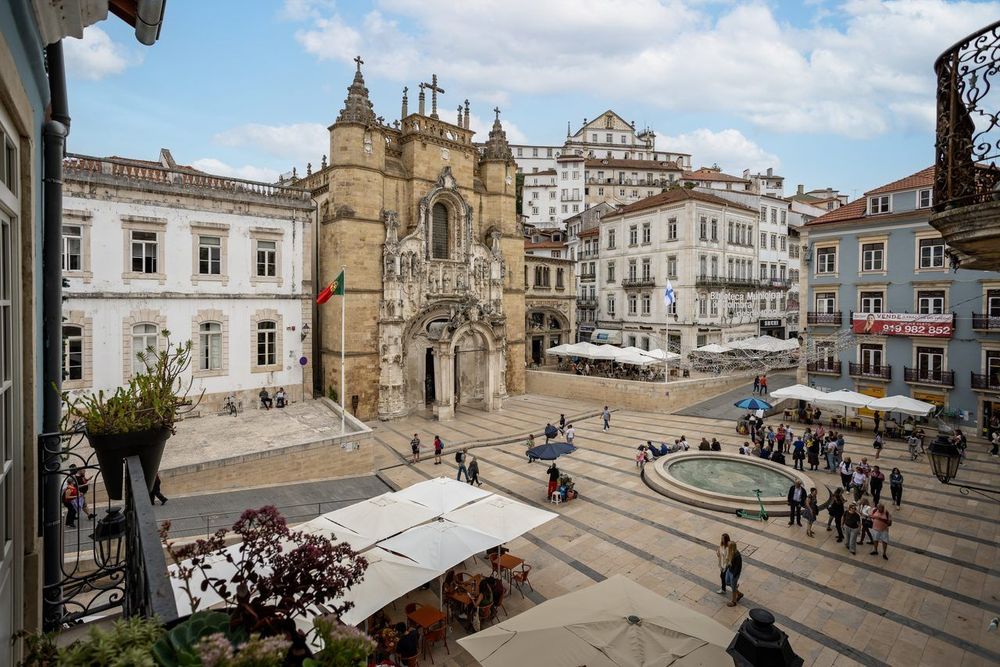
Visiting Coimbra for the first time means discovering a Portuguese city unlike any other. As soon as you walk down Rua Ferreira Borges toward the Mondego, you realise that the city lives to the rhythm of a university more than 700 years old, whose tower still dominates the whole valley. You have to accept getting lost among steep alleyways, a library covered in gold leaf and a Roman crypt forgotten beneath a museum. The Ryo audio-guided tour of Coimbra does precisely that: it links these places on foot, in the order in which they make sense.
A few details are enough to understand why the city deserves more than an afternoon. The Joanina Library admits visitors only in timed slots, to protect its 18th-century shelves. The university's Faculty of Arts and its scientific collections are overlooked by most tourists. You can paddle down the Mondego in a kayak at the foot of the university hill. And Coimbra fado, unlike Lisbon's, was born in student nights, sung by men in black capes and never applauded: by tradition, people simply cough softly at the end of the song.
The University of Coimbra, a UNESCO-Listed Jewel
Founded in Lisbon in 1290, the University of Coimbra settled permanently in the former royal palace of the Alta in 1537, after several moves back and forth between the two cities. This historic campus, the Paço das Escolas, has been a UNESCO World Heritage Site since 2013, together with Rua de Sofia, under the title “University of Coimbra – Alta and Sofia”. Today you will see students in the traditional black cape, the capa, walking among the same stones as their 16th-century predecessors.
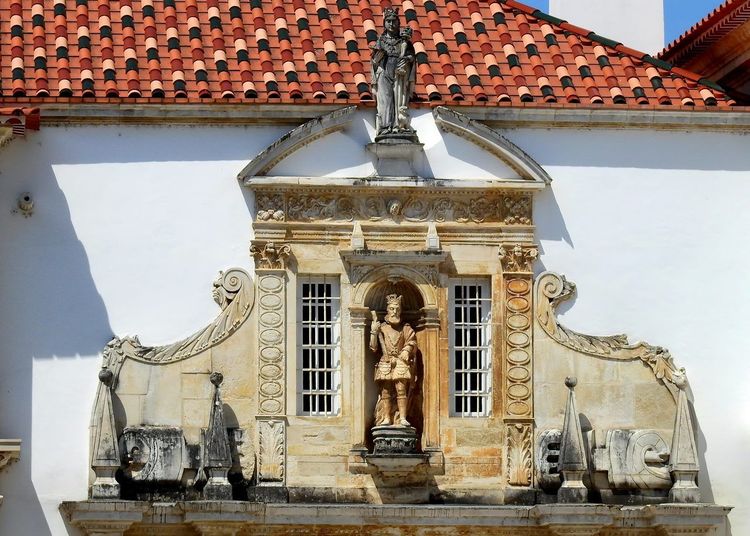
The campus is traditionally entered through the Porta Férrea (Rua Larga, 3000 Coimbra, rated 4.6/5 on Google from 3.2K reviews), a Mannerist gateway from 1634 adorned with statues of kings and allegories of the faculties.
Beyond it, the Via Latina opens onto the Sala dos Capelos, the former throne room that is now the hall for major academic ceremonies, and onto the university tower, completed in the 18th century. Students nickname its bell “a Cabra”, the goat: it once rang the start and end of classes, and the nickname still turns up in the songs and jokes of academic life.
Allow a good hour and a half for the campus alone, more with the Joanina Library. There is no separate ticket for the Joanina: the university's combined ticket (€16.50 for an adult, valid for two days) includes the royal palace, the São Miguel chapel, the library, the Laboratorio Chimico and the cabinet of curiosities. The time printed on your ticket is your entry time to the Joanina; plan the rest of your visit around that slot. It is precisely on this campus that the Ryo audio-guided tour of Coimbra begins, with one stop devoted to the Via Latina and another to the Porta Férrea, placing each stone in context before you venture further into the city. The short version of the Ryo audio-guided tour is a good fit if you only have a morning.
The Joanina Library, One of the Most Beautiful Baroque Libraries in the World
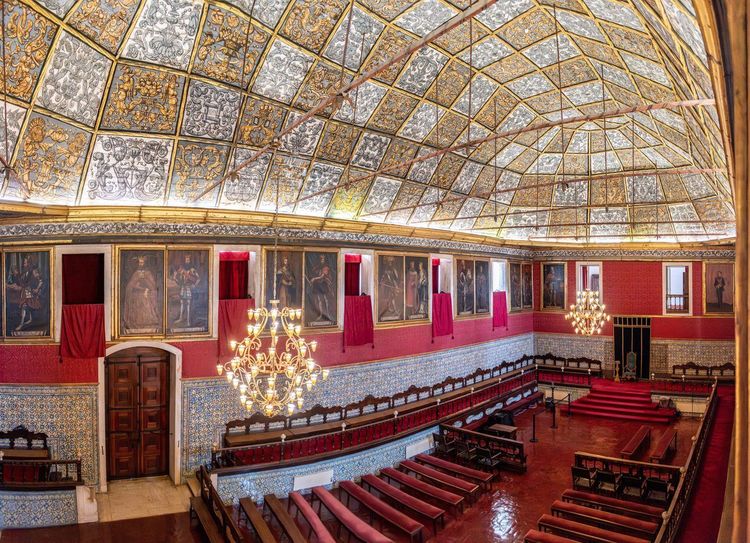
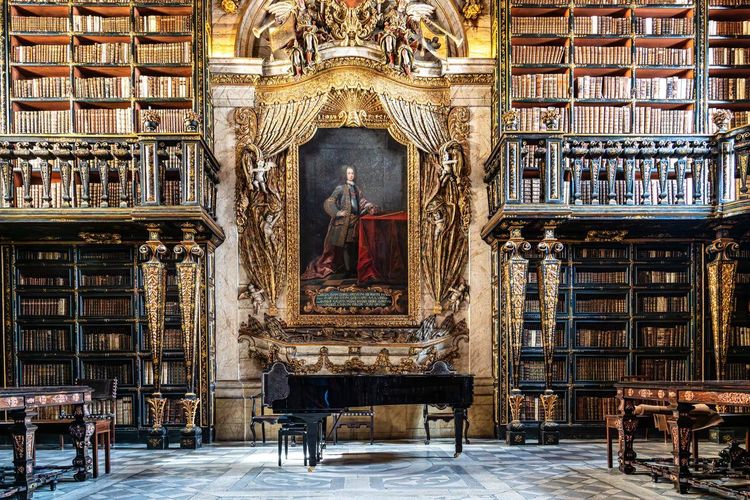
Getting into the Joanina Library takes a little planning, but the reward is worth it. Built between 1717 and 1728 on the orders of King John V, it holds around 60,000 volumes in its three grand rooms laid out in a row, each more richly decorated than the last, with gilded woodwork and trompe-l'œil ceilings. Beneath these rooms, two plainer levels house other collections and the former academic prison, which you also walk through during the visit.
A detail that invariably surprises visitors: a colony of bats lives in the building and goes out at night to hunt the insects that could damage the old paper. Each evening the staff cover the tables with leather protectors, then remove them in the morning before opening. You will never see these bats during the day, but the guards will happily talk about them if you ask.
Access is in small groups and by time slot, online up to twenty minutes before the visit time or at the ticket office depending on remaining places. In high season, afternoon slots often sell out by mid-morning: buy your ticket online the day before. The visit itself lasts only about twenty minutes and photos are forbidden in the main room, which leaves you free to simply look.
The University's Hidden Treasures: Faculty of Arts, Cabinet of Curiosities and Science Museum
Few visitors venture as far as the Faculdade de Letras, housed in a 20th-century building a few steps from the Paço das Escolas. Its corridors, study rooms and library show the university in daily life, far from the queues at the Joanina: a good way to feel that this heritage remains a place of work.
Close by, the Gabinete de Curiosidades (Largo Marquês de Pombal, 3000-272 Coimbra, rated 4.4/5 on Google from 90 reviews), or cabinet of curiosities, brings together scientific instruments, minerals and objects collected by the university since the 18th century. It is included in the combined ticket.
The Science Museum of the University of Coimbra, housed in the Laboratorio Chimico of 1773 and in the former Colégio de Jesus, completes the visit with physics and natural history collections and a few interactive displays that children enjoy too. It is an angle most guides neglect, even though it shows how much Coimbra was, after the Marquis of Pombal's reform, a European scientific centre as much as a theological one. Allow 45 minutes for a single one of these spaces, double that for all of them.
Sé Velha and Sé Nova, the Two Cathedrals of Coimbra
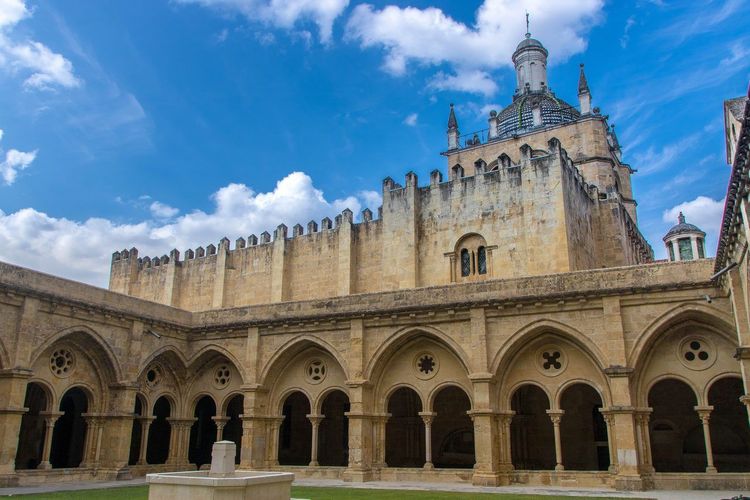
The Sé Velha, or old cathedral, is one of the best-preserved examples of Romanesque architecture in Portugal. Built in the 12th century while the Reconquista was not yet complete, it looks almost like a fortress: thick walls, battlements on the roof. The interior, plainer than you might imagine, contrasts with the gilded Gothic altarpiece of the early 16th century that fills the whole choir.
A ten-minute walk uphill toward the campus, the Sé Nova (Largo da Feira, 3000-240 Coimbra, rated 4.5/5 on Google from 1,477 reviews) offers a completely different face. A church built by the Jesuits from 1598, which became a cathedral in 1772 after their expulsion, it has an imposing Baroque façade and an interior far brighter than that of its Romanesque neighbour.
The contrast sums up Coimbra rather well: a city that has always layered its eras rather than erasing them. If you see both in the same afternoon, passing through the old town, you will feel the shift from defensive Romanesque to triumphant Baroque without reading a line of art history. Both cathedrals ask for a modest contribution of a few euros, with the Sé Velha giving access to its Gothic cloister.
The Machado de Castro National Museum and the Roman Crypt
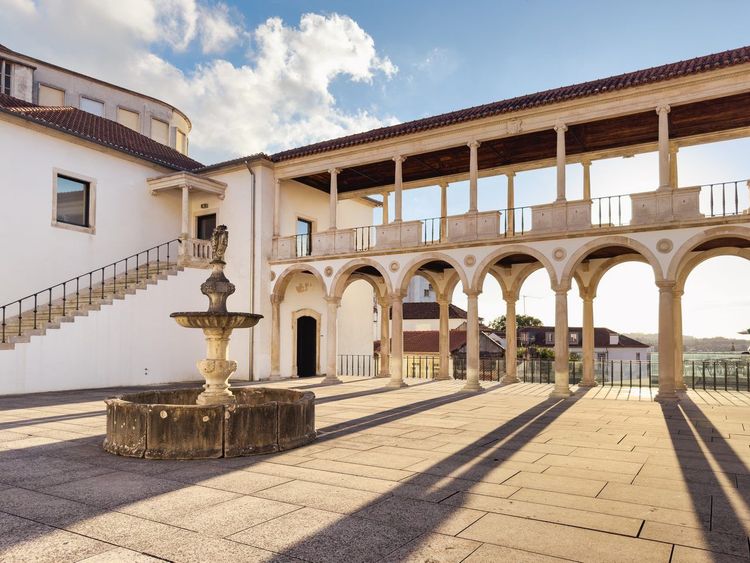
Housed in the former episcopal palace, the Machado de Castro National Museum overlooks the city from the Alta hill. It holds a remarkable collection of medieval Portuguese sculpture, religious goldsmithing and ceramics, but it is above all what lies beneath your feet that surprises.
The building in fact rests on a 1st-century Roman cryptoporticus, a set of vaulted galleries that served as the foundation of the forum of ancient Aeminium, the Roman name for Coimbra. You wander through the cool half-light of these almost intact galleries, several metres below the present-day street, before climbing back up to the exhibition rooms and the museum's loggia, one of the finest views over the rooftops of the lower town. Allow 1h30, and aim for late morning for the light.
The University Botanical Garden, a Green Break in the Heart of the City
Founded in 1772 as part of the Pombaline reform, the Botanical Garden of the University of Coimbra spreads over about thirteen hectares in terraces, with a 19th-century cast-iron greenhouse, ponds and centuries-old trees from all five continents.
Access to the outdoor garden is free and often peaceful on weekdays, making it an ideal stop to catch your breath between two intensive visits. Allow 45 minutes for a stroll, a little more if you are looking for shade to read or picnic.
Wandering the Alleyways of Old Coimbra: Quebra Costas, Praça da República and the Student Repúblicas
The Rua do Quebra-Costas, literally the street that breaks your ribs, drops in a steep staircase from the Sé Velha to the Arco de Almedina, gateway to the lower town. Its name is no exaggeration: the cobblestones are slippery in the rain, and the terraces lining it take advantage of the slope to offer a plunging view over the rooftops.
On the other side of the Alta, below the Sé Nova and near the Jardim da Sereia, the Praça da República changes mood once night falls. It is the heart of student life, lined with bars and terraces where students and locals mingle, especially at weekends and during the Queima das Fitas, the big end-of-year university festival in May.
In the surrounding streets, several Repúblicas of Coimbra remain, those communal student houses where traditions specific to each have been handed down for decades: nicknames, shared meals, welcome rituals for newcomers. Their façades covered in graffiti and banners are easy to spot; some open their doors during student festivities.
Along the way, stop at a craft shop in the Baixa to buy hand-painted azulejos, far more authentic than the printed versions on tourist stalls. The Mercado Municipal D. Pedro V (Rua Olímpio Nicolau Rui Fernandes, 3000-122 Coimbra, rated 4.3/5 on Google from 3,411 reviews), opened in 1868 on the former Santa Cruz garden, completes the stroll with its stalls of fruit, sheep's cheese and dried cod, handy for putting together a picnic.
This neighbourhood is precisely that of the Ryo audio-guided sub-tour Knowledge as an Elixir of Youth, which takes you through Quebra Costas and the Praça da República while recounting the traditions of the Repúblicas, far harder to uncover alone with a simple map.
The Banks of the Mondego: Walking, Kayaking and Crossing the River
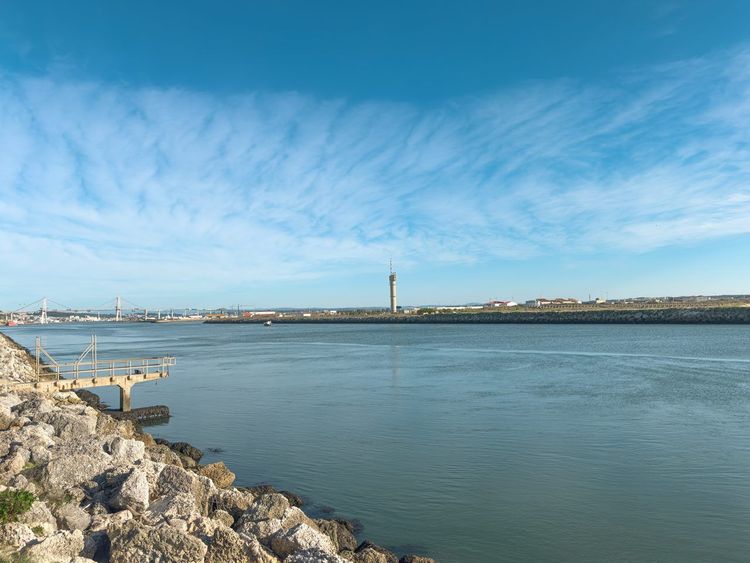
The banks of the Mondego form a long landscaped park on both sides of the river, the Parque Verde, enjoyed by early-morning joggers and families in the late afternoon. The view from the left bank, facing the university, especially at sunset, remains one of the best vantage points over the university hill.
To get from one bank to the other, take the Pedro e Inês footbridge, opened in 2007 and dedicated to the tragic lovers of Portuguese history, or the Santa Clara bridge. On the left bank, the Santa Clara-a-Velha monastery, long drowned by floods, is worth a detour. In fine weather, rental companies offer kayaks by the hour, and several operators organise descents of the Mondego from Penacova, about twenty kilometres upstream. If you follow the Ryo audio-guided tour, one of its stops runs along these quays and recounts the river's role in the city's history, to be listened to while walking or between two more intensive visits.
Listening to Fado, the Musical Soul of Coimbra

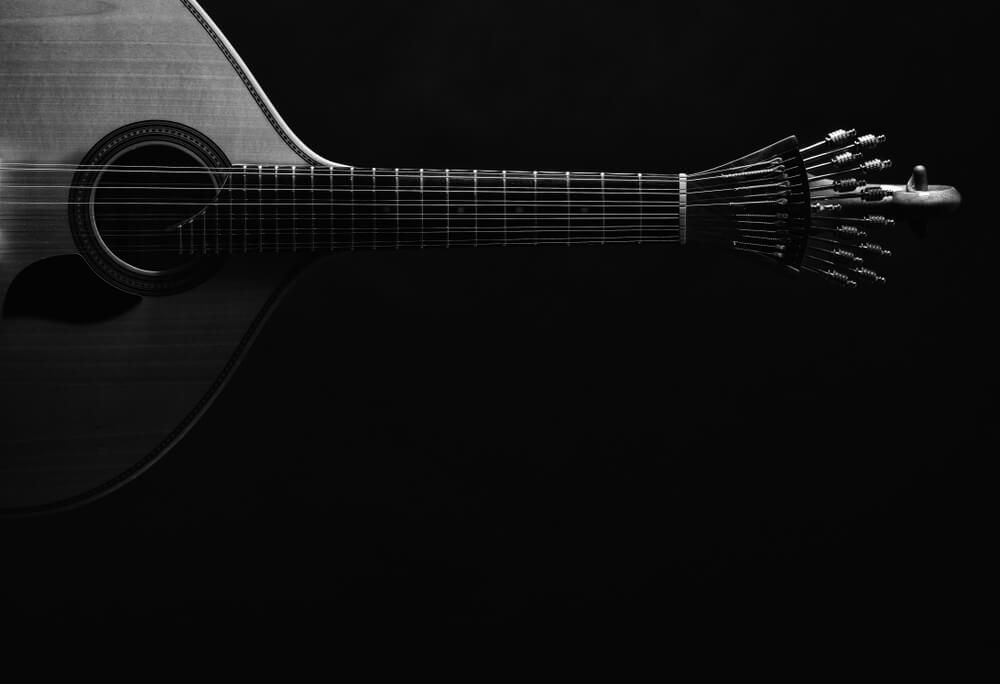
Unlike Lisbon fado, often sung by women, Coimbra fado is traditionally performed by men and carried by the city's university heritage. Born in the 19th century in student serenades, it is sung in a black cape, accompanied by the twelve-string Portuguese guitar and a classical guitar.
One of the most renowned places to hear it is A Capella (Rua do Corpo de Deus, 3000-049 Coimbra, rated 4.5/5 on Google from 927 reviews), a 14th-century chapel converted into a concert café, which some French-language guides call the Chapelle Café.
Be aware that Coimbra fado is traditionally not applauded: people cough lightly at the end of the song, out of respect. Concerts start in the evening; book a table if you come on a weekend in high season. To understand this ritual before attending, one audio stop of the Ryo tour recounts the student origins of this song, and our article on getting to know and listening to Coimbra fado details the other addresses.
The Santa Cruz Monastery and the Religious Heritage of the Lower Town
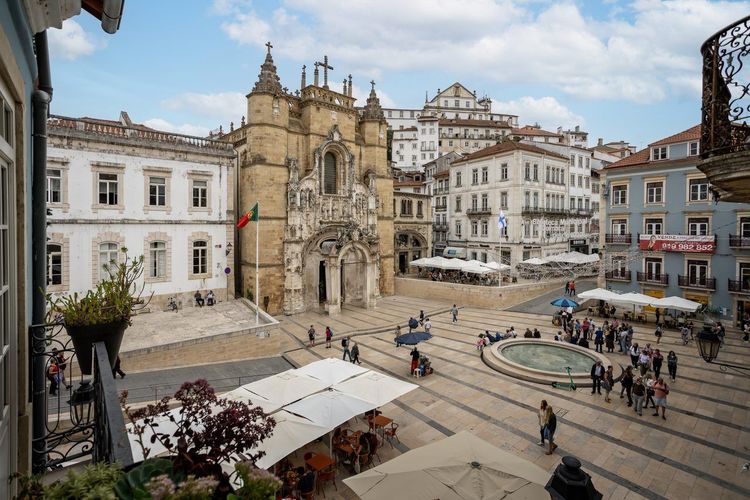
The Mosteiro de Santa Cruz, founded in 1131, houses the tombs of the first two kings of Portugal, Afonso Henriques and Sancho I. The church, the Igreja de Santa Cruz (Praça 8 de Maio, 3000-300 Coimbra, rated 4.6/5 on Google from 6,379 reviews), deserves a stop for its walls covered in 18th-century azulejos, its carved Renaissance pulpit and its Cloister of Silence, accessible with a small ticket.
Right next door, the Café Santa Cruz occupies a former chapel of the monastery: have a coffee there beneath the Gothic vaults. Higher up, on Rua Vandelli, near the botanical garden, the Grand Seminary of Coimbra (Seminário Maior) can be visited for its old library, its azulejo room and its Church of the Holy Family, one of the finest ensembles of 18th-century Italian art in Portugal, rarely visited by groups.
Planning Your Visit: Duration, Transport, Accommodation and Good Restaurants
Two full days are enough to see the essentials of Coimbra without rushing: one day for the campus and the Joanina Library, a second for the cathedrals, the Machado de Castro Museum, the lower town and the riverbanks. If you add Conimbriga or Aveiro, plan a third day.
To get there, the train remains the most comfortable option from Lisbon (about 1h45 on the Alfa Pendular) or Porto (about 1h). Note that long-distance trains stop at Coimbra-B, on the outskirts: since January 2025, the rail link to the city-centre station (Coimbra-A) has been suspended because of the Metro Mondego works, and connecting buses run the route every few minutes. By car, the A1 motorway connects to Lisbon in about two hours.
As for accommodation, the lower town around Praça 8 de Maio and Rua Ferreira Borges lets you walk to most of the sights while enjoying affordable restaurants in the evening. The neighbourhoods near the campus, on higher ground, offer superb views but involve more climbing, a detail to anticipate if you are travelling with heavy luggage or children.
At the table, Coimbra stands out for its slow-cooked dishes rather than grilled fish: chanfana, goat cooked for hours in red wine, and leitão à Bairrada, roast suckling pig from the neighbouring region, are among the specialities. Finish with a pastel de Santa Clara, a pastry made with almonds and eggs, very different from the Lisbon pastel de nata.
A few practical pointers for travellers coming from France: an identity card is enough, as Portugal is part of the Schengen area, and you need to set your watch back one hour, since mainland Portugal keeps London time. A direct Paris–Porto flight takes about 2h15; add an hour by train to Coimbra. To go further, the Ryo article on the best things to do in Coimbra is a useful complement to this guide.
Day Trips from Coimbra: What to See in the Surrounding Area
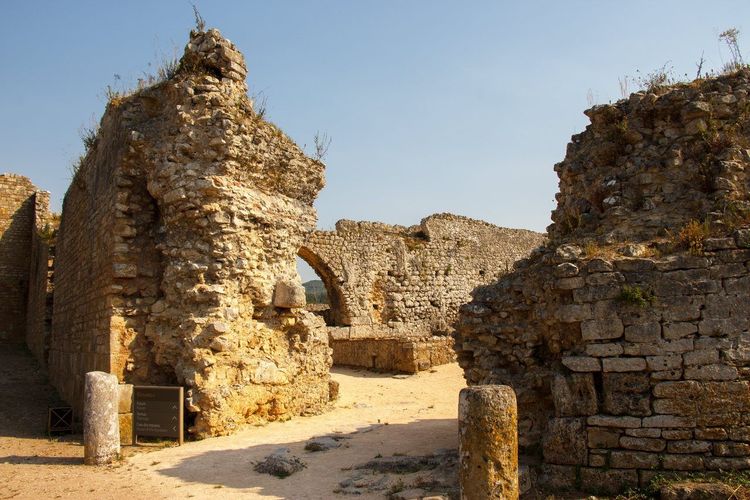
About twenty minutes by car to the south-west, the Roman ruins of Conimbriga form one of the best-preserved archaeological sites in Portugal. You walk on astonishingly intact mosaics, among villa foundations, baths and a Late Empire rampart, with a site museum that puts each discovery in context.
To the north-west, Aveiro, less than an hour by train, draws visitors with its canals traversed by colourful boats, the moliceiros, and its ovos moles. A few kilometres away, Costa Nova is recognisable by its fishermen's houses striped in bright colours, one of the most photographed settings on the coast.
For nature, the Buçaco forest is worth the detour, with its neo-Manueline palace turned hotel and its shaded paths planted with rare species by the Discalced Carmelites. Travellers seeking spirituality will head to Fátima, one of the great Catholic sanctuaries of Europe, about an hour away by road.
For a more rural day, three names come up: Montemor-o-Velho and its castle overlooking the Mondego plain, Penela and its medieval fortress, and Piódão, a schist village nestled in the Serra do Açor, often described as one of the most authentic in central Portugal.



FAQ
How long does it take to visit Coimbra?
Two full days let you cover the university, the Joanina Library, the cathedrals, the Machado de Castro Museum and the old quarter without rushing. Add a third day for Conimbriga or Aveiro.
How do you get to Coimbra from Lisbon or Porto?
The Alfa Pendular connects Lisbon to Coimbra-B in about 1h45 and Porto in about 1h. From Coimbra-B, a connecting bus goes to the city centre. Driving via the A1 remains an alternative if you are combining several cities.
Where should you stay in Coimbra for a first visit?
The lower town around Praça 8 de Maio offers the best compromise between walking access to the sights and a choice of restaurants. The neighbourhoods near the campus appeal for their views, at the cost of steeper climbs.
Where to eat in Coimbra and what to try?
Chanfana, goat slow-cooked in red wine, and leitão à Bairrada, roast suckling pig, are the most frequently mentioned specialities. Finish with a pastel de Santa Clara.
What is the best time to visit Coimbra?
Spring and early autumn offer pleasant temperatures without the crowds of high summer. In early May, the Queima das Fitas enlivens the whole city, but accommodation is then more expensive. Winter remains mild but rainy, with slippery alleyways.
What can you do around Coimbra in one day?
Conimbriga, about twenty minutes away by road, combines easily with half a day in the city. Aveiro and Costa Nova, Fátima or the Buçaco forest each require a dedicated day.
Coimbra for a First Visit: What to Remember
By the end of these two or three days, Coimbra leaves a different impression from the one you expected: less monumental than Porto, less spectacular at first glance than Lisbon, but inhabited by a student life that gives relief to every stone. It is a city you understand by walking slowly, by pausing on the Mondego quays or at a terrace on the Praça da República rather than by ticking off a list of museums.
If you would rather be guided, the Ryo audio-guided tour of Coimbra links these places in a logical order, from the Porta Férrea to the alleyways of the lower town, telling the stories that appear on no signpost.