© Shutterstock
 Votre guide Ryo
Bratislava for Couples: The Romantic 2026 Guide for a Trip Together
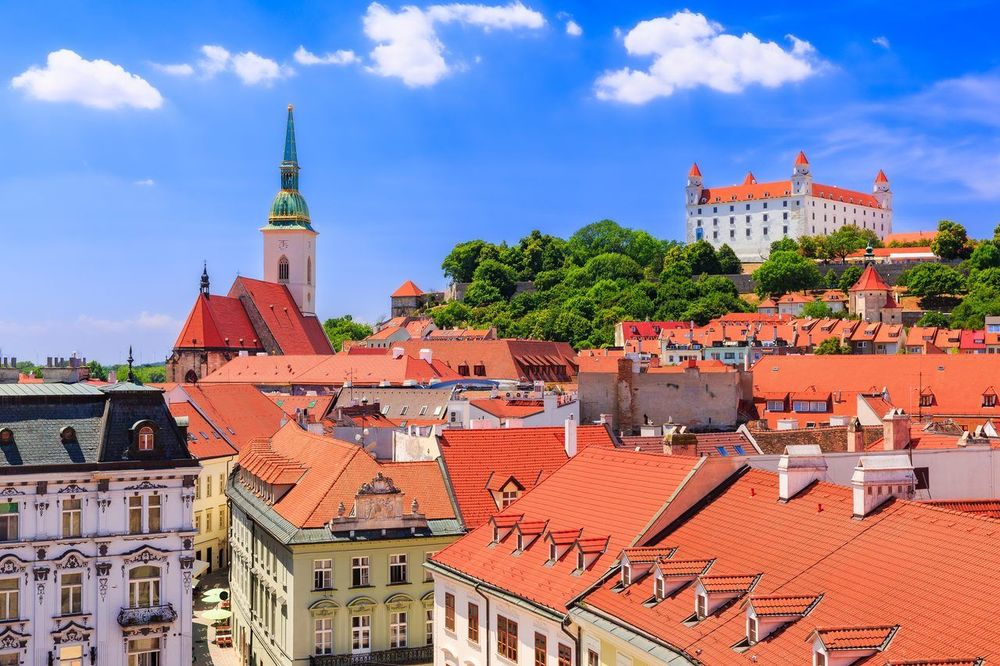
As dusk falls, when the streetlamps light up the cobblestones of the old town and the Danube turns copper beneath the UFO Bridge, Bratislava reveals a side that few visitors suspect before setting foot here. For those who want to visit Bratislava as a couple, it is precisely this human scale that changes everything: no endless queues, no dense crowds to navigate, a historic centre you can walk end to end in just under an hour. That unhurried pace is something the Ryo audio tour of Bratislava embraces too: 20 audio stops along a 6.5 km loop, with anecdotes whispered in your ear as you stroll hand in hand between two Baroque facades.
This guide brings together the experiences that make Bratislava a truly rewarding destination for two: a square lined with palaces centred on a Renaissance fountain, a castle shaped like an upturned table offering a panorama across three countries, a baby-blue church unlike anything else in Central Europe, a flying saucer perched 85 metres above the river, and castle ruins reachable in half an hour by bus. Between the old town, the wooded heights of Kamzík, and a day trip to Vienna just about an hour away by train, Bratislava lends itself to a genuine weekend for two, without ever straining the budget.
Bratislava's Old Town, the Perfect Setting for a Romantic Stroll
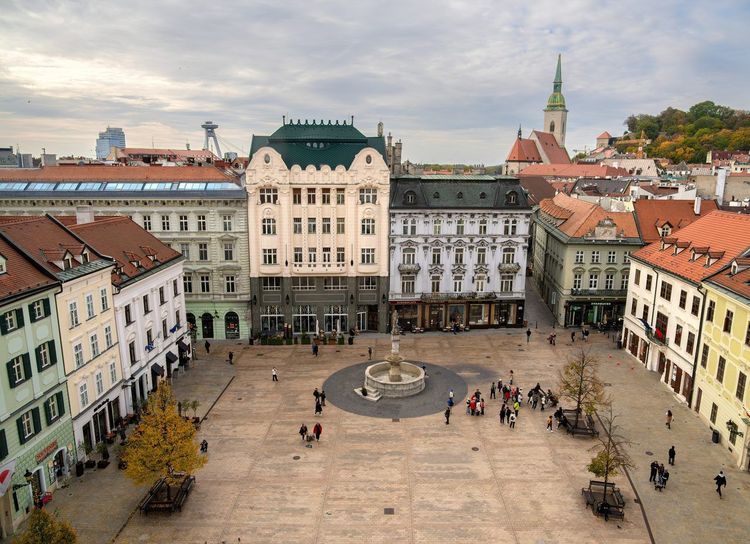
Staré Mesto, the old town, can be crossed from one end to the other in twenty minutes flat. But no one ever crosses it that quickly: the pastel facades, the half-open inner courtyards, and the tightly packed café terraces invite you to slow down, and it is precisely this rhythm that makes the neighbourhood so well suited to a walk with no fixed route.
Hlavné námestie Square and the Old City Hall
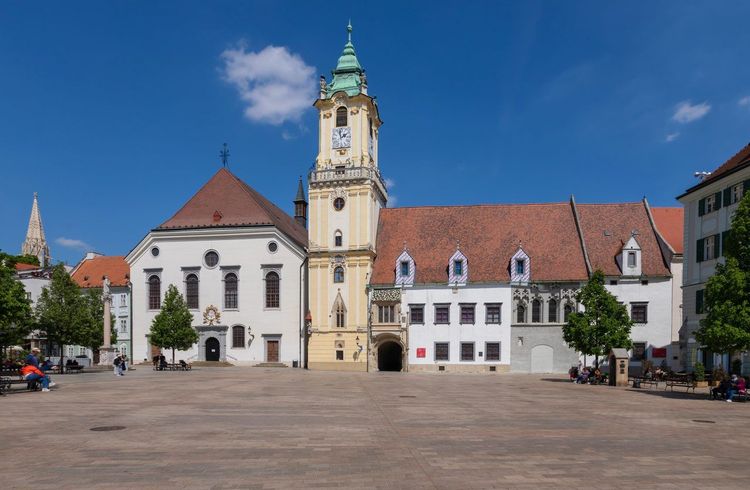
The heart of the old town beats on Hlavné námestie, the main square, where a Renaissance fountain dedicated to Maximilian II has occupied the centre since 1572. The buildings surrounding it tell four centuries of architecture without resembling one another: powder-pink Baroque facades, Renaissance gables, Art Nouveau shopfronts. Late in the afternoon, the terraces fill up and the raking light gives the stone an almost honey-coloured hue.
On one side of the square stands the Old City Hall, a mismatched assembly of medieval buildings gathered around a Gothic tower. You can still spot, embedded in the wall, a cannonball fired by Napoleon's troops in 1809. Inside, the city history museum occupies several vaulted rooms and traces Bratislava's evolution from its earliest fortifications to its status as the Slovak capital, with a scale model that helps you get your bearings before heading back out to explore the lanes. Allow around half an hour, which is more than enough for an overview.
Saint Michael's Gate and the Cobbled Lanes
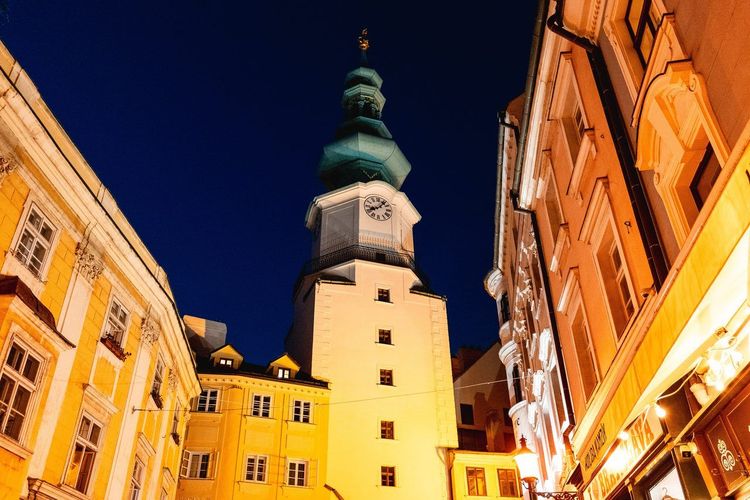
Just a short walk away, Saint Michael's Gate (Michalská 22, 811 01 Bratislava, rated 4.7/5 on Google from 1,436 reviews) (Michalská brána) is the last surviving gate of the medieval fortifications that once encircled the city. Its green tower rises 51 metres and houses a small museum of antique weapons; you can climb to the top for a tight but photogenic view over the red-tiled rooftops of the centre. Just beneath the arch, a plaque set into the pavement marks kilometre zero and indicates the distance to several world capitals: passers-by happily step on it for a photo.
Beyond the gate, Michalská Street and then Ventúrska unfurl their uneven cobblestones past craft shops, wine bars, and small galleries. Take the time to get deliberately lost in the side alleys: it is often there, away from the main axis, that you find the quietest inner courtyards.
Keep your eyes open along the way, as Bratislava has scattered bronze statues at pavement level throughout its streets. Čumil, the worker poking his head out of a manhole at the corner of Panská and Rybárska streets, is by far the most photographed; a little further on, Schöne Náci tips his hat, and a Napoleonic soldier leans against a bench on the main square. Hunting them down together quickly turns into a treasure hunt.
If you want a framework to make sure you miss nothing without following a paper guide, the Ryo audio tour The City of a Thousand Palaces takes you right through Hlavné námestie, the Primatial Palace, and Saint Michael's Gate, with anecdotes about the townhouses and statues of the centre, at your own pace and with no time constraints.
Bratislava Castle and Saint Martin's Cathedral, a Panorama Over the Danube
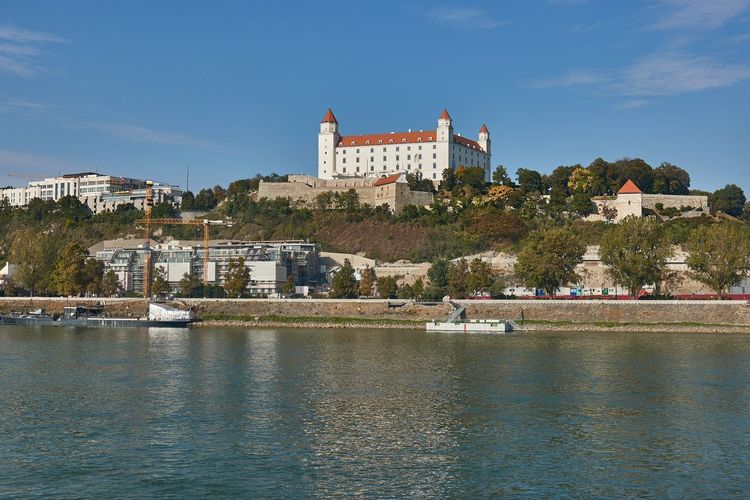
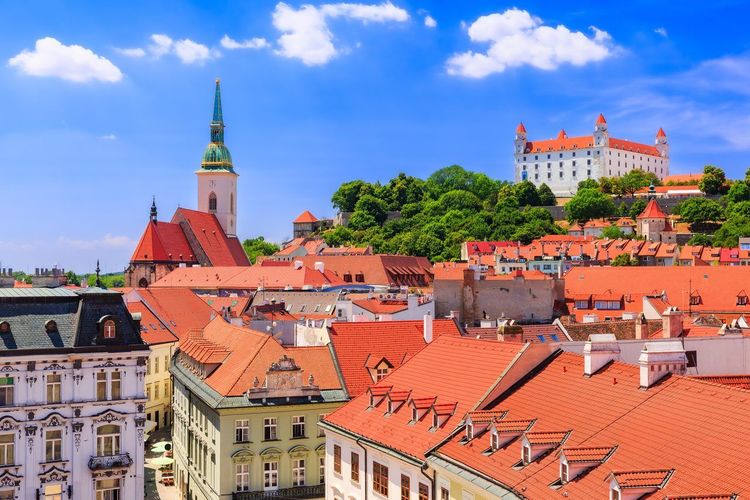
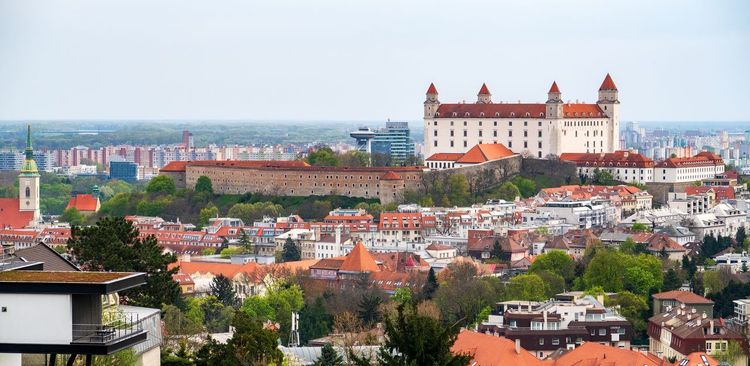
Above the old town, a white four-towered silhouette dominates the entire panorama: Bratislava Castle, which locals nickname "the upturned table" because of its square shape with raised corners.
Climbing up to Bratislava Castle (Hrad)
Bratislava Castle stands on a hill that has been inhabited since Celtic times, but the current building owes its appearance chiefly to the transformation carried out under Maria Theresa of Austria in the 1760s. Ravaged by fire in 1811 and left in ruins for more than a century, it was rebuilt after the war and then underwent an extensive restoration begun in 2008. The climb from the old town takes about fifteen minutes on foot via steps and terraced gardens, just enough effort to appreciate the reward at the top.
Once at the top, the inner courtyard and gardens offer a 360-degree panorama: on one side the old town and its steeples, on the other the Danube heading towards Hungary and, on a clear day, the Austrian hills. It is one of the few places in the city from which you can see three countries at once. Inside, the Slovak National Museum houses historical collections, but many visitors simply enjoy the outdoor walk and the gardens, which are free to enter, and settle on a bench to wait for the sunset.
The Ryo audio tour of Bratislava devotes three of its stops to this area — the castle, the view from its terraces, and the cathedral — with commentary on the successive coronations that took place here: the perfect way to understand what you are looking at before heading back down.
Saint Martin's Cathedral, Setting of the Coronations
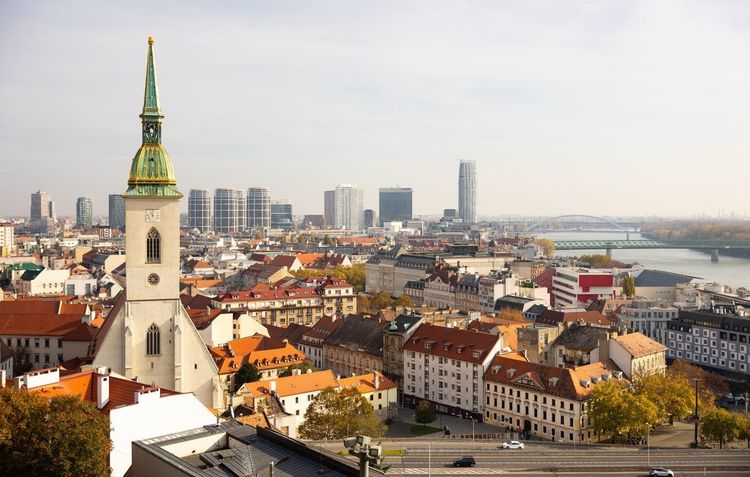
Descending towards the old town along the southern slope, you pass Saint Martin's Cathedral (Rudnayovo námestie 1, 811 01 Bratislava, rated 4.6/5 on Google from 8,973 reviews) (Dóm sv. Martina), a Gothic edifice that served as the setting for the coronations of Hungarian monarchs between 1563 and 1830: nineteen kings and queens were crowned here, including Maria Theresa in 1741. A gilded replica of the Crown of Saint Stephen, placed atop the spire at 85 metres, is a reminder of that history from outside.
The interior, plainer than the facade suggests, is still worth a pause: the three-nave nave and the stained-glass windows create a particular quality of light late in the morning. Twenty minutes is enough, making it an easy stop to combine with the climb up to the castle.
If you didn't have time to visit the city history museum earlier, it pairs well with this castle-cathedral combination: all three sites tell, each at their own scale, the same story of royal power and successive fortifications. There is no need to fit everything into a single afternoon, either: Bratislava lends itself better to a leisurely pace spread over two days than to a sightseeing marathon.
The Little Blue Church, an Architectural Gem to Admire Hand in Hand
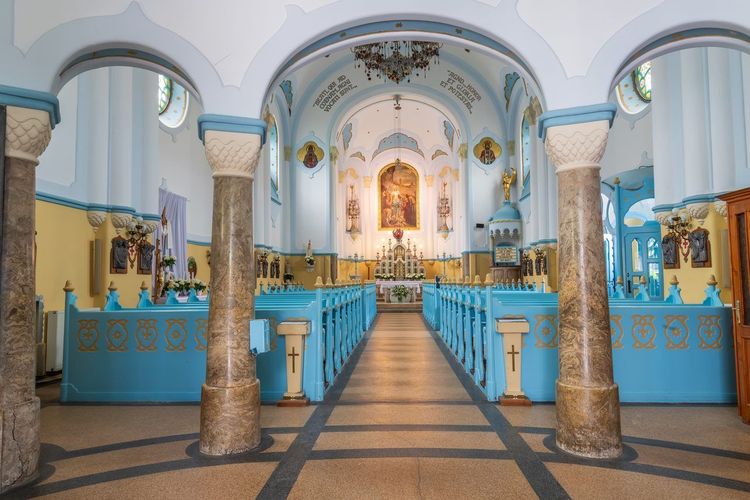
A few streets east of the old town, almost hidden beside a secondary school, stands one of Bratislava's most photographed architectural curiosities: the Church of Saint Elizabeth (Bezručova 2, 811 04 Bratislava, rated 4.6/5 on Google from 13,956 reviews), which everyone here simply calls the Blue Church. Built between 1909 and 1913 to designs by Hungarian architect Ödön Lechner in a highly personal Art Nouveau style, it is entirely dressed in a single baby blue, from the walls and the majolica-tiled roof to the interior furnishings and the facade decorations.
The visit takes only a few minutes, as the interior is tiny and often closed outside of services, but the exterior is more than enough to justify the detour: the facade, all curves, produces an almost dreamlike effect in the late afternoon sun. It is a short stop, ideal on the way to the national theatre or on the way back from a walk in the neighbouring area, and ten minutes is all you need to appreciate it together.
The UFO Bridge at Sunset, a View for Two
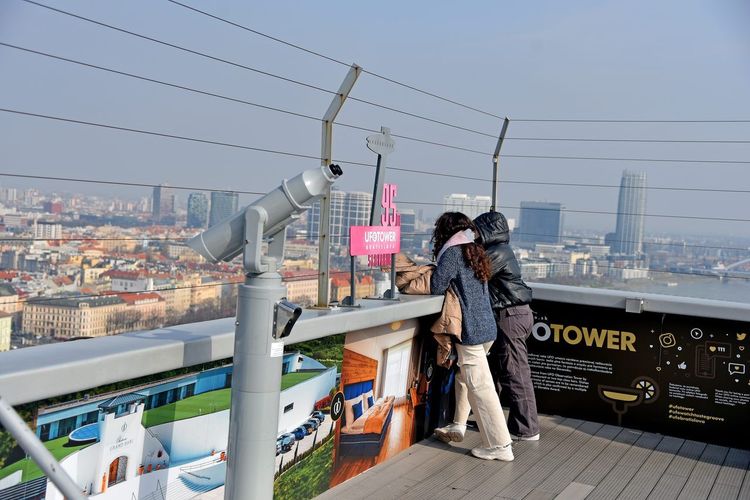
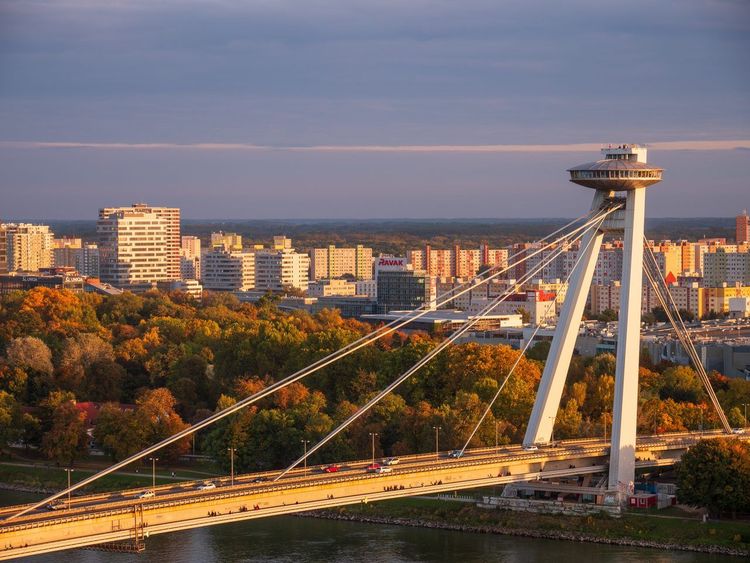
On the other side of the Danube, a futuristic silhouette cuts a sharp contrast with the Baroque facades of the historic centre: the SNP Bridge, topped by a flying-saucer-shaped capsule that everyone calls the UFO. Built between 1967 and 1972, the bridge required the demolition of almost the entire old Jewish quarter at the foot of the castle to make way for the expressway leading to it: a darker chapter of history than the postcard image suggests.
A lift housed in the bridge's eastern pylon rises in under a minute to the saucer, about 85 metres above the water, where the restaurant and, on the roof, the observation platform are located. Expect to pay around twelve euros per person for access, a sum deducted from the bill if you dine there. The view takes in the old town and the castle on one side, the towers of the Petržalka district on the other. Booking a window table for sunset is one of the most sought-after experiences in the city, as the sky turns orange and the lights of the centre come on one by one far below.
Viewpoints and Green Breaks: Slavín, Kamzík, and Horský Park
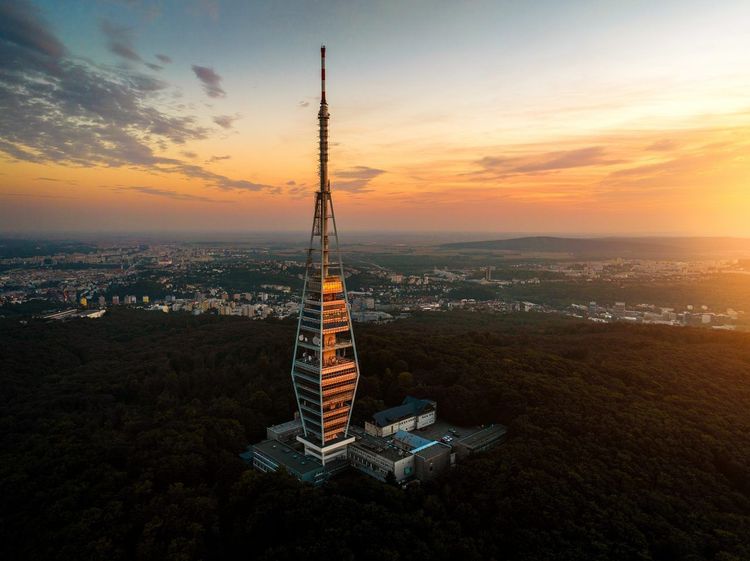
Bratislava hides several elevated lookout points away from the busiest circuits, where you can easily find a bench all to yourselves.
The Slavín Memorial, a View Over the Old Town
On a hill to the northwest of the centre stands the Slavín Memorial, inaugurated in 1960 in memory of the Soviet soldiers who fell during the liberation of the city in April 1945. The 6,845 soldiers buried here rest at the foot of a 42-metre obelisk, topped by a 12.5-metre statue of a soldier brandishing a flag. The site impresses by its scale, but also by the quiet that prevails: few tourists make it this far, despite an unobstructed view over the rooftops of the old town and the castle.
The walk up from the centre takes about twenty minutes on foot through a well-heeled residential neighbourhood of villas and embassies, or a few minutes by bus. Slavín does not feature on the Ryo audio tour loop, which stays within the historic centre, but the contrast is worth the detour: after the audio stop devoted to the viewpoint from the castle, this belvedere offers the reverse panorama, with the castle itself in the frame.
Kamzík and Horský Park, a Nature Walk at Altitude
Further north, the Kamzík hill reaches 439 metres and carries a 194-metre television tower open to the public, with a revolving panoramic restaurant. It is further out — about twenty minutes by bus from the centre — but the view from the platform surpasses the UFO's in its breadth: on a clear day you can make out the Little Carpathians to the north and the Hungarian plain to the south.
Closer to the centre lies Horský Park (Horský park, 811 02 Bratislava, rated 4.7/5 on Google from 2,399 reviews), a rolling forested park with shaded paths, several old fountains, and enough quiet corners for an impromptu picnic. The people of Bratislava come here to run in the morning and walk with their families at the weekend; if you are looking for a break away from monuments, it offers an excellent balance between nature and proximity to the centre.
A Cultural Evening for Two: National Theatre, Philharmonic, and Primatial Palace
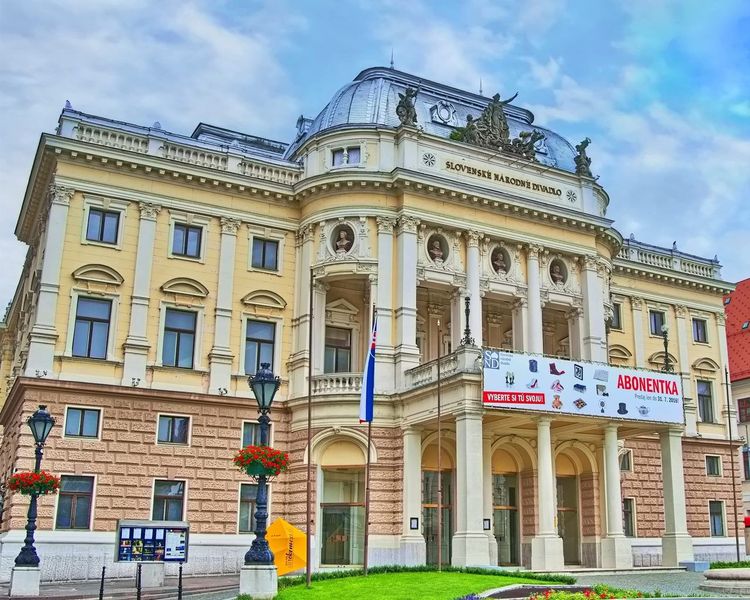
Bratislava is not only a daytime city: its cultural institutions offer plenty to extend the evening beyond the terraces.
The Slovak National Theatre and the Philharmonic
The Slovak National Theatre exists in two distinct forms: the old Neo-Renaissance building from 1886 on Hviezdoslavovo námestie, which mainly hosts ballet and repertoire opera, and the new modern building inaugurated in 2007 on the banks of the Danube, dedicated to opera and dramatic theatre. Seats remain significantly more affordable than in Vienna or Paris, often under 30 euros for a good position, making an evening at the opera entirely accessible.
The Slovak Philharmonic performs in the Reduta hall, a Neo-Baroque building in the city centre whose renovation was completed in 2011. A weekday symphonic concert makes for an elegant interlude, best booked a few days in advance during high season.
The Primatial Palace and Its Hall of Mirrors
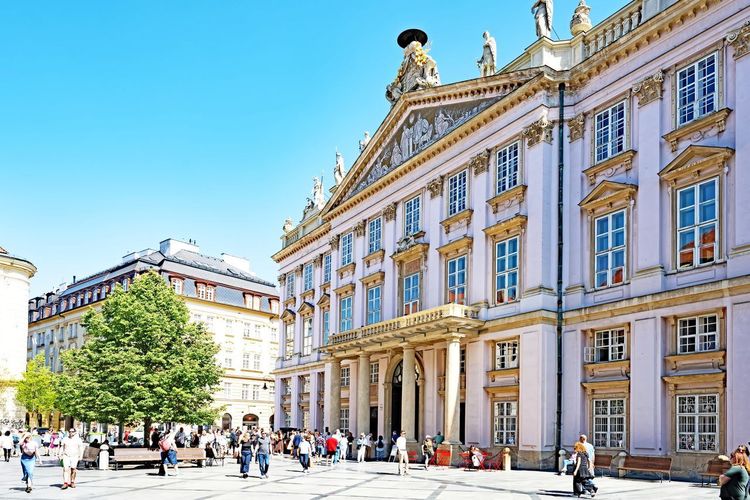
The Primatial Palace (Primaciálne námestie 2, 811 01 Bratislava, rated 4.5/5 on Google from 4,239 reviews) (Primaciálny palác), a pink Neoclassical residence built between 1778 and 1781, is well worth a visit for its Hall of Mirrors and its six 17th-century English tapestries, woven at Mortlake, which tell the story of Hero and Leander. They were rediscovered by chance in 1903 during building works, hidden behind wall panelling: a find that brought the palace renown far beyond Slovakia.
It was also in this Hall of Mirrors that the Treaty of Pressburg was signed on 26 December 1805, between Napoleon's France and Austria, in the aftermath of Austerlitz. The visit takes thirty to forty minutes, a format perfectly suited to slipping in between two strolls through the centre.
A Danube Sunset Cruise for Two
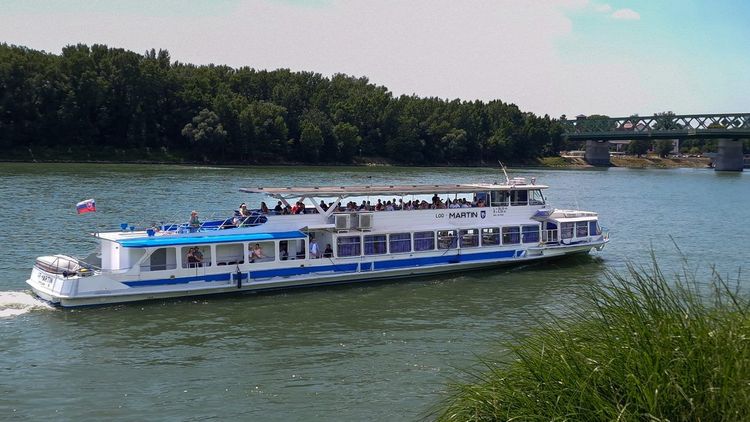
Nothing conveys Bratislava's position, wedged between Austria and Hungary, better than an hour spent on the water. Several companies offer cruises departing from the old town quays, near the SNP Bridge, some with dinner on board, others as a simple one-hour panoramic outing.
The short option, without a meal, is more than enough to enjoy the spectacle: you glide past the old town and the castle from the water, pass beneath the illuminated UFO Bridge at nightfall, and catch a distant glimpse of the Petržalka towers. Try to book the sunset departure rather than the afternoon one: the raking light on the castle facades is well worth the small premium, and the late-day boats tend to be calmer, with fewer organised groups on board.
Danubiana Museum, Contemporary Art Along the River
About fifteen kilometres south of the centre, in Čunovo, at the tip of a peninsula jutting into the Danube, stands one of Central Europe's most singular museums: the Danubiana Museum (Vodné dielo, 900 42 Čunovo, rated 4.8/5 on Google from 5,018 reviews), inaugurated in 2000 at the initiative of Dutch collector Gerard Meulensteen and Slovak gallery owner Vincent Polakovič. The building itself resembles a Roman galley run aground between two branches of the river.
The collections blend Central European contemporary art with monumental sculptures installed in the open air in a park that borders directly onto the water: you walk among the works with the Danube all around you. It is arguably the most romantic museum in the region, less for the works themselves than for the setting: a bench facing the river, a sculpture in silhouette, and silence broken only by the lapping of water. Allow half a day there and back including the visit, by bus or taxi from the centre.
Day Trips from Bratislava: Devín Castle and Vienna
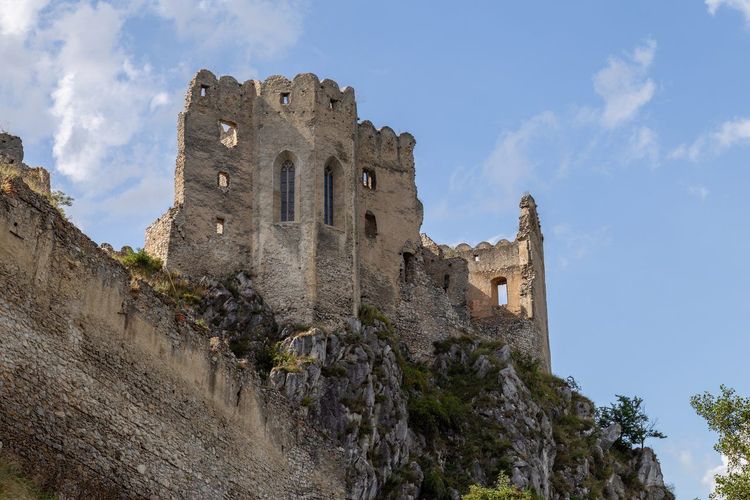
Two excursions stand out for extending a stay beyond the city limits, one just a few kilometres away, the other across the border.
Devín Castle, Ruins at the Confluence of the Danube and the Morava
About ten kilometres west of the centre, on a rocky spur at the confluence of the Danube and the Morava, stand the ruins of Devín Castle. Occupied since Celtic times, fortified during the Roman era and then by Great Moravia, the site was blown up by Napoleon's troops in 1809 and was never rebuilt, giving it the appearance of an open-air fortress, with its breached walls framing the landscape beyond.
From the summit, the view over the confluence of the two rivers — one clearer, the other more turbid, slowly mingling below your feet — remains one of the most striking images in the area. On the far side of the Morava, you are already in Austria. The climb to the ruins takes about twenty minutes along a stony path, best tackled with sturdy shoes. Bus 29, departing from the stop beneath the SNP Bridge, reaches the village of Devín in just under half an hour, allowing for a half-day excursion without a car.
A Day Trip to Vienna, About an Hour Away
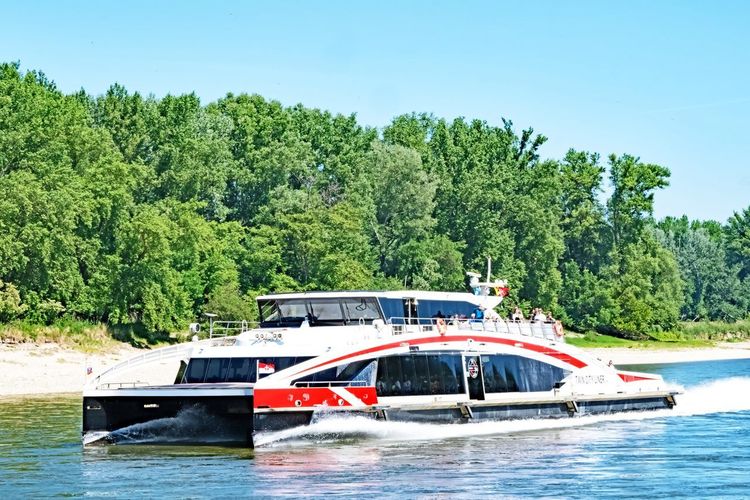
A rare distinction: Bratislava lies about sixty kilometres from Vienna. Setting aside the case of Rome and the Vatican, these are the two closest capitals in Europe. The direct train links the two city centres in around one hour, with frequent departures throughout the day, and in the warmer months the Twin City Liner catamaran travels down the Danube in about 1 hour 15 minutes, with views of the riverbanks as a bonus.
The ideal arrangement is a full day in Vienna — leaving in the morning, returning in the evening — making the most of the Ringstrasse, a coffee in a historic patisserie, and a museum of your choice, before returning to the more intimate and less expensive atmosphere of Bratislava for dinner. This is one of the city's strongest selling points: it serves as an affordable base for a trip that includes, optionally, an imperial capital within easy reach by train. For more ideas to combine, our article on the best things to do in Bratislava details further excursion ideas, including towards the wine-growing hills of the Little Carpathians.
Dinners and Bars for Two: the Best Spots in Bratislava
Bratislava's food scene has evolved considerably over the past ten years, driven by a generation of chefs who returned from Vienna or London with a desire to reinvent Slovak cuisine.
Restaurants and Intimate Dinners
For a dinner that is as much about the view as the food, the Sky Bar & Restaurant, perched on the top floor of a building on Hviezdoslavovo Square, offers a rooftop terrace with views over the old town and the castle, particularly sought after at sunset. Book a window table several days in advance at weekends.
More intimate, Zylinder Cafe Restaurant (Hviezdoslavovo námestie 19, 811 02 Bratislava, rated 4.3/5 on Google from 1,725 reviews), on the same square, serves Austro-Hungarian-inspired cuisine in a Viennese café setting.
For brunch, Bistro St. Germain, tucked into a quiet street east of the old town, draws local residents for its generous breakfasts and carefully prepared coffee: expect a wait at weekends if you haven't reserved, as it remains a popular address.
Bars and Rooftops for a Drink Together
For an early evening drink, Savage Garden cultivates a secret-garden atmosphere with its tables scattered among the plants, a setting that makes a refreshing change from standard bars.
To end the evening on a more classic note, the Old Fashioned Bar serves classic cocktails in a setting of dark wood and leather. And if you prefer wine, the wine bars in the centre pour by the glass the dry whites from the Little Carpathians — Grüner Veltliner and Riesling leading the way — a fine way to sample the vineyard that borders the city without leaving the old town.
To complement this selection with the typical dishes to order, our article on Bratislava's culinary specialities lists ten unmissable dishes, from bryndzové halušky to kapustnica.
Shopping and Souvenirs for Two
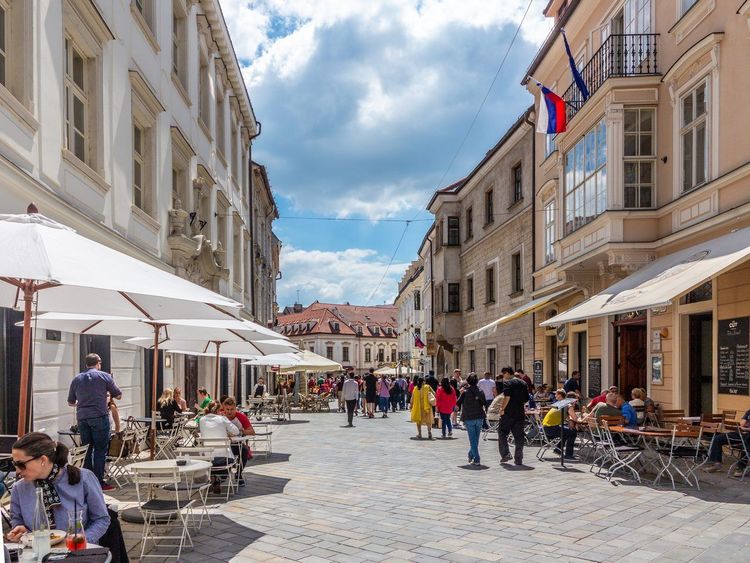
Between visits, the old town is full of small craft shops where you can find a souvenir that actually means something: hand-blown glassware, ceramics painted in Slovak folk style, or bottles of slivovica, the local plum brandy, sold in specialist shops around Ventúrska Street.
The Eurovea shopping centre on the banks of the Danube rounds out the offer with international brands and Slovak designer boutiques, and features a terrace that looks directly onto the river. For a more original gift, stop by the Stará tržnica, the old covered market in the centre, which hosts a producers' market on Saturdays: local honey, sheep's cheeses, and wooden objects make a welcome change from the usual souvenirs.
Where to Stay in Bratislava for a Couple's Trip
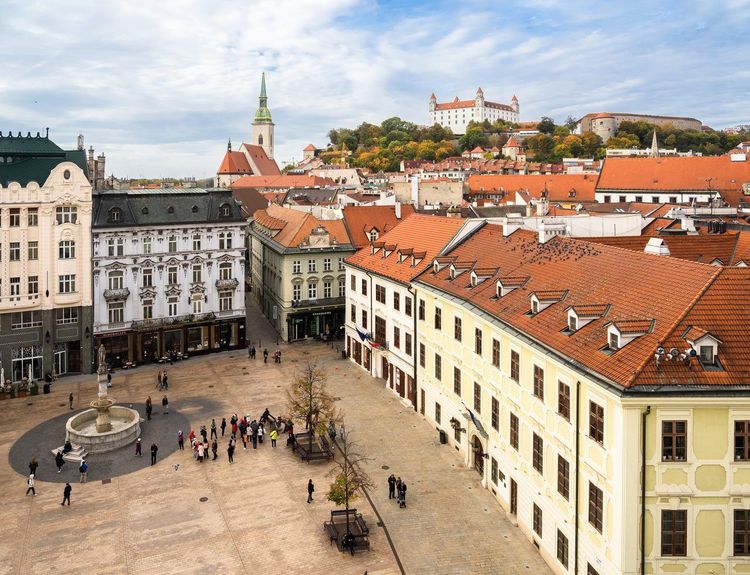
The Staré Mesto neighbourhood, the old town, remains the most obvious choice: boutique hotels here often occupy former Baroque townhouses, with attic rooms and cobbled inner courtyards. You sleep within walking distance of everything, though prices rise accordingly, especially at weekends.
The Podhradie neighbourhood, sloping up between the old town and the castle, offers a quieter alternative with charming guesthouses and rooftop views, five minutes on foot from the bustle of Hlavné námestie. For a tighter budget without sacrificing comfort, hotels in the Eurovea area on the banks of the Danube offer modern rooms with river views, fifteen minutes' walk from the historic centre along the quays.
Whichever neighbourhood you choose, try if possible to book a room with a view — over the rooftops or over the river. At this price level, generally gentler than Vienna or Prague for a comparable standard, the upgrade often transforms a stay without blowing the budget.
Budget for a Romantic Weekend in Bratislava
Bratislava remains one of the most affordable capitals in Central Europe, making it an easy weekend destination to combine with a desire for good food and culture without breaking the bank.
Budget on average 70 to 120 euros per night for a double room in a boutique hotel in the centre, a little less outside Staré Mesto. Dinner for two at a good restaurant comes to around 40 to 60 euros including wine, and a coffee on the main square terrace rarely costs more than 6 euros for two drinks. Paid attractions — the castle, the cathedral, the Primatial Palace — run to around 10 euros per person or less, the UFO slightly more, and many of the highlights — a stroll through the old town, the castle gardens, the Blue Church — are free. Over a two-night weekend, you will generally come in at between 350 and 500 euros for two, including local transport and a trip to Devín, but not flights or trains to Bratislava.
How to Get to and Get Around Bratislava
Bratislava benefits from a central position in Europe that makes it easily accessible from France and Switzerland, even without a direct flight from every city.
By Plane or Train from France and Switzerland
Bratislava Airport, about ten kilometres from the centre, mainly serves low-cost flights, with a few routes from France depending on the season. A common alternative is to fly into Vienna, which is better served from France and Switzerland, then reach Bratislava in an hour by train or direct bus from Vienna Airport — an option that sometimes works out cheaper overall.
By train, there is no direct service from France: allow for a connection in Vienna or Munich, for a total journey of around ten to twelve hours from Paris. From Switzerland, the route via Zurich and Vienna follows a similar logic. For a weekend trip, flying via Vienna remains the fastest option.
Getting Around Bratislava
Once you are there, the old town is entirely walkable, which greatly simplifies getting around. For more out-of-the-way destinations — Devín Castle, Kamzík, or the Danubiana Museum — the urban bus and tram network, cheap and frequent, covers most of the useful routes, with tickets valid for between 15 and 90 minutes depending on the length of the journey.
When to Go for a Romantic Trip to Bratislava
Spring, between April and June, and early autumn, in September, offer the best compromise: mild temperatures of around 18 to 22 degrees, pleasant light for terrace meals and walks on the heights of Kamzík, and still manageable crowds compared to the peak of summer. Pack an umbrella in May and June, often the wettest months.
Summer, from July to August, brings open-air festivals and long evenings on the terraces, but also sometimes oppressive heat and more groups in the old town. Winter, on the other hand, completely transforms the atmosphere: the Christmas market on Hlavné námestie, from late November to Christmas Eve, bathes the main square in a particularly photogenic golden light, and hotel prices drop noticeably outside the festive period. For a glimpse of this often underrated season, our article on the winter experience in Slovakia offers further ideas for a midwinter stay.
FAQ
How many days should I plan to visit Bratislava as a couple?
Two full days are enough to cover the old town, the castle, the cathedral, and one of the elevated viewpoints. With three days, you can add Devín Castle and a day trip to Vienna without feeling rushed.
What budget should I plan for a weekend for two in Bratislava?
Budget between 350 and 500 euros for two over two nights, including boutique hotel accommodation, meals, and paid attractions, but not transport to the city. It is one of the most affordable capitals in Central Europe.
Where should couples stay in Bratislava?
The old town, Staré Mesto, remains the most convenient choice, putting everything within walking distance. The Podhradie neighbourhood, at the foot of the castle, offers a quieter alternative, just five minutes on foot from the centre.
What is the best time to visit Bratislava as a couple?
Spring and early autumn offer the best balance of mild weather and manageable crowds. The Christmas market in December is a lovely option if you enjoy a wintry atmosphere.
How do I get to Bratislava from France?
There is neither a direct train nor a year-round direct flight from France: the most common solution is to fly into Vienna, then reach Bratislava in about an hour by train or bus, or to take a direct low-cost flight depending on the dates and airports served.
What can a couple do in just one day in Bratislava?
In one day, focus on the old town in the morning, the climb up to the castle and Saint Martin's Cathedral late morning, a terrace lunch, then the UFO for sunset, followed by dinner at one of the city-centre restaurants.
Bratislava lacks the glamorous reputation of Prague or Vienna, and that is precisely what makes it such a successful destination for two: you discover things together, without fighting for space on a crowded bridge or queuing an hour for a museum. Between the old town that you explore on instinct, the wooded heights of Kamzík, and a neighbouring capital roughly an hour away by train, your itinerary takes shape around the mood of the moment rather than a rigid schedule.
To stay connected to the city's historical thread as you wander, the Ryo audio tour of Bratislava unfolds across 20 audio stops in around 3 hours 40 minutes, from Grassalkovich Palace to Saint Michael's Gate: no paper guide, no organised group, just the two of you, the historic centre, and the stories waiting around every corner.