© Shutterstock
 Votre guide Ryo
Petit Bayonne: Complete Itinerary to Visit the Neighborhood in 2026
There are two Bayonnes. The one hurried visitors pass through — cathedral, ramparts, chocolate — and the one regulars keep a little to themselves: Petit Bayonne, on the left bank of the Nive, with its medieval alleyways, half-timbered facades, and bars where people speak Basque between drinks. Visiting Petit Bayonne means choosing the living side of the city over the postcard side. This neighborhood is home to two outstanding museums — the Basque Museum and the Bonnat-Helleu Museum — authentic street food, and the liveliest nights in the French Basque Country. Whether you have a morning or a full day, this guide gives you a precise itinerary, concrete addresses, and the keys to understanding this extraordinary slice of the city. To make sure you miss nothing, the Ryo audio guide for Bayonne accompanies you over 3.4 km with 23 audio stops.
A Neighborhood Apart: Understanding Petit Bayonne Before You Visit
Petit Bayonne is not a picturesque neighborhood frozen in time for tourists. It is a piece of medieval urban fabric that has survived the centuries with rare coherence, and it remains inhabited, commercial, and noisy come evening. Bounded by the Nive to the east, the Rempart Lachepaillet to the south, and the northern quays, it forms a dense triangle of roughly 400 metres per side — compact enough to explore entirely on foot.
Historically, this was the neighborhood of artisans and tanners, settled along the Nive to take advantage of the current. This working-class vocation explains the modest, functional architecture of the buildings: commercial ground floors, two or three residential storeys, exposed timber frames. Unlike Grand Bayonne, which houses the cathedral and civic institutions, the neighborhood has always had a more working-class, more strictly Basque identity. Signs in Euskara (the Basque language) remain numerous, fine food shops display Bayonne ham and sheep's cheese in their windows, and pelota players still train on the fronton on rue des Tonneliers.
If you are visiting Bayonne for the first time, start with Grand Bayonne to see the Sainte-Marie cathedral, then cross one of the bridges over the Nive to plunge into Petit Bayonne. The geographical order is natural and the contrast is striking.
Historic Streets and Medieval Architecture
The rue Pannecau (Rue Pannecau, 64100 Bayonne) is the backbone of the neighborhood. Barely six metres wide, it is lined with 15th- and 16th-century facades, some of which have undergone only minor restoration. Walk it early in the morning, when bakery deliveries jostle with the first tourists, and look up at the jettied upper floors — these overhanging storeys narrow the strip of sky above you even further.
The rue des Cordeliers is worth a detour for its Franciscan convent, whose 14th-century Gothic arcades form a discreet cloister that is often overlooked. The building is now used for cultural purposes and is partially open depending on the season.
The rue d'Espagne, running perpendicular to the Nive, was the historic road to Madrid via the Col du Somport. A few houses with enclosed wooden galleries recall the transit architecture typical of staging towns on pilgrimage routes: merchants were sheltered from the rain without closing off the street.
The place des Basques is the geographic heart of the neighborhood. This is where the alleyways converge, where terrace seating spills out in the evenings, and where children play under the plane trees. Not a postcard square — a genuine neighborhood square.
On the fortifications side, the Rempart Lachepaillet (Rempart Lachepaillet, 64100 Bayonne, rated 4.3/5 on Google based on 95 reviews) runs along the southern edge of the neighborhood. These remains of the city's former fortifications (reinforced by Vauban at the end of the 17th century) offer an unobstructed view over the Nive and, on clear days, the foothills of the Pyrenees. A fifteen-minute walk above street level, ideal for mentally mapping the geography of the area.
Allow at least an hour for this wander through the streets. Don't look for a strict route: the neighborhood rewards doubling back and exploring dead ends.
The Basque Museum and History of Bayonne
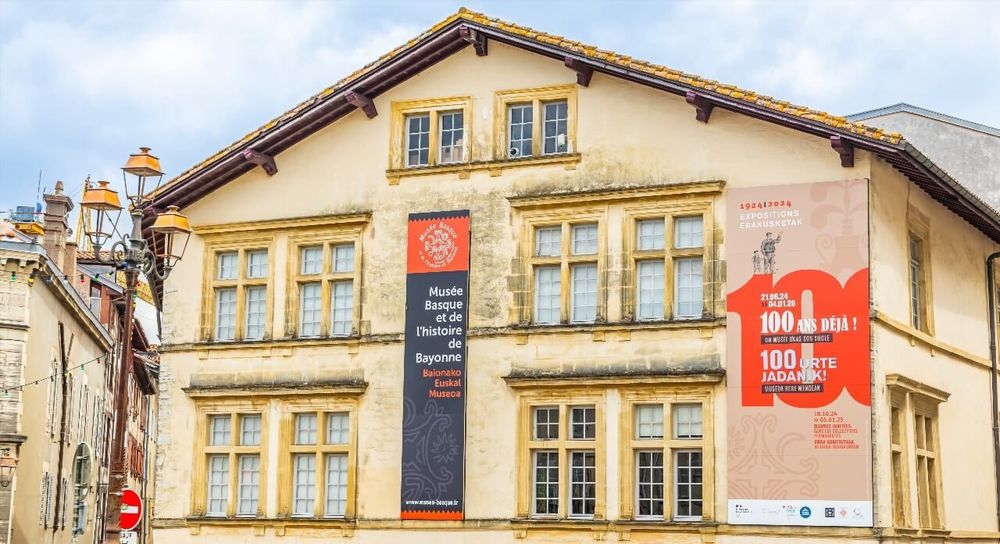
If you can only visit one museum in all of Bayonne, make it this one. The Basque Museum and History of Bayonne (37 Quai des Corsaires, 64100 Bayonne, rated 4.5/5 on Google based on 1,580 reviews) occupies the Maison Dagourette, a 16th-century harbour house subsequently modified. Its collections, spread across three floors, tell the history of the Basque Country from prehistory to the 20th century — not as a regional folklore collection, but as a coherent civilisation with its own culture, architecture, sports, and funerary practices.
The permanent collections are organised thematically rather than chronologically: the traditional Basque house (with a reconstruction of an etxe, the Basque farmhouse), the sea and fishing (Bayonne was long a major whaling and cod-fishing port), pelota and its many forms, and funerary furniture including the disc-shaped steles — circular engraved markers that still populate Basque cemeteries.
The section devoted to the Napoleonic episodes is illuminating: Bayonne, a border city and fortress, played a major military role in the early 19th century, and the traces of that history are still readable in the topography of the neighborhood.
Visiting plan: allow a minimum of 1h30, or 2 hours if you read the labels. Full price €9, free for under-26s, as well as on Thursday evenings (6 pm to 8 pm) and the first Sunday of each month. The museum is open Tuesday to Sunday (closed Monday); check seasonal opening hours before you go.
The Bonnat-Helleu Museum
A short walk from the Basque Museum, the Bonnat-Helleu Museum (5 Rue Jacques Laffitte, 64100 Bayonne, rated 4.4/5 on Google based on 314 reviews) houses one of the most underrated painting collections in France, and it has made a grand comeback: after fourteen years of closure for a renovation and expansion project, Bayonne's fine arts museum reopened its doors at the end of November 2025. The exhibition space has been doubled to around 3,000 m², and more than a thousand works are now on display.
Léon Bonnat (1833–1922), a Bayonnais painter celebrated in his lifetime, bequeathed to his hometown an exceptional collection: works by Rubens, Ribera, Goya, Ingres, and Degas, as well as a collection of old master drawings considered one of the richest in France after that of the Louvre. The new permanent route abandons chronological order in favour of broad themes (the body, identity, otherness) and draws unexpected connections between works.
Note: the old master drawings collection, being fragile, is displayed on a rotating basis. Check which temporary hang is on before your visit. The building has a lift, an asset for visitors with reduced mobility. Be sure to verify up-to-date admission prices and opening times on the museum's website, as these may still be evolving following the reopening.
If time is short, start with the Basque Museum (more specific to the region) and finish with Bonnat-Helleu (more universal). Both can be visited in the same half-day.
The Banks of the Nive and the Riverside Atmosphere
The Nive is not merely the boundary between Grand and Petit Bayonne: it is the neighborhood's lifeblood. The quays that line it — the quai des Corsaires and the quai Jauréguiberry — lead a remarkably double life depending on the time of day.
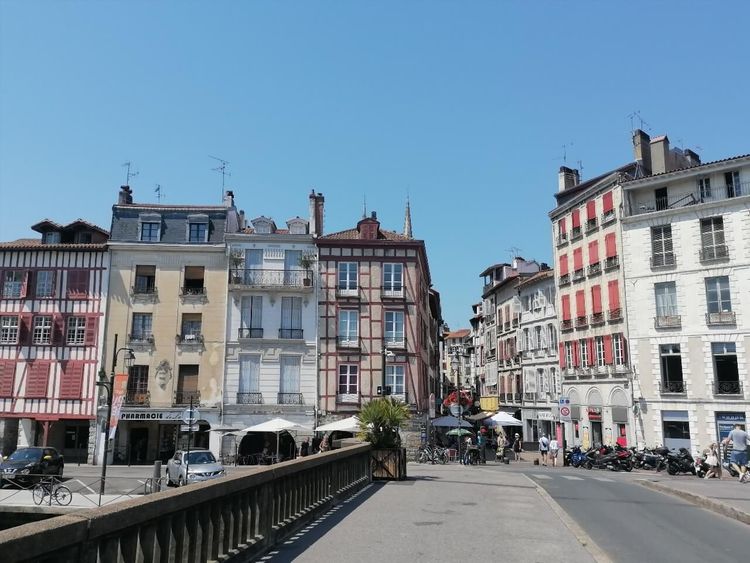
In the morning, it is the neighborhood's logistical artery: deliveries, anglers on the stone steps, joggers. In the afternoon, bar terraces set up along the water's edge and the five-storey half-timbered houses dominating the bank reflect in the current — this is exactly the view that illustrates every postcard of Bayonne, and it is even better in person.
The bridges over the Nive linking Petit Bayonne to Grand Bayonne each deserve a look. The pont du Génie is one of the most photographed, thanks to its perspective on the houses of the left bank. The pont Pannecau, opposite the street of the same name, is one of the busiest and most lively crossings.
If you are visiting in summer, note that flooding on the Nive can temporarily close the waterfront terraces. The locals are well acquainted with the phenomenon and move their tables inside with remarkable composure. The Nive rises and falls quickly — generally less than a day of disruption.
Gastronomy: Eating and Drinking in Petit Bayonne
Petit Bayonne is the most densely packed neighborhood for food and drink in the entire city. No grand gastronomic tables here, but an exceptional concentration of tapas bars (or rather pintxos bars, in the Spanish Basque tradition that has crossed the border), artisan charcuteries, and wine cellars.
For Bayonne ham, stop in at Cazaux, on the quai des Corsaires. It is one of the oldest establishments in the city for Basque charcuterie; the ham is cured for many months, and the staff will straightforwardly explain the difference between a Label Rouge ham and an IGP-certified one.
For chocolate, do not forget that Bayonne is the city where eating chocolate was introduced to France in the 17th century, by Sephardic Jewish merchants expelled from the Iberian Peninsula. Cazenave is the historic address, but its prices have risen. The less touristy alternative: Chocolats Daranatz (15 Rue du Port-Neuf, 64100 Bayonne, rated 4.5/5 on Google based on 101 reviews), on rue du Port-Neuf, whose mendiant chocolate bars are exemplary.
For a budget-friendly lunch, the Halles de Bayonne (on the Grand Bayonne side, but a three-minute walk from the pont Pannecau) offer stalls selling sheep's cheese, gâteau basque, and local produce. The covered market is open every morning except Monday.
In the evening, pintxos bars come alive from 7 pm. The usual format: pintxos laid out on the counter for a few euros each, a glass of txakoli or white irouléguy for €3 to €4. Bar du Marché and Café du Théâtre are two straightforward addresses for experiencing the neighborhood atmosphere without needing a reservation. For a broader selection of food addresses, see our guide to the culinary specialities of Bayonne.
Nightlife and Evening Outings
Petit Bayonne is THE bar district of the city — something worth bearing in mind before booking accommodation there. After 10 pm on weekends, the alleyways of rue Pannecau, rue des Tonneliers, and rue des Cordeliers effectively become pedestrianised, glasses spill onto the cobblestones, and conversations blend in French, Basque, and Spanish.
This neighborhood life is not organised for tourist purposes: it is simply the social fabric of the French Basque Country concentrated within a few hundred square metres. Bars here often operate without a visible illuminated sign — you find the place by the noise and the crowd on the doorstep.
For Basque music concerts (trikitixa, polyphonic singing, bertsolaris sessions), keep an eye on the programming at the city's venues. And if you are looking to extend the evening in a quieter setting, the banks of the Nive remain accessible and pleasant even after midnight in summer.
The Fêtes de Bayonne: When the Neighborhood Ignites
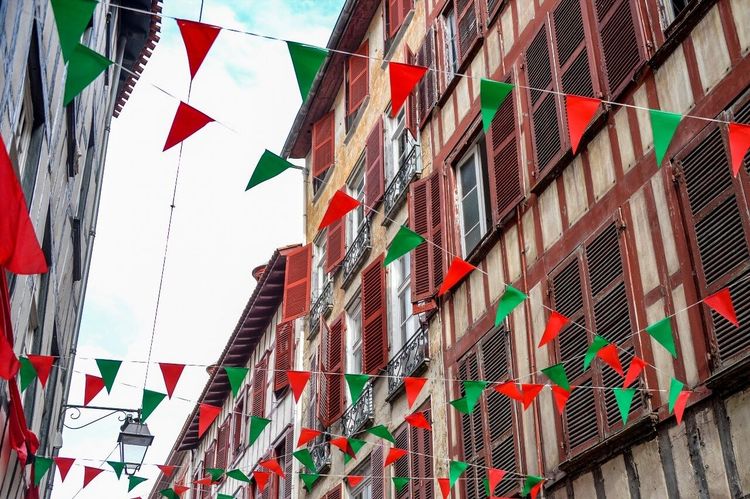
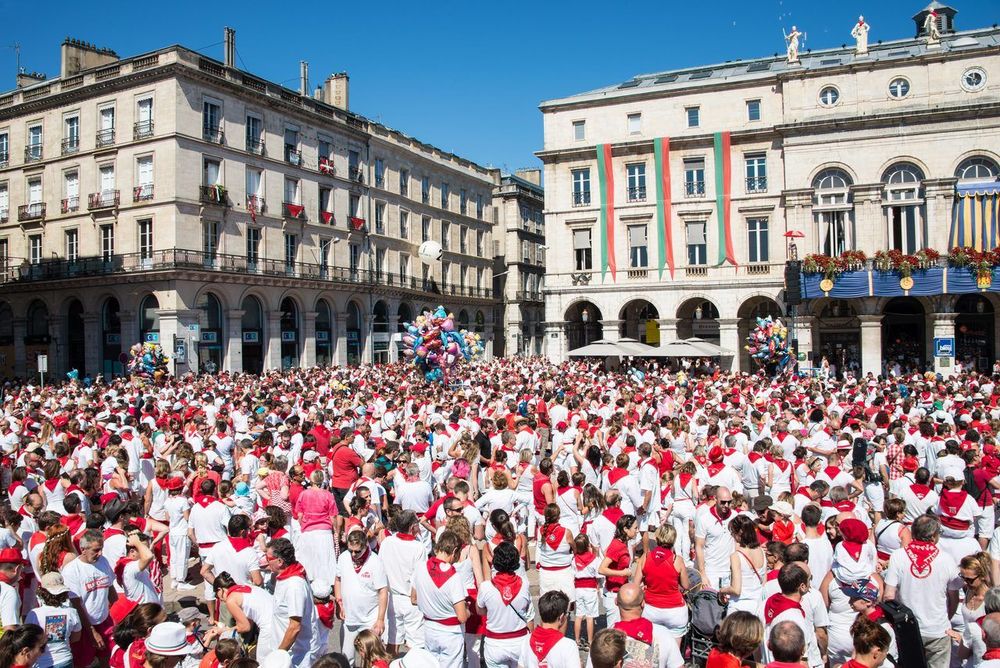
It is impossible to talk about Petit Bayonne without mentioning the Fêtes de Bayonne, the five days of summer festivities that transform the city into one of the largest festive gatherings in Europe. Each year they draw more than a million festayres over five days, from Wednesday to Sunday. The dates have varied in recent years: long scheduled for the end of July, the festival can now take place as early as the beginning or mid-July — check the year you are planning your stay.
Petit Bayonne is the epicentre of these festivities. Its narrow alleyways become permanent party corridors, its bars barely close, and place des Basques hosts impromptu entertainment. The dress code: white and red, without exception — latecomers in other colours are gently reminded of the rules.
But the neighborhood thrives outside the festival too. The Bayonne carnival (February–March) is another popular event, more intimate in feel, with parades of peñas (festive associations) that set off from place des Basques. And in December, the Christmas markets take over the banks of the Nive with an atmosphere that is remarkably uncommercial for the genre.
To plan your stay around events in the Basque Country, our article on things to do in Bayonne rounds up plenty of outing ideas.
Walking Itinerary Through Petit Bayonne
Here is a 2h30 itinerary covering the essential parts of the neighborhood on foot, without entering the museums. Add 3 hours if you visit the Basque Museum and Bonnat-Helleu. This is exactly the kind of walk that the Ryo audio guide lets you do independently, earphones in.
Starting point: pont Marengo, left bank of the Nive. An overview of the half-timbered houses on the quai des Corsaires.
Stop 1 — Quai des Corsaires (15 min): walk along the bank looking at the facades on the waterside. Notice the differences in style between the 16th-century houses and those from the 19th century rebuilt after flooding.
Stop 2 — Basque Museum (15 min outside, 1h30 if visiting): step into the courtyard of the Maison Dagourette to see the spiral staircase, even if you are not visiting the exhibition that day.
Stop 3 — Rue Pannecau (20 min): head north along the street, duck into the covered passages, and look out for signs in Euskara. Optional stop at the chocolate shop.
Stop 4 — Place des Basques (10 min): terrace coffee break if the time is right. Look at the nearby fronton — pelota matches take place there in the late afternoon.
Stop 5 — Rue des Cordeliers and the cloister (20 min): approach the Franciscan cloister, one of the rare surviving medieval monastic remains in the city centre.
Stop 6 — Rempart Lachepaillet (20 min): climb the ramparts for the view over the Nive and the Pyrenees.
Return: head back down to the pont Pannecau and cross over to Grand Bayonne and the cathedral.
This itinerary is available as an audio guide via the Ryo audio guide for Bayonne, with 22 audio commentaries detailing each stop across 3.4 km. Ideal for self-guided visits, especially with children.
Practical Information for Visiting Petit Bayonne
How to get there. Bayonne train station is a 15-minute walk from the neighborhood. By car, the nearest car parks are the Allées Marines car park and the Mairie car park; expect to pay €1 to €2 per hour. In summer, public transport is preferable: traffic within the city walls is difficult in July and August.
When to go. Petit Bayonne is pleasant year-round. Avoid the Fêtes de Bayonne period (in July) if you are seeking peace and quiet. The best time for architectural wandering: early morning in summer (before 9 am) or in the low season (October to April), when the alleyways are almost deserted.
Average budget. Allow €20 to €30 for a visit without museums (light lunch + pintxos in the evening). With both museums: €35 to €45 per person approximately. Accommodation within the neighborhood itself is limited; most hotels are on the Grand Bayonne side or in the outskirts.
Accessibility. The medieval neighborhood is cobbled and hilly in places. Visitors with reduced mobility can access the quays and the museums (the Bonnat-Helleu Museum has a lift), but some inner streets are difficult by wheelchair. Our audio-guided tour keeps mostly to the quays and to Petit Bayonne, the flattest part of the walk.



FAQ
How Long Does It Take to Visit Petit Bayonne?
Allow half a day for a stroll through the streets and a meal break. If you visit the two main museums (the Basque Museum and the Bonnat-Helleu Museum), plan a full day: each requires between 1h30 and 2 hours. In the evening, the neighborhood takes on a different face and lends itself to a second outing for bars and pintxos.
Is Petit Bayonne Different from Grand Bayonne?
Yes, clearly. Grand Bayonne (right bank) is the institutional and ecclesiastical district: the Sainte-Marie cathedral, city-centre shops, and commercial alleyways. Petit Bayonne (left bank of the Nive) is more working-class, architecturally denser, with a more pronounced Basque identity and a more intense neighborhood life, especially in the evening. Both can be visited together — crossing one of the bridges over the Nive is all it takes.
What Is There to Do in Petit Bayonne with Children?
The Basque Museum offers family-friendly visit materials centred on the traditional Basque house. The banks of the Nive are ideal for young children (flat space, easy supervision). Place des Basques, with its plane trees and fronton, is a natural play area. Avoid weekend evenings: the concentration of bars makes the inner alleyways noisy and crowded. The Ryo audio guide, followed on a smartphone, also turns the walk into a treasure hunt for younger visitors.
Is There a Market in Petit Bayonne?
The main covered market is the Halles de Bayonne, technically on the Grand Bayonne side but just a two-minute walk from the pont Pannecau. It is open every morning except Monday, with stalls selling cheese, charcuterie, fruit, and vegetables. Outdoor markets also set up along the banks of the Nive on certain weekends, particularly in summer.
Is Petit Bayonne Wheelchair Accessible?
Accessibility is partial. The banks of the Nive and both museums are accessible (the Bonnat-Helleu Museum has a lift, and the Basque Museum has adapted access). However, several medieval alleyways are cobbled and have small steps of a few centimetres between the houses and the road. Place des Basques and rue Pannecau are manageable, but some secondary passages are not. The Ryo audio tour follows the riverside and the Bonnat-Helleu Museum, which makes for the easier half of the neighborhood.
Conclusion
Petit Bayonne delivers a rare promise: that of a medieval neighborhood that has not been turned into a stage set. Its alleyways still function, its museums are worth the trip, its food is genuine, and its nightlife needs nothing to envy from cities twice its size. A guide cannot replace the pleasure of wandering, but it helps you look in the right places.
To go further in your discovery of Bayonne and the Basque Country, our Bayonne audio-guided tour offers a route of 23 stops that crosses Petit Bayonne and Grand Bayonne in 1h20, from your smartphone, at your own pace. With Ryo, you keep the guide in your pocket and move without time constraints. And if you would like to extend your stay, our selection of the most beautiful villages in the French Basque Country will give you plenty to plan the days that follow.
À lire également