© Shutterstock
 Votre guide Ryo
The 7 Most Beautiful Villages Around Clermont-Ferrand (2026)
Less than an hour's drive away, Auvergne hides its finest surprises in villages, some of which rank among the best-preserved in France. When looking for villages around Clermont-Ferrand, you might expect panoramas over the Chaîne des Puys — what truly surprises you is the accumulation of unlikely facts: the only intact Romanesque cloister in Auvergne in a village of two hundred inhabitants, 14th-century frescoes depicting the legend of Tristan and Iseult painted on the walls of a forgotten keep just 35 km from the city, nineteen years of royal exile condensed on a volcanic outcrop above the Limagne plain. Six villages in this selection carry the "Most Beautiful Villages of France" label; the seventh richly deserves to join them. If you are beginning your stay in Clermont-Ferrand, the Ryo audio-guided tour of Clermont-Ferrand offers a useful grounding before you hit the road: 21 audio stops, 5.3 kilometres of city walking, and a geographical and historical context that makes the surrounding villages even more legible. This guide covers seven stops, from Puy-de-Dôme to Haute-Loire, with distances from Clermont, what you really need to see, and how to organise your days.
Montpeyroux, the Medieval Jewel of the Auvergne Volcanoes
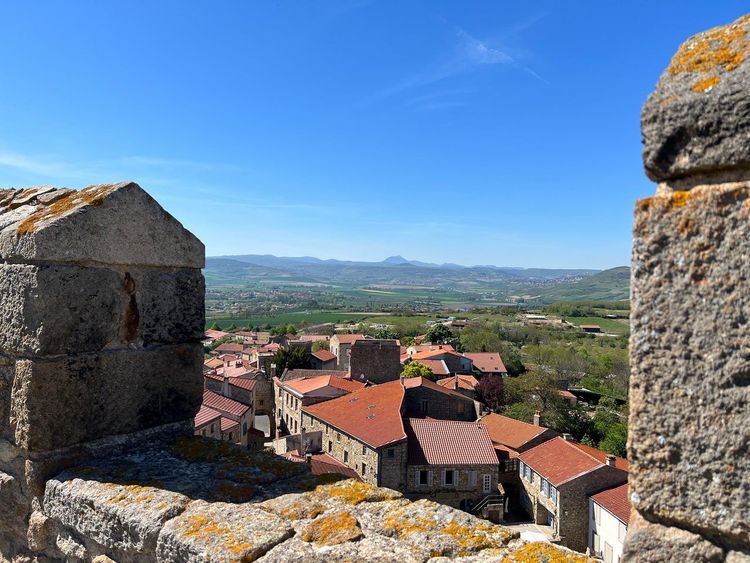
Some 45 kilometres south of Clermont-Ferrand, Montpeyroux rises like a silhouette of black basalt against a backdrop of vines. The village has been part of the "Most Beautiful Villages of France" network since 1989 — a designation that owes nothing to chance: the cobbled lanes date back to the Middle Ages, the volcanic stone houses retain their arched doorways, and the grey slate roofs catch the low morning light in a way that is hard to put into words.
The église Saint-André (12th century) remains the focal point of the village. Less spectacular than the great abbeys of the region, it compensates with a sobriety that suits the character of Montpeyroux: no superfluous ornament, just Romanesque mastery in its most pared-back form. Walk around the building to see the apse from the lower lane — this is the angle that best reveals the basalt architecture.
What surprises further is the presence of the vineyard at the foot of the ramparts. The village has been producing wines under the AOC Côtes d'Auvergne designation (predominantly Gamay) for centuries. Several estates offer tastings by appointment, and the volcanic terroir — the same basalt that forms the village walls — lends the wines a characteristic minerality that Loire enthusiasts will recognise. In September, during the harvest, the village changes pace and colour: a particularly rewarding time to visit if your schedule allows.
Park at the bottom of the village (free car park) and walk up: the slope is short, but the stone can be slippery in wet weather. The Cave coopérative de Corent, nearby, brings together a number of producers if you want to taste without scheduling multiple appointments. In July, Montpeyroux hosts a night market that draws residents from neighbouring villages — a local event rather than a tourist spectacle, worth stopping for if the timing works. Allow two hours on site.
Lavaudieu, the Romanesque Pearl of Haute-Loire
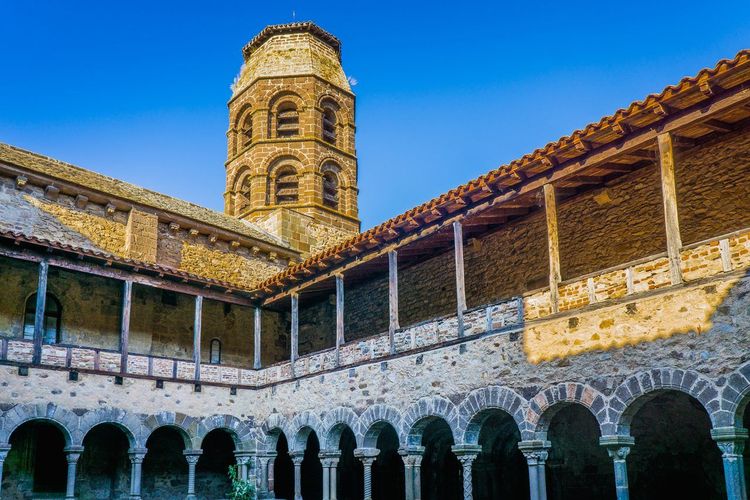
Lavaudieu is worth the drive to Haute-Loire, 75 kilometres from Clermont-Ferrand up the Allier valley. What the village conceals behind its yellow stone facades is of absolute rarity: the Benedictine abbey of Saint-André, founded in 1057 by Saint Robert de Turlande (the founder of La Chaise-Dieu), possesses the only intact Romanesque cloister in Auvergne. Just one. That fact alone justifies the journey.
The cloister is of a haunting elegance. The paired columns, the capitals carved with foliage and interlacing, the central garden overgrown with aromatic herbs in summer — together they create an impression of suspended time that photographs fail to capture. The guided tour, available in July and August (around 45 minutes), illuminates the carved symbols and traces the history of the female religious community that occupied the abbey until the Revolution.
In the refectory, a 12th-century Byzantine-influenced fresco depicts Christ in Majesty, while the former abbey church preserves 14th-century mural paintings from the Italian school, including a striking allegory of the plague, in a remarkable state of conservation for their age. Beyond the abbey, the village unfolds with half-timbered houses and a communal wash-house that recall the time when Lavaudieu was a thriving market town. Allow half a day to combine the abbey, a stroll through the lanes, and a stop at one of the small local inns serving straightforward Auvergne cuisine.
Charroux, Bourbonnais Authenticity and Its Legendary Mustard
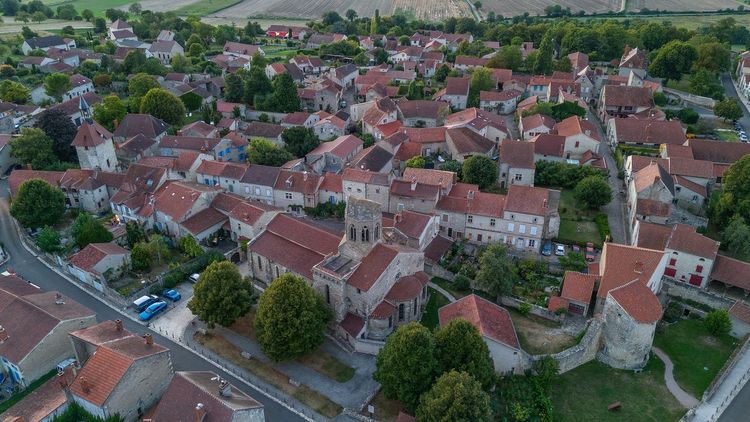
Charroux (Village de Charroux, 03140 Charroux) lies 80 kilometres from Clermont, in the Allier department. Technically outside Puy-de-Dôme, it still sits within the natural orbit of a day trip from the prefecture. Two things put Charroux on the map: the "Most Beautiful Village of France" label and Charroux mustard, a stone-ground old-fashioned mustard that several producers sell directly from their workshops on site.
The medieval ramparts still encircle the village. The Clock Gate is the natural entrance: pass through it to find yourself on the main street lined with half-timbered houses and working craftsmen's studios. The Museum of Ancient Pharmacy, an 18th-century dispensary left virtually intact with its faience jars and period medical instruments, is worth an hour's stop for anyone with an interest in arts and crafts.
Charroux is quiet on weekdays and livelier on spring weekends when artisans open their workshops. The walk along the ramparts takes about thirty minutes and opens up views over the Bourbonnais plains. For the mustard, look for producers who still use stone-grinding: the difference in texture and heat on the palate compared to an industrial mustard is immediately apparent.
Saint-Saturnin, the Royal Village 20 km from Clermont-Ferrand
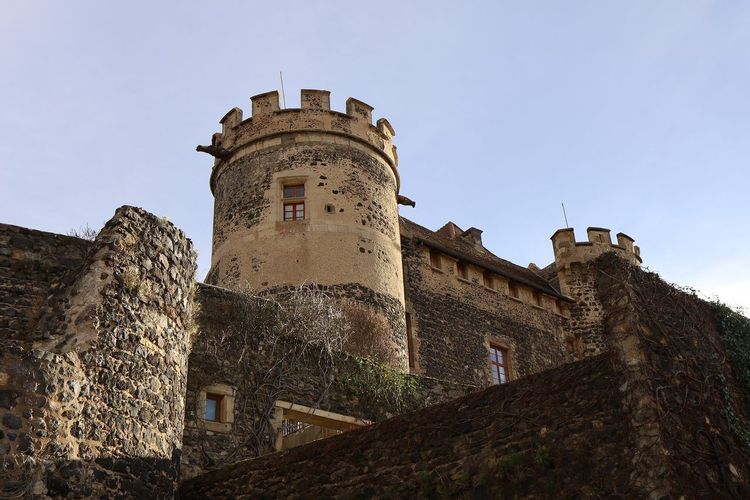
Saint-Saturnin is the most accessible village in this selection: 20 kilometres south of Clermont-Ferrand, less than 25 minutes by road. The village owes its official standing to two complementary yet contrasting monuments: a medieval castle and a 12th-century Romanesque church.
The château de Saint-Saturnin (Place du Château, 63450 Saint-Saturnin, rated 4.4/5 on Google with 390 reviews) was a residence of the Dukes of La Tour d'Auvergne, Catherine de Medici's family, who stayed here. Its crenellated silhouette dominates the village from the hilltop, with its corner towers and a manor house in a remarkable state of preservation. The interior tour (open May to September) reveals furnished rooms and a chapel that allow you to imagine court life during the Renaissance — the castle has been occupied almost without interruption, which explains the quality of the interiors.
On the way down to the church, you will pass the Renaissance fountain from the 16th century, a sculpted basin set in the main street as if it had always belonged there. The Romanesque church of Saint-Saturnin (12th century) is a genuine textbook of Auvergne Romanesque architecture: the lantern tower, the chevet with radiating chapels and the historiated capitals can be read one by one as you walk around the building. It is, incidentally, the smallest of the five major Romanesque churches of Auvergne. From the village, views of the Chaîne des Puys on clear days are among the finest in the department.
Usson, the Refuge of Queen Margot
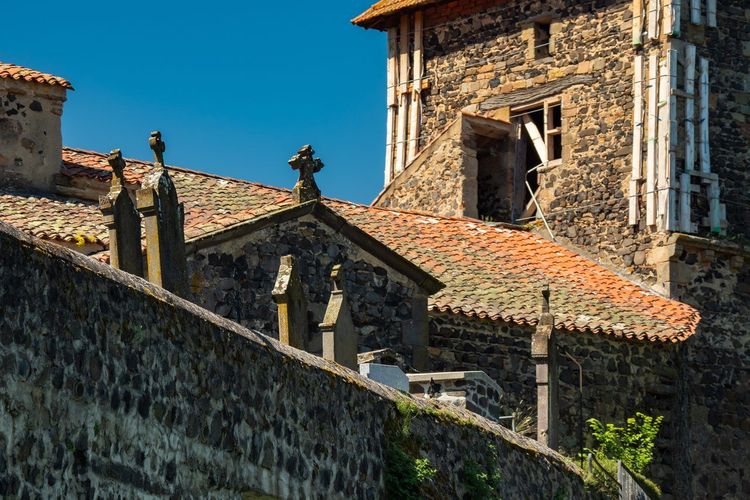
Perched on a volcanic outcrop 35 kilometres south-east of the city, Usson owes its fame to a historical episode that reads like a novel. In 1586, Marguerite de Valois, the Queen Margot, was placed under house arrest here by her brother Henri III. She was meant to stay for a few months. She stayed for nineteen years, until 1605, gradually transforming her exile into a literary and artistic court where she wrote part of her Memoirs.
What you find today is a village of around one hundred inhabitants, a monumental statue of the Virgin (Notre-Dame d'Usson) crowning the summit of the outcrop, and a 360-degree panorama over the Limagne plains and the first foothills of the Massif central. The medieval fortress, once reputed one of the most impregnable in the kingdom, was dismantled on Richelieu's orders in 1634; only traces remain at ground level, but the site itself is enough to understand why the position was so coveted.
The climb from the car park takes about ten minutes on a steep but waymarked path. The Romanesque church of Saint-Maurice, where the queen came to pray, preserves fine sculpted capitals. Usson can be visited in two hours, ideally in the morning when the light comes from the Puy-de-Dôme and visitor numbers are still low. Combine it with Issoire (12 km to the north, abbaye Saint-Austremoine) for a full day in this area.
Blesle, the Monastic Treasure of Haute-Loire
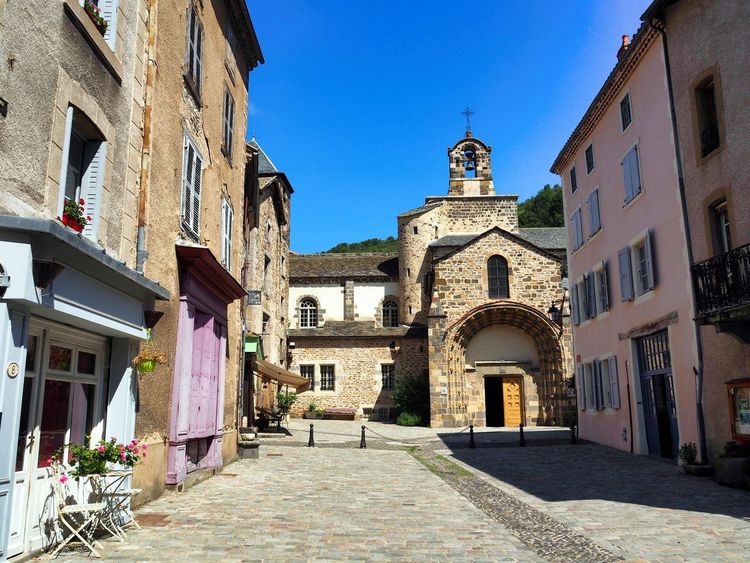
Blesle (Village de Blesle, 43450 Blesle) takes some effort to reach: 85 kilometres from Clermont towards the Cézallier, through landscapes of basalt and gorges that already justify the distance. The labelled village preserves a medieval ensemble of rare coherence: two fortification towers still standing, partially covered lanes, and houses whose vaulted ground floors date back to the 13th century.
The Benedictine abbey of Blesle, founded around 880 by Ermengarde d'Auvergne, was one of the most influential religious institutions in medieval Auvergne. Its abbess exercised temporal power over several surrounding villages — a fact that still surprises visitors today. All that remains of the abbey is the abbey church of Saint-Pierre (11th–12th centuries), now the parish church, but the sculpted capitals of the choir bear witness to an uncommon quality of craftsmanship: hunting scenes, stylised vegetation, figures in motion carved from stone.
The walk through Blesle naturally continues towards the wash-houses along the stream that runs through the village, then on to the tour de Mercœur, nicknamed the "tower of twenty angles", a 13th-century vestige of the power struggles between the barons of Mercœur and the abbesses. The Allagnon gorges, two kilometres away, offer an hour's round-trip walk through a setting of basalt and tufa. An overnight stay allows you to combine Blesle with Lavaudieu the following day without rushing — together they represent the essential Romanesque heritage of Haute-Loire within a reasonable distance. Clermont-Ferrand itself loops in 5.3 km of commentary, a good primer before the villages.
Saint-Floret, the Forgotten Frescoes of the Couze Pavin
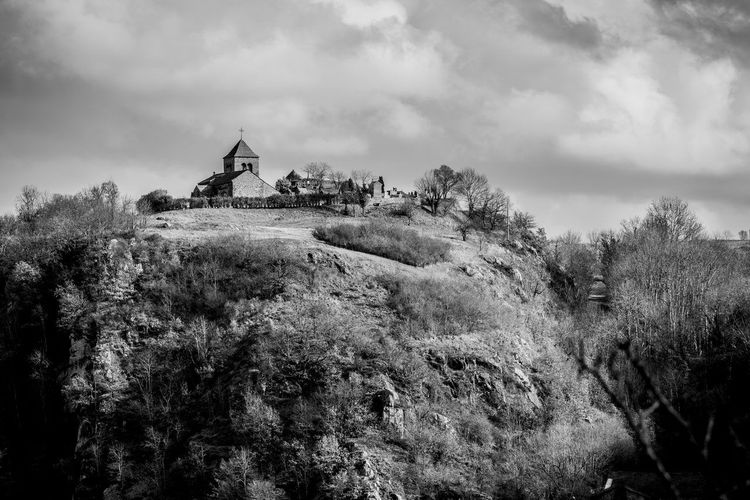
Saint-Floret does not carry the "Most Beautiful Village of France" label, but it possesses something none of the previous six villages can claim: 14th-century medieval frescoes depicting scenes from the legend of Tristan and Iseult, painted directly on the walls of the seigneurial keep. Located 35 kilometres south of the prefecture, in the Couze Pavin valley.
The château de Saint-Floret (Saint-Floret, 63400 Saint-Floret, rated 4.6/5 on Google with 89 reviews) consists of a square keep (14th century) and an adjoining ground-floor hall. The mural paintings cover the walls with a narrative quality one would more readily associate with an illuminated manuscript than an Auvergne stronghouse: characters from Arthurian legend, court and tournament scenes, in ochre and brick-red tones that have survived six centuries with remarkable resilience. The visit is guided (around 45 minutes) and clearly explained, even for visitors with no particular background in medieval studies.
The village stretches along the Couze Pavin, a trout river whose banks are accessible from the centre. The Romanesque chapel higher up in the village is worth a five-minute climb for its sculpted doorway. Saint-Floret pairs naturally with a hike to Lac Pavin, a volcanic maar some thirty kilometres to the south-west, for a full day in this lesser-known part of Puy-de-Dôme.
A Few Extra Hidden Gems to Explore
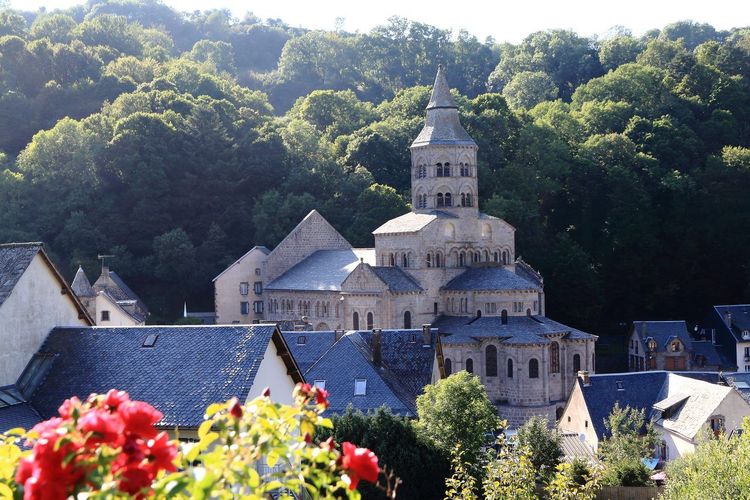
Seven villages cannot exhaust the richness of the territory. At Orcival (30 km to the west), the Romanesque basilica of Notre-Dame is one of the five great major Romanesque churches of Auvergne, less well known than its neighbours but architecturally comparable. At La Tour-d'Auvergne (65 km to the south-west), the mountain village retains an atmosphere of an old market town that the usual tourist circuits have largely left untouched. More discreet still, Parentignat (30 km to the south) offers an 18th-century château nicknamed the "little Versailles of Auvergne", inhabited by the de Lastic family since 1707, with guided tours led by the owners that have a character difficult to find anywhere else.
To explore the department further, our selection of the most beautiful villages in Puy-de-Dôme lists other lesser-known addresses off the beaten track.
Planning Your Trip: Practical Tips
Most villages in this selection are easily reached by car. Public transport exists (the Fluo Auvergne-Rhône-Alpes network) but frequencies are low and timetables are geared towards school needs rather than tourism — to visit several villages in a single day, a car remains essential.
Suggested itineraries. For a half-day, Saint-Saturnin is the obvious choice: 20 km, two major monuments, an easy return. For a full day, the combination of Montpeyroux and Saint-Floret offers a fine contrast between a wine-growing village and a village of frescoes, both heading south. For the Haute-Loire villages (Lavaudieu, Blesle), an overnight stay avoids covering more than 160 km in a single day and gives you time to truly absorb the atmosphere.
Opening periods. Castles and abbey interiors generally close from November to March. Village exteriors remain accessible year-round. Check opening times on each local tourist office website before you set out: access conditions vary considerably between high season (July–August) and the shoulder season.
For hiking enthusiasts, our article on the most beautiful hikes in Puy-de-Dôme pairs well with this village itinerary. The Ryo audio guide covers the Auvergne capital itself if you wish to prepare your base before venturing into the surrounding countryside.
FAQ
Which village in this selection is closest to Clermont-Ferrand?
Saint-Saturnin is just 20 kilometres to the south, less than 25 minutes by road. It is the ideal starting point for a half-day trip: the medieval castle and the 12th-century Romanesque church each warrant a thorough visit, and the walk between the two monuments requires no particular effort.
How many "Most Beautiful Villages of France" are found around Clermont-Ferrand?
Within a 100-kilometre radius, at least six villages carry the official label: Montpeyroux, Lavaudieu, Charroux, Saint-Saturnin, Usson and Blesle. Puy-de-Dôme (four villages) and Haute-Loire (two villages) account for this density, one of the highest in France for a territory of this size.
Can you visit several villages in a single day from Clermont-Ferrand?
Yes, provided you plan a geographically coherent route. The combination of Montpeyroux, Saint-Floret and Usson is achievable in one day, as all three lie in the same southerly direction. The Haute-Loire villages (Lavaudieu, Blesle) are better suited to an overnight trip: the round trip exceeds 160 km.
Are there outdoor activities to combine with visits to the villages?
Most villages in this selection border major natural sites. Saint-Floret provides access to the Couze Pavin valley and Lac Pavin. Blesle is two kilometres from the Allagnon gorges. Orcival is a few minutes from the first slopes of the Puy de Dôme. For volcano enthusiasts, our article on the must-see volcanoes in Auvergne lists the most spectacular sites in the region.
What is the best time to visit these villages?
Spring (April–June) and autumn (September–October) offer the best conditions: light favourable for architectural photography, pleasant temperatures and lower visitor numbers than in midsummer. The grape harvest at Montpeyroux in late September adds an extra dimension. Winter remains interesting for outdoor settings and the deserted atmosphere of the lanes, provided you accept that monument interiors will be closed.
How can you discover Clermont-Ferrand before setting out to explore the surrounding villages?
The Ryo audio-guided tour of Clermont-Ferrand covers the city's major sites in 2h10: the black-stone cathedral, Place de Jaude, the Montferrand quarter and its Renaissance houses. A great way to understand the regional context before hitting the road.
These Auvergne villages form one of the densest heritage areas in central France, and one of the least crowded outside the summer season. Seven stops give a first measure of the territory, but the region holds more in store — which is what makes exploring it so addictive. Start with Saint-Saturnin if time is short; head as far as Lavaudieu or Blesle if you have two days. And to ground your stay in the Auvergne capital, the Ryo audio-guided tour of Clermont-Ferrand remains the best starting point: 21 audio stops, 2h10 of walking, the whole city accessible from your phone before you take to the road.
À lire également