© Shutterstock
 Votre guide Ryo
Unusual Visit to Colmar: 12 Secret Experiences in 2026
In Colmar, all it takes is a glance upward above a shopfront on rue des Tanneurs to come face to face with a tiny carved wooden figure that the vast majority of visitors never notice. Behind the search for an "unusual visit to Colmar" there almost always lurk the same ten addresses, copied from one website to the next. This guide goes one step further: the city of art and history, with its canals and half-timbered façades, is full of details that the crowds in the historic centre completely overlook. The Ryo Colmar audio guide tour is precisely designed to slow your pace and spot what the usual postcard leaves out.
Here, a replica of the Statue of Liberty stands on a roundabout at the northern entrance to the city, a quiet tribute to Bartholdi, a native of Colmar. There, an entire museum is dedicated to the pastel world of illustrator Hansi, while just a few metres away, a chocolatier melts cacao in front of visitors in a museum you wander through with your nose in the air. Add a rowing-boat trip along the Lauch, a segway tour through the vineyards, and a handful of wine route villages less than half an hour away, and you have a Colmar that is entirely different from the one on the postcards.
Colmar, a City of Art and History That Keeps Its Secrets
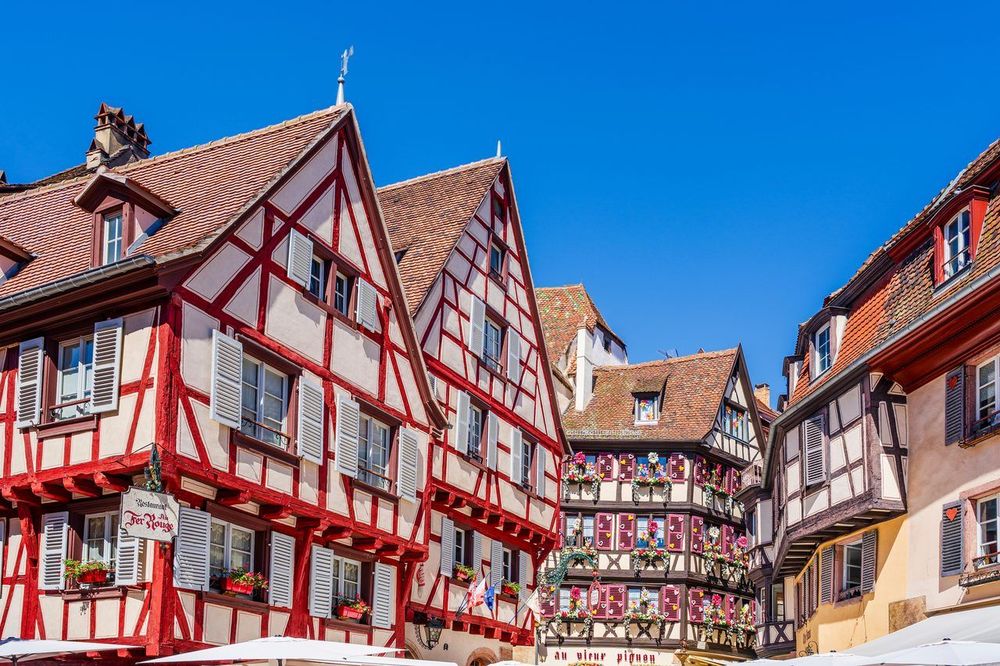
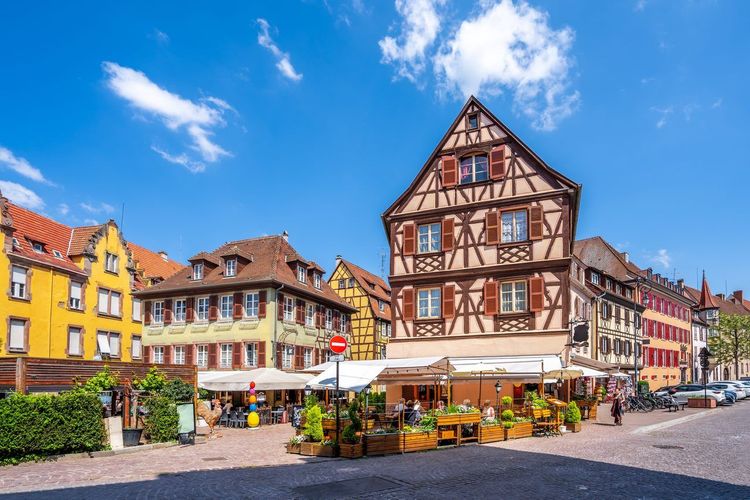
Colmar's historic centre is home to several hundred half-timbered houses, a density that is rare in France. This architectural richness owes much to a historical stroke of luck: the old town emerged from both World Wars largely unscathed, even though the battles of the Colmar Pocket in January and February 1945 took place just a few kilometres away. The Koïfhus, the canals that cut through the Tanneurs district, and the corbelled wine warehouses all tell the story of a flourishing trading city from the fifteenth century onwards.
The Maison Pfister, with its wooden corner turret and painted frescoes depicting biblical scenes and Germanic emperors, is the most photographed example. Built in 1537 for a wealthy hatter, it long served as a showcase for Colmar's prosperity.
But Colmar is not reducible to that postcard image, however appealing it may be. An unusual visit to Colmar means stepping off the classic axis of rue des Marchands, Petite Venise, and the Collégiale Saint-Martin to seek out what printed guides skim over too quickly: a sculpture hidden in a timber frame, an entire museum dedicated to chocolate, a New York-inspired wink planted on a suburban roundabout.
This rich heritage owes much to a local son: sculptor Auguste Bartholdi, born in Colmar in 1834, before achieving worldwide fame for another statue — the one in New York. His imprint can be found throughout the city, right down to a roundabout we cover later in this article.
You can follow this selection in the order suggested, or pick and choose according to your interests and available time. Some places take twenty minutes, others deserve a full half-day. Be generous with your schedule: two days are enough to cover everything without rushing, but a well-paced single day already allows you to see the most surprising experiences the city centre has to offer.
The Little Figure on Rue des Tanneurs, a Hidden Sculpture in the Timber Frame
At the corner of rue des Tanneurs and rue de la Herse, you need to look up to the first floor of a half-timbered house to spot, wedged between two diagonal beams, a tiny figure carved into the wood. Barely thirty centimetres tall, legs crossed, it seems to have been keeping watch for centuries without anyone — or almost anyone — noticing.
Local oral tradition offers several versions of its origin: a mischievous carpenter's discreet signature, a protective figure meant to ward off bad luck from the house, or simply an ornament inherited from a common practice in half-timbered architecture. None of these explanations has been conclusively documented, which only adds to its charm: the little figure remains a local enigma, passed on more by street guides than by official signage.
You will not find it on any tourist map handed out at the visitor centre. That is precisely what makes it one of the symbols of this lesser-known Colmar: you need to know where to look, and above all when. Come in late morning, when the light grazes the façade and separates the silhouette from the rest of the timber frame. Local photographers also recommend late afternoon, when the cast shadow accentuates the relief of the carving.
Petite Venise by Rowing Boat, Another Way to Discover Colmar
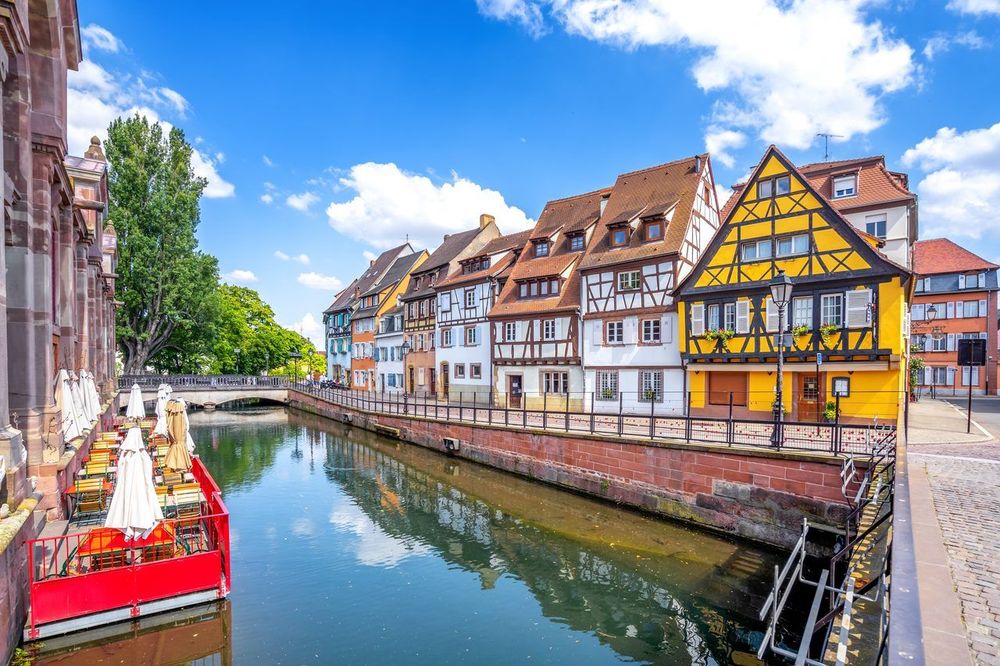
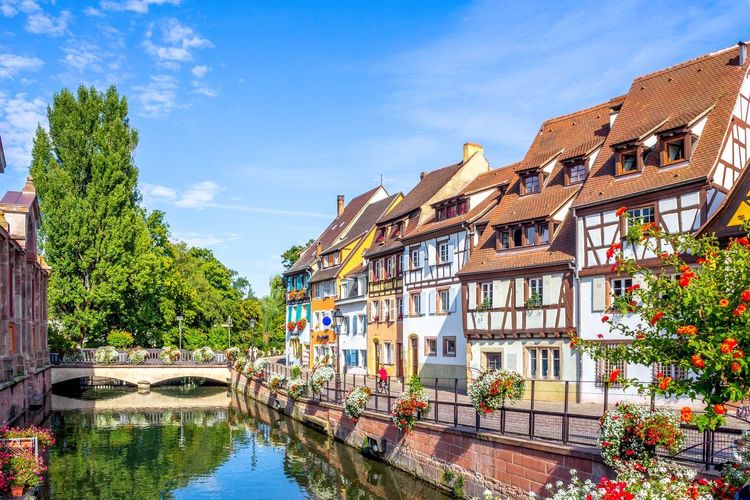
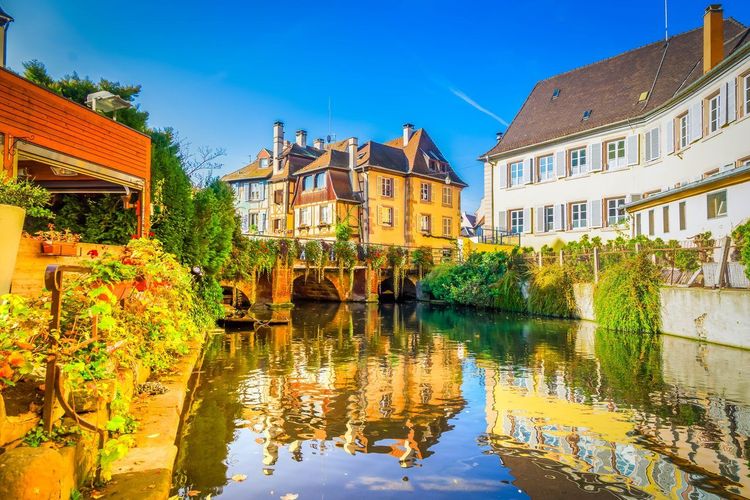
Petite Venise shifts your perspective on Colmar entirely. From the quays, the city is no longer a succession of façades to admire from the pavement, but a collection of private gardens, footbridges, and flower-lined balconies that drop straight down to the Lauch, the small river that flows through the former Tanneurs and Poissonniers district.
The boatmen depart from Quai de la Poissonnerie, a short walk from the covered market. The trip lasts around thirty minutes and follows a route of just over one kilometre, as far as the Pont Saint-Pierre and back. Expect to pay around 8 to 10 euros per adult and slightly less for children — indicative prices that vary by season and operator.
The first thing that strikes you is the relative quiet. Once you move away from the shopping streets, all you hear is the lapping of water against the hull and, sometimes, the boatman recounting the history of the district: until the early twentieth century, tanners would wash their hides directly in the river, and fishmongers would unload their catch straight onto the quays. The once less-than-pleasant smell has given way to masses of geraniums and wisteria spilling from the windows.
The view from the water also reveals details invisible from the street: unsuspected inner courtyards, exterior wooden staircases climbing up to the attics, tiny gardens suspended above the canal. That is the real value of the boat trip: it does not replace a walk, it complements it by changing your angle entirely.
If you want to avoid queues, go early in the morning before 10:30, or at the end of the day after 6pm in summer. At weekends, and especially during the Christmas market, the wait can exceed thirty minutes. Some operators also offer evening slots in summer, when the façades are lit up and reflected in the almost still water — an experience that is noticeably less crowded than the classic daytime crossing.
You can also walk along the canals for free, following the path that starts at the Pont Saint-Pierre. It is the most economical option for enjoying the district without booking a time slot, even if it obviously does away with the view from the water.
The Hansi Village and Its Museum, a Dive into Alsatian Imagery
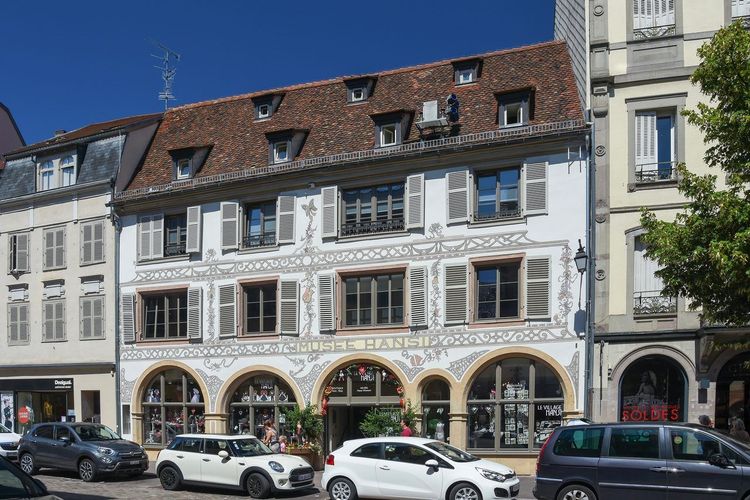
Jean-Jacques Waltz, better known by the pen name Hansi, was born in Colmar in 1873. An illustrator and caricaturist, he built an entire visual world around traditional Alsace: villagers in costume, storks on rooftops, terraced vineyards, and flower-decked half-timbered houses — a style so distinctive that it became, long after his death in 1951, the visual shorthand for the entire region, well beyond Colmar.
His work also has a political dimension that is sometimes forgotten behind the picturesque imagery. During the German annexation from 1871 to 1918, Hansi published satirical drawings openly hostile to the occupying power, which earned him several trials and exile in France. His postcards, apparently naive, carried an unambiguous message of cultural resistance.
The Hansi village (28 Rue des Marchands, 68000 Colmar, rated 4.3/5 on Google from 1,885 reviews), a boutique-museum on rue des Marchands, extends this world in an immersive setting: coloured stained glass, reconstructed Alsatian furniture, projections, and life-size characters recreating an Alsatian village street under glass. The boutique can be visited freely, making it an easy stop to fit between two other visits in the historic centre.
The atmosphere often surprises visitors who were expecting a simple souvenir shop: the staging spreads across several levels, with considered lighting and a subtle soundtrack accompanying the wander. You will find reproductions, lithographs, and merchandise ranging from very affordable to high-end for collectors.
A short distance away, Bartholdi's birthplace houses the museum dedicated to him, also on rue des Marchands: the two visits complement each other well for understanding how two local sons each shaped, in their own way, the image the world has of Colmar and Alsace.
To extend the visit, the Collégiale Saint-Martin and the Krutenau district, five minutes on foot, offer more façades that seem to have stepped straight out of Hansi's illustrations: colourful half-timbering, wrought-iron signs, geranium pots lined up on window ledges. It is this continuity between the artwork and the real backdrop that makes the visit so enjoyable: by the time you leave, you understand that Hansi did not really invent the image of Colmar — he simply framed it with precision.
Allow around 30 to 45 minutes on site, longer if you are travelling with curious children who want to spot every hidden detail in the sets. The venue is open year-round, including during the Christmas market, a period when the atmosphere fits the illustrator's aesthetic particularly well.
The Replica of the Statue of Liberty, Bartholdi's Wink to His Hometown
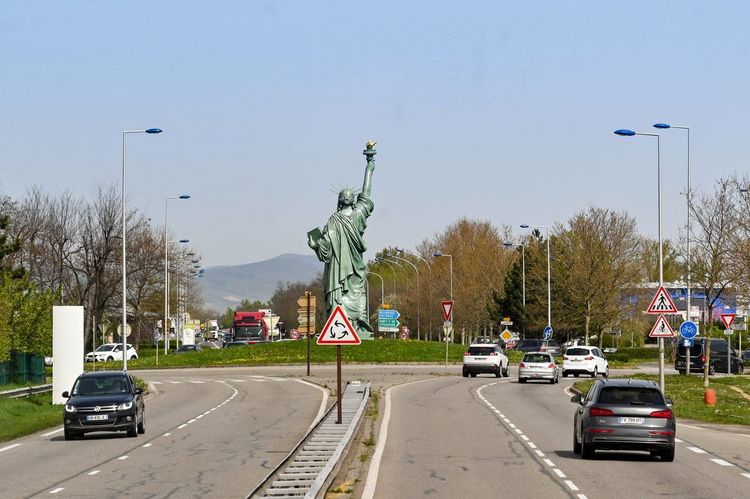
After sculpting the Statue of Liberty gifted by France to the United States in 1886, Auguste Bartholdi never entirely left his hometown — at least symbolically. At the northern entrance to Colmar, on a roundabout along the route de Strasbourg, stands a scaled-down replica of his most famous work.
Unveiled in 2004 to mark the centenary of the sculptor's death, this Colmar version stands around twelve metres tall including the torch — just over a quarter of the height of the New York original (46 metres without the pedestal). The choice of location is no accident: it sits on one of the most heavily used road axes into the city, so the statue literally greets motorised visitors before they even catch sight of the historic centre.
The anecdote often amuses American tourists, surprised to find a miniature version of their national monument in the middle of an Alsatian roundabout. It also has genuine educational value: few visitors know that Bartholdi was born in Colmar, and this replica acts as a full-scale reminder of that local legacy, just a few minutes from the Bartholdi Museum housed in his birthplace in the city centre.
To see it properly, it is better to stop on foot or by bike rather than by car: the heavy traffic around the roundabout does not always allow you to slow down enough. Some cycling routes linking the city centre to the commercial areas to the north pass close by, which means you can combine the visit with a journey you were already planning rather than making a dedicated trip.
The Wine Museum and Choco-Story, a Gourmet Parenthesis
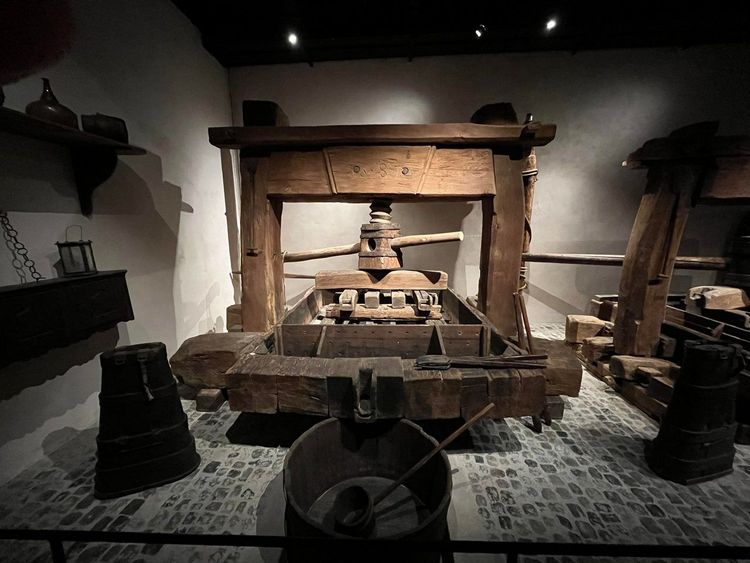
Colmar cultivates a way of life that two themed visits convey better than any winstub window display: wine on one side, chocolate on the other, a few minutes' walk from the Petite Venise district.
On the wine side, the region is in its element. Alsace has more than 15,000 hectares of vineyards and seven main grape varieties (riesling, gewurztraminer, pinot gris, pinot blanc, pinot noir, sylvaner, and muscat) — a diversity that the Musée du Vignoble et des Vins d'Alsace, located about fifteen minutes by road from Colmar in Kientzheim, explains in a very hands-on way: old wine presses, cooperage tools, reconstructed cellars, and objects from the Saint-Étienne brotherhood.
What makes the visit more engaging than purely educational is the format: unlike a traditional wine cellar where you taste standing at a counter, the tour alternates historical rooms, monumental cooperage spaces, and explanations of the vintner's work, before a tasting at one of the neighbouring estates. Allow around an hour on site, more if you follow up with a cellar visit.
Right in the centre of Colmar, Choco-Story Colmar (4 Rue des Tanneurs, 68000 Colmar, rated 4.5/5 on Google from 1,792 reviews) applies the same formula to chocolate rather than wine. The tour traces the history of cacao from pre-Columbian civilisations through to chocolate's arrival in Europe, with live artisan-making demonstrations and tastings at several points along the way.
Families particularly enjoy this stop: unlike many themed museums, this one relies on constant interaction rather than reading panels. Children can watch a chocolatier work the paste live, smell raw cacao beans before they are processed, and leave with a small sample tasted on the spot. Allow 45 minutes to an hour depending on how busy it is — more on Wednesdays and weekends.
Prices are reasonable for this type of experience: expect around ten euros per adult, slightly less for children and students, with family rates available depending on the time of year. Check opening hours before you go: these museums often close one day a week outside peak season and adjust their schedules during the Christmas market, when footfall in the district rises sharply.
The contrast between the two visits works well on the same day: the wine museum's atmosphere, more sober and historical, is a clear counterpoint to Choco-Story's, which is far more playful and colourful, designed to hold the attention of young visitors as much as chocolate lovers. It is this complementarity, more than either venue taken on its own, that makes the pairing worthwhile.
To go further on the city's gourmet side — from kougelhopf and munster to traditional winstubs — our Ryo article on the culinary specialities to try in Colmar details the addresses and dishes not to miss beyond these two museums.
Segway Tour Through the Vineyards With Fun Moving
Fun Moving (3 Rue du Conseil, 68230 Turckheim, rated 4.4/5 on Google from 40 reviews) offers gyropod tours through the heart of the Alsatian vineyards, departing from wine-growing villages about ten minutes by road from the centre of Colmar. The experience completely changes your relationship with the vineyard: no walking, no pedalling, just a self-balancing electric platform that you master after a few minutes of instruction.
Several formats are available, generally between one and two and a half hours, with routes weaving between the rows of grand cru vineyards, offering views over Colmar and the Vosges foothills that are rarely accessible any other way without several hours of walking. Some routes include a stop in a nearby wine village; others stay focused on the hillside slopes.
The activity is primarily aimed at participants aged 10–12 and above, as the balance required on the gyropod makes it difficult for younger children. No particular physical condition is required: unlike an electric bike, the segway demands no pedalling effort, only a reasonable sense of balance and a brief learning phase guided by an instructor.
The best time for this outing is late afternoon in summer, when the heat eases and the raking light across the vines gives the landscape a particularly photogenic golden hue. Late-day slots, where available, often fill up several days in advance during high season.
Expect to pay roughly between 35 and 60 euros per person depending on the duration chosen; advance booking is strongly recommended, especially between June and September. It is one of the most popular activities for a couples' outing or a trip with friends around Colmar, precisely because it steps well outside the classic vineyard tourism experience, which is so often limited to cellar tastings.
No special equipment is needed: closed-toe shoes and comfortable clothing are sufficient, as helmets are provided on site. Consider booking a slot that leaves time before or after to visit Turckheim, whose medieval centre and three fortified gateways are also worth a leisurely walk.
Family Activities to Discover in Colmar
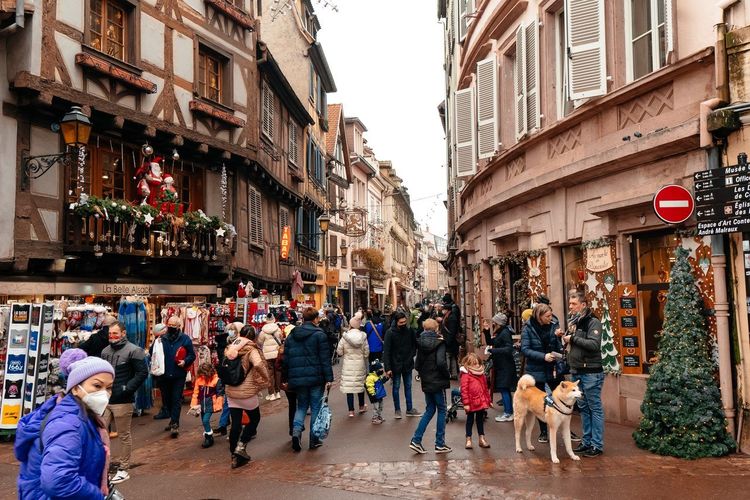
Stepping off the beaten track in Colmar is not just for adults in search of architectural details. Several activities in the city centre and its surroundings work particularly well for families, with formats designed to hold children's attention without sacrificing what parents want to see.
The Butterfly Garden, located in Hunawihr, about twenty minutes by road north of Colmar, lets you observe several hundred exotic butterflies in free flight inside a heated greenhouse. The temperature, kept at around 25 to 28 degrees, deliberately contrasts with the outside air — an instant change of scene that is particularly welcome in spring or autumn. Allow 45 minutes to an hour, more if children stop at every observation point, and check opening dates: the site closes for part of the winter.
The Unterlinden museum (Place Unterlinden, 68000 Colmar, rated 4.6/5 on Google from 5,281 reviews), better known for the Isenheim Altarpiece, also runs occasional educational workshops for families: detail hunts in the artworks, drawing workshops, storytelling tours adapted for younger visitors. These formats, generally available during school holidays, turn a visit to art that can sometimes feel austere into a playful experience for a young audience.
Escape games set up in the historic centre are another popular option for families with teenagers. Several venues offer scenarios rooted in local history, from medieval mysteries to wine-related puzzles, generally accessible from ages 8–10 when accompanied by an adult. Allow around an hour per session, and book ahead during school holidays, as weekend slots fill up quickly.
Finally, the tourist train that covers the historic centre in about thirty minutes remains a reliable choice for very young children or families short on time: a multilingual audio commentary, a route past all the key façades, and no long stretches of walking required. It is a complementary option rather than a substitute for detailed visits, but it offers a quick first overview before exploring more thoroughly on foot.
Logistics matter as much as the choice of activities. A pace of two activities per half-day, rather than three or four, avoids fatigue and leaves time to wander through the historic centre streets, where children often spontaneously spot details that hurried adults miss entirely. Plan a proper lunch break between visits, especially with young children: the terraces of the Tanneurs district and the Place de l'Ancienne Douane are well suited to this.
To put together a complete family programme over one or two days, our Ryo selection of things to do in Colmar suggests additional options, including more classic ideas that children enjoy just as much. Colmar's audio-guided tour also fits well into a family day, at a pace young walkers can keep up with.
Hidden Curiosities of Colmar to Track Down
Beyond the big names already mentioned, Colmar conceals a series of more discreet details, invisible to anyone who crosses the city centre without looking up. Here is a selection of curiosities that usefully complement the classics.
The wrought-iron signs along rue des Marchands are among the finest in the city. Bakers, tailors, goldsmiths, and apothecaries once advertised their trade through symbols forged in metal rather than words, at a time when much of the population could not read. Some of these old signs have been carefully restored, retaining traces of their gilding.
The Maison des Têtes, on the street of the same name, takes its name from the dozens of sculpted mascarons adorning its Renaissance façade, completed in 1609: grimacing faces, fantastical animals, and allegorical figures mingle in a dense composition that rewards several minutes of close attention. Look a little higher: the bronze cooper that crowns the gable is a later work by Bartholdi.
On the Collégiale Saint-Martin (Place de la Cathédrale, 68000 Colmar, rated 4.5/5 on Google from 3,103 reviews), often mistakenly called a cathedral, the gargoyles at the chevet repay careful attention: some depict hybrid creatures that are unusual in standard religious iconography, probably the result of the imagination of medieval stonemasons, who were given considerable creative latitude on these secondary decorative elements placed well out of easy sight.
The Koïfhus, the old customs house built in 1480, has a glazed roof with typically Alsatian coloured patterns, but it is above all its inner courtyard, freely accessible, that surprises: exterior staircases, stacked galleries, and an atmosphere of a medieval trading court that feels almost intact, just steps from the always-lively Place de l'Ancienne Douane.
In the Tanneurs district, several façades still retain the large openings characteristic of hide-drying lofts: the tanners would air-dry their leathers in the open, several storeys above the street, a functional piece of architecture that has since become a purely decorative element that few visitors know how to read.
Elsewhere in the centre, an old sundial painted directly onto a façade still tells the time on sunny days, a relic of an era when public clocks were rare. A few streets further on, a Latin inscription carved above a doorway recalls the original purpose of a building now converted into a shop, without most passers-by ever pausing to notice it.
The Krutenau district, less frequented than the main tourist axis, retains more modest but equally old façades, with exposed half-timbering that urban renovation over recent decades has chosen to preserve rather than conceal beneath a uniform render. It is precisely in these less-photographed streets that the exercise makes most sense: the heritage is not signposted by a panel — you simply have to take the time to look for it.
One final practical tip for this detail hunt: bring lightweight binoculars or use your phone's zoom to examine elements positioned at height, particularly the mascarons on the Maison des Têtes and the gargoyles of the Collégiale, which are difficult to appreciate fully with the naked eye from street level.
Surprising Excursions Around Colmar
Within less than half an hour by road, several excursions naturally extend the discovery well beyond the historic centre.
The Château du Hohlandsbourg, perched on its rocky spur above Wintzenheim, about fifteen minutes by road from Colmar, has dominated the Alsatian plain since the late thirteenth century. Restored from its medieval remains, the site offers medieval activities for children, archery workshops, and a panorama that, on a clear day, stretches as far as the German Black Forest.
Further afield, in northern Alsace and therefore significantly further away — allow around an hour and a half by road — the Betschdorf pottery perpetuates a unique regional craft: salt-glazed stoneware, a firing technique that gives the pieces their characteristic blue-grey colour. Several family workshops, some established for six or seven generations, open their doors to visits and direct purchases. This is not a half-day excursion from Colmar, but it is worth considering for anyone extending their stay in Alsace beyond two days.
More accessible, the wine route villages surrounding Colmar account for the bulk of the most popular excursions. Eguisheim, just ten minutes from the city centre, is one of the Plus Beaux Villages de France: its concentric lanes arranged around the castle, a rare vestige of medieval town planning, can be explored in a leisurely hour's walk.
Riquewihr, a quarter of an hour by road, charms with its intact ramparts and brightly coloured Renaissance houses, while Kaysersberg (Hôtel de Ville, 68240 Kaysersberg, rated 4.6/5 on Google from 482 reviews), a little further along the same road, combines a hilltop castle, a sixteenth-century fortified bridge, and the birthplace of Albert Schweitzer, winner of the Nobel Peace Prize in 1952.
Each of these three villages takes two to three hours to visit, which means you can comfortably fit two into the same day — provided you set off early to avoid the midday crowds, which can be particularly dense in summer and during the December Christmas markets.
To explore this regional dimension further, two complementary resources go into greater detail: our Ryo article on the area around Colmar extends the radius of exploration, while our Ryo selection of Alsatian villages around Colmar details every possible stop on an improvised wine route over one or two days.
If you only have half a day, prioritise Eguisheim — the closest — and return to Colmar in the late afternoon to enjoy the city centre curiosities already described above. With a full day, combining the Château du Hohlandsbourg in the morning and a wine village in the afternoon remains the most time-efficient option.
For visitors with a car, getting between these different points is straightforward: the Alsace wine route is signposted along its entire length, connecting villages without major detours, and parking — often paid in village centres but rarely full outside peak season — generally poses no difficulty. Without a car, several regional bus lines serve Eguisheim and Kaysersberg from Colmar, though frequency is reduced on Sundays.
Cyclists will also find their place here: a cycle path connects Colmar to Eguisheim in about twenty minutes of easy pedalling through the vineyards, a pleasant alternative to the car for anyone who wants to carry the spirit of the day through to the choice of transport.
How to Plan Your Unusual Visit to Colmar: Guided or on Your Own
Three options are open to anyone who wants to explore Colmar differently: a classic guided tour with a local professional, a self-guided visit with a paper map, or an intermediate format supported by an audio guide app.
A guided tour remains the most comprehensive option for anyone wanting in-depth historical context and the chance to ask questions in real time. The tourist office and several independent guides offer themed itineraries built around lesser-known curiosities, with anecdotes rarely shared in written guides. Expect to pay roughly between 12 and 20 euros per person for a group tour lasting 1.5 to 2 hours; booking at least a week in advance is recommended in high season.
A self-guided visit, map or notebook in hand, offers greater flexibility over pace and timing, with no group constraints or fixed schedule. It does, however, require a minimum of preparation to avoid missing the most discreet details — precisely the ones that make the exercise worthwhile: without clear directions, the little figure on rue des Tanneurs (Rue des Tanneurs, 68000 Colmar, rated 3.9/5 on Google from 477 reviews) or the mascarons of the Maison des Têtes are easily overlooked.
That is precisely the gap our Ryo app fills: a geolocated audio guide that combines the freedom of a self-guided visit with the contextual content of a guided tour, with no fixed schedule and no group to follow. The Ryo Colmar audio guide tour covers the historic centre in 21 commented stops — around 2h10 of listening over 4.7 km — to be started and paused freely at your own pace.
The main advantage of this intermediate format lies in its availability: no need to book a slot several days in advance, or to fit your schedule around a fixed group time. You can start the tour at 9am or at 5pm, pause for lunch, and pick up exactly where you left off.
For families with young children, a hybrid format often works well: an audio guide for the main rhythm of the historical visit, complemented by one or two structured activities such as a segway tour or an escape game, which bring a more physical and interactive dimension that listening alone cannot provide.
The cost varies noticeably depending on the option chosen: a small-group guided tour is the most expensive but richest in direct exchanges; a self-guided visit is free beyond museum entry fees; and the audio guide sits in between, with a fixed price regardless of the number of participants, making it particularly good value for families or groups of friends.
Whatever format you choose, bear in mind that this side of Colmar is discovered as much by walking slowly as by following a precise itinerary: the best finds are usually made by looking up, between two planned stops on the route.
Three Mistakes That Can Spoil the Discovery
Not looking up, first of all: the best of what makes Colmar surprising plays out above ground-floor level, where shop windows stop competing for your attention. Arriving on a Monday, next: several museums close that day outside high season, and the whole programme falls apart. Trying to cram everything in, finally. Four paid visits in a single day is the surest way to retain nothing.
When to Go and How to Get Around Colmar
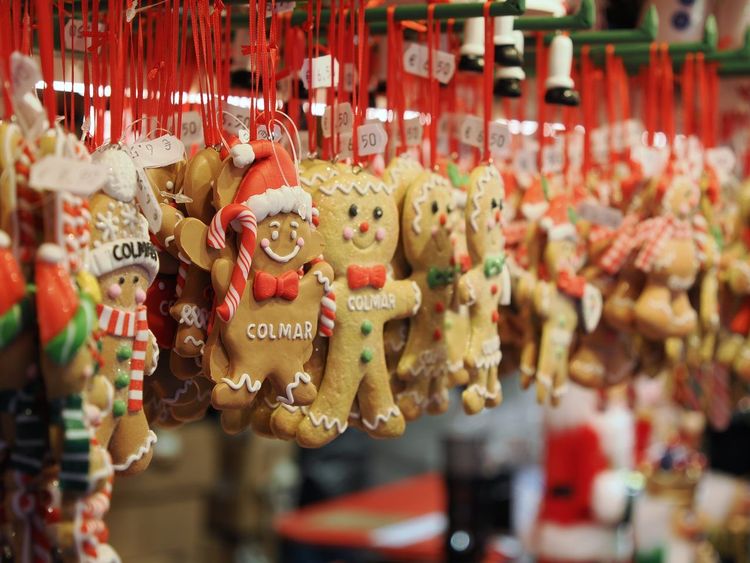
The time of year makes all the difference, even for the most discreet spots in this selection. The Christmas market, which generally sets up from late November to late December across several squares in the historic centre, transforms the city into a magical setting — but also into a zone of heavy foot traffic: queues lengthen outside Petite Venise and the museums, and accommodation prices rise sharply.
Spring, between April and June, is widely considered the ideal compromise: mild temperatures, flowering gardens and façades, and still manageable crowds on weekdays. Autumn, from September to October, adds the colours of the surrounding vineyards, which are particularly photogenic for anyone planning an excursion along the wine route.
Summer, despite sometimes notable heat in July and August, remains the busiest season, especially at weekends and on public holidays. Planning visits for early morning or late afternoon helps avoid both the heat and the heaviest tourist traffic.
Getting around: Colmar's historic centre is entirely walkable — the pedestrian zone concentrates the vast majority of places mentioned in this article, and no internal distance exceeds fifteen to twenty minutes on foot. A bike, available to rent at several points in the city centre, becomes useful for reaching the Statue of Liberty replica (Rond-point de la Liberté, 68000 Colmar, rated 4.4/5 on Google from 4,499 reviews) or cycling out to Eguisheim along the cycle path. For Hunawihr, Kientzheim, or Wintzenheim, plan on a car or a regional bus.
On the budget side, a day in Colmar focused on the experiences in this selection (museums, boat ride, possibly a segway tour) generally comes to between 40 and 90 euros per adult, excluding accommodation and meals, depending on how many paid activities you choose. Children almost always benefit from reduced rates, or even free entry below a certain age depending on the venue.
For a full weekend, it is better to book accommodation several weeks in advance during the Christmas market period, as demand regularly outstrips available supply in the city centre. For the rest of the year, booking the day before or two days before is usually sufficient, except during major May bank holiday weekends and the summer school holidays.
FAQ
How long does an unusual visit to Colmar take?
Allow around two hours to spot the main curiosities of the historic centre (the little figure, Petite Venise, the Hansi village). Half a day lets you add a food museum, and a full day allows you to include an activity such as a segway tour. With an excursion to the surrounding area, plan for two full days.
What are the most surprising places to see in Colmar?
The little figure on rue des Tanneurs, Petite Venise seen from a rowing boat, the Hansi village, the replica of the Statue of Liberty, and Choco-Story are among the most frequently mentioned experiences for stepping off the standard tourist trail.
Where is the little figure on rue des Tanneurs?
It is carved into the timber frame of a half-timbered house, at the corner of rue des Tanneurs and rue de la Herse, on the first floor. No sign points to it — you simply have to look up to spot it.
Are these off-the-beaten-track visits suitable for children?
Yes, several activities are specifically aimed at families: the Butterfly Garden in Hunawihr, workshops at the Unterlinden museum, escape games from ages 8–10, and segway tours in the vineyards from around ages 10–12.
Do you need to book a guided tour, or can you explore on your own?
Both options work well. A guided tour provides context and live anecdotes, while an audio guide such as the Ryo Colmar tour allows you to explore in complete freedom, with no fixed schedule, while still offering structured contextual content.
What budget should you plan for an unusual visit to Colmar?
Allow between 40 and 90 euros per adult for a day including two or three paid activities (museums, boat ride, possibly a segway tour), excluding accommodation and meals. Walking through the historic centre remains free.
What is the best time to discover Colmar differently?
Spring and autumn offer the best balance between pleasant weather and moderate crowds. Summer is busier, and the Christmas market, though spectacular, concentrates heavy tourist traffic in the same spots.
This side of Colmar is not just a list of places to tick off: it is another way of looking at a city that most visitors pass through too quickly, drawn in by postcards of Petite Venise without ever looking up at a carved timber frame or stepping into a food museum. Between the little figure on rue des Tanneurs, Bartholdi's nod on his roundabout, and the wine route villages just a few minutes away, the key lies in the pace you choose: slowing down is often enough to turn a standard visit into a genuine discovery.
Whether you opt for a guided tour, a self-guided itinerary, or the Ryo Colmar audio guide tour, what matters most is leaving time for unexpected detours. It is usually there, between two planned stops on the programme, that the best finds of a stay in Colmar are made.
À lire également