© Shutterstock
 Votre guide Ryo
Visiting Compiègne in 3 Days: Complete 2026 Itinerary
There is something strange about seeing such a discreet city having hosted the splendor of two empires, witnessed Joan of Arc's capture beneath its walls, and sheltered, just a few kilometers away, the signing of the armistice that ended the First World War. Compiègne cultivates this contrast with a surprising calm for a city that has so much to tell.
To visit Compiègne in 3 days, expect a palace that forms, alongside Versailles and Fontainebleau, the trio of great royal and imperial residences — but without the crowds — a rose garden in the small park, a forest of more than 14,000 hectares where you can sleep in a treetop cabin, and Gallo-Roman ruins freely accessible among the trees at Champlieu. The Ryo audio guide tour of Compiègne sets the scene from the very first morning, even before you step inside the château. Three days are enough to take in the imperial heritage of the city center, a full day in the national forest, and then an excursion to Pierrefonds or the Chantilly-Senlis triangle, without ever feeling rushed.
Day 1: Imperial Compiègne, Between the Château and Its Museums
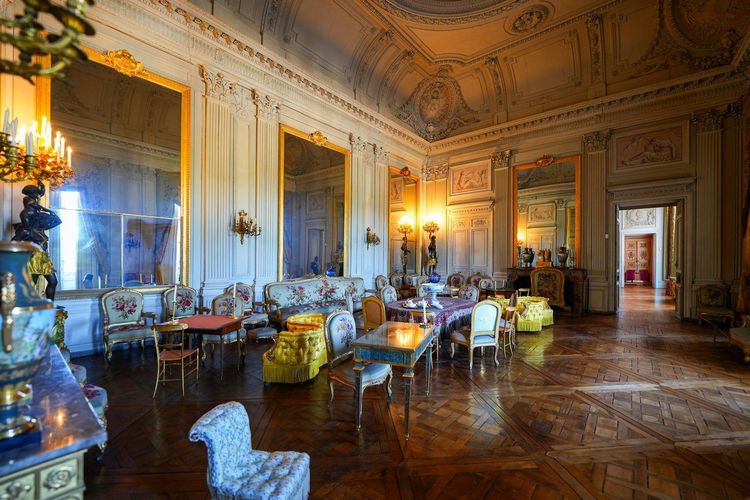
Few French cities can claim to have served as a residence for so many successive regimes. The Château de Compiègne was rebuilt under Louis XV by architect Ange-Jacques Gabriel, then restored by Napoleon I, who welcomed Marie-Louise of Austria there in 1810, before Napoleon III made it the stage for the most lavish balls and hunts of the Second Empire.
Devote your entire first morning to the imperial palace: the apartments of the emperor, the empress, and the King of Rome take about 1.5 hours to visit. The entrance ticket costs €10 (€8 at the reduced rate), and admission is free for visitors under 26 as well as on the first Sunday of the month. The National Carriage Museum houses around one hundred horse-drawn vehicles dating from the 18th century and some thirty pioneering automobiles, including La Jamais Contente, the electric racing car of 1899 that was the first vehicle to exceed 100 km/h. The Second Empire Museum reconstructs daily court life under Napoleon III through furniture, paintings, and personal objects: it is here that the atmosphere of the Compiègne séries — those weeks when the emperor's guests came to hunt and enjoy themselves in the forest — is best captured.
Exiting on the park side, make your way to the rose garden of the Château de Compiègne (Parc du Château, 60200 Compiègne, rated 4.6/5 on Google with 1,799 reviews), a more intimate space than the grand perspective, where the rose bushes bloom from late spring through early autumn, peaking in June.
A practical note: the château is closed on Tuesdays, and some spaces have staggered opening hours (the carriage museum opens in the afternoon). Check the schedule before planning your day, especially if you want to visit all three museums.
To add depth to this morning, the Ryo audio guide tour of Compiègne takes you through the château's surroundings and the French formal garden in 17 audio stops, lasting around 1 hour 50 minutes: a way to let the guide narrate the court intrigues while you walk, without your nose buried in a leaflet.
The Historic City Center of Compiègne
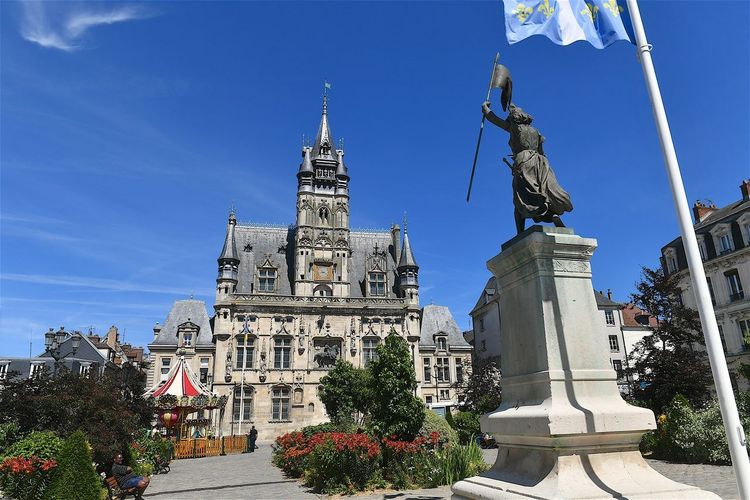
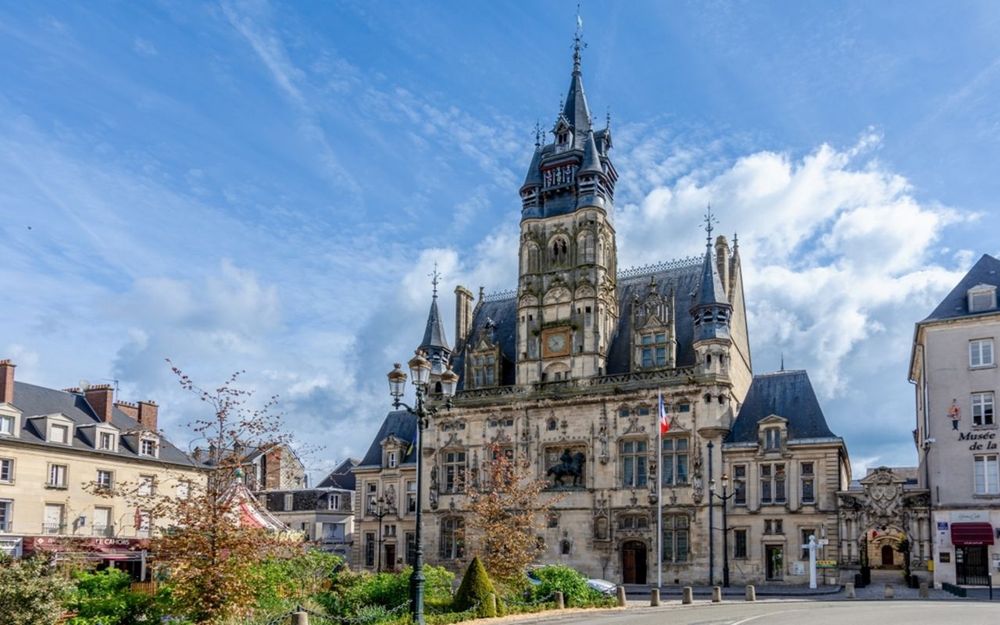
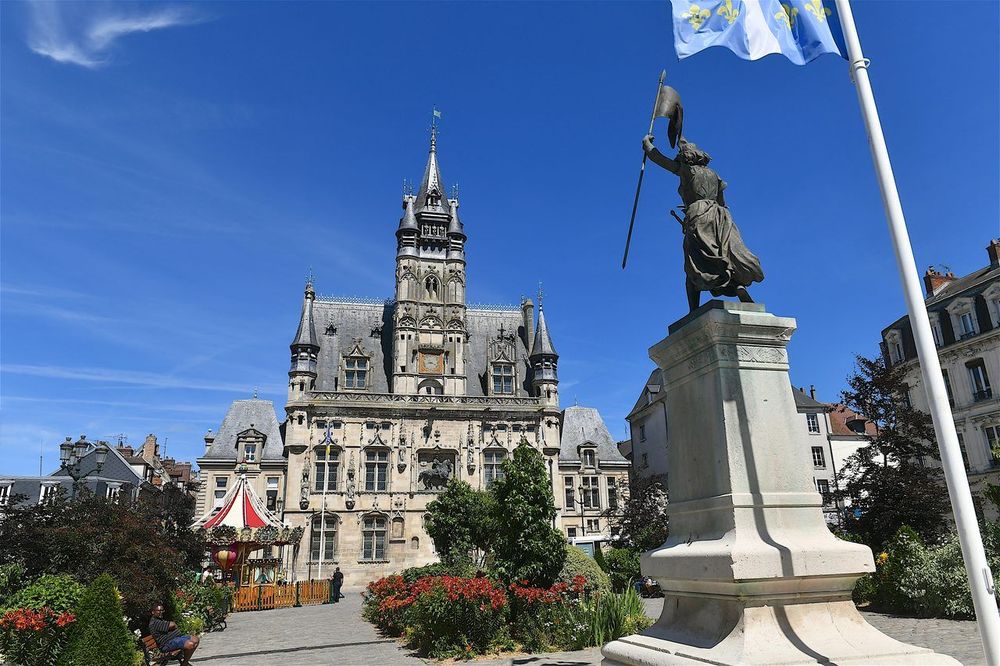
The afternoon of the first day lends itself to a stroll through the historic center, a ten-minute walk from the château. A must-see landmark, the Compiègne City Hall displays a Flamboyant Gothic façade from the early 16th century, adorned with an equestrian statue of Louis XII and topped by a belfry where three wooden automatons, the Picantins, have been striking the hours since 1530.
Nearby, the statue of Joan of Arc (Place de l'Hôtel de Ville, 60200 Compiègne, rated 4.4/5 on Google with 208 reviews) recalls a lesser-known episode in her story: it was at Compiègne that she was captured by the Burgundians in May 1430, during a sortie to defend the besieged city.
Continuing on, the Église Saint-Jacques, begun in the 13th century with its tall tower completed in the 15th, remains the church where the imperial court attended Mass. A little further, the Église Saint-Antoine and the cloître Saint-Corneille, a remnant of a former royal abbey, offer a quieter moment between visits.
If time allows, round off the walk with a detour to the Parc de Bayser and the Parc des Songeons, two neighborhood green spaces popular with locals for an impromptu picnic, far from the heritage sites.
The same Ryo audio guide that accompanied you in the morning continues toward the city hall and the Église Saint-Jacques, weaving in anecdotes about Joan of Arc's capture and the city's imperial history: no need to launch a new app, everything flows seamlessly.
Day 2: The National Forest of Compiègne, Between Walks and Thrills
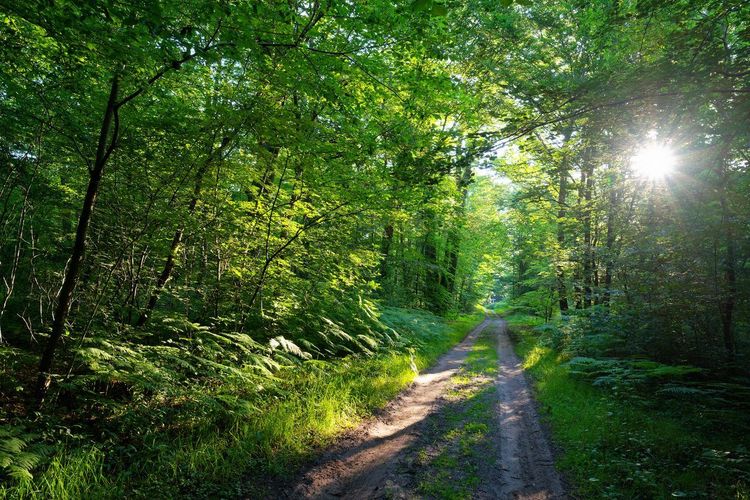
Second day, a complete change of scenery: head to the national forest of Compiègne, more than 14,000 hectares of beech and oak trees that were the favorite hunting grounds of Napoleon III and his guests.
Drive or cycle to the Allée des Beaux Monts, cut on the orders of Napoleon I to remind Marie-Louise of the perspectives of Schönbrunn: nearly 4 kilometers in a straight line from the château to the hilltop. The view from the summit, especially at sunset, remains one of the most photographed viewpoints in the Oise.
Traveling with family or looking for a bit of adventure? The forest brings together several activities within a few kilometers of each other: a treetop adventure course in the canopy, with circuits suited to children, and a Henson horse ride, a sturdy and gentle breed born in the Bay of Somme in the 1970s, ideal for a forest trail ride.
Horse racing fans can time their visit with a meeting at the Compiègne Racecourse (Avenue Royale, 60200 Compiègne, rated 4.4/5 on Google with 359 reviews), which specializes in flat and jump racing in a woodland setting quite different from urban racecourses.
End the day in the village of Vieux-Moulin, at the very heart of the forest: a handful of old houses, ponds, and a few places to eat after a day of walking. The forest is crossed by the GR12 long-distance trail, but many waymarked loops of 2 to 3 hours start directly from the main forest crossroads, identifiable by their signposts.
Before heading into the forest, there is nothing stopping you from finishing the Ryo audio tour of the historic center: the stops play at your own pace, and you can pause and pick up again the next day, unlike a traditional guided tour.
The Armistice Clearing and the Gallo-Roman Ruins of Champlieu

About ten minutes by road from the city center, near Rethondes, the Armistice Clearing (Route de Soissons, 60200 Compiègne, rated 4.6/5 on Google with 2,165 reviews) marks the spot where, on 11 November 1918, the armistice ending the First World War was signed in Marshal Foch's railway carriage. Hitler had the armistice of June 1940 signed in the same carriage, which he then had taken to Germany, where it was destroyed in 1945. The carriage on display in the memorial today is a model from the same series, fitted out identically.
The memorial takes about an hour to visit, including the statue of Marshal Foch and the commemorative slab. Taking the road southeast toward Crépy-en-Valois, the Gallo-Roman ruins of Champlieu round off the day with a plunge two thousand years back in time: a temple, baths, and an ancient theater with a capacity of several thousand, emerging amid fields and woodland, with no museum around them.
Wear sturdy shoes: the site is not pram-friendly and the ground remains uneven after rain, but the absence of tourist infrastructure is precisely what makes the visit feel more authentic. Access is free year-round, making it an ideal stop to slot between two more formal visits.
Niche Museums and Memorial Sites Not to Miss
Three lesser-known addresses are worth a detour if you have a little time between stops. The Museum of Historical Figurines, just steps from the city hall, brings together tens of thousands of figurines and tin soldiers tracing military history from Antiquity onward: a remarkable collection — check opening hours before making the trip.
The Musée Antoine Vivenel, dedicated to fine arts and archaeology, holds a notable collection of Greek ceramics and a body of paintings largely overlooked by general-interest guides.
More emotionally charged, the Memorial of Internment and Deportation (2 bis Avenue des Martyrs de la Liberté, 60200 Compiègne, rated 4.6/5 on Google with 479 reviews), located on the site of the former Royallieu camp, traces Compiègne's role as a transit camp to the Nazi camps between 1941 and 1944: several tens of thousands of people passed through here before being deported.
Allow a good hour for this last site, which is walked in a silence no one needs to impose.
Day 3: Pierrefonds and Its Fairy-Tale Château
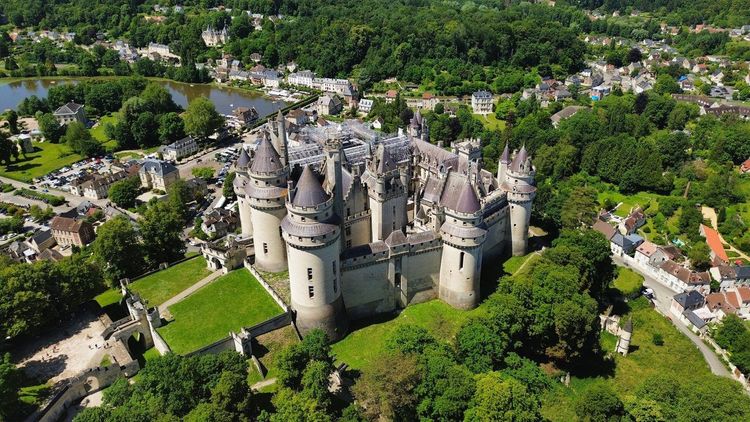
The third day opens with the most photogenic excursion of the stay: the Château de Pierrefonds (Rue Viollet le Duc, 60350 Pierrefonds, rated 4.6/5 on Google with 16,060 reviews), a quarter of an hour's drive from Compiègne. A medieval ruin purchased by Napoleon I and then entirely rebuilt at the request of Napoleon III by Viollet-le-Duc from 1857 onward, the fortress looks more like a fairy-tale set than a period relic, which explains why it has served as a filming location for several productions, including the BBC series Merlin.
The interior takes about 1.5 hours to visit, featuring a very free reconstruction imagined by Viollet-le-Duc: the Salle des Preuses, the main courtyard, and the battlements are well worth the visit, especially during the quieter morning hours between opening time and 11 a.m.
Then head down into the village of Pierrefonds, nestled beside a pond that reflects the château on calm days: a few café terraces and a viewpoint from the opposite bank. If you did not finish listening on the first day, an early morning departure solves the problem: the Ryo audio guide tour of Compiègne, just under two hours for 17 stops, wraps up before late morning, leaving plenty of time to head to Pierrefonds without sacrificing either the city center or the château.
On the question of crowds, Pierrefonds is busiest in July and August and during medieval events held on certain weekends: check the calendar before you go if you are looking for peace and quiet instead. Allow about half a day for Pierrefonds, château and village combined, which leaves time in the late afternoon to continue on to Saint-Jean-aux-Bois.
Saint-Jean-aux-Bois and the Abbey of Chiry-Ourscamp
A few minutes' drive from Pierrefonds, deep in the forest, the village of Saint-Jean-aux-Bois (Place de l'Abbaye, 60350 Saint-Jean-aux-Bois, rated 4.7/5 on Google with 105 reviews) deserves a stop for its 13th-century former abbey church and its stone houses clustered around a peaceful square. The village has only a handful of streets, making it a short but rewarding halt.
It is also the perfect spot for a forest picnic, in the shade of the tall trees, with the national forest as your only neighbor.
Heading further north, beyond Compiègne, the ruins of the Abbey of Chiry-Ourscamp offer a more romantic scene: the Gothic choir of the former Cistercian abbey church, ruined after the Revolution, stands open to the sky, while a religious community still occupies the conventual buildings.
Few visitors make it this far from Compiègne, which means you will have the site almost to yourself on weekdays, unlike Pierrefonds. A good complement — calm and contemplative — after the relative bustle of the château.
Chantilly, Senlis, and the Hidden Gems of the Picardy Countryside
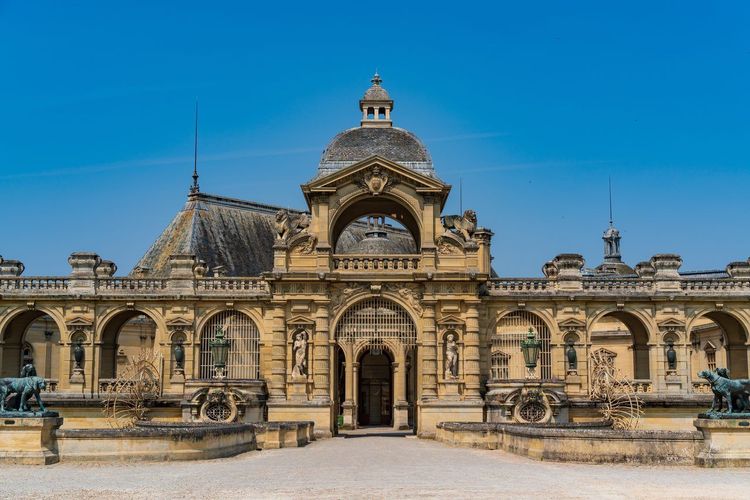
If your stay extends beyond the weekend, or if you prefer to swap a half-day in the forest for a more urban excursion, the triangle formed by Chantilly, Senlis, and their surroundings lies 30–45 minutes by road from Compiègne.
Chantilly is difficult to reduce to its château alone: the estate brings together the Musée Condé, the second-largest collection of old master paintings in France after the Louvre, the Grandes Écuries housing the Musée du Cheval, and a park designed by Le Nôtre.
Twenty minutes away, Senlis preserves a remarkably intact medieval center: its Gothic cathedral, Gallo-Roman ramparts, and cobbled lanes have served as a backdrop for numerous film and TV productions.
Further south, Ermenonville and its Parc Jean-Jacques Rousseau, where the philosopher died in 1778 and was first buried on the Île des Peupliers, add a romantic touch to the excursion. Close by, the abbey of Fontaine-Chaalis extends this Rousseau-inspired thread. To the west, Beauvais and its Cathedral of Saint-Pierre, whose choir vault at 48 meters remains the highest in the Gothic world — with a nave that was never built — rounds out the picture, as does Gerberoy, listed among the Most Beautiful Villages of France for its roses and its half-timbered houses.
Fitting everything into one day is a stretch: choose one or two sites based on your interests rather than multiplying drives. Listening to the Ryo audio guide of Compiègne before you leave also helps explain why this entire region revolved around royal and then imperial power.
Where to Stay in Compiègne and the Surrounding Area
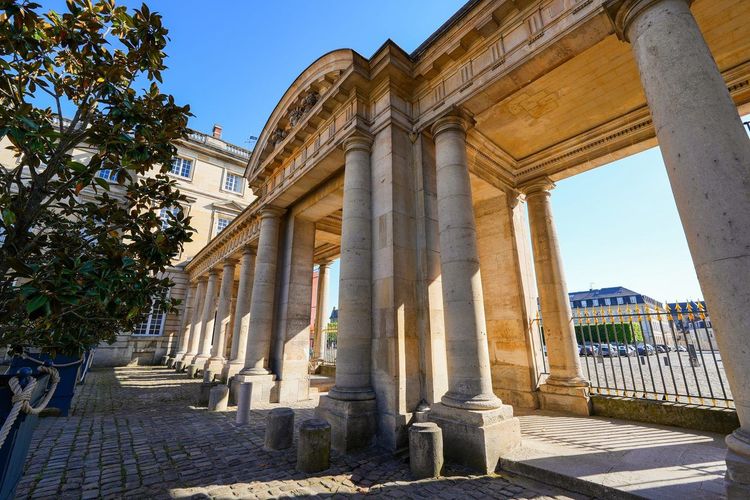
Compiègne has several charming addresses housed in former townhouses in the city center, within walking distance of the château — ideal for a 3-day stay without a car in the city. Expect guesthouses and small independent hotels rather than large chains, which are concentrated on the outskirts.
For a different experience, the surrounding forest offers several unusual accommodations: treehouses perched among the branches, wagons, or yurts on the forest edge, designed to extend the natural atmosphere of a day spent in the forest without returning to the city each evening.
The choice depends largely on your pace: staying in the city makes it easier to go back and forth to the château and historic center, while sleeping near Pierrefonds cuts down on travel time on the third day. To refine your list of activities based on where you stay, our article on the best things to do in Compiègne details additional options to complement this itinerary.
Where to Eat: Local Specialties and Oise Terroir

The Oise terroir leans on a cuisine of forest and river: seasonal game, freshwater fish, regional cheeses, and the famous Chantilly cream for dessert. In Compiègne itself, several restaurants in the city center play the traditional bistro card, with a few addresses specializing in game in autumn and winter.
For a quiet lunch during an excursion day, the Auberge de la Bonne Idée (3 Rue des Meuniers, 60350 Saint-Jean-aux-Bois, rated 4.5/5 on Google with 547 reviews), in Saint-Jean-aux-Bois, offers a traditional table at the heart of the forest village.
On the market front, the Compiègne market is held several mornings a week in the center — a good opportunity to head home with a few local products, from forest honey to artisanal jams.
Getting Around Compiègne and the Surrounding Area
Compiègne is reached in 40 to 50 minutes by train from Paris-Nord, making it an accessible destination without a car for the city itself: the historic center, the château, and the train station are all within 15 minutes' walk of each other.
However, a car becomes necessary from the second day onward: the national forest, the Armistice Clearing, Champlieu, and especially Pierrefonds or Saint-Jean-aux-Bois are not served by practical public transport for a 3-day itinerary. Plan a rental on arrival if you are coming by train. For the forest alone, cycling is an excellent alternative: the forest roads, often closed to motor traffic, form a very pleasant cycling network.
When to Go and Tips for a Successful Visit

Spring, between April and June, remains the best period to visit Compiègne in 3 days: the rose garden comes into bloom, the national forest offers particularly photogenic light, and temperatures allow you to walk all day.
Autumn, in October and November, has its own appeal: the forest colors draw photographers, and game appears on the menus of local restaurants. Summer remains feasible but concentrates most of the visitor traffic, especially at Pierrefonds and Chantilly, while winter suits a more intimate visit to the château, with far fewer people in the rooms.
On the events front, Compiègne honors the memory of Joan of Arc in spring, and Armistice commemorations mark November 11 at the Rethondes clearing. Horse-racing meetings also punctuate the racecourse calendar, while Pierrefonds regularly hosts medieval events.
To make the most of your stay, avoid Tuesdays (château closure), keep half a day in reserve if the weather turns during the forest section of the program, and favor weekdays over weekends to enjoy the sites without crowds. Also keep in mind the first Sunday of the month, when admission to the château is free.


FAQ
How long does it take to visit Compiègne?
A full day is enough to see the château, its museums, and the historic city center. But to add the national forest and at least one excursion to Pierrefonds or Chantilly, 3 days offer a more comfortable pace, without rushing from one site to the next.
What is the best itinerary for visiting Compiègne in 3 days?
The most effective plan is to dedicate the first day to the château and city center, the second to the national forest and nearby memorial sites (the Armistice Clearing, Champlieu), and the third to excursions toward Pierrefonds, Saint-Jean-aux-Bois, or the Chantilly-Senlis triangle depending on your preferences.
What are the must-see highlights of Compiègne?
If time is short, prioritize the Château de Compiègne and its park, then the Allée des Beaux Monts in the forest for the view, and finally the Château de Pierrefonds if an extra half-day is available.
How much does it cost to visit the Château de Compiègne?
The full-price ticket costs €10 (€8 at the reduced rate). Entry is free for visitors under 26 and for everyone on the first Sunday of the month. The château is closed on Tuesdays.
Which towns or villages are worth visiting near Compiègne?
Pierrefonds and Saint-Jean-aux-Bois can be visited in half a day from Compiègne. Further afield, Chantilly, Senlis, Ermenonville, Beauvais, and Gerberoy form a second ring of day trips, reachable in 30 minutes to an hour by road.
When is the best time to visit Compiègne?
Spring and early autumn offer the best balance between pleasant weather and manageable crowds. Summer is still possible but draws more visitors, particularly to Pierrefonds.
How do you get around Compiègne without a car?
The city center, the château, and the train station are all walkable. However, the national forest, Pierrefonds, and other excursions require a car or bicycle, as public transport is not well suited to a 3-day itinerary.
Is Compiègne worth a long weekend?
Yes: the density of heritage sites, the forest, and the proximity of excursions such as Pierrefonds or Chantilly make it easy to fill 3 days without any downtime, at a more relaxed pace than Paris while remaining less than an hour from the capital by train.
Conclusion
Three days barely scratch the surface of everything Compiègne and its forest have to offer, from the splendor of the imperial palace to the silence of the Gallo-Roman ruins and the fairy-tale château of Pierrefonds. The city is compact enough to explore on foot, while opening up, within less than an hour's drive, onto an excursion territory that stretches all the way to Chantilly and Senlis.
To get your bearings before you leave, the Ryo audio guide tour of Compiègne is the simplest starting point: launch the app on arrival, headphones on, and your first morning becomes a guided tour with nothing booked in advance.