© Shutterstock
 Votre guide Ryo
Côte Fleurie: 15 Must-See Highlights for a Normandy Getaway (2026)
The first thing you notice when setting out to discover the highlights of the Côte Fleurie is the light. Not the light of a postcard, but something shifting and unpredictable that changes the colour of the slate façades every hour. This forty-kilometre stretch of coastline between Honfleur and Cabourg, in the Calvados department, drove the Impressionist painters to distraction before seducing the Parisian social elite, and it continues today to exert that same dual pull on visitors who have nothing else in common.
The must-sees of the Côte Fleurie are bewilderingly diverse: a listed old harbour whose seven-storey houses have been reflected in the green port water since the fifteenth century, wooden boardwalks famous the world over, clay cliffs that release Jurassic ammonites with every big tide, a racecourse where thoroughbreds change hands for several million euros in August, and a medieval village that watched William the Conqueror set sail for England in 1066. From Merville-Franceville to Honfleur, taking in Deauville, Trouville, Cabourg, Houlgate and Villers-sur-Mer, this guide brings together the fifteen essential stops for planning your stay, along with the practical advice that most online articles leave out. The Ryo app lets you explore several of these Norman towns with an audio guide at your fingertips, going beyond the clichés to understand what makes each coastal town unique.
Honfleur, Artistic Jewel of the Côte Fleurie
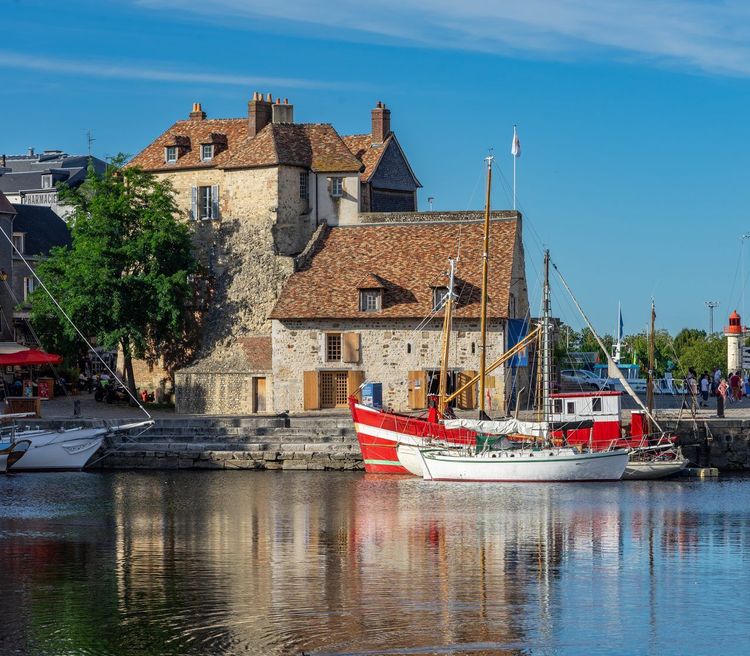
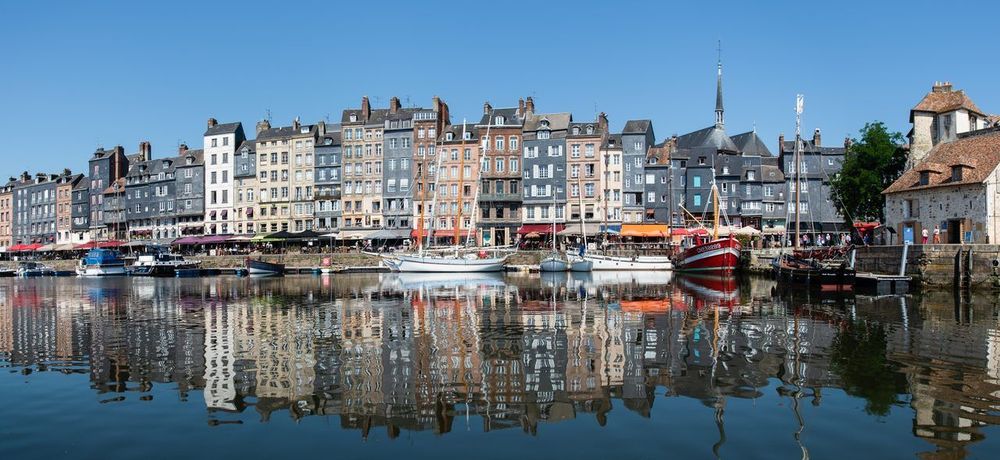
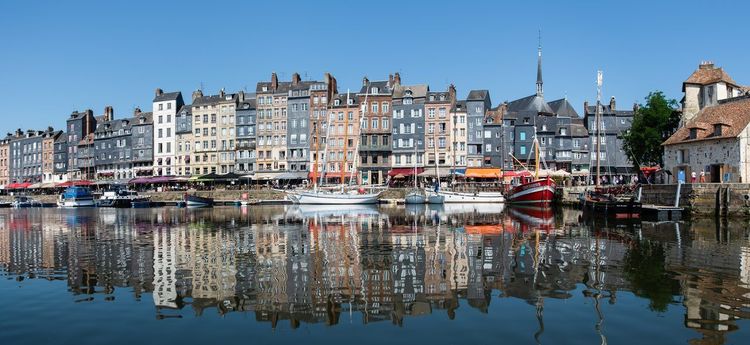
Honfleur is Normandy's most accomplished paradox. A town of 8,000 inhabitants that shaped a significant part of the history of French Impressionism. Boudin, Monet and Jongkind gathered here as early as the 1860s, drawn by the estuary light that painters from the north came all the way from Paris to find. Even today, when you rest your gaze on the Vieux-Bassin on a June morning with the raking light cutting through the half-timbered slate houses, you understand immediately why.
The six- and seven-storey houses lining the basin were built this way for tax reasons: in the Middle Ages, shipowners preferred to pay lower land taxes by building upward rather than outward. The narrow plots, the grey slate façades typical of the Pays d'Auge and the reflections in the port's green water form an architectural ensemble unique in northern Europe. The north quay hosts the tourist restaurants; the south quay, considerably quieter, reveals fishing boats still at their moorings and artists' studios, some of which are open to visitors.
Just steps away, the Église Sainte-Catherine never fails to surprise first-time visitors. It is built entirely of wood — an absolute curiosity for a fifteenth-century church — because the town's stonemasons had left to rebuild Harfleur after the Hundred Years' War. The ships' carpenters, however, were available. The result is a double nave shaped like an upturned boat hull, with a bell tower set apart from the main body to protect the building from lightning-caused fires. It is one of the few timber-framed churches in France still in regular use.
The Musée Eugène Boudin (Place Éric Satie, 14600 Honfleur, rated 4.2/5 on Google from 980 reviews) holds the most comprehensive collection of the Honfleur-born painter's work, alongside several canvases by the Impressionists who frequented the Ferme Saint-Siméon. Allow around an hour and a half. Open year-round except Tuesdays out of season. The museum has recently benefited from a renovation of the first-floor galleries that considerably improves the clarity of the chronological itinerary.
The Saturday morning market, held around the church and along the quays for several centuries, remains one of the finest markets in Normandy. Farm-matured Camembert, aged Calvados, apple-and-cinnamon jam, fish from the Trouville fish auction delivered at dawn — the stalls open around 8am and are stripped bare before noon. If you are staying locally, this alone is good reason to plan your arrival for Friday evening.
To explore the old town on foot and understand the chronology of its neighbourhoods — from the medieval salt warehouses to the eighteenth-century alleyways — the Ryo audio guide offers a thematic itinerary following the Impressionist painters from Boudin's studio to the quays where they set up their easels. A way of going beyond the postcards and giving meaning to the architectural details you might otherwise walk past without noticing.
Deauville, the Aristocracy of Norman Sand
There are towns that manage to sustain their reputation on two opposing registers. Deauville is simultaneously the playground of the ultra-wealthy since 1860 and a perfectly accessible Norman seaside resort where a family can spend a weekend on a reasonable budget. Both visions coexist without a false note.
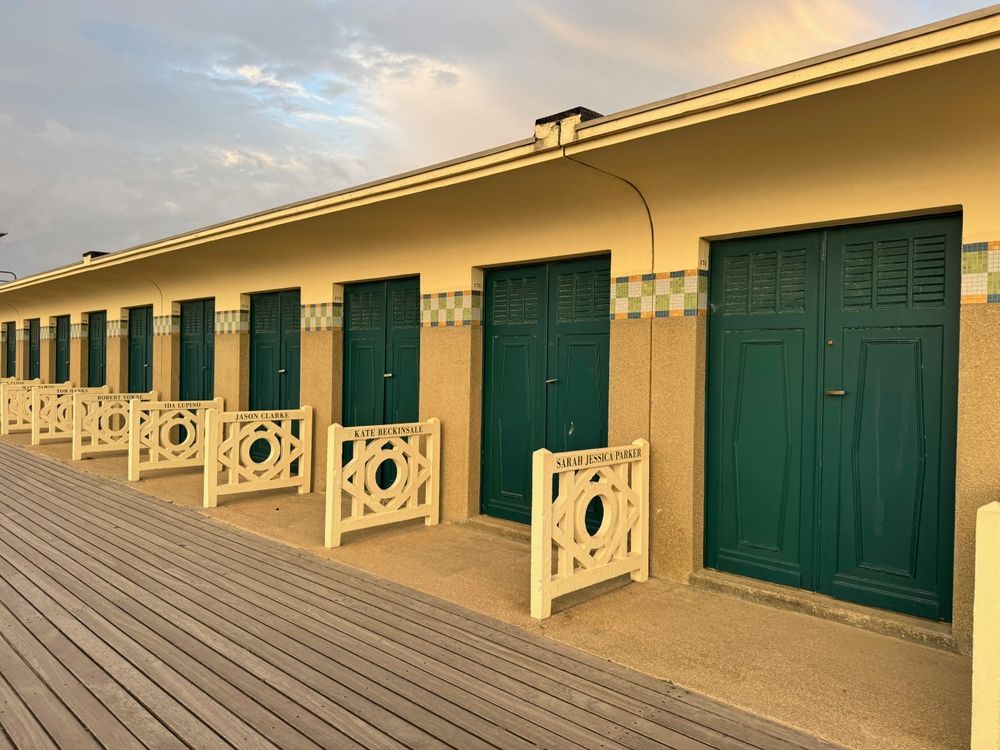
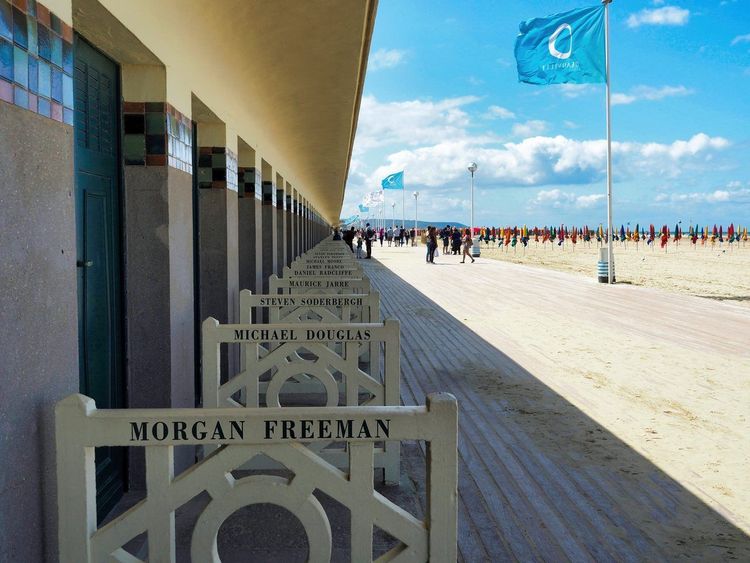
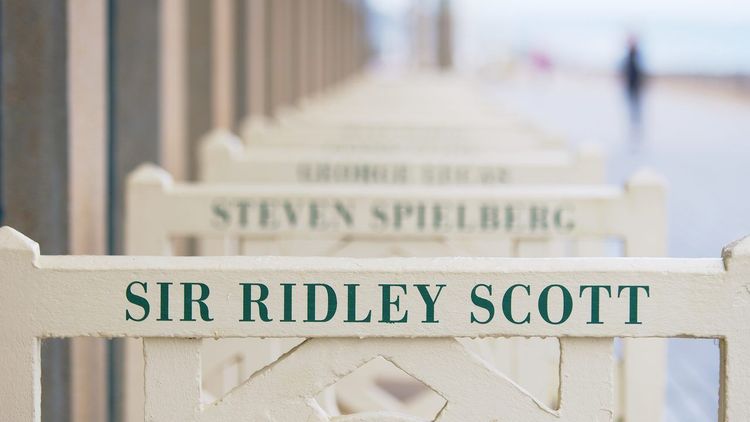
The Planches de Deauville are the ultimate emblem. This 643-metre wooden boardwalk, lined with striped cabins bearing the names of stars from the American Film Festival — from Clint Eastwood to Katharine Hepburn, Robert Redford to Jean-Paul Belmondo — is one of the most photographed seafront promenades in France. It is free, permanently open, and offers an unobstructed view of the beach and the Seine estuary at low tide.
The town's architecture is as compelling as its seafront. The late nineteenth-century Norman villas, with their half-timbering, turrets and lush gardens, form a remarkably cohesive architectural heritage. Rue Désiré-Le Hoc and the surrounding streets concentrate the finest properties. Note in passing the Villa Strassburger, a sumptuous neo-Norman mansion built at the beginning of the twentieth century for Baron Henri de Rothschild, bought in 1924 by the American Ralph Beaver Strassburger, then bequeathed to the town of Deauville in 1980. Listed as a historic monument and preserved with its period furnishings, it can be visited in summer — a detail that few guides mention.
Deauville has two racecourses: La Touques for flat and jump racing, Clairefontaine a few kilometres away for trotting races. The Deauville-La Touques racecourse hosts the ARQANA sales each August, a yearling market considered one of the two or three most important in the world, where foals change hands for several million euros before a crowd of breeders, owners and specialist journalists. On ordinary race days in July and August, admission is free or nominal.
The Casino Barrière de Deauville (2 Rue Edmond Blanc, 14800 Deauville, rated 4.3/5 on Google from 7,755 reviews) is worth a visit even if you don't gamble. The 1912 building blends Art Nouveau with Norman architecture and has a terrace on the boulevard overlooking the beach. The casino's restaurants serve Franco-Norman cuisine at moderate prices for this type of establishment. On summer evenings, the animation on the seafront naturally gravitates towards this area.
The American Film Festival, held every early September since 1975, transforms the town for ten days: screenings on the beach, a red carpet on the Planches, American stars and European distributors. If you visit Deauville outside the summer season, this is the moment when the atmosphere is at once most intense and most authentic.
Trouville-sur-Mer, Authentic Norman Character
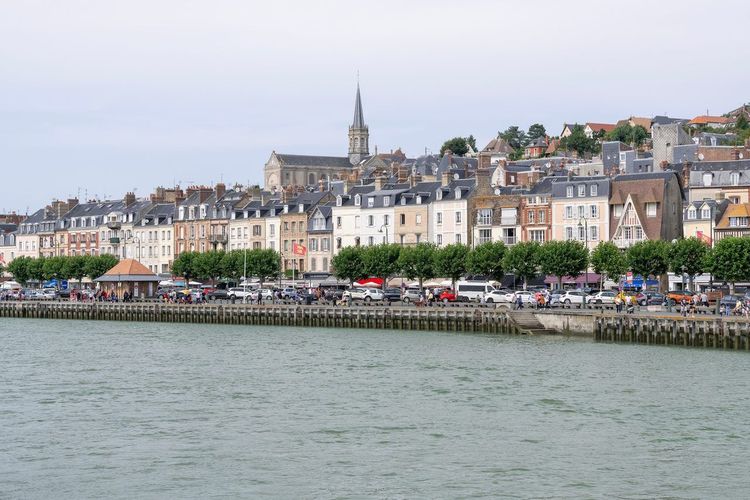
Trouville and Deauville face each other across the Touques, separated by just a few hundred metres as the crow flies. Yet they are not two versions of the same place. Trouville is a real fishing town, with its nets drying on the quayside and fishwives who look you in the eye when you choose your turbot.
The Halles de Trouville, built on the bank of the Touques, house a permanent fish market whose reputation extends well beyond the region. The Trouville fish auction is one of the most active in Normandy; morning landings dictate the market stalls from 8am. Bay of Seine grey shrimps, fresh sole, rope-grown mussels, periwinkles and crab are sold by weight in a covered-market atmosphere that has barely changed since the 1970s.
The Plage de Trouville is livelier and less formal than Deauville's, with its ice-cream sellers, anglers on the jetty and families settling on the sand without ceremony. The Belle Époque villas lining the southern seafront make for a pleasant architectural stroll, in particular the Villa Montebello, which now houses a municipal museum devoted to the history of the resort and the painters who depicted it.
If you have a car, the bridge spanning the Touques lets you switch between the two towns in under five minutes. Many visitors sleep in Trouville, noticeably cheaper, and spend their days in Deauville. A perfectly valid economic logic that local hoteliers will not discourage you from adopting.
Cabourg, in Proust's Footsteps along the Grande Digue
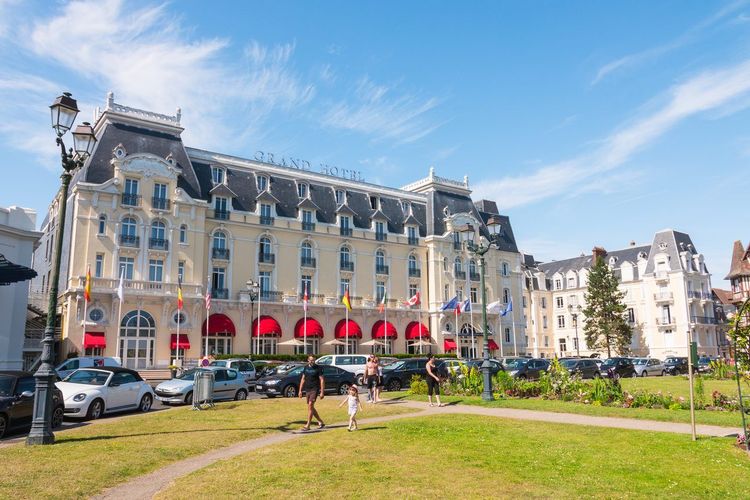
Marcel Proust spent several summers in Cabourg between 1907 and 1914, installed at the Grand Hôtel facing the sea. The seaside resort became "Balbec" in In Search of Lost Time, and the town's radial street plan — every road converging on the casino like the spokes of a wheel — has survived perfectly intact.
The Grand Hôtel de Cabourg, opened in 1907, is still in operation. The room occupied by Proust on the second floor is not open to visitors, but the entrance hall with its white columns and polished parquet is worth the detour. Even if you are not staying here, stopping for a coffee in the panoramic restaurant with its direct sea view remains a perfectly justified ritual.
The Promenade Marcel Proust (Promenade Marcel Proust, 14390 Cabourg, rated 4.6/5 on Google from 3K reviews), which runs along the beach for two kilometres, is one of the longest wooden promenades in Normandy. The beach huts arranged in an arc, the Norman villas on the seafront and the late-afternoon light on the mouth of the Dives create an atmosphere that fully justifies the detour.
Behind the promenade, the town's fan-shaped layout is perfectly legible from the higher ground: the Boulevard des Flandres, the Boulevard des Anglais and the Boulevard des Belges all converge on the municipal casino. The villas lining these avenues represent one of the most intact concentrations of late nineteenth-century Norman seaside architecture anywhere, carefully preserved by strict planning regulations.
The Friday morning market in the centre of Cabourg is more family-oriented and accessible than those of Deauville or Honfleur. A good option for buying local produce without paying the tourist premium charged at the headline markets.
Houlgate, Cliffs and Belle Époque Villas
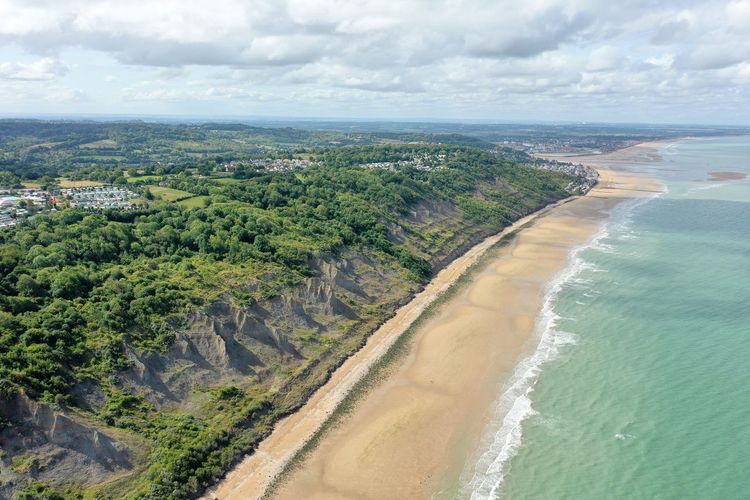
Between Cabourg and Villers-sur-Mer, Houlgate is the resort that best combines architectural elegance with easy access to the coast. The beach is wide, rarely crowded outside July and August, and the clifftop corniche to the south offers a clear-day view of the Vaches Noires.
The architectural heritage is remarkable for a resort of this size. The Victorian and Belle Époque villas on the seafront, some still bearing their original names, were built between 1880 and 1914 for the Parisian bourgeoisie who took the train from Saint-Lazare. Rue des Bains and the surrounding streets make for an unhurried walk of about an hour, with genuine surprises at every turn.
The Beuzeval cliff, accessible from the Route des Falaises south of the town centre, leads to the natural viewpoint overlooking the Vaches Noires. It is the ideal starting point for a three-to-four-hour hike to Villers-sur-Mer along the sentier des douaniers, with the sea on one side and Norman pastures on the other.
Villers-sur-Mer, Beach, Fossils and Maritime Museum
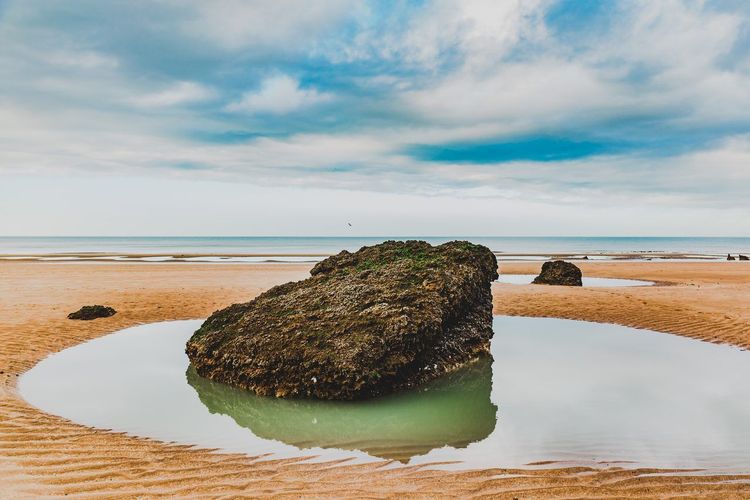
Villers-sur-Mer draws its identity from two very different realities: a fine sandy beach stretching for more than three kilometres, and cliffs to the east that regularly yield fossils from the Mesozoic era. The Palais de la Mer, a local museum on the seafront, holds a collection of ammonites, plesiosaur vertebrae and ichthyosaur teeth gathered along this shore since the nineteenth century.
The beach itself is worth lingering on. Less well known than those of Deauville or Cabourg, it is noticeably less crowded in July and August and offers decent conditions for swimming in the supervised zone. For families with children, it is often the best compromise between quality and peace and quiet.
The village itself, with its twelfth-century Romanesque church and half-timbered Norman houses, can be explored in under an hour. The summer market combines local food and Norman crafts in an accessible, unpretentious format.
The Falaises des Vaches Noires, Fossils and the Edge of the World
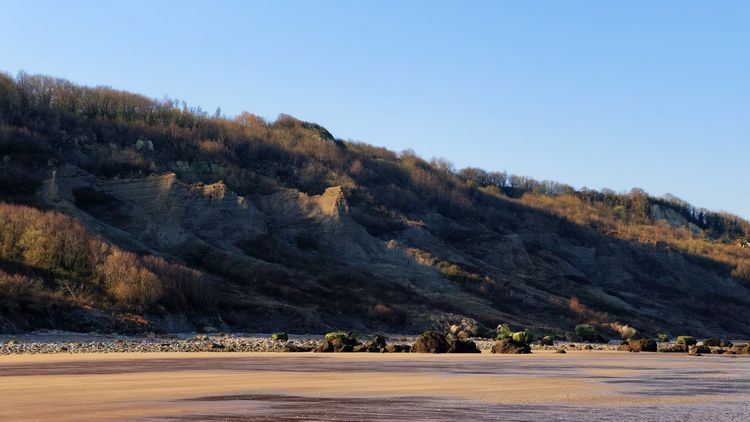
The Falaises des Vaches Noires (Chemin des Falaises, 14640 Villers-sur-Mer, rated 4.1/5 on Google from 434 reviews) extend for roughly four kilometres between Villers-sur-Mer and Houlgate. The name comes from the black rocks that emerge at low tide, covered in seaweed, which sailors once mistook for cows sleeping in the water. It is one of the richest palaeontological sites in France, listed as a protected area for several decades.
The hike along the base of these cliffs, accessible only at low tide and with waterproof closed-toe shoes, is one of the most remarkable walks on the entire Norman coast. The Jurassic clay strata (155 to 165 million years old) regularly give way under marine erosion, releasing fossils and calcareous concretions onto the foreshore. Ammonites the size of dinner plates, ichthyosaur fragments and marine crocodilian teeth have been identified and described by professional palaeontologists here since the late nineteenth century.
Three rules to follow without exception. Check the tide timetable before setting out: the tidal coefficient must be above 70 for the passage to be sufficiently clear. Never approach the base of the cliffs: rockfalls are frequent and often give no warning. Pick up only material lying loose on the foreshore, without digging or destabilising the cliff face: in-situ fossils belong to the public domain and their removal is regulated.
The full route from the Villers-sur-Mer car park to Houlgate covers roughly 5 km and takes a minimum of 2 hours 30 minutes. Bring water and sun protection, and arrange a return by car or via the clifftop path if you do not want to retrace your steps.
Blonville-sur-Mer, Tranquility between Sea and Bocage
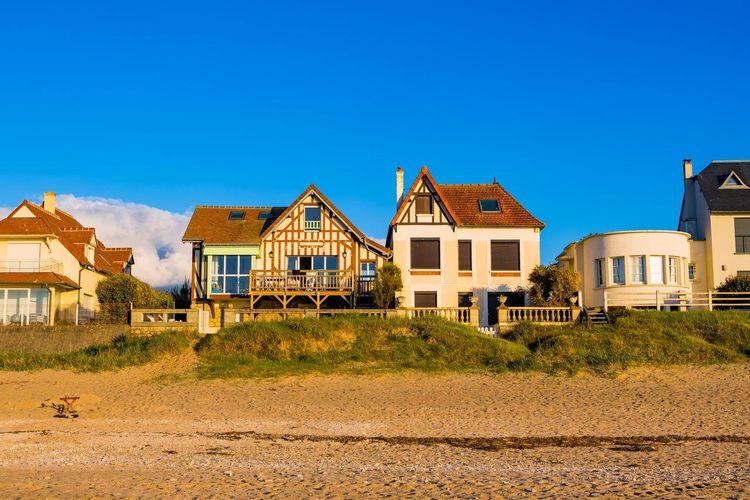
Three kilometres from Villers, Blonville-sur-Mer is the quietest resort on the Côte Fleurie. Its municipal campsite, its uncrowded sandy beach and its family villas from the 1930s–1960s are its main attractions. It is a place for those who want the Côte Fleurie without the summer crowds and without paying the rates of the major resorts.
The small road connecting Blonville to Bénerville-sur-Mer via the heights passes through typical Norman bocage — thick hedgerows, Norman cows, apple trees in blossom in spring. This abrupt contrast between the coastal strip and the Pays d'Auge hinterland, less than two kilometres from the beach, is one of the defining characteristics of this coastline that hurried visitors consistently miss. Taking an hour for this short detour is one of the best decisions you can make on the Côte Fleurie.
Dives-sur-Mer, William the Conqueror and the Medieval Market Halls
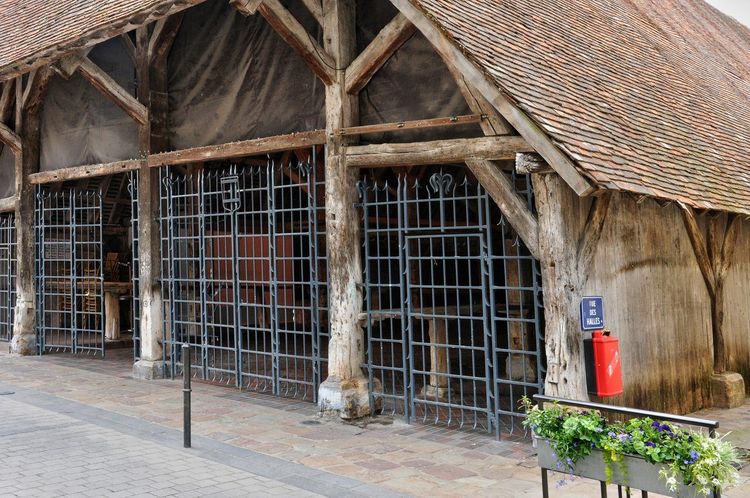
Dives-sur-Mer is the circuit's surprise. This town at the mouth of the Dives, sandwiched between Cabourg to the east and Houlgate to the northwest, was the departure point from which William the Conqueror sailed for England in 1066. A commemorative plaque in the church of Notre-Dame lists the names of the duke's companions who embarked from this port, many of which have since become common English surnames.
The Halles de Dives-sur-Mer (Place du Général de Gaulle, 14160 Dives-sur-Mer, rated 4.5/5 on Google from 2,456 reviews), built in the early fifteenth century (dendrochronology dates the timber frame to between 1405 and 1423), are among the oldest surviving market halls in Normandy. The oak framework, hand-hewn pillars and original stall layout are a rare testimony to medieval market architecture. A market is still held here on Thursday and Sunday mornings.
The Cité Médiévale adjacent to the halls, laid out around the old inn of William, brings together around fifteen craftspeople's shops — potters, glassblowers, jewellers — within an authentic fifteenth-century half-timbered setting. A good option on a rainy day, or for anyone looking for a souvenir that was not made on the other side of the world.
Merville-Franceville, between Dunes and D-Day Memory
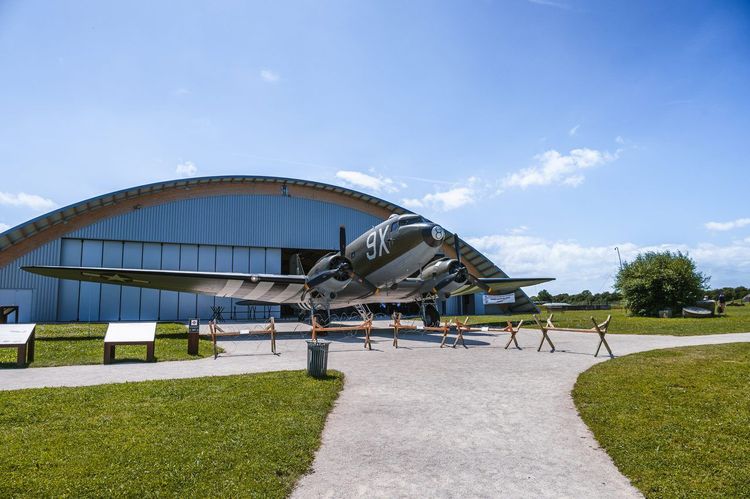
At the mouth of the Orne, Merville-Franceville-Plage marks the western boundary of the Côte Fleurie. It was here that the 9th Parachute Battalion of the British Army seized, in the darkness of 6 June 1944 at 4:30 in the morning, the Batterie de Merville (Allée du 9ème Bataillon, 14810 Merville-Franceville-Plage, rated 4.7/5 on Google from 6,421 reviews) — four guns capable of enfilading the D-Day landing beaches at Sword Beach and inflicting catastrophic losses during the amphibious landings.
The battery museum, installed in the original casemates, recreates the assault with striking realism. An authentic Horsa glider, of the same type used during the operation, is displayed outside. The visit lasts around 45 minutes and is suitable for children aged ten and above. Admission is charged but reasonable given the quality of the content.
The beach at Merville, rarely crowded out of season, extends for several kilometres of marram-grass-covered dunes. It is one of the few places on the Côte Fleurie where you can walk for an hour through the dunes without encountering any recent construction — an experience that the property development pressure of neighbouring resorts makes increasingly rare.
The Baie de Sallenelles, Natural Sanctuary between Land and Sea
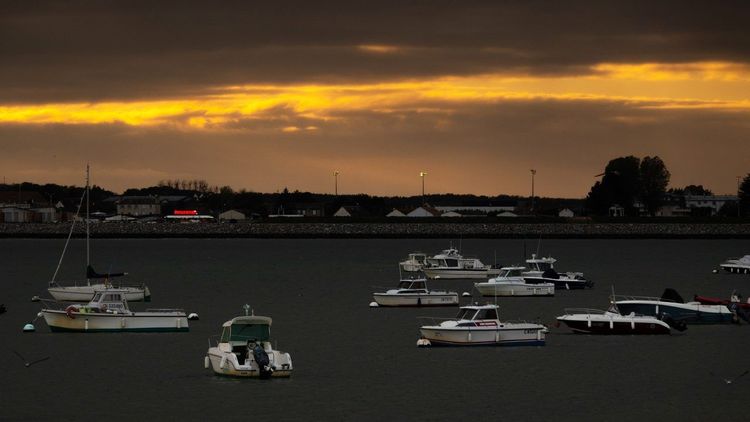
Just east of Merville, the Réserve Naturelle de la Baie de Sallenelles (Route du Marais, 14121 Sallenelles, rated 4.4/5 on Google from 140 reviews) covers 470 hectares of salt marshes, mudflats and saltings between the Orne and the Bay of Caen. More than 250 bird species have been recorded here, including spoonbills, little egrets and dunlins on migration.
The ornithological hide accessible from the Sallenelles car park provides an exceptional vantage point over the marshes and estuary. Come at dawn or late afternoon to maximise sightings. Free guided activities are offered in season by the Conservatoire d'Espaces Naturels de Normandie, including two-hour guided outings with volunteer naturalists. Deauville, a short drive east, has its own audio-guided tour: 20 stops over 5 km.
Villerville, the Secret Village between Honfleur and Trouville
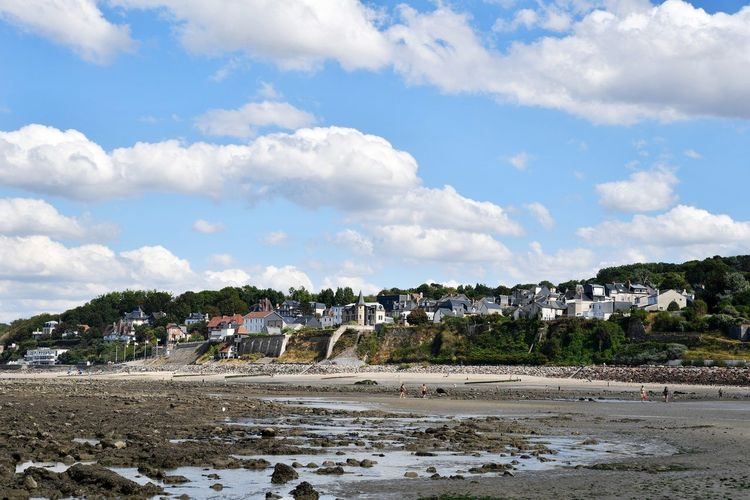
Squeezed along the D513 between Honfleur and Trouville, Villerville barely exists in mainstream travel guides. Yet it is one of the most visually cohesive villages on the Côte Fleurie: Belle Époque villas on the heights, a sentier des douaniers path running along reddish clay cliffs, and a viewpoint over the Seine estuary that, on a clear day, reaches as far as the offshore wind turbines of the North Sea.
The église Saint-Martin, a twelfth-century Romanesque church with thirteenth-century additions, is worth a five-minute stop for its limestone porch and sober proportions. The churchyard surrounding it offers a plunging view over the village rooftops and the sea. For travellers venturing off the beaten tourist track, Villerville is one of those quiet stops that serve as a reminder that the Côte Fleurie still has corners untouched by coach tourism.
The Racecourses of the Côte Fleurie, between Tradition and High Society
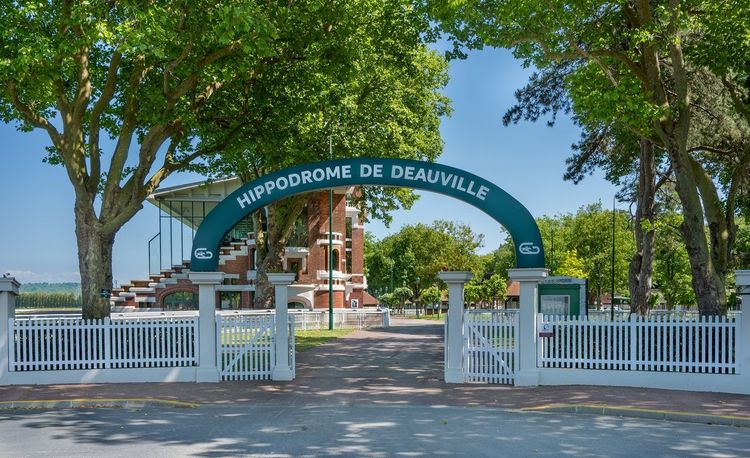
The Côte Fleurie has two racecourses that largely define the region's social identity. The Deauville-La Touques racecourse hosts the summer race meetings (July and August) and the ARQANA sales, one of Europe's most prestigious yearling markets. Thoroughbreds change hands here for several million euros in an atmosphere that blends the tweed caps of Irish breeders with the haute couture outfits of international owners. The grandstands offer a sweeping view over the Bay of the Seine.
The Clairefontaine racecourse, a few kilometres south of Deauville in the bocage of the Pays d'Auge, is more family-friendly and far more accessible. Races take place on weekdays and some weekends from June to September. The atmosphere is that of a provincial racecourse where you can still place a two-euro bet and watch the jockeys in the paddock from three metres away. Admission is free on many days.
If you visit the Côte Fleurie in summer, set aside an afternoon for one or the other. The experiences are radically different, but in both cases you will have the certainty of seeing something you will find nowhere else in France.
The Route du Cidre, a Gourmet Detour through the Pays d'Auge
About twenty minutes from the beaches of Deauville, the Route du Cidre of the Pays d'Auge winds through half-timbered villages and Norman orchards where around twenty producers open their doors year-round. The signposted 40-kilometre circuit passes through Cambremer, Bonnebosq, Beaufour-Druval and, above all, Beuvron-en-Auge (Place Michel Vermughen, 14430 Beuvron-en-Auge, rated 4.7/5 on Google from 3K reviews).
Beuvron-en-Auge is listed among the most beautiful villages in France. Its seventeenth-century market hall, its painted half-timbered houses and its central square make it an unmissable stop. The village has two or three restaurants serving traditional Norman cuisine — veal in cream sauce, tarte normande, a local cheese board — at fair prices for the quality on offer.
The producers along the route generally offer free tastings of cider, pommeau and calvados with a tour of the press. Some also offer bed-and-breakfast rooms or gîtes in intact Norman farmhouses. For families, it is a welcome alternative to the beach on bad-weather days or when the swell is rough — Normandy sees its fair share, even in summer.
Beaches and Promenades of the Côte Fleurie
Forty kilometres of sand, with very different characters depending on the resort. Here is how to tell them apart if you are tailoring your stay to your holiday style.
Deauville: the most iconic beach, the most photographed, but also the most crowded. Hire-a-beach-hut available, supervised swimming in summer. Better for strolling and a lively atmosphere than for peace and quiet.
Trouville: livelier than Deauville while remaining more natural. Direct access from the pedestrian seafront. Good for swimming and seafront walks without any formal protocol.
Cabourg: a wide, arc-shaped, family-friendly beach. The wooden promenade makes it the most elegant setting for a walk by the sea. Houlgate: rarely crowded outside July and August. Fine sand, easy access from the village, excellent south-facing exposure.
Villers-sur-Mer: vast, with few facilities but genuine character. Merville-Franceville: preserved dunes, ideal for walking and quiet contemplation. Less suited to swimming for those unfamiliar with the currents at the mouth of the Orne.
Boat Trips from Trouville and Honfleur
The Côte Fleurie can also be discovered from the sea. Several companies offer boat trips from the ports of Trouville and Honfleur from May to September, with varying formats depending on the operator.
From Trouville, catamaran or motorboat excursions head up the Seine estuary as far as the Pont de Normandie, providing a unique reading of the coastal geography seen from the water. Some trips stop for grey seal spotting on the sandbanks of the estuary — a population that has re-established itself since the 1990s.
From Honfleur, sailing and motorboat outings on the Bay of the Seine are offered by several nautical clubs based in the port. A two-hour trip at the end of the afternoon offers the spectacle of the Vieux-Bassin seen from the water and the golden evening light on the slate façades — exactly what the Impressionists were trying to capture from their boats in the 1860s.
Norman Gastronomy on the Côte Fleurie
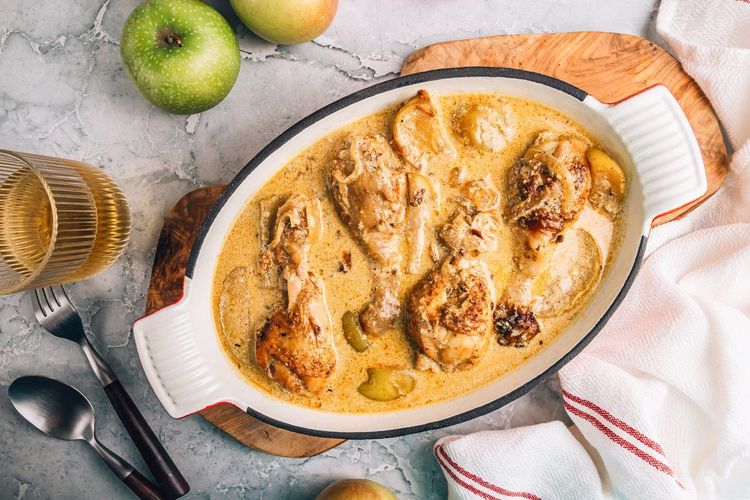
The Côte Fleurie is one of the areas of France with the highest density of quality local produce per square kilometre. It pays to know the specifics before you arrive, so you don't end up eating industrially produced food in a restaurant that advertises "Norman products" on the door.
The Camembert de Normandie AOP — to be distinguished from "camembert made in Normandy", which is not the same thing — is recognised by its raw milk ladled into moulds by hand. About a dozen AOP producers remain in the Pays d'Auge, accessible from the Côte Fleurie. The rind should be white and bloomy with russet patches when fully ripe; the interior slightly runny. The cheesemonger at your local market should be able to name the producer.
The moules de bouchot de la baie des Veys, grown on wooden stakes driven into the mudflats off the Cotentin coast, reach the stalls of Trouville and Honfleur from July to January. Small, sweet and uniformly sized, they are served in most seafront restaurants, either marinière or with Norman cream. Avoid the "mussels and chips" set menus at promenade restaurants: the mussels will be from the Netherlands.
The sole normande is one of the region's most coherent culinary preparations: a sole meunière served with a sauce of crème fraîche, mushrooms and grey shrimps. The best versions are found in the small harbour restaurants of Trouville and Honfleur, not in the large brasseries on the seafront. Expect to pay between €24 and €32 for the dish depending on the establishment.
The calvados vieux du Pays d'Auge AOP is the region's digestif par excellence. Not to be confused with young calvados, which is harsh and uninteresting: aged calvados has been matured in oak casks for a minimum of 2 years (VS) or 6 years or more (XO). Several distilleries on the Route du Cidre offer free comparative tastings, with the option to buy directly at the estate.
The grey shrimps of the Bay of the Seine are caught by hand by the shrimp fishermen of Trouville. A tray bought directly from the fish auction, peeled by the waterside with a glass of Muscadet, is the most authentically Norman meal imaginable and one of the least expensive on the entire Côte Fleurie.
Markets and the Norman Art of Living
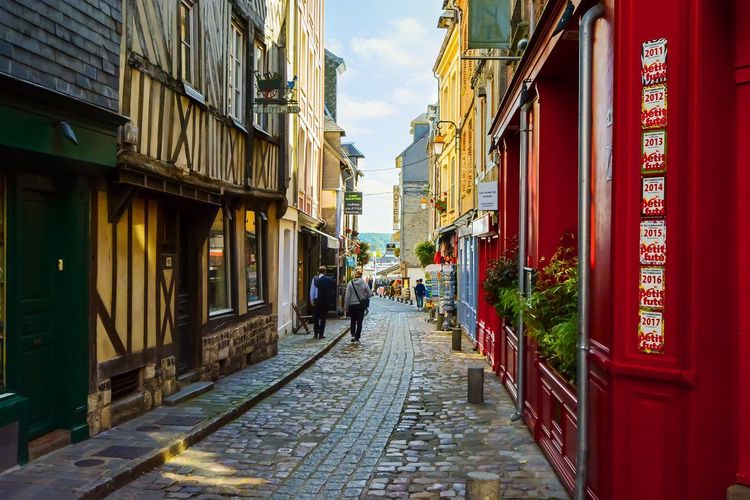
The Côte Fleurie has a network of weekly markets that give rhythm to any stay. Honfleur (Saturday morning) is the most spectacular, with its cheesemakers, calvados producers and fish-auction stalls. Trouville (Wednesday and Sunday morning) is the most vibrant for seafood. Deauville (Tuesday and Friday morning) draws a well-heeled clientele with its upmarket cheesemakers and market gardeners. Cabourg (Friday morning) is more family-oriented and noticeably more affordable.
The arts-and-crafts shops of Honfleur — ceramics, watercolours, wood sculptures, leather goods — fill the alleyways around the Vieux-Bassin. Rue Haute and Rue Brûlée are worth a detour for anyone looking for something beyond mass-produced souvenirs. Several galleries offer original works by contemporary Norman artists at reasonable prices if you take the time to look.
Practical Information: When to Come, How to Get Around, Where to Stay
Best time to visit. The Côte Fleurie is pleasant from May to October. July and August are the busiest months, with packed beaches and accommodation prices two or three times higher in the main resorts. May, June and September are ideal: the sea is still cool in June but sunshine is reliable, restaurants are not overwhelmed and the racecourses are in full swing. September weekends are particularly recommended: Deauville's American Film Festival (early September) animates the town for ten days, and temperatures remain summery.
Getting there. From Paris, the A13 motorway (exit 29 for Deauville-Trouville, exit 30 for Cabourg) puts you on the coast in around 2 hours 15 minutes from the ring road. The N175, after leaving Caen, serves Honfleur and the western section. The train from Paris-Saint-Lazare to Trouville-Deauville takes between 2 hours 05 and 2 hours 30 depending on the service. Direct trains run at weekends in July and August. Honfleur has no direct train service: from Trouville-Deauville station, a Bus Verts service covers the connection in 30 minutes.
Getting around. A car remains the most convenient way to move between resorts and venture into the Pays d'Auge. The Bus Verts du Calvados network connects the main resorts from May to September, but timetables are geared to local use and are not particularly practical for visitors. Several tourist offices offer bicycle hire by the day or week, sufficient for coastal stretches between neighbouring resorts.
Where to stay. Options vary considerably according to budget. In Honfleur, the most developed charming hotels are in the half-timbered houses of the town centre: expect €90–€180 per night out of season, more in summer. In Deauville, the grand seafront hotels charge palace rates, but two- and three-star establishments exist in the surrounding streets for €80–€130. Trouville is noticeably cheaper than Deauville for equivalent quality and remains the best value-for-money option on the seafront. Houlgate and Villers offer mainly campsites and self-catering rentals ideal for families. The Route du Cidre has farmhouse bed-and-breakfasts at €65–€90 per night, often including a home-made breakfast.
To explore the towns of the Côte Fleurie with an audio guide at hand — history, architecture, literary and artistic anecdotes — the Ryo app offers thematic itineraries for several Norman towns. A useful option if you are travelling alone or want to structure your exploration without being tied to a fixed-schedule guided tour. If the Norman coast makes you want to explore further east, the highlights of Yport according to Ryo offer another facet of the Norman coastline, along the Côte d'Albâtre, about an hour's drive from Deauville. In the same spirit, Veules-les-Roses and its highlights, a village home to one of the shortest rivers in France, make an ideal continuation of your Norman coastal journey.
FAQ
Where exactly is the Côte Fleurie in Normandy?
The Côte Fleurie stretches for about forty kilometres through the Calvados department (14), between Honfleur to the west and Cabourg to the east. It is part of the Normandy region and stands apart from other Norman coastlines thanks to its fine sandy beaches, Belle Époque villas and historic seaside resorts. It should not be confused with the Côte d'Albâtre, the chalky cliffs running between Dieppe and Le Havre, nor with the Cotentin peninsula.
How many days do you need to visit the Côte Fleurie?
A three-day weekend is enough to cover the highlights: Honfleur, Deauville, Trouville and a beach day. To explore the full coastline, from Merville-Franceville to Cabourg, including the Falaises des Vaches Noires and the Route du Cidre, allow a minimum of five to six days. A full week lets you explore at a relaxed pace, with half-days set aside for markets, boat trips and local gastronomy.
What is the best time to visit the Côte Fleurie?
May, June and September are the best months. The weather is generally sunny, the beaches are usable and accommodation prices remain reasonable. In July and August, visitor numbers surge, accommodation fills up weeks in advance and roads can be congested at weekends. If you must visit in high season, opt for lesser-known resorts such as Villerville, Blonville-sur-Mer or Dives-sur-Mer rather than Deauville or Honfleur during peak hours.
How do you get around the Côte Fleurie without a car?
Trains serve Trouville-Deauville from Paris-Saint-Lazare several times a day. Once there, the Bus Verts du Calvados connect the main towns from May to September, though frequencies are geared to local residents' needs rather than visitors. Cycling is a good option for coastal stretches, and several tourist offices offer bike rentals by the day or week. Honfleur, which has no direct train service, can be reached by bus from Lisieux or Caen, or by seasonal ferry from Le Havre.
Which town should you choose for a first stay on the Côte Fleurie?
Deauville or Trouville for the classic seaside atmosphere and easy access from Paris. Honfleur for architectural charm and cultural richness. Cabourg for a quieter, more literary feel. If you're unsure, base yourself in Trouville: prices are lower than Deauville, the beach is less crowded and Honfleur is 30 minutes away by road. You can comfortably cover the entire Côte Fleurie on day trips from there.
Are the Falaises des Vaches Noires accessible to everyone?
No. Walking along the base of the cliffs requires a tidal coefficient above 70, waterproof closed-toe shoes and reasonable physical fitness. The terrain is unstable, strewn with slippery pebbles, and rockfalls are frequent. The route is not recommended for people with limited mobility or young children. The viewpoint accessible by car from the heights of Houlgate offers a satisfying aerial view of the Vaches Noires without any of these constraints.
Are there free activities on the Côte Fleurie?
Yes, and plenty of them. Beaches and seafront promenades are free to access. The walk along the Planches de Deauville is always free. Weekly markets are open to all. The sentier des douaniers coastal path between the various resorts is entirely free. The Réserve Naturelle de la Baie de Sallenelles and its hides are accessible without an entrance fee. Beuvron-en-Auge can be visited freely. Only museums (Boudin, Batterie de Merville, Palais de la Mer) and certain events (ARQANA racing sales, film festival) charge admission.
The Côte Fleurie, a Coastline to Explore without Rushing
Forty kilometres of coast, a dozen seaside resorts and just as many different characters: the Côte Fleurie is only truly understood after several days spent drifting from one town to the next. From the light of Honfleur to the boardwalks of Deauville, from the fossils of the Vaches Noires to the orchards of the Pays d'Auge, each stop adds a layer to a territory that refuses to be reduced to a single image.
The fifteen highlights listed in this guide cover the essentials, but leave room for the unexpected — a stop in a village with no tourist signs, lunch at the Trouville fish auction on a Wednesday morning, an evening stroll along the Cabourg sea wall once the summer crowds have gone home. It is in those moments that the Côte Fleurie truly belongs to you. The Ryo app will accompany you with audio guides on several of these Norman towns to enrich your exploration at your own pace, with no timetable or group to answer to.