© Shutterstock
 Votre guide Ryo
Deauville Beach: Complete Guide 2026
Deauville Beach: two kilometres of fine sand facing the English Channel, a century-old Boardwalk and cabins bearing the names of movie stars. At low tide, the sand stretches so far that an early-morning walker barely crosses two or three silhouettes before reaching the first parasols. This vastness contrasts with the glamorous image the town has carried for a century and a half — that of colourful beach huts and elegant Sunday outfits. Ryo has built an audio-guided tour to tell the story of this beach without reducing it to a simple postcard: Ryo's Deauville audio-guided tour revisits the Planches, the cabins and the stories that shaped the Normandy seafront. If you are looking for where to lay your towel in Deauville, between century-old wooden boards and pale sand, this guide covers the essentials before you set off.
You will find the exact address of the beach, the travel time by train from Paris (around two hours), the rules you need to know if you are travelling with a dog, as well as the hundreds of named cabins bearing the names of actors who attended the Festival du Cinéma Américain. The guide also covers weather, tides, car parks, hotels less than ten minutes' walk from the sand, seafront restaurants and the neighbouring beaches of the Côte Fleurie that are well worth the detour.
Deauville Beach at a Glance
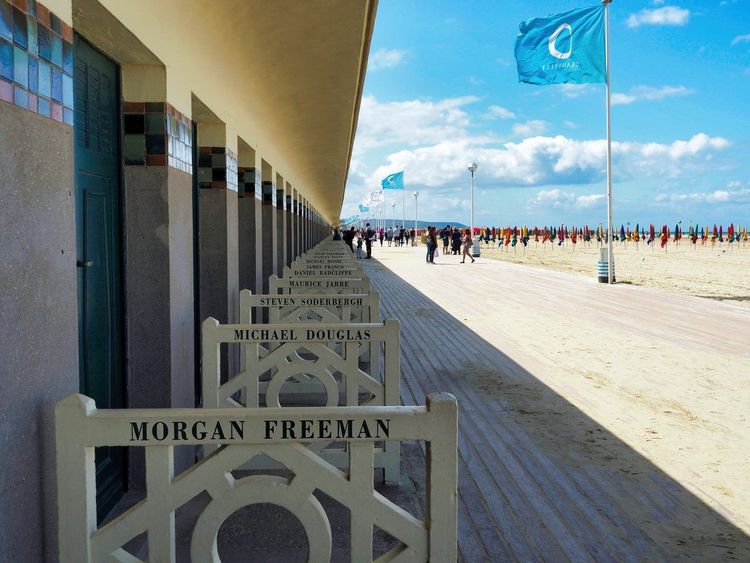
The Deauville Beach (Boulevard de la Mer, 14800 Deauville, rated 4.4/5 on Google across 16,718 reviews) sits at the mouth of the Touques river, facing Trouville-sur-Mer on the opposite bank. The fine sand stretches for approximately two kilometres, bordered along its entire length by the famous Promenade des Planches, a wooden walkway built as early as 1923 so that bathers could reach the water without getting their feet dirty.
The tidal range here is considerable, with a tidal amplitude that can exceed six metres during the equinoctial spring tides. At low tide, the beach almost doubles in width, revealing sandbars where children collect cockles. At high tide, the water laps at the foot of the Planches, and swimming takes place on a narrower strip, supervised in season by lifeguards. This twice-daily rhythm gives the beach two faces: in the morning, a vast, smooth expanse ideal for long walks; in the afternoon, a lively strip where towels and parasols crowd together.
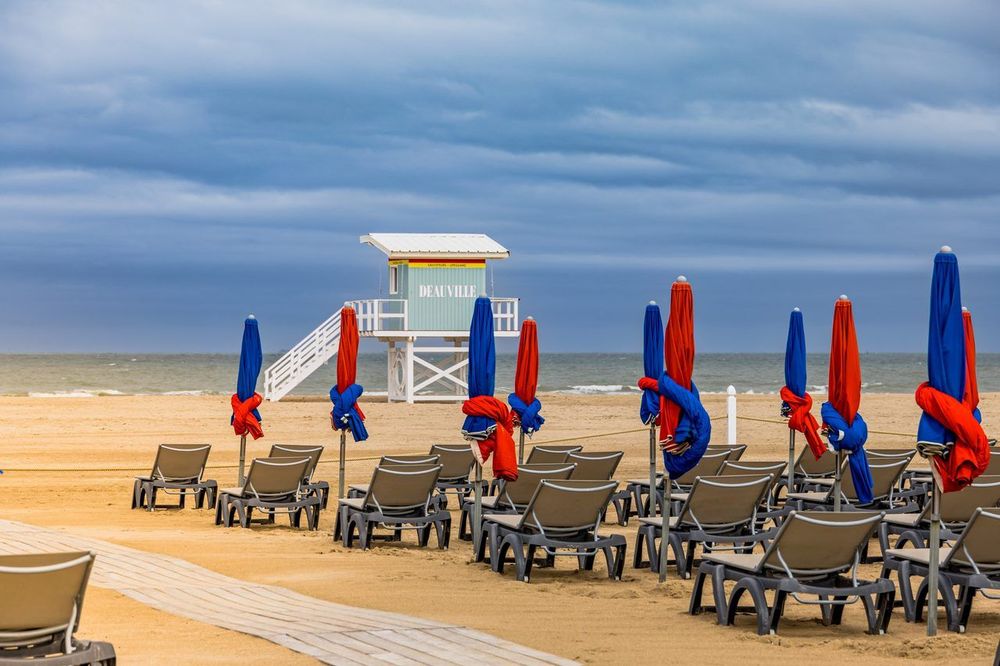
Facing due west, the beach receives the afternoon sun and, above all, its spectacular end-of-day light, when the raking rays lengthen the shadows of the cabins across the wet sand. The seabed slopes gently, with no noticeable holes or currents in the central supervised area, making it a reassuring beach for families with young children. You will encounter as many swimmers as walkers, horse riders who trot their mounts along the shore in the early morning, and photographers in search of the famous row of parasols.
In practical terms, a few figures are enough to place the beach: two kilometres of sand, 643 metres of wooden walkway, hundreds of named cabins and a seafront that is entirely pedestrianised on the Planches side. The municipality of Deauville is tiny — barely more than three square kilometres — which explains why almost everything can be reached on foot from the seafront: the station, the casino, the historic hotels, the covered market and the shopping streets all fit within a very small area. It is this compactness, as much as the sand itself, that has built the resort's reputation among visitors coming for a simple weekend, the same compact stretch Ryo's Deauville audio-guided tour follows along the Planches.
A Resort Designed for the Sea
This particular relationship with the ebb and flow explains why Deauville was built here rather than anywhere else along the Normandy coast. In the 1860s, the Duc de Morny, half-brother of Napoleon III, chose this hamlet of marshes and fishermen to build from scratch a seaside resort designed for the Parisian aristocracy. The idea could be summed up in a single sentence: offer Parisians the sea in less than two hours by train, away from the popular crowds that were already flooding Trouville, its older neighbour on the other side of the Touques.
The gamble paid off beyond all expectations. Within a few decades, the town acquired a casino, a racecourse, grand hotels and villa after villa, until it became during the Roaring Twenties the social meeting place for all of Paris's elegance. The current layout of the beach — pale sand, dark boardboards and multicoloured cabins — dates largely from this period of the 1920s, when architect Charles Adda designed the promenade and the first rows of bathing cabins.
Cinema did the rest. A natural backdrop for numerous films, including the unforgettable opening of Claude Lelouch's "A Man and a Woman" shot on these Planches in 1966, Deauville established itself as an open-air film set. Every time you walk across the wooden slats, you are literally treading a century of seaside and cinematic history — something Ryo's Deauville audio-guided tour recounts at each stop along the way.
The Planches and the Stars' Beach Cabins
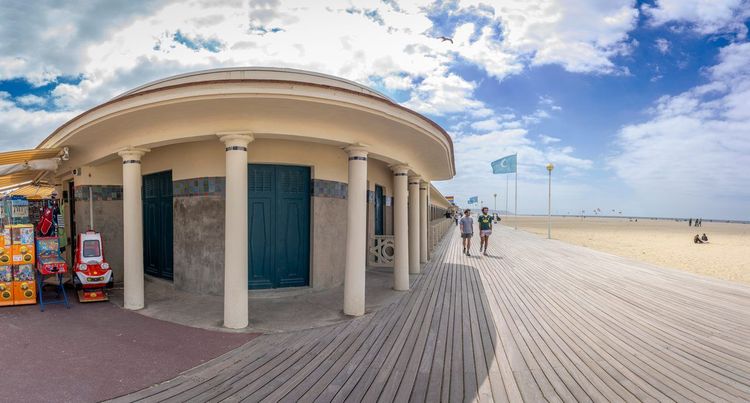
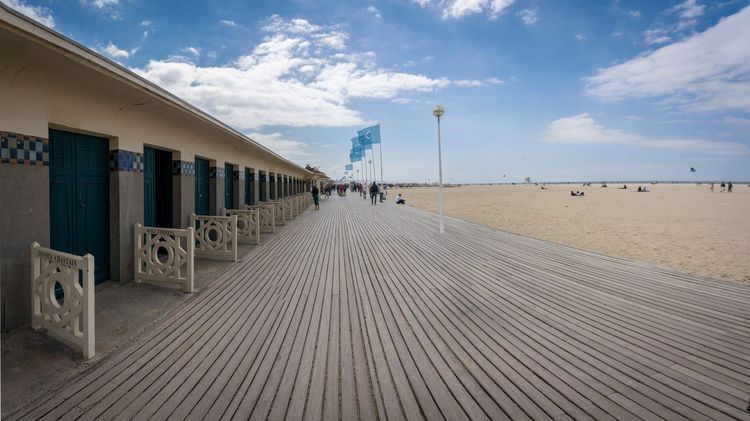
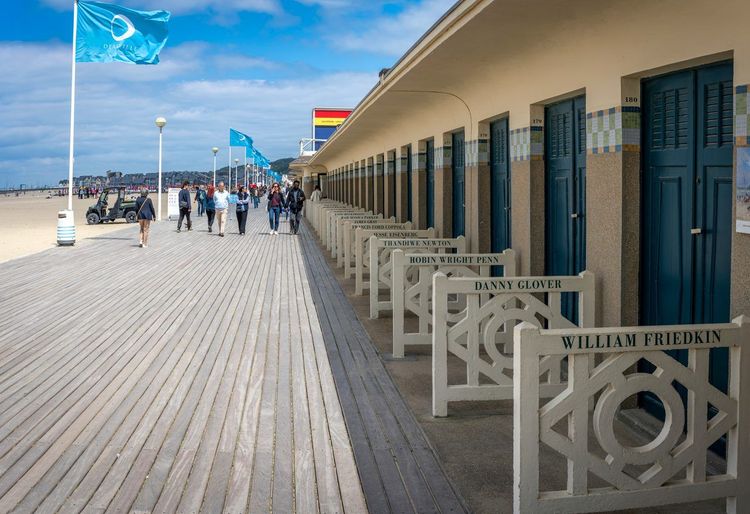
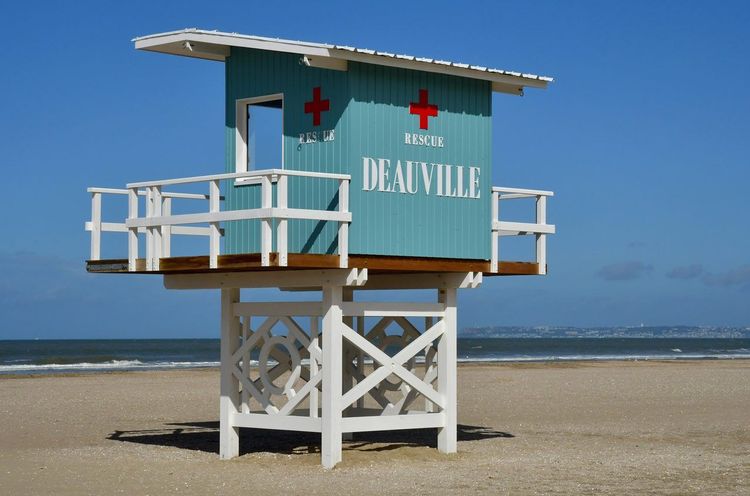
It is impossible to talk about Deauville Beach without dwelling at length on its Planches. This walkway of exotic hardwood, maintained every winter to withstand the storms, runs alongside the beach for nearly 643 metres, from the Casino Barrière to the Piscine Olympique. Originally laid over 444 metres, it was extended through successive expansions. The wood used today is azobé, a very dense tropical species chosen for its resistance to marine moisture, which replaced the original pitch pine that had become too costly to maintain.
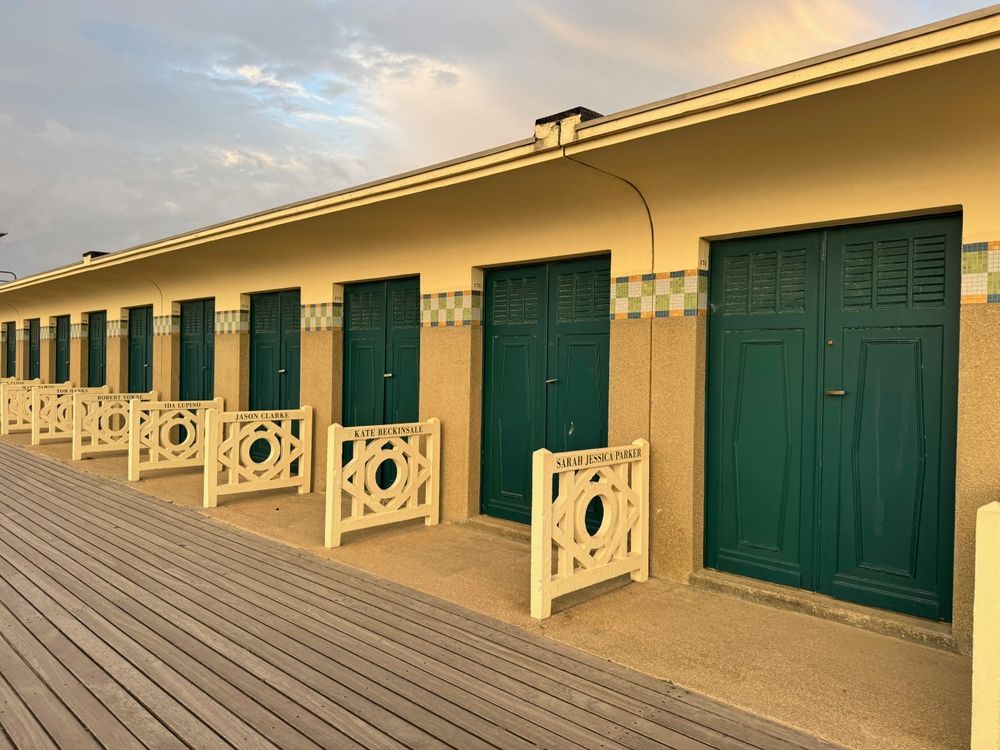
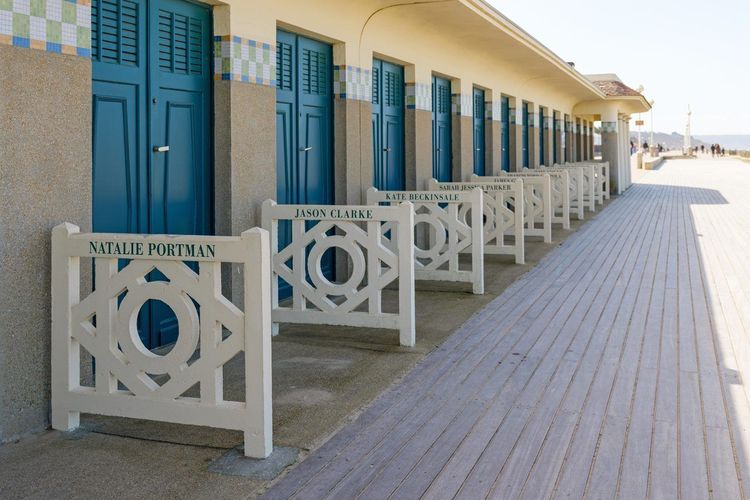
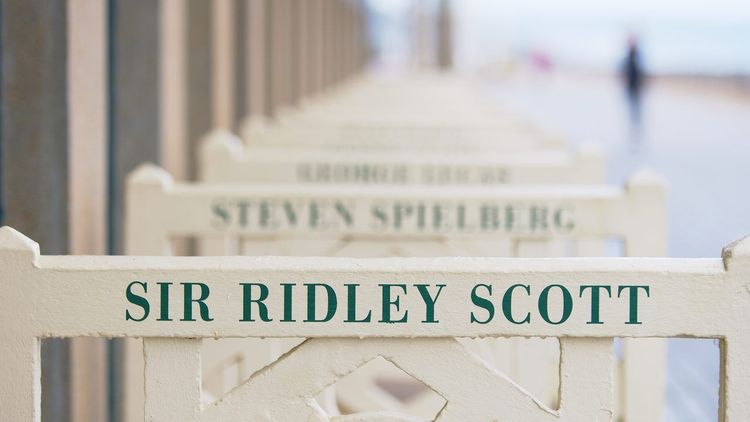
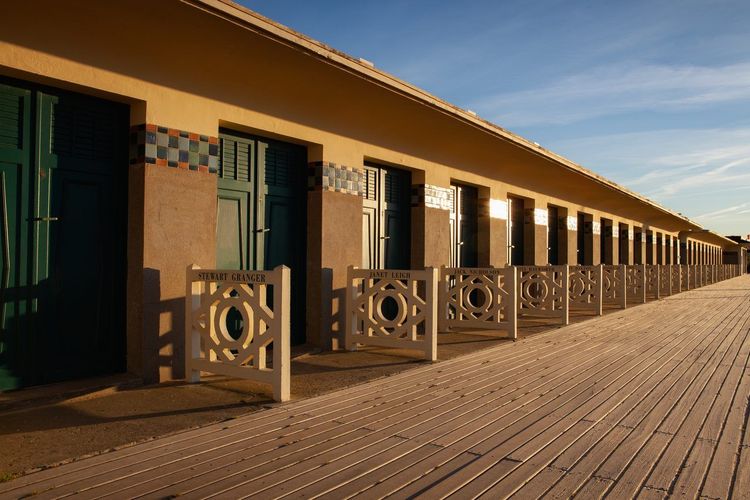
What strikes you first are the named beach cabins, lined up in their hundreds along the promenade. The huts themselves have existed since the 1920s, but it was not until 1987, at the initiative of the municipality then led by Anne d'Ornano, that each one received the name of an actor, actress or filmmaker who had passed through the Festival du Cinéma Américain de Deauville, created in 1975. You will come across the Catherine Deneuve cabin, that of Jean-Paul Belmondo, and also Gérard Depardieu, Romy Schneider and Robert De Niro. The list grows every year after the September Festival, when new names are assigned to the edition's most notable guests.
This principle is far from anecdotal to the identity of the town. It transforms a simple row of beach huts into an open-air trail of cinematic memory, which many visitors discover while walking without even realising they are following a route built up over the decades. Ryo has dedicated an entire audio-guided tour to this phenomenon: 19 audio segments that tell the story, cabin by cabin, of how cinema shaped the seaside landscape of Deauville, from behind-the-scenes filming anecdotes to the history of how the names were assigned.
At the eastern end of the promenade stands the Piscine Olympique de Deauville (Quai de la Marine, 14800 Deauville, rated 3.7/5 on Google across 347 reviews), inaugurated in 1966 facing the sea. Long considered a glamorous destination in its own right, it now welcomes swimmers and sports enthusiasts in a large outdoor heated seawater pool with a direct view of the sand. At the opposite end, on the Casino side, the Planches run alongside well-maintained flower gardens kept tidy all year round — a detail that many hurried visitors miss while focusing on the cabins.
If you only do one thing in Deauville, walk the Planches at sunset: it is the advice most often given by locals, and it is well deserved. The raking light across the wet sand and the half-timbered facades of the seafront gives this hour an almost unreal quality, and the closed cabins take on the air of a theatre set.
Tides, Swimming and Safety on the Beach
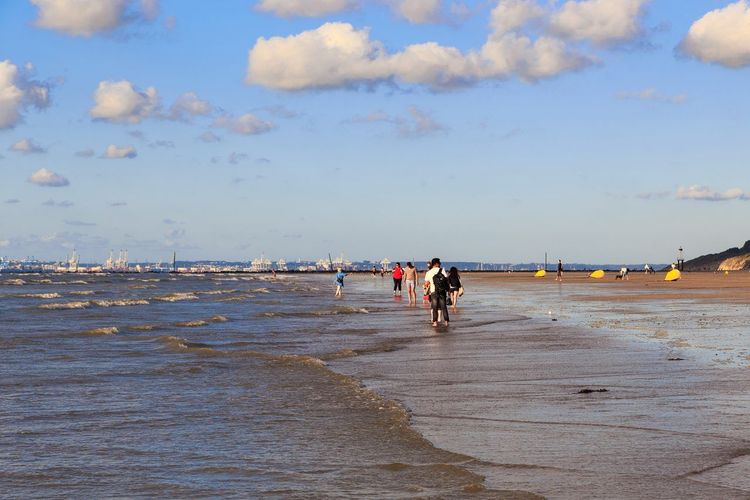
On the Côte Fleurie, the tide is not a minor detail: it sets the rhythm of the day. Before heading out to settle on the beach, check the tide times — easy to find online or posted at the beach entrance. At low tide, the water retreats far out and swimming requires a long walk across firm sand; at rising tide, however, the water comes back quickly and you need to keep an eye on belongings left too close to the water's edge.
Swimming is supervised in the summer season within a marked central zone, generally from mid-June to early September during peak hours. The classic flag system applies: green for safe swimming, orange for caution, red for a complete ban. Since the English Channel remains cool and can be choppy, it is best to respect the marked boundaries and avoid straying from the supervised area, especially with children.
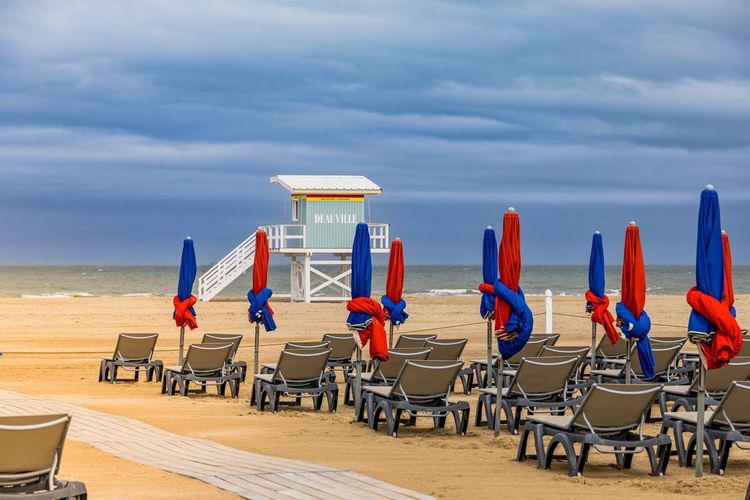
With its gently sloping seabed and the absence of any notable current in the main area, Deauville Beach remains one of the safest on the coast for families. A lifeguard post and several freshwater points are dotted along the seafront; if in doubt about the day's conditions, the lifeguards on the sand are always happy to advise. Remember to apply sunscreen even under an overcast sky: at these latitudes, the wind often misleads visitors about the actual strength of the sun.
Address and Practical Access to the Beach
Deauville Beach is located at Boulevard de la Mer, 14800 Deauville, right in the heart of the town, less than ten minutes' walk from the station and the pedestrianised shopping streets. No entry ticket is required to access the sand: the beach is public along its entire length, and only the rental of sun loungers or individual cabins is charged in season.
From the town centre, several access points lead directly to the Planches, notably via the rue Désiré Le Hoc or the place Morny, where the majority of shops, cafés and boutiques are concentrated. Each entrance opens onto the wooden walkway, from which you descend to the sand via short ramps spaced at regular intervals. For visitors coming from Trouville-sur-Mer, a footbridge allows you to cross the Touques in just a few minutes, a pleasant walk that offers a fine overview of both resorts and the marina.
In terms of accessibility, the flat seafront and the wooden promenade make it easy to push prams and navigate for people with reduced mobility as far as the edge of the sand; getting into the water on the sand itself remains, as everywhere, more challenging. During the season, ask at the lifeguard post about any assisted swimming facilities that may be available, a short stretch also covered by Ryo's Deauville audio-guided tour near Place Morny and the Marina.
Getting to the Beach by Train from Paris
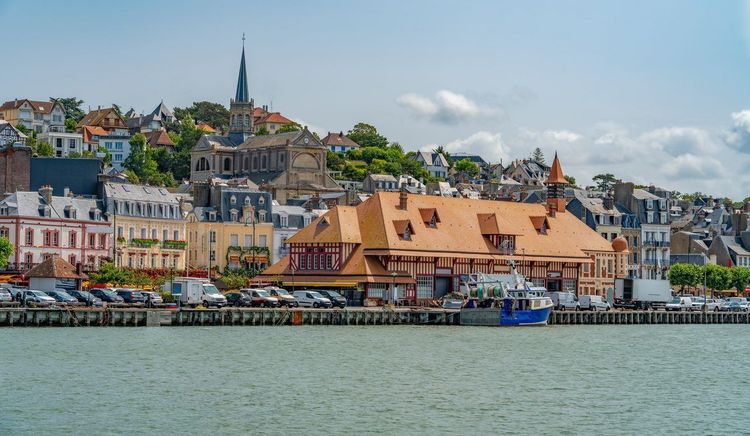
The Deauville - Trouville - Saint-Gatien station serves both resorts from Paris-Saint-Lazare, with Intercités and TER Nomad services running either direct or with a connection at Lisieux depending on the timetable. Journey times are generally around two hours, between 2h and 2h30 depending on the service, which explains why Deauville has always been a favourite weekend destination for Parisians.
In high season, the frequency rises to several return journeys daily, with reinforced trains on Friday evenings and Sunday late afternoons — the busiest periods for both Parisians and coastal residents. Booking a few weeks in advance generally allows you to secure fares well below the full price, especially for festival weekends or major race meetings, when trains quickly fill up.
Once you arrive at the station, the beach can be reached on foot in fifteen to twenty minutes by walking through the town centre, or in just a few minutes by taxi or local shuttle. No vehicle reservation is therefore needed for a stay focused on the seafront: Deauville's compactness makes a car almost superfluous once you are there, especially since parking in the town centre is both paid and fills up quickly in summer.
Parking near the Beach
Several paying car parks are dotted immediately around the seafront, notably the Casino car park and the Place Morny car park, less than five minutes' walk from the sand. In summer, it is best to arrive early in the morning: surface spaces fill up quickly from 10 a.m. onwards on sunny weekends, and it is not uncommon to drive around for a while before finding a free spot close to the Planches.
Park-and-ride car parks a little further out, a 10 or 15-minute walk away, are often available and noticeably cheaper; this is the most stress-free option if you are coming for the day in peak season. Bear in mind that on race days or during the festival, traffic in the town centre becomes heavy and some seafront streets are subject to temporary restrictions. In the off-season, by contrast, parking near the beach presents no difficulty at all, even at weekends.
Deauville Beach and Dogs: What You Need to Know
Dogs are permitted on Deauville Beach, but only outside certain time windows during the summer period. From June to September, they are generally banned between 9 a.m. and 7 p.m. in the supervised area in front of the town centre — a rule common to most Normandy seaside resorts for hygiene and swimmer safety reasons.
Outside this window — early in the morning or in the evening — as well as during the off-season from October to May, dogs on leads can enjoy the sand without any particular restriction. Some more outlying stretches of the beach, closer to the sea wall towards Blonville-sur-Mer, are more tolerant of dogs throughout the year. Owners would do well to check the municipal notices on arrival, as these rules may change from one season to the next depending on the by-laws in force.
A few simple habits prevent unpleasant surprises: keep your dog on a lead even in permitted areas, always pick up after them, and bring fresh water since salt and hot sand tire animals out quickly. Out of season, a long walk on the deserted beach at low tide remains one of the great pleasures of Deauville for anyone travelling with a four-legged companion.
Weather and the Best Time to Visit the Beach
Deauville enjoys a temperate oceanic climate, without excessive heat but also without bitter cold. The months of June to September offer the best conditions for swimming, with sea temperatures rarely exceeding 19 to 20 degrees even at the height of summer — the English Channel remaining cool compared to the Mediterranean. Days are often bright, but the weather changes quickly: it is always worth slipping a windbreaker into your bag, even in the middle of August.
July and August concentrate the bulk of the crowds, extended into September by the Festival du Cinéma Américain and the numerous summer race meetings. To enjoy the sand without the crowds, May and the first half of September remain ideal periods: the weather stays mild, accommodation prices drop, and the Planches regain a calm that many regulars prefer to the bustle of high summer.
Conversely, autumn and winter transform the beach into an almost deserted place, perfect for long walks facing the waves beneath the ever-changing skies typical of the Côte Fleurie. Some local photographers even consider these quiet months the best season to capture Deauville's particular light, when the closed cabins and wind-swept sand compose images far removed from the summer postcard.
Activities and Leisure around the Beach
Beyond swimming, Deauville Beach offers a range of activities that goes well beyond a simple sunbathe. The Piscine Olympique offers daily public sessions, an outdoor heated seawater pool and a direct view of the open sea — particularly appreciated out of season when the waters of the English Channel are still too cold for comfortable outdoor swimming.
A few minutes' walk away, the Casino Barrière de Deauville has been animating evenings facing the sea since 1912, with gaming rooms, shows and integrated restaurants. Its Belle Époque facade, lit up at night, is one of the most photographed landmarks on the seafront and the natural starting point for an evening out in Deauville.
On the sports side, the sand hosts beach volleyball courts in season, as well as sand yachting and kite-flying sessions during the big tides, when the Norman wind picks up over the wide-open beach. Golf enthusiasts will find several renowned courses a short distance away on the wooded heights of Mont Canisy, while the seafront thalassotherapy centres offer marine treatments and heated pools — a reliable option on rainy days. A little further out, the town's racecourses host prestigious meetings throughout the summer, starting with the Hippodrome de Deauville-Clairefontaine (14 Avenue Hocquart de Turtot, 14800 Deauville, rated 4.5/5 on Google across 808 reviews) — an event that many combine with a day on the beach followed by an evening at the races.
Those wishing to plan a more complete stay will find it useful to consult the Top 5 Things to Do in and around Deauville, which details the options to combine with a day at the beach, from golf and thalassotherapy to horse rides along the sand at dawn.
The Calendar of Major Events
Deauville lives to the rhythm of an events calendar that often spills right onto the sand. The most famous is the Festival du Cinéma Américain, held every year in early September since 1975: the town fills with stars, the Planches cabins receive new names, and the atmosphere on the seafront becomes electric. If you are after the buzz, this is the moment to come; if you want to avoid the crowds, it is precisely the period to steer clear of, beach-wise.
Summer is also the great racing season: yearling sales, flat racing and polo attract an elegant crowd and push hotel prices up. Throughout the year, markets, regattas, competitions and food events regularly enliven the seafront. Checking the tourist office's calendar before booking allows you either to time your visit to coincide with an event or, conversely, to choose a quieter date and have the beach almost to yourself.
Where to Stay near the Beach
Deauville boasts a dense concentration of hotels around its seafront, with several historic establishments less than five minutes' walk from the sand. The Normandy Barrière, recognisable by its half-timbered facade and Anglo-Norman manor silhouette, and the Royal Barrière, right beside the Planches, remain the most iconic addresses, with rates that climb sharply in July-August and during the Festival.
For a more modest budget, several three-star hotels in the town centre, around the rue Gambetta and the place Morny, offer a good compromise between walking distance and price — often 30 to 40% cheaper than seafront establishments in high season. Airbnb-style furnished rentals are a highly sought-after alternative in Deauville, particularly for family stays or groups of friends who want to cook for themselves: studios and apartments can often be negotiated more easily outside July-August, with a noticeable drop in price from the first week of September.
Booking well in advance remains essential for festival or race meeting weekends, when the entire hotel stock can be fully booked several months ahead. To compare options without overspending, the Top 5 Best Budget Hotels in Deauville lists tried-and-tested addresses, all within a few minutes' walk of the sand.
Dining by the Sea
The Planches and their immediate surroundings are home to a majority of brasseries and seafood restaurants, making the most of their direct view of the beach. Prices naturally rise the closer you get to the sand — a seafood platter can cost noticeably more here than in a street further into the town centre. For the atmosphere and the view, it can sometimes be worth the premium, especially at aperitif time facing the sunset.
For a quick lunch between swims, several kiosks and wooden stalls set up along the promenade serve crêpes, waffles and artisan Norman ice creams, often made with local crème fraîche. Locals tend to save the gastronomic meal for the inner streets of the town, around the place Morny, where prices remain more reasonable without sacrificing the quality of Norman produce — notably oysters, raw-milk camembert, cider and the famous trou normand. Booking the evening before is wise at weekends in season, as the best tables fill up quickly.
Seafood lovers should not miss the short walk across to Trouville, whose fish market sells the day's catch directly on the quayside, often at more accessible prices than in Deauville. Back on the beach side, an ice cream enjoyed on the Planches at sunset remains one of those simple pleasures that even the most seasoned regulars never tire of, a fitting last stop before heading back toward Place Morny on Ryo's Deauville audio-guided tour.
The Neighbouring Beaches of the Côte Fleurie
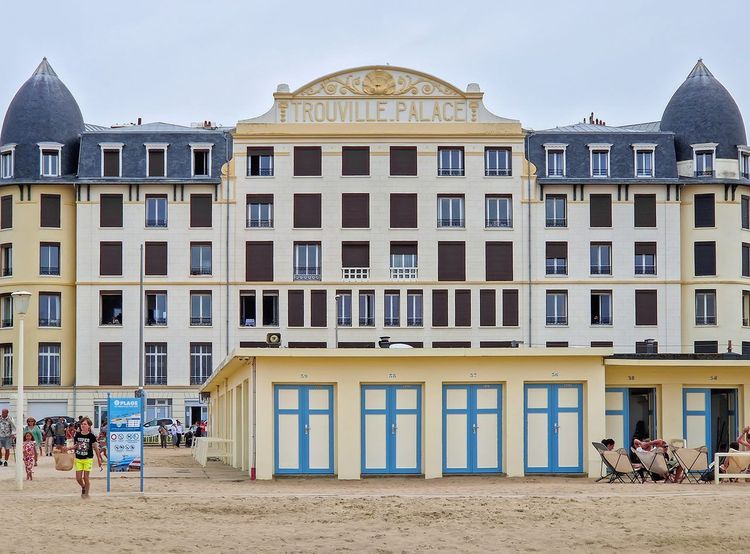
Deauville is just one entry point on a stretch of coastline that deserves to be explored over several days. Just across the Touques, Trouville-sur-Mer has its own beach, more popular and lively than Deauville's, bordered by the fish market and a seafront promenade that is just as pleasant to walk along. The two towns resemble and contrast with each other: Deauville the glamorous, Trouville the fishing port, separated by just a few minutes on foot.
Heading east, about twenty minutes by car, Villers-sur-Mer offers a wider beach and, above all, direct access to the spectacular Falaises des Vaches Noires (14640 Villers-sur-Mer, rated 4.1/5 on Google across 435 reviews), a geological formation rich in Jurassic fossils where erosion regularly reveals ammonites millions of years old. It is an ideal outing with children, combining fossil-hunting at low tide with a picnic at the foot of the cliffs.
Further still, Houlgate retains a more family-friendly, less crowded seaside atmosphere than Deauville at the height of summer, with its Belle Époque villas set back from the sand. Some visitors push on to Cabourg, immortalised by Marcel Proust and its eponymous promenade, to complete this stretch of the Normandy coast often grouped under the name Côte Fleurie.
To plan a multi-day itinerary between these resorts, the article Côte Fleurie: 10 Must-Sees outlines a route that goes beyond Deauville alone, useful if you have a car and more than a day to spend in the area.
Photographing the Beach: Best Viewpoints
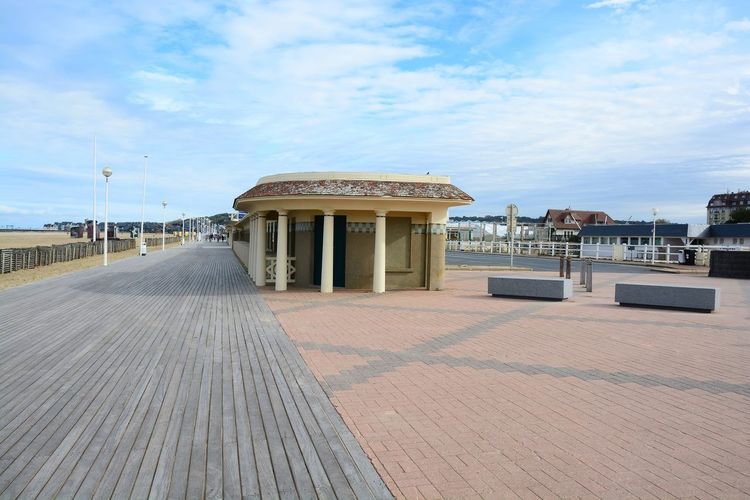
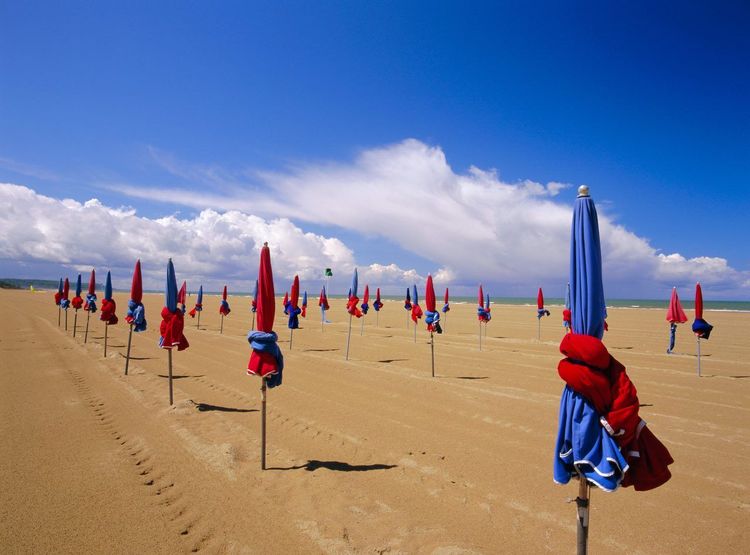
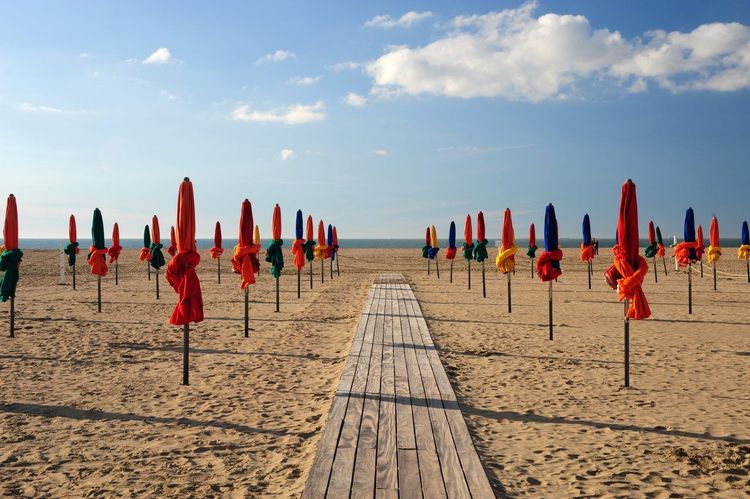
The multicoloured parasols lined up in front of the cabins are the most widely shared image on social media, particularly in late morning when the light is still soft and the sand barely trampled. For a different framing, the sea wall on the Piscine Olympique side offers a sweeping perspective along the full length of the Planches, cabins included, while stepping into the Casino gardens allows you to incorporate the half-timbered facades as a backdrop.
Sunset remains the favourite moment for local photographers, as the raking light colours both the wet sand and the rooftops of the seafront. At low tide, the reflections in the damp sand double the sky and turn the beach into a giant mirror — a spectacular effect in the hour before the sun goes down. To identify these angles without wasting time on site, the map mode in the Ryo app helps you quickly locate each viewpoint mentioned in the audio-guided tour dedicated to the Planches.
Enjoying the Beach on a Budget
Access to the sand and the promenade remains entirely free all year round; only the rental of sun loungers, parasols or individual cabins is charged in season. The public showers and toilets installed along the Planches allow you to rinse off after swimming free of charge — a practical detail that many visitors discover on the spot rather than in advance.
To keep ancillary costs down, bringing your own towel and parasol is the most economical approach, as on-site rentals rise steeply in July and August. A picnic bought at the Place Morny market in the morning works out far cheaper than a terrace lunch facing the sea, without taking anything away from the pleasure of the view. Visiting out of season, in May or September, finally allows you to enjoy the same sand and the same Planches without the inflated high-season prices, while also avoiding the festival crowds.
Planning Your Beach Day: the Checklist
A little preparation is enough to turn a good day into a great one. Before you leave, note the high tide time to choose your swimming window, and check the marine weather forecast — more changeable here than on southern coasts. A windbreaker or light jumper is never superfluous late in the afternoon, even during warm summers, as the breeze picks up as soon as the sun begins to dip.
In terms of kit, pack sun protection (cream, hat, sunglasses), a water bottle, and a towel large enough for two if you are not planning to hire a sun lounger. Families will appreciate arriving early to set up close to the supervised area and the lifeguard post. Finally, a little cash or a bank card remains useful for showers, ice creams and parking, which are still often paid along the seafront.
FAQ
Where exactly is Deauville Beach located?
The beach is located on Boulevard de la Mer, 14800 Deauville, a few minutes' walk from the town centre and the train station. It runs along the entire seafront of the municipality, from the Casino Barrière to the Piscine Olympique.
How do you get to Deauville Beach by train from Paris?
Trains from Paris-Saint-Lazare reach the Deauville - Trouville - Saint-Gatien station in approximately two hours, either direct or with a connection at Lisieux depending on the timetable. From the station, the beach can be reached on foot in fifteen to twenty minutes by walking through the town centre.
Are dogs allowed on Deauville Beach?
Yes, but with time-based restrictions in summer: they are generally banned between 9 a.m. and 7 p.m. from June to September in the central supervised area. Outside this period — early in the morning, in the evening or during the off-season — dogs on leads are welcome without any issue.
What is the best time to visit Deauville Beach?
June to September offers the best swimming conditions. May and early September allow you to enjoy the sand with fewer crowds and lower accommodation prices than at the height of summer.
Where can you park near Deauville Beach?
The Casino car park and the Place Morny car park are the closest to the sand, less than five minutes' walk away. Arriving before 10 a.m. on summer weekends makes finding a space much easier; the park-and-ride car parks a little further out remain cheaper and more available.
How much does it cost to access Deauville Beach?
Access to the sand and the Promenade des Planches is entirely free. Only the rental of sun loungers, parasols and individual cabins is charged, with prices varying by season.
Can you rent Airbnb-style accommodation near the beach?
Yes, there is a wide range of furnished rentals in Deauville, particularly around the town centre and the streets close to the Planches. Prices drop noticeably once the high season ends in early September.
Deauville Beach is as much earned as admired: two kilometres of sand, a century of seaside history and cabins that recount, name by name, the story of cinema. Whether you come for a single day from Paris or for a long weekend between the Planches and the neighbouring beaches of the Côte Fleurie, this stretch of the Normandy coast deserves to be explored well beyond the familiar image of colourful parasols. To extend your visit beyond the sand, Ryo's Deauville audio-guided tour offers a complete exploration of the town, cabins, half-timbered facades and Belle Époque fronts included.