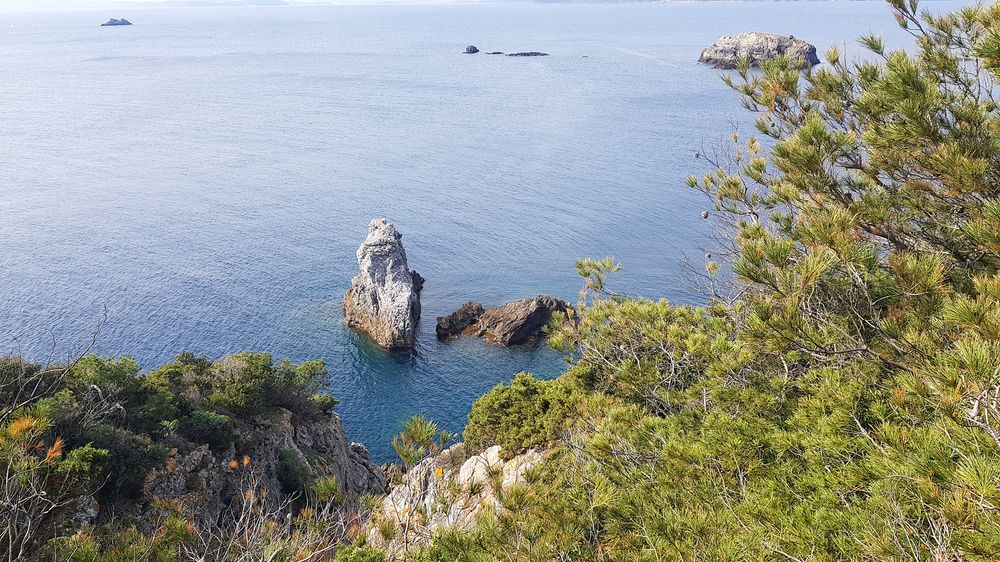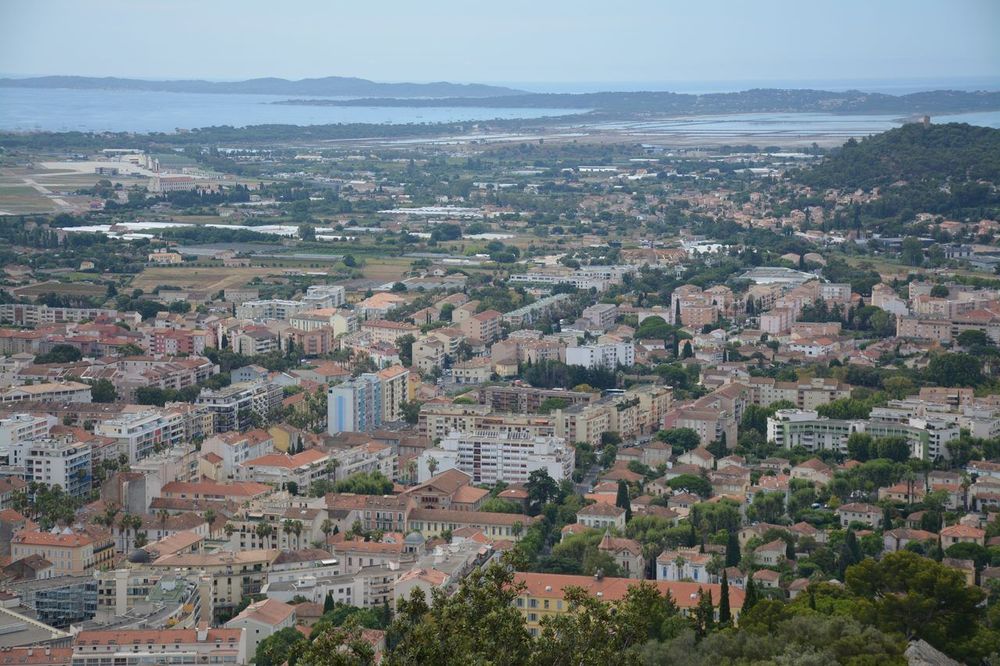
© Shutterstock
 Votre guide Ryo
Visit Hyères Without a Car in 2026: the Complete Guide on Foot, by Bike, and by Boat
Visiting Hyères without a car is no constraint at all — it's actually the best way to discover this city that layers a medieval hill, a modernist villa, and an archipelago where cars simply have no place. The train drops you off a quarter of an hour's walk from the center, Mistral network buses serve the Giens Peninsula all the way to its tip, and from the Tour Fondue, the ferry to Porquerolles crosses in fifteen minutes. In practice, you'll explore Hyères the way locals do: on foot through the cobbled lanes of the old town, by bike along the Salt Road, and by boat to the three islands. This guide covers public transport, the walk up to the Villa Noailles and the castle ruins, the crossings to Porquerolles, Port-Cros, and Le Levant, a ready-to-follow one-day itinerary, and the villages reachable by bus. At every step, the Ryo audio guide for Hyères takes over from the paper map to tell you what the facades don't say.
How to Get to Hyères Without a Car (Train, Bus, Plane)
Hyères is very easy to reach without a car, as long as you know the right entry points. The Hyères train station is a terminus, connected by direct trains to Toulon in about twenty minutes, with connections onward to Marseille-Saint-Charles. The building is a fifteen-minute walk from the historic center, or just a few bus stops away.
For long-distance journeys, Toulon station remains the main hub for the Var: TGV from Paris, Lyon, or Marseille, then a regional TER train to Hyères. This is often the fastest option when arriving from northern France. One tip: check that your TER connection isn't too tight, as trains toward Hyères run less frequently in the evening.
By air, Toulon-Hyères Airport (Boulevard de la Marine du Levant, 83400 Hyères, rated 4/5 on Google based on 842 reviews), also known as Le Palyvestre, is just a few kilometers from the city center, right next to the urban area. A Mistral network line connects the terminal to the center and the train station, making it the most direct gateway from Paris, Corsica, or certain European capitals, without going through Toulon.
From Marseille, allow approximately 1h15 to 1h30 by regional TER train, with or without a change in Toulon depending on the timetable; from Nice, the journey also goes through Toulon. In summer, some weekend trains can be very crowded: booking your seat or leaving early in the morning will save you from standing the whole way.
Finally, Zou! coaches, the Région Sud regional network, fill the gaps for those coming from Aix-en-Provence, Marseille, or nearby towns along the Var coast, often at lower fares than the equivalent train journey. You can very easily combine a Zou! coach with an urban bus without ever touching a steering wheel.
Getting Around Hyères Without a Car: Bus, Bike, and Walking
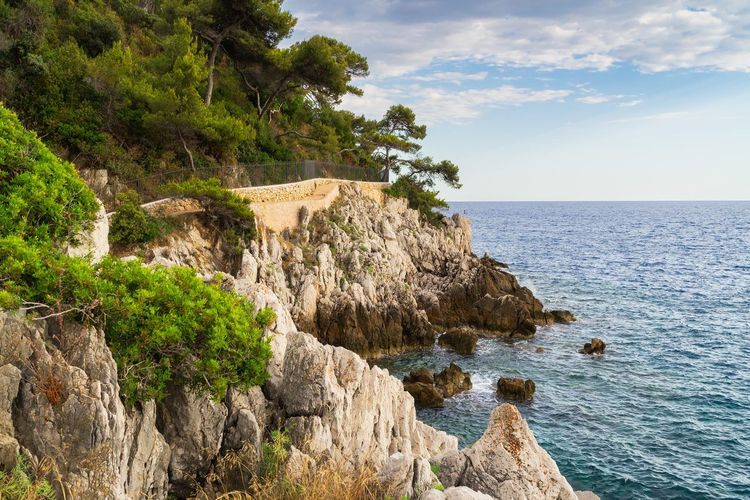
Once you've arrived, the question is no longer whether you can manage without a car, but which mode to start with. Hyères concentrates its heritage within a compact area: walking is more than enough for the old town and the Castel hill. For the Giens Peninsula, the beaches, and the ferry to the islands, the bus takes over.
Mistral Network, TLV-TVM, and Zou! Coaches
The Mistral network is the backbone of public transport in Hyères. Operated since May 2023 by RD TPM, a subsidiary of RATP Dev, on behalf of the Toulon Provence Méditerranée Metropolis, it connects the train station, the center, Hyères-Plage, l'Ayguade, and the Giens Peninsula all the way to the Tour Fondue. In July and August, the network's summer lines increase service to the beaches when ridership peaks. Real-time departures can be checked on the network's app and website — a useful habit on Sundays or off-season, when services run less frequently.
Don't confuse this with TLV-TVM: this is not a bus but the maritime company that operates ferry shuttles to the islands — from the Tour Fondue to Porquerolles and from the port of Hyères to Port-Cros and Le Levant. The two networks work in tandem: a Mistral bus drops you at the pier, and the boat does the rest.
For journeys to nearby towns, regional Zou! coaches take over, with some Var lines operated by carriers such as Keolis Sodetrav. In practice, you'll often combine a bus in the morning to reach a starting point, then walk for the rest of the day.
Taxis, Bike-Share, and Bike Rental

If bus schedules don't match your plans, Radio Hyérois taxis cover the urban area as well as routes to the airport, the train station, and the Tour Fondue. They're a practical backup when you have luggage or when the last bus has already left.
For more active outings, bike rental has expanded considerably: several operators offer standard and electric-assist bikes by the day or half-day, ideal for reaching the Salt Road or Giens without relying on timetables. The flat coastal terrain is perfectly suited for cycling, unlike the old town, where the slopes and steps make bikes impractical. Walking remains the rule in the historic center, while cycling becomes the right choice as soon as you head toward the sea.
In the center, the Ryo audio guide replaces the paper map to great effect: you follow a narrated route at your own pace from one monument to the next, without ever looking for a parking space.
The Old Town of Hyères on Foot
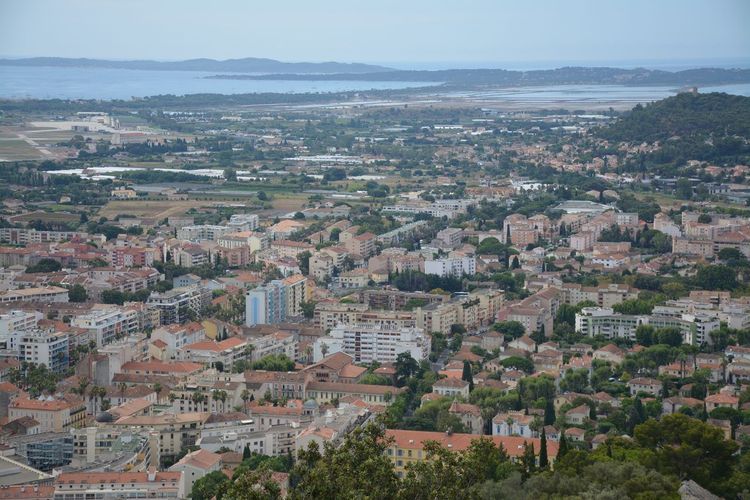
The old town is explored exclusively on foot: its sloping alleyways and staircases make cars useless — even impossible on certain stretches. Compact and gently rising toward the top of the Castel, every street here tells a chapter of the city's medieval history.
Collégiale Saint-Paul and Tour des Templiers
At the top of the old town, the Collégiale Saint-Paul is recognizable by its wide exterior staircase climbing between ochre facades. The building, Romanesque in the 12th century and extended with a Gothic nave in the 14th, houses one of the most significant collections of ex-votos in France: around 430 small painted panels dating from the 17th to the 20th century, left as thanks to the Virgin or the saints for a healing, a near-miss, or a survived shipwreck. Take time to look at them one by one: they offer a window into the everyday lives of the Hyères residents of the past.
On the way back down, the Tour des Templiers rises with its square silhouette on Place Massillon (Place Massillon, 83400 Hyères, rated 4.5/5 on Google based on 890 reviews). Also known as the Chapelle Saint-Blaise, it is the last remaining vestige of the commandery founded by the Knights Templar in the 12th century. After the dissolution of the order in 1312, it passed to the Knights of Malta, then to the city in 1673. Restored between 1985 and 1992, it now hosts temporary exhibitions, and its terrace offers a close-up view over the tiled rooftops. Between the collegiate church and the tower, allow about twenty minutes of walking, stops included.
Place Massillon, La Banque Museum, and Picturesque Alleyways
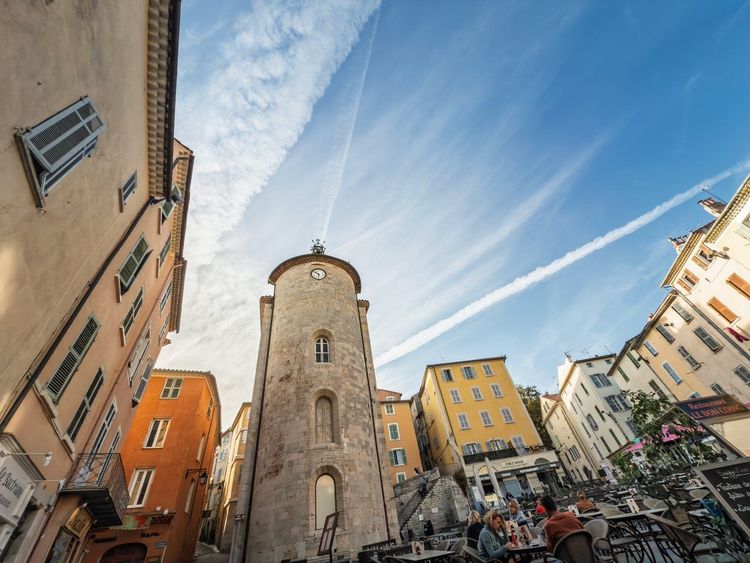
At the foot of the tower, Place Massillon pulses with neighborhood life: shaded terraces, food shops, and market stalls spilling out onto the cobblestones. This is where most visits begin or end, and it's the easiest landmark for reorienting yourself in the maze. On Saturday mornings, the large Îles d'Or market animates the city center — a good reason to time your stroll for that day.
A few minutes' walk away, in the lower town, La Banque, Museum of Cultures and Landscapes occupies the former branch of the Banque de France, a building remodeled in the 1920s with Art Deco accents. Inaugurated in November 2021, the museum draws on more than 8,000 works and objects (fine arts, archaeology, natural sciences) and traces the evolution of the Hyères landscape, from the palm trees of the resort era to the islands. It's the ideal stop on a rainy afternoon or during a heatwave.
Around Place Massillon, lanes such as Rue Rabaton or Rue Paradis are worth wandering without a fixed itinerary: this is where the oldest facades and carved doorways hide. Rue Massillon, pedestrianized and lined with shops, runs straight down from the square to the gate of the same name, one of the old entrances to the medieval fortifications. Look up: the carved lintels, Provençal cornices under the rooflines, and small statue niches tell several centuries of architecture across just a few hundred meters. To make sure you miss nothing without having to improvise, the Ryo audio guide for Hyères leads you through these alleyways with audio commentary that covers, among other things, the history of the Knights Templar and the origin of the nickname "Hyères-les-Palmiers."
Villa Noailles, Parc Saint-Bernard, and the Château d'Hyères
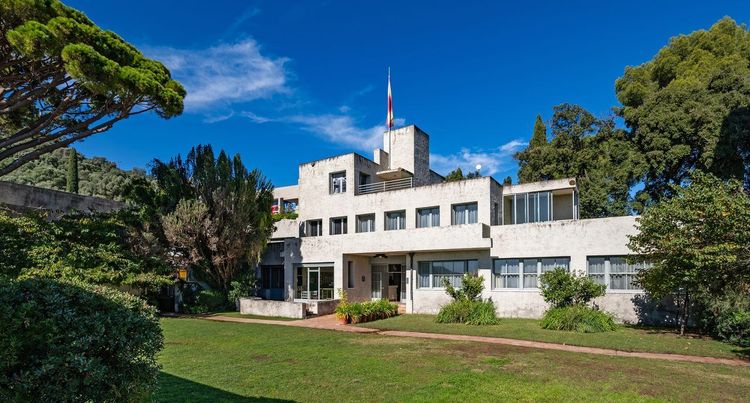
Above the old town, the Castel Sainte-Claire hill brings together three sites that can be visited in sequence, along a single uphill route. Allow a good half-day for all of them, photo stops included. The hill takes its name from the Castel Sainte-Claire, the former home where American novelist Edith Wharton spent her winters between the two world wars; its terraced gardens, now open to the public, naturally extend the walk and offer a shaded rest stop before tackling the final climb.
Villa Noailles, a Jewel of Art Deco Architecture
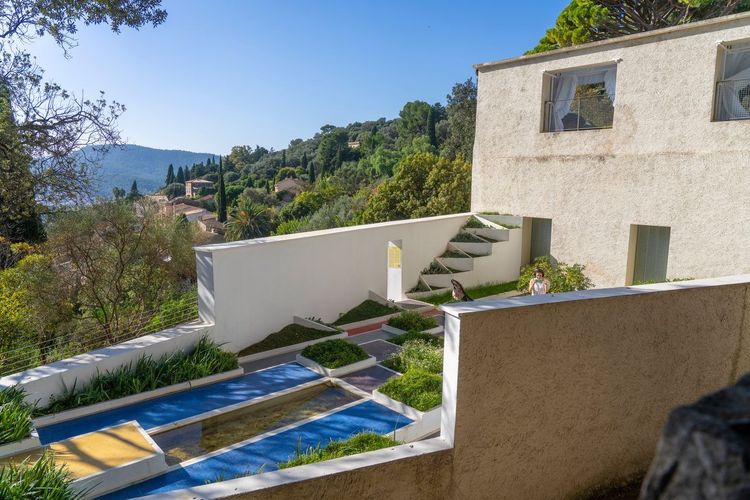
The Villa Noailles is probably the most surprising site in Hyères for anyone not expecting to encounter 1920s modernism at the top of a Provençal hill. Built from 1923 onward by Robert Mallet-Stevens for Charles and Marie-Laure de Noailles, great patrons of the avant-garde, it blends geometric volumes, a covered swimming pool, and a triangular cubist garden designed by Gabriel Guevrekian. The villa is now an arts center hosting the international festival of fashion, photography, and accessories, an annual event that draws audiences well beyond the Var. Good news for your budget: admission to the exhibitions is free, and the original rooms — including the indoor pool and gymnasium — can be visited alongside the temporary shows. Simply check the opening days before heading up, as hours vary by season and festival schedule.
The climb from the center is entirely on foot, via ramps and staircases that wind upward for about twenty minutes through agaves and stone pines. It's steep in places, never technical, and the panorama that opens up over the bay makes the effort worthwhile. This ascent is one of the highlights of the Ryo audio guide: the terraced gardens are narrated step by step along the way.
Parc Saint-Bernard and the View from the Château d'Hyères
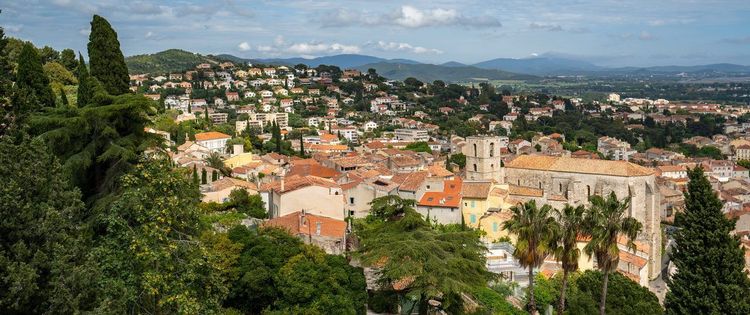
Just below the villa, Parc Saint-Bernard (Montée de Noailles, 83400 Hyères, rated 4.7/5 on Google based on 55 reviews) spreads across Mediterranean terraces planted with species acclimatized over more than a century: giant agaves, cacti, palm trees, irises, and cistus in spring. Benches await at every level, and several sculptures punctuate the walk, in the avant-garde spirit instilled by the Noailles.
At the very top, the ruins of the Château d'Hyères offer the most unobstructed view in the city: the old town below, the bay, the Giens Peninsula, and on a clear day, the outline of Porquerolles. Built in the 11th century by the lords of Fos, the fortress held out for five months against the troops of Henri IV in 1596; its dismantling, ordered as punishment, was finally carried out in 1620 under Louis XIII. What remains are sections of ramparts and a keep, freely accessible, perfect for a sunset picnic.
A One-Day Walking Itinerary in Hyères Without a Car
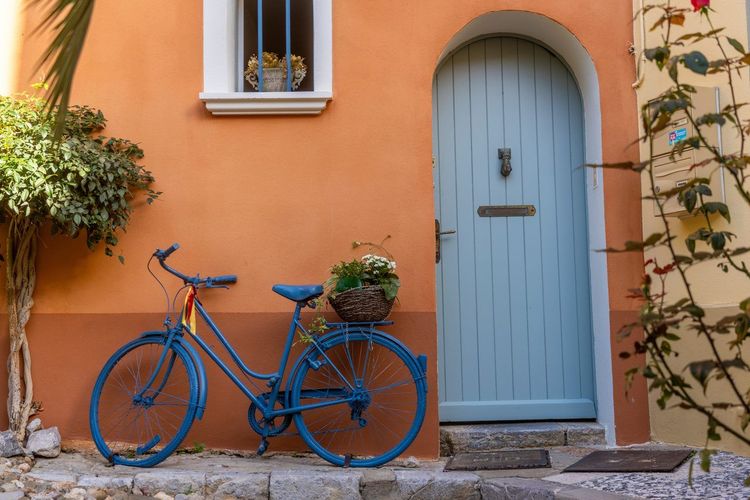
Have just one day, or wondering what to do in Hyères today without taking a single bus? Here is a walking tour that covers the essential highlights of the center, over roughly 5 kilometers with some elevation gain.
In the morning, start from Place Clemenceau, the gateway to the old town, and pass through the Porte Massillon to reach the square of the same name. Grab a coffee on a terrace, visit the Tour des Templiers, then climb through the alleyways to the Collégiale Saint-Paul. Around 11 a.m., continue upward to the Villa Noailles, timing your arrival for opening to enjoy the spaces before the crowds arrive.
At midday, have a picnic in Parc Saint-Bernard or head back down for lunch in the old town, where there is no shortage of small restaurants around Place Massillon.
In the afternoon, climb to the castle ruins for the panoramic view, then make your way down to the lower town: Avenue Gambetta with its palm trees evokes the era when Hyères welcomed English winter visitors and the European upper class in the 19th century. If your legs are still willing, the Jardin Olbius Riquier, a public park of several hectares with a tropical greenhouse, a small zoo, and a pond, makes for a peaceful end to the day, about a twenty-minute walk from the center. In the heat, swap it for the La Banque museum.
This program works entirely without any vehicle. To follow it with stories along the way, the Ryo audio guide for Hyères covers a large part of these stops as short audios to listen to on-site, with your smartphone acting as your guide.
The Hyères Islands Without a Car: Porquerolles, Port-Cros, and Le Levant
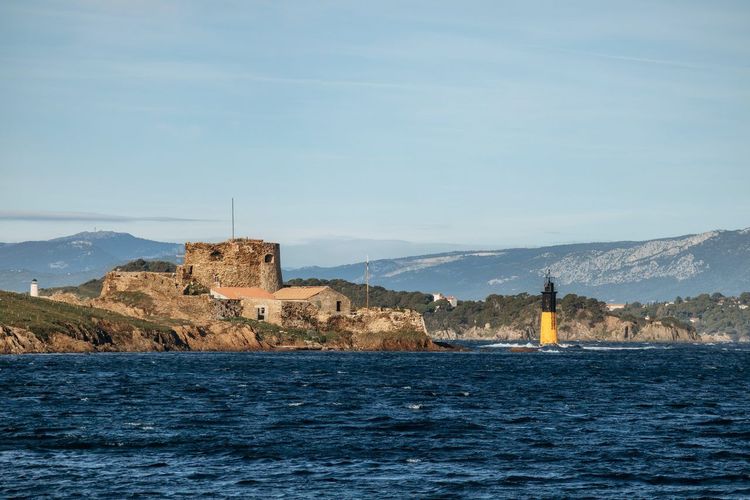
The three Hyères islands share a rarely highlighted feature: you simply cannot drive a car on any of them. On Porquerolles, only a handful of service vehicles are permitted. On Port-Cros (83400 Port-Cros, rated 4.6/5 on Google based on 260 reviews), the heart of the national park created in 1963, even bicycles are banned. On Le Levant, most of the island is military territory. Visiting the Hyères islands without a car is therefore not a constraint to work around — it's the only way to explore them, and it's also what has preserved their landscapes.
Boarding for the Islands from the Tour Fondue or the Port of Hyères
Crossings to Porquerolles depart from the Tour Fondue, at the southern tip of the Giens Peninsula, reachable by Mistral bus from the city center. TLV-TVM maritime shuttles operate year-round from there, with a crossing of just 15 to 20 minutes. Expect around thirty euros for an adult return ticket, with reduced fares for children.
For Port-Cros and Le Levant, departures are from the port of Hyères (about one hour's crossing to Port-Cros), or from Le Lavandou with another operator. Sailings are less frequent, especially off-season. In July and August, book your tickets several days in advance: morning slots often sell out.
Porquerolles, Port-Cros, and Le Levant: What to See Without a Car
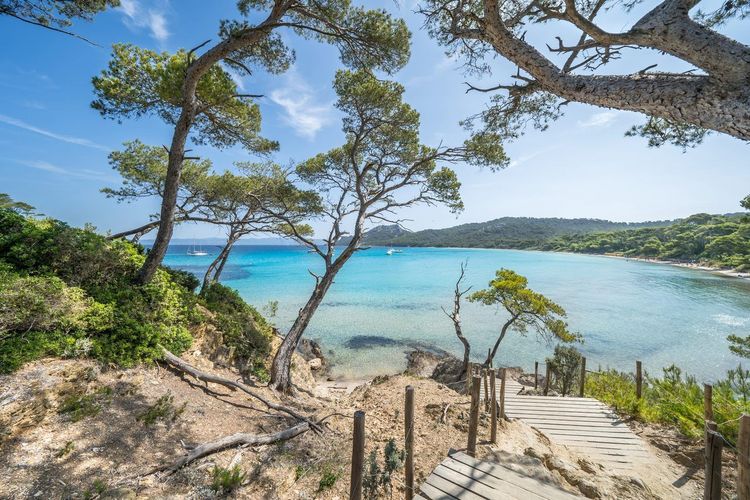
Porquerolles is explored on foot or by bike, rented at the village as you step off the boat. Fort Sainte-Agathe, built in the 16th century above the harbor, hosts the national park's seasonal exhibitions, a true museum of Porquerolles covering the island's history and natural heritage. Beyond the village, Plage d'Argent is a fifteen-minute bike ride away, and Plage Notre-Dame is about half an hour, along flat, shaded tracks. Further south, the Porquerolles lighthouse, lit in 1837, is a forty-minute walk away and overlooks the cliffs of the much wilder southern coast. The island was largely purchased by the French state in 1971 and also houses the Mediterranean National Botanical Conservatory, whose orchards of heritage varieties (fig trees, olive trees, mulberry trees) can be explored freely along the paths. You can also push on to the Villa Carmignac, a contemporary art foundation nestled among the vineyards, by reservation.
Port-Cros, by contrast, can only be explored on foot, along marked trails that wind through a preserved Mediterranean forest down to the shore. The underwater trail, followed with fins, mask, and snorkel from Plage de la Palud, lets you observe posidonia seagrass and fish without a boat or heavy equipment. A full day is needed to make the most of it. The plant trail, connecting the village to Plage de la Palud in under an hour, remains the most accessible option if you're traveling with children.
Le Levant, finally, is split between a military zone closed to the public over most of its area and the village of Héliopolis, known for its naturist tradition since the 1930s. It is the least visited of the three. Whichever island you choose, a few habits will make the day easier. Bring plenty of water, a hat, and sturdy shoes: the paths are rocky and shade disappears as soon as you leave the forest. In summer, fire risk may lead to the closure of certain areas — information posted at the pier on the morning itself. And keep an eye on the last boat's departure time: missing it would mean finding accommodation on the island, often fully booked and expensive in high season. To plan your crossing in detail, our article on visiting Porquerolles covers how to organize your day on the island.
L'Almanarre and the Salt Road on Foot or by Bike
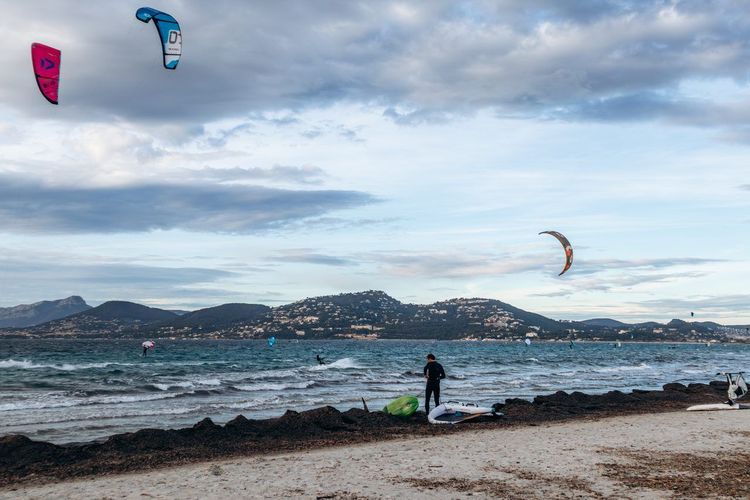
To the west of the city, l'Almanarre beach (Route du Sel, 83400 Hyères, rated 4.5/5 on Google based on 3,632 reviews) stretches as a long, wind-exposed strip of sand, making it one of the most renowned kitesurfing and windsurfing spots on the Mediterranean. Just behind the beach, the Olbia archaeological site preserves the remains of a Greek trading post founded around the 4th century BCE, the only Greek town of this type still visible in France, open to visitors during the season.
It is also the starting point of the Salt Road, which runs for 4 kilometers along the western tombolo all the way to the Giens Peninsula, between the sea and the Pesquiers salt marshes.
Every year, the road is closed to cars from November to April to protect it from storm surges: this is the best time to walk or cycle along it with no traffic. In summer it reopens to vehicles, but you can still ride alongside it by bike. From the observation point halfway along, you may spot flamingos, egrets, and herons depending on the season. The contrast is striking: breaking waves on one side, flat rosy waters on the other. The Pesquiers salt marshes, protected and managed alongside the Port-Cros National Park, are also the subject of guided nature tours at certain times of year: check with the tourist office if you want to understand how salt was harvested here until the early 1990s. From the city center, the round trip by bike takes about two hours at a leisurely pace.
Bring water and sun protection, as shade is scarce. Off-season, the low-angle light of late afternoon turns the salt marshes into a gradient of pink and ochre that is worth the trip in itself.
Giens, Beaches, and Villages Reachable Without a Car Around Hyères
Beyond the city center and the islands, several nearby destinations remain accessible without a car, provided you plan ahead for bus frequencies, which are more spread out off-season.
The Giens Peninsula by Bus
The Giens Peninsula is reachable by Mistral bus from the center of Hyères, via the eastern tombolo and la Capte, all the way to the village of Giens perched on its headland and to the Tour Fondue. Allow half a day to take in the coves on the northern side, the coastal path on the southern side, and the head-on view of the Hyères Islands. The village square, around the tower-belfry, is worth a stop, as is the small port of Le Niel below. Literature enthusiasts may want to make a detour to the Giens cemetery, where poet Saint-John Perse, 1960 Nobel Prize laureate in literature, who spent his final years on the peninsula, is buried. At the tip, the Tour Fondue itself is a small 17th-century fort guarding the entrance to the Porquerolles channel: take a few minutes to walk around it before boarding.
Bus frequencies thin out considerably outside the summer period: check the time of the last evening return before setting off, rather than counting on an unplanned connection.
Beaches and Villages Accessible Without a Car Around Hyères
For beaches reachable by bus, Hyères-Plage and la Capte are about fifteen minutes from the center, with fine sand and shallow water that families enjoy. A little further east, l'Ayguade beach (83400 Hyères, rated 4.1/5 on Google based on 2,034 reviews) draws a more local crowd, less busy even at the height of summer.
Among the charming villages around Hyères that lend themselves to a car-free excursion, La Londe-les-Maures is reachable by Zou! coach, while Carqueiranne and Le Pradet, toward Toulon, are served by the Mistral network. All retain a deliberately unhurried seaside pace. To plan these excursions, our article on what to see around Hyères covers the highlights of each.
How Much Time to Allow and Where to Stay to Visit Hyères Without a Car
Three days are enough for the essentials: one day for the old town and the Castel hill, one for Porquerolles, and a last one for l'Almanarre and the Giens Peninsula. A week in Hyères lets you add Port-Cros, one or two nearby villages, and above all, no need to rush — which matters twice as much when every journey depends on a bus or boat timetable.
In practical terms, a three-day car-free stay can be organized as follows. On the first day, stay in the center: old town in the morning, Villa Noailles and the castle in the afternoon, dinner on Place Massillon. On the second day, take an early morning bus to the Tour Fondue, cross to Porquerolles, cycle to the beaches and the lighthouse, and return on the last afternoon boat. On the third day, rent a bike in town, ride the Salt Road, visit the Olbia site, and swim at l'Almanarre or la Capte. If the weather turns, simply swap the days around: the historic center and the La Banque museum suit a grey day perfectly, while the island crossing deserves calm seas.
For accommodation, the key is to stay in the city center or within easy reach of a well-served bus stop. A hotel in the old town or near Place Massillon puts everything within walking distance: the train station, restaurants, and buses to the Tour Fondue. Conversely, accommodation on the Giens Peninsula simplifies access to the islands but complicates evenings in town.
For a short break, what to do in Hyères this weekend often comes down to the old town on Saturday and Porquerolles on Sunday — a format that works perfectly without a car. For a single-day visit, our article on visiting Hyères in 1 day offers a tighter itinerary focused on the historic center.
Budget and Tips for Getting Around Hyères Without a Car
Getting around Hyères without a car costs considerably less than parking one there. A single Mistral bus ticket comes to under 2 euros, and day passes or multi-journey carnet cards reduce the cost further once you start chaining trips. For journeys to Toulon or nearby villages, always compare the Zou! coach fare with the TER train price before deciding.
For the islands, budget for the largest outlay: around thirty euros return for Porquerolles, slightly more for Port-Cros, with reductions for children and certain family passes. Add fifteen to twenty euros for a full-day bike rental on the island. By comparison, a day's parking in the city center or at the Tour Fondue car park in peak summer can quickly exceed all of that.
On the sightseeing side, many sites are free to access: the old town alleyways, the castle ruins, Parc Saint-Bernard, Jardin Olbius Riquier, and the Salt Road. And once you're out and about, the Ryo audio guide is followed entirely on foot, at your own pace, with no guide to book in advance and no timetable to stick to. One last tip: group sites by hill or by peninsula rather than following a paper guide in order — you'll cut down on back-and-forth bus journeys considerably.
One more often-forgotten expense: meals. On the islands, restaurant prices climb sharply in high season, and a picnic bought the evening before at the market or from a grocery shop in the city center will save you a meaningful amount, while giving you the freedom to eat by the sea rather than on a crowded terrace. The same logic applies to water: a refillable bottle filled before boarding spares you the overpriced bottles sold at the harbor.

FAQ
How Can I Get Around Hyères?
The historic center and the Castel hill are best explored on foot. For everything else, Mistral network buses, Zou! regional coaches, and Radio Hyérois taxis cover the Giens Peninsula, the beaches, and access to the ferry terminals. Renting a bike is a great addition for the Salt Road.
How Do I Visit the Old Town of Hyères on Foot?
Starting from Place Massillon, visit the Tour des Templiers, then head up toward the Collégiale Saint-Paul before winding back down through the alleyways. Allow one to two hours for a first visit, or half a day if you continue toward the Villa Noailles and the castle.
How Do I Reach the Hyères Islands Without a Car?
Take a Mistral bus to the Tour Fondue, from where TLV-TVM shuttles reach Porquerolles in 15 to 20 minutes. For Port-Cros and Le Levant, boats depart from the port of Hyères (about one hour to Port-Cros) or from Le Lavandou.
How Much Time Do I Need to Visit Hyères Without a Car?
Three days are enough to see the old town, the Castel hill, and one island. A week gives you time to add Port-Cros, the Salt Road, and a nearby village without rushing from one journey to the next.
What Is the Best Way to Get Around Hyères?
No single mode of transport covers everything: walking for the center, the Mistral bus for the peninsula and beaches, cycling for the Salt Road, and the ferry for the islands — together they cover all the essentials without ever needing a car.
Can You Visit Porquerolles in a Day Without a Car?
Yes, and it's actually the most common approach: a morning shuttle from the Tour Fondue, a full day cycling or walking on the island, then a return in the late afternoon. Just make sure to check the time of the last boat.
Where Should I Stay in Hyères to Visit Without a Car?
Choose the city center or the area around Place Massillon, within walking distance of the old town and close to a frequent bus stop toward the train station and the Tour Fondue. An isolated accommodation makes evening connections much harder.
Visiting Hyères without a car is ultimately not a compromise but a travel format in its own right — one that forces you to slow down, look up at the facades rather than at a GPS, and let the boat or the bus set the pace of the day. Between the old town, the Castel hill, and the archipelago, the city offers enough contrasts to fill several days without ever getting behind the wheel.
To keep track of the local history, the Ryo audio guide for Hyères is the best walking companion: a smartphone, a good pair of shoes, and everything else takes care of itself.
À lire également