© Shutterstock
 Votre guide Ryo
Le Panier in Marseille: Complete Guide to the Oldest Neighborhood in 2026
Some neighborhoods are visited, and others are inhabited by the gaze, even in passing. Le Panier, in Marseille, belongs to the second category: this maze of ochre and blue lanes, perched on the butte Saint-Laurent above the Vieux Port, is the oldest quarter in the city, founded long before the first tourist coaches dropped off their visitors here. The Ryo audio guide for Marseille actually starts just a few minutes from its lanes, making it a natural starting point for exploring the Phocaean city on foot.
Here, a mural several stories high covers an entire city block, a 17th-century former hospice houses a museum of African and Oceanic art that is sometimes free, and a passageway so narrow that two people can barely pass has long served as a discreet shortcut for locals. This guide brings together everything you need to know to find your way around in 2026: history, must-see sites, good addresses, a recommended itinerary and practical tips for a successful visit.
Where Le Panier Is and How to Get There
Le Panier occupies the butte Saint-Laurent, just north of the Vieux Port, between the Hôtel de Ville and the Joliette district. Administratively, it belongs to the 2nd arrondissement of Marseille, which answers one of the most frequently asked questions about this area. Its surface spans just a few hectares: you can walk around it in half an hour, but it takes a full day to truly take it all in.
From the Vieux Port, allow five to ten minutes on foot, heading up via rue de la Prison or the Montée des Accoules. The Vieux-Port and Joliette metro stations flank the neighborhood, and several bus lines run along its perimeter. By car, it is best to park before entering the maze: the streets are narrow, often pedestrian-only, and ill-suited to through traffic. The tourist train that winds through the Vieux Port also drops passengers off a few minutes from the Vieille Charité, a comfortable option if the heat or tired legs make the uphill walk unappealing.
For public transport, the Régie des transports métropolitains serves the edges of the neighborhood well: metro line 1 stops at Vieux-Port and Colbert, line 2 at Joliette, and the tram runs along rue de la République just steps from the first lanes. From Saint-Charles station, allow about fifteen minutes on foot heading down toward the port, or two metro stops if you want to save your legs before the climb. Cyclists will find several bike-share stations along the quay, but it is best to leave the bike behind once inside the maze: stairs and cobblestones make walking the only real option.
Two Thousand Years of History between the Vieux Port and the Hills
The history of Le Panier begins even before that of Marseille in the strict sense: it is on this hill that the Phocaean colonists are said to have set foot around 600 BCE, making this area the original nucleus of the oldest city in France. For centuries, the neighborhood remained a place of fishermen and craftsmen, gathered around the ancient port, before becoming from the 19th century onward a gateway for successive waves of immigration: Italians from Piedmont and Liguria, Corsicans, Armenians, then Comorians and populations from North Africa after decolonization. This layering of communities forged a working-class identity that remains legible today in the shops, the cooking smells drifting from windows and the languages mingling on place de Lenche. This working-class, cosmopolitan memory can still be read in street names and shops — oriental grocery stores, Corsican wine merchants, artists' studios that moved in for the character of the place: Le Panier has never stopped being an arrival neighborhood, and that is undoubtedly what still gives it today its atmosphere halfway between a Provençal village and a world port.
The origin of the name itself remains debated: some trace it to an old inn bearing the sign of a basket (panier), others to a term referring to the fishing baskets stored on the nearby port. The name eventually came to designate the entire hill, even though originally it referred only to a specific street.
The most brutal turning point in this history came in January 1943. On orders from the German occupation authorities, the part of the old neighborhood closest to the port — deemed too conducive to resistance activity and black-market trade — was evacuated within hours and then dynamited. Nearly 1,500 buildings disappeared and around 20,000 inhabitants were displaced overnight, some rounded up in the process and deported to the camps. Le Panier as we visit it today is therefore not a stage set frozen since antiquity: it is an urban fabric rebuilt in fragments, where preserved medieval blocks coexist with more recent buildings erected on the rubble.
In the decades that followed, the neighborhood went through a period of decline, before a rehabilitation movement got underway in the 1980s, driven in particular by the restoration of the Vieille Charité. Artists and workshops moved into still-affordable rents, followed from the 2000s onward by a more pronounced gentrification that transformed part of the lanes into a tourist showcase, without entirely erasing the working-class neighborhood life that persists in the inner courtyards. To extend this immersion in the city's past, the Ryo guide to the Musée d'Histoire de Marseille, a stone's throw from the Vieux Port, usefully complements a visit to Le Panier with collections spanning more than 26 centuries of occupation of the site.
The Must-See Highlights in One Visit
Le Panier is best explored lane by lane, but a few fixed points structure the walk and deserve a longer stop.
Arriving from the Vieux Port, the natural first stop is Place de Lenche, an amphitheater of café terraces said to occupy the site of the ancient Greek agora. Shaded by plane trees, it has served for decades as an informal meeting point for the neighborhood's pétanque players. Sip a coffee while watching the impromptu games before heading up toward the heart of Le Panier.
Just behind it, the Montée des Accoules (Montée des Accoules, 13002 Marseille) climbs by steps toward the bell tower of the same name, one of the few surviving remnants of the former church of Saint-Laurent-des-Accoules, demolished during the Revolution. From the small square above the staircase, the view plunges over the neighborhood's tiled rooftops and the Vieux Port below: one of the most photographed perspectives in Le Panier, especially at the end of the day when the light grazes the facades.
Head back south to reach Fort Saint-Jean, a fortified site dating back to the Middle Ages that Louis XIV had rebuilt in the 17th century to control the entrance to the Vieux Port. It now houses part of the Mucem's collections, to which it is connected by a pedestrian footbridge open throughout the day. Access to the gardens and ramparts is free, making it a welcome break between two cobbled lanes. The Ryo guide to the Mucem details opening hours and exhibitions if you plan to spend half a day there.
At the other end of the neighborhood, the imposing Cathédrale de la Major strikes with its dimensions and its stripes of green and white stone, an unabashed blend of Romano-Byzantine styles completed in the late 19th century. It dominates the esplanade separating Le Panier from the môle J4 and the cruise terminal, a striking contrast between ancient stone and modern ocean liners.
Not far away, the Hôtel-Dieu, a former hospital founded in the Middle Ages and rebuilt in the 18th century, was converted into a luxury hotel in the early 2010s. Its classical facade and rooftop terrace, open to non-residents for a drink, offer a rare vantage point over the rooftops of Le Panier.
For a more intimate glimpse of the working-class neighborhood, slip into the Passage de Lorette (Passage de Lorette, 13002 Marseille), nicknamed locally le trou du chat — a passageway so narrow that two people can barely pass each other, typical of the shortcuts that once allowed residents to slip past checkpoints. Laundry strung from window to window and the sound of bells echoing between the walls compose a scene that has changed little in a century.
Finally, Place des Treize-Coins, at the intersection of several streets and alleys according to local legend, remains one of the neighborhood's informal meeting points, where bistro tables spill onto the cobblestones as soon as the weather turns fine. Allow an hour and a half to string these seven stops together at the unhurried pace that suits Le Panier, two hours if you multiply the coffee breaks.
The Vieille Charité: A 17th-Century Masterpiece
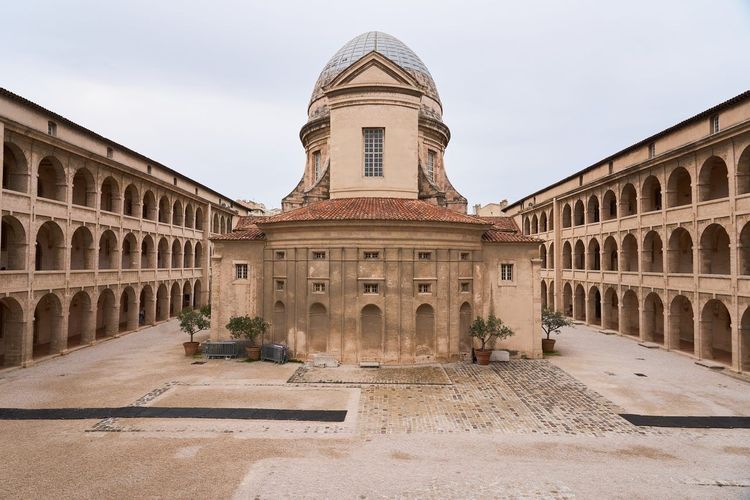
If a single monument were to sum up Le Panier, it would be the Vieille Charité. Commissioned in the mid-17th century to house — and often confine — beggars and vagrants, the building was entrusted to Marseille architect and sculptor Pierre Puget, whose plans were approved around 1670: the construction, spread over the years 1671 to 1749, takes the form of a vast quadrilateral of pink stone arranged around a courtyard with three floors of arcaded galleries. At the center, an oval chapel crowned by a dome, completed nearly a century later, stands out by its baroque elegance from the building's charitable — and sometimes carceral — purpose.
The hospice changed function several times over the centuries: barracks, shelter for populations displaced by the 1943 bombings, then social housing for the neighborhood's most modest families until the 1960s. Threatened with demolition, it was saved by a mobilization of residents and architects, then restored from 1986 onward to become the cultural center visited today.
The courtyard is freely accessible on most days, allowing you to admire the architecture at no cost even without visiting the museums it houses. Inside, the Musée d'Archéologie Méditerranéenne and the Musée d'Arts Africains, Océaniens et Amérindiens display collections assembled since the 19th century, ranging from Egyptian artifacts to West African masks. The Musée d'Archéologie Méditerranéenne holds one of the most important collections of Egyptian antiquities in France after the Louvre, inherited from the cabinets of curiosities assembled by Marseille scholars in the 19th century. Allow a good hour for the collections, about fifteen minutes for the courtyard and chapel alone. The chapel, with its unusual oval volumes for Provençal baroque, photographs particularly well in late morning, when the light comes through the central oculus. A café set up under the arcades provides a welcome shaded break, much sought after on summer afternoons when the neighborhood's cobblestones heat up quickly.
Rue du Panier and the Lanes That Tell the City's Story
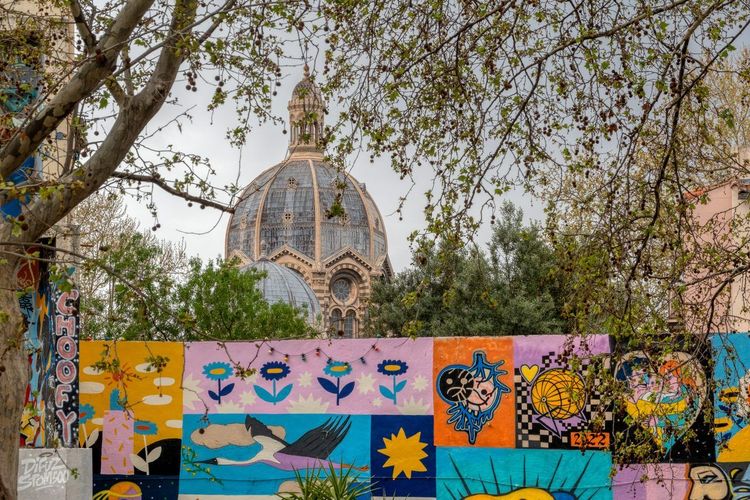
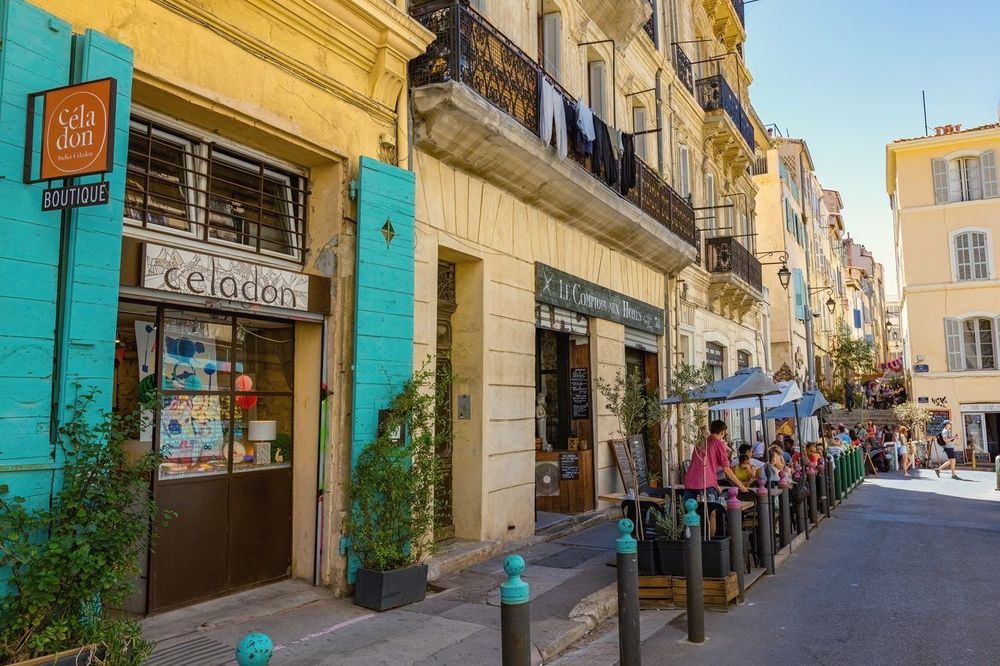
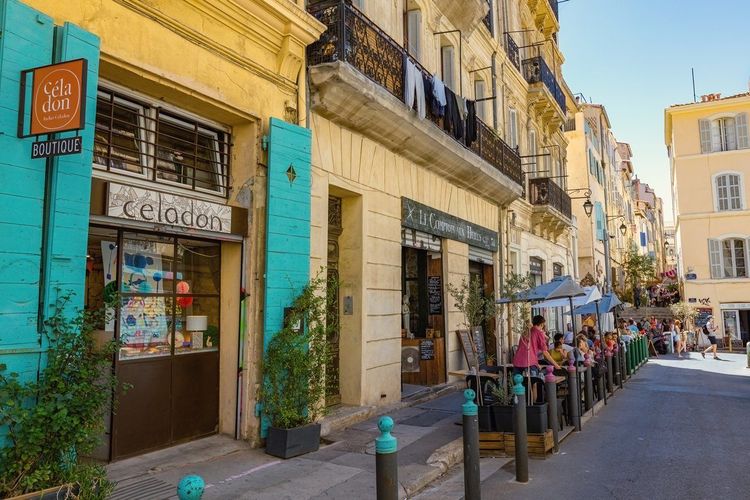
Beyond the monuments, it is the very texture of the streets that makes Le Panier's reputation. Rue du Panier itself, with its facades painted in ochre, pink and faded blue, sums up the neighborhood's aesthetic: laundry drying from one balcony to the next, pots of geraniums on the sills, cats dozing on the steps.
Around it, a network of alleys bears names that tell their own story: rue du Refuge, rue des Muettes, rue du Petit Puits. Some are less than three meters wide and open without warning onto a small square adorned with a fountain or a potted olive tree. You will encounter artists' studios with half-open shutters as readily as inner courtyards where the laundry of the neighborhood's long-standing residents still hangs out to dry.
This interweaving of private lives and tourist footfall calls for a little tact: you visit Le Panier as you would visit a village, keeping in mind that the facades you photograph are also lived-in facades. Take the time to look up rather than following only your map: the details — old ironwork, carved lintels, enameled street signs — are best discovered by walking slowly, without too rigid an itinerary. Many of these lanes have kept their original paving and steep gradients, vestiges of a medieval urbanism designed for people and mules long before the automobile. It is this intimate, almost village-like scale that explains why Le Panier is so well suited to walking and so poorly suited to any other means of getting around.
Street Art: the Mural and the Cours des Fresques
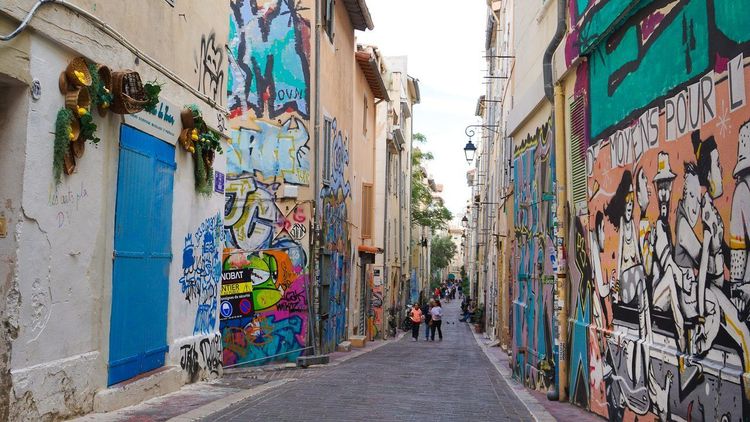
Le Panier is not only an old neighborhood: it has also established itself as a showcase for Marseille's street art scene. Its centerpiece, often called the Fresque des Marseillais (Rue de la Loge, 13002 Marseille, rated 4.8/5 on Google with 4 reviews), covers the full height of an entire city block in trompe-l'œil: painted balconies, fictitious windows and some thirty personalities who have marked the city's history stand side by side across several floors, from an ancient navigator to more contemporary figures from local sport and culture.
This monumental mural set the tone for an entire neighborhood: around it, what locals call the Cours des Fresques brings together a series of more modest painted walls — portraits, scenes of daily life or abstract compositions — created by local collectives over the years. Unlike the main mural, these works change regularly: a wall repainted this year may no longer exist in two years' time, giving the circuit a deliberately ephemeral character.
For photography enthusiasts, the best time remains early morning, when the raking light accentuates the painted relief and the lanes are still deserted. At midday, groups of visitors cluster in front of the main mural, making it harder to get a clear shot. The contrast between this contemporary street art and the centuries-old facades of the rest of the neighborhood fairly sums up the spirit of Le Panier: a neighborhood that layers its eras rather than erasing them. Several Marseille collectives occasionally organize open painting sessions, and it is not unusual to come across an artist at work, spray can in hand, on a wall that will have changed its face before the end of the season.
Église Saint-Laurent: Sentinel of the Vieux Port
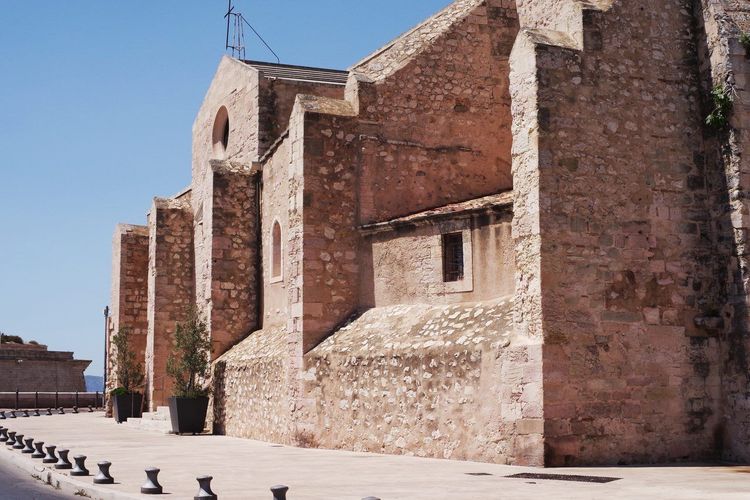
On the edge of Le Panier, facing Fort Saint-Jean, stands the église Saint-Laurent, one of the few Romanesque structures still visible in Marseille. Built from the 12th century onward by the fishermen's guild, it occupies a rocky promontory that places it almost at water level, separated from the fort by the very entrance to the Vieux Port.
Its architectural austerity — thick walls, narrow openings — deliberately contrasts with the splendor of the Cathédrale de la Major that faces it across the esplanade. Long the church of the sailors and fishing families of Le Panier, it survived the 1943 bombings with limited damage compared to the rest of the waterfront, making it today one of the rare direct witnesses to the urban layout that existed before the destruction of the old neighborhood.
If you combine a visit to Fort Saint-Jean with one to the Major, a five-minute detour is enough to take a look inside: the sober interior makes a pleasant contrast with the tourist bustle of the neighboring esplanade.
Where to Eat: Restaurants, Cafés and Good Addresses
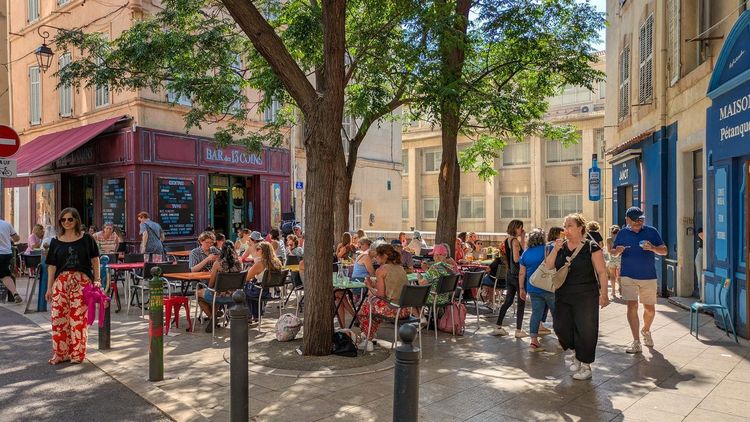
Le Panier's food scene is divided between the neighborhood's long-standing institutions and the more recent tables opened by a new generation of restaurateurs. The Bar des Treize Coins (Place des Treize-Coins, 13002 Marseille, rated 3.9/5 on Google with 1,895 reviews), on the square of the same name, has been a local landmark for decades: an interior that has not changed, a pastis served without fuss and a clientele mixing neighborhood regulars with passing visitors.
On the culinary side, the neighborhood remains a good place to sample Marseille classics: panisses pan-fried until golden, pieds paquets slow-simmered, socca sold by the slice at the most unassuming stalls. The Ryo ranking of the best Marseille specialties lists the must-tries if you want to plan a gourmet trail before or after visiting Le Panier.
Prices vary considerably depending on proximity to the most touristy thoroughfares: a table set up on place de Lenche or right in front of the Fresque des Marseillais will cost noticeably more than an establishment tucked two streets higher up. You will generally make better discoveries — and better deals — by moving a little away from the most photographed squares. In the morning, a few artisan bakeries open early to serve local shopkeepers before the first groups arrive; this is often the most authentic moment to observe neighborhood life, espresso in hand, on a doorstep still cool in the morning shade.
For a sweet break, several addresses in the neighborhood offer navettes marseillaises, those small dry biscuits flavored with orange blossom traditionally associated with Candlemas. At lunchtime, a handful of neighborhood canteens serve unpretentious southern cooking, while in the evening a few more ambitious tables revisit Mediterranean produce: small-boat fish, seasonal vegetables, Provence olive oil. Book ahead if you are after a terrace on a summer evening, as the best spots fill up fast once the light begins to fade on the facades, so leave some slack either side of Ryo's audio-guided tour of the city.
Shops, Craftspeople and Workshops in the Neighborhood
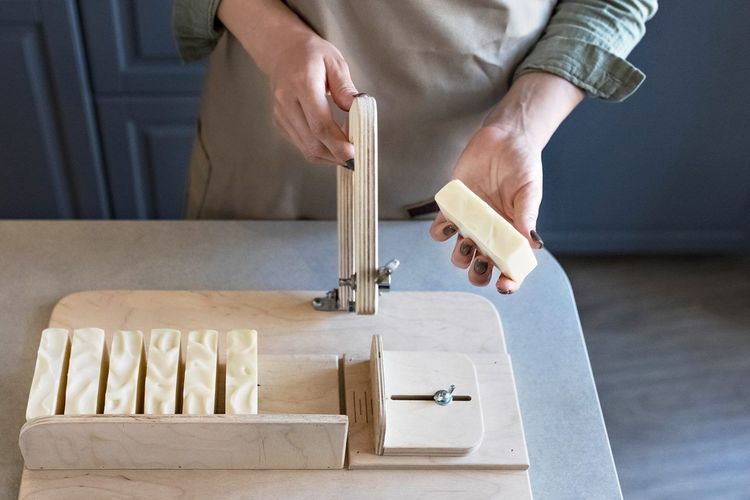
Le Panier long housed the craftspeople who kept the port alive: ropemakers, soap-makers, santon makers. A portion of that activity survives, transformed into shops aimed as much at locals as at visitors. Savon de Marseille in particular holds pride of place: several stalls sell traditional cubes made according to the ancient method, based on olive oil and soda, to be distinguished from the perfumed reproductions sold elsewhere in the city center. True savon de Marseille, recognizable by its stamp pressed into the block and its high vegetable oil content, follows a process whose rules were codified as far back as the 17th century under Colbert. In Le Panier, a few shops keep up the old-fashioned production — kettle cooking, air drying, hand-cutting and hand-stamping — and sometimes let you watch the process from the street. Be wary of overly colored or overly scented cubes sold near the tourist squares: real savon de Marseille is understated, olive green or beige, and has almost no scent.
Alongside the soap workshops, santon makers' studios carry on a more discreet Provençal tradition: hand-painted clay figurines representing the trades of a 19th-century southern village. Some craftspeople open their workshops to the public in the late afternoon, a privileged moment to watch the craft before making a purchase.
The neighborhood also has a handful of contemporary art galleries, often run by the same artists who paint the walls of the Cours des Fresques, as well as designer boutiques set up in former food shops that have been converted. Browsing these stores with no intention of buying remains one of the most pleasant ways to pass a quiet hour between two visits.
Le Panier at Night: Atmosphere and Precautions
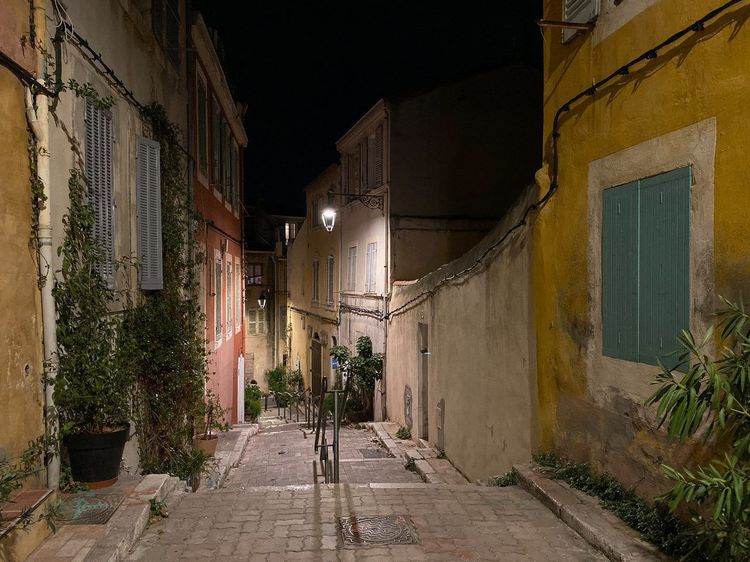
Le Panier in Marseille changes completely after dark. The groups of visitors disperse after 7 p.m., the terraces come alive with a more local crowd, and the facades lit by streetlamps take on warm tones that make a photographic detour worthwhile.
In terms of safety, the neighborhood presents no particular risk as long as you stick to the main, well-lit axes: rue du Panier, place de Lenche, place des Treize-Coins. As in any dense historic center, it is better to avoid venturing alone late into the narrowest and least frequented lanes, where street lighting can still be sparse. The usual precautions — bag worn at the front, valuables kept discreet — are more than sufficient for a quiet evening.
If you prefer to explore the neighborhood during the day with an audio commentary rather than after dark, the Ryo audio guide for Marseille, designed for daytime use, covers part of the neighborhood and lets you scout out the locations before returning to enjoy the nighttime atmosphere, drink in hand.
Visiting Le Panier with Families or on a Budget
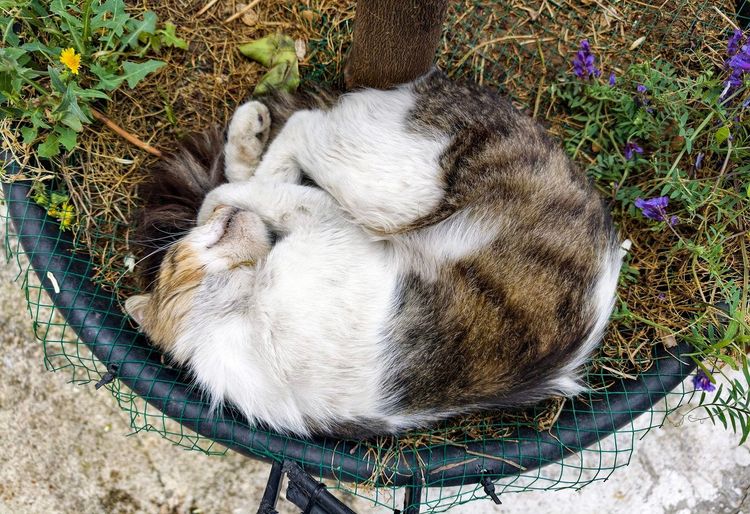
Le Panier lends itself well to a family visit, provided you adjust the pace to suit the youngest. Most of its attractions — the colorful lanes, the painted murals, the courtyard of the Vieille Charité, the gardens of Fort Saint-Jean — are free, making it an accessible outing even on a tight budget. Children often take readily to the game of spotting details: counting cats asleep on the steps, finding the characters depicted in the Fresque des Marseillais, guessing what is hidden behind the half-open shutters of the workshops.
Wear closed shoes for the uneven cobblestones, and bring a water bottle — especially in summer, when shade is scarce on the open squares: several public fountains allow you to cool off along the way. For very young children, a pushchair is manageable on the main thoroughfares but quickly becomes cumbersome in the staircase lanes, where a baby carrier proves more practical. For a snack, the neighborhood's bakeries and the ice cream parlors of the nearby Vieux Port offer enough to keep everyone going until the return journey, without making a dent in the day's budget.
Recommended Itinerary and Practical Map
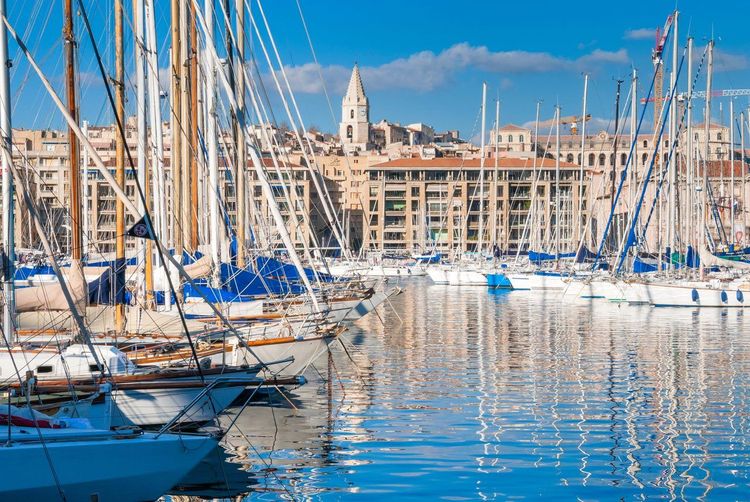
For those who prefer a mental map over a paper plan, here is an itinerary that strings together the main points of interest in Le Panier without retracing the same street twice. Start from the Vieux Port and head up via rue de la Prison to place de Lenche, your first coffee stop. Continue along the Montée des Accoules to the bell tower and its viewpoint, then head back west to reach rue du Panier and its succession of colorful facades.
From there, a detour through the Cours des Fresques and the Fresque des Marseillais is a must before heading up to the Vieille Charité, the longest stop on the route. Finish with the southern part of the neighborhood: Fort Saint-Jean, église Saint-Laurent and Cathédrale de la Major follow one another on the esplanade that slopes down toward the môle J4, before returning to the Vieux Port along the quays.
This complete itinerary takes between two hours and two and a half hours at a leisurely pace, longer if you stop for lunch along the way. If you prefer a commented format to following a map on your own, the Ryo audio-guided tour of Marseille offers an audio-guided tour that covers part of this route with historical context section by section, which works well for a first discovery of the neighborhood.
For those coming with children or with limited mobility, note that the elevation change is moderate but constant: the uneven cobblestones of several lanes make pushchairs or wheelchairs difficult on certain stretches, particularly around the Montée des Accoules. Wear good shoes and bring a water bottle: the route accumulates several dozen meters of elevation gain including the staircases, and shade is scarce on the seafront esplanades during the hottest hours.
Practical Information: Access, Parking, Best Time, Guided Tours
For parking, two covered car parks flank the neighborhood: the one at the Vieux Port and the one at the Hôtel de Ville, both less than ten minutes on foot from the first lanes of Le Panier. Avoiding driving into the neighborhood itself is the number-one piece of advice: the streets are too narrow for regular use and many are reserved for residents.
The best time to visit remains early morning, between 8:30 and 10:30, when the light is soft and the cruise-ship groups have not yet come ashore from the nearby terminal. On days when large cruise ships are docked — recognizable by their silhouettes moored at the môle J4 — footfall around Fort Saint-Jean and the Major rises noticeably around midday. Conversely, late afternoon offers warm, ideal light for photographing the facades.
If you prefer a guided format to a printed map, an app like Ryo offers a commented itinerary that covers part of Le Panier and the Vieux Port, useful for not missing anything without having to check your phone at every intersection. To broaden the visit beyond Le Panier, the Ryo overview of Marseille's most beautiful neighborhoods helps you plan a more complete stay, between the seafront and the hills. Finally, note that most sites in Le Panier can be visited year-round: only the museums of the Vieille Charité have a weekly closing day, generally Monday, and adjust their hours in the low season. Check opening days before you go if your visit depends on a specific exhibition.
FAQ
Where exactly is the Le Panier quarter in Marseille?
Le Panier is located in the 2nd arrondissement of Marseille, on the butte Saint-Laurent, immediately north of the Vieux Port. It is bordered by the Hôtel de Ville to the south and the Joliette district to the north, less than ten minutes on foot from the main square of the Vieux Port.
How much time should I plan to visit Le Panier?
A complete visit, including the Vieille Charité, the Fresque des Marseillais and a tour of the main lanes, takes between two and three hours. Allow half a day if you add a lunch break and a visit to the nearby Fort Saint-Jean or the Mucem.
Is Le Panier safe at night?
Yes, generally speaking, as long as you stick to the main lit thoroughfares such as rue du Panier or place des Treize-Coins. As in any dense historic center, it is best to avoid the most isolated lanes late at night and to take the usual precautions with your personal belongings.
Where can I park near Le Panier?
The covered car parks at the Vieux Port and the Hôtel de Ville are the most convenient options, both less than ten minutes on foot from the neighborhood. Driving inside Le Panier itself is not recommended due to the narrowness of the streets.
Which arrondissement is Le Panier in Marseille?
Le Panier belongs to the 2nd arrondissement of Marseille, which also encompasses the northern side of the Vieux Port, the Joliette and the port districts close to the Cathédrale de la Major.
Is there an itinerary or a map to visit Le Panier without getting lost?
The neighborhood is small and lends itself well to free exploration, but a structured itinerary (place de Lenche, Montée des Accoules, Vieille Charité, Fresque des Marseillais, then the esplanade de la Major) lets you take in the highlights without retracing your steps, in about two hours.
What is the best time to visit Le Panier?
Spring and early autumn offer pleasant temperatures without the oppressive summer heat. During the day, opt for early morning or late afternoon to avoid the crowds of cruise-ship groups that pour in around midday.
At the end of this stroll through Marseille's oldest lanes, one thing becomes clear: Le Panier cannot be reduced to a postcard or a box to tick on a list of sights. It is a living neighborhood, shaped by twenty-six centuries of successive arrivals, reconstructions and reinventions, where a contemporary mural stands just a few meters from a baroque chapel and a medieval passageway.
To extend the discovery beyond its lanes, the Ryo audio guide for Marseille allows you to move naturally on to the Vieux Port, the Corniche or the nearby calanques, with the same commented-itinerary format that will have accompanied your time in Le Panier.
À lire également