© Shutterstock
 Votre guide Ryo
The Menton Lemon Festival: Complete 2026 Guide
You must see at least once nearly 140 tons of citrus fruits assembled into 10-meter-high sculptures in the Biovès gardens. Every year in February, the Menton Lemon Festival attracts more than 250,000 visitors in less than three weeks, a dizzying figure for a town of 28,000 inhabitants. The spectacle is like nothing else on the Riviera: floats covered in oranges and lemons parade along the seafront, brass bands play until sunset, and the entire old town is fragrant with fresh citrus. The 92nd edition runs from February 14 to March 1, 2026, with the theme 'Wonders of the Living World', featuring illuminated nighttime corsos, a free-access citrus exhibition in the Biovès gardens and a PGI lemon market that alone is worth the trip. To prepare your visit, dates, corso tickets, accommodation, parade program, here's everything you need to know. And if you want to extend the experience beyond the Biovès gardens, the Ryo audio guide route The Pearl of France explores Menton in 22 audio stages over 4.8 km.
What is the Menton Lemon Festival?
The Lemon Festival is an annual festival officially created in 1934 in Menton, centered on a raw material as banal as it is extraordinary: citrus fruits grown in the Menton hinterland. Each edition is based on a different theme that dictates the motifs of all sculptures, floats and decorations. The event mainly revolves around two distinct types of events.
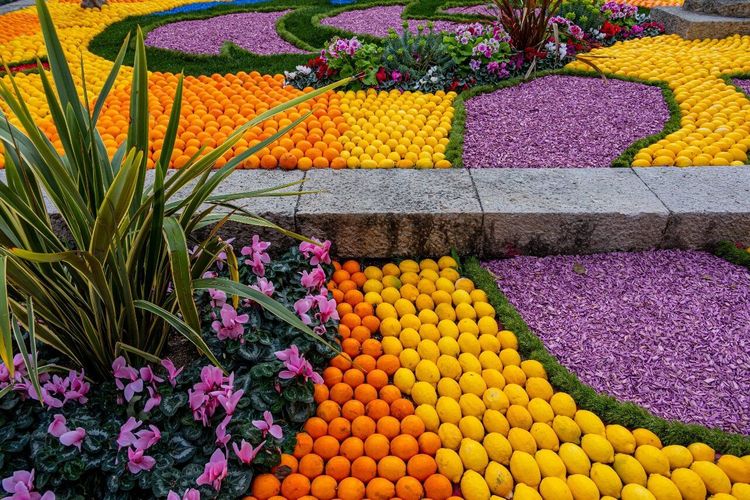
On one side, the sculpture exhibitions in the Biovès gardens (Avenue Boyer, 06500 Menton, rated 4.5/5 on Google for 5,215 reviews), monumental citrus compositions built on metal frameworks, accessible day and evening under special lighting. On the other, the corsos (outdoor float parades) on the seafront, which gather thousands of spectators standing along the promenade. Between the two, street entertainment, concerts and tastings of lemon products enliven the town from morning until evening.
Good news for your budget: the citrus motif exhibition in the Biovès gardens is free and open access. What you pay for are the corsos: the roadside promenade remains accessible at a low price, and the seated stands offer a clear view of the floats. It's one of the rare French festivals of this scale to leave its visual heart open to all.
History and Origins: From Flower Exhibition to World Festival
It all began in 1895, during a private flower exhibition organized in the villa of a Menton notable. Baskets of flowers and fruits decorated the paths, guests wanted more the following year, and the idea began to circulate in the town. In 1929, a hotelier organized an exhibition of flowers and citrus fruits in the gardens of the Hotel Riviera; the success was such that from 1930 the festivities spread to the streets in the form of a parade. The Lemon Festival was officially created in 1934, with its first citrus exhibition in the Biovès gardens.
The economic context is not insignificant. Menton was then one of the main lemon production areas in Europe. The terraced orchards of the hinterland supplied fruit to the entire Riviera and as far as England, the Menton lemon was renowned for its low acidity, its thick skin ideal for jams and its ability to keep for a long time without refrigeration. At its peak in the 19th century, the Menton territory had more than 200,000 lemon trees.
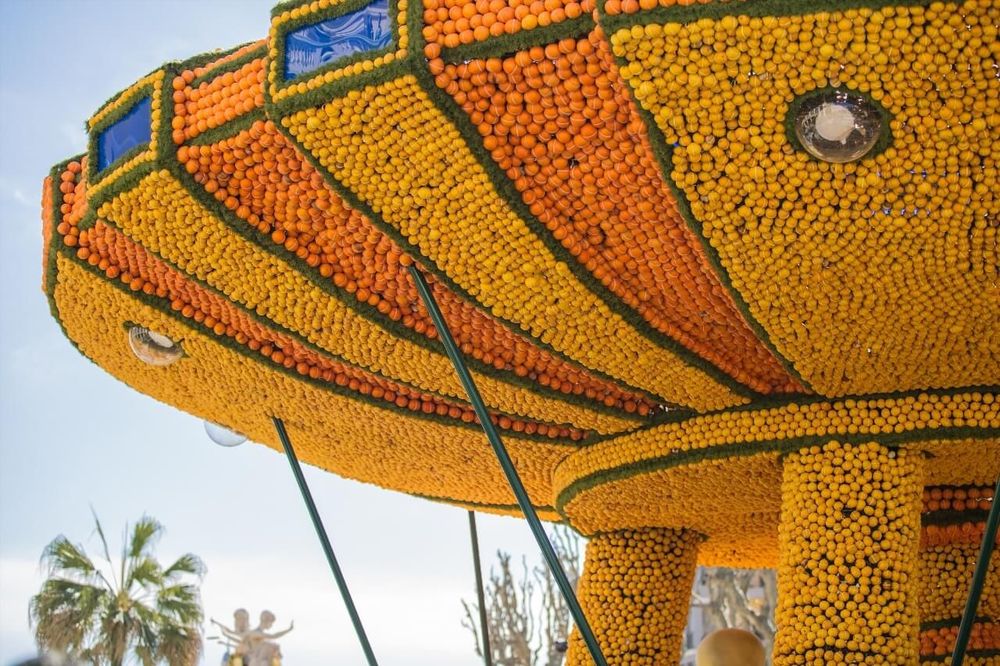
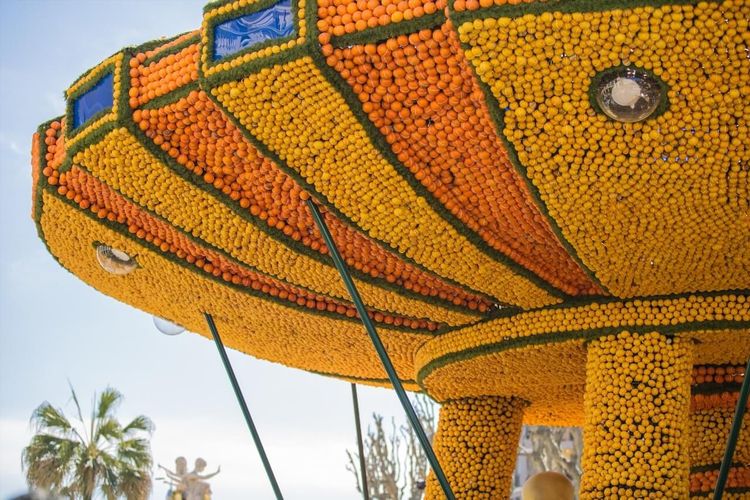
The current form, monumental sculptures built on metal frameworks covered with citrus fruits, was gradually established after World War II. It was the hotelier Louis Novat who introduced in the 1940s-1950s the first architectural structures made of citrus fruits. Each sculpture mobilizes thousands of fruits held by pins and strings, replaced mid-festival when the first ones start to wrinkle. A recent edition mobilizes around 140 tons of oranges and lemons for the entire festival.
Since 2003, each edition receives an official theme that unifies the aesthetics. The name 'Lemon Festival®' is now a trademark registered by the city of Menton. This visual coherence distinguishes Menton from regional carnivals: you don't come to see a heterogeneous collection of floats, but a collective creation organized around a single idea, revisited each year.
The Menton Lemon, a PGI Citrus Fruit in Its Own Right
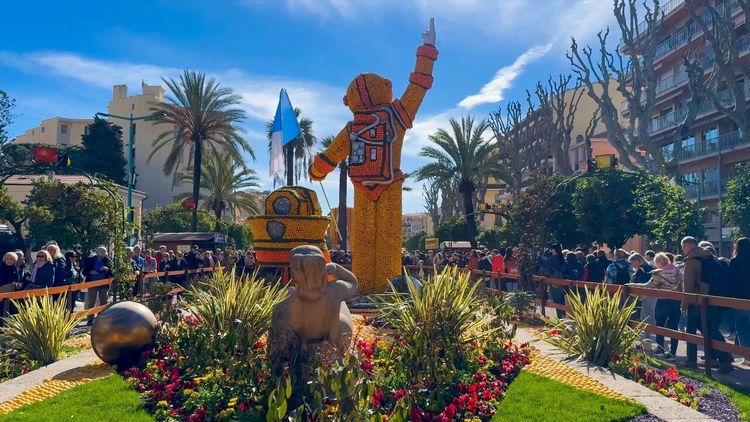
The Menton lemon has benefited since 2015 from a protected geographical indication (PGI), making it one of the rare French citrus fruits to enjoy such recognition. It grows on the sunny slopes of the hinterland, between 100 and 500 meters altitude, in microclimates where frost is almost non-existent.
What distinguishes it from ordinary lemons: a thicker and more fragrant skin, less acidic flesh, abundant juice. Chefs in the region use it as much for zest as for juice, candied, in tarts, in essential oil, in limoncello. Current production remains modest, about 50 tons of certified fruit per year for about a hundred producers committed to the PGI. The specifications require hand harvesting, spread from November to April, and prohibit the picking of still green fruits: it is this complete ripeness on the tree that gives the Menton lemon its recognizable fragrance. During the festival, stands with official badges are the only ones selling authentic PGI lemon, tourist stalls often offer imported fruits.
The approximately 125 tons of citrus fruits ordered for the floats in 2026 come mainly from Spain (Murcia and Valencia regions), with a supplement from Portugal and Egypt: local production cannot cover the event's needs. This is no secret: the festival celebrates a territory and citrus culture, not just a production volume.
The Golden Fruit Corsos: The Heart of the Spectacle
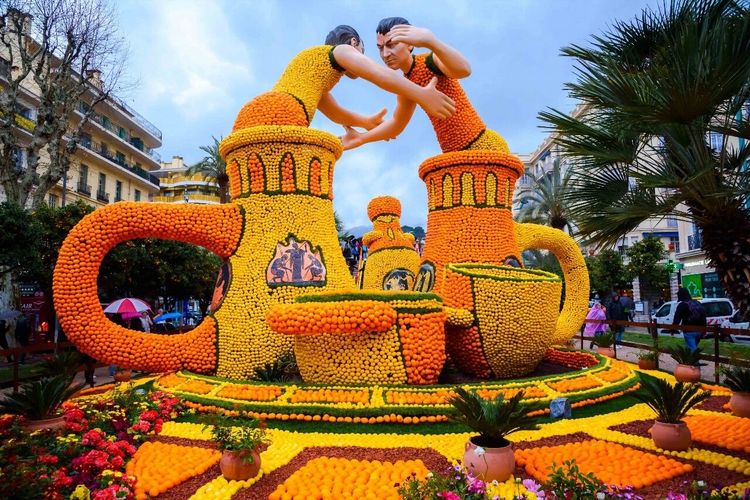
Daytime Corso and Nighttime Corso: Two Distinct Experiences
The corsos are the parades of monumental floats, entirely covered with oranges and lemons, that travel along the Menton seafront for about 1.5 kilometers. There are two formats, and many visitors don't know this difference until they arrive.
The golden fruit corso takes place during the day, under Mediterranean light. The floats advance slowly, accompanied by majorettes, brass bands and folk groups from all over Europe, Portuguese brass bands, German brass orchestras, Brazilian samba groups. Teams throw oranges and lemons into the crowd, a tradition dating from the first editions. A corso lasts about two hours. Each float weighs between 8 and 25 tons and is escorted on foot by its creators.
The illuminated corso takes place in the evening: two dates in 2026, Thursdays February 19 and 26. The same floats are lit by thousands of LEDs and spotlights. The orange and yellow citrus fruits vibrate under the lights, the motifs take on new depth, and the parade transforms into something that resembles a light installation more than a folk procession. It's the version not to miss if you're only doing one.
Paid Stands or Free Roadside?
For the corsos, two paid formulas in 2026: the promenade standing along the route (€16 adult, €8 reduced rate for 6-12 year-olds) and the seated stand (€30 adult, €14 reduced rate), free for under 6s. The stand offers the best visibility, at eye level with the floats. Be realistic: for Saturday and Sunday corsos, the best promenade spots are taken two hours in advance. Arrive early or book a stand, the experience is incomparable.
In 2026, the program includes five corsos: three daytime golden fruit corsos on Sundays February 15, 22 and March 1 (departure at 2:30 PM on the Soleil promenade), and two nighttime illuminated corsos on Thursdays February 19 and 26. The inaugural corso and the closing one are traditionally the most spectacular; the mid-festival corsos are a bit calmer and less crowded.
Six to Eight Months of Work for Two Hours of Parade
What visitors see in two hours is the result of enormous work. The artists in charge of each float submit models to the city of Menton from the previous spring. Construction of the metal frameworks starts in autumn. The citrus dressing can only begin a few days before the first parade, the fruits having to remain fresh.
A medium-sized float mobilizes between 4,000 and 8,000 oranges and lemons, fixed one by one on the framework with stainless steel pins. After the last corsos, the undamaged fruits are redistributed to visitors and local associations, or transformed into juices and jams.
The Biovès Gardens: Getting Your Bearings at the Heart of the Festival
The Biovès gardens occupy the nerve center of Menton, between Avenue Boyer and the seafront. It's a 400-meter-long French-style park, with wide paths and basins, a setting naturally suited to outdoor exhibitions.
Some practical landmarks to organize your visit.
The morning slot (generally 9:30 AM-12 PM) is the calmest. The Mediterranean light in winter is often soft and lateral at this time, ideal for photography. The entrance queues are much shorter than in the afternoon.
The afternoon (2-6 PM) gathers the most people, especially families with children. It's also when street entertainment is most numerous around the gardens.
In the evening (from 7 or 8 PM depending on editions), the sculptures are lit: the citrus fruits vibrate under the lighting and the atmosphere changes completely. Access remains free and open, but attendance climbs quickly on weekends; come at opening time if you're targeting this moment.
A little-known tip: position yourself at the north end of the gardens at the start of your visit, where the tallest sculptures are usually installed, then go back down towards the seafront. You'll have an overview of each piece with the necessary perspective before approaching for details.
Menton also has a network of exceptional botanical gardens open during the festival. The Serre de la Madone garden, classified as a Historical Monument, houses collections of rare plants. The Val Rahmeh (Avenue Saint-Jacques, 06500 Menton, rated 4.5/5 on Google for 2,278 reviews), managed by the National Museum of Natural History, offers night visits in small groups during the festival.
2026 Lemon Festival Program and Dates
The 2026 edition, which marks the 92nd, runs from February 14 to March 1, 2026, just over fifteen days of festivities with the theme 'Wonders of the Living World'. The festival takes place at the same time as the Nice carnival, the other major winter event on the French Riviera.
For reference: the 2025 festival was held from February 15 to March 5, the 2024 festival from February 17 to March 3. The mid-February/early March window has been the constant for several decades.
The weekends concentrate the majority of the public and all the corsos. The weeks between weekends allow you to visit the gardens in much more serene conditions, with reduced queues. The closing weekend is paradoxically one of the least crowded, many visitors choose the first or second weekend. So it's a good option if you're flexible.
For corso tickets, the official ticket office opened on September 22, 2025 on the fete-du-citron.com site. Stand seats for corsos sell out in a few days during peak weekends.
2026 prices: the citrus exhibition in the Biovès gardens is free and open access, day and evening. For corsos, count €16 for promenade (€8 for 6-12 year-olds) and €30 for seated stand (€14 reduced rate), free for under 6s.
How to Get to Menton and Get Around
By Train: The Best Choice During the Festival
Menton is on the Nice-Ventimiglia railway line, one of the most picturesque regional lines in France. From Nice, the TER journey takes about 40 to 50 minutes. Trains are frequent (every 20-30 minutes during the day) and prices remain reasonable (about €5-7). Menton station (Place de la Gare, 06500 Menton, rated 4.1/5 on Google for 324 reviews) is a 10-minute walk from the Biovès gardens, it's by far the most convenient means of access during the festival.
From Monaco, Menton is 12 km away, less than 20 minutes by train. It's a logical combination if you're spending several days on the Riviera. From Cannes, count 1h15 to 1h30 with connection in Nice.
During festival weekends, SNCF generally reinforces frequencies on this line. Sunday evening return trains can be very crowded, plan to take an earlier train than expected.
By Car: Plan for Parking
Coming by car during a corso weekend is not recommended, unless you arrive before 9 AM. City center parking lots are saturated from 10 AM. The solution: use the relay parking lots on the outskirts (marked P+R) with free shuttles set up by the city. The A8 highway serves Menton via exit 59.
Getting Around Menton
Menton is a compact city. Between the station, the Biovès gardens, the seafront and the old town, all distances are covered on foot in less than 20 minutes. For botanical gardens on the outskirts, free shuttles run during the festival, check at stops indicated by the tourist office.
On corso days, Boulevard de Garavan and several adjacent streets are closed to traffic. If you arrive by car that day, count on an extra half hour to reach your accommodation.
Some practical tips: come early (between 9:30 and 11 AM, crowds are still manageable), dress in layers (14-18°C during the day, 10-13°C in the evening), bring cash for the market (most producers only accept cash), and avoid large strollers in the old town streets.
Where to Stay During the Lemon Festival
In Menton Itself
Corso weekends are fully booked several weeks in advance in all Menton hotels. Book at least 3 to 4 months in advance for weekends, seafront hotels are snapped up from October.
The Hotel Napoleon, on the seafront, is one of the most sought-after addresses during the festival. Its terrace overlooking the Mediterranean offers one of the best views of the bay in winter. 4-star category, rates sharply increased during the event.
The Hotel Aiglon (7 Avenue de la Madone, 06500 Menton, rated 4.5/5 on Google for 413 reviews), on Avenue de la Madone, is a classic of the Menton Riviera. Its terraced garden with sea view is a pleasant setting to decompress at the end of the day after the crowds of the Biovès gardens. Several small family hotels in the streets behind Place du Cap offer good value for money in well-renovated old buildings.
In Neighboring Towns
If Menton is full or over budget, several options within 20 minutes are worth considering.
Roquebrune-Cap-Martin, 5 km to the west, is a hilltop village with some guest houses and rental houses. The atmosphere is much calmer than Menton during the festival, and rates are generally 20 to 30% lower.
Ventimiglia, the first Italian town on the other side of the border, is 15 minutes by train. Accommodation prices are significantly lower there, and the border crossing is invisible since Schengen works. Many Italian visitors to the festival make this journey in the opposite direction.
Monaco, 12 km away, offers a wide hotel range, from budget to luxury, at prices sometimes competitive compared to Menton during festival time.
For tight budgets, apartment rentals via the usual platforms remain the best option. With a kitchen, you can stock up at the festival market and enjoy local lemon economically and authentically.
What to Do in Menton Beyond the Festival
If you're in Menton during the festival, you have access to one of the most photographed towns on the Riviera in its moment of visual glory. But the town itself deserves half a day of exploration outside the Biovès gardens.
Menton's old town is one of the most beautiful on the Côte d'Azur. Its ochre and pale pink facades stack above the port in a calculated disorder that evokes both Italian Liguria and Provence. The narrow streets climb from the covered market to Saint-Michel-Archange church, the largest baroque church in the region, whose pebble square is a masterpiece of popular mosaic.
The rampe des poilus is the main axis connecting the covered market to old Menton, a series of flights of steps framed by brightly colored houses, lined with plants and potted orange trees. It's the postcard image of Menton. During the festival, some sculptures outside the gardens are sometimes installed in this area.
The Old Castle cemetery, on high ground, offers the most photogenic view of Menton's rooftops, Garavan bay and the first Italian hills. Access is free; the path from the Saint-Bernardin chapel is clearly marked.
The Jean Cocteau Museum - Severin Wunderman Collection (2 Quai de Monléon, 06500 Menton, rated 4/5 on Google for 492 reviews) deserves an hour. Cocteau left a deep mark on Menton, he notably decorated the Wedding Hall of the Town Hall with frescoes now protected. The museum houses the world's largest Cocteau collection, in a contemporary building facing the sea.
The covered market of Les Halles is where locals meet in the morning, before noon. During the festival, vendors of lemon products are more numerous than usual: jams, flavored oils, preserves, spirits. Arrive before 11 AM to avoid crowds and find the best tables.
To explore all this with historical context and local anecdotes, the Ryo audio guide The Pearl of France accompanies you over 4.3 km through 23 stopping points in the old town and seafront. It's a natural complement to the festival for those who want to understand what Menton is beyond the festival.
Gastronomy: The Flavors of Menton Lemon
The festival is also an opportunity to discover Menton gastronomy and everything this territory has developed around citrus.
The barbagiuan is perhaps the most emblematic specialty, a fritter stuffed with chard, ricotta and parmesan, fried in olive oil. Although it doesn't contain lemon, it's often served with a drizzle of local lemon juice that reveals its aromas. You can find it in several bakeries and restaurants in old Menton.
The pasta al limone, a dish of Ligurian influence omnipresent in Menton, comes in dozens of versions depending on restaurants. The traditional Menton version uses grated PGI lemon peel, fresh cream and aged parmesan.
The Menton lemon tart is not the same as the Parisian pastry version. It incorporates zest into the filling in generous quantity, giving a more fragrant and less sweet result. Confiserie Herbin, founded in 1974, has the most established reputation for this specialty.
The Menton limoncello is produced locally from PGI lemon zest. Its local version is less sweet than the industrial Italian version, more bitter, fresher. Several shops around the gardens offer tastings during the festival.
During corso weekends, seafront restaurants are stormed. Book several weeks in advance or eat outside rush hours (before noon or after 2 PM at lunch, after 9 PM in the evening). Restaurants located in the streets behind Place aux Herbes are more accessible without reservation.



FAQ
When does the Menton Lemon Festival take place in 2026?
The 2026 edition, the 92nd, runs from February 14 to March 1, 2026, with the theme 'Wonders of the Living World'. For reference: the 2025 festival was held from February 15 to March 5, the 2024 festival from February 17 to March 3. The corso ticket office has been open since September 22, 2025 on fete-du-citron.com.
How much does entry to the lemon festival cost?
The citrus sculpture exhibition in the Biovès gardens is free and open access, both day and evening. What you pay for are the corsos: €16 standing promenade (€8 for 6-12 year-olds) and €30 seated stand (€14 reduced rate), free for under 6s. Check exact prices on fete-du-citron.com before booking.
Is it better to come during the week or on weekends?
Weekdays are much more pleasant for visiting the Biovès gardens: fewer crowds, no queuing, more relaxed atmosphere. The golden fruit daytime corsos take place on Sundays (February 15, 22 and March 1, 2026) and the illuminated corsos on weekdays (Thursdays February 19 and 26). If the parade is your priority, time your stay around these dates and book well in advance. If you prefer the sculptures without crowds, choose a weekday slot. The closing weekend (early March) is paradoxically less busy than the first or second.
How do you get to Menton from Nice?
The train is the simplest means. TER trains connect Nice to Menton every 20 to 30 minutes, for a journey of 40 to 50 minutes and a price of about €5 to €7. Menton station is a 10-minute walk from the Biovès gardens. By car, count on 30 km via the A8 with tolls, but parking is very difficult during festival weekends. Prioritize the train.
Can you visit Menton's old town during the festival?
Yes, and it's highly recommended. Menton's baroque old town, with its colorful streets, Saint-Michel-Archange church and pebble square, is partially decorated during the festival. Early morning (before 9 AM), it's practically deserted despite the festival. The Jean Cocteau Museum, often overlooked in favor of the sculptures, is a real gem. The rampe des poilus and Saint-Bernardin chapel are also worth the detour. To explore with context, Menton's Ryo audio-guided tour, 'The Pearl of France', covers these places in 23 audio stages.
Can you visit the Biovès gardens with young children?
Yes, the festival is very family-friendly. The monumental sculptures impress children from 3-4 years old. The garden paths are wide and suitable for compact strollers. The best times for little ones: morning to avoid fatigue and crowds, or early afternoon on weekdays. The illuminated evenings are fascinating even for very young children, but queues can be long. Avoid large strollers in the old town, the stepped streets don't suit them.
Is the lemon sold at the festival really Menton PGI lemon?
Not systematically. The approximately 125 tons of citrus fruits used for the floats are mostly imported from Spain, the local PGI production (about 50 tons per year) being far too small to cover the event's needs. However, certified producers present at the festival market with the official badge do sell authentic PGI lemon. To be sure, buy from them or from fine food shops in the city center that clearly display certification. Count on €4 to €7 per kilo for real Menton lemon. Our audio-guided tour, The Pearl of France, links the Biovès Gardens to the Jean Cocteau Museum for those who want to explore beyond the market.
Menton and Its Lemons: A Festival to Experience at Least Once
This celebration is not just a spectacle, it's the singular way a small Mediterranean town reinvents its identity each year around a fruit. The approximately 140 tons of citrus fruits assembled into ephemeral sculptures, the corsos that perfume the seafront, the scents of limoncello and fresh tart in the old town streets form a coherent experience found nowhere else on the Riviera.
If you extend your visit beyond the festival, the Ryo audio guide The Pearl of France will give you the historical and cultural keys to understand this town that was for a century one of the favorite winter destinations of European aristocracy. Twenty-two audio stages, 4.8 km, to do at your own pace between two garden visits or the day after the festival, it's the best way to leave with the feeling of having really seen Menton, and not just its citrus fruits.
À lire également