© Shutterstock
 Votre guide Ryo
Visiting Narbonne for the First Time: The Complete 2026 Guide
Planning your first visit to Narbonne but not sure where to start between the unfinished cathedral, the century-old market halls, and the sea just twenty minutes away? Good news: this city in the Aude is easy to navigate without a complicated plan, as long as you know the right sequence. Here, a canal runs through the city center from end to end, a Gothic cathedral has remained unfinished for seven centuries, and the traces of the first Roman road built in Gaul surface in the middle of a public square. To get your bearings from the moment you arrive, the Ryo audio tour of Narbonne covers 20 commented stops over approximately 4 km, enough to connect the main sites of the center in about one hour and forty minutes without getting lost. This guide covers everything you need: the historic core, the museums, Narbonne-Plage, local gastronomy, Fontfroide Abbey and the wine route, nearby villages, and everything worth knowing before you book.
Where Is Narbonne and Why Should You Visit?
Narbonne is located in the Aude department, in the Occitanie region, halfway between Montpellier and Perpignan. The city is no longer directly on the coast since the sea receded in the Middle Ages, but Narbonne-Plage is less than 20 minutes from the center. You are here at the crossroads of two worlds: the Mediterranean on one side, and the arid foothills of the Corbières with their vineyards on the other.
Is Narbonne worth the detour? For a mid-sized city, it packs a disproportionate amount of heritage: the capital of Gallia Narbonensis under Rome, it has preserved an inland port, a never-completed cathedral, and a network of canals inherited from the 19th century. Getting familiar with these key features before arriving helps you organize your visit — much like the Ryo audio tour does, which lays out the city's geographical landmarks before you even pull out a map.
How to Get to Narbonne
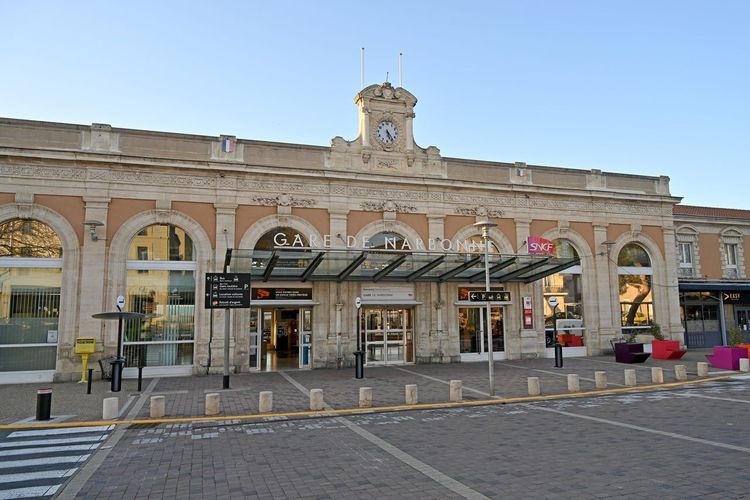
By train, Narbonne is served by a direct TGV from Paris (about 4h30) and by more frequent connections from Bordeaux, Toulouse (1h30), and Montpellier (about 1h). The SNCF station is ten minutes' walk from the historic center, making car-free arrivals particularly convenient.
By car, the A9 motorway (the Languedocienne) runs through the urban area and meets the A61 from Toulouse at the Narbonne interchange — a road junction that explains why the city long served as a logistical stopover between Spain and Italy, already in Roman times. Allow about 4 hours from Lyon and 1 hour from Perpignan. If you arrive by car, park in one of the peripheral car parks near the center: the streets of the historic core are narrow and often pedestrianized.
By air, three airports serve the region: Béziers-Vias (35 km, low-cost flights), Carcassonne (65 km), and Perpignan-Rivesaltes (also 65 km), all connected to Narbonne by shuttle or car rental. No airport serves Narbonne directly, but the city's central position on the Mediterranean axis more than makes up for this: whatever entry point you choose, the final leg never exceeds an hour's drive.
Narbonne's Historic Center: Cathedral, Canal, and Via Domitia
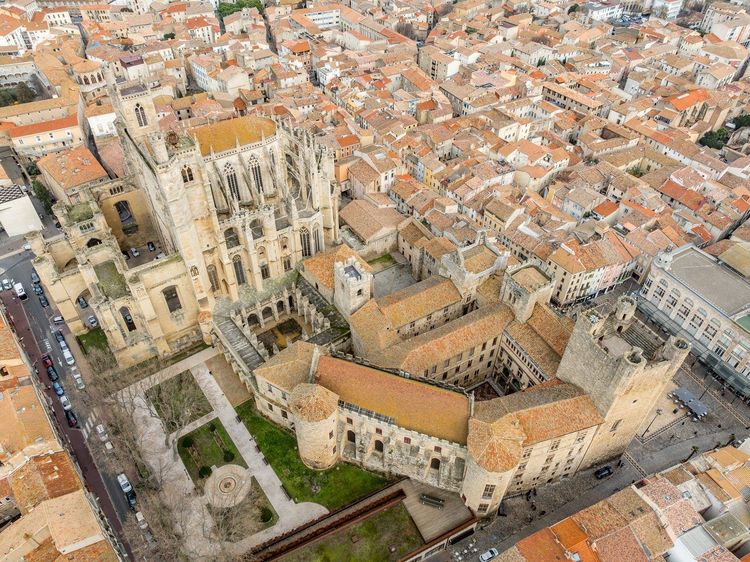
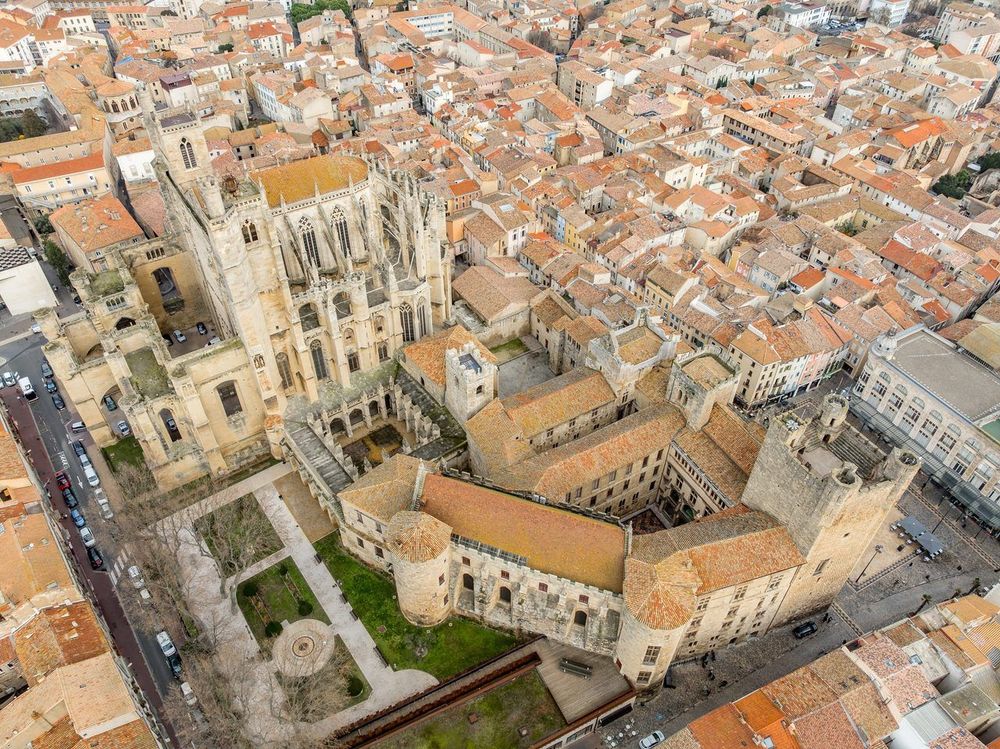
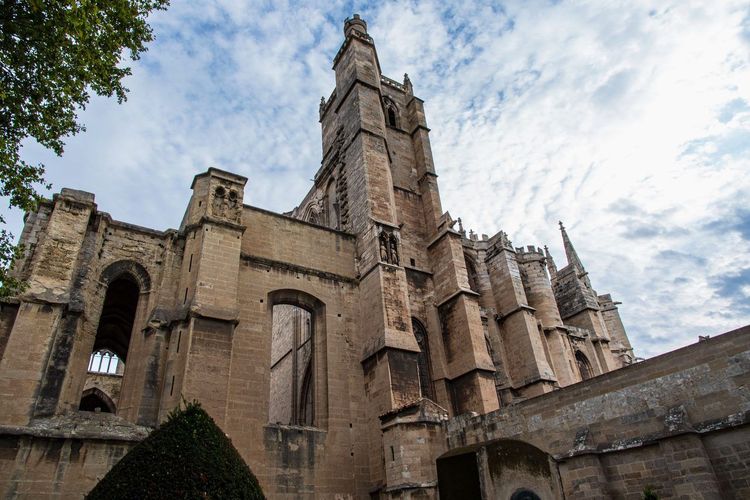
The city center of Narbonne can be visited on foot in a morning, as long as you're not rushing through everything. It usually starts at the Place de l'Hôtel de Ville, where the imposing ensemble formed by the Cathédrale Saint-Just-et-Saint-Pasteur and the Palais des Archevêques stands. The cathedral, begun in 1272 on the model of the great cathedrals of northern France, was never completed: for lack of funds and space for its flying buttresses, only the Gothic choir was built, still soaring to 41 meters beneath its vaults — one of the highest in France after Amiens and Beauvais.
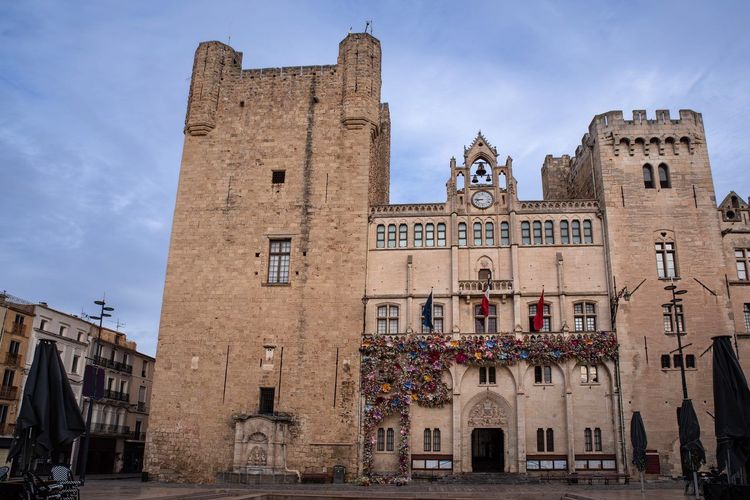
Right next door, the Palais des Archevêques today houses the town hall and several museums. Its neo-Gothic facade, designed in the 19th century by Viollet-le-Duc, conceals much older medieval towers: the donjon Gilles Aycelin, which you can climb for a panoramic view over the tiled rooftops and, on a clear day, all the way to the Mediterranean.
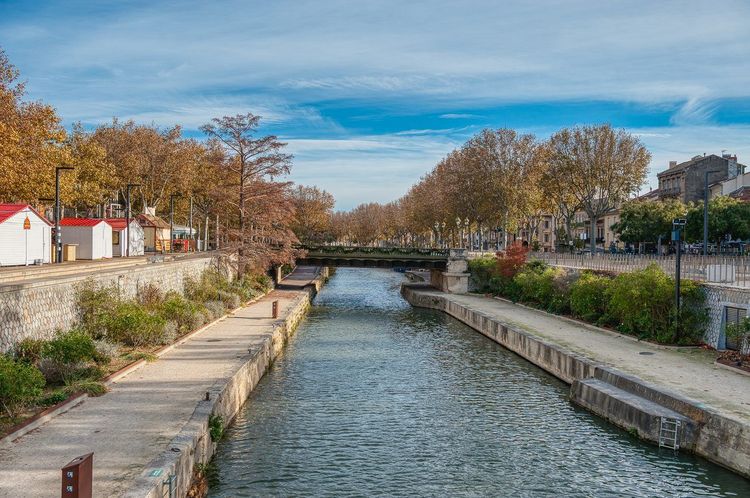
Stepping out onto the square, turn right toward the canal de la Robine: this former branch of the Aude river, developed as early as the 14th century and made navigable all the way to the Canal du Midi in 1787, listed as a UNESCO World Heritage extension of the Canal du Midi, runs through Narbonne from end to end and divides the city into two neighborhoods. Its shaded quays are lined with terraces, and the barges that moor there in summer give the city center an almost Provençal rhythm. A few steps from the canal, the Halles de Narbonne (Cours Théodore Mommsen, 11100 Narbonne, rated 4.5/5 on Google based on 21,024 reviews), a metal market hall from 1901 still operating every day, are worth a visit for their ironwork structure alone.
The last stop in this city core: the remains of the Via Domitia, visible in the open air on the Place de l'Hôtel de Ville itself. These stone slabs worn down by cart traffic belong to the first Roman road built in Gaul, linking Italy to Spain as early as 118 BC. Narbonne (Narbo Martius) was its official starting point, the capital of Rome's first province in Gaul. It's a relic you almost stumble upon while crossing the square, with barely any barrier to signal it — which makes it one of the most unexpected encounters in the historic center.
To make the most of this sequence — cathedral, palace, canal, and Roman ruins — the Ryo audio tour of Narbonne connects these points in one continuous loop: its 20 audio stops, spread over about 1h40 of walking, tell the story of each facade at the exact moment you're standing in front of it, without having to search for explanations on a panel.
The Must-See Museums of Narbonne
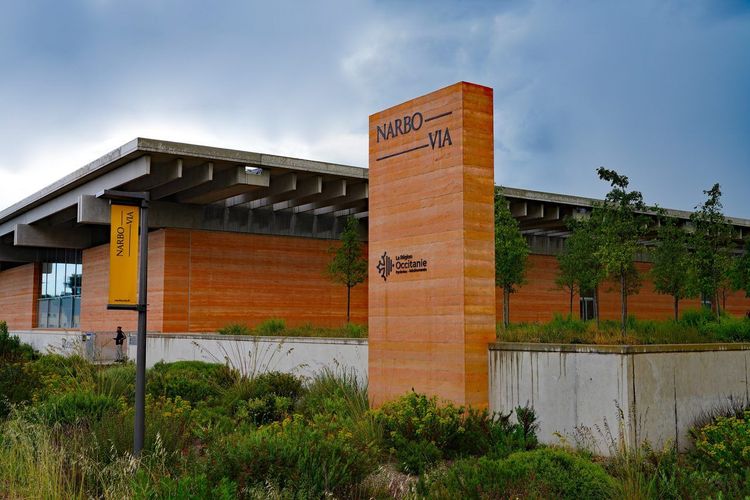
Three sites grouped under the Narbo Via banner complement a visit to the historic center, each offering a different angle on the city's ancient past. The Narbo Via archaeological museum, opened in 2021 in a building designed by Foster + Partners at the eastern entrance to the city, holds one of the largest collections of Roman stonework in France. Its centerpiece, the lapidary gallery, lines up nearly 800 carved blocks along a wall 76 meters long and 10 meters high: funerary steles, friezes, and monument fragments that François I had embedded in the city's ramparts during the Renaissance.
If you've read older guidebooks, you may come across the lapidary museum of the église Notre-Dame-de-Lamourguier: it closed in 2018, when these blocks — recovered from 1868 onward during the dismantling of the city's fortifications — were transferred to Narbo Via. There is no point trying to visit it; the new museum is where they are now on display.
The third site, the Roman Horréum museum (Rue Rouget de Lisle, 11100 Narbonne, rated 4.2/5 on Google based on 1,586 reviews), is perhaps the most surprising: you descend below the current street level to walk through an underground warehouse from the 1st century BC, where the Romans stored grain and goods transported via the river port. The vaulted galleries, cool even in the height of summer, give a sense of time travel that neither Narbo Via nor the lapidary museum quite replicates.
The third site in the network, Amphoralis, is located in Sallèles-d'Aude, about twenty minutes to the northwest: this open-air museum presents a Gallo-Roman potter's workshop and its amphora kilns — an excursion that pairs well with a walk along the canal. On the budget side, expect to pay €12 for Narbo Via and from €5 for the Horréum, or €17 for a three-site pass valid for one month; entry is free for under-18s and on the first Sunday of each month.
If you can only choose one, go for Narbo Via for the general context, then the Horréum if time allows: the two complement each other far more than they overlap. The Ryo audio guide also comments on the facade of the Palais des Archevêques just before entering the archaeological collections — a useful transition between a narrated walk and a museum visit.
Narbonne-Plage and Seaside Activities
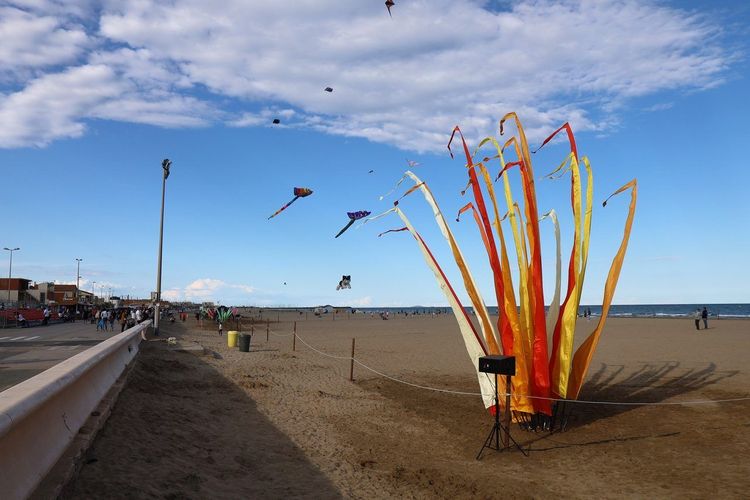
About 15 kilometers from the city center — roughly twenty minutes by car or bus (a dedicated line runs in summer) — Narbonne-Plage (11100 Narbonne, rated 4.6/5 on Google based on 1,741 reviews) stretches nearly 5 km of fine sand along the Gulf of Lion. It is the city's seaside resort, backed by the limestone cliffs of the Clape massif, which gives it a greener setting than most resorts along the Languedoc coast.
The water is shallow for a good distance offshore, making it a particularly family-friendly beach for young children. In terms of facilities, lifeguard posts in season, water sports equipment rental, and a handful of restaurants with sand underfoot are more than enough to fill a full day without returning to the city.
For a change of perspective, a boat trip on the canal de la Robine or on the nearby lagoon offers a different way to experience Narbonne: local companies offer outings from one hour to half a day, some combining sailing with wine or local oyster tastings. Try to book a late-afternoon slot: the raking light over the Bages-Sigean lagoon is at its best then, and the heat has faded.
Just beyond Narbonne-Plage, several wilder coves stretch southward toward Gruissan, a village whose houses spiral in a circle around the Tour Barberousse, about fifteen minutes by road. Less crowded than the main beach in high season, they are better suited to those seeking quiet rather than organized activities.
If your stay exceeds two days, alternating mornings in the city center with afternoons at the beach remains the most comfortable balance: the two worlds are only twenty minutes apart — close enough that you don't have to sacrifice one for the other.
Food and Drink: Markets, Halls, and Good Addresses
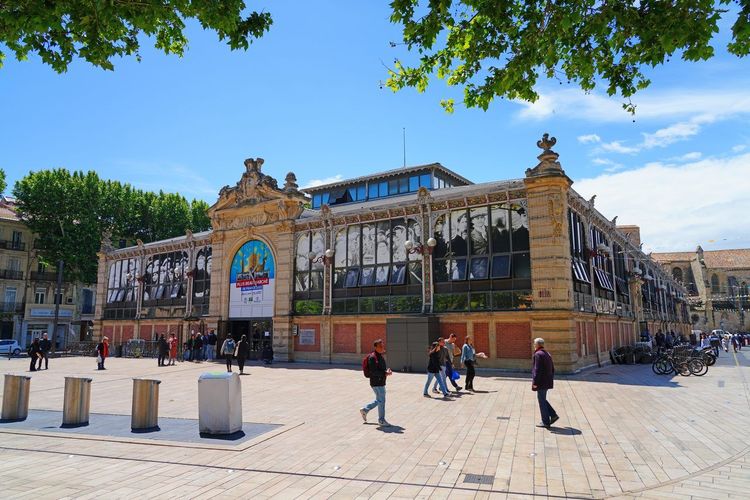
Narbonne is as much to be eaten as visited. The Halles de Narbonne, already encountered in the historic center, are also the best place to sample local produce: marinated Collioure anchovies, petit-gris snails prepared in persillade, Corbières charcuterie, and aged goat's cheeses sit side by side across some thirty stalls open every morning of the year, Sundays included.
On the wine front, two local appellations deserve attention: La Clape, grown on a limestone massif overlooking the sea and producing briny whites that are quite rare in Languedoc, and Corbières, a larger and better-known wine region prized for its full-bodied reds. Wine shops in the city center offer walk-in tastings daily without a reservation.
Outside the market hall, open-air markets are held several times a week on different squares in the center, notably on Thursdays, traditionally the day with the most local producers. It is often there, more than in a restaurant, that the city's specialties truly reveal themselves.
For a sit-down meal, a simple rule of thumb: have lunch directly at the market halls, where several counters cook market-fresh produce to order, then save dinner for the terraces along the Robine quays or the tables near the cathedral quarter. Book the night before in high season — the best-located spots fill up quickly.
One stop on the Ryo audio tour tells the story of this century-old market hall just before you step inside — a natural way to combine the covered market with a narrated walk without breaking the flow of your visit.
Around Narbonne: Fontfroide Abbey and the Wine Route
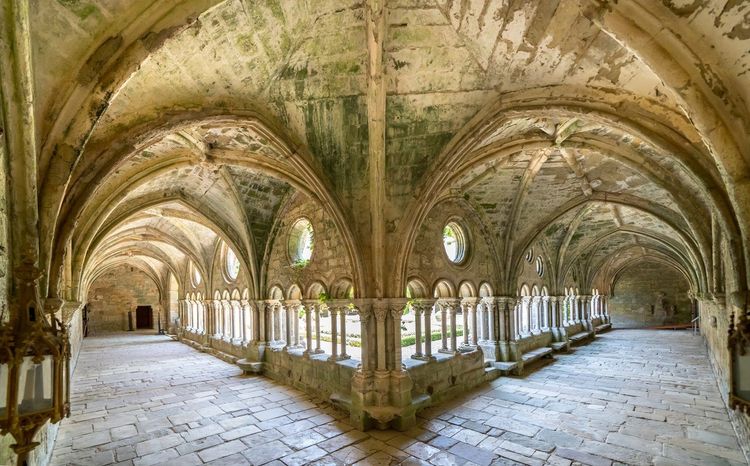
About twenty minutes southwest of the city center, Abbaye Sainte-Marie de Fontfroide ranks among the most beautiful Cistercian abbeys in southern France. Founded in 1093 and inhabited by a community until the early 20th century, it was purchased by a private family who has maintained it for over a hundred years — which accounts for its excellent state of preservation. The Romanesque cloister, the terraced gardens planted with cypresses and old roses, and the abbey church with its remarkable acoustics are reason enough for a half-day excursion on their own. In summer, the abbey also organizes evening concerts in the church — an experience quite different from the standard daytime visit.
The area around Fontfroide is home to one of the densest wine-growing landscapes in the region, and exploring the Languedoc-Roussillon wine route from Narbonne is very doable in a day if you pick your stops wisely. Château l'Hospitalet, a wine estate a few kilometers from Narbonne-Plage, cultivates much of its vineyard biodynamically and offers cellar tours, tastings, and even an on-site hotel-restaurant, making it a complete destination in its own right. Further north, Château Camplazens, perched on the heights of the Clape massif, offers an open view over the garrigue and the vines from its tasting terrace — an argument that counts as much as the wine for many visitors. For a longer stay, Château de Paraza, on the banks of the Canal du Midi, offers guest rooms in a 17th-century building where Pierre-Paul Riquet, the canal's engineer, stayed during construction. Finally, Château de Lastours (11490 Portel-des-Corbières, rated 4.6/5 on Google based on 293 reviews), in the wilder Corbières, combines wine tasting with an outdoor contemporary sculpture trail and hiking paths through the vines — a complete experience for those who want more than a simple cellar visit.
If time is short, a good compromise is to pair the abbey visit with just one wine estate rather than hopping between cellars in the same day: the country roads, winding and often limited to 70 km/h, take longer than they look on a map. Expect to pay between €15 and €25 for a tasting of three to four wines at most of these estates; reservations are recommended on weekends in summer.
The mineral, saline whites from l'Hospitalet contrast sharply with the fuller-bodied reds of Lastours or Camplazens, typical of the stony soils of the Corbières — a good reason to visit several estates rather than just one if time allows. A car is essential for this excursion: none of these sites is really accessible by public transport from Narbonne, and the distances, though not long (10 to 30 minutes depending on the estate), are best covered at your own pace.
Day Trips from Narbonne: Villages and Nearby Towns
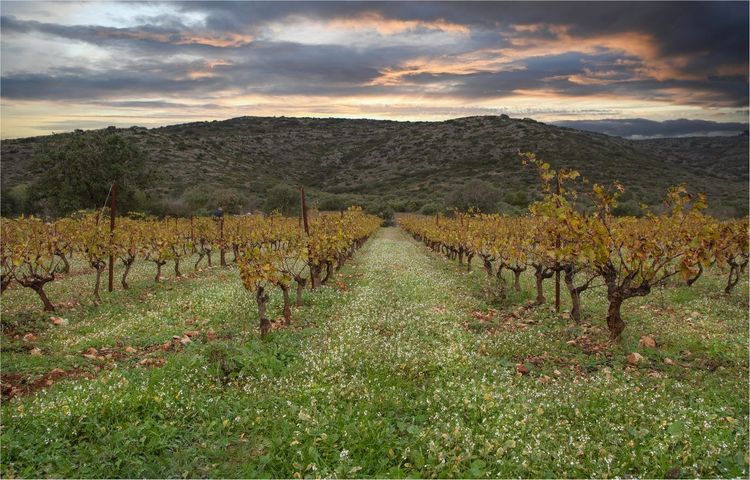
Narbonne also lends itself very well to day trips to towns and villages that rank among the most charming in Languedoc-Roussillon and the neighboring Roussillon. Three directions stand out clearly depending on what you're in the mood for: the coast, the Corbières hinterland, or the Catalan border.
Along the coast, soaking up the charm of Collioure takes about 1h15 by road heading south. The old Catalan fishing port, with its lighthouse-bell tower rising from the water and its pastel-colored alleyways that inspired Matisse and Derain in the early 20th century, is best visited early in the morning before the day-trippers arrive. On the way, experiencing the energy of Perpignan (about 1 hour by road) offers a complete contrast with the pace of Narbonne: a colorful market, a proudly Catalan identity right down to the architecture, and a city center that stays lively well into the evening — unlike Narbonne, which tends to wind down earlier.
Heading inland, the hilltop villages of the Corbières form a world of their own. Lagrasse, often cited among France's most beautiful villages, lines its medieval houses along the Orbieu river, about three-quarters of an hour by road. Further south, the Cathar castles of Peyrepertuse and Quéribus, perched on dramatic rocky peaks, pair well with a stop in a village such as Villerouge-Termenès, where the last Cathar parfait was burned in 1321. These three destinations are difficult to combine in a single day from Narbonne: it's better to pick one axis — either the Catalan coast or the Cathar Corbières — rather than trying to fit in everything.
Between these two poles, two shorter stops fit easily into a there-and-back trip: the fishing village of Bages, with its houses sitting at the edge of the Bages-Sigean lagoon, just 10 minutes from Narbonne, and the Sigean African Reserve, a 300-hectare wildlife park where lions and giraffes roam in semi-freedom — particularly well suited to a family outing on the road to Perpignan.
To help you decide, ask yourself one simple question: are you looking for sea and color (Collioure, Perpignan) or medieval heritage and panoramic views (Corbières, Lagrasse)? The answer almost always points you in the right direction faster than any lengthy itinerary comparison.
To dig deeper into your options, the Ryo article on the 13 most beautiful villages around Narbonne details each option with travel times and highlights, giving you everything you need to build a tailor-made itinerary based on how many days you have.
Where to Stay in Narbonne
Three neighborhoods compete for visitors' favor when it comes to spending a night in Narbonne. The historic center, around the cathedral and the canal, suits those who want to do everything on foot: charming hotels in old buildings, bed and breakfasts above the market halls — but also the city's highest prices in high season.
Near the SNCF train station, chain hotels offer good value for money and are particularly convenient for travelers arriving by train late at night or leaving early in the morning, even if it means a ten-minute walk to reach the historic center.
Finally, staying on the Narbonne-Plage side makes sense for a multi-day beach holiday: campsites, seasonal rentals, and holiday residences are plentiful there, with the drawback that you'll need to drive every time you want to visit the city center.
Whatever neighborhood you choose, booking several weeks in advance is advisable in July and August, when the city combines urban tourism with seaside crowds. Out of season, the picture changes completely: booking in Narbonne for November, for example, is straightforward even a week before departure, and prices drop noticeably compared to summer.
Good to Know Before You Go
For a first visit, allow a full day for the historic center and the museums, and two days if you're adding Narbonne-Plage or an excursion to Fontfroide and the vineyards. Beyond that, the city itself can feel explored, but the surroundings — the Corbières, the Catalan coast — can easily fill three or four additional days.
On the budget side, a day in Narbonne remains affordable compared to many other cities in the south of France: the Narbo Via sites cost between €5 and €12 (€17 for the three-site pass, free on the first Sunday of each month), the market halls let you eat on the go for around ten euros, and wine excursions add €15 to €25 per tasting if you choose to take part.
The best time to visit runs from April to June and then September to October: temperatures are pleasant without the sometimes stifling heat of July and August, and tourist numbers drop noticeably after the summer holidays. Winter, cooler but rarely harsh thanks to the Mediterranean proximity, is well suited to a cultural visit without the crowds.
Narbonne also marks its year with events and festivities: Christmas markets, summer fêtes votives with bullfights and bandas in the streets, and harvest celebrations in September in the surrounding wine villages. Checking the calendar before fixing your dates can sometimes let you time your visit to coincide with one of these events — or equally, to avoid them if you're looking for peace and quiet.
One final practical note: once you've parked, the entire historic center can be explored on foot, which makes organizing a first visit considerably simpler than in larger, more spread-out cities.
FAQ
Is Narbonne worth visiting?
Yes, without hesitation for a first trip to the Aude: few cities of this size combine a major Gothic cathedral, a UNESCO-listed canal, open-air Roman ruins, and a beach just twenty minutes away. One day is enough for the center, but two days let you add the sea or the surrounding wine country.
How Much Time Should I Plan to Visit Narbonne?
A full day covers the historic center and one museum. Allow two days to add Narbonne-Plage or a trip to Fontfroide, and three to four days if you include the villages of the Corbières or the nearby Catalan coast.
How Do I Get to Narbonne from Paris or Toulouse?
From Paris, the direct TGV takes about 4h30. From Toulouse, allow 1h30 by train on the classic line, or about 1h45 by car via the A61. By train, the station drops you off ten minutes' walk from the historic center.
What Is the Best Time to Visit Narbonne?
April to June and September to October offer the best balance between pleasant weather and low crowds. July and August remain very busy and hotter, while winter, mild thanks to the Mediterranean proximity, is well suited to a cultural visit without the crowds.
Where Can I Park Easily in Narbonne?
Several covered car parks surround the historic center, particularly near the Halles and the Palais des Archevêques, with reasonable hourly rates. Avoid looking for a surface parking spot on Saturday mornings, when crowds are heaviest around the market halls.
What Local Specialties Should I Try in Narbonne?
Marinated anchovies, petit-gris snails in persillade, and wines from the La Clape and Corbières appellations are among the must-tries. The Halles de Narbonne remain the best place to sample several local specialties in a single visit, straight from the producers.
Narbonne doesn't need several days to win you over: an unfinished cathedral, a UNESCO-listed canal, open-air Roman ruins, and a beach twenty minutes away are enough to fill a two- or three-day stay without a dull moment. It's precisely the density of the historic center, where everything can be explored on foot in a few hours, that makes the city accessible even for a quick first visit.
To explore the city center at your own pace, without being tied to the schedule of a classic guided tour, the Ryo audio tour of Narbonne is the most flexible option: its 20 commented stops can be launched at any time of day, paused at will on a canal terrace, and ended whenever you decide rather than when the group dictates. The perfect way to turn a hesitant first visit into a self-guided stroll — cathedral, palace, canal, and Roman ruins included.