© Shutterstock
 Votre guide Ryo
Unusual Visit to Nîmes: 15 Off-the-Beaten-Path Experiences in 2026
Unusual visit to Nîmes: behind the arenas and the Maison Carrée that the city proudly displays on every postcard lies a side that most hurried visitors never see. Setting out on an unusual visit to Nîmes means accepting to look up at a stone footbridge suspended in a courtyard, to search for a cast-iron crocodile hiding against a facade, or to sleep in a transparent bubble twenty minutes from the city center. The Ryo audio guide tour of Nîmes already covers the major classics; this guide goes in search of what remains off the beaten path.
Along the way you'll encounter a miniature aqueduct planted in the middle of a residential intersection, an arena that can also be visited at night, vaulted galleries carved beneath the buildings of the old city center, and a herd of bison grazing a few kilometers from the Gard prefecture. On this list of fifteen experiences, some take an hour and are free, while others require booking an entire night in a treehouse. Enough to turn a classic weekend into a getaway that truly steps outside the ordinary.
The Nîmes Arena Seen Differently
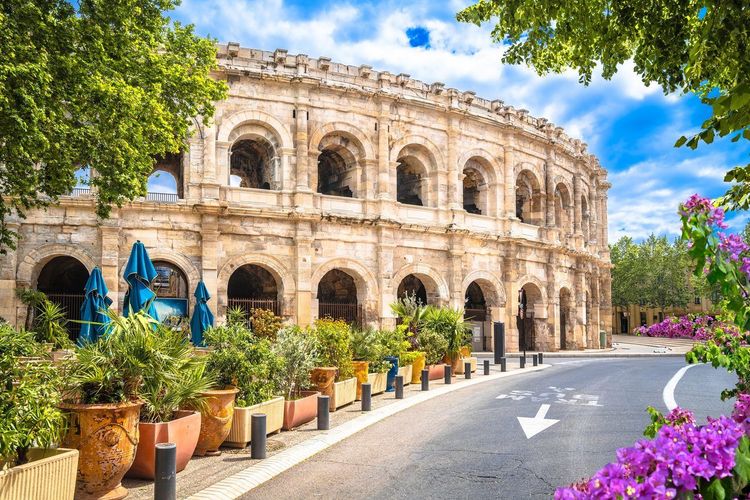
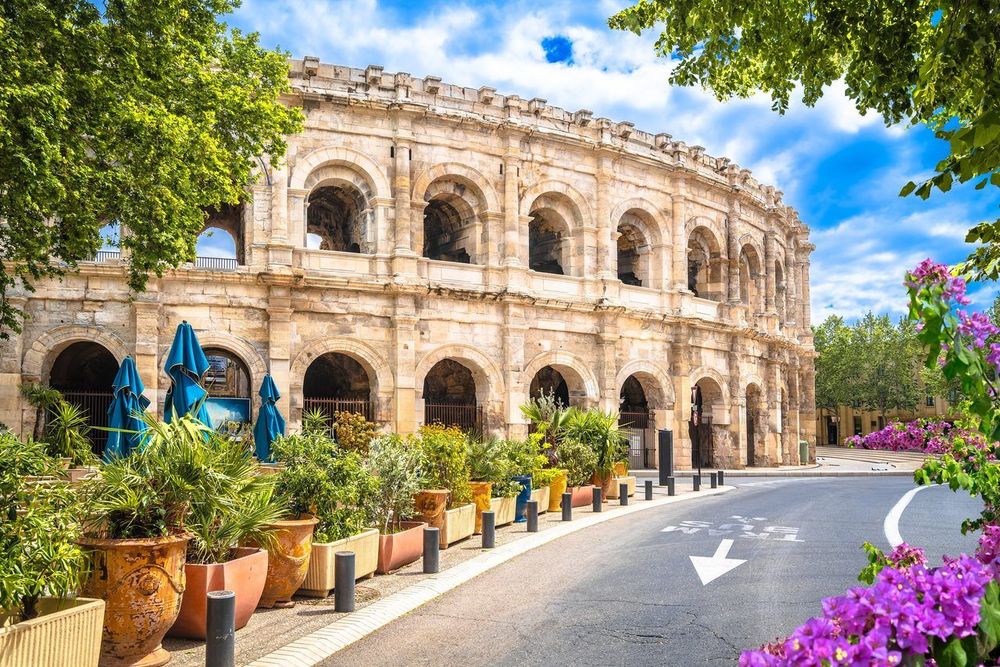
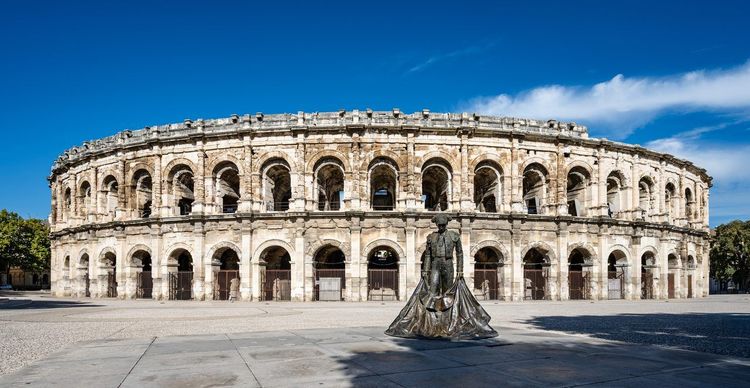
The Nîmes Arena (4 Boulevard des Arènes, 30000 Nîmes, rated 4.6/5 on Google with 39,048 reviews) appears in every tourist brochure in the Gard, and for good reason: this 1st-century Roman amphitheater ranks among the best preserved in the world, alongside those of Arles and El Djem. Twenty-four thousand spectators could once fill its seats to watch gladiator fights, compared to just over thirteen thousand today for concerts and Ferias. But most visitors settle for a daytime visit, ticket in hand, never suspecting what the building holds after dark.
For several seasons now, a nighttime visit has allowed visitors to walk the tiers in the glow of spotlights, audio headset on, while a narration recreates the atmosphere of an ancient games day. The experience completely changes the perception of the place: the shadows cast on the limestone, the silence of the empty rows, the wind rushing through the arcades — everything serves as a reminder that this monument has endured two thousand years without ever ceasing to welcome the public.
Few visitors also descend beneath the arena itself. The service galleries, which once ran under the sand to bring sets and wild animals surging into the middle of the combat, can be visited during special days organized by the city. There you discover the ingenuity of a system of trapdoors and winches conceived long before the invention of the motor, and the scale of the titanic construction project the building represented using simple Roman tools.
For an unusual visit to Nîmes that truly steps off the beaten path, aim for a weekday outside the major spring and September Ferias: the tiers empty out, the raking late-afternoon light sculpts the stone, and it becomes possible to linger without jostling on the upper rows — those once reserved for the common people — where the view over the city's pink roof tiles is at its widest.
This monument remains the logical gateway to understanding the rest of the city: almost everything, from the gardens to the Castellum, was built in echo of this arena that already stood at the center of the Roman city, the very starting point our Nîmes audio-guided tour picks up first.
The Maison Carrée and Its Secret Forecourt
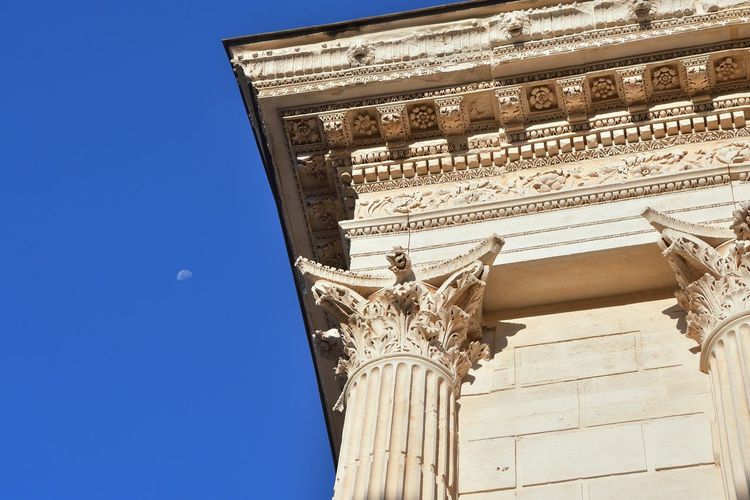
The Maison Carrée is the best-preserved Roman temple in the world, a distinction that always surprises visitors who came simply to see "just" an arena. Built at the end of the 1st century BCE in tribute to the emperor Augustus's grandsons, it has survived the centuries by changing function several times: stable, church, archive depot, then museum. Since September 2023, it has been inscribed on the UNESCO World Heritage List, a distinction that makes it the first monument in the city to earn that label, ahead of even the arena.
What most tourists don't realize is that the square in front of the temple was entirely redesigned by British architect Norman Foster, who also designed the Carré d'Art directly opposite. The dialogue between the contemporary glass facade and the two-thousand-year-old Corinthian columns is worth the visit on its own, especially at the end of the day when the raking sun turns the temple's limestone red while the contemporary art museum's glass reflects it back.
Inside, an immersive film projected in 3D on a giant screen tells the city's history without any human guide: a surprising way to visit an ancient monument, with an augmented reality headset available as an option for certain screenings. Many visitors head straight to the arena without ever pushing open the door, missing one of the few places where the history of Nîmes is told in fifteen minutes.
Nearby, take a look at the Carré d'Art directly opposite: its terrace offers one of the best free vantage points over the temple, well above the crowd gathered at street level.
The Jardins de la Fontaine and the Nymphaeum Grotto
The Jardins de la Fontaine rank among the first public gardens in Europe, laid out in the 18th century directly on the site of a Roman sanctuary dedicated to the cult of water. Past the grand balustraded basin and the neoclassical statues lining the main avenue, most visitors stop at the first lawn without ever climbing toward the back of the park, where the scenery shifts abruptly from a French formal garden to wild garrigue.
It is there, at the foot of the hill, that the Nymphaeum grotto hides: a turquoise pool fed by the spring that gave rise to the entire ancient city. Nemausus, the local deity that gave Nîmes its name, was worshipped here, in a damp half-darkness where water still seeps through the limestone walls. Few guides mention that this spring has flowed continuously since Roman times and still partly feeds the garden's basins.
Just beside it, the remains of the Temple of Diana surprise visitors with their partial state of preservation: a half-collapsed vault, niches that once housed statues, and a romantic ruined atmosphere quite different from the rigorous order of the arena. Legend has it that Benedictine monks occupied the site in the Middle Ages before a fire ravaged it in the 16th century during the Wars of Religion.
The park is also home to peacocks that roam freely among the flowerbeds, an unexpected presence that many visitors discover by surprise turning a corner. In the late afternoon, once the tour groups have deserted the gardens for the arena, the Jardins de la Fontaine offer one of the few moments of calm in the city center, shaded by century-old plane trees.
To extend the walk, a discreet staircase climbs from the back of the park to the top of Mont Cavalier, where the city's least-known tower awaits.
The Tour Magne, the Panorama Visitors Forget
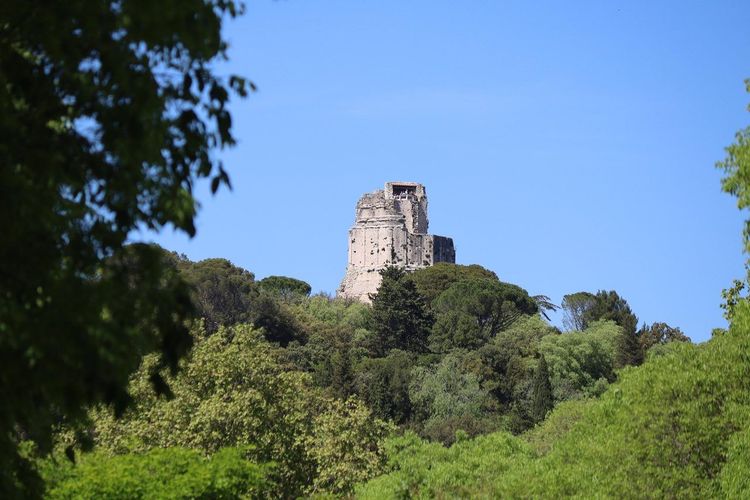
The Tour Magne dominates Nîmes from its thirty-two meters, perched on the highest point of Mont Cavalier. Built under Augustus, it formed one of the strongpoints of the ancient Roman wall, nearly seven kilometers long, making it the tallest tower of its kind preserved in France.
Unlike the arena or the Maison Carrée, the tower is rarely climbed on impulse: most tourists don't go beyond the Jardins de la Fontaine and thus miss the widest panorama over the city, the Cévennes on the horizon, and on a clear day, Mont Ventoux to the east.
The ascent is made via a fairly steep spiral staircase, but the reward justifies the effort: no other view of Nîmes allows you to grasp in a single glance the alignment between the arena, the Maison Carrée, and the outline of the ancient Roman rampart. Go up in the late morning, when the raking light still sculpts the tiled rooftops better than the midday sun.
Rarely busy on weekdays, the tower remains one of the best examples of an unusual visit to Nîmes accessible without a reservation or an expensive ticket.
On the Trail of the Nîmes Crocodiles
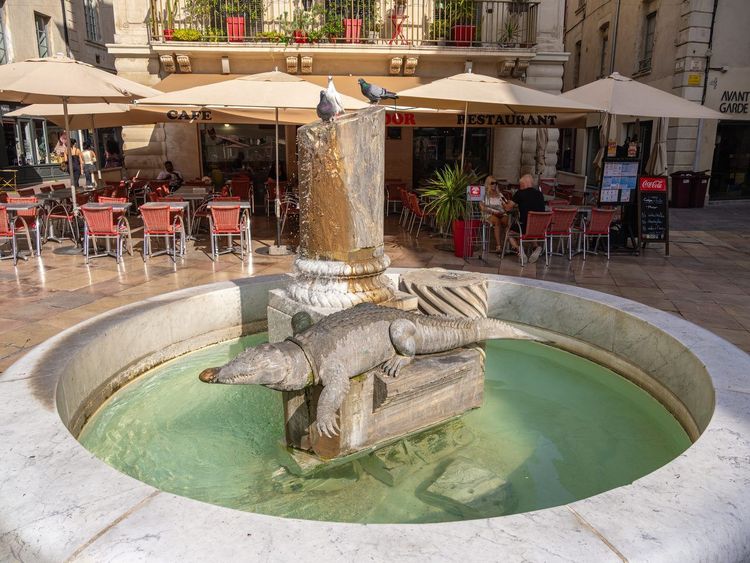
The crocodile chained to a palm tree has become, along with the salamander, the official emblem of Nîmes — a symbol inherited from the veterans of the Roman legion who settled in the city after Augustus's conquest of Egypt. It can be found almost everywhere, provided you know where to look.
The most famous version adorns the Fontaine Pradier (Esplanade Charles-de-Gaulle, 30000 Nîmes, rated 4.6/5 on Google with 1,022 reviews), on the Esplanade Charles-de-Gaulle, where the bronze reptile has literally been spouting water since 1848. But the coat of arms also appears on the gates of many public buildings, on manhole covers in the city center, and even on some jerseys worn by the local rugby club.
A quiet game involves spotting the crocodiles hidden on the facades of old Nîmes: carved in stone above a doorway, painted on a shop front, or integrated into recent street furniture near the tram. Children generally love this improvised treasure hunt, which turns a simple stroll through the alleyways into a scavenger game.
The symbol has even made its way into the city's shop windows, where several retailers sell figurines, magnets, and T-shirts bearing the reptile's image. A playful way to understand just how deeply Nîmes claims its Roman heritage, down to the smallest details of its street furniture.
The Castellum, a Roman Relic Hidden on a Street
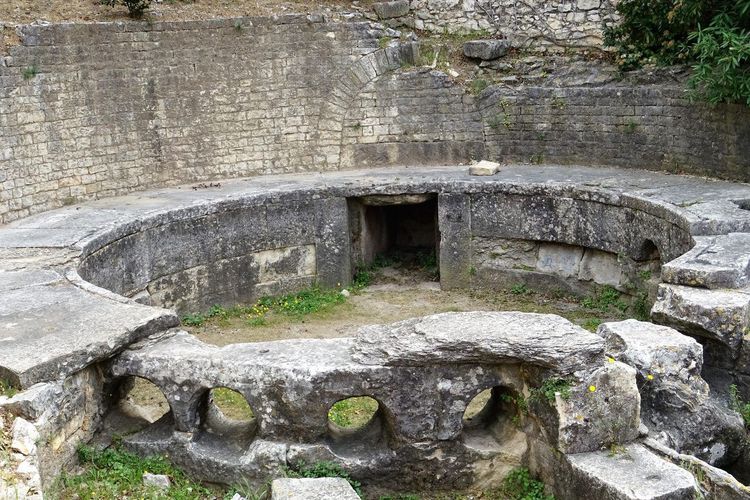
Few visitors — and even few residents of Nîmes — know that a major ancient relic hides at the end of a residential dead end, wedged between two ordinary apartment buildings. The Castellum divisorum is the only Roman water-distribution basin preserved anywhere in the world: this is where the water arrived, carried from the Eure spring near Uzès via the aqueduct that crosses the Pont du Gard.
Ten lead plugs, still visible, were used to distribute the flow between the different districts of the ancient city according to a carefully calculated system of priorities. The discovery in 1844 provided archaeologists with concrete evidence about how Roman water networks actually functioned — previously known only through the writings of Vitruvius.
Access is free, making it one of the quickest visits in the city: allow barely ten minutes to take it all in, slotted between two stops on a longer tour of the historic center.
The Musée de la Romanité, Rome Seen from the Rooftops
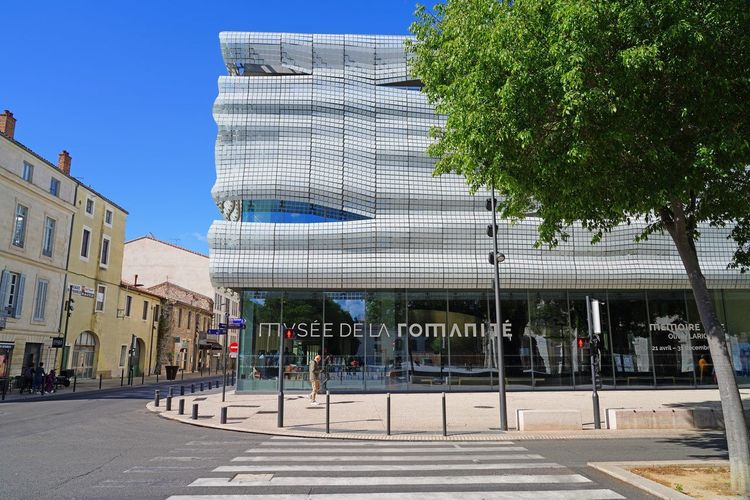
Opened in 2018 directly opposite the arena, the Musée de la Romanité (16 Boulevard des Arènes, 30000 Nîmes, rated 4.6/5 on Google with 5,630 reviews) breaks radically with the usual image of ancient history museums. Its undulating facade, composed of eight thousand screen-printed glass panels evoking a draped Roman toga, initially divided the people of Nîmes before becoming one of the most photographed buildings in the city.
What many visitors miss — rushing to discover the archaeological collections inside — is the museum's rooftop terrace, laid out as a Mediterranean garden planted with olive trees, vines, and aromatic plants arranged along a layout that echoes the plan of a Roman villa. The view from this terrace takes in both the arena below and the hills encircling the city, a free vantage point accessible even without a ticket to the collections.
Inside, the collection traces the history of Nîmes from the Iron Age to the Middle Ages through several thousand objects, monumental mosaics, and ancient jewelry, presented in an immersive scenography that uses projections and digital reconstructions rather than simple display cases.
Nîmes Through Street Art and Surprising Architecture

Contemporary Nîmes is not limited to its Roman remains: for some thirty years, the city has also cultivated a clear taste for bold architecture and street art, to the point of becoming a surprising playground for anyone who looks up between two Haussmann-era facades.
On Rue Fontfroide, a private mansion catches the eye with its facade completely unlike anything else on the street: twisted columns, extravagant ironwork, sculptured bay windows. It looks more like a fantasy film set than a residential street in the city center. Built at the turn of the 20th century by an owner who was clearly unconcerned with the architectural conventions of the day, the building continues to intrigue passersby who have never heard of its existence before stumbling upon it by chance.
A few streets away, a facade entirely covered in vivid colors has established itself as one of the favorite photo spots for visitors passing through Nîmes. The contrast between the pastel tones of the traditional Gard buildings and this chromatic explosion creates a backdrop that cuts sharply against the rest of the neighborhood, so much so that many visitors stop without knowing exactly what they are looking at.
Even more surprising: a tram stop designed by Philippe Starck, whose minimalist design makes it a self-contained urban object rather than a simple public transport shelter. The French designer, known for creations combining function with radical aesthetics, imagined a structure that sparked controversy at its inauguration before becoming one of the symbols of Nîmes's architectural renewal.
Not far away, a house entirely covered in colorful mosaics directly evokes the work of Antoni Gaudí in Barcelona, with its ceramic fragments assembled into organic patterns across the entire facade. The owner spent years patiently covering every square centimeter of the house, turning his personal residence into an open-air work of art that residents of Nîmes are happy to point out to visitors passing through.
In the Écusson district, several murals created during successive street art festivals adorn blank gable walls, renewed almost every year. A way of transforming once-neglected walls into an open-air gallery, free and accessible at any hour. The contrast with the ancient monuments of the center, just a few hundred meters away, neatly sums up the temporal leap that defines Nîmes today.
Taken together, these stops make up a walking itinerary of about two hours that passes through residential neighborhoods rarely visited, far from the queues at the arena. It is also one of the most economical ways to experience an unusual visit to Nîmes, since none of these curiosities requires an entrance ticket.
Beneath the Cobblestones: Vaulted Galleries and Underground Passages of Nîmes
Beneath the urban fabric of the Écusson, Nîmes's historic center, stretches a network of vaulted galleries and medieval cellars largely unknown to passing visitors. Some date from the Middle Ages, dug to store wine or to discreetly connect convents; others served as refuges during the Wars of Religion that deeply scarred the city in the 16th and 17th centuries.
Supervised spelunking visits, organized occasionally by local associations, allow visitors to descend into these galleries by headlamp, hard hat on. The experience surprises through the temperature contrast — several degrees cooler than at the surface — and the humidity seeping through limestone walls several centuries old.
Some businesses in the city center, notably restaurants set up in old vaulted cellars, offer a glimpse of this underground network without any specific visit needed. A simple meal in one of these vaulted rooms is enough to sense the historical depth of the Nîmes subsoil, so often overlooked by visitors focused on the monuments above ground.
For those who want to explore the subject more thoroughly, the tourist office organizes a few guided visits per year of this underground Nîmes, a format that sells out as soon as it goes online, such is the curiosity surrounding these galleries.
Sleeping in an Unusual Place Around Nîmes
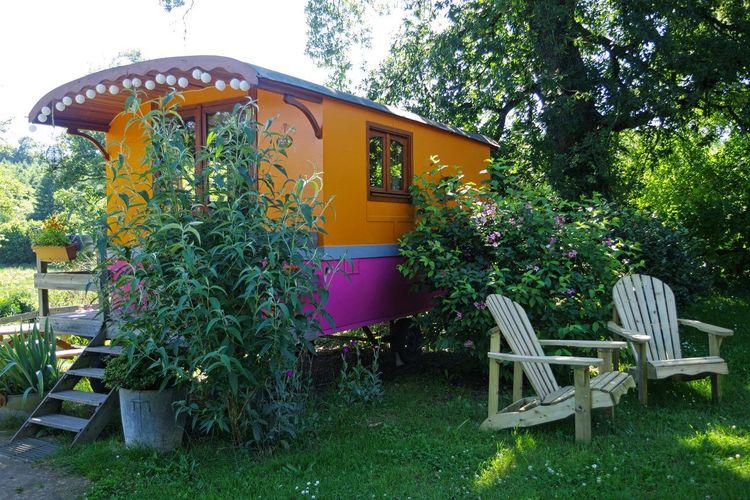
Spending the night in an unusual place naturally extends a day of off-the-beaten-path sightseeing, and the Gard is full of addresses that go well beyond the classic city-center hotel. Less than an hour's drive from Nîmes, several estates have chosen alternative accommodation over standard rooms.
Treehouses and transparent bubbles, set in the heart of nature between vineyards and garrigue, allow you to sleep under the stars without giving up the comfort of a private jacuzzi or a wood-burning stove. Some estates even offer themed rooms — one inspired by Bali, another by Japan — in villas with a shared pool.
Further south, toward the Camargue, sleeping on a houseboat moored along the Rhône canal offers a radically different experience: the lapping of water against the hull as background noise, horses and bulls sometimes grazing a few meters from the boat, and direct access to the lagoons at dawn — the best time to watch the flamingos.
Safari tent and yurt enthusiasts will also find their ideal stay at several campgrounds in the Gard, where wooden caravans and canvas lodges replace the classic mobile homes. Expect to pay generally between 90 and 220 euros per night depending on the standard and whether or not a private spa is included — a budget comparable to a good gastronomic dinner in Nîmes for two. Many of these establishments require a minimum of two nights on weekends, a detail worth checking before confirming the booking.
Many travelers also follow this unusual overnight stay with the Ryo audio guide tour the next morning, to keep the experience going with no downtime between nature and heritage. Before booking, keep in mind that these addresses sell out from spring onward for May and June weekends: it's best to plan several weeks ahead if you're targeting a specific date. Our Ryo selection of unusual accommodations in the Gard details a wider range of tried-and-tested addresses around Nîmes, from the Camargue to the Cévennes.
XXL Excursion: The Pont du Gard from Nîmes
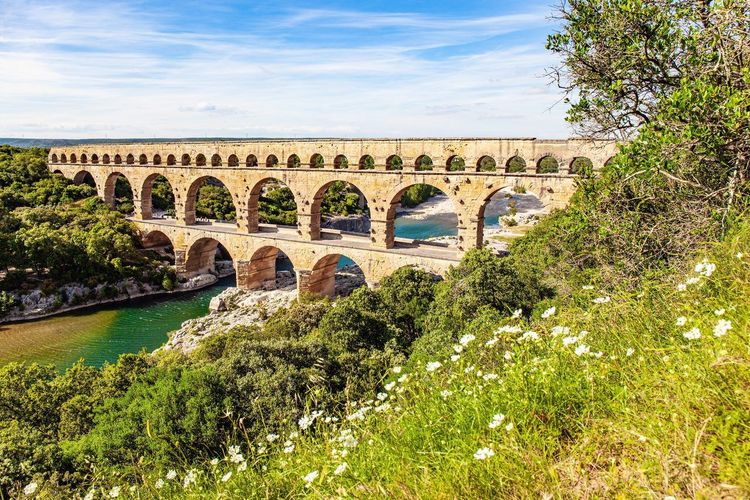
The Pont du Gard, a short half-hour drive from Nîmes, remains the most spectacular excursion for extending an unusual visit to Nîmes beyond the city walls. This Roman aqueduct, built in the 1st century to carry water from the Uzès spring to the Castellum in Nîmes, rises forty-nine meters above the Gardon and remains one of the best-preserved Roman bridges in the world.
What few hurried visitors know is that it is possible to descend to the banks of the Gardon and actually swim at the foot of the structure in summer — a radically different way of discovering the monument than the standard photo from the official viewpoint. Swimming beneath the arches, with the golden stone reflected in the turquoise water, transforms a classic heritage visit into a welcome cool-down during the summer heat of July and August in the Gard.
A museum space on the right bank traces the technical feat of the construction: the Romans managed to maintain a slope of just 34 centimeters per kilometer over nearly fifty kilometers of aqueduct, an engineering precision that remains astonishing even by modern standards. Few guides stress this detail, yet it is central to understanding the scale of the technical challenge met two thousand years ago.
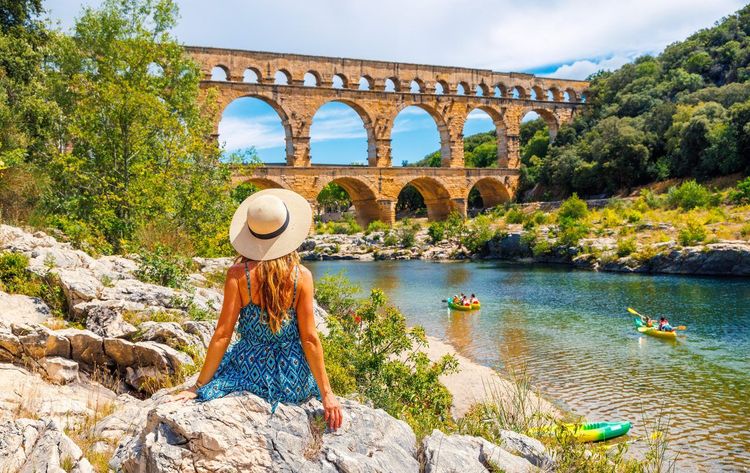
By canoe, the perspective shifts again: paddling beneath the bridge's arches, at water level, gives a sense of being dwarfed by the structure's height — a feeling completely different from the overhead view from the usual vantage points. Several rental operators offer one-to-two-hour descents on the Gardon, accessible without prior experience.
Thrills: Bison, Skydiving, and Indoor Skydiving

The Gard has a strong taste for experiences that step firmly outside the heritage framework, and some activities around Nîmes have clearly nothing Roman about them. About thirty minutes from the city, a ranch offers horseback or horse-drawn carriage rides through an authentic herd of American bison — a scene that evokes the great plains of Montana more than the Mediterranean garrigue.
The farm, spread across several dozen hectares, has been raising these impressive animals for years and offers guided rides that allow visitors to approach the herd to within just a few meters, under the supervision of guides who know each animal by its character. Children are generally fascinated by the size of these animals, far more imposing than the Camargue cattle encountered on the road.
Thrill-seekers with a taste for altitude will find what they're looking for at skydiving centers on nearby airfields, where a tandem jump lets you take in the arena, the Pont du Gard, and the foothills of the Cévennes in a single sweeping glance. The freefall lasts about thirty seconds before the canopy opens — long enough to etch a view of Nîmes that no other visitor can claim.
For a less vertiginous but equally spectacular version, an indoor skydiving wind tunnel recreates the sensations of skydiving without leaving the ground: a powerful vertical airflow allows you to float safely inside a glass tube, an activity accessible from age seven that appeals as much to families as to adrenaline seekers looking to improve their freefall skills.
These three activities share one thing in common: almost all of them require advance booking, particularly on weekends and during school holidays, when slots fill up quickly.
Living a 100% Roman Day
To go all the way with the ancient theme, several events organized in Nîmes allow visitors to spend a full day in the shoes of an inhabitant of Nemausus, the Roman city from which Nîmes takes its current name. Reenactors in legionnaire costume, mosaic workshops, gladiator combat demonstrations, and a Roman market regularly enliven the area around the arena during themed days dedicated to antiquity.
These events, often scheduled in spring, transform the historic center into a full-scale backdrop: the smell of reconstituted garum, ancient coins to handle, wax tablet writing workshops for children. The atmosphere contrasts sharply with the classic, silent visit to the monuments outside of these dates.
The full program varies each year, but generally includes an armored procession through the streets of the center and choreographed fights inside the arena itself, replaying the great moments in the monument's history before a captivated audience. Booking seats well in advance is essential for evening shows, which sell out several weeks before the event date. To complete the program, our Ryo roundup of the best activities in Nîmes lists more outing ideas throughout the year.
The Halles Market and Nîmes's Little-Known Gastronomy
The Nîmes Halles market, covered and open every morning, remains one of the best places to taste a local specialty that few visitors know before arriving: brandade de morue, a preparation made from flaked salt cod and olive oil, whose Nîmes origins date back to the 18th century thanks to the salt trade between the port of Sète and the Camargue.
Another culinary curiosity: gardiane de taureau, a slow-cooked stew made from Camargue bull meat, traditionally served with local Camargue rice. This dish, directly inherited from the traditions of the gardians and the extensive livestock farming of the surrounding manades, barely appears on any classic tourist menu outside the region.
Between the stalls of Cévennes goat cheeses and the fishmongers unloading their Mediterranean catches from dawn onward, the Halles also offer an unexpected glimpse of Nîmes life far from the ancient monuments: producers calling out to regulars by first name, impromptu tastings between stalls, the smell of pastis and olives mingling from nine in the morning.
Nîmes Differently: Practical Tips for Your Stay
The best way to string these experiences together is to do everything on foot or by tram: the historic center of Nîmes can be covered entirely in half a day of walking, with most curiosities less than twenty minutes from one another. Allow two full days if you add the Pont du Gard and activities in the rural Gard.
The Nîmes audio-guided tour lets you follow a commented itinerary between the must-sees and a few lesser-known curiosities, without depending on a human guide's schedule or the cost of a group tour. Twenty-seven audio tracks cover nearly six kilometers of walking through the city, adaptable to your own pace. The Ryo audio guide works offline — a real advantage in the rural areas around the Pont du Gard where mobile coverage remains unreliable.
Avoid if possible the spring Feria period (late February) and the September one: the streets of the center are packed, accommodation prices rise sharply, and the festive atmosphere, however legendary, leaves little room for a quiet exploration of the historic center's singular facades. The months of May, June, or October offer equally beautiful light with far more manageable crowds.

FAQ
Which unusual visit in Nîmes should you prioritize?
Beyond the arenas and the Maison Carrée, focus on the Nymphaeum grotto in the Jardins de la Fontaine, the hunt for hidden crocodiles on the facades of the historic center, or a climb up to the Tour Magne for a panorama that few visitors take the time to discover. The Castellum, a Roman aqueduct relic planted in the middle of a residential street, ideally completes this off-the-beaten-path tour, as do the vaulted galleries running beneath the old city center. Allow a full day to cover the highlights without rushing.
Where can you sleep in an unusual place near Nîmes?
The immediate surroundings of Nîmes offer many unusual accommodations: treehouses, transparent bubbles, and villas with private spas in the Gard garrigue, houseboats moored on the Camargue canals, or safari tents and yurts in several campgrounds in the department. Rates generally range from 90 to 220 euros per night depending on the level of comfort. Book several weeks in advance for spring and summer weekends, when these accommodations fill up within just a few days.
Is Nîmes really a Roman city like Rome?
Nîmes claims the nickname of 'French Rome' thanks to the exceptional density and state of preservation of its ancient heritage: an arena still in use, an almost intact Roman temple in the Maison Carrée, and an aqueduct, the Pont du Gard, listed as a UNESCO World Heritage Site. Few European cities of this size concentrate so many functional Roman monuments within a few minutes' walk of each other, which fully justifies the comparison.
When should you visit Nîmes to avoid the crowds?
Avoid the two major Ferias, in late February and mid-September, as well as July and August weekends when tourists flock in large numbers. The months of May, June, and October offer pleasant weather with noticeably more manageable crowds at the monuments and streets of the historic center. On weekdays, early in the morning, the Jardins de la Fontaine and the Tour Magne remain almost deserted until ten o'clock.
Can you visit the Nîmes Arena at night?
Yes, nighttime visits are organized at certain times of year, with a light trail and immersive narration that recreates the atmosphere of an ancient games day. Tickets can be booked online and sell out quickly in high season. This nighttime version offers a radically different perspective on the monument, with shadow play on the stone and the silence of the empty tiers, far from the daytime crowds.
How much time should you allow for an unusual visit to Nîmes?
A full day allows you to cover the essentials of the historic center on foot: the arena, the Maison Carrée, the Jardins de la Fontaine, and architectural curiosities. Add half a day for the Musée de la Romanité and the underground galleries, and a full day if you extend your trip to the Pont du Gard or rural Gard activities such as hiking with bison. A two-to-three-day weekend remains the most comfortable option.
What original family activities are there around Nîmes?
The hunt for crocodiles hidden in the streets of the center particularly entertains children, as does a walk among American bison about thirty minutes from the city. Indoor skydiving is accessible from age seven, and Roman workshops organized during themed days allow younger visitors to handle ancient coins and wax tablets. The Musée de la Romanité also offers family-friendly interactive tours.
Is the Pont du Gard accessible from Nîmes without a car?
A seasonal bus line connects Nîmes to the Pont du Gard in high season, with a journey of about forty minutes. Outside the season, a car or taxi is more practical, as the site is poorly served by public transport for the rest of the year. Plan your return journey in advance if you depend on buses, whose frequencies remain limited.
Nîmes off the Beaten Path — Your Turn
Between hidden crocodiles, a miniature aqueduct tucked into a dead end, and nights spent in a transparent bubble in the middle of the garrigue, Nîmes proves that a city as heavily photographed as this one still holds vast reserves of surprise for anyone willing to step off the beaten path. The arena and the Maison Carrée are always worth the detour, but it is often the details — a sculpted doorway, a mosaic-covered facade, a garden that shifts without warning into wild garrigue — that leave the most lasting memory.
Whether you have a single day or a long weekend, the essentials on this list combine easily: a morning for the ancient monuments, an afternoon hunting architectural curiosities, and an evening to try the brandade in a vaulted room in the city center. For those who prefer a ready-made itinerary, the Ryo audio guide to Nîmes covers the essential heritage while leaving room for these more singular detours, headphones on and address book in hand.
That's everything you need to turn a simple stopover into a truly unusual visit to Nîmes — the kind you talk about long after returning home, between two crocodile photos and a memory of swimming at the foot of the Pont du Gard. All that's left is to choose: crocodile hunting, a night in a transparent bubble, or a plunge beneath the arches of the Pont du Gard. Nîmes lends itself to all three, often in the same weekend.
À lire également