© Shutterstock
 Votre guide Ryo
Walking Tour of Nîmes in 2026: the On-Foot Itinerary through the French Rome
A walk through Nîmes is unlike any other in France: in the city center, a crocodile chained to a palm tree still adorns manhole covers, railings, and even the stained-glass windows of the town hall. The emblem dates back to Augustus, who granted land to veterans of the Egyptian campaign: legend has it that Roman soldiers laid down their arms here, in what would become the colony of Nemausus. This walk through Nîmes follows exactly that thread, from the almost perfectly preserved Arènes to the gardens carved around a sacred spring, by way of a Roman temple that Thomas Jefferson came to copy when designing the Virginia State Capitol.
Allow about three hours for this walk through the historic center of Nîmes, a little more if you push on to Mont Cavalier or extend your trip to the Pont du Gard, less than thirty minutes away by road. Along the way, you will come across a temple better preserved than most in Rome, a pre-Roman tower standing 32 meters high that long served as a reference point for Napoleonic surveyors, and a unique ancient basin in Europe where water from the Pont du Gard was distributed across the entire city. The Ryo audio-guided tour of Nîmes follows much of this route, with 26 audio stops spread over 6 kilometers, if you prefer a voice in your ear rather than a paper map.
Before You Go: When Is the Best Time for This Walk in Nîmes?
Nîmes can be visited year-round, but the best window remains April–June and September–October: temperatures stay mild enough for several hours of walking, and the low late-afternoon light brings out the beauty of the stone of the Arènes. In midsummer, the thermometer regularly climbs above 33°C in the city center, a dry heat that makes walking through Nîmes much more pleasant early in the morning, between 8 and 11am, before the cobblestones start radiating accumulated heat.
Allow a morning for the full historic center route, or a full day if you add Mont Cavalier, the Pont du Gard, and a lunch break at the Halles. The route of this Nîmes walk starts at the Arènes and ends in the Vieux Nîmes, covering about 4 flat kilometers, accessible to all fitness levels.
The Arènes de Nîmes: the Essential Starting Point
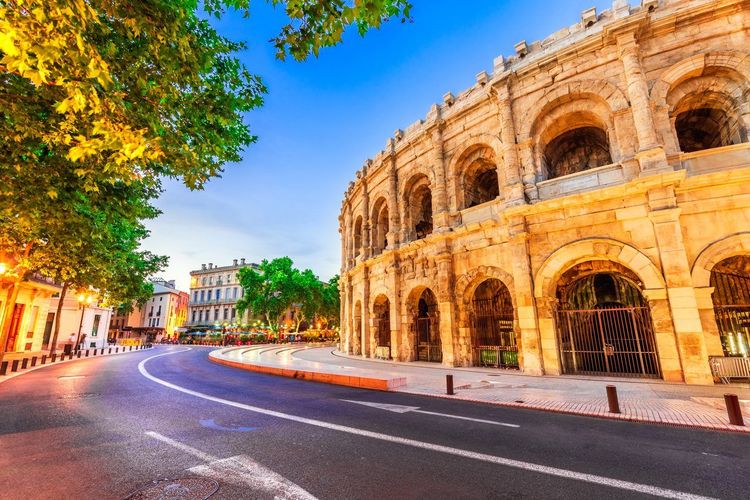
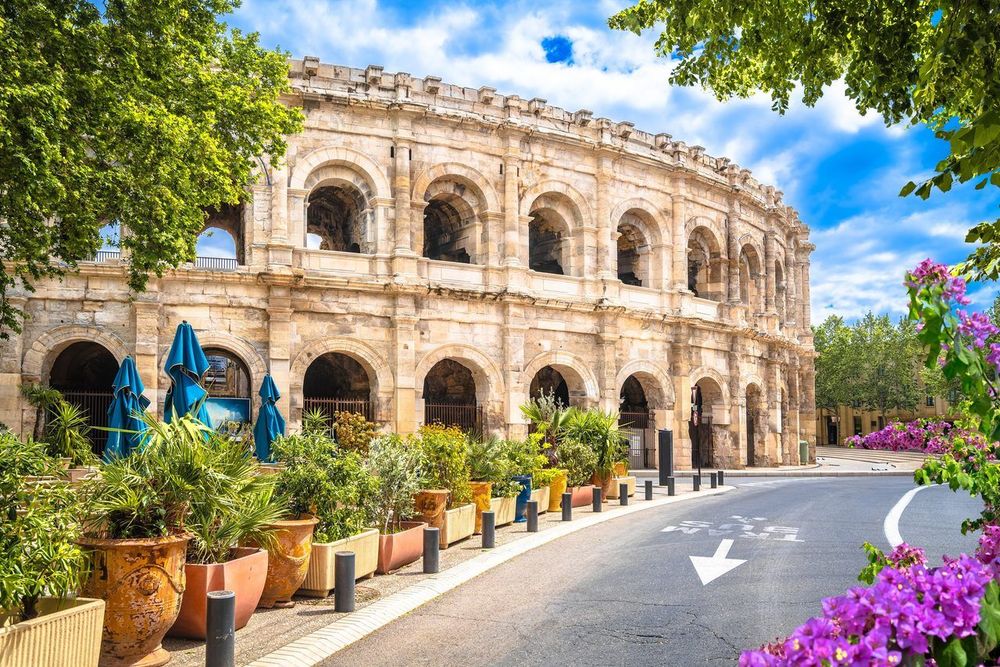
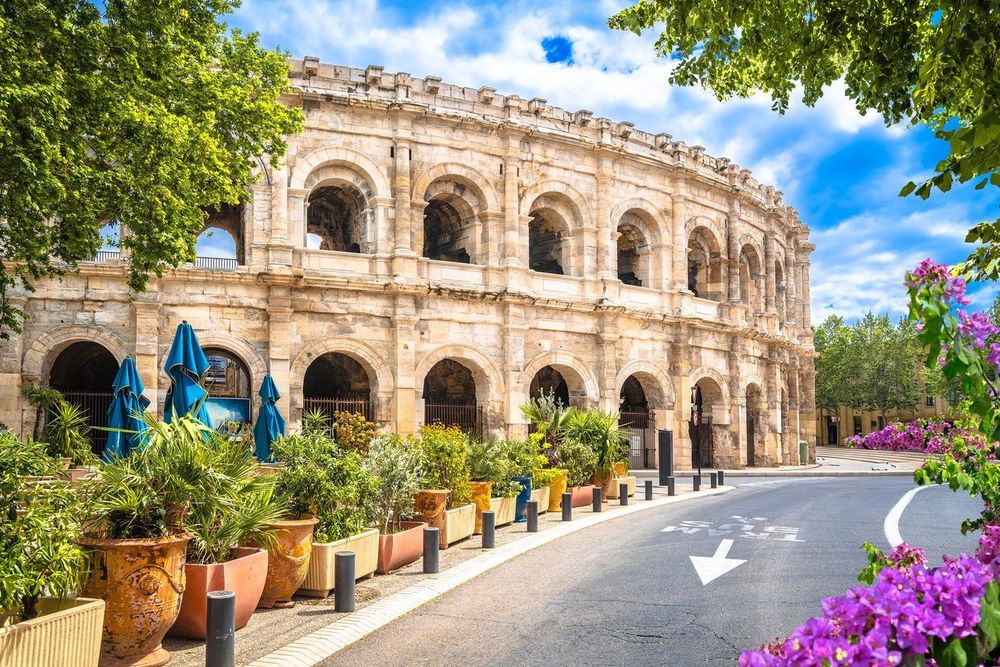
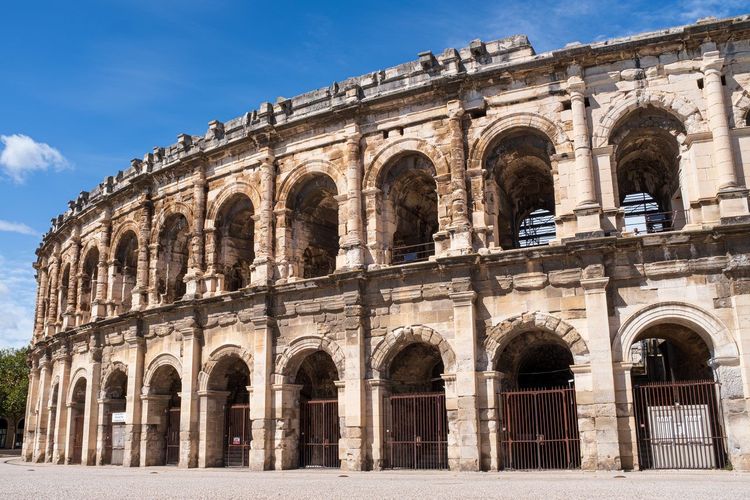
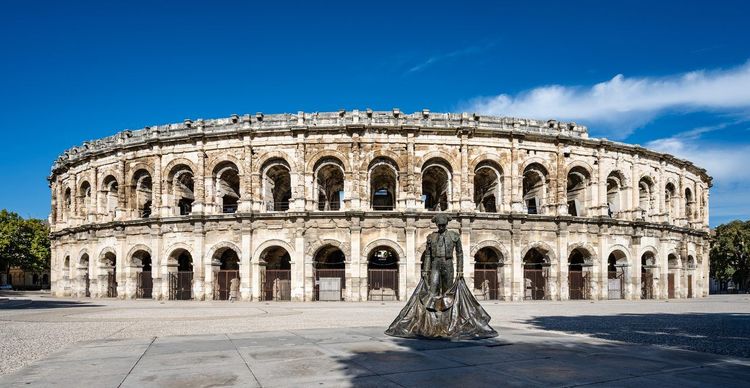
It is hard to start anywhere else. The Arènes de Nîmes (Boulevard des Arènes, 30000 Nîmes, rated 4.6/5 on Google based on 39,096 reviews) were built at the very end of the 1st century AD, under the Flavians, about twenty years after the Colosseum in Rome, whose layout they reproduce on a smaller scale. The amphitheater could then hold around 24,000 spectators who came to watch gladiatorial combat and animal hunts. Today capped at around 13,000 seats for safety reasons, the arena remains the best-preserved Roman amphitheater in the world, a status it owes to its early conversion into a medieval fortress, which protected it from the stone-robbing that razed so many other ancient monuments.
Enter through the lower gallery and let your eyes adjust to the dim light before emerging into the stands: the effect is striking, as a disc of light suddenly floods two thousand years of limestone from the Barutel quarries, just a few kilometers away. During the ferias in May and September, the amphitheater reclaims its original function with bullfights and Camargue races, a spectacle that divides the people of Nîmes but fills the stands.
Unlike the Arènes d'Arles, barely 30 kilometers away and often confused with them, those of Nîmes preserve an almost intact attic wall around their entire circumference, which is why archaeologists consider them the reference for understanding Roman amphitheater architecture. The two cities also engage in a friendly rivalry over which arena is the finest, a debate you can settle yourself by comparing the two during a single stay in the Gard.
Allow 45 minutes to 1 hour for the visit with the audio guide included in the ticket, longer if you climb to the top tier of seats for the view over the Roman-tiled rooftops of the city center. Book your slot online during peak periods, between July and August, to avoid queues that can exceed 30 minutes at midday. For full details on planning your visit, our Ryo article on how to visit the Arènes de Nîmes covers seasonal opening hours and reduced-price tickets.
Just outside, on the esplanade, the statue of Nîmeno II pays tribute to a bullfighter from Nîmes who died in the arena in 1991, now a local figure whose statue is still adorned with flowers every May. The arena's sand itself has been relaid several times, most recently with a blend that reduces dust during equestrian shows.
The Musée de la Romanité: a Modern Interlude Facing the Arènes
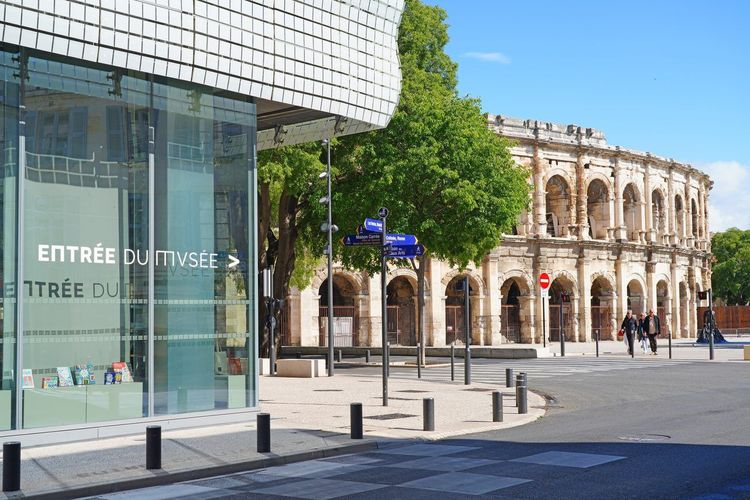
A stone's throw from the Arènes, on the same boulevard, the Musée de la Romanité (16 Boulevard des Arènes, 30000 Nîmes, rated 4.6/5 on Google based on 5,634 reviews), opened in 2018, makes a deliberate contrast with the ancient stone: its screen-printed glass facade, designed by architect Elizabeth de Portzamparc, evokes the folds of a Roman toga rippling across the full length of the building. The museum brings together more than 25,000 archaeological objects found in Nîmes and the surrounding region, including monumental mosaics discovered almost intact beneath city-center apartment buildings during preventive excavations.
The permanent collection traces nine centuries of history, from the Iron Age to the end of Antiquity, with a layout designed for families as much as archaeology enthusiasts. The real highlight is the rooftop terrace, freely accessible, planted with a Mediterranean garden built over the remains of the Roman city wall: the view plunges directly down onto the Arènes, at eye level with the upper tiers, an angle you will find nowhere else in the city.
Allow an hour and a half for a full visit, or twenty minutes if you only go up to the terrace, which is free even without a museum ticket. The ground-floor café, open onto the boulevard, makes a pleasant stop before continuing the walk toward the old town.
From the Amphitheater to the Maison Carrée: the Ancient Heart of the City
Leaving the museum, head up the Boulevard Victor Hugo for about 400 meters: this is the most direct straight line to the city's second Roman monument. The Maison Carrée suddenly appears at the end of the perspective, perched on its podium as though it has always been waiting to be photographed from that angle. Built around 2 BC, this Corinthian temple dedicated to Caius and Lucius Caesar, grandsons and designated heirs of Augustus, is considered the best-preserved Roman temple in the world, across all provinces. That exceptional state of preservation earned it, in 2023, inscription on the UNESCO World Heritage List, a long-awaited recognition for a monument admired since the Renaissance.
The building has passed through the centuries constantly changing its use: a stable in the Middle Ages, a canon's residence, then a church, before becoming one of France's very first museums installed in an ancient monument in 1823. Thomas Jefferson, then US Ambassador to France in the late 18th century, had its plans sent to Richmond to design the Virginia State Capitol, which faithfully reproduces its proportions and Corinthian-columned peristyle.
The interior visit lasts about half an hour, centered on an immersive film retracing the founding of Nemausus. You can also simply walk around the podium, free of charge, to admire the building's proportions from multiple angles: the morning light, around 9am, casts sharp shadows between the columns that are worth the detour for photographers.
On the neighboring esplanade, Norman Foster's Carré d'Art, all glass and steel, faces the ancient temple in an architectural dialogue the city has embraced since its inauguration in 1993. The top-floor terrace, freely accessible, offers a bird's-eye view of the Maison Carrée that allows you to take in at a glance the contrast between the two eras.
Nearby, the Fontaine Pradier adorns the Place de l'Horloge and serves as an easy landmark if you lose track of the route: from here, the pedestrian lanes of the old town already open to the north, toward the gardens.
The Jardins de la Fontaine: the Coolest Walk in Nîmes
Head northwest, ten minutes' walk from the Maison Carrée, to reach the Jardins de la Fontaine. Laid out from 1745 by military engineer Jacques Philippe Mareschal around the ancient spring of Nemausus, they are considered the first public garden in Europe designed according to the principles of the French formal garden, long before Paris had anything comparable.
The spring itself was bubbling here long before the Romans arrived: it gave its name to Nemausus, the protective deity and then the city itself. The water, cool even in the height of August, flows today through symmetrical pools bordered by stone balustrades and 18th-century statues, in the shade of century-old chestnut trees that bring the perceived temperature down several degrees compared with the surrounding streets.
At the heart of the garden, the ruins of the Temple de Diane have intrigued scholars for centuries: no one really knows which deity this 2nd-century sanctuary was dedicated to, or even whether it was a temple or a library annexed to the ancient baths that once occupied the entire site. The Benedictine monks who settled here in the Middle Ages, and then the Protestants who partly destroyed it during the Wars of Religion, left only gutted walls, but enough of them remain intact to convey the building's original scale.
Near the main pool, 18th-century allegorical statues represent the nymphs of the fountain and the god Nemausus himself, partly eroded by three centuries of exposure to the elements. The freshwater turtles that populate the secondary pools, introduced decades ago, have become a quiet attraction for children joining the walk.
Allow at least 45 minutes of leisurely strolling, longer if you then head up toward the Tour Magne along the path that sets off from the back of the park, to the right of the temple. The garden generally closes at nightfall, with extended summer hours until 10:30pm, allowing for a particularly pleasant evening stroll when the pools are lit. The people of Nîmes themselves come here for Sunday picnics or their morning jog, an everyday use that sets this garden apart from purely tourist sites.
Climbing the Tour Magne: the Oldest Tower in France
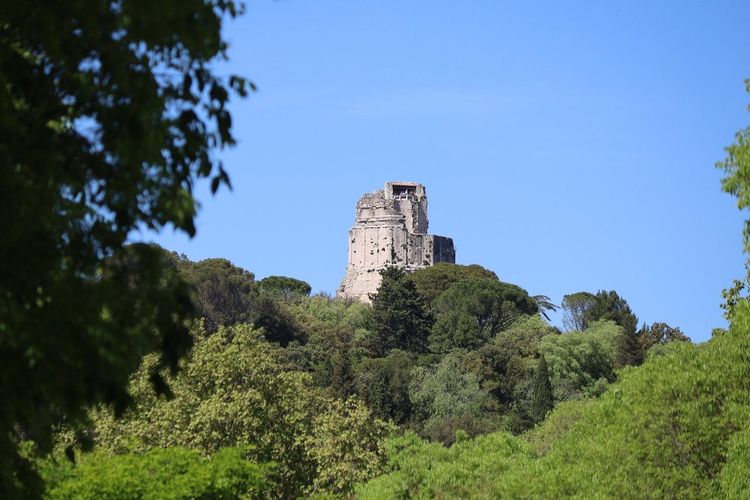
From the back of the Jardins de la Fontaine, a sloping path climbs to the top of Mont Cavalier, where the Tour Magne stands. Built around 15 BC on pre-Roman foundations dating perhaps from the 3rd century BC, this 32-meter tower is an exceptionally rare survival: it was once the highest point on the 7-kilometer Roman city wall that encircled Nemausus, one of the largest such enclosures in the Empire at the time.
The climb up 140 spiral steps takes some effort in hot weather, but the reward comes as soon as you reach the summit platform: a 360-degree panorama that takes in the whole city, the Cévennes as a backdrop to the north, and on a clear day, the silhouette of Mont Ventoux to the east. Napoleon I had made the tower a geodetic triangulation point for mapping the Paris meridian, a scientific use that remains unknown to most visitors today.
Allow 20 minutes of climbing from the gardens. A combined ticket is available with the Arènes and the Maison Carrée if you plan to visit all three sites in the same day, the most economical option for taking in the essentials of the Roman heritage.
The Vieux Nîmes: Lanes, Mansions, and 17th-Century Facades
Head back down toward the center along the Rue de la Lampèze to enter the Vieux Nîmes, also nicknamed the Écusson because of the shield shape traced by its medieval street plan. Unlike other historic centers in the south of France, this neighborhood was long neglected by investors, which explains why so many 17th- and 18th-century facades, sometimes dilapidated, escaped the overly aggressive renovations of the 1980s.
The Rue de l'Aspic (Rue de l'Aspic, 30000 Nîmes), one of the city's oldest commercial streets, follows the line of a Roman road and today lines up independent shops and jetted facades. A few streets further on, the Place aux Herbes and its arcades host a small food market each morning, a scene of local life that contrasts with the silence of the ancient monuments visited earlier in the morning.
The neighborhood contains around fifteen private mansions built by the Protestant textile bourgeoisie in the 17th and 18th centuries, a period when Nîmes exported throughout Europe a hardwearing serge cloth, the famous "serge de Nîmes," whose phonetic contraction eventually gave English the word denim. Several of these mansions, such as the Hôtel de Régis on the Grande-Rue, open their inner courtyards to the public during the Journées du Patrimoine in September.
Get deliberately lost in this network of lanes for an hour or so: it is the best way to feel the city without checking your phone at every corner. If you would still prefer a commented thread to follow, the Ryo audio-guided tour of Nîmes offers a step-by-step route through this same neighborhood, with anecdotes about each remarkable facade.
Keep an eye out for the manhole covers decorated with the chained crocodile, scattered throughout the old quarter: an improvised treasure hunt that children joining the walk always enjoy.
The Cathedral and the Place aux Herbes: the Midway Pause
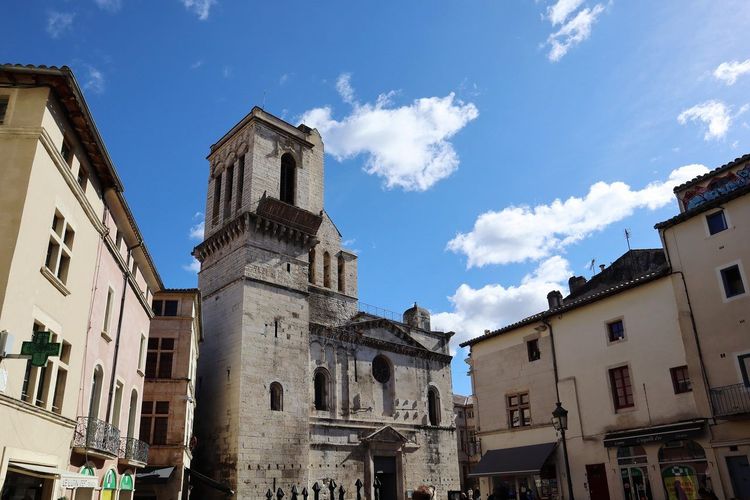
The Cathédrale Notre-Dame-et-Saint-Castor (Place aux Herbes, 30000 Nîmes, rated 4.4/5 on Google based on 1,346 reviews) closes off one side of the Place aux Herbes. Largely rebuilt in the 17th century after the destruction of the Wars of Religion, it retains on its facade an 11th-century Romanesque frieze, one of the few original elements to have survived the multiple reconstructions.
The interior, more restrained than baroque, can be visited free of charge in about ten minutes: the bare nave contrasts with the richness of the exterior Romanesque frieze, the only original element to have truly survived the Wars of Religion. Take the time to walk along the facade on the square side to spot, carved in stone, the biblical scenes that crown the portal. On the square itself, the café terraces bordering the Place aux Herbes offer a welcome mid-route break, particularly pleasant at the end of the morning when the nearby market is still in full swing and the shade of the plane trees covers much of the square.
Mont Cavalier and the Castellum: the Walk Most Tourists Miss
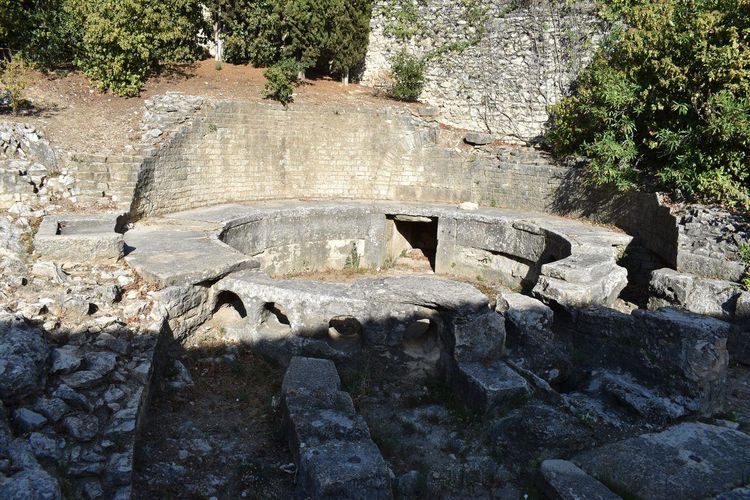
Few visitors make their way back down to the Rue de la Lampèze to see the Castellum Aquae (Rue de la Lampèze, 30000 Nîmes, rated 4.3/5 on Google based on 558 reviews), yet it is one of the rarest archaeological sites in Europe. Discovered by chance in 1844 during roadworks, this circular basin 5.9 meters in diameter is one of only two Roman castellum divisorum preserved in the world, along with the one in Pompeii: it is here that water carried from the springs of Uzès by the Pont du Gard aqueduct, after a journey of 50 kilometers, was distributed between the ten pipes that supplied the different neighborhoods and baths of Nemausus.
The site, freely accessible behind a gate, can be visited in just five minutes, but it illuminates everything you have just seen: the Maison Carrée, the Arènes, and the vanished baths of the Jardins de la Fontaine all depended on this unique hydraulic system, whose flow at its peak is estimated at 35,000 cubic meters per day.
Poorly signposted, the spot can be identified by a simple metal gate in the street: ask local shopkeepers for directions if you cannot find it on the first attempt — they are used to guiding lost visitors to this little-known corner of the city.
The Halles de Nîmes: the Gourmet Interlude
The Halles de Nîmes (5 Rue Général Perrier, 30000 Nîmes, rated 4.5/5 on Google based on 4,480 reviews), a covered market built in 1885, bring together around thirty food stalls under a single glass roof: fishmongers, cheesemongers, coffee roasters, and a stall selling brandade de morue, a local specialty made from salt cod and olive oil that the people of Nîmes claim to have invented.
Allow about twenty minutes to walk around, longer if you give in to the temptation of a plate of oysters at the counter as early as 10am, a firmly established local habit on weekends. For a broader overview of the specialties to try in the city, our Ryo article on the culinary specialties of Nîmes lists the must-tries, from brandade to fougasse aux gratterons. Back on the historic loop, Ryo's short audio-guided tour of Nîmes threads nearby, handy if you have less time to spare.
Contemporary Nîmes: Street Art and New Neighborhoods
This walk through Nîmes, as Roman as it is, does not tell the whole story of the city. Over the past decade, several neighborhoods around the train station and the Boulevard Gambetta have been covered in murals commissioned from French and international street artists, a municipal initiative designed to revitalize facades that had previously been neglected. The largest of these murals cover entire gable ends of buildings, along former working-class suburbs gradually being converted into cafés and artists' studios.
These works, changing from one year to the next, are best discovered by chance detour rather than on a fixed route: rely on your curiosity rather than a map to spot them between two lanes of the wider city center. The contrast with the limestone of the ancient monuments gives the walk through Nîmes one final unexpected dimension, suspended between two thousand years of history and a city that is still writing itself.
Practical Itinerary: Distance, Duration, and Best Direction
This walk through Nîmes covers about 4 flat kilometers, doable in 2.5 to 3 hours without the visits, or a full half-day including monument entrance fees. The Arènes-to-Vieux Nîmes direction works best in the morning, when the light still filters through the gardens and the heat has not yet beaten down on the cobblestones of the historic center.
If you are short on time, narrow the itinerary to the Arènes, the Maison Carrée, and the Jardins de la Fontaine: this trio already covers the essentials of the ancient heritage in 2 hours. For a step-by-step guided version in your pocket, the Ryo app offers an identical route with geolocation, useful for not missing the Castellum, which is often invisible on standard tourist maps.
To broaden the program beyond the walk itself, our Ryo article on the best things to do in Nîmes lists other options, from the Musée de la Romanité to the banks of the Vistre.
Extending the Walk: a Half-Day at the Pont du Gard
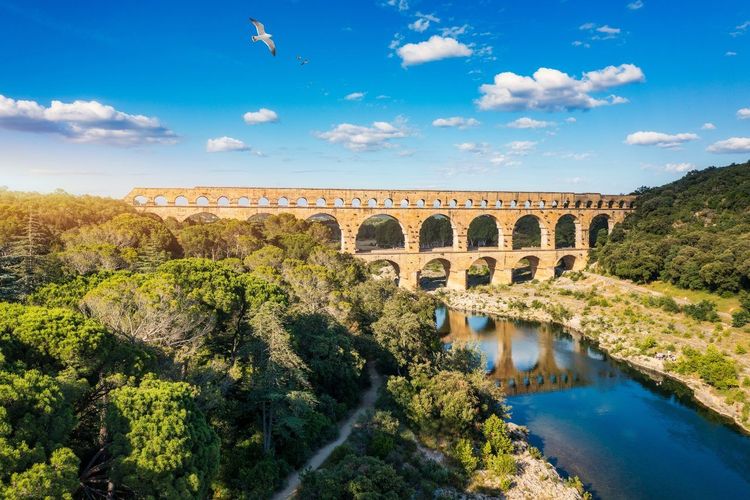
If this walk through Nîmes has whetted your appetite for antiquity, the Pont du Gard is just 25 minutes by road from the city center. This three-tiered aqueduct bridge, rising 49 meters above the Gardon river, was part of the same hydraulic network as the Castellum you have just seen: it carried water from the springs of Uzès to Nemausus over nearly 50 kilometers, with an average gradient of just 24.6 centimeters per kilometer, an feat of engineering that long puzzled archaeologists.
Listed as a UNESCO World Heritage Site since 1985, the site is best discovered by walking beneath the arches from the left bank, where the monument's shadow draws changing arcs throughout the day. Swimmers enjoy the waters of the Gardon just below, an impromptu dip at the foot of an ancient monument that always surprises visitors from other regions. The more active can paddle the river by canoe from Collias, a two-hour journey that passes under the bridge's arches — a view that visitors on foot cannot enjoy.
Allow a half-day for the round trip including a visit to the museum dedicated to the history of the aqueduct, which is included in the site entrance fee. The paid car park fills up fast in summer from 10am onwards: arrive early or opt for a late-afternoon visit, when the low-angle light gives the limestone a particularly photogenic golden hue.
For a full breakdown of the visit, up-to-date opening hours, and admission prices, our dedicated Ryo article on the Pont du Gard covers all the practical details before you set off.
Extending the Walk: Uzès and Aigues-Mortes, Two Easy Day Trips
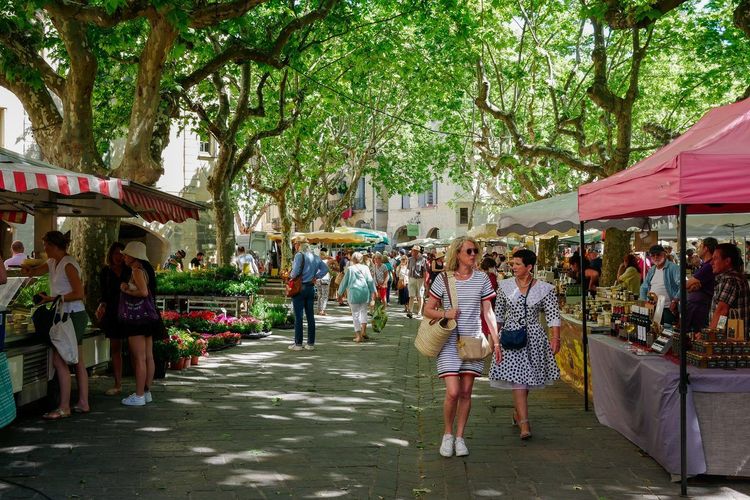
25 kilometers to the north, Uzès deserves a half-day in its own right. France's first duchy, the town has preserved a round arcaded Place aux Herbes that is almost a mirror image of the one in Nîmes, and a Saturday morning market renowned throughout the Gard for its local producers and seasonal truffles. The lanes around the Duchy, still inhabited by the same family since the Middle Ages, lend themselves to a walk just as rich as the one through the center of Nîmes, but quieter.
To the south, 40 minutes by road, Aigues-Mortes offers a completely different setting: a 13th-century fortified town, built in the middle of salt marshes by Saint Louis as a departure point for his crusades to the Holy Land. The ramparts, 1,640 meters long and almost entirely intact, can be walked in about an hour, with views over the surrounding salt flats that turn pink in summer thanks to a microscopic algae.
These two excursions are difficult to combine in the same day, one to the north and the other to the south of Nîmes, but each complements the walk through Nîmes well if you are staying several days in the region. For a broader overview of the villages worth the detour, our Ryo article on the most beautiful villages around Nîmes goes into detail with nine selected destinations.
Where to Eat after the Walk: Addresses in the Historic Center
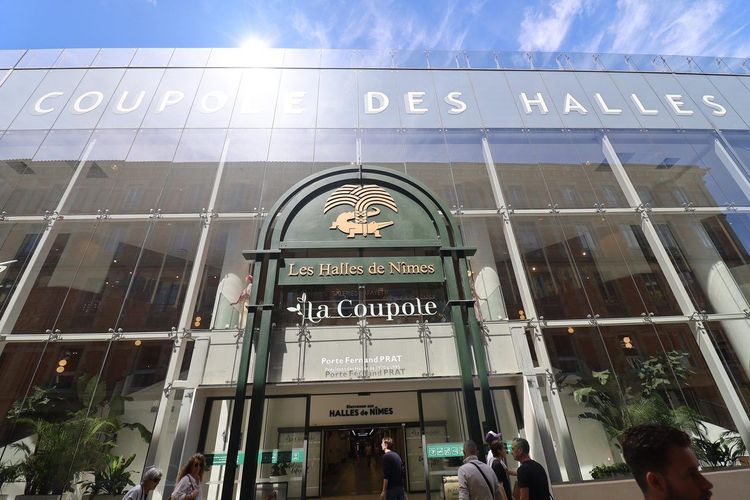
Around the Place du Marché and the Rue Fresque, a handful of spots serve simple bistro cooking at reasonable prices for a tourist city, often between 15 and 22 euros for a lunchtime main course. Brandade de morue, fougasse aux gratterons, and Camargue bull gardiane feature on most menus in the old town. For a shorter break, the counters at the nearby Halles serve lunchtime plates of charcuterie and local cheeses, to take away or eat in, a practical option when the walk through Nîmes overruns into lunchtime.
Book in the evening during high season, especially near the Arènes where terrace tables fill up from 7:30pm onward during the feria period in May and September.
Getting Around, Parking, and What to Bring: Practical Information
The historic center of Nîmes can be explored entirely on foot, with no significant elevation gain apart from the climb to the Tour Magne. The underground car parks at Arènes and Carré d'Art are the most convenient for quick access to the start of the route, with an hourly rate of around 2 euros. Electric bikes and scooters available for hire supplement the Tango bus network if you are staying on the outskirts or plan to continue to the Pont du Gard by bike.
Wear closed-toe shoes for the uneven cobblestones of the Vieux Nîmes and bring a water bottle in summer: public fountains are rare outside the gardens. Nîmes train station, about ten minutes' walk from the Arènes, also puts the city less than three hours from Paris by TGV, which explains the crowds on spring weekends — the ideal time to begin this walk through Nîmes. The Tango bus network serves the center well, with a single ticket costing less than 2 euros, a practical option when the midday heat discourages walking.



FAQ
How long does this walking tour of Nîmes take?
Allow 2.5 to 3 hours for the historic center route between the Arènes, the Maison Carrée, the Jardins de la Fontaine, and the Vieux Nîmes, not including interior visits. With monument entrance fees and a lunch break, plan on a full day.
What is the best itinerary for walking around Nîmes?
The most logical route starts at the Arènes, heads up toward the Maison Carrée, then the Jardins de la Fontaine and the Tour Magne, before descending through the Vieux Nîmes. This direction allows you to finish the morning in the shaded lanes of the old town, which are more pleasant during the hottest hours than the mineral esplanades around the Roman monuments.
Where can I park to walk around the center of Nîmes?
The underground car parks at Arènes, Carré d'Art, and Feuchères are all less than ten minutes' walk from the main monuments. They fill up faster on market days, Friday and Sunday mornings, as well as during the ferias in May and September.
Is Nîmes a pleasant city to explore on foot?
Yes: the historic center remains compact, flat, and largely pedestrianized, making a walk through Nîmes one of the easiest in the south of France, around the Maison Carrée and the Vieux Nîmes. Walking is all the more enjoyable because the ancient monuments are close to one another, unlike other Roman cities where sites are scattered across distant neighborhoods.
What is the difference between the Arènes de Nîmes and those of Arles?
Both amphitheaters date from the same period and look very similar, but the one in Nîmes preserves an almost complete attic wall around its entire circumference, making it the architectural reference for historians. Arles, about thirty kilometers away, has an arena that is slightly larger in floor area.
Do you need to book in advance to visit the Arènes or the Maison Carrée?
Online booking is not mandatory but is recommended in July–August and during the ferias, when the queue at the ticket office can exceed 30 minutes. A combined ticket generally covers the Arènes, the Maison Carrée, and the Tour Magne, a more economical choice if you plan to visit all three.
Can you do the Nîmes walk with children?
Absolutely: the route stays flat, short, and punctuated by natural breaks such as the pools of the Jardins de la Fontaine or the terrace of the Musée de la Romanité. The manhole covers decorated with crocodiles also turn the walk into an improvised treasure hunt that keeps younger visitors entertained between monuments.
One Last Walk Before You Leave
Nîmes reveals itself through these few kilometers on foot far more than in any museum: every monument encountered, from the Arènes to the Castellum, was part of the same ancient urban system, designed for a city of more than 25,000 inhabitants two thousand years ago. What strikes you most is the continuity: the spring of Nemausus still flows in the Jardins de la Fontaine, the same paving stones of the Rue de l'Aspic follow the Roman alignment, and the city's crocodile still adorns the railings of the 21st century.
To explore each stop in depth with audio commentary as you walk, the Ryo audio-guided tour of Nîmes follows much of this itinerary, enriched with anecdotes about the private mansions of the Vieux Nîmes that this article has only scratched the surface of. Enough to turn this walk through Nîmes into a true immersion in the French Rome.
À lire également