© Shutterstock
 Votre guide Ryo
Weekend in Nîmes in 2026: 2-Day Itinerary between Roman Monuments and Gard Escapes
There is something dizzying about having lunch on a terrace in the Écusson while looking, a hundred meters away, at an amphitheater where gladiator fights took place two thousand years ago. Nîmes cultivates this remarkable contrast with disarming ease: the city has preserved more standing Roman monuments than any other French city, while living at the very contemporary rhythm of its covered market halls and tapas-lined alleyways. Spending a weekend in Nîmes means taking advantage of this short format to take in the essentials without spreading yourself too thin: arenas still used for shows, a museum displaying an entire mosaic found beneath a parking lot, a Roman temple so well preserved that Thomas Jefferson drew inspiration from it to design an American state capitol, and, less than 25 kilometers away, one of the most photographed Roman bridges in Europe. This guide details hour by hour how to organize these two days, with addresses, realistic visit times, and two or three detours that few websites mention, such as the half-day at the Pont du Gard or nights in a treehouse with a spa in the Gard countryside. The Ryo audio guide tour of Nîmes serves as a practical thread once you are on the ground, so nothing is left to chance between monuments.
Day 1 Morning: the Arènes de Nîmes and the Musée de la Romanité
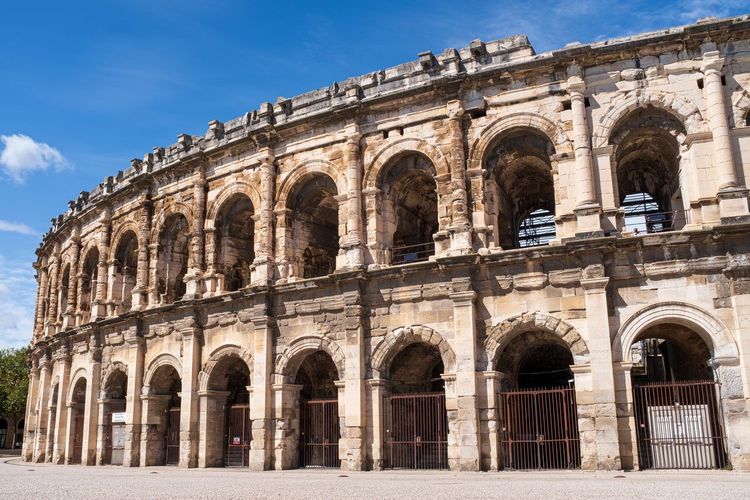
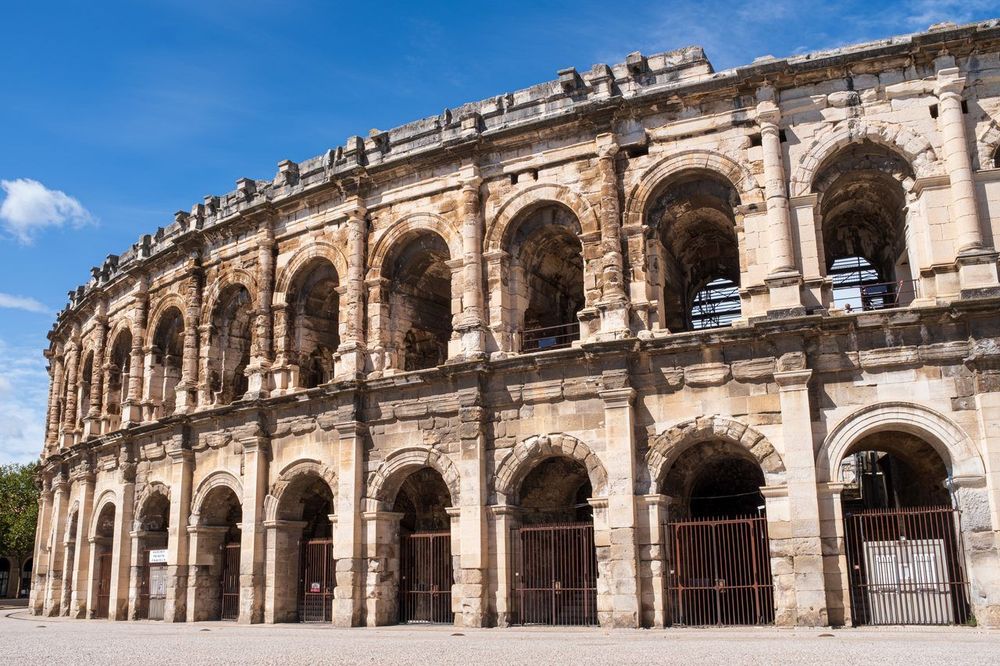
Start the day early, before tour groups fill the Boulevard des Arènes. Around 9 a.m., the limestone of the amphitheater takes on a golden hue in the raking light, and it is still possible to cross the stands without jostling anyone.
The Arènes de Nîmes are one of the best-preserved Roman amphitheaters in the world, completed at the very end of the 1st century. The ellipse measures 133 meters by 101, with an original capacity estimated at 24,000 standing spectators, compared to around 16,300 seated places today. What is most striking is that the monument has never stopped being used: gladiators in Roman times, a medieval fortress housing up to 700 inhabitants crammed into the galleries and vomitoria (the vaulted corridors that allowed crowds to evacuate within minutes), bullfighting arenas since the 19th century, and still today a stage for concerts and Camargue-style races.
Allow 1 to 1.5 hours for the visit with the audio guide included in the ticket (around €10 at full price), and make a point of climbing to the upper levels for the view over the city's pink roof tiles. A practical tip before moving on: the Pass Nîmes Romaine (€13 to €15 depending on the season) gives access to the arenas, the Maison Carrée, and the Tour Magne for less than the combined price of three separate tickets. If you follow this guide's full itinerary, it is almost always the most cost-effective choice, and it means you won't have to queue again at each ticket desk.
If your weekend falls during the Feria de Pentecôte (late May) or the Feria des Vendanges (mid-September), the arenas host Camargue-style races and bullfights: tourist visiting hours are then reduced or even suspended on some afternoons. Check the calendar before locking in your time slot, and if needed, swap the order with the museum.
Five minutes' walk away, on the other side of the boulevard, the glass facade of the Musée de la Romanité (16 Boulevard des Arènes, 30000 Nîmes, rated 4.6/5 on Google with 5,698 reviews) deliberately contrasts with the ancient stone facing it. Inaugurated in 2018 by architect Elizabeth de Portzamparc, the building spreads across 9,000 m² a translucent skin intended to evoke the folds of a Roman toga, an architectural nod that generated considerable debate at the time of its opening.
Inside, the museum holds more than 5,000 pieces from excavations carried out in the region over two centuries, Roman archaeological collections ranging from amphorae to jewellery, coins, and fragments of statues. The star of the collection is a monumental mosaic depicting the wedding of Admetus, found intact beneath a city-center parking lot during construction work in the 2000s. It occupies an entire wall on its own and gives a fairly precise idea of the standard of living in a wealthy Nîmes townhouse two thousand years ago. The chronological tour, from prehistory through to the Middle Ages, takes 1.5 to 2 hours depending on your appetite for detail, with a few digital features (augmented-reality reconstructions of a Roman neighborhood) that are particularly popular with children.
Once the visit is over, don't leave straight away: the museum garden is worth ten minutes all on its own. Laid out in terraces along the side of the ancient Augustan ramparts, it recreates a Mediterranean garden with olive trees, vines, and fig trees, and offers an unobstructed view of the arenas below. Entry is free, even without a museum ticket, making it a pleasant break between two paid visits.
This immediate proximity between the amphitheater and the museum illustrates well why Nîmes claims the title of the French Rome: nowhere else outside Italy will you find such a density of Roman remains in working condition, within a few minutes' walk of one another. To explore this history before you leave, the Ryo article dedicated to the Arènes de Nîmes details the evolution of the monument through the centuries.
The Halles de Nîmes: Covered Market and Gard Specialties
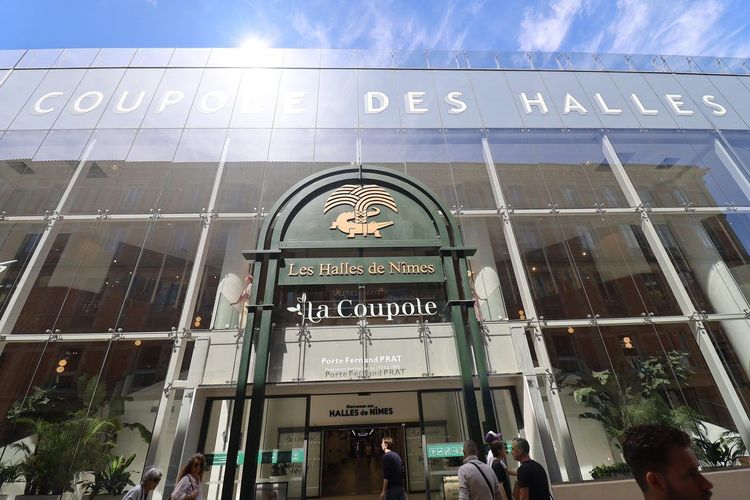
Around noon, shift gears entirely: head to the covered market for a lunch break. The Halles de Nîmes (5 Rue Général Perrier, 30000 Nîmes, rated 4.5/5 on Google with 4,573 reviews), built in 1884 and since extensively renovated, bring together around a hundred vendors under a period metal-and-glass canopy, in an organized chaos of olive crates, aged goat cheeses, and fishmongers calling out the morning's catch.
This is where you will understand Gard gastronomy better than in any restaurant. Three specialties appear consistently on the stalls and are worth tasting before you leave. First, the petit pâté nîmois: a small puff-pastry pie filled with a minced beef and pork stuffing marinated in wine and spices, a recipe said to date back to the 17th century and still jealously guarded by a handful of local charcutiers. Next, brandade de morue, that creamy preparation made from desalted cod and olive oil that has made Nîmes famous well beyond the Gard. And finally, taureau de Camargue, an AOP-certified beef raised in the nearby marshes, found on most menus in the city as a gardiane (a slow-cooked stew). Alongside this trio, the croquants Villaret — dry almond biscuits sold since 1775 in the same family shop on the rue de la Madeleine — are also worth a detour as an afternoon snack or a gift to take home.
Allow about an hour to wander between the stalls, sample a few things on the go, and head off with a pâté nîmois for the next day. The Halles close early in the afternoon (generally around 1:30 p.m. on weekdays, a little later on weekends), so don't linger if you want to avoid finding the shutters down. The market is open every morning except Monday, but Sunday is when it is at its most lively, with additional producers set up on the outdoor square. If your weekend includes a Sunday, make this a priority stop: the atmosphere is nothing like a quiet low-season Tuesday.
If you prefer to sit down rather than eat standing up, several addresses around the Halles serve more elaborate Gard cuisine, often using the same produce the chefs bought that very morning. Our Ryo selection of Nîmes culinary specialties lists around ten dishes and addresses to go deeper into this gastronomic chapter of the weekend.
The Maison Carrée and the Carré d'art
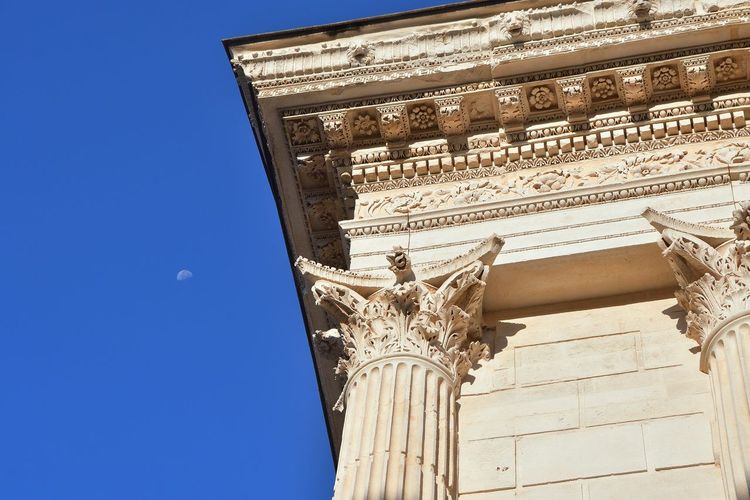
Heading back toward the center, a square suddenly opens onto one of the best-preserved Roman temples in the world. The Maison Carrée, despite its name, is not square at all: it is a rectangular temple built around 5 BC, dedicated to Gaius and Lucius Caesar, the adopted grandsons of Emperor Augustus. Its proportions and state of preservation are so exceptional that Thomas Jefferson drew direct inspiration from it to design the Virginia State Capitol in the late 18th century, an architectural lineage that crosses the Atlantic and of which few visitors are aware when they first arrive.
The temple has survived the centuries by constantly changing purpose: a church in the Middle Ages, a stable during the Revolution, then an archive before becoming a protected monument. The interior, now cleared of its old furnishings, hosts a 3D short film retracing the history of the Roman city on a large screen — an effective way to put everything you saw that morning at the arenas and the museum into context. The visit takes 30 to 45 minutes, film included.
What makes the setting particularly photogenic is the contrast with the building opposite. The Carré d'art (Place de la Maison Carrée, 30000 Nîmes, rated 4.2/5 on Google with 1,439 reviews), a contemporary art museum designed by British architect Norman Foster and inaugurated in 1993, deliberately echoes the proportions and column alignment of the ancient temple, but in a fully glazed and metallic version. Foster explained that he wanted to build a "dialogue" between the two eras rather than a rupture, and the result works: from the rooftop terrace, the plunging view over the Maison Carrée and the old city's rooftops is worth the climb on its own.
The Carré d'art's collections cover contemporary art from the 1960s onward, with a regularly changing hang. If your schedule is tight, you can make do with the terrace and the top-floor café without paying museum admission — a trick many pressed visitors are unaware of.
This single square concentrates twenty centuries of Nîmes architecture, and it is precisely this kind of temporal shortcut that makes the city so special to explore over a weekend. To place this site within the city's broader Roman heritage, the short version of the audio-guided tour of Nîmes, focused on the French Rome, offers a condensed route connecting this neighborhood to the arenas in under an hour of listening.
Strolling through the Écusson, the Historic Heart of Nîmes
End this first day without a fixed itinerary. The Écusson, the name given to the historic center of Nîmes due to its shield-like heraldic shape, is best explored on instinct, drifting along cobbled alleyways and platane-shaded little squares.
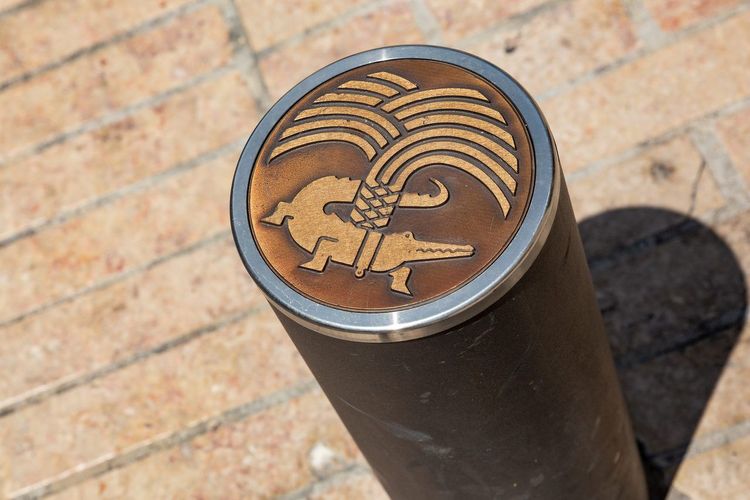
Start at the Place du Marché, where the Crocodile Fountain (Place du Marché, 30000 Nîmes, rated 4.5/5 on Google with 122 reviews) stands chained to a palm tree — the city's official symbol since Antiquity (the animal is said to evoke the conquest of Egypt by the Roman legions later settled in Nîmes). A few alleyways further on, the Cathédrale Notre-Dame-et-Saint-Castor blends an 11th-century Romanesque facade with 19th-century reconstructions, testament to the sieges and wars of religion that swept through the neighborhood.
The Écusson is above all a place of details: ochre limestone facades, colorful shutters, inner courtyards glimpsed through half-open gateways, small craftsmen's shops set up in former workshops. The streets of l'Aspic, du Chapitre, and de la Madeleine concentrate most of the dining and wine-bar addresses, with an atmosphere that picks up noticeably as the afternoon progresses.
It is also the perfect time to observe local life rather than tick off monuments. Settle onto a terrace around 6–7 p.m., when the people of Nîmes finish work and the squares gradually fill up. The contrast with the more tourist-heavy crowd around the arenas, a few hundred meters away, is striking.
If you still have energy, a walk to the remains of the Porte d'Auguste (one of the ten gates of the original Roman enclosure, still visible near the Boulevard Gambetta) lets you close the historical loop of the day before choosing a restaurant for dinner. The Ryo walking tour through the lanes of Nîmes offers a detailed route if you prefer to follow a thread rather than wander at random.
Day 2: the Jardins de la Fontaine and the Tour Magne
Fuel up with a proper breakfast: the second day involves a bit more walking than the first. Head northwest from the Écusson, where the Jardins de la Fontaine stretch out, considered one of the first public gardens in Europe since they were laid out as early as 1745, well before the fashion for urban parks in the 19th century.
The site occupies the exact location of the ancient spring of Nemausus, the local deity who gave the city its Latin name. The Romans had already built a sanctuary here, of which the ruins of the Temple de Diane remain today — a building whose precise function (temple, library, or nymphaeum) continues to divide archaeologists. The classical basins with stone balustrades, adorned with mythologically inspired statues, and the geometric 18th-century walkways lend the whole place an elegance very different from the ancient roughness encountered the day before.
Allow 45 minutes to an hour to cross the garden while enjoying the lower basins, before tackling the climb to the top of the Mont Cavalier hill. The path winds through a fragrant garrigue of pines and holm oaks, with several intermediate viewpoints over the city that are worth a photo stop.
At the summit, the Tour Magne dominates Nîmes from its height of 34 meters. Built around 15 BC, it is the tallest tower of the original Augustan enclosure, which once had about ten, and one of the oldest Roman monuments still standing in France. The ascent via a narrow interior staircase — around 140 steps — leads to a platform that offers the most complete panoramic view of Nîmes of the entire weekend: the arenas and cathedral below, the Cévennes garrigue on the northern horizon, and on a clear day, the foothills of Mont Ventoux to the east.
One tip that genuinely changes the experience: go up early, before 10 a.m. The path faces due south and becomes grueling in the summer heat, and the morning light on the city is far more photogenic than the flatter midday light. Wear proper shoes: the paths are cobbled or packed earth, entirely unsuitable for heels.
This climb in fact closes a logical circuit begun the previous day at the arenas: from the monuments of the plain up to the watchtower that once surveyed the entire city. The Ryo audio guide for Nîmes follows this same ascending route, with commentary triggered automatically at each stop.
Half-Day Excursion: Pont du Gard and Uzès
This is the section that most guides on a weekend in Nîmes overlook entirely, even though it is less than 25 kilometers from the city center. If your weekend stretches to two and a half days, or if you tend to start early, devoting a half-day to this excursion completely changes the nature of the stay.
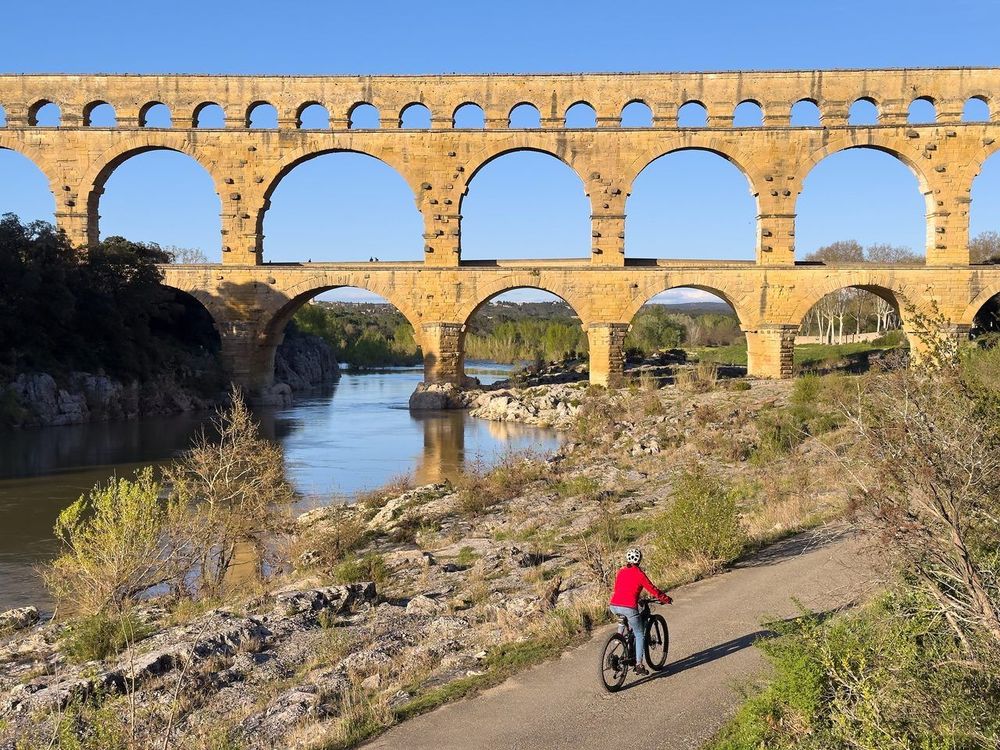
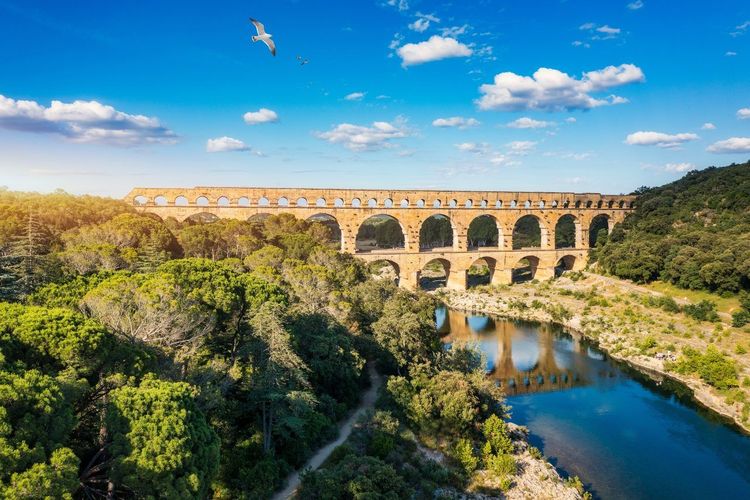
The Pont du Gard, about 20 minutes' drive from Nîmes, is the tallest Roman aqueduct bridge ever built, standing 49 meters high with three tiers of superimposed arches. It was part of a 50-kilometer aqueduct that carried water from Uzès to Nîmes, with an average gradient so precise (24 centimeters per kilometer) that modern engineers still marvel at it. Listed as a UNESCO World Heritage Site since 1985, the site can be visited freely from the riverbanks at no cost, or via the paid museum space, which explains the technical feat with models and interactive displays suited to children.
In summer, swimming and canoeing in the Gardon, right beneath the arches, is an activity in its own right: several rental operators offer two-to-three-hour descents with an unbeatable view of the monument from the water, a perspective that most hurried visitors miss entirely. Allow at least 2 hours on site for a classic visit, or a half-day if you add canoeing or a swim, and keep about an hour's margin for the sentier de la mémoire de la garrigue, a waymarked walk that follows the left bank well away from the crowds.
Back on the road, an extra 15-minute detour leads to Uzès, often called the "first duchy of France" and far less crowded than Nîmes or Avignon despite a comparable heritage. The Place aux Herbes, lined with arcades and century-old plane trees, hosts one of the finest Provençal markets in the region every Wednesday and Saturday morning, with a remarkable concentration of local producers, seasonal truffles, and artisan ceramics — a historical specialty of the town, which also saw the birth of the writer André Gide, whose family home can be visited nearby.
The Duché d'Uzès, a château inhabited by the same family since the Middle Ages, can be visited in about an hour and fits naturally into the logic of the itinerary: after the Roman public monuments of Nîmes, here is an example of medieval seigneurial power, barely twenty minutes' drive away. The alleyways around the Place aux Herbes, with their ochre facades and artisan shops, are perfect for an hour's stroll before heading back toward Nîmes.
On a practical note, allow a full half-day — 4 to 5 hours including travel — to visit both sites by car, or a full day if you add a swim in the Gardon. No train serves the Pont du Gard directly; a car or arranged carpooling are the most straightforward options, short of buses running from Nîmes in high season. The Ryo article dedicated to the Pont du Gard details the various access points to the site (left bank, right bank) and their respective parking areas, and our Ryo selection of the most beautiful villages around Nîmes expands the list to other possible stops if you extend your stay.
Where to Stay in Nîmes for a Successful Weekend
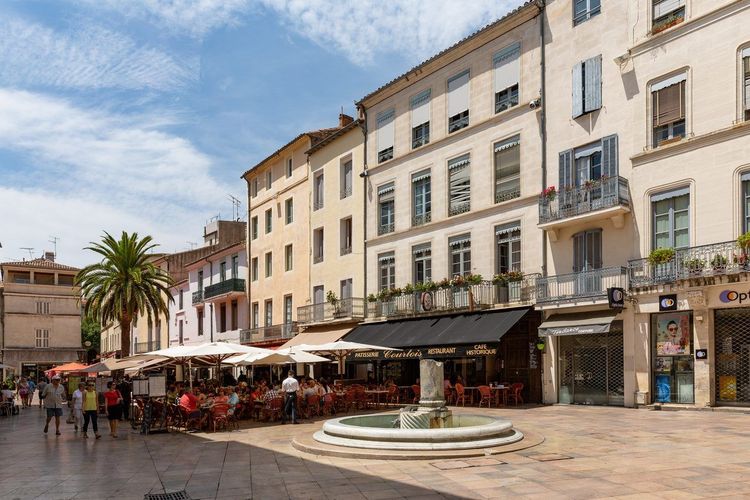
For a weekend format, it is better to stay in the Écusson or just on its edge: everything is then walkable, the arenas included, with no need to rely on public transport. Boutique hotels set up in former private mansions on the rue Fresque or the rue de l'Aspic offer a good compromise between period character and central location, typically between €90 and €160 per night for a double room depending on the season.
On the budget side, the HI Nîmes youth hostel (257 Chemin de l'Auberge de Jeunesse, 30900 Nîmes, rated 4/5 on Google with 247 reviews), about fifteen minutes' walk from the center in a leafier setting near the Jardins de la Fontaine, offers dormitories and a few private rooms from around twenty euros per night in a dorm. It is a solid option for solo travelers or groups of friends who want to keep the accommodation budget for other things.
If you are traveling as a couple or a family and prefer a bit more space, the serviced apartments and apart-hotels near the train station often offer a better space-to-price ratio than the historic center, at the cost of an extra 5 to 10 minutes' walk to the arenas.
One point not to overlook: during the two annual ferias — Pentecôte in late May and Vendanges in mid-September — accommodation prices within the Nîmes city walls can double or even triple, and availability shrinks drastically several weeks in advance. If your weekend falls on those dates, book at least a month ahead, or consider staying in Uzès or surrounding villages and driving in and out. For an easy start the next morning, Nîmes' short audio-guided tour begins right in the historic centre, wherever you end up staying.
Unusual Stays around Nîmes: Treehouses, Eco-Lodges, and Gypsy Wagons
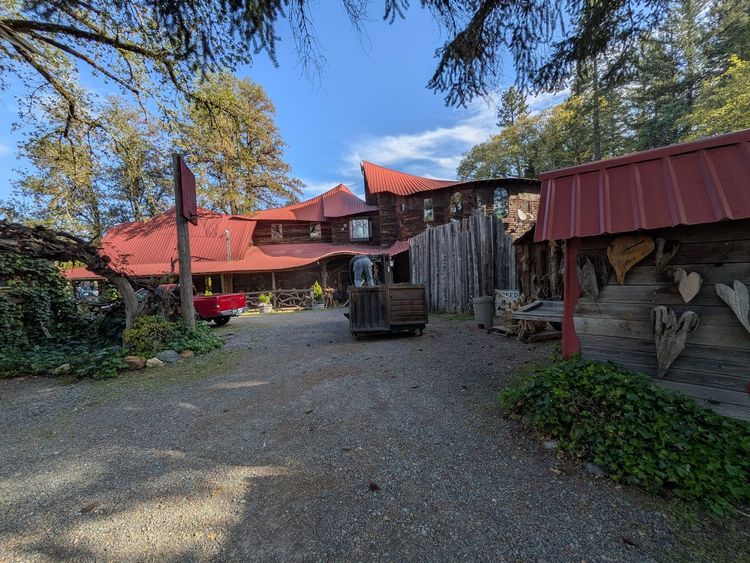
If your weekend in Nîmes spills over into the surrounding countryside, the region abounds in accommodation that steps well outside the standard hotel mold. The Gard, paired with the neighboring Camargue and Cévennes, concentrates a particularly dense offering of unusual stays, to the point that some platforms list several dozen within a 40-kilometer radius of the city.
Rather than listing establishments one by one, it is more useful to think in broad categories so you can choose the one that matches your mood. The treehouse or cabin with private spa, perched in or set on the ground of a Provençal mas, remains the most sought-after formula for a couple's weekend: outdoor jacuzzi, cozy décor, often isolated from the other lodgings on the estate. Expect between €150 and €350 per night depending on the standard and the season, with a peak in demand around Valentine's Day and spring weekends.
The eco-lodge, aimed more at guests mindful of environmental impact, focuses on natural materials (wood, hemp, green roofing) and thorough landscape integration, often with a natural pool or shared pond. The gypsy wagon, more down-to-earth and cheaper than spa cabins, appeals mainly to families with children who enjoy the playful aspect of the experience, usually set on a campsite or equestrian farm, at an average nightly rate two to three times lower than a high-end cabin.
In the Camargue, less than an hour's drive from Nîmes, a houseboat offers a different experience: sleeping on the water, moored on a canal, in the heart of the marshes where flamingos and white horses roam. Finally, yurts and tipis, rarer in the Gard but present in the Cévennes and into neighboring Provence, round out the range for those craving a stronger sense of escape, often at a more gentle price-to-quality ratio than high-end cabins.
One tip that applies across the whole category: book early, especially at weekends and during school holidays. Most of these accommodations have only a single unit available per estate, unlike a conventional hotel, which means they fill up the moment the forecast looks promising. Our Ryo article on unusual accommodations in the Gard details a selection of addresses by type if you want to dig deeper.
Weekend Ideas in Nîmes Based on Your Interests
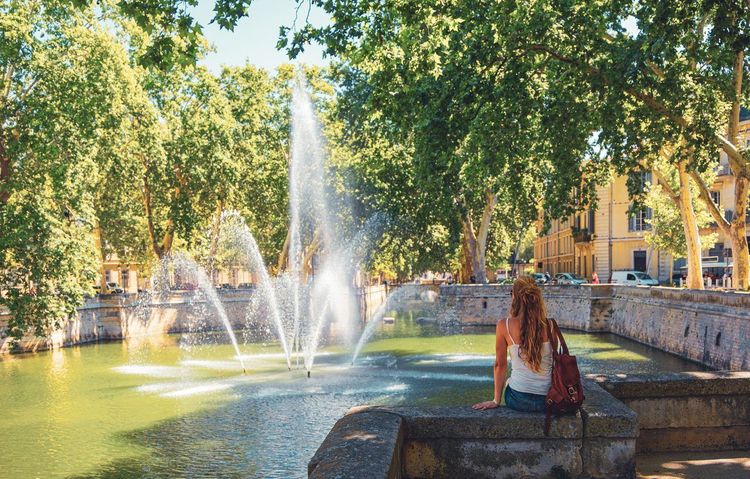
A weekend in Nîmes is not the same experience depending on who you are traveling with, and the itinerary in this guide can easily be reorganized to suit your priorities.
For a romantic weekend, favor the start and end of the day: the Jardins de la Fontaine at sunset, when the classical basins turn golden, followed by dinner in one of the discreet inner courtyards of the Écusson. You might skip the museum and use that time instead for a night in a cabin with a spa in the surrounding countryside.
For a family weekend, the Musée de la Romanité works particularly well thanks to its interactive features designed for children, and the arenas easily capture the attention of younger visitors with their gladiatorial history. The Pont du Gard, with the option to swim and canoe, turns the excursion into a genuinely fun outing rather than a heritage visit, a real asset if you are traveling with children who quickly lose interest in historical explanations.
For a weekend with friends, focus on the Écusson in the late afternoon: the terraces along the rue de l'Aspic lend themselves well to a more relaxed pace, with a long aperitif and a late dinner, without the constraint of a too-rigid schedule. A gypsy wagon or houseboat in the Camargue shared among several people can also replace two standard hotel rooms at a better price for a group.
Whatever your travel profile, bear in mind that the order proposed in this guide — Roman in the morning, gastronomic at noon, leisurely in the evening — is fully adjustable: there is nothing to stop you swapping Day 1 and Day 2 if opening hours or the weather demand it. The Ryo top 6 things to do in Nîmes also suggests other combinations if you are looking for more variety.
How to Get to and around Nîmes
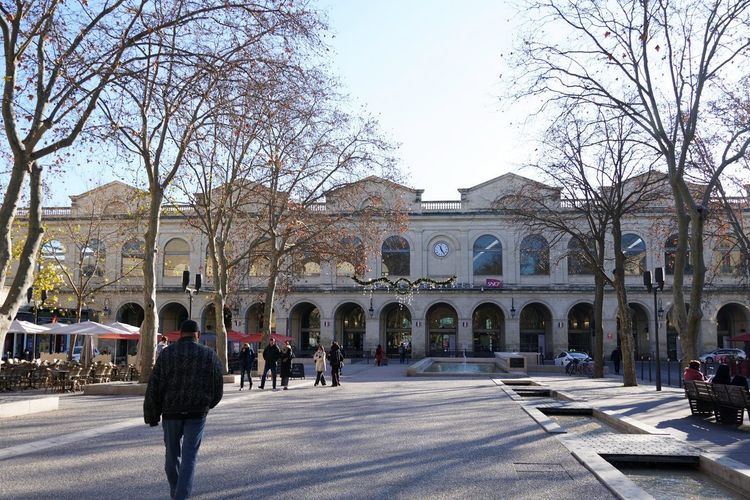
By train, Nîmes is served by direct TGVs from Paris (around 3 hours), as well as more frequent links from Montpellier (30 minutes) and Avignon (25 minutes), handy if you are combining this weekend with another base in the region. The Nîmes Centre station is 15–20 minutes' walk from the Écusson, an entirely manageable journey on foot with light luggage, or a few minutes by bus.
By car, Nîmes sits directly on the A9 motorway, about 1 hour from Montpellier and 45 minutes from Avignon. It is the most practical option if you are planning the excursion to the Pont du Gard and Uzès, since no direct train serves either site. As the city center is largely pedestrianized or has restricted traffic, it is better to use one of the parking lots on the edge of the Écusson (Arènes, Feuchères) rather than hunting for a space in the narrow streets.
Once on the ground, Nîmes is almost entirely walkable: the distance between the arenas and the Jardins de la Fontaine, at opposite ends of the historic center, is no more than 25 minutes at an easy pace. The Tango bus network usefully fills in for longer trips, particularly to the youth hostel or the station, with a single-journey ticket of around €1.60.
Budget and Money-Saving Tips for a Weekend in Nîmes
For two days in Nîmes, budget an overall spend of between €150 and €350 per person depending on the level of comfort you are after, accommodation included. The breakdown works out roughly as follows: €60 to €150 for one night's hotel (or €20 to €40 in a youth hostel), €40 to €80 on food over two days by using the Halles for at least one meal, and €25 to €40 on visits by opting for the Pass Nîmes Romaine rather than separate tickets.
Several activities on the weekend are entirely free and are worth weaving into the program to keep costs down: the Jardins de la Fontaine (free entry), the garden of the Musée de la Romanité (free even without a museum ticket), the stroll through the Écusson, the climb toward the Tour Magne along the exterior path, and the visit to the Pont du Gard riverbanks without going through the paid museum space.
If your budget is tight, favor the low season, outside July–August and outside feria dates: accommodation rates drop noticeably, often by 20 to 30%, while the weather remains pleasant in spring and autumn.
When to Go and How Many Days to Plan
Spring (April–June) and early autumn (September–October) offer the best compromise for a weekend in Nîmes: mild temperatures around 20–24°C, pleasant light for outdoor visits, and still-manageable crowds outside feria dates. In summer, the heat can climb above 35°C during the day, making longer walks (Tour Magne, Pont du Gard) considerably more demanding physically.
Two dates are essential to know if you want to avoid the crowds — or on the contrary seek them out: the Feria de Pentecôte in late May and the Feria des Vendanges in mid-September, two periods that completely transform the atmosphere of the city, with packed streets, sharply higher accommodation prices, and some monuments on modified hours.
In terms of duration, two full days are the realistic minimum to cover the arenas, the museum, the Maison Carrée, the Écusson, and the Jardins de la Fontaine without rushing. If you want to comfortably add the half-day at the Pont du Gard and Uzès without sacrificing any city-center stop, plan on two and a half to three days.

FAQ
How many days should I plan for a weekend in Nîmes?
Two full days are enough to cover the essentials: the arenas, the Musée de la Romanité, the Maison Carrée, the Écusson, and the Jardins de la Fontaine. Plan two and a half to three days if you add the excursion to the Pont du Gard and Uzès without sacrificing anything from the city-center itinerary.
What are the must-sees for a weekend in Nîmes?
The Roman arenas, the Musée de la Romanité, the Maison Carrée and the Carré d'art, the Écusson, and the Jardins de la Fontaine form the heart of the program. If time allows, the Pont du Gard, less than 25 km away, ideally completes this foundation.
How do I get to Nîmes by train or by car?
By train, direct TGVs connect Paris to Nîmes in about 3 hours, with frequent connections from Montpellier or Avignon. By car, the city sits directly on the A9 motorway, less than an hour from Montpellier.
Where should I stay in Nîmes for a short trip?
The Écusson and its immediate surroundings allow you to do everything on foot. For budget travelers, the HI Nîmes youth hostel offers dormitories from around twenty euros per night, fifteen minutes' walk from the center.
What budget should I plan for a weekend in Nîmes?
Budget between €150 and €350 per person for two days, including accommodation, meals, and visits. The Pass Nîmes Romaine and several free activities, such as the Jardins de la Fontaine, can significantly reduce the bill.
What is the best time to visit Nîmes?
Spring and early autumn offer the best balance between mild weather and manageable crowds. Avoid the two ferias, in late May and mid-September, if you prefer a quieter city, or target them if the festive atmosphere appeals to you.
Can you visit the Pont du Gard from Nîmes in half a day?
Yes, the site is about 20 minutes' drive from Nîmes. A half-day — 4 to 5 hours including travel — is enough for a classic visit of the riverbanks and the museum space, or a full day if you add canoeing or a swim in the Gardon.
A weekend in Nîmes ultimately holds a fairly rare paradox: the density of Roman heritage allows you to see everything seriously in two days, while still leaving enough room to stroll, grab a pâté nîmois on the go, or push on to the Pont du Gard without rushing. It is this combination, more than each monument taken in isolation, that truly sets the city apart from other Roman escapes in Europe.
Whether you follow this itinerary hour by hour or prefer to improvise once on the ground, the audio-guided tour of Nîmes remains the simplest companion to make sure you miss nothing: each monument automatically triggers its audio commentary as you approach, without having to pull out this guide between visits.
À lire également