© Shutterstock
 Votre guide Ryo
Poitiers Off the Beaten Path: 11 Secret Visits to Discover in 2026
Many search for unusual things to do in Poitiers hoping to find sealed underground tunnels and secret passages. The city does indeed hide some, but rarely where you expect them: a 4th-century baptistery older than Notre-Dame de Paris, a Merovingian burial chamber buried beneath a garden of centuries-old conifers, a dolmen weighing several dozen tonnes sitting in the middle of a residential neighbourhood. Poitiers rarely plays the spectacular card, and that is precisely what makes it interesting: the surprises hide in the details, not in the façades. The Ryo audio-guided tour of Poitiers tells many of these stories as you walk, which changes the way you approach a city you might think you already know after a single afternoon.
This article brings together eleven sites and experiences that go beyond the classic circuit: a 4th-century Christian building still standing, a Merovingian hypogeum open only a few weeks each year, an abbey founded in 361 that has never stopped housing monks, the third-largest public French collection dedicated to Camille Claudel, and a park laid out on former ramparts. We also add an excursion to the Futuroscope, a gourmet break around farci poitevin, and everything you need to spread an unusual visit to Poitiers over two days without ever feeling rushed.
The Baptistère Saint-Jean, a Paleo-Christian Gem in the City Centre
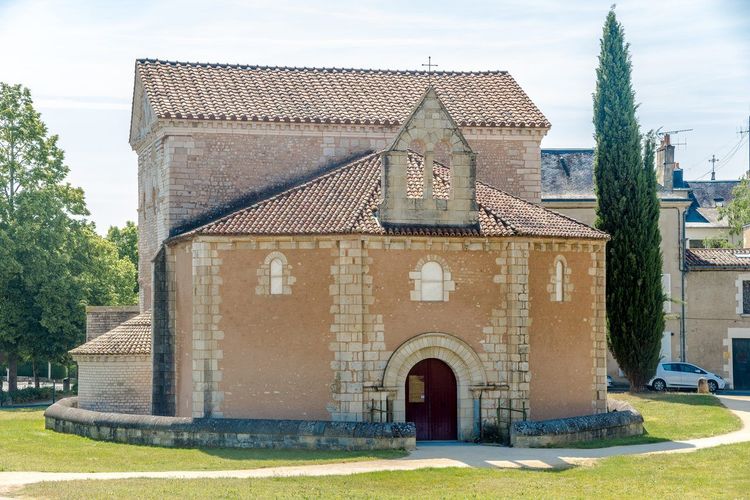
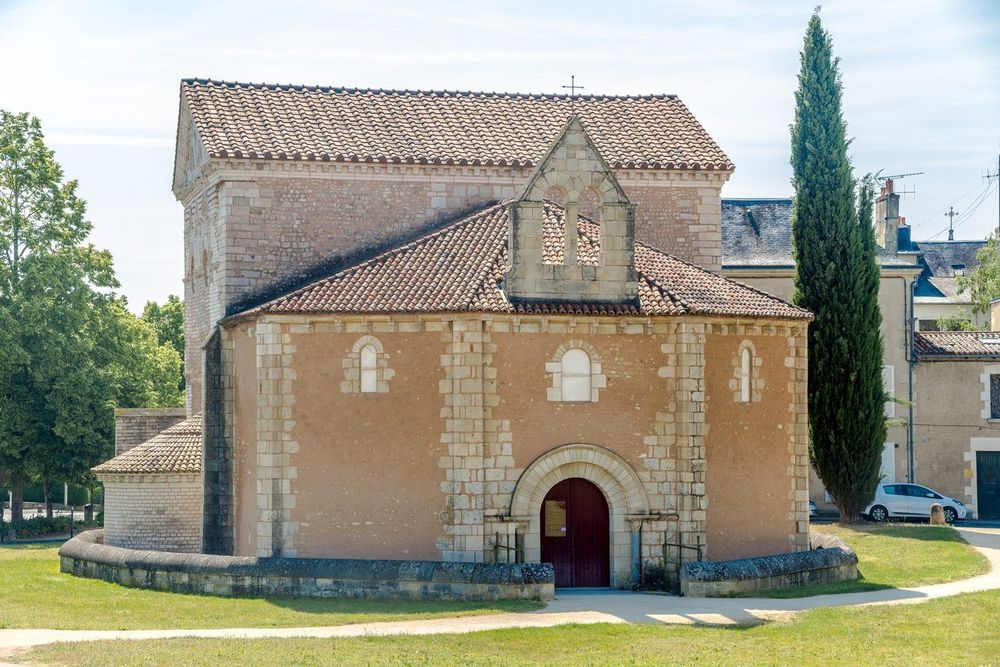
Most visitors walk past without noticing it. Wedged between two buildings in the city centre, the Baptistère Saint-Jean (Rue Jean Jaurès, 86000 Poitiers, rated 4.5/5 on Google based on 284 reviews) looks like a small stone chapel slightly stooped by time. And yet it is one of the oldest Christian buildings preserved in France, erected as early as the 4th century and then altered over the following centuries.
The interior surprises with its sobriety: a baptismal font carved into the floor, columns clearly salvaged from ancient buildings and reused, and wall paintings from the 11th, 12th and 13th centuries that have survived against all odds. You can make out scenes of horsemen — a rare decorative scheme for a place of worship of this era. The building also houses a small Merovingian museum, with a collection of sarcophagi discovered in the region.
Allow around twenty minutes on site. Admission costs 3 euros, free for children under 6. Opening hours change dramatically by season: from 21 June to 30 September, open daily from 10:30am to 12:30pm and then from 2pm to 6pm; for the rest of the year, access is limited to afternoons, Tuesday to Sunday, with a reduced window of just two hours in the depths of winter. Check before you go — many visitors arrive at 11am in February and find the door locked.
The Hypogée des Dunes, a Burial Chamber Buried for Fourteen Centuries
East of the Clain, on the Plateau des Dunes, a staircase descends beneath a garden planted with centuries-old conifers. At the bottom, a burial chamber carved from the rock in the 7th and 8th centuries preserves engraved slabs, sarcophagi and Latin inscriptions. The Hypogée des Dunes (101 Rue Camille de la Croix, 86000 Poitiers, rated 4.4/5 on Google based on 40 reviews) ranks among the most emblematic early medieval monuments in Europe, yet it rarely appears in guidebooks.
The site owes its rediscovery to Father Camille de la Croix, a Jesuit priest and archaeologist who cleared the crypt at the end of the 19th century. A protective structure built in 1908 now covers the whole complex, which explains the nondescript little-house silhouette you can see from the street. Listed as a historic monument and labelled Musée de France, the hypogeum is managed by the Musée Sainte-Croix.
This is probably the most discreet stop on this unusual visit to Poitiers, because access remains limited: guided tours in July and August, plus a few exceptional slots during the European Heritage Days in September. Allow around €4.50 on top of the museum admission, with a reduced rate of €2.50 and free entry for certain groups. Places go quickly; booking usually opens at the start of summer.
The Pierre Levée, a Dolmen at the Gates of the City
A few minutes' walk from the hypogeum, on the same plateau, a Neolithic dolmen stands in the middle of a residential square. The Pierre Levée (Rue de la Pierre Levée, 86000 Poitiers, rated 4.2/5 on Google based on 480 reviews) weighs several dozen tonnes and was erected around five thousand years ago, making it the oldest monument still visible in the city.
Rabelais brought it into literature: in Pantagruel, he attributes the raising of the slab to his giant and describes Poitiers students coming to feast on top of it. The tradition of nocturnal student gatherings at the site lasted for centuries. Today the place remains remarkably discreet: no ticket booth, no crowds, just a massive stone table resting on its supports, in the middle of a residential neighbourhood.
You can access it freely at any time. It makes a quick stop to slip in between two visits in the city centre without disrupting your schedule.
Notre-Dame-la-Grande, a Façade to Read Like a Book
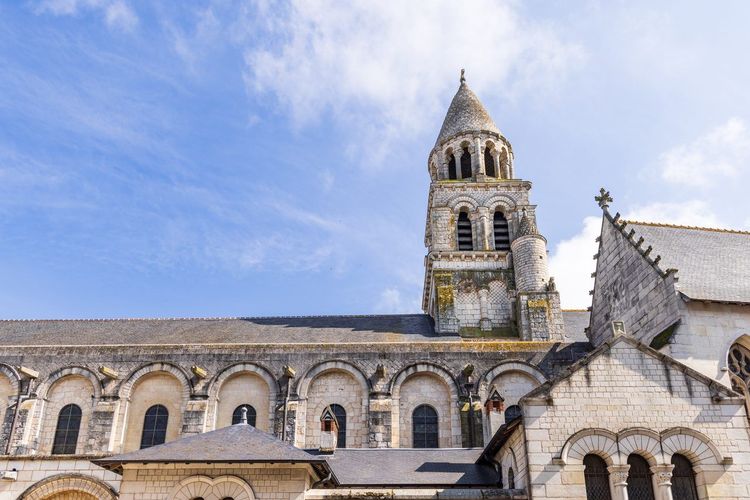
From a distance, the façade of Notre-Dame-la-Grande (Place Charles de Gaulle, 86000 Poitiers, rated 4.6/5 on Google based on 2,452 reviews) looks like a lacework of stone. Up close, it tells a precise story: every sculpture depicts a biblical scene, from the Annunciation to the Last Judgement, arranged like a 12th-century Romanesque comic strip.
The real showstopper comes after dark. For years, a light projection show has recoloured the façade by restoring the original polychrome decoration that archaeologists were able to reconstruct through pigment analysis. The current creation, by Spectaculaires, runs in the late evening from late June to late September, with several back-to-back screenings from 10:30pm in midsummer, and again during the end-of-year holidays. The effect surprises even locals who thought they knew the church inside out.
Inside, the nave remains dark and intimate, almost in deliberate contrast with the exuberant exterior. Many visitors head straight to the neighbouring market square without pushing open the door — a mistake that the Ryo audio guide for Poitiers easily corrects by flagging the entrance along its route.
Saint-Hilaire-le-Grand, the Church with Seven Naves
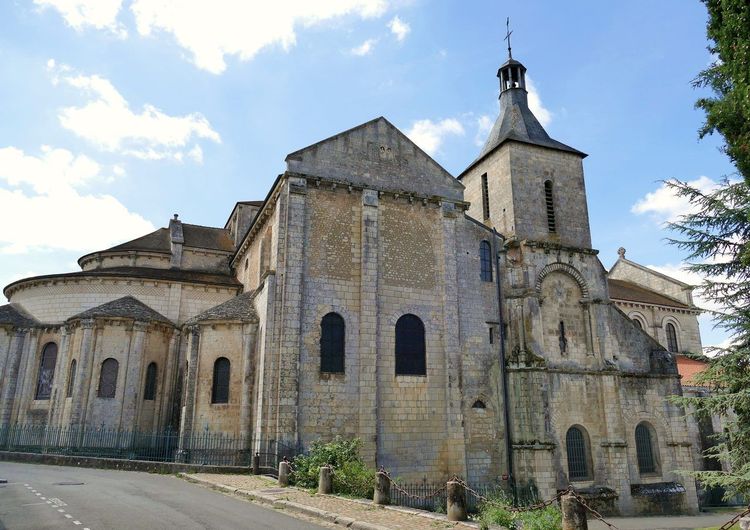
Listed as a UNESCO World Heritage Site since 1998 as part of the pilgrimage routes to Santiago de Compostela, the church of Saint-Hilaire-le-Grand confounds visitors with its layout: seven naves separated by rows of columns, a raised choir and an apse that seems to float above the ground.
The explanation lies in a failed building project. After a medieval fire, the builders wanted to replace the timber roof with a stone vault, but the original nave was far too wide to support one. Rather than tearing everything down, they erected rows of pillars inside the vessel to reduce the spans, in the process creating these extra naves found nowhere else in the region. The result looks like a forest of columns, with perspectives that shift at every step.
Look up at the wall paintings: one of the very earliest known depictions of the Apocalypse is still there, half faded. The crypt, beneath the choir, houses the tomb of Saint Hilaire, Bishop of Poitiers in the 4th century and the reason for the pilgrimage that sustained the neighbourhood throughout the Middle Ages. Admission is free, and the church stays open throughout the day.
The Musée Sainte-Croix, Camille Claudel and Twenty Centuries of Archaeology
You wouldn't necessarily expect the third-largest public French collection of Camille Claudel's work in a municipal museum in Poitou — and yet there it is. The Musée Sainte-Croix (3bis Rue Jean Jaurès, 86000 Poitiers, rated 4.6/5 on Google based on 808 reviews) houses a remarkable ensemble, displayed alongside works by Rodin and a panorama of sculpture around 1900.
The rest of the collections cover prehistory, Gallo-Roman archaeology from excavations carried out in the city, the early Middle Ages and fine arts from the 14th to the early 20th century. A more unexpected section documents Egyptomania — the European fascination with ancient Egypt that flooded the decorative arts of the 19th century. The building itself deserves a look: constructed in exposed concrete in the 1970s, it deliberately contrasts with the medieval heritage of the rest of the city.
Allow a good hour and a half for the full visit, more if you linger over the archaeology. Full admission is €5, €2.50 at the reduced rate, with free entry for under-18s, students, job seekers, every Tuesday and on the first Sunday of the month. Another detail few visitors know: admission becomes entirely free from 21 June to 20 September 2026. Closed on Mondays and public holidays.
The Espace Mendès France, Science under the Stars
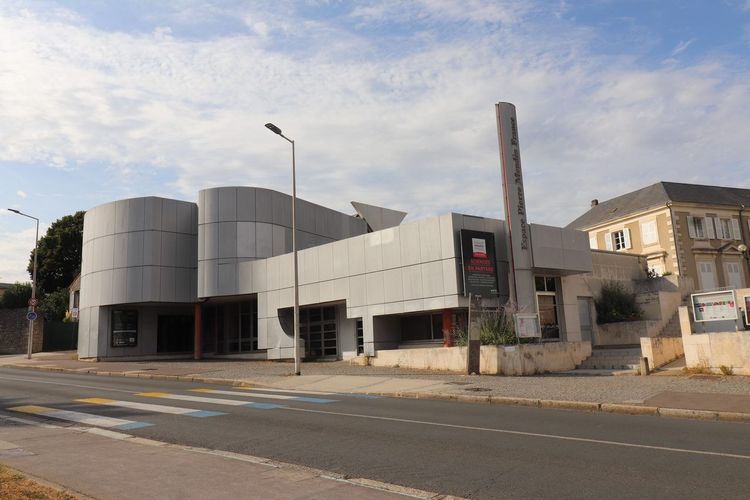
A stone's throw from the cathedral, the Espace Mendès France (1 Place de la Cathédrale, 86000 Poitiers, rated 4.5/5 on Google based on 173 reviews) offers an experience that stands apart from the rest of the heritage trail: a digital planetarium, an astronomical observatory and temporary exhibitions on science, often interactive.
Planetarium shows change themes regularly — some designed for families, others aimed at audiences already familiar with recent astrophysics. On clear nights, public observation evenings open the dome so visitors can point a telescope at Saturn or the craters of the Moon. The programme follows the astronomical calendar rather than school holidays, which is why it's worth checking the schedule before you visit.
If you're looking for more ideas to fill a day combining science and heritage, the top 6 things to do in Poitiers lists several complementary addresses around the city centre, easy to pair with Poitiers' own audio-guided tour for the heritage side of things.
The Abbaye Saint-Martin de Ligugé, the Oldest Monastery in the Western World
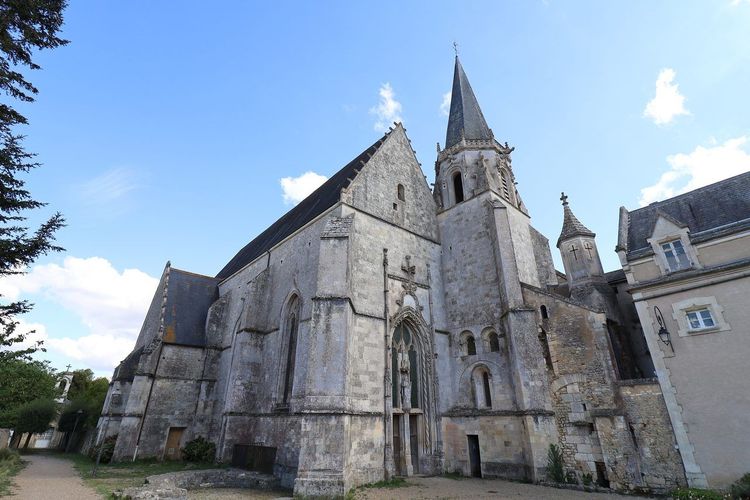
About ten kilometres south of Poitiers, the Abbaye de Ligugé (Place du Cloître, 86240 Ligugé, rated 4.5/5 on Google based on 335 reviews) claims the title of the oldest monastery in the Western world still in operation. Founded in 361 by Saint Martin, future Bishop of Tours, even before his move to Touraine, it has survived invasions, the Wars of Religion and the Revolution without ever being entirely extinguished.
The current buildings date largely from the 19th century, the period during which the Benedictine monks rebuilt the entire complex. What strikes you most of all is the continuity: a community still lives on site and produces art enamels in its workshop — a recognised craft you can find in the monastery shop alongside the abbey's own publications.
Excavations carried out beneath the parish church have uncovered early Christian remains, witnesses to the very first centuries of monastic life on this site, even if archaeologists remain cautious about the precise dating of each layer. Guided tours take place on Saturday and Sunday at 3pm and cover the church, the exhibition room and the enamels made by the monks. The shop opens Tuesday to Sunday with a long midday break.
If you don't have a car, a bus serves Ligugé in about twenty minutes from Poitiers. Check the timetables before you leave: the rhythm of the monastic community takes priority over that of visitors, and everything stops during services.
The Parc de Blossac, a Breath of Fresh Air between Two Visits
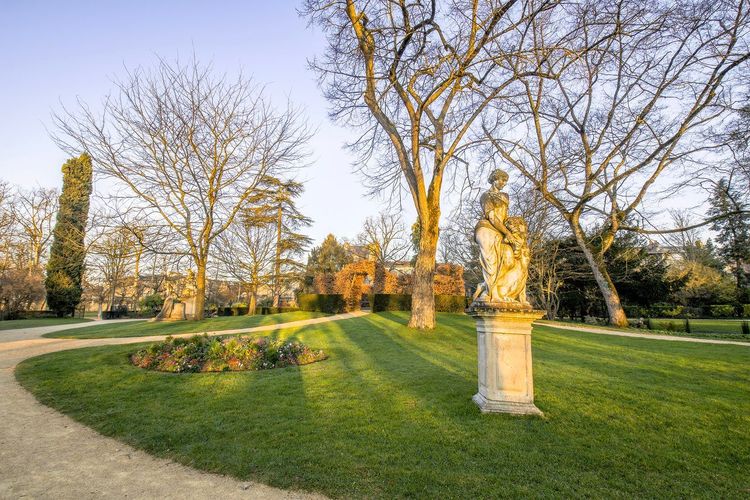
Laid out in the 18th century on former ramparts by the intendant Comte de Blossac, this park offers an open view over the Clain valley and serves as a decompression chamber between two heritage visits. Formal tree-lined avenues bordered by centuries-old trees on one side, a more relaxed English-style garden on the other, and a small free-access animal park that delights local families. Free entry every day; half an hour is enough to walk around it.
The Futuroscope, the Other Side of the Visit

It's impossible to talk about curiosities in the Poitiers area without mentioning the Futuroscope, about fifteen minutes by car from the city centre. The park has built a reputation as a classic family attraction, but several experiences stand well above the rest: virtual reality simulators, night-time shows projected onto the site's buildings, and rides that play on the senses rather than pure speed.
What often surprises visitors is the architecture itself. The buildings shaped like spheres, geological faults or crystals were designed in the 1980s by architects who were literally imagining what a city of the future would look like — with results that have aged rather well.
For transport, forget about a tram: Poitiers doesn't have one. The Vitalis bus network connects Poitiers station to the park in about twenty minutes, and the Futuroscope TGV station is just a few hundred metres from the entrance. For practical information (prices, best time to visit, must-see attractions), the article visiting the Futuroscope: tips and practical information details a complete itinerary for one or two days.
Allow a full day at minimum for a first visit, two if you want to take in the night shows without rushing from one attraction to the next.
Poitiers at Night, Legends and Stones That Speak
Once night falls, the historic centre changes its face. The cobbled streets around Notre-Dame-la-Grande empty out, and it is precisely at that moment that the local stories make the most sense: a façade that lights up in colours thought lost forever, a baptistery that has witnessed sixteen centuries of baptisms, a dolmen that served as a banquet hall for Rabelais's students.
Occasional guided night-time tours organised by the tourist office stop at details invisible by day: medieval graffiti carved into the stone, masons' marks left by the builders, old shop signs that have reappeared during renovation work. The Ryo audio guide offers an equivalent route, available at any hour, if you prefer to explore at your own pace rather than follow a fixed timetable.
To round off the evening, several addresses in the city centre serve farci poitevin, a slow-cooked dish of greens and herbs that takes some getting used to at first. The top 10 culinary specialities in Poitiers lists the best places to try it along with a few other local gastronomic curiosities.

FAQ
Which unusual visit in Poitiers is truly worth the detour?
The Hypogée des Dunes, without hesitation: a 7th-century burial chamber buried beneath a garden, both little-known and spectacular once you descend the staircase. Its only drawback is its limited availability, as it only opens for a few weeks each year.
Where can you see ancient and medieval remains in Poitiers?
The Musée Sainte-Croix displays pieces from excavations carried out in the city, from prehistory to the early Middle Ages. The Baptistère Saint-Jean completes the picture with its Merovingian sarcophagi and wall paintings, and the Hypogée des Dunes rounds things off for the Merovingian period.
Is the Baptistère Saint-Jean free to visit?
No, admission costs 3 euros, with free entry for children under 6. Opening hours vary considerably by season, with continuous daytime opening only from 21 June to 30 September.
Can you visit the Abbaye de Ligugé freely?
No, access is only possible through guided tours scheduled on Saturday and Sunday at 3pm. The monastery shop, open Tuesday to Sunday, remains accessible outside those time slots.
How much time should you allow for an unusual visit to Poitiers?
A full day is enough to cover the historic centre (baptistère, Notre-Dame-la-Grande, Saint-Hilaire, Musée Sainte-Croix). Add half a day for the Plateau des Dunes and Ligugé, and a separate full day if you include the Futuroscope.
Does Poitiers have any particular local legends?
Several stories circulate around the Pierre Levée, which entered literature thanks to Rabelais, who attributed its erection to Pantagruel, and around the underground passages of the city centre, where verified archaeological facts blend with the oral traditions of generations of students.
Poitiers does not try to impress at first glance — it prefers to reveal its surprises to those who take the time to stop: a 4th-century baptistery tucked between two façades, a Merovingian burial chamber beneath a garden of conifers, a dolmen in the middle of a residential neighbourhood. Add the Abbaye de Ligugé and the Futuroscope a few minutes away by road, and the city becomes a solid base for two or three days of exploration rather than a simple stopover on the way somewhere else.
To organise your route in the most logical order, the Ryo audio guide for Poitiers remains the easiest way to connect these sites on foot, with historical commentary straight in your ears as you walk.