© Shutterstock
 Votre guide Ryo
15 Free Activities in Rouen in 2026
Search "free activities Rouen" in any search engine and you'll mostly find lists of museums — which makes sense, since the city has made free access to its collections a deliberate cultural policy since 2008, when it chose to open all its municipal museums without a ticket. A rare choice in France, and one that changes everything when planning a weekend on a budget. Between the Seine and the Gothic spires, this Norman city stacks up curiosity after curiosity that can be enjoyed without spending a cent, from the sculpted forecourt of its cathedral to the unsettling silence of a half-timbered former cemetery. The Ryo audio-guided tour of Rouen connects a good number of these places on foot, in just under two hours of walking.
Expect a 19th-century stuffed rhinoceros on free display, an astronomical clock over 600 years old visible from the street, a botanical garden with century-old greenhouses, and a funerary gallery adorned with macabre sculptures. Five municipal museums open without a ticket all year round, a Gothic abbey that survived the 1944 bombings, and a panoramic view over the entire city round out the list. Here are fifteen ways to discover Rouen without spending a euro, from unmissable monuments to corners that even some locals don't know about.
1. Rouen Notre-Dame Cathedral
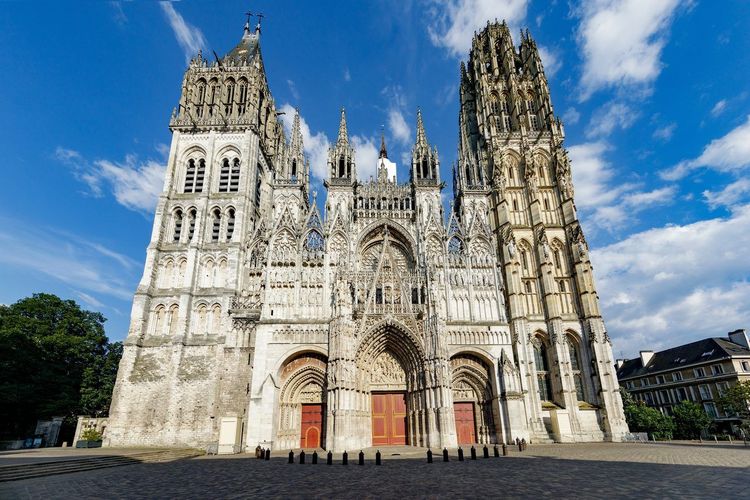
The Rouen Notre-Dame Cathedral (Place de la Cathédrale, 76000 Rouen, rated 4.7/5 on Google based on 19,081 reviews) owes part of its fame to Claude Monet, who painted its façade more than thirty times between 1892 and 1894 at different times of day, seeking to capture the shifting light on the sculpted stone. The results of those sessions, now scattered between the Musée d'Orsay and several international collections, made this Flamboyant Gothic portal one of the most reproduced pictorial subjects of the 19th century.
Entry to the building is free all year round, with no reservation required. The cast-iron spire, rising to 151 metres, made the cathedral the tallest building in the world between 1876 and 1880, before being surpassed by Cologne Cathedral. Inside, the Tour de Beurre (Butter Tower) takes its name from donations made by the faithful who, in the 15th century, paid for the right to consume butter during Lent — a piece of local legend worth recounting on the spot, in front of the corresponding stained-glass window.
You can extend your visit by examining the Portail des Libraires on the north side, whose bas-reliefs are said to have heavily inspired the scenes in the Disney version of The Hunchback of Notre-Dame. Arrive on a weekday afternoon: the raking light on the limestone recalls Monet's canvases directly, and tourist numbers are noticeably lower than in the morning.
2. The Gros-Horloge and Its Renaissance Street
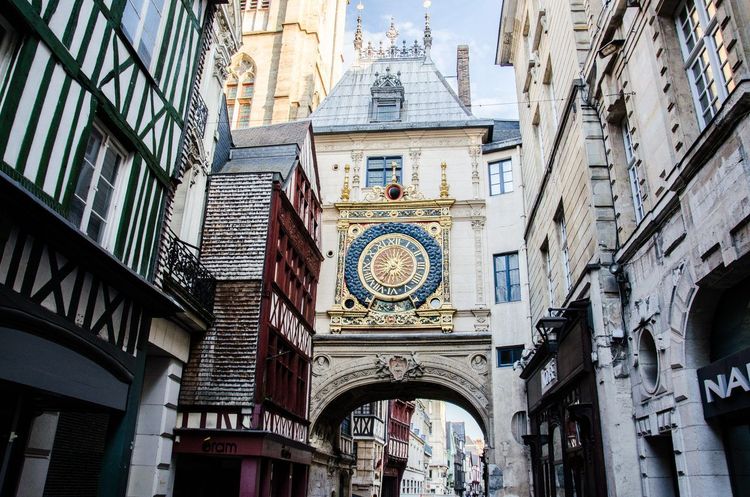
You can't miss the Gros-Horloge, the Renaissance arch built in 1527 that straddles the street of the same name. The original mechanism, however, dates back to 1389, making it one of the oldest in Europe still in working order. Its single-handed gilded dial also indicates the phases of the moon via a mobile sphere integrated beneath the main clock face.
Climbing the belfry is paid, but viewing the dial from the street costs nothing and is more than enough to take in the richness of the sculpted decoration: the paschal lamb, the drapers' coat of arms, and the half-timbered façades lining the entire pedestrian street. A two-minute walk away, on Rue de la Pie, stands the birthplace of Pierre Corneille, which our article on the Corneille and Flaubert houses in Rouen covers in detail for those interested in literary heritage. The street itself is worth a leisurely stroll: every overhanging upper storey tells three or four centuries of Rouen's textile trade.
3. The Musée des Beaux-Arts de Rouen
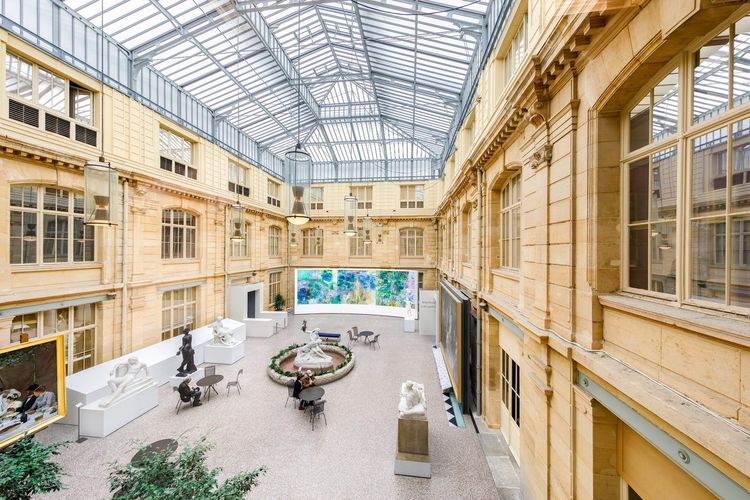
The Musée des Beaux-Arts de Rouen (Esplanade Marcel-Duchamp, 76000 Rouen, rated 4.6/5 on Google based on 5,113 reviews) ranks among the richest regional collections in France, with works by Monet, Sisley, Renoir and Géricault, as well as a Flagellation of Christ attributed to Caravaggio. Free to enter since 2008, it stands as one of the free activities in Rouen that neither art lovers nor passing visitors should miss.
Only temporary exhibitions remain paid, which still leaves several hours of visiting across three floors. The rooms dedicated to the Rouen School, an unjustly overlooked local Post-Impressionist movement, are well worth lingering in. Allow an hour and a half for a full tour, slightly less if you head straight for the 19th-century galleries on the first floor. A tip: start with the medieval collections at the back, usually deserted in the morning, before the groups arrive through the large glass roof.
4. The Aître Saint-Maclou
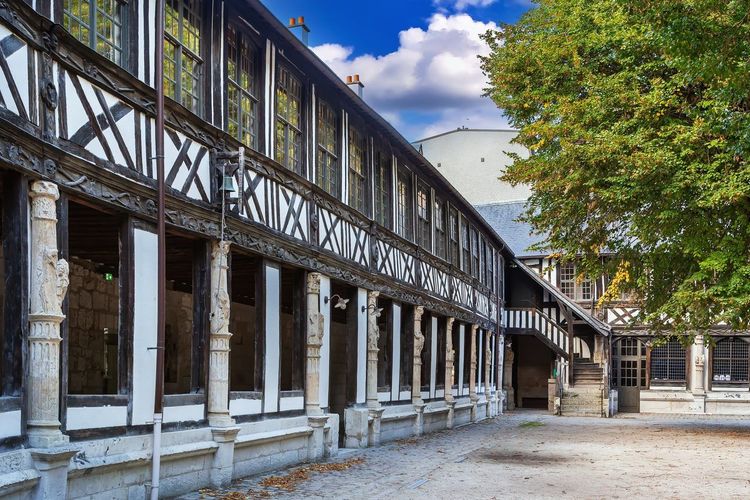
The Aître Saint-Maclou (186 Rue Martainville, 76000 Rouen, rated 4.6/5 on Google based on 2,245 reviews) is arguably the city's most unsettling site, and one of the free activities in Rouen that stays with you the longest: a former plague cemetery from the 14th century, surrounded by half-timbered galleries carved with skulls, crossbones and gravediggers' tools. The Black Death epidemics, followed by successive waves through the 17th century, filled this small quadrangle with thousands of bodies, before the site was converted into a school and later an annex of the School of Fine Arts.
A mummified cat, discovered during restoration work and kept under glass in one of the galleries, adds an almost surreal touch to the whole. Access to the inner courtyard is free during the day, and the carved wooden galleries can be explored in about twenty minutes. It is also one of the few places in Rouen spared by the 1944 bombings, which explains the remarkable state of preservation of the original timber frames.
The Ryo audio-guided tour of Rouen includes a dedicated listening point here, with the full historical context of the epidemics that shaped the Martainville district. For anyone seeking a striking contrast after the light of the cathedral, it's hard to do better: a few streets separate the two sites, and the atmosphere changes completely.
5. Rue Eau-de-Robec
The Rue Eau-de-Robec takes its name from the stream that still runs through it, channelled between colourful half-timbered houses that seem straight out of a Norman postcard. This waterway once fed the dyeing workshops and tanneries of the Saint-Maclou district, before the textile industry declined in the 19th century. Small stone footbridges span the trickle of water at regular intervals, a detail that hurried visitors often miss while gazing at the façades.
The pink, yellow and blue houses lining the stream make it one of the most photographed streets in the city, particularly at the end of the day when the light rakes across the timber frames. Take time to sit at one of the café terraces along the street: from there, at stream level, the scene comes fully into its own. A simple stroll along the water, without any fixed itinerary, is enough to understand why some residents compare the district to Bruges or Colmar. The street also hosts small flea markets on several weekends throughout the year, which makes for a pleasant extension of the walk.
6. The Muséum d'Histoire Naturelle de Rouen
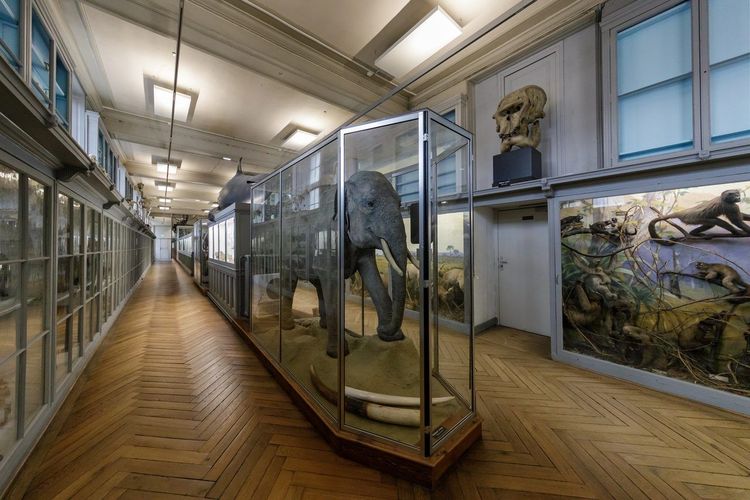
The Muséum d'Histoire Naturelle de Rouen (198 Rue Beauvoisine, 76000 Rouen, rated 4.4/5 on Google based on 906 reviews) holds one of the most significant natural history collections in France outside Paris, with over one million catalogued specimens. Among the most striking pieces: a stuffed white rhinoceros dating from the 19th century, several Egyptian mummies brought back during 19th-century expeditions, and an entire gallery devoted to minerals and meteorites.
Like the other municipal museums, the Rouen natural history museum is free to visit all year round for its permanent collections, making it an obvious stop for families: the cases of taxidermied animals tend to fascinate children far more than rooms of classical painting. Allow an hour and a half to see all three floors of the exhibition without missing anything, as the comparative anatomy gallery is usually the longest to explore. Among leisure activities in Rouen suited to younger visitors, this is probably the safest bet.
7. Place du Vieux-Marché
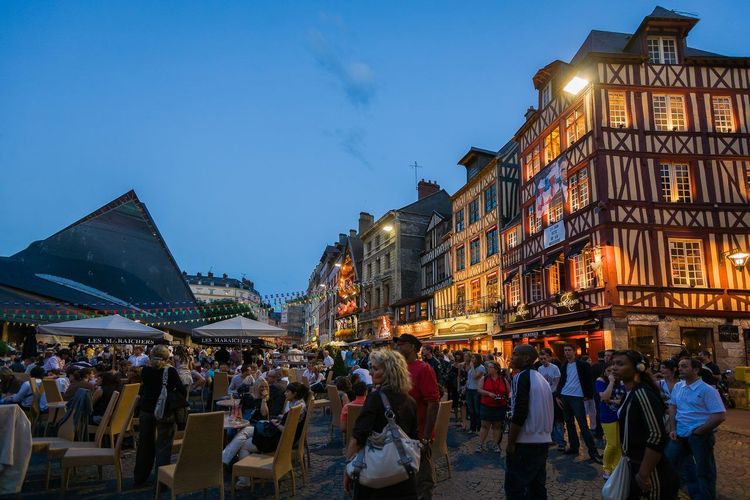
The place du Vieux-Marché is the site where Joan of Arc was burned at the stake in 1431, recalled by a modern cross planted at the exact spot of the pyre. The Église Sainte-Jeanne-d'Arc, built in 1979 in a resolutely contemporary style, houses the 16th-century stained-glass windows salvaged from the former Église Saint-Vincent, which was destroyed during the Second World War bombings.
Around the square, the covered market halls host a daily food market where you can simply wander between the stalls without buying anything — a very Rouen way of watching local life without opening your wallet. The architectural contrast between the church with its undulating roof, meant to evoke the flames of the pyre like an upturned boat hull, and the surrounding half-timbered houses often surprises visitors who were expecting a more traditional setting.
8. The Jardin des Plantes de Rouen
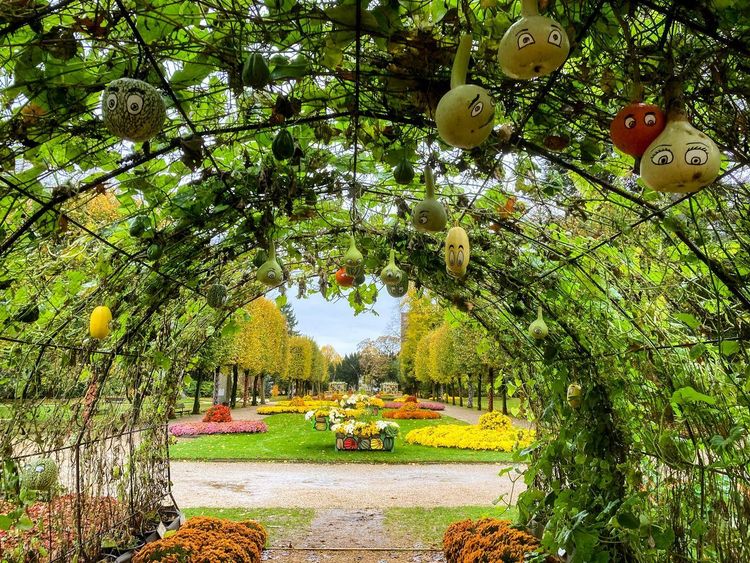
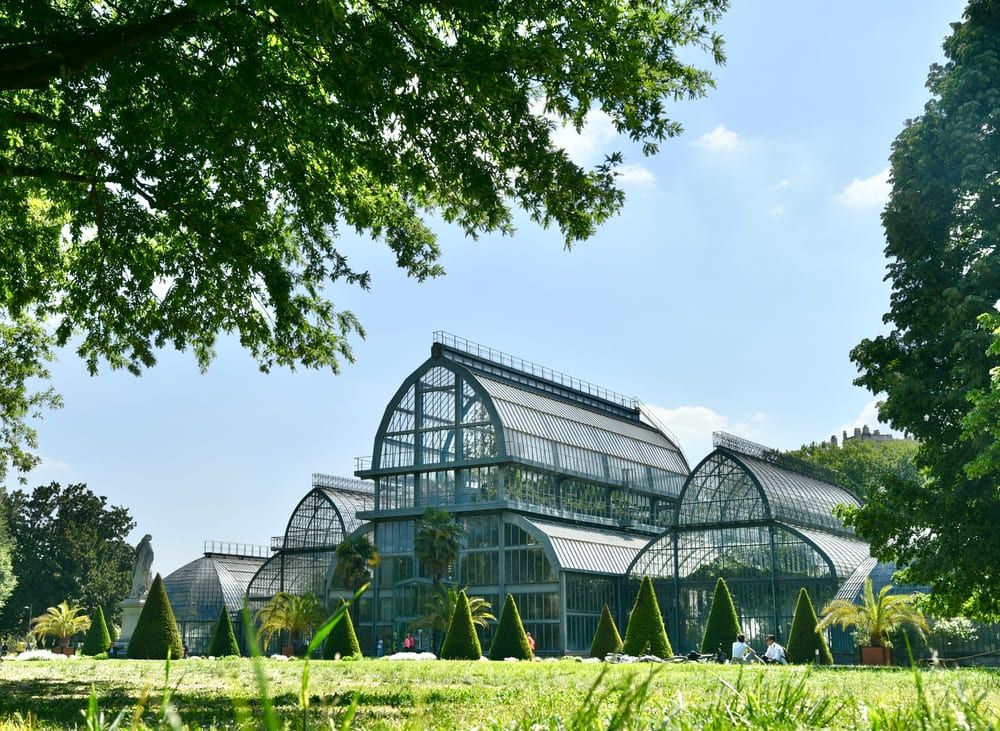
The Jardin des Plantes de Rouen (114 bis Avenue des Martyrs de la Résistance, 76100 Rouen, rated 4.5/5 on Google based on 6,743 reviews) covers nearly 10 hectares in the south of the city, with tropical greenhouses, a rose garden and ponds inhabited by ducks and swans. Founded in the mid-19th century, it still preserves an orangery and several listed remarkable trees, including a cedar of Lebanon planted more than 150 years ago.
Entry is free all year round, and the lawns lend themselves readily to an impromptu picnic on fine days. Among the most relaxing free activities in Rouen, this one has the advantage of suiting everyone: families find a playground and plenty of space for children to run around, while botany enthusiasts hunt down the labels of rare species in the giant water-lily greenhouse. For more ideas for nature outings around the city, our article on activities in Rouen and surroundings covers several complementary options, including the Roumare forest.
9. The Musée Le Secq des Tournelles
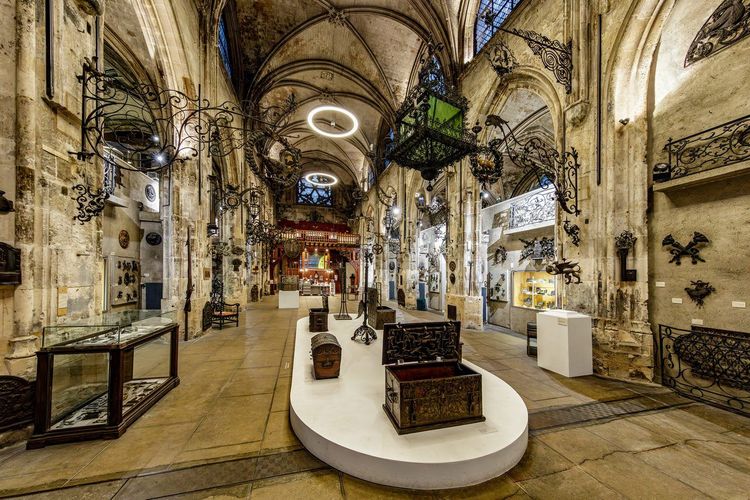
Housed in the former Église Saint-Laurent, the Musée Le Secq des Tournelles (Rue Jacques-Villon, 76000 Rouen, rated 4.7/5 on Google based on 819 reviews) is entirely devoted to historic ironwork: over 15,000 wrought-iron objects, from medieval shop signs to Renaissance keys, as well as grilles and door knockers.
The Gothic religious setting, preserved almost intact, gives the collection an almost theatrical dimension: the metal pieces are suspended right up into the heights of the nave, creating a play of shadows that is particularly photogenic late in the morning. Allow 45 minutes for a full visit — this stop works well as a quick follow-on after the nearby cathedral. It is one of those niche museums you would probably never have pushed open the door to if entry had been paid, yet it leaves a lasting impression, one more reason to loop it into our Rouen audio-guided tour of the cathedral quarter.
10. The Côte Sainte-Catherine Panorama
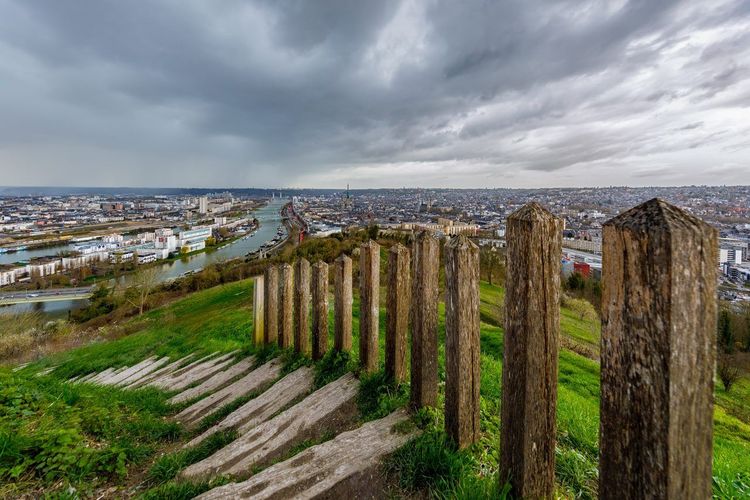
For a sweeping view over the city, climb up to the Côte Sainte-Catherine panorama, accessible via a steep path from the Martainville district. The effort — about twenty minutes of climbing — is rewarded by an unobstructed view over Rouen's rooftops, the meander of the Seine and the cathedral spires that dominate the whole scene. This is where a fort once stood, dismantled in the 16th century, of which only a few remains lie buried beneath the vegetation.
Wear closed shoes: the path is cobbled in places and can become slippery after rain, which is frequent in Normandy. Come preferably in the late afternoon, when the sun is behind you and lights up the façades on the right bank — it is one of the few points in the city from which you can take in the logic of the river's meander at a single glance. A bench and an orientation table let you catch your breath before the descent, and the spot remains surprisingly quiet compared to the terraces in the centre.
11. The Musée des Antiquités de la Seine-Maritime
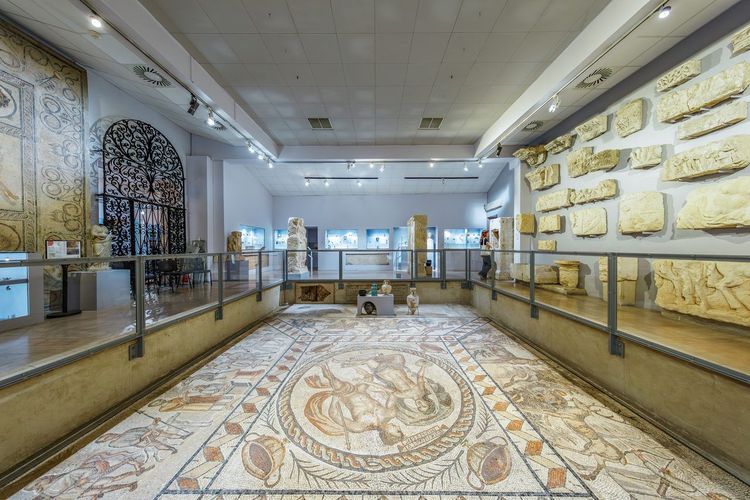
Neighbouring the Muséum d'Histoire Naturelle, the Musée des Antiquités de la Seine-Maritime (198 Rue Beauvoisine, 76000 Rouen, rated 4.7/5 on Google based on 819 reviews) occupies part of the same former Visitandines convent. Its collections span local Gallo-Roman archaeology, medieval decorative arts and a series of 16th-century tapestries, some of which came directly from the cathedral.
Free admission and the immediate proximity of the natural history museum make it easy to visit both institutions in a single outing, without returning to the historic centre. The rooms, less crowded than those of the Musée des Beaux-Arts, often offer a quieter moment, almost a one-to-one encounter with the collections. Don't leave without tracking down the Gallo-Roman mosaic from Lillebonne, one of the largest preserved north of the Loire.
12. The Abbatiale Saint-Ouen and Its Garden
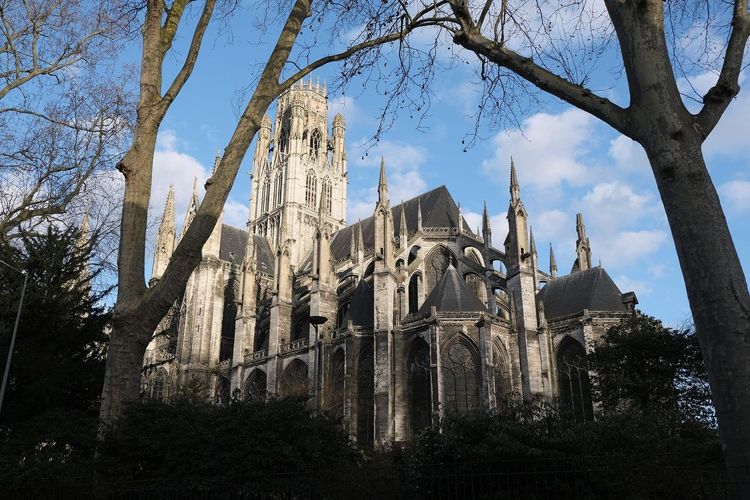
The Abbatiale Saint-Ouen rivals the cathedral in height and houses one of the largest organs in France, a Cavaillé-Coll dating from 1890 still used for concerts. This Gothic building, a former Benedictine abbey church, escaped the 1944 bombings even as the surrounding district was largely destroyed.
Around the church stretches the Hôtel de Ville garden, a public park planted with flowering beds and large trees, perfect for a shaded break after the visit. The Ryo audio-guided tour of Rouen stops at this very spot, offering a full architectural reading of the façade before continuing towards the historic centre. If you visit on a Sunday, keep your ears open: it is not unusual to hear the organist making the instrument resound during rehearsals.
13. The Musée de la Céramique
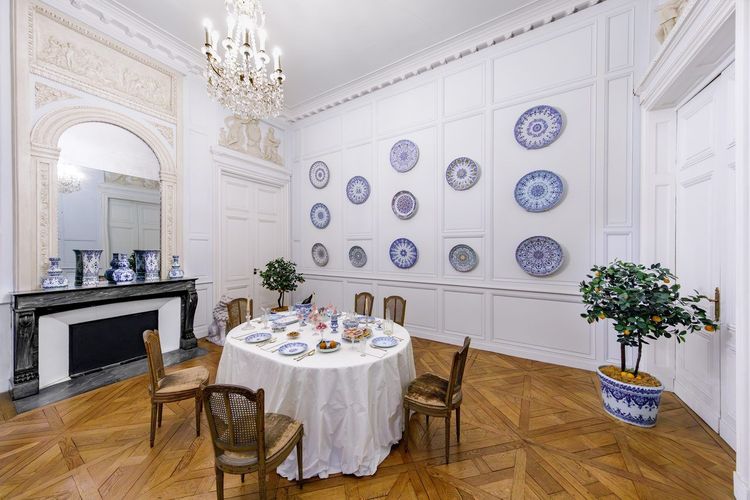
Housed in the Hôtel d'Hocqueville, the Musée de la Céramique (1 Rue Faucon, 76000 Rouen, rated 4.4/5 on Google based on 500 reviews) traces three centuries of Rouen faience production — the decorated pottery with blue and polychrome motifs that made the city's reputation in the 17th and 18th centuries. Visitors can follow the evolution of the famous "rayonnant style", those fan-shaped decorations that adorned the tableware of the great Norman households, through to later pieces inspired by Chinese porcelain.
The state rooms of the hôtel particulier, with their original wood panelling, add at least as much to the visit as the display cases themselves. Allow about an hour: it is a short but dense stop, ideal to slot in between two larger sites, and one of the few places to grasp what long made the fortunes of Rouen's faience makers.
14. The Seine Riverbanks
The Seine riverbanks, redeveloped since 2012, offer several kilometres of walkway along the river, with public benches, play areas and views of the Pont Gustave-Flaubert — one of the tallest lifting bridges in Europe, with spans that rise to over 50 metres to let vessels pass. On fine days, the people of Rouen gather here in numbers to picnic or cycle along the bike path that runs beside the bank.
Count the riverbanks among the free activities in Rouen most enjoyed by locals: a permanently installed carousel punctuates family weekends, with no need to ride it to soak up the atmosphere, and pop-up guinguettes set up there in summer. On the left bank, the Hangar 106 and the converted former industrial docks give the walk a more contemporary feel, far from the half-timbered buildings of the centre. It is also the best place to watch the Armada, the great tall-ships gathering that returns every four or five years.
15. Street Art and Murals in Rouen
Rouen conceals a contemporary urban heritage that is often overlooked by conventional guides: several dozen monumental murals, notably in the Saint-Marc and Jouvenet districts, some of which were painted to mark the 130th anniversary of Monet's stays in the city. Entire façades reproduce Impressionist scenes on a large scale, a wink at the cathedral canvases that reappear, enlarged, on the corner of a residential street.
Venture a little beyond the tourist centre and you will also come across more spontaneous works, signed by local artists, along the walls that run beside the railway lines. This is one of the unmissable activities for anyone who enjoys walking without a fixed plan: download the mural map published by the city beforehand, or simply let the maze of backstreets guide you from one painted façade to the next. An hour of wandering is enough to spot around ten of them in the Saint-Marc district alone.
FAQ
Are Rouen's museums really free all year round?
Yes, for their permanent collections. The Musée des Beaux-Arts, the Muséum d'Histoire Naturelle, the Musée des Antiquités, the Musée de la Céramique and the Musée Le Secq des Tournelles have been accessible without a ticket all year round since 2008. Only temporary exhibitions sometimes remain paid.
Which free activities in Rouen are best for families?
The Jardin des Plantes, the Muséum d'Histoire Naturelle with its taxidermied animals, the Seine riverbanks and their carousel, and the Aître Saint-Maclou with its mysterious atmosphere are among the outings most appreciated by children and parents alike.
Can you go up the Gros-Horloge for free?
No, access to the belfry and its mechanism is paid. However, viewing the gilded clock face and the Renaissance arch from the street is entirely free and is more than enough to appreciate the richness of the sculpted decoration.
Where can you park for free when visiting Rouen?
Some residential areas on the outskirts of the city centre, particularly on the left bank near the Saint-Sever district, offer unregulated parking. The historic centre itself is mostly paid during the day: it is better to use park-and-ride facilities served by the metro.
What is the best time to visit Rouen without spending money?
Weekday mornings offer the best combination of light and reduced crowds, particularly for the cathedral and the Aître Saint-Maclou. Spring and early autumn avoid the summer crowds while still offering pleasant weather conditions.
What can you see in one day among Rouen's free activities?
A realistic itinerary links the cathedral, the Gros-Horloge, the Aître Saint-Maclou, the Musée des Beaux-Arts and the place du Vieux-Marché — around 2 kilometres of walking spread over a full day with breaks.
Rouen can thus be visited in its entirety without ever reaching for your wallet, provided you accept skipping the belfry climb and a few temporary exhibitions. The density of museums open without a ticket, rare at this scale in France, makes it possible to plan a two- or three-day stay without exceeding the budget of a simple return train ticket.
To connect these fifteen stops in a logical order and save time on walking routes, the Rouen audio-guided tour offers a commented route that broadly follows the logic of this article, from the Gothic centre to the more outlying districts — turning a list of free activities in Rouen into a truly structured day of sightseeing.
À lire également