© Shutterstock
 Votre guide Ryo
Visiting Bamberg as a Couple: The Bavarian Little Venice for a Weekend for Two in 2026
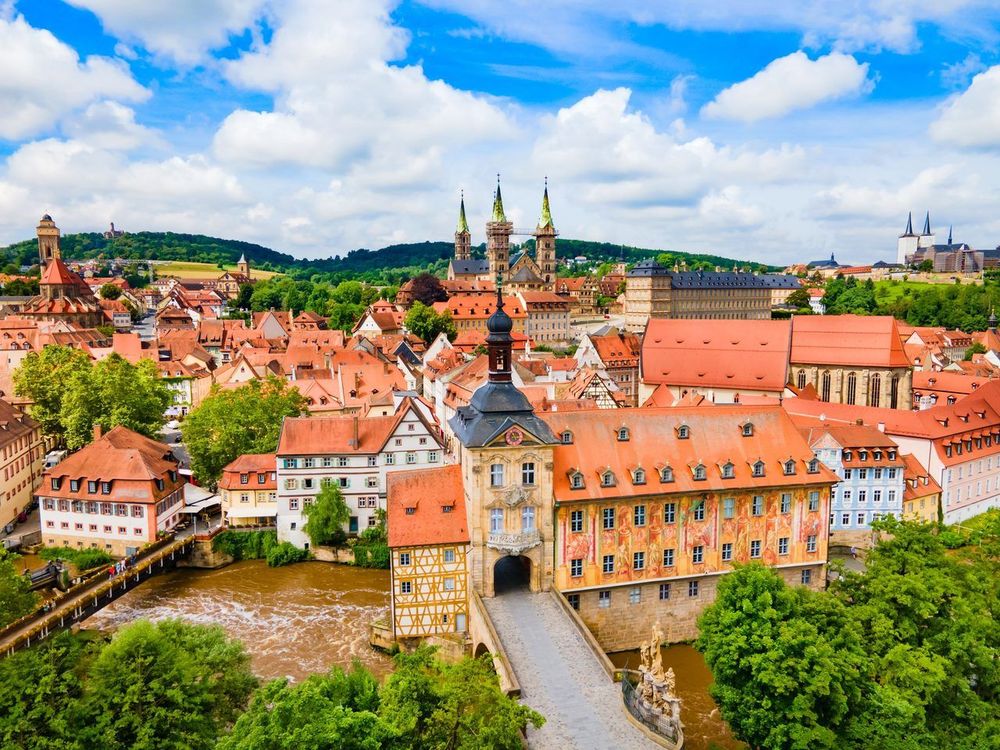
Just step onto the Obere Brücke at dusk, when the half-timbered façades are reflected in the Regnitz, and you'll understand why Bamberg attracts so many couples looking for a setting far from the bustle of Munich or Berlin. Visiting Bamberg as a couple means agreeing to slow down: the whole city can be explored on foot, among cobbled lanes, houses leaning over the water and hills crowned with bell towers. The Ryo audio-guided tour of Bamberg links these places together at the pace of two people rather than a group, with headphones on and no schedule to follow. In a few hours of walking, you'll come across a four-towered cathedral that has dominated the city for over a thousand years, a town hall built on an islet in the middle of the river, a fishermen's quarter nicknamed the Bavarian Little Venice and a hilltop rose garden that offers one of the finest panoramas in Franconia. You'll also taste a smoked beer you won't find anywhere else, served in taverns that are several centuries old. Enough to fill a weekend for two without ever rushing from one monument to the next.
Bamberg, a Stopover for Two in Bavaria
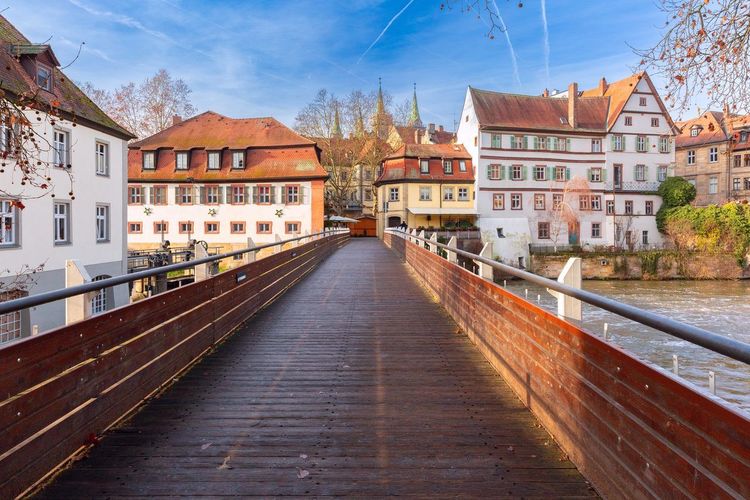
Bamberg never needed to be rebuilt, unlike many Bavarian cities flattened during the Second World War. The result: more than 2,000 protected historic buildings, a centre listed as a UNESCO World Heritage Site since 1993, and a modest size, barely 80,000 inhabitants, which lets you see everything without ever taking public transport. That is precisely what makes it a more interesting destination for two than its larger neighbours: you walk, you stop, you retrace your steps without wasting time.
Bamberg suits a couple who enjoys alternating heritage with informal moments, who wants to taste a distinctive regional cuisine without breaking the bank, and who prefers a human-scale city to a capital saturated with tour groups. Amateur photographers will also find plenty to enjoy: the morning light on the Domberg and the evening light on Little Venice offer two very different atmospheres within a few hundred metres.
On the other hand, you'd better look elsewhere if you want a lively nightlife or beaches: Bamberg goes to bed early during the week, and most of the historic taverns favour a convivial atmosphere over a festive one. Likewise, if walking for long on uneven cobblestones is a mobility issue, be aware that some lanes on the Domberg remain steep and poorly suited to strollers or wheelchairs.
The rest of this article details, neighbourhood by neighbourhood, what is worth the detour: the listed old town, Little Venice and its walks on the water, the viewpoints overlooking the city, a full-day itinerary, beer and food addresses, possible excursions to Nuremberg or Rothenburg, and practical information for organising a stay for two.
The UNESCO-Listed Old Town: Cathedral, Old Town Hall and Cobbled Lanes
Bamberg's historic centre is divided into two parts linked by bridges: the episcopal city on the hills on one side, the bourgeois and commercial island on the other. Both can be visited in half a day, on foot, with no complicated itinerary.
Bamberg Cathedral and Cathedral Hill (Domberg)
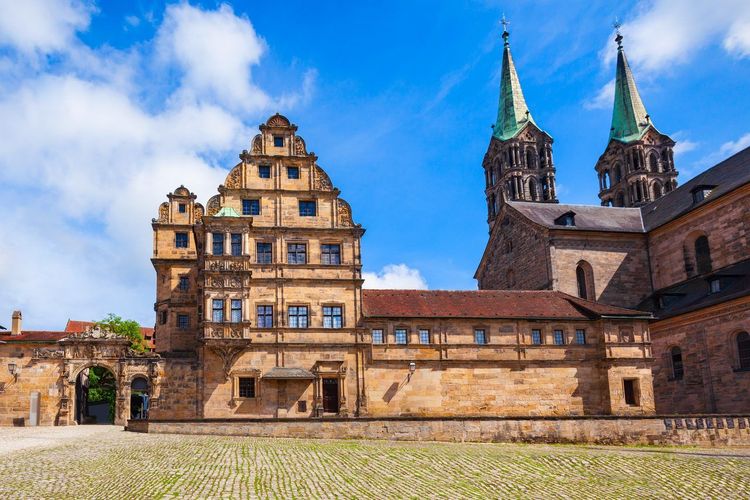
The Bamberg Cathedral (Bamberger Dom) dominates the city from its hill, the Domberg, with its four towers visible from almost every surrounding viewpoint. A first cathedral was consecrated here in 1012; the current building, rebuilt after two fires, was completed in 1237. It houses the tomb of Emperor Henry II, the only Holy Roman Emperor to have been canonised, and that of his wife Cunigunde, also a saint, as well as the famous Bamberg Horseman, a 13th-century equestrian statue whose identity is still debated by historians.
Around the cathedral, the Domplatz brings together most of the religious and political power of the former prince-bishopric. The former court of the prince-bishops (Alte Hofhaltung), with its half-timbered inner courtyard, served as a residence before the construction of the New Residence, right opposite. You can enter the courtyard to admire the wooden galleries, even without visiting the historical museum housed there.
Sit for a moment on the steps of the Domplatz in late morning: it is one of the rare times when the square empties of guided groups, and when you can truly hear the silence unique to the heights of Bamberg. Many couples miss this moment by heading straight to Little Venice.
The Old Town Hall Above the River and the Cobbled Lanes of the Historic Centre
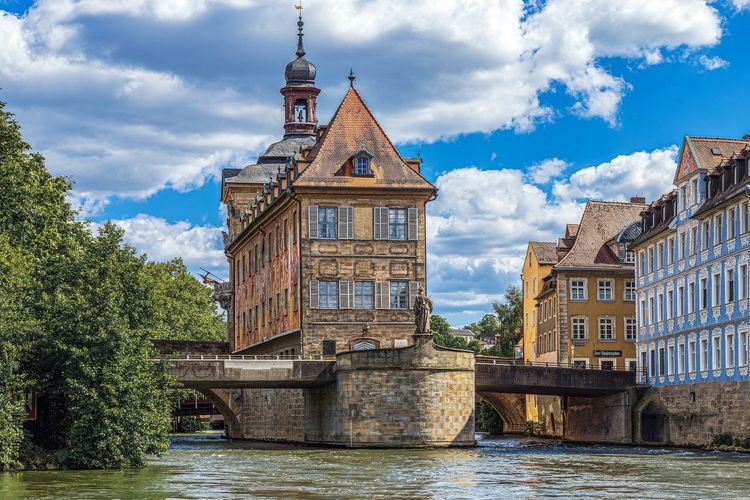
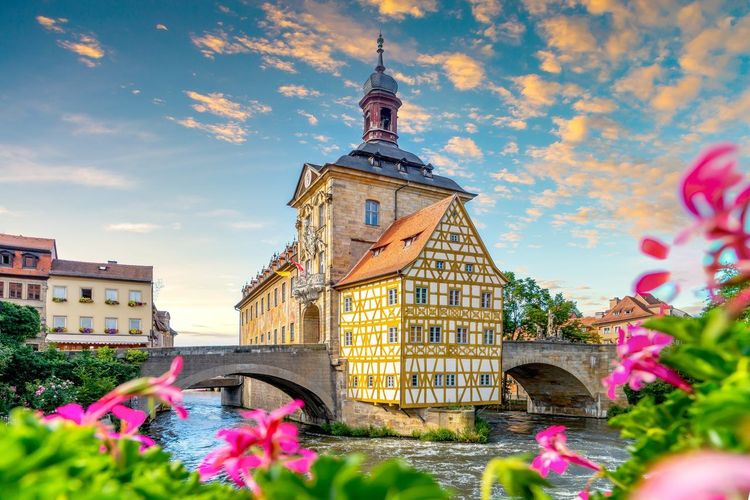
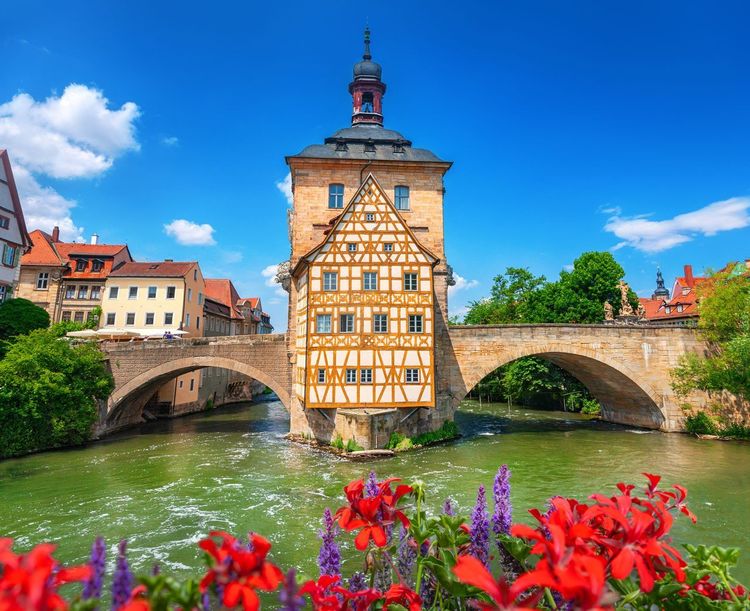
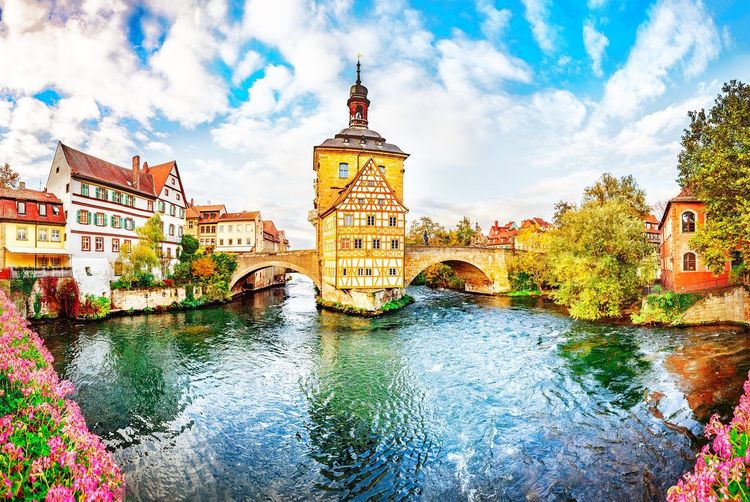
Walking back down from the Domberg towards the river, you come upon the most photographed image of Bamberg: the Old Town Hall (Obere Brücke 1, 96047 Bamberg, rated 4.6/5 on Google from 3.2K reviews) (Altes Rathaus), set on an artificial islet in the middle of the Regnitz, between the Obere Brücke and the Untere Brücke. Local legend has it that the bishop refused the townspeople a plot of land for their town hall; they then drove piles into the river to build on the water, territory that belonged to no one. Its half-timbered section, the Rottmeisterhaus, contrasts with the Baroque façades covered in trompe-l'œil frescoes, to the point where cherub legs seem to emerge from the wall.
The building now houses a collection of porcelain and faience, but the best of it is experienced from the outside: the bridge offers one of the best views of the fishermen's houses below, and this is generally where visitors understand why Bamberg is so often compared to Venice.
Continuing towards the island, Lange Straße and its side streets concentrate independent shops, pastry shops and listed façades that have not changed silhouette since the 18th century. Look up: the steeply pitched roofs and carved dormers often tell more than the information plaques. On the hill side, Sandstraße, at the foot of the Domberg, lines up some of the oldest half-timbered houses in the city and a handful of neighbourhood bars where you can stop before dinner.
This triangle of cathedral, court of the prince-bishops and Old Town Hall forms the heart of the Ryo audio-guided tour of Bamberg: of its 20 audio stops, a good number recount the intrigues of the prince-bishops at the very moment you walk past their palaces, making it a solid base for the first half-day.
Klein Venedig, Little Venice: A Walk and a Cruise for Two
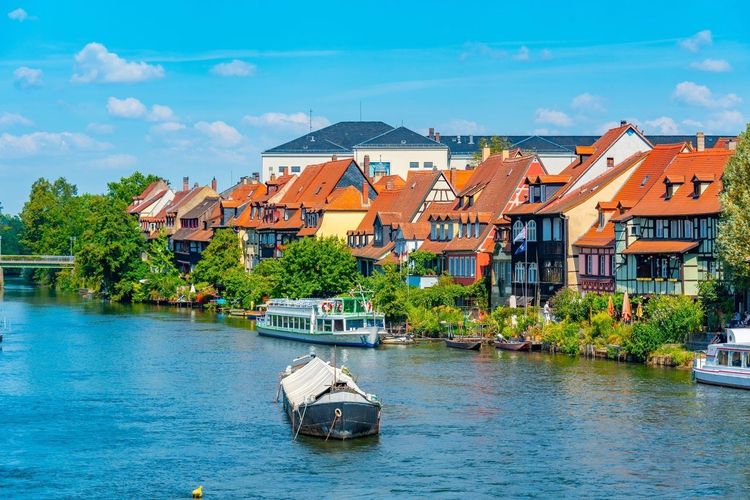
On the other side of the bridge, the lanes give way to an almost silent neighbourhood where the water becomes the real subject of the stroll.
The Fishermen's Quarter and Its Half-Timbered Houses
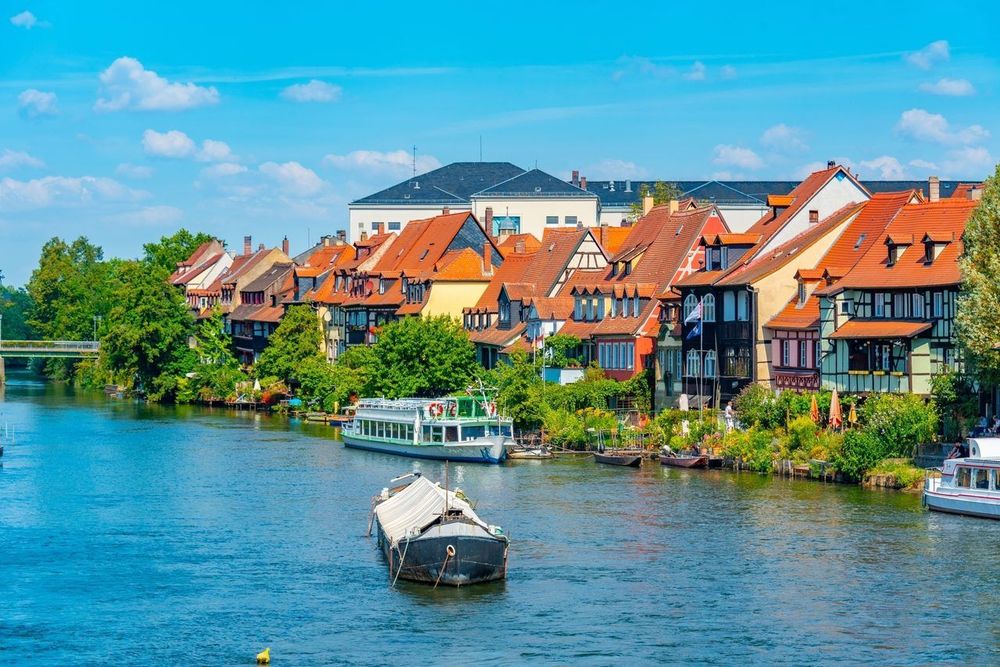
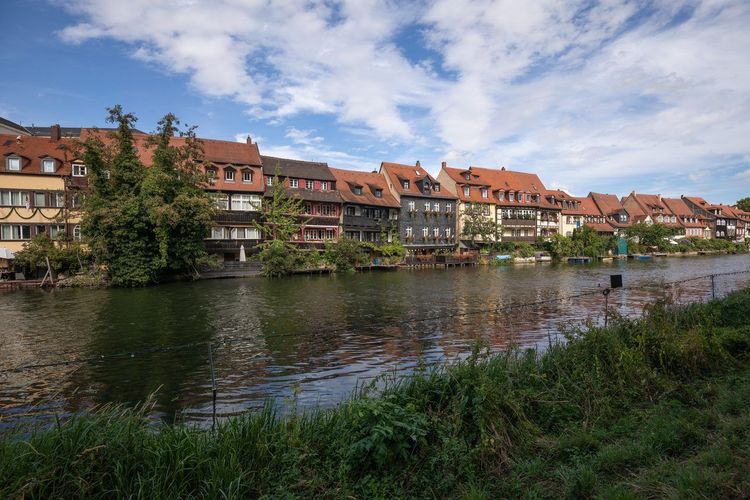
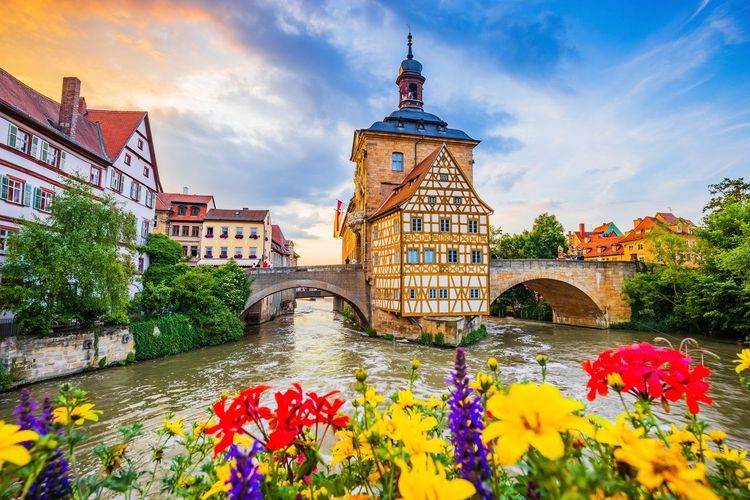
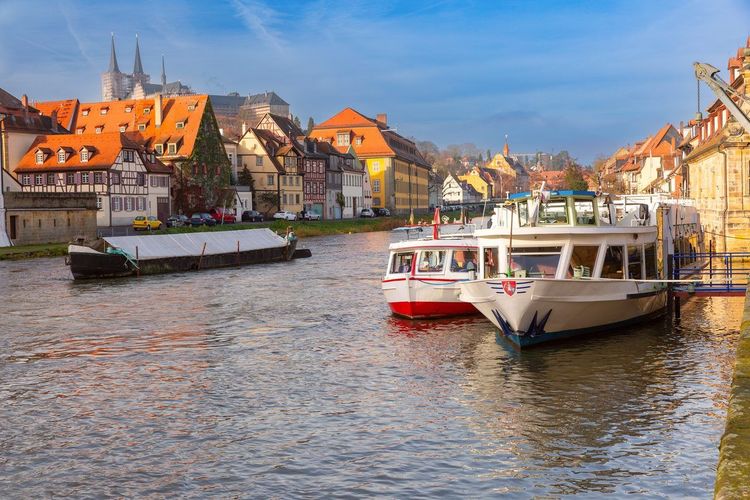
Klein Venedig, Little Venice, refers to the former fishermen's and boatmen's quarter that borders the Regnitz on the island side. The half-timbered houses, decked with geraniums in the warm season, plunge straight into the water, with their little gardens and boats moored at the foot of the façades. The nickname comes from this resemblance to Italian canals, with no historical link between the two cities.
The best view is from the Am Leinritt promenade, on the opposite bank, or from the Untere Brücke, in the late afternoon when the light skims the façades. A few fishing families still live here, even though the professional activity has largely disappeared.
The Am Leinritt promenade follows the old towpath, where horses once pulled boats against the current. It is now one of the locals' favourite places to sit by the water at the end of the day, a takeaway beer in hand. Arrive before sunset if you want a spot on the steps that lead down to the river: you'll have the whole row of fishermen's houses in front of you, with their wooden balconies and boats, and the Old Town Hall as a backdrop.
The Cruise on the Regnitz: The Neighbourhood Seen from the Water
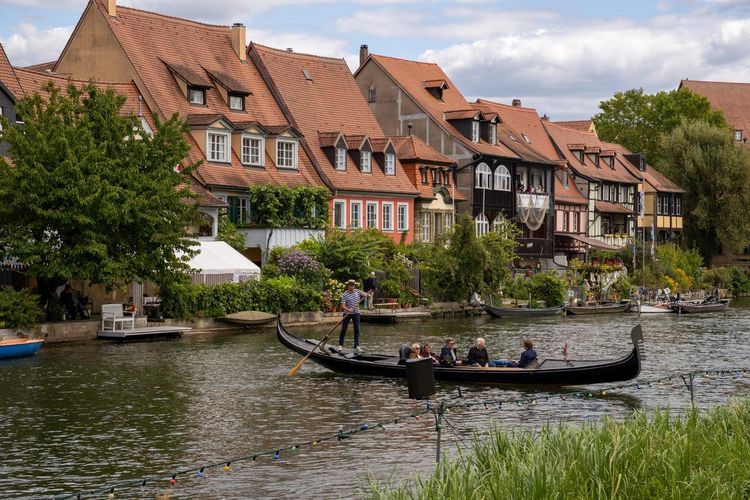
To discover the neighbourhood from the water, two options exist. The most intimate: a Venetian gondola, with a gondolier in costume, which departs from under the Obere Brücke or from the Hain landing stage. Expect around 60 euros for 30 minutes for the private gondola (up to six people), or 15 euros per person on a shared gondola; a sunset ride should be booked in advance. More classic, the boats of the Kropf company offer from May to mid-October a tour of about one hour along Little Venice and as far as the harbour, around 14 euros per adult, with several departures a day from Wednesday to Sunday.
If you prefer to walk, a path follows the bank to the Hain Park (Münchner Ring, 96050 Bamberg, rated 4.8/5 on Google from 736 reviews), a large English-style garden south of the old town where the people of Bamberg come to picnic, swim in the old river pool or rent a rowing boat for half an hour on a quiet arm of the Regnitz.
A Ryo audio stop pauses right on this quay, with the full story of the Bavarian Little Venice nickname told while you take in the façades: no need to look up from a paper guide to enjoy the scenery.
Panoramas: The New Residence Rose Garden and Altenburg Castle
Two high points overlook Bamberg, and both are worth the climb for a couple who doesn't mind a few steps.
The New Residence Rose Garden, the Finest View of Bamberg
The New Residence (Neue Residenz), whose Renaissance wings date from 1602 and whose large Baroque wing dates from 1697, served as the palace of the prince-bishops. Behind it, a terraced garden designed by Balthasar Neumann houses a rose garden that arguably offers the finest viewpoint over the city: about 4,500 rose bushes of some fifty varieties, with the red roofs of the old town and St. Michael's Church on its hill in the background.
Access to the rose garden is free, unlike a visit to the princely apartments and the painting gallery, making it a light break between two denser visits. Come late in the day in June or July, when the roses are at their peak and the golden light glides over the tiles.
Altenburg Castle, a Hike and a Panorama over the Valley
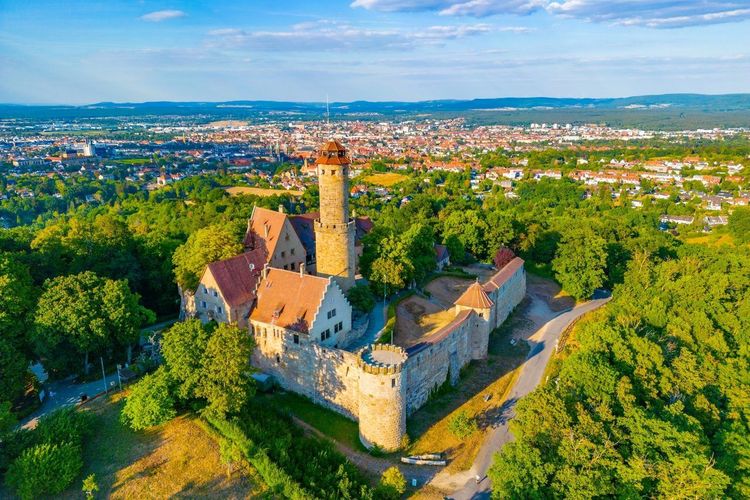
Perched on the highest of Bamberg's seven hills, Altenburg Castle (Altenburg 1, 96049 Bamberg, rated 4.7/5 on Google from 2,742 reviews) requires a short hike, between 30 and 45 minutes' walk from the Domberg depending on your pace, to reach its medieval ramparts. The effort is rewarded with a panorama over the Regnitz valley, much wider than that of the rose garden since it takes in the Franconian countryside all around.
The prince-bishops once retreated here in times of unrest, preferring the isolation of the fortress to the lower town. A restaurant now occupies part of the castle: extend the climb with a drink on the terrace facing the sunset rather than heading straight back down.
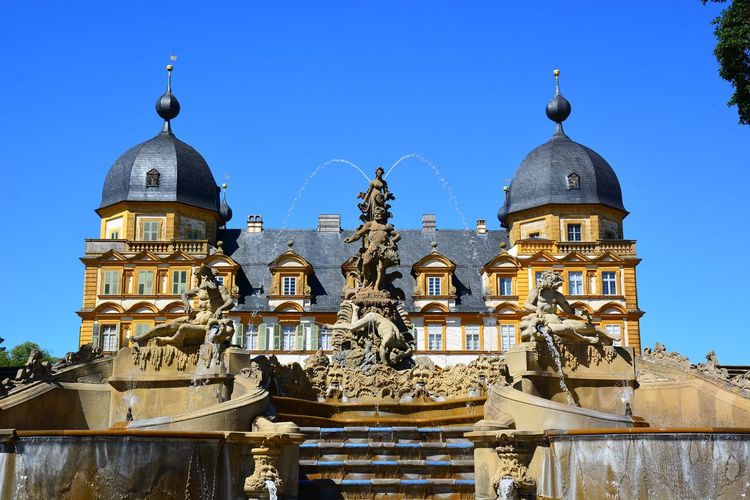
Fancy a third setting? About ten kilometres to the north-east, in Memmelsdorf, Seehof Palace, the former summer residence of the prince-bishops built in the late 17th century, surrounds a Baroque park whose great cascade comes to life in summer at set times. It is a quiet half-day, accessible by bus, far from the crowds of the centre.
A Day in Bamberg as a Couple: Step-by-Step Itinerary
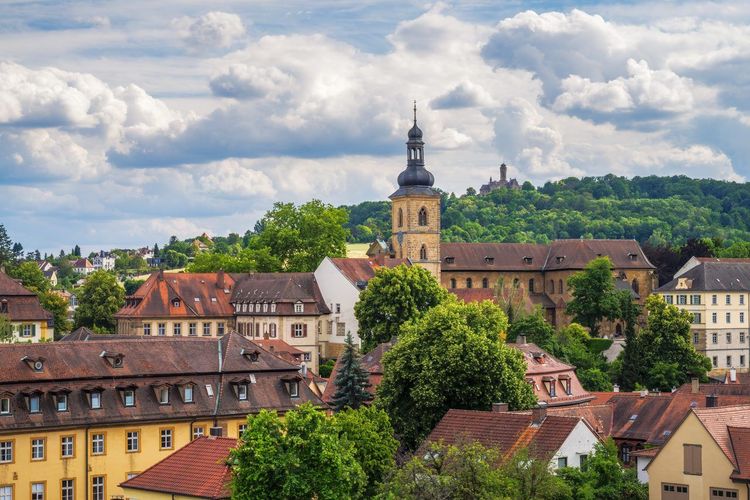
If you only have one full day, here is how to organise it without retracing your steps or missing the essentials.
Morning: Old Town and Market
Start with the Domberg as soon as it opens, before the groups arrive, to enjoy the cathedral and the court of the prince-bishops on your own. Stop by the rose garden, then head back down to the Old Town Hall through the lanes of the historic centre, before branching off towards the Grüner Markt for a coffee on a terrace amid the fruit and vegetable stalls. Allow about three hours for this first part, without rushing.
Afternoon: Breweries and a Stroll Along the Water
The afternoon starts with lunch in a historic tavern, followed by a digestive stroll to Little Venice. This is the right time for the gondola or the boat, ideally between 3 and 5 p.m. when the light begins to skim the façades without yet being the evening light. If you prefer to walk, continue to Hain Park for a break in the shade before heading back to the centre.
Evening: Dinner and Sunset over the Regnitz
For dinner, two options: a terrace on the Grüner Markt if the weather allows, or a climb to Altenburg Castle for a meal with a view before nightfall. In both cases, plan to head back down to the Obere Brücke at sunset: it is from this bridge that the façades of the Old Town Hall take on their most photogenic colours of the day.
This itinerary follows almost step by step the route of the Ryo audio guide to Bamberg: 1h40 of listening over 4 km, which nothing prevents you from splitting into two half-days if you prefer to spread the visit over two days.
Beer, Gastronomy and Terraces for a Dinner for Two
Bamberg has a dozen working breweries within a small area, a density rare in Europe, and a speciality you won't find anywhere else in this form.
Smoked Beer and Historic Breweries
The smoked beer (Rauchbier) is Bamberg's absolute speciality: malt dried over beechwood smoke gives it a pronounced smoky taste, close to smoked ham for unaccustomed palates. The Schlenkerla tavern, mentioned as early as 1405 and located at the foot of the Domberg, remains the reference for discovering it, drawn straight from the wooden barrel in its dark-beamed room. The Spezial tavern, the other Rauchbier brewery, with a milder style, and Fässla, on Obere Königstraße, complete the trio of must-visit addresses.
Many couples hesitate at the very distinctive taste of the first sip. The usual advice from the people of Bamberg: pair it with a local sausage or a meat dish rather than drinking it on its own, as the combination works far better. Locals also say it takes three glasses to truly appreciate it.
In summer, do as the people of Bamberg do and head up to one of the Bierkeller, those beer gardens set above the old cellars dug into the hills. The Spezial-Keller, on the Stephansberg, offers under its lime trees a direct view of the cathedral and the old town: a glass of unfiltered cellar beer (Kellerbier), a charcuterie board, and the sun going down behind the Domberg. People sometimes bring their own picnic, as long as they order drinks there. It is probably the most authentic experience to share as a couple, far from the terraces of the centre.
The Franconian Brewery Museum
Housed in the vaulted cellars of the former Benedictine brewery on the Michaelsberg, the Franconian Brewery Museum (Fränkisches Brauereimuseum) traces the brewing history of the whole region, from malting to barrelling, with more than a thousand objects. It is open from April to October, Wednesday to Sunday in the afternoon, and its cellars stay pleasantly cool even in midsummer.
The site also offers, from the monastery terrace and its vineyards, an open view of the lower town that complements that of the rose garden and the castle, often without the crowds.
Terraces on the Grüner Markt
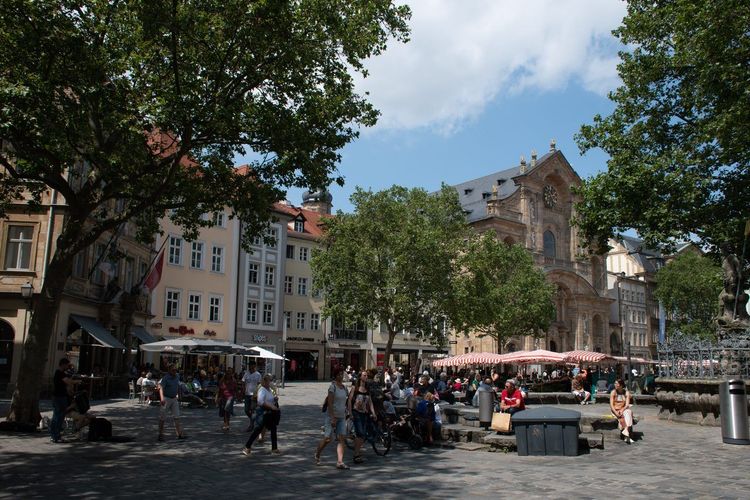
The Grüner Markt square (96047 Bamberg), with its Neptune fountain that locals affectionately call the Gabelmann ("the fork man"), concentrates most of the city-centre terraces. The atmosphere remains lively without being noisy, carried by the producers' stalls in the morning and the restaurant tables in the evening.
For a dinner for two, choose tables slightly set back from the central axis rather than those next to the fountain: the view remains good, and the foot traffic is more discreet. Franconian dumplings (Klöße) with roast pork with a crispy crackling (Schäufele) remain the most representative dish to try at least once. For dessert, look for Bamberger Hörnla, local brioche croissants, or Bamberger Hörnchen potatoes, an old horn-shaped variety served as a side dish. For a wider selection of addresses, the Ryo article on the best activities in Bamberg details a few more breweries off the beaten track.
Excursions Around Bamberg
Bamberg lends itself equally well to a single-base stay or as a base for exploring Franconia by train.
Nuremberg and Würzburg, Day Trip Escapes
Nuremberg is reached in 40 minutes to an hour by direct train, making it the easiest excursion. Its imperial castle, medieval ramparts and world-famous Christmas market justify a full day.
Würzburg, also about an hour away, offers a different contrast: the Residence of the prince-bishops, UNESCO-listed, rivals Bamberg's in grandeur, and the old bridge over the Main (Alte Mainbrücke) becomes an evening meeting place where locals drink a glass of Franconian wine standing up, a ritual that couples particularly enjoy.
The Romantic Road and Rothenburg ob der Tauber
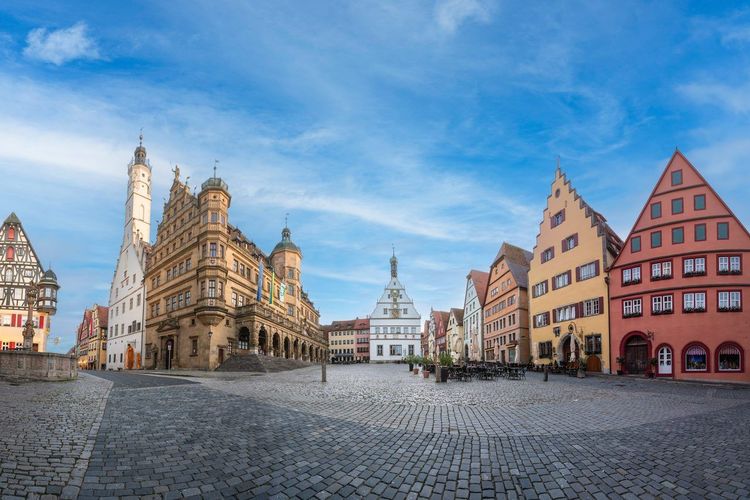
Würzburg is also the starting point of the Romantic Road, a route of more than 400 kilometres heading south to Füssen and its castles. Its most famous stop, Rothenburg ob der Tauber, embodies postcard-perfect medieval Bavaria: complete ramparts, colourful half-timbered houses and an almost total absence of modern construction. Allow about two hours by train with one or two changes from Bamberg: plan for a full day.
Regensburg (Ratisbon), another UNESCO-listed city on the Danube, about two hours by train, completes this list for a couple who wants to string together several medieval stops without taking a plane again.
Closer and more nature-oriented, the Franconian Switzerland (Fränkische Schweiz) begins some thirty kilometres to the east: limestone cliffs, caves, hilltop castles such as Pottenstein and one of the highest densities of small village breweries in the world. A couple who likes walking will spend a lovely day hiking between two inns. To the north, the basilica of Vierzehnheiligen, a Baroque masterpiece by Balthasar Neumann, faces Banz Abbey on the other side of the Main valley: half an hour by train to Bad Staffelstein is enough to combine the two.
Where to Stay in Bamberg as a Couple
The choice of neighbourhood matters as much as that of the hotel: Bamberg is explored on foot, so the distance to the centre really changes the experience.
The Old Town and the Island, to Sleep at the Heart of History
Staying on the island, between the Altes Rathaus and the Grüner Markt, lets you reach all the main sites in under ten minutes. It is the most comfortable choice for heading back to rest between visits or after a late dinner. The addresses here often occupy historic buildings, with rooms sometimes modest in size but full of character: exposed beams, courtyard windows, old parquet floors. Some taverns, such as Fässla, even rent a few rooms upstairs.
Charming Addresses Outside the Centre
The Gärtnerstadt, the market gardeners' town, also included in the UNESCO perimeter for its gardens cultivated in the middle of the city, offers a calmer alternative ten minutes' walk from the centre, with generally gentler prices. Another option, the station district suits you if you arrive late in the evening or plan an early-morning excursion to Nuremberg: direct access to the trains makes up for the walk to the Domberg.
Between the two, the hill town (Bergstadt), around the Domberg, the Michaelsberg and the Stephansberg, appeals to couples seeking calm: residential streets, small guesthouses in bourgeois homes and open views from some windows. The downside is the daily climbs, to keep in mind if you travel with heavy suitcases.
To plan your nights around the visits, the Ryo article dedicated to a weekend in Bamberg details a complete two-day itinerary.
Bamberg in Sweethearts' Season: Christmas Markets and Winter Atmosphere
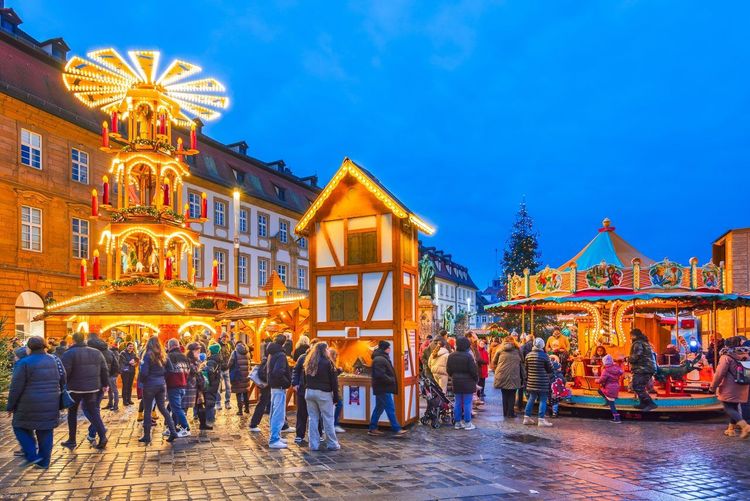
December transforms Bamberg into one of the warmest stopovers in Bavaria for couples who love the cold and the lights. The Christmas market sets up on the Maxplatz and spills over into the adjacent lanes, with mulled wine, gingerbread and a nativity trail (Krippenweg) linking dozens of nativity scenes in churches, museums and shop windows across the centre, a tradition rare on this scale. The reflections of the illuminations on the Regnitz, seen from the Obere Brücke, offer a winter version of the usual panorama.
Spring suits those who prefer terraces: the rose garden is not yet in bloom but the trees in Hain Park are budding, and crowds remain limited before high season. Summer makes the gondola and the Grüner Markt terraces far more pleasant, at the cost of heavy foot traffic on the Domberg in the middle of the day. In late August, the Sandkerwa, a big popular festival in the Sandstraße district, enlivens the quays for five days, with water jousting on the Regnitz.
For a marriage proposal or Valentine's Day, many couples choose the Advent period: heated terraces, illuminations and markets smaller than Nuremberg's create an atmosphere that is more intimate than spectacular. Autumn, finally, remains the least crowded season and the mildest for the hike to Altenburg Castle, with the colours of the forest as a bonus.
Practical Information: Getting There, Budget and Tips for Two
Before you go, a few concrete pointers to organise your stay without surprises.
How to Get to Bamberg
Bamberg is easily reached by train: 40 minutes to an hour from Nuremberg, about two hours from Munich by ICE, two and a half to three hours from Frankfurt. The nearest airport is Nuremberg's, about an hour away by train. From Paris, the simplest route combines a flight to Nuremberg or Frankfurt followed by the train, or the TGV/ICE Paris-Frankfurt followed by a connection.
On site, the historic centre can be explored entirely on foot: a car is even a handicap in the cobbled lanes. City buses leave from the ZOB, the central bus station near the Promenade, for the train station or Memmelsdorf.
Daily Budget for a Couple
Travelling economically, expect around 80 to 100 euros per day for two excluding accommodation, favouring taverns over tourist restaurants: a 50 cl beer there still often costs less than 5 euros, a Franconian dish 12 to 18 euros. A comfort budget is more like 150 to 200 euros per day with a room in the old town. High-end stays, with a river view and more refined restaurants, easily exceed 250 euros per day for two.
Tips and Bookings
Book the gondola in advance for a sunset slot, especially at weekends. For the boat, prefer weekdays or early afternoon. A Bayern-Ticket regional pass lets you combine Bamberg with Nuremberg or Würzburg on the same day at a lower cost, valid from 9 a.m. on weekdays. The BambergCard, sold at the tourist office, bundles bus transport and entry to several museums over three days.
Payment, Language and Connectivity
Germany remains attached to cash: many historic taverns and market stalls don't accept cards, so always keep a few notes on you. English is understood in hotels and most restaurants, less so in neighbourhood taverns where a few words of German ("Ein Rauchbier, bitte") are always appreciated. As for your phone, European roaming applies at no extra charge.
To plan your visit time, keep in mind the format of the Ryo audio guide: 20 stops and 1h40 of listening over about 4 km, which fit just as well into a morning as into an afternoon.



FAQ
How long should you plan to visit Bamberg as a couple?
One full day lets you see the essentials of the listed old town, Little Venice and one of the two viewpoints. To also enjoy the castle, the brewery museum and a day trip to Nuremberg or Würzburg, two to three days offer a more comfortable pace.
What is the best time for a romantic stay in Bamberg?
Late spring and early autumn offer the best compromise between pleasant weather and fewer crowds, with the rose garden in bloom from June to September. December, during the Christmas market, creates a very warm atmosphere despite the cold, while July and August remain the busiest period for visitors.
How do you get to Bamberg from Nuremberg or Munich?
From Nuremberg, the direct train takes 40 minutes to an hour. From Munich, allow about two hours by ICE. Both connections are frequent and don't require a reservation for most departures.
Where should you stay in Bamberg for a romantic weekend?
The island and its immediate surroundings offer the most convenient location for doing everything on foot. The Gärtnerstadt, a little further out, suits a couple looking for more peace and quiet without actually leaving the centre.
What can you do in Bamberg in one day?
Focus on the Domberg and the cathedral in the morning, Little Venice and a gondola ride in the afternoon, then dinner on the Grüner Markt or at the Altenburg Castle in the evening to enjoy the sunset over the Regnitz.
Is Bamberg a good destination for Valentine's Day or a marriage proposal?
Yes, particularly for the discretion of its viewpoints: the rose garden of the New Residence and the Altenburg Castle offer a photogenic setting away from the crowds, especially late in the day or outside peak season. A private gondola at sunset is also a very popular option.
Conclusion
Bamberg never imposes its pace: you can spend one dense day or three days there without tiring of it. Between the listed old town and Little Venice, the essentials are covered on foot, and the panoramas overlooking the city are worth the climb to close out your stay. To string the visits together without worrying about the order, download the complete Ryo audio-guided tour of Bamberg, designed to match the rhythm of a couple rather than that of a group.