© Shutterstock
 Votre guide Ryo
Saronic Islands: The Complete Guide to Discovering the Greek Archipelago (2026)
Forty minutes by boat from Piraeus, the Saronic Islands of Greece reveal a side that classic tours overlook: no international airport, no giant hotel complexes, just fishing villages, cobbled lanes and a sea that turns turquoise as you leave Athens behind. Yet this archipelago packs, within fewer than 100 kilometres, some of the most remarkable monuments of the ancient world, including a Doric temple that once rivalled the Parthenon.
The archipelago has six main islands: Salamine, Égine, Angistri, Poros, Hydra and Spetses. Each has a distinct personality. Égine smells of pistachios and harbours a temple 2,500 years old. Hydra has banned all motorised vehicles since 1953 and runs on donkeys and wooden boats. Spetses funded the Greek Revolution and still has its sea captains' mansions. Poros sits in a strait so narrow its residents could call out to their neighbours on the Peloponnese without raising their voices. Before boarding at Piraeus, many travellers choose to start with the Greek capital, and the Ryo Athens audio-guided tour in 29 stops lets you explore the Acropolis, the Monastiraki district and Pláka at your own pace, before heading out to sea.
This guide covers each island in detail: its sites, beaches and character, as well as ferries from Athens, the best seasons, local gastronomy and a 5-day itinerary for seeing several islands without rushing.
The Saronic Archipelago at a Glance
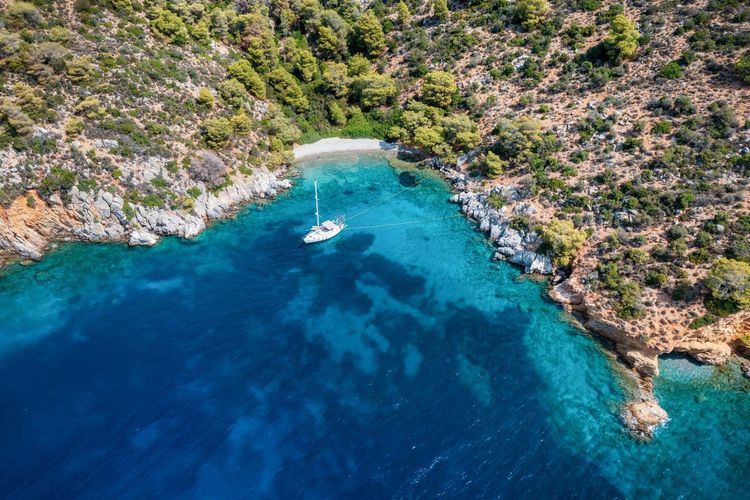
The Saronic Gulf stretches between Attica to the east and the Peloponnese to the west, just south of Athens. The archipelago's six islands are spread from north to south across roughly 100 kilometres: Salamine and Égine in the north, close to the capital; Poros and Angistri in the centre; Hydra and Spetses in the south, not far from the Peloponnesian coast.
Salamine is the largest (95 km²) and the closest to the mainland, but also the least touristy island in the archipelago. It is more of a floating suburb of Athens than a holiday destination. The Battle of Salamine (480 BC), where the Greeks defeated Xerxes' fleet, remains its most enduring claim to fame.
The other five islands hold the bulk of the tourist interest. To reach all of them, there is only one gateway: the port of Piraeus, reachable in 20–25 minutes by metro from the centre of Athens. Ferry tickets range from 8 to 20 euros per person depending on the island and type of vessel.
Égine: Ancient Temple, Pistachios and Coves
Égine is often the first stop for anyone discovering the Saronics. Just 35 minutes by hydrofoil from Piraeus (or 70 minutes by conventional ferry), it combines one of the best-preserved ancient temples in Greece, pistachio orchards on its hillsides and a family-friendly east coast.
The port of Égine opens onto a row of yellow and ochre neoclassical houses that look as though they stepped out of a 19th-century engraving. On the quayside, vendors offer bags of fresh pistachios: Égine pistachios have held a Protected Designation of Origin (PDO) since 1996 and are distinguished by their smaller shell and more pronounced flavour than the Iranian variety. Following the coastal road northeast for 13 kilometres brings you to the island's major monument.
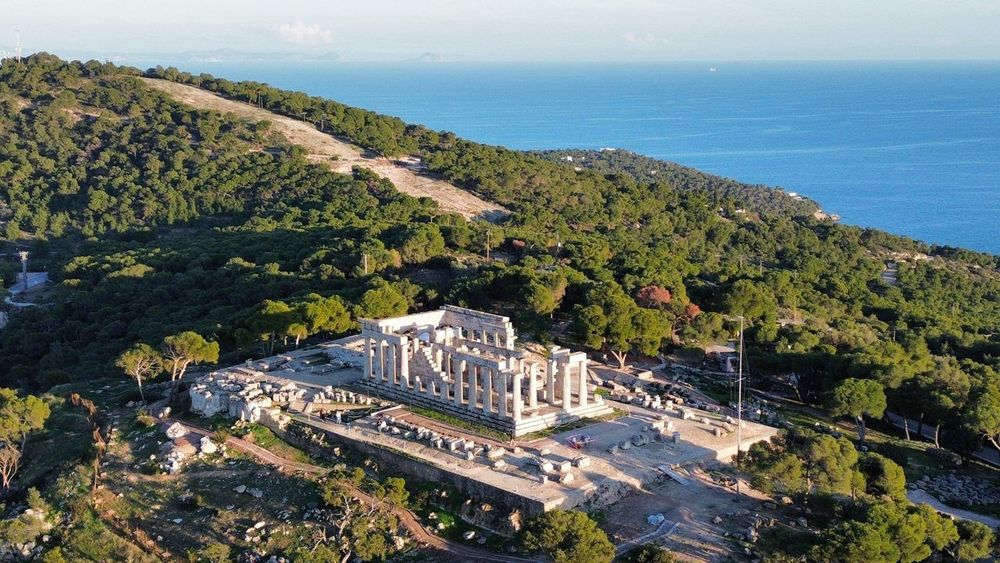
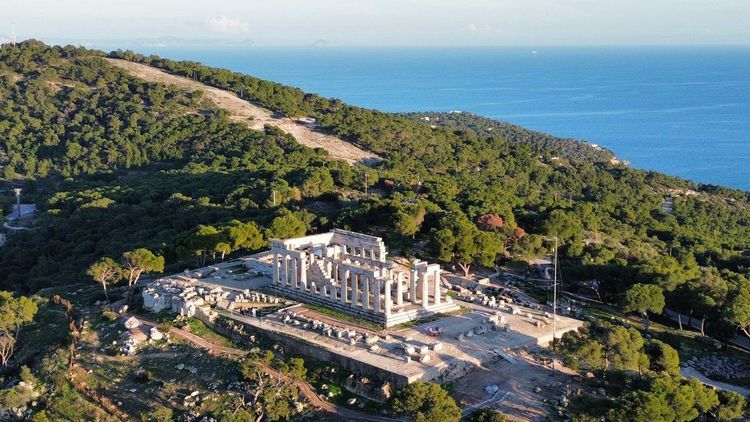
The Temple of Aphaia dates from around 500 BC and stands on a pine-covered hill with views over the Saronic Gulf and, on a clear day, all the way to the Acropolis in Athens. Its 25 still-standing Doric columns make it one of the best-preserved sanctuaries in the Hellenic world. Inside the ruins, panels explain that the pediment sculptures, now on display in Munich, depicted scenes from the Trojan War.
South of the harbour, the coastal road leads down to Perdika (Village of Perdika, 18010 Égine), a fishing village where a handful of tavernas serve grilled squid straight off the quay. Ferries to the tiny island of Moni depart from here: a 10-minute excursion to see deer and peacocks roaming freely through near-wild Mediterranean vegetation.
On the east coast, Agia Marina is the island's main seaside resort. A sandy beach, tavernas and a few mid-range hotels make up a family-friendly scene: the sea is shallow with a gently sloping entry, making it ideal for young children. Sun loungers and parasols are available for hire.
In the island's interior, Paleochora is a historical curiosity: a Byzantine town abandoned in the 19th century after centuries of pirate raids, from which some forty churches carved into the hillside or built into the rock face remain. The site can be visited freely and gives a sense of the fragility of human settlement on these islands, long exposed to plundering. A marked trail starts from the village of Mesagros, winds through the pistachio orchards and climbs to the site in about 45 minutes on foot.
One day is enough to see the highlights of Égine. Staying overnight, however, lets you enjoy the harbour atmosphere in the evening, once the day-trippers have gone and the tavernas settle back into their natural rhythm.
Angistri: The Little Island Worth Seeking Out
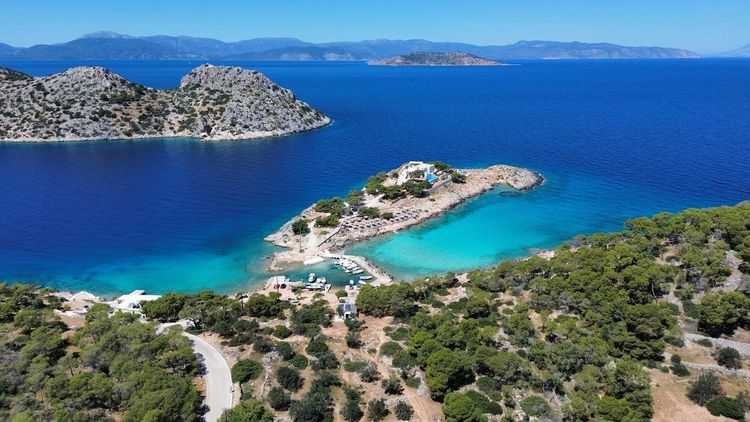
At just 13 km², Angistri is the smallest inhabited island in the archipelago and by far the least known among international travellers. Ferries from Piraeus stop here after Égine, taking roughly one hour in total from Athens. Some passengers sail past without even realising they have come close.
The island has two ports: Skala, the livelier one, with a few family hotels and waterfront tavernas, and Mylos, quieter, 2 kilometres away. The beach at Dragonera, walkable from Skala, offers clear waters over a pebble and rock seabed ideal for snorkelling. Halkiada, further north, is the island's only true sandy beach. Angistri is very popular with Athenians escaping the heat at weekends, but remains largely undiscovered by foreign tourists — which only adds to its charm.
Poros: Jacarandas and a 200-Metre Strait
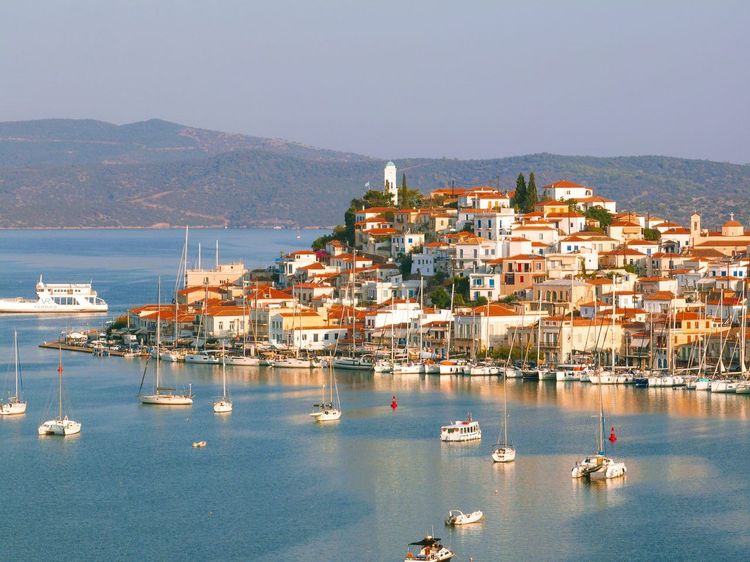
Poros is in fact two islands fused together: Sferia, a volcanic peninsula that holds the town of Poros, and Kalavria, the main island covered in pine forests. Together they form a distinctive silhouette visible from the ferry: a harbour of white and ochre houses rising to a blue clock tower visible from far out at sea.
What makes Poros unique is its strait. The channel separating the island from the town of Galatas on the Peloponnesian coast is just 200 metres wide. You cross by rowing boat in just a few minutes to reach the lemon groves on the opposite shore, where the fruit of Lemonodassos is harvested from October to May. The crossing costs about one euro and runs on demand throughout the day.
On Kalavria, the ruins of the Temple of Poseidon (Kalavria, 18020 Poros, rated 4.7/5 on Google from 21,337 reviews) are worth an hour's walk through the forest heights. This is where the orator Demosthenes took his own life in 322 BC to avoid capture by the Macedonians. The site is less spectacular than Égine's Temple of Aphaia, but the surrounding pine forest more than makes up for it.
Flower lovers should not miss the jacaranda bloom in May–June: Poros is famous throughout the Saronic Gulf for its violet-lined avenues bordering the harbour streets. It is one of the few Greek towns where this South American tree has naturalised with such vigour. Outside that period, the harbour remains pleasant year-round, more accessible than Hydra and less crowded than Égine.
Hydra: The Island That Banned Engines since 1953
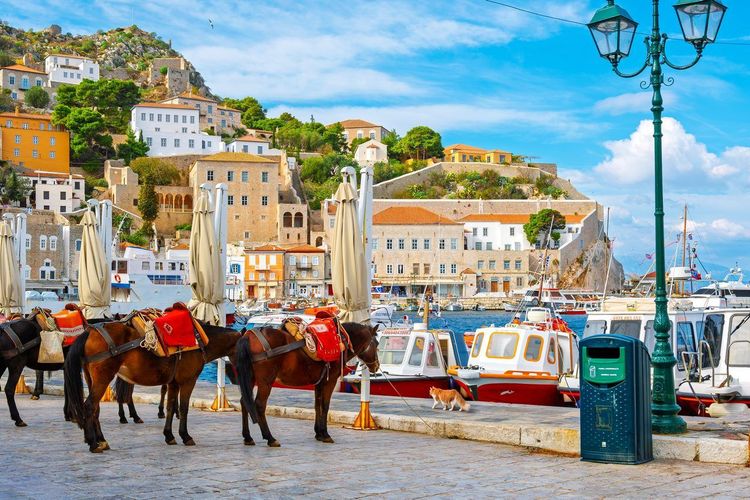
Some places have a reputation for being ahead of their time and fail to deliver. Hydra is the exception. This island has banned cars, motorcycles and scooters for over 70 years — a decision taken not out of green ideology but out of necessity: its stone lanes were never designed for motorised vehicles and the islanders simply refused to widen them. The result is that Hydra runs on donkeys for carrying goods, water taxis for reaching its coves, and feet for everything else.
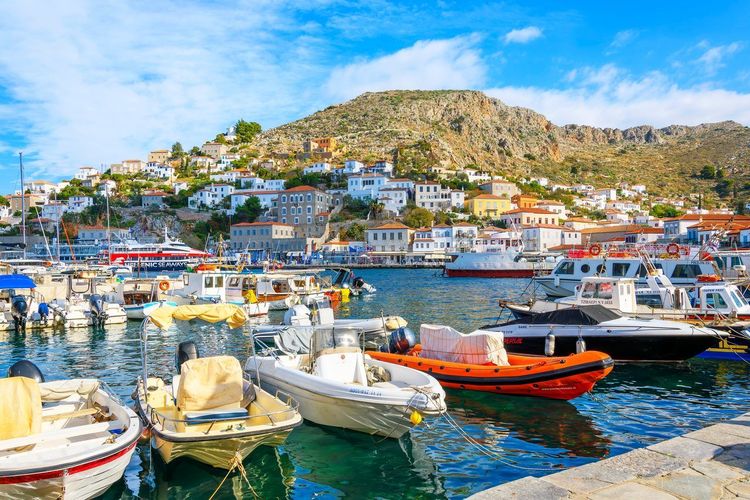
The port of Hydra is one of the most striking arrivals in the eastern Mediterranean. The ferry rounds a rocky headland and suddenly the town appears: grey stone houses climbing from the quayside up the hillside, ruined windmills on the ridges, Ottoman cannons facing the sea. No concrete hotels, no advertising hoardings, no double-parked cars. Donkeys stand in their place, loaded with butane canisters or groceries.
The island owes part of its international fame to the artists and writers who settled here in the 1950s and 1960s. Leonard Cohen lived here from 1960 to 1968, in a house he had bought for 1,500 dollars. Henry Miller, in The Colossus of Maroussi, described Hydra as the place where one understood why the ancient Greeks had invented the gods. That reputation has endured: every summer the island draws gallery owners, photographers and musicians who find in the absence of mechanical noise a form of luxury unavailable anywhere else.
To explore the interior, two options are available: hire a donkey to climb to the Monastery of the Prophet Elias (Profitis Ilias, 18040 Hydra, rated 4.7/5 on Google from 235 reviews), perched at 588 metres with a panoramic view of the entire archipelago, or take the marked footpaths from the harbour. The climb takes about 90 minutes at a steady pace.
Hydra's beaches are nothing like those of Égine. There is no sandy beach in the town itself: swimmers use the flat rocks of the harbour or take a water taxi to coves accessible only by sea. Vlychos, 20 minutes on foot from the harbour along a coastal path, has a small taverna and remarkably clear water. Bisti, on the opposite side of the island, is one of the finest coves in the archipelago but requires a boat (around 15 euros one way).
The harbour square is home to cafés, art galleries and a handful of carefully curated shops, set within a homogeneous neoclassical architecture protected since the 1970s. The sea captains' houses around the port, with their wrought-iron balconies and hidden inner gardens, are worth lingering over: simply glancing through half-open doors onto sloping lanes gives you a glimpse of the extraordinary inner life of this town.
Spetses: The Heiress of the Saronic Gulf
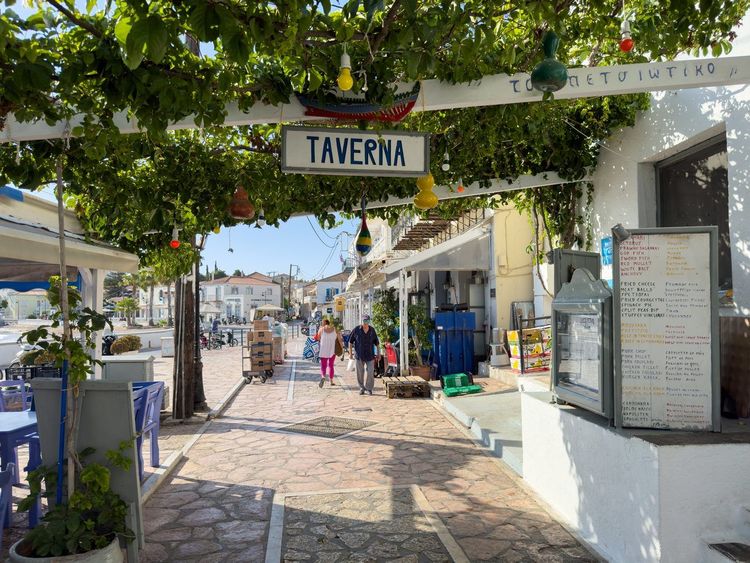
If Hydra is bohemian, Spetses is patrician. This island in the south of the archipelago grew wealthy in the 18th century through maritime trade, and its great families invested in sea captains' mansions that still line the waterfront today. The atmosphere is more refined than Hydra, more family-oriented than Égine.
Spetses plays an important role in modern Greek history. Captain Laskarina Bouboulina, who financed and commanded her own fleet during the War of Independence of 1821, was born on this island. Her mansion, the Bouboulina Museum (Dapia, 18050 Spetses, rated 4.8/5 on Google from 2,307 reviews), can be visited on guided group tours from the main street: it is one of the most interesting private collections in Greece, featuring period weapons and paintings of naval battles.
Cars are partially banned on Spetses: they are only permitted on certain roads outside the centre. Residents get around by bicycle, on horseback or by horse-drawn carriage, giving the town an atmosphere that neither money nor urban planning could have created artificially. The kaikia, traditional brightly painted wooden boats, are still built on the island by a handful of craftsmen: a tradition that has almost disappeared everywhere else in Greece.
The Anargyrios College, a private school founded in 1927 on the Eton model, will be familiar to readers of John Fowles: his novel The Magus is set on an island that closely resembles Spetses. The colonial building facing the sea is worth a look, even if the school opens and closes as its institutional fortunes rise and fall.
Spetses' beaches rank among the finest in the archipelago. Agia Paraskevi, on the north coast, and Agia Anatysia to the south offer very clear water and fine sandy seabeds. Both are accessible by boat from the harbour or via the ring road that circles the island (25 km, suitable for cycling or by horse-drawn carriage).
Which Saronic Island Should You Choose?
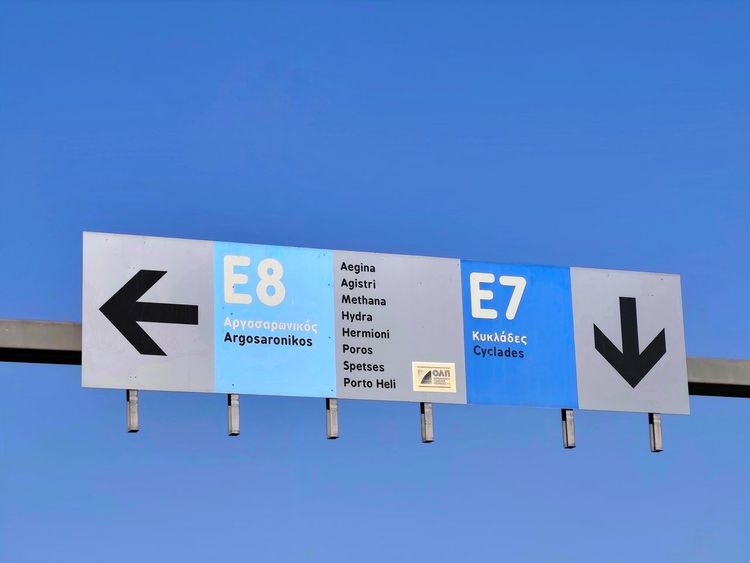
The question every traveller asks before booking a ferry ticket. Here is a breakdown by priority.
For history and archaeology enthusiasts, Égine stands out with the Temple of Aphaia and the medieval site of Paleochora. The ruins of the Temple of Poseidon on Poros complement a culturally focused stay nicely.
For absolute peace and quiet, Hydra remains the reference. The absence of engines radically changes the experience: if you are looking for a place where you can hear your neighbours' conversations rather than car horns, this is it. Angistri also offers genuine tranquillity, though of a more summery, beach-oriented kind.
For families with young children, Poros and Égine (on the Agia Marina side) offer the gentlest beaches and the most affordable accommodation. Spetses can also work well thanks to its calm waters and family atmosphere.
For a romantic getaway, Hydra, without hesitation. The harbour at night, the car-free lanes, the tavernas on the quay: the setting naturally lends itself to this kind of trip. Spetses is a slightly more affordable alternative.
For beaches above all, Spetses and Angistri offer the best waters in the archipelago. Bear in mind that Hydra has no real sandy beach accessible from the town: you need to take a boat to reach its coves.
If you are considering the Cyclades with their distinctive volcanic landscape instead, bear in mind that the Saronics cultivate a radically different identity: no caldera, no clifftop white villages, but fishing harbours, pine forests and Doric temples. Two very different moods — choose according to what you want from an island stay.
How to Reach the Saronic Islands from Athens
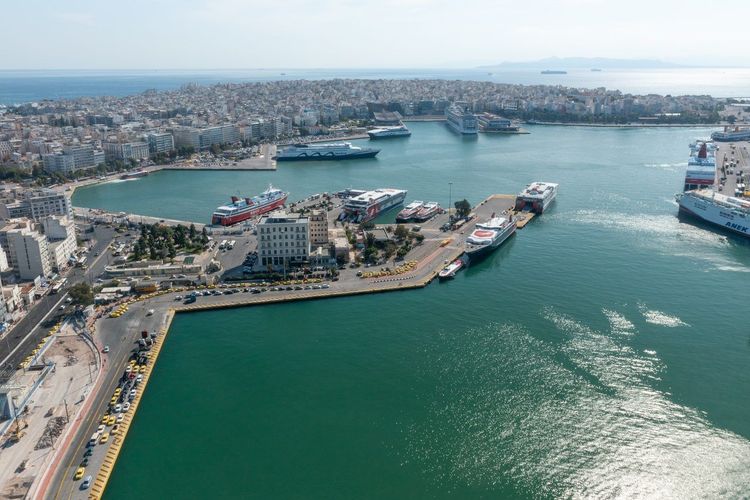
All the Saronic Islands are reached from the port of Piraeus (Akti Poseidonos, 18531 Piraeus, rated 4.3/5 on Google from 60 reviews), located at the terminus of Athens metro line 1 (station 'Piraeus'). From the centre of Athens (Syntagma or Monastiraki), allow 20 to 25 minutes by metro. If you are discovering Athens for the first time, the Ryo Athens audio walking tour will guide you in 3h30 through its 31 key stops, from the Acropolis to the central market.
Departures for the Saronics leave from piers E7 to E9 at Piraeus. Two types of service operate.
Conventional ferries carry cars, motorbikes and bicycles as well as passengers. Slower — 70 minutes to Égine, 2h30 to Hydra — they are also cheaper (8 to 12 euros one way to Égine). Saronic Ferries operates the majority of these routes.
Hydrofoils ('Flying Dolphins' and 'Flying Cats') are twice as fast but carry passengers only. Allow 35 minutes to Égine, 1h15 to Hydra, 1h45 to Spetses. Fares are roughly twice as high (15 to 22 euros depending on the destination). Hellenic Seaways operates the vast majority of these services.
Frequency varies considerably by season. In July–August, departures to Égine run almost every hour from Piraeus, but in low season only a single daily sailing may be offered to the southernmost islands. Booking in advance is strongly recommended at the height of summer, either on the Hellenic Seaways website or at the port ticket office.
For travel between the islands themselves, local connections exist but are less regular. For comprehensive information on sailing between Greek islands, our Ryo guide to ferries in Greece covers schedules, companies and tips for making the most of your journeys. And before casting off, our Athens audio walking tour lays out 31 stops to take the measure of the capital.
When to Visit the Saronic Islands
The Mediterranean climate of the Saronics leaves a wide travel window, but not all periods are equal.
May–June is often the best window. Temperatures reach 24–28 °C, the sea is starting to warm up pleasantly (22–24 °C), accommodation is not yet at peak summer rates and the ferries are less crowded. Poros' jacarandas bloom in May: a spectacle in its own right.
July–August is high season. Temperatures climb to 32–36 °C and the meltemi wind can make crossings uncomfortable on some days. Hydra and Spetses are particularly sought after, and accommodation prices readily double. The sea remains beautiful, but the islands are very busy.
September–October forms the second good window. The sea is at its warmest (25–27 °C in September), crowds thin out noticeably and prices drop. Many establishments start closing from mid-October.
November–April: most hotels and tavernas close, particularly on the smallest islands such as Angistri. Ferries run at reduced frequency. On the plus side, archaeological sites like the Temple of Aphaia are virtually deserted.
Gastronomy: The Flavours of the Saronic Islands
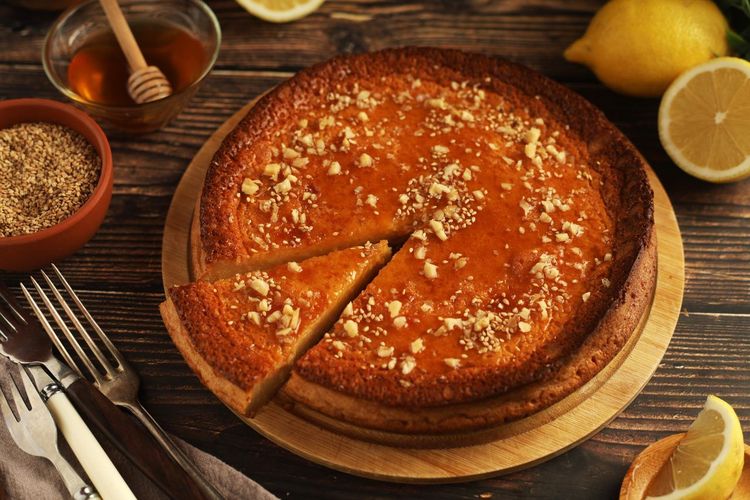
Saronic cuisine sits within the great Greek culinary tradition, with a few local specialities worth knowing before you go.
Égine pistachios are the archipelago's signature product. The variety grown here, smaller and greener than the Iranian pistachio, has held a PDO since 1996. They are available fresh between August and October, or dried year-round. The best come from producers in the village of Mesagros, in the island's interior, or from the stalls at Égine harbour.
Fish and seafood are essential on every island. Grilled squid (kalamari) and sun-dried octopus (htapodi) appear on almost every menu. Perdika, the fishing village south of Égine, is renowned for the freshness of its catch. On Hydra, sea urchins (achinos) are eaten raw or as a velouté from September to May.
In Spetses, amygdalota (small pear-shaped almond cakes) are the traditional pastry, made to recipes passed down since the 19th century and sold in every bakery at the harbour.
Throughout the Saronics, mezze (small shared plates) remain the best way to eat: taramas (smoked carp roe), tzatziki, dolmades (stuffed vine leaves), fava (split pea purée). Kakavia, a rockfish soup comparable to a bouillabaisse, is often prepared on Sundays in local tavernas. For drinks, ouzo is everywhere, but the fresh white wines from neighbouring Attica are well worth lingering over.
Where to Stay on the Saronic Islands
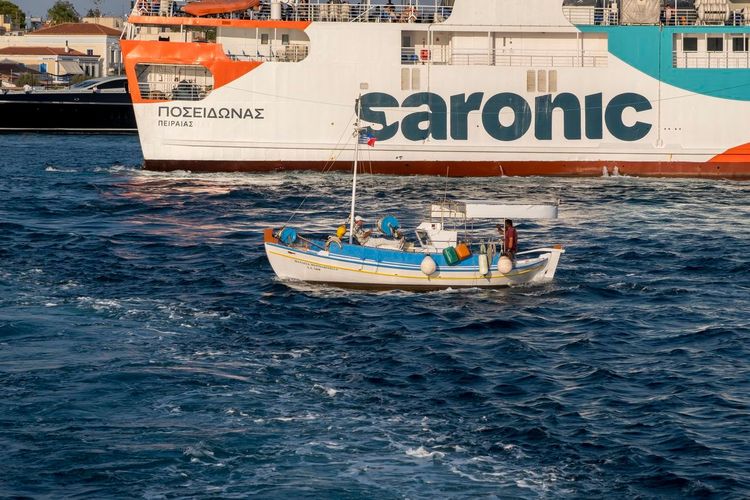
Options vary considerably from one island to the next, both in range and availability.
Égine offers the widest choice: seafront hotels at Agia Marina, guesthouses and rooms with locals in the harbour town, a few boutique hotels near Perdika. Rates remain accessible off season (50 to 80 euros for a double room). In July–August, prices double and advance booking is essential.
Angistri has limited accommodation capacity, mainly studios and small hotels in Skala. It is the most affordable island in the archipelago, ideal for travellers on a tight budget.
Poros has several guesthouses in the town and a few hotels along the waterfront. For the most budget-conscious travellers, a local tip is to sleep in Galatas on the Peloponnesian coast opposite and cross by rowing boat each morning.
Hydra is the most expensive: the ban on vehicles makes transporting goods costly, which feeds through into all prices. Boutique hotels such as the Bratsera (a former sponge factory converted into a hotel) rank among the most elegant in the archipelago. Budget 120 to 250 euros per night in season for quality establishments.
Spetses sits in the middle range: more affordable than Hydra, more stylish than Égine. Several charming guesthouses in the harbour lanes offer a good quality-to-setting ratio, particularly around the Dapia.
Whichever island you choose, booking 2 to 3 months in advance for the July–August period is advisable. Hotel capacity is significantly lower here than at destinations such as Mykonos or Santorin.
Sample Itinerary: Combining the Saronics in 5 Days
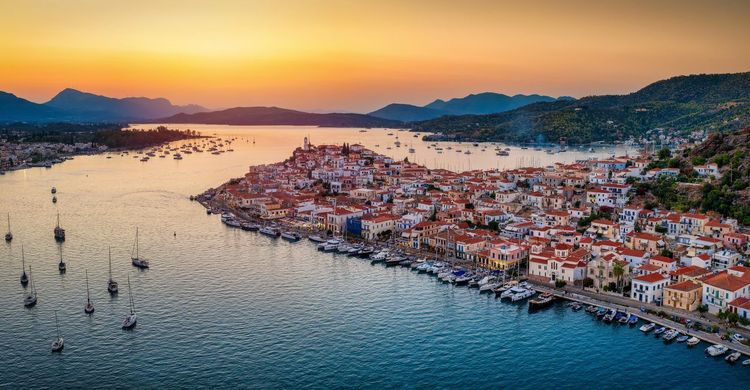
With 5 days from Athens, it is possible to visit the four main islands without feeling rushed. The following itinerary moves southward, ending with the most distant islands.
Day 1: Arrival on Égine
Take the morning ferry from Piraeus, recommended departure between 7am and 9am. You arrive on Égine before 10am, leaving the whole day to visit the Temple of Aphaia in the morning, when the light is better and visitor numbers are lower. Lunch in Perdika, swim on the west coast on the way back. Night on Égine.
Day 2: Égine and Angistri
Free morning on Égine: harbour market, exploring Paleochora or a walk through the pistachio orchards inland. In the afternoon, take the local ferry to Angistri (20 minutes) and enjoy Dragonera beach towards the end of the day. Night on Angistri.
Day 3: Poros
Ferry heading south from Angistri. Allow roughly two hours to reach Poros, with a possible stop at Égine. On the island: rowing boat crossing to Galatas for the lemon groves in the morning, climb to the Temple of Poseidon on Kalavria in the afternoon. The harbour of Poros (Plateia Iróon, 18020 Poros, rated 4.4/5 on Google from 2.1K reviews) is particularly enjoyable in the evening, with its jacarandas (in May–June) or its lively terraces (in summer). Night on Poros.
Day 4: Hydra
The crossing from Poros takes about 45 minutes. Arrive in Hydra mid-morning, before the influx of tourist ferries (11am–12pm). Explore the lanes, lunch at a harbour taverna, walk to Vlychos in the afternoon. This is the island where one night is genuinely worth the investment: the harbour lit up at night is an experience in itself. Night on Hydra.
Day 5: Spetses and Return
Spetses is 45 minutes from Hydra by ferry. Half a day is enough for a first visit: the Bouboulina Museum, the old harbour with its kaikia, a swim at Agia Paraskevi if time allows. Take the hydrofoil in the late afternoon for a direct return to Athens (approximately 2 hours from Spetses). Arrival at Piraeus around 6–7pm.
Practical notes for this itinerary:
- Book your ferries in advance during high season, at least for departures from Piraeus.
- Bring cash for local rowing boats and small tavernas that do not always accept bank cards.
- A simple backpack is far more practical than suitcases on islands with no paved roads for wheeled luggage.
- Check inter-island connections on the OpenSeas website before you leave.
FAQ
Which is the best Saronic island for a first visit?
Égine is generally the top recommendation: connections from Athens are frequent and fast (35 minutes by hydrofoil), the island is large enough to offer several sites to visit over one or two days, and accommodation remains affordable. For those who prefer a unique atmosphere over monuments, Hydra is the strongest recommendation, provided you accept slightly higher prices and a car-free logistics.
Can you visit the Saronic Islands on a day trip from Athens?
Yes, this is the most common option for travellers staying in Athens. Égine is the most suitable: morning ferries get you to the island by 9am and back by 6–7pm. Angistri and Poros are also doable in a day. Hydra is theoretically accessible (1h15 by hydrofoil), but the round trip eats up a good portion of available time. Spetses is too far for a single day without serious compromises.
Are the Saronic Islands suitable for families with children?
Yes, provided you choose the right island. Égine (on the Agia Marina side) is the most family-friendly, with a gently sloping sandy beach and comfortable accommodation at reasonable prices. Poros works well too. Hydra, on the other hand, can be challenging for families with pushchairs or reduced mobility: its steep stone lanes have no adapted access, and beaches are not directly reachable from the town.
How do you travel between the Saronic Islands without going back through Athens?
In high season, daily ferries connect Égine, Poros, Hydra and Spetses in both directions. Off season, sailings are reduced and some direct links disappear, meaning you may have to go back through Piraeus. Local water taxis allow short hops between nearby islands, particularly between Égine and Angistri. To plan your connections, the Hellenic Seaways website and the Open Seas app are the most reliable tools.
Are there sandy beaches in the Saronic Islands?
The Saronics are nothing like the Cyclades: pristine white sandy beaches are rare. Most coastlines are pebbly or rocky. The best sandy beaches are found at Agia Marina (Égine), on the northern coast of Angistri (Halkiada) and at Agia Paraskevi (Spetses). The water, however, is remarkably clear across all the islands, particularly at Angistri and in the coves of Hydra accessible by boat.
When are Égine pistachios available fresh?
The Égine pistachio harvest takes place in August–September. This is the only time you can find fresh pistachios: still green, slightly creamy, and very different from the dried variety sold year-round. Producers in the Mesagros area sell them directly at local markets during harvest. Off season, shops at Égine harbour sell vacuum-packed dried varieties that keep for several months and make an excellent souvenir.
Conclusion
The Saronic Islands are arguably the best introduction to Greek island life for anyone who wants to discover it without the crowds of the Cyclades. Their proximity to Athens makes them accessible even on a short trip, and their diversity is great enough for every traveller to find their own favourite island: archaeology and pistachios on Égine, absolute serenity on Hydra, patrician elegance on Spetses, gentle living on Poros.
To start your exploration with the capital, the Ryo Athens audio-guided tour will guide you in 3h30 through the Acropolis, Pláka and the historic markets. It is the ideal starting point before boarding at Piraeus and heading out to sea towards the archipelago.
To go further in your exploration of the Greek islands, our Ryo guide to the most beautiful islands in Greece will help you compare the Saronics with the Cyclades, the Dodecanese and the Ionian Islands. And to dive into Greek cuisine before you even leave, the Athens culinary specialities on Ryo offer an excellent preview of what awaits you at the table.
À lire également