© Shutterstock
 Votre guide Ryo
Visiting the Acropolis of Athens: Complete Guide 2026
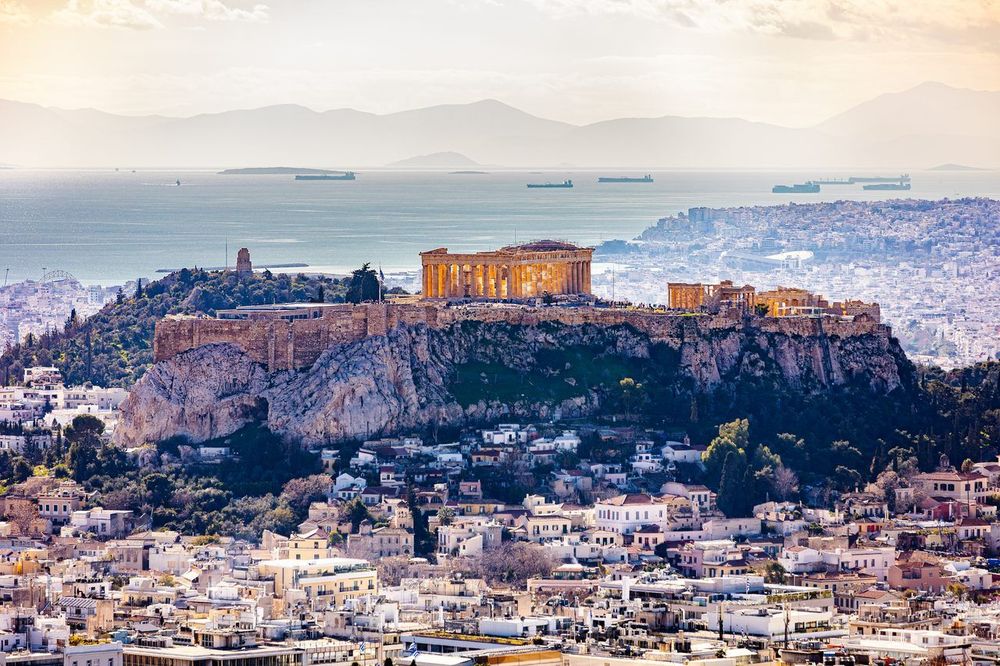
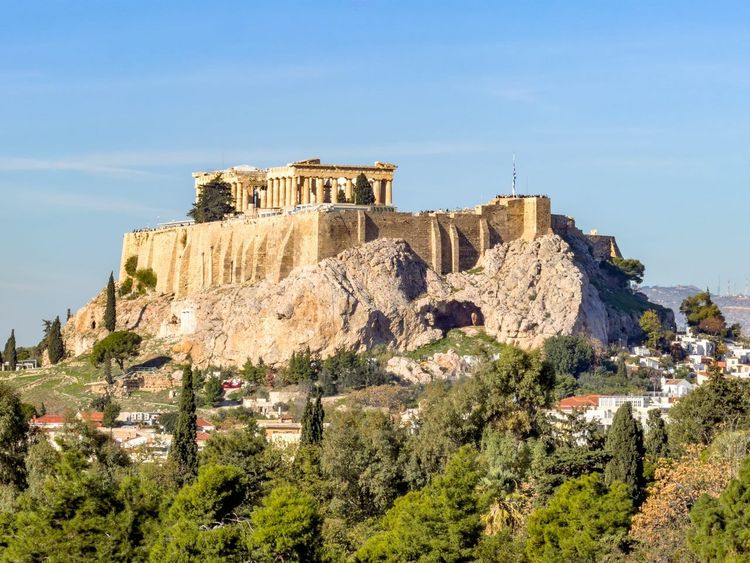
It's 8:05 a.m. on a June morning at the Acropolis of Athens, the heat has not yet crushed the sacred hill, and already a line stretches before the south gates. This limestone rock, rising 156 metres, has dominated Athens for more than three thousand four hundred years, and no one has ever managed to dethrone the Parthenon from its status as a symbol of Western civilisation. Visiting the Acropolis of Athens is not about ticking a box on a list of monuments: it is about walking on marble polished by ancient pilgrims, looking up at Doric columns that have weathered earthquakes, Venetian bombardments and twenty-five centuries of wind. The Ryo audio-guided tour tells this story across 29 stops throughout Athens, several of which pass directly through this site.
This guide details the real 2026 opening hours, the updated ticket price, the combined ticket at 36 euros granting access to six other ancient sites, the days of the year when admission is free, and the difference between the Caryatids visible today on the Erechtheion (copies — the originals are kept at the museum) and the one displayed at the British Museum for two centuries. You will also learn why entering through the Dionysiou Areopagitou entrance often saves twenty minutes of queuing, which time slot avoids the rush of cruise ship coaches, and how the new daily visitor quota works. Whether this is your first approach to the site or a long-awaited return, everything is gathered here to help you visit the Acropolis of Athens with peace of mind, from ticket to itinerary.
A Site Rooted in the History of Athens
The hill has been inhabited since the Neolithic period, long before any temple was built there. The Mycenaeans constructed a fortress there in the second millennium BCE, and traces of cyclopean blocks can still be found integrated into the current walls. The first archaic sanctuaries dedicated to Athena were razed by Persian forces in 480 BCE, an episode the Athenians would never forget.
It was Pericles who relaunched the building project after the victory over the Persians, financing the reconstruction with the treasury of the Delian League, originally intended for the common defence of the Greek city-states. Between 447 and 406 BCE, the Parthenon, the Propylaea, the Erechtheion and the Temple of Athena Nike rose under the supervision of the sculptor Phidias. This architectural programme, funded at the cost of considerable diplomatic tensions with Athens' allies, remains one of the best-documented building projects of ancient Greece.
The Acropolis then changed function several times: a Byzantine church dedicated to the Virgin, an Ottoman mosque, a military powder store. It was this last use that caused the disaster of 1687, when a Venetian shell detonated the munitions stored inside the Parthenon and blew away much of its roof. In the early nineteenth century, Lord Elgin had part of the friezes and sculptures dismantled and shipped to London, a move still contested by Greece today. Listed as a UNESCO World Heritage Site since 1987, the hill has hosted a permanent restoration service since 1975, working on site with cranes still visible during your 2026 visit.
Understanding what the ancient Acropolis was helps to better navigate it today: far from being a simple cluster of temples, it was the religious heart of the city, where every four years the great Panathenaic procession took place. Starting from Kerameikos, the crowd would make its way up the sacred road to the plateau to offer Athena a peplos woven by the young women of Athens. This is the scene Phidias had carved on the inner frieze of the Parthenon — the very same one whose fragments are now shared between Athens and London. Keeping this image in mind transforms the ascent: you are following, more or less, the same path taken by the Athenians twenty-five centuries ago.
How to Get to the Acropolis of Athens
To visit the Acropolis of Athens, you first need to reach the hill, and several options are available depending on where you are staying in the city. The metro is the fastest option: Line 2 (red) stops directly at Acropoli station, less than five minutes' walk from the south entrance, which runs alongside the Theatre of Dionysos. If you are staying near Syntagma, allow fifteen minutes on foot along the pedestrian avenue Dionysiou Areopagitou, a pleasant route lined with terraces.
From Monastiraki or Thissio, another walking route passes through the Ancient Agora and climbs toward the main entrance on the west side, near the Propylaea. This western entrance is historically the one used by ancient processions, but it also draws the most coach groups in the middle of the morning. A taxi from the city centre rarely costs more than 8 to 10 euros, a practical option in intense heat or when travelling with young children.
If you are arriving directly from Eleftherios Venizelos International Airport, Line 3 (blue) of the metro reaches the city centre in about forty minutes; a change at Syntagma will then drop you at Acropoli. The airport ticket costs around 9 euros, compared to around forty euros for a taxi. Two entrances therefore exist to access the plateau: one to the south (near the Theatre of Dionysos), the other to the west (below the Propylaea). They lead to the same site, but rarely to the same level of crowding at the same time. Checking which one is less congested before you set off can often save a good half-hour.
Opening Hours in 2026
During high season, from 1 April to 31 October, the Acropolis is open from 8 a.m. to 8 p.m., with the last admission accepted thirty minutes before closing. During low season, from November to March, hours are generally reduced to 8 a.m. to 5 p.m., with the last admission around 4:30 p.m. The site closes on major public holidays: 1 January, 25 March, Orthodox Easter Sunday and 1 May. These hours vary slightly each year, particularly in September and October when the closing time follows sunset: a quick check on the official website of the Greek Ministry of Culture before you leave avoids any unpleasant surprises.
Ticket Prices for the Acropolis in 2026
This is one of the points on which many online guides still get it wrong, due to a lack of updates. Since the price revision applied in 2024, the full-price individual ticket to visit the Acropolis costs 30 euros, and the winter discount that used to bring the price down to 10 euros between November and March has been abolished: the rate is now the same year-round. If you come across a price of 20 euros in an old blog post, treat it as outdated.
A reduced rate of 15 euros nonetheless applies to European Union citizens aged 65 and over, on presentation of an identity document, between 1 November and 31 March only. During high season, those same visitors pay full price.
More interesting if you plan to explore ancient Athens as a whole: the combined ticket at 36 euros, valid for five consecutive days, grants access not only to the Acropolis but also to the Ancient Agora, the Roman Agora, Kerameikos, the Temple of Olympian Zeus, Hadrian's Library and the Lyceum of Aristotle. From the moment you visit three or more of these sites, the saving becomes clear: bought separately, these admissions would add up to well over 70 euros.
Admission is completely free on several days each year: 6 March, 18 April (International Day of Monuments), 18 May (International Museum Day), the last weekend of September, 28 October, and the first Sunday of every month between November and March. Be aware, however, that these free days attract very large crowds, with waiting times that can climb to two or three hours in the sun. EU citizens and residents under the age of 25 also enter free of charge year-round on presentation of an identity document, as do practising European teachers. These provisions partly explain why the search term 'Acropolis Athens free ticket' comes up so often: the conditions genuinely exist, you just need to tick the right boxes. While you wait, the short Ryo audio-guided tour that passes Hadrian's Library and the Ancient Agora is a good way to start learning the site's history.
Where and How to Buy Your Ticket
The official ticketing website of the Greek Ministry of Culture (accessible via odysseus.culture.gr or etickets.tap.gr depending on the period) remains the most reliable source, with time slots to book in advance during high season. Using this official site avoids the commissions charged by third-party platforms, which can sometimes be two to three times more expensive for an identical service.
To visit the Acropolis of Athens at the best price, buying online a few days before your visit also allows you to choose a morning slot, which is often fully booked a week in advance in July and August. A printed ticket or one displayed on a smartphone is sufficient at the entry turnstile, with no separate queue for online reservations. On site, a physical ticket office exists at both entrances, but queues there can exceed forty-five minutes during peak tourist season.
Booking Your Time Slot: Daily Quota and Entry Windows
Since 2023, the Acropolis has applied a cap of 20,000 visitors per day, divided into one-hour time slots. In practice, your online ticket specifies an exact entry time that staff enforce at the turnstile: arriving two hours late may result in refusal, or at the very least some negotiation. The first slots, between 8 a.m. and 9 a.m., are the first to go and are often fully booked a week in advance in July and August.
In peak season, online booking is therefore no longer simply a matter of convenience: it is sometimes the only way to enter at your desired time on your chosen day. In low season, the constraint eases considerably and on-the-spot purchase becomes viable again, though booking in advance is always the more relaxed option.
What Is the Best Time to Visit the Acropolis
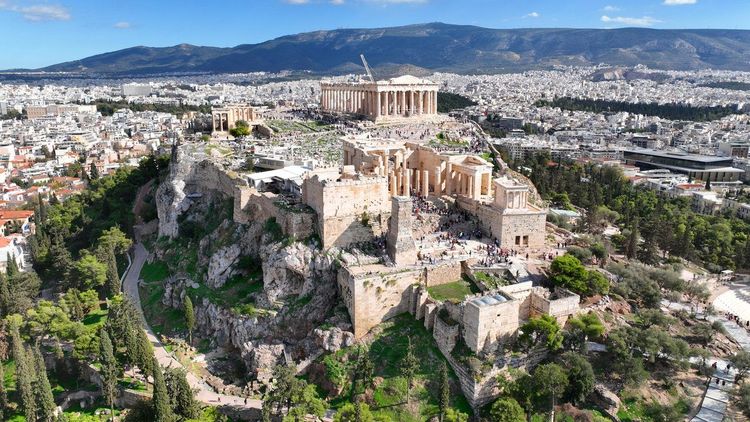
The best time to visit the Acropolis of Athens depends mainly on two factors: the time of day and the season. The two quietest windows are opening time at 8 a.m. and the final hour and a half before closing. Between these two windows, the hill fills progressively from around 10 a.m., when groups from cruise ships docked at Piraeus arrive in numbers, often led by guides managing several dozen people at once.
In terms of season, spring (April–May) and autumn (September–October) offer mild temperatures, between 20 and 26 degrees, compared to peaks of 38 degrees in midsummer on a site completely devoid of shade. On heatwave days, the Ministry of Culture sometimes closes the site during the hottest afternoon hours, a measure that has become routine since recent summers. Winter, cooler and sometimes rainy, remains paradoxically one of the most pleasant periods to enjoy the site without the crowds, provided you accept shorter daylight in the late afternoon.
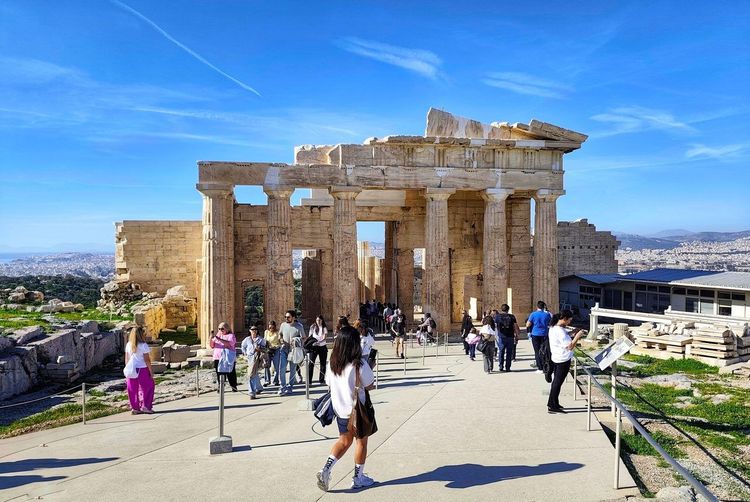
The Propylaea, the Monumental Gateway to the Sanctuary
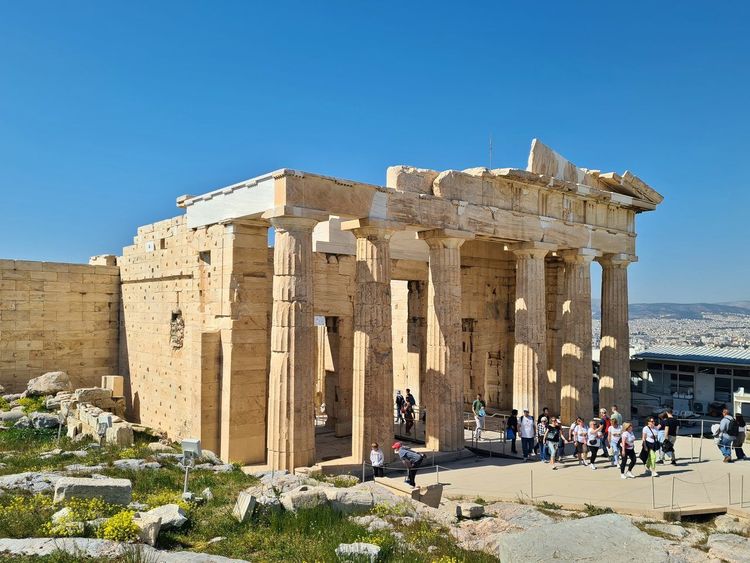
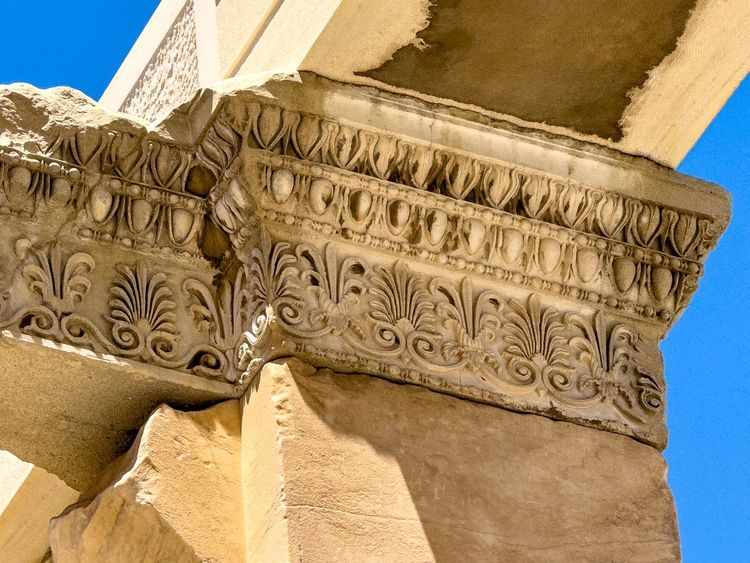
Even before catching sight of the Parthenon, visitors pass through the Propylaea (Acropolis of Athens, 105 58 Athens, rated 4.8/5 on Google with 1,111 reviews), the ceremonial entrance to the sanctuary designed by the architect Mnesicles between 437 and 432 BCE. The structure combines Doric columns on the façade with Ionic colonnades in the central vestibule, an architecturally bold choice for its time.
The construction was never completed: the Peloponnesian War, which broke out in 431, cut off funding before the north wing was finished. This wing housed the Pinacotheke, an ancient painting gallery that has since disappeared. Take a moment to look up at the coffered ceiling before moving on: it is one of the few remaining covered spaces on the site.
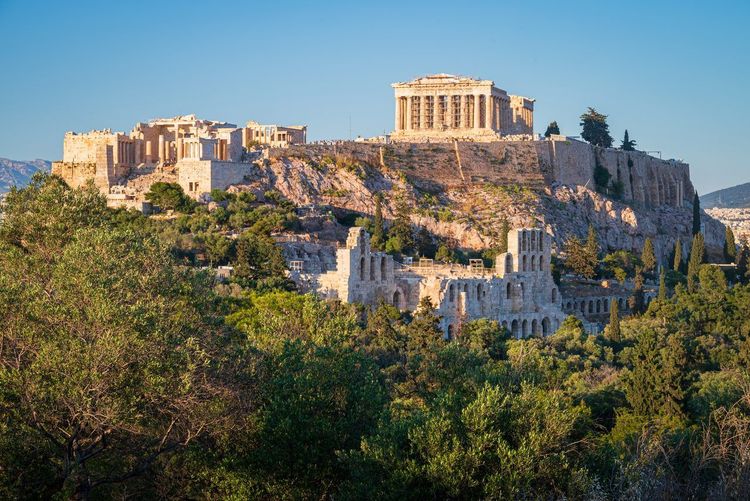
The Parthenon, Jewel of the Acropolis
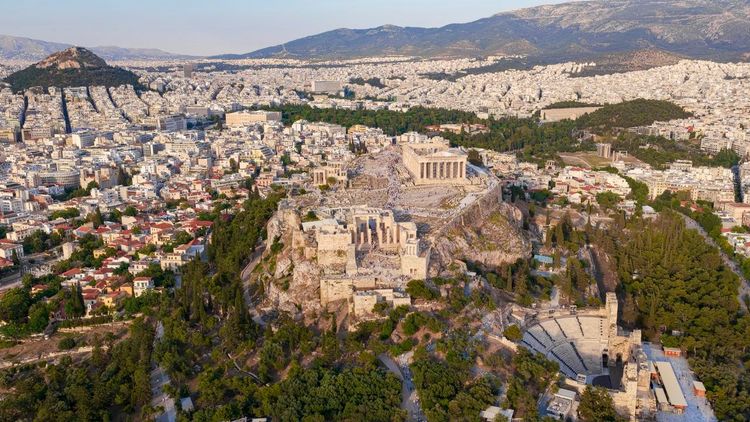
At the centre of the plateau stands the Parthenon (Acropolis of Athens, 105 58 Athens, rated 4.8/5 on Google with 86,512 reviews), a temple dedicated to Athena Parthenos ('the Virgin'), built between 447 and 432 BCE under the direction of architects Ictinus and Callicrates, with Phidias overseeing the entire sculptural programme. The peristyle features 8 columns on the façade and 17 on the sides, a proportion precisely calculated to balance the building's silhouette.
What strikes most visitors as they approach is the apparent absence of straight lines: the architects incorporated optical refinements, a slight convex curve in the stylobate and a swelling of the columns known as entasis, to correct optical illusions and create an impression of geometric perfection. Inside once stood a chryselephantine statue of Athena, twelve metres tall, made of gold and ivory over a wooden core. This statue disappeared in late Antiquity, most likely melted down or moved to Constantinople.
The sculpted friezes and metopes depicted mythological scenes: battles against the Centaurs, against the Amazons, the Panathenaic procession. A significant portion of these reliefs, removed in the early nineteenth century by Lord Elgin, is now housed at the British Museum in London, an ongoing source of diplomatic tension between Athens and London. What you see on site is therefore a mix of originals, casts and missing sections — a puzzle that the Acropolis Museum, further down the hill, helps to reconstruct visually.
The monument remains, to this day, under continuous restoration since 1975. Do not be surprised to encounter a crane or partial scaffolding: this is the price of stabilising a structure nearly 2,500 years old against the frequent earthquakes of the Aegean region.
The Erechtheion and the Caryatids
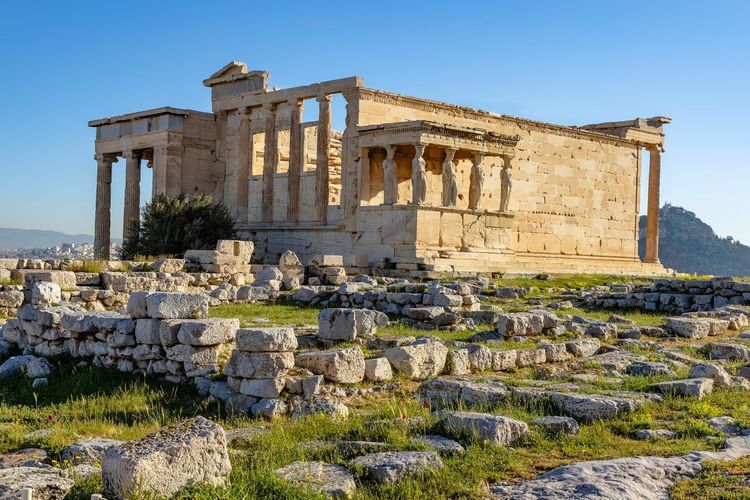
A few dozen metres from the Parthenon, the Erechtheion (Acropolis of Athens, 105 58 Athens, rated 4.8/5 on Google with 2,384 reviews) stands out for its asymmetrical plan, dictated by the sloping terrain and the need to encompass several sacred sanctuaries on a single site. Built between 421 and 406 BCE, this Ionic temple marks the spot where, according to legend, Athena and Poseidon competed to become the city's patron deity: she by offering an olive tree, he by striking the ground with his trident to produce a spring of salt water.
The most photographed section is the Porch of the Caryatids, where six female statues support the entablature in place of conventional columns. Five of the originals have been transferred to the Acropolis Museum to protect them from air pollution, replaced here by casts that are nearly indistinguishable to the naked eye. The sixth is also at the British Museum, having been there since the early nineteenth century — the sole absentee from the reconstituted group.
The difference in ground level forced the architects to design varying heights on each façade, a technical achievement rarely matched in classical Greek architecture.
The Temple of Athena Nike
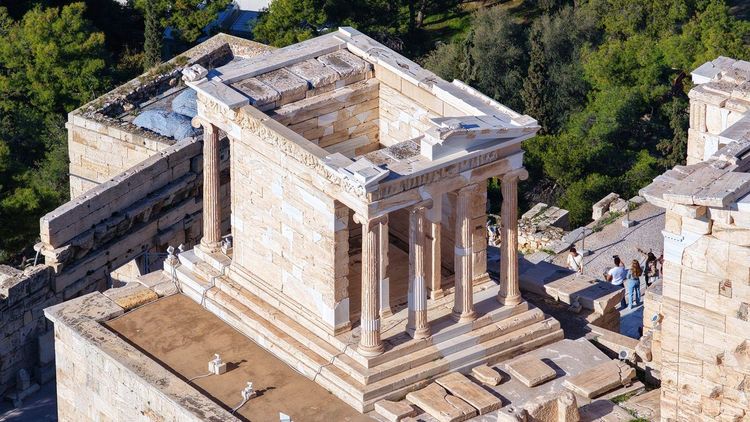
Perched on the south-west bastion, just before passing through the Propylaea, the small Temple of Athena Nike (Acropolis of Athens, 105 58 Athens, rated 4.8/5 on Google with 1,217 reviews) sometimes goes unnoticed, so modest does it appear beside its neighbours. Built around 420 BCE by the architect Callicrates, this Ionic temple celebrates Athena in her role as goddess of Victory.
Its frieze, depicting battle scenes between Greeks and Persians, has been removed for preservation and can now be viewed at the Acropolis Museum. You will spot it easily as you begin the ascent: it is the first ancient structure that stands out clearly on the right.
The Theatre of Dionysos
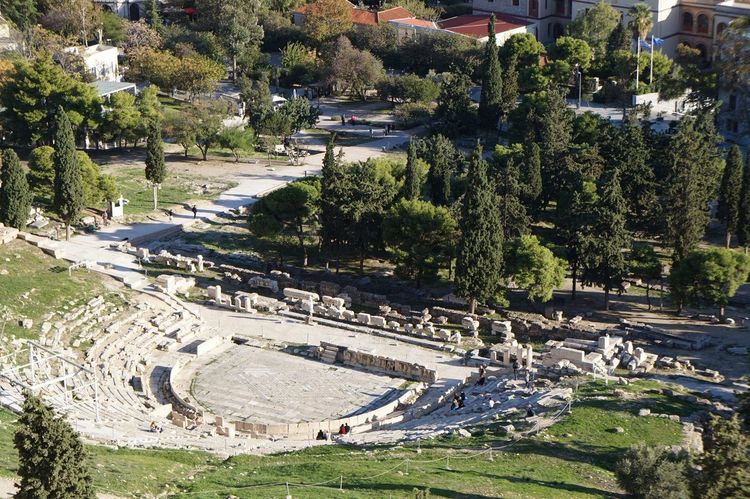
On the southern slope of the hill stretches the Theatre of Dionysos (Dionysiou Areopagitou 27, 117 42 Athens, rated 4.7/5 on Google with 6,599 reviews), considered the oldest identifiable theatre in the world. It was here, in the fifth century BCE, that the tragedies of Sophocles, Euripides and Aeschylus were performed for the first time, before an audience that could reach 17,000 spectators at the site's peak.
The marble seating visible today dates largely from a later Roman reconstruction, but a few richly carved seats of honour survive in the front row, once reserved for priests and city dignitaries. If the history of Greek theatre intrigues you, the dedicated article on visiting the Theatre of Dionysos explores the birth of Western tragedy in far greater depth than a brief stop at the site allows.
The Odeon of Herodes Atticus
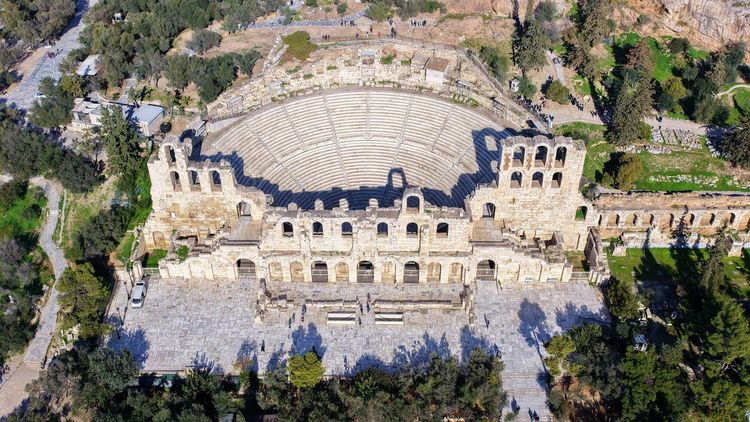
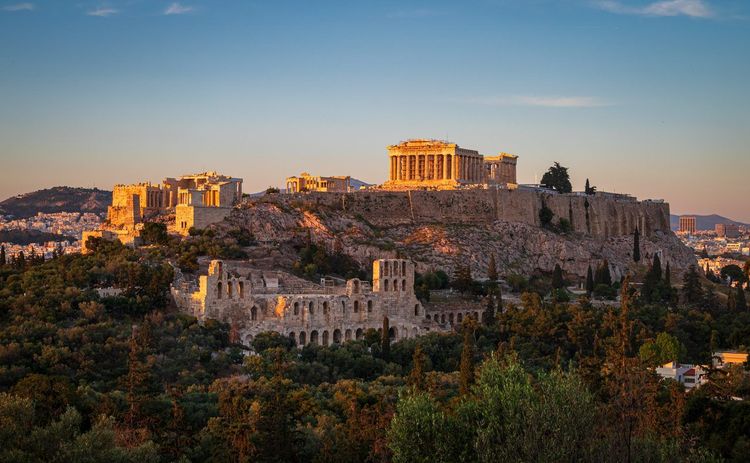
A little further west on the same slope, the Odeon of Herodes Atticus (Dionysiou Areopagitou, 105 58 Athens, rated 4.9/5 on Google with 17,942 reviews) presents its still-intact façade, built in 161 CE by a wealthy Roman patron in memory of his deceased wife. This semi-circular amphitheatre, restored in the 1950s, hosts the Athens and Epidaurus Festival every summer, with concerts and performances under the stars.
Unlike the Theatre of Dionysos, the Odeon is only accessible to the public during scheduled performances; for the rest of the year, it can only be admired from the path overlooking its white marble seating. The view from this vantage point, at the end of the day when the stone takes on a golden hue, ranks among the most beautiful of the entire visit.
The Areopagus and the Views over Athens
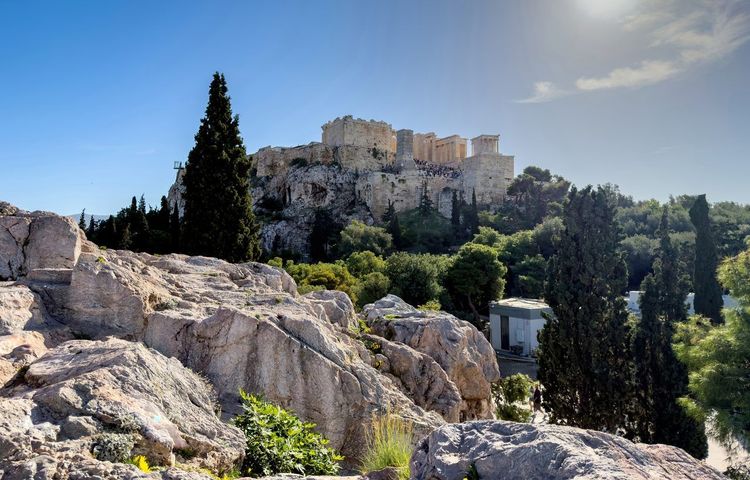
Just before the western entrance rises a bare, slippery rock, the Areopagus (Areopagus Hill, 105 58 Athens, rated 4.8/5 on Google with 5,354 reviews), also known as Mars Hill. In Antiquity, this place housed the supreme court of Athens, responsible for judging capital crimes. According to the Acts of the Apostles, it was here that Paul of Tarsus preached to the Athenians, an episode commemorated by a plaque at the foot of the stairway.
The steps carved into the limestone, polished by millions of footsteps, become particularly slippery in wet weather: it is best to wear shoes with good grip before climbing up. The reward, at the end of the day, is a panorama over the ancient agora, the Piraeus in the distance and, on some autumn evenings, a sunset that sets the whole city ablaze. The nearby Philopappos Hill offers a less-frequented alternative for the same view of the illuminated Parthenon.
Do You Need a Guide or an Audio Guide to Visit the Acropolis
Many travellers wonder whether they absolutely need a guide to visit the Acropolis of Athens, or whether they can manage without missing the essentials. Official guides, recognisable by their badge issued by the Ministry of Tourism, gather near the entrances and offer small-group tours, generally between 25 and 40 euros per person for an hour and a half. Their certified training guarantees an accurate commentary, but fixed schedules suit poorly those who prefer to move at their own pace.
The official audio guide rented at the entrance costs around 5 euros and covers the main points without much narrative depth. The Ryo app offers an alternative: an audio-guided tour designed to tell the story of the site through storytelling, with anecdotes that place each column in its context, to be listened to at the pace of your own walk. Ryo's Athens audio walking tour covers the entire ancient city across 31 stops and 3 hours 30 minutes of content, several of which are located directly on the sacred hill.
If your time is limited to a single guided visit during your stay, prioritise one that includes the Acropolis Museum as well: understanding the sculptures missing from the site becomes far clearer once you have seen them up close, behind glass, a few hundred metres below.
The Acropolis Museum, the Natural Next Step
Opened in 2009 under the direction of architect Bernard Tschumi, the Acropolis Museum (Dionysiou Areopagitou 15, 117 42 Athens, rated 4.7/5 on Google with 83,512 reviews) stands at the foot of the hill, in a glass building that reveals, beneath visitors' feet, the remains of an ancient neighbourhood excavated during construction. This transparent floor often surprises families right from the entrance: you are literally walking above foundations several millennia old.
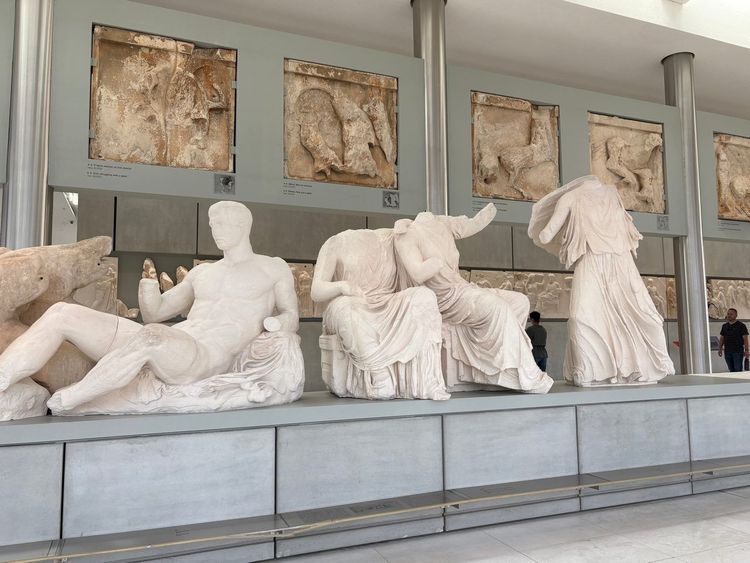
The top floor, aligned at the exact same angles as the Parthenon, reconstructs the entirety of its sculpted frieze at full scale. The original fragments preserved in Athens alternate with white casts marking the sections still held in London — a deliberately political curatorial choice that makes the Elgin Marbles controversy immediately legible, without a single word of explanation needed.
Be aware of a point that often causes confusion: the combined ticket at 36 euros covering the Acropolis and six other ancient sites does not include admission to the museum. Budget a separate ticket at 20 euros full price, regardless of the season. The top-floor café, with its terrace overlooking the Parthenon, is worth a stop even if you are not visiting the collections — provided you avoid it during the busiest hours inside the galleries.
Regularly ranked among the world's finest archaeological museums, the institution takes an hour and a half to visit for the essentials, or two hours for those who read every explanatory panel.
Visiting the Acropolis with Children
Visiting the Acropolis of Athens as a family requires a little more preparation than a trip for two. The site has virtually no natural shade: hats, sunscreen and plenty of water are essential, even on overcast days. Young children generally enjoy the visit more when it is presented as a story rather than a list of dates, which is precisely what an audio-guided tour designed for narrative rather than simple description allows.
Pushchairs are difficult to manage on the irregular and slippery marble surfaces: a baby carrier is far more practical for the very young. Also plan for frequent breaks in the partial shade of the Propylaea or near the museum, where benches and water fountains are more plentiful than on the plateau itself. Good to know: children and teenagers under the age of 18, regardless of nationality, enter free of charge year-round on presentation of an identity document.
Accessibility at the Acropolis
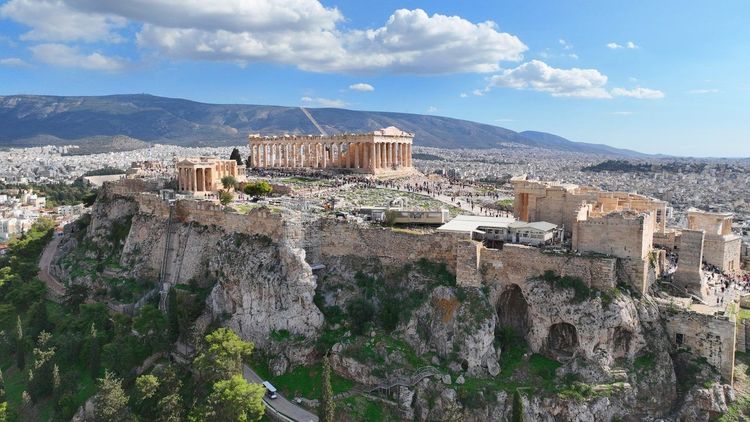
A lift installed on the north slope allows people with reduced mobility to reach the plateau without using the stone steps. Its operation sometimes depends on weather conditions, and it is advisable to contact the site in advance to confirm its availability on the day of your visit.
Once at the top, some routes remain uneven despite this provision: the ancient ground, carved from raw rock in places, was not designed for wheelchairs. Companions of visitors with disabilities generally benefit from free admission on presentation of supporting documentation, as do visitors with a high degree of disability.
Practical Tips for Your Visit
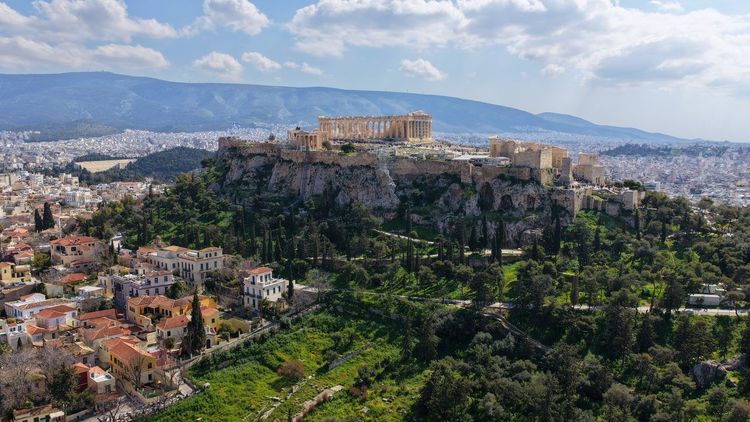
Leave sandals and flip-flops behind: the marble, polished by millions of visitors, becomes extremely slippery, even in dry weather. Closed shoes with a good grip genuinely change the experience, especially on the ascent toward the Propylaea.
There are no food outlets on the site itself, only a few drinking water fountains: bring a filled bottle before entering, since drinks can only be purchased outside the archaeological zone. Drones are prohibited, as are large backpacks, which may need to be left at the entrance depending on the period. Selfie sticks and tripods are also refused inside the enclosure.
Allow two to three hours for a complete visit of the plateau, longer if you continue to the Areopagus and the museum on the same day. Many travellers underestimate this total and find themselves rushing between monuments for lack of time — an easy mistake to avoid by simply setting aside an entire half-day rather than squeezing the visit between two other commitments.
One last habit, often overlooked: download your ticket and audio guide in advance, as mobile coverage is poor on the plateau, hemmed in between marble blocks and restoration cranes. Nothing is more frustrating than wanting to launch the commentary for a particular column and being stuck on a loading page. By anticipating these details, visiting the Acropolis becomes a smooth stroll rather than an obstacle course, and you can give your full attention to what truly matters: the stone, the light and the history that clings to it.
Where to Eat and Sleep near the Acropolis
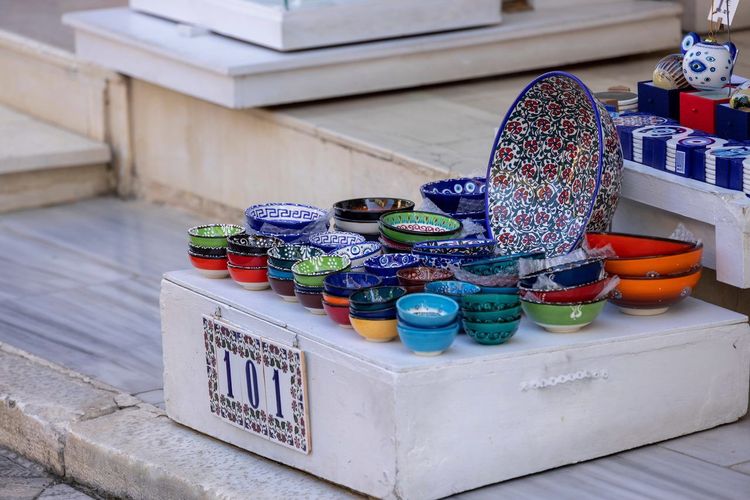
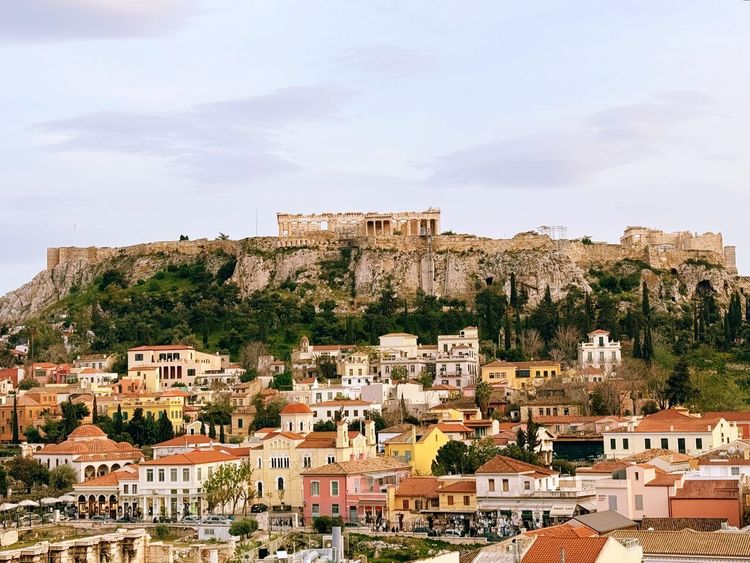
The Plaka neighbourhood, just below, is packed with traditional tavernas and terraces looking up toward the hill. Dionysos Zonar's, with its front-on view of the Parthenon, remains a reliable choice for a slightly more refined lunch after the visit, even if the price reflects the location.
For an evening drink, several rooftop bars in Plaka and Monastiraki frame the illuminated Parthenon between their tables: they fill up quickly around sunset, so it is better to book ahead or arrive early. On the food side, do not leave without trying a proper souvlaki at a neighbourhood taverna rather than on the most touristy terraces, which are often twice the price for lesser quality.
For accommodation, the Herodion Hotel (Rovertou Galli 4, 117 42 Athens, rated 4.6/5 on Google with 2,040 reviews), a short walk from the south entrance, wins visitors over with its rooftop terrace offering a direct view of the illuminated columns at night. To explore local flavours more broadly before or after your time on the hill, the article on Athens culinary specialities lists the dishes and addresses worth seeking out. And if you are still undecided about which neighbourhood to base yourself in, the guide on the best neighbourhoods to stay in Athens compares Plaka, Koukaki and Monastiraki according to your budget.




FAQ
How long does it take to visit the Acropolis of Athens?
Two to three hours are enough to cover the entire plateau at a comfortable pace, stopping in front of each monument. Add an hour and a half if you follow up with the Acropolis Museum, and plan a full half-day if the Areopagus and the Theatre of Dionysos are also on the programme.
How much does admission cost to visit the Acropolis in 2026?
The full-price individual ticket costs 30 euros year-round since the 2024 price revision, as the winter discount has been abolished. The combined ticket at 36 euros, valid for five days, remains the best option if you plan to visit the other ancient sites of Athens as well. Several categories of visitors (Europeans under 25, those under 18, people with disabilities) enter free of charge.
Is admission to the Acropolis free one day per month?
No, free admission does not follow a regular monthly schedule. It applies on specific fixed dates throughout the year (6 March, 18 April, 18 May, the last weekend of September, 28 October) as well as on the first Sunday of every month between November and March.
Can you visit the Acropolis without booking tickets in advance?
It is possible outside peak season, but risky between June and September, when morning time slots often sell out several days in advance and a cap of 20,000 visitors per day applies. Booking online through the official website eliminates this risk and avoids the physical queue at the entrance.
What is the price of the combined ticket to visit the Acropolis and the other ancient sites?
The combined ticket costs 36 euros and remains valid for five consecutive days. It covers the Acropolis, the Ancient Agora, the Roman Agora, Kerameikos, the Temple of Olympian Zeus, Hadrian's Library and the Lyceum of Aristotle — seven sites in total: as soon as you visit three monuments, it becomes more cost-effective than buying separate tickets.
Do you absolutely need to book a guide to understand the Acropolis?
No, but without historical context, a good portion of the site loses its meaning: the columns say very little without the stories that go with them. A licensed guide, a narrative audio guide such as the one from Ryo, or solid preparation beforehand all fulfil this role, each at a different budget and pace.
Is the Acropolis accessible to people with reduced mobility?
A lift on the north slope provides access to the plateau, but its use often requires prior confirmation with the site. Once at the top, some areas remain difficult to navigate due to the uneven ancient ground, which is carved directly from the rock in places.
What is the best season to visit the Acropolis of Athens?
Spring and autumn offer the most pleasant conditions, with temperatures between 20 and 26 degrees and a particularly photogenic light in the late afternoon. Summer, though the busiest period, remains manageable if you visit early in the morning or just before closing time, when the heat subsides.
At the end of this climb, one thing becomes clear after visiting the Acropolis of Athens: the site is not limited to the Parthenon photographed from the street below. It is a collection of sanctuaries, theatres and porticoes that tell, stone by stone, the birth of democracy, of Western theatre and of a certain idea of architectural beauty.
Whether you choose a certified guide, the official audio guide or Ryo's audio-guided tour to explore Athens as a whole, what matters most is taking the time to look up rather than rushing from one monument to the next. Ryo's Athens audio walking tour extends this discovery well beyond the hill, through the alleyways of Plaka and the ruins scattered throughout the city.
À lire également