© Shutterstock
 Votre guide Ryo
Christmas Markets in Ljubljana: The Complete Guide for Winter 2026
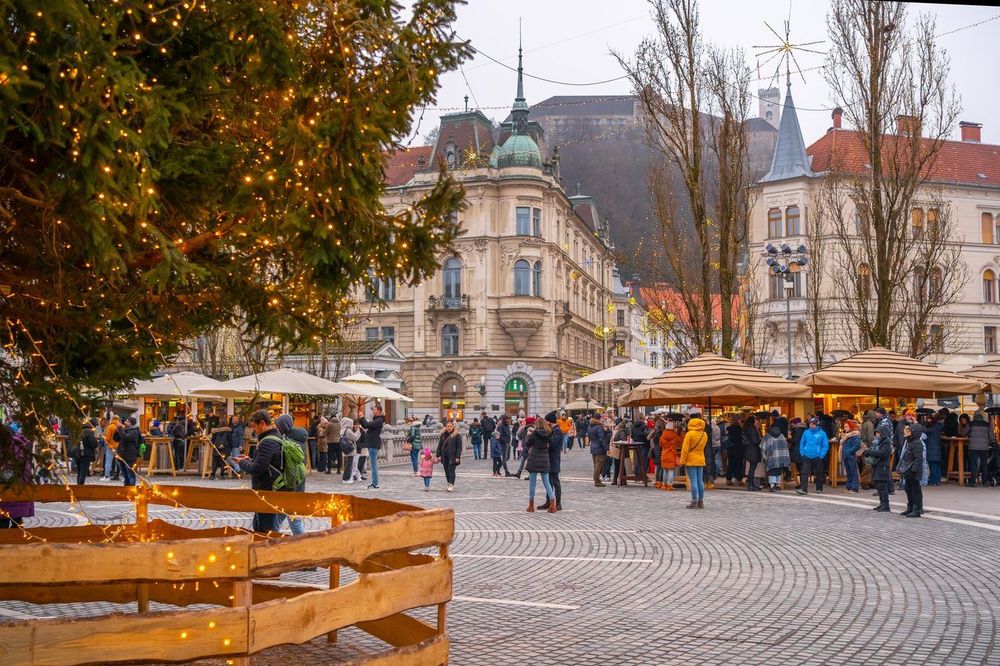
At 6 p.m. in December, Prešeren Square slips into the golden dark of string lights, and no one seems in a hurry to go home. That is exactly the image that sums up the Christmas markets in Ljubljana: a human-sized capital where the scent of mulled wine drifts along the Ljubljanica without ever getting lost in the crowd. Before heading into the side streets, the Ryo audio-guided tour of Ljubljana retraces the history of these squares in a guided stroll, useful for understanding what you are walking through between two stalls.
Here, the Christmas markets are not limited to a single spot: they are spread between Congress Square, the garland-lined embankments and an ice rink set up in the heart of the historic center. You will find a large nativity scene in a pink 17th-century Baroque church, roasted chestnuts sold by the bagful, and possible day trips to Radovljica, Maribor or the stone village of Štanjel. This guide details where the stalls are, what to eat, where to stay and how to organize two to three days on site.
Where to Find the Christmas Markets in Ljubljana
Prešeren Square and Congress Square
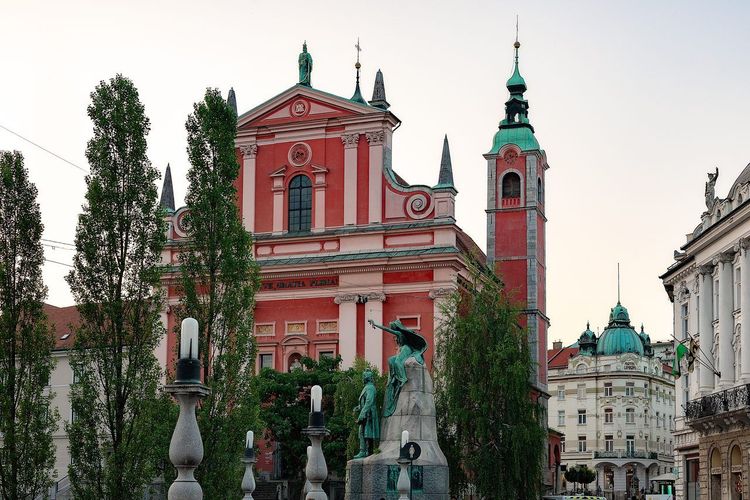
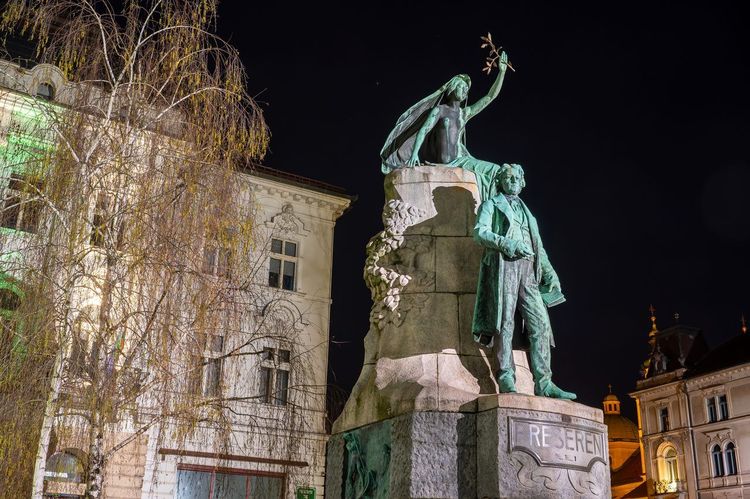
The Prešeren Square concentrates most of the buzz as soon as night falls. This is where the statue of national poet France Prešeren stands facing the Franciscan Church of the Annunciation, its pink facade suddenly lit by white garlands. The first mulled wine stalls are set up literally at the foot of the steps leading down to the Triple Bridge (Tromostovje, 1000 Ljubljana, rated 4.7/5 on Google from 3,676 reviews), so you spot them before you even reach the square.
Two minutes away on foot, Congress Square takes over with a calmer atmosphere. You will find a good share of the craft stalls, children's activities and, in the 2025 edition, an "Ice Land" designed by Slovenian and foreign artists around the ice rink. The Ryo audio-guided tour starts at Prešeren Square before crossing this second square, with the historical story of each facade told step by step if you prefer a guided walk to wandering at random.
What strikes you on arrival is that these Christmas markets in Ljubljana never occupy a single site: one large market spread across several spots in the center, which you naturally cover on foot, with no shuttle or complicated map. Drink and food stalls are spread between Prešeren Square, Congress Square, Stritarjeva Street and the Breg, Cankarjevo nabrežje and Gallusovo nabrežje embankments. If you are wondering where the Christmas markets are really hiding when you arrive by train, the answer is simple: follow the crowd heading down to the old town, and it will lead you straight from one square to the next.
Along the Ljubljanica and the Triple Bridge
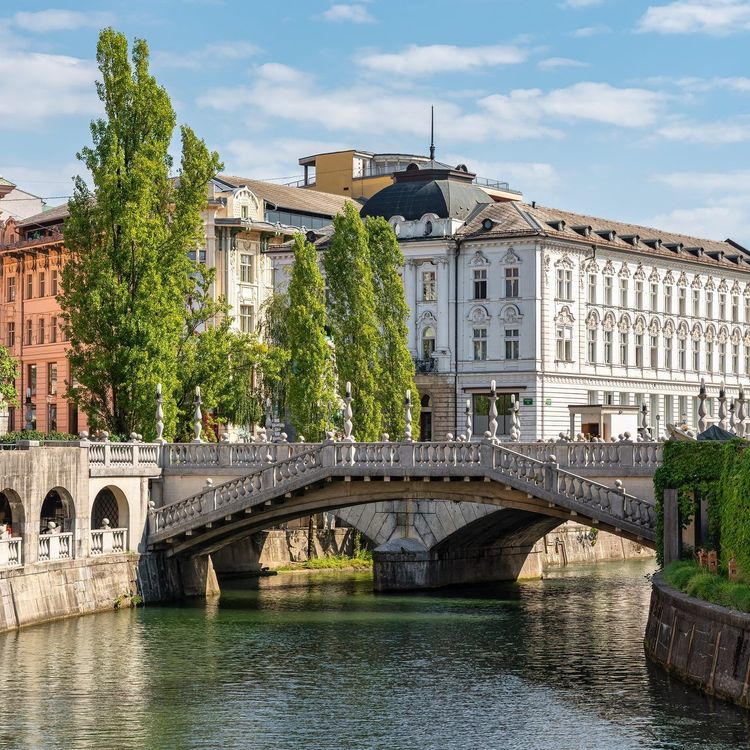
Going down the steps from Prešeren Square, the stalls continue on both banks of the Ljubljanica, as far as the Triple Bridge. The central stone bridge dates from 1842; architect Jože Plečnik flanked it with two pedestrian bridges between 1929 and 1932, hence this fan-shaped silhouette unique in Europe.
It is one of the few places where the Christmas markets in Ljubljana are experienced on two levels: the embankments below, where mulled wine and chestnuts are served, and the bridge level, where people mostly stop for photos. The boats moored along the quays are decorated too, and some offer short night cruises on the illuminated river.
If you are looking for a simple landmark, follow the water. The chalets line up along several hundred meters of embankment, from Breg to the Butchers' Bridge and beyond, making it the stretch with the strongest smell of cinnamon and burning wood in the whole city. The benches along the banks also let you sit for a moment, glass in hand, to watch the comings and goings.
The Special Atmosphere of a Pop-Up Market
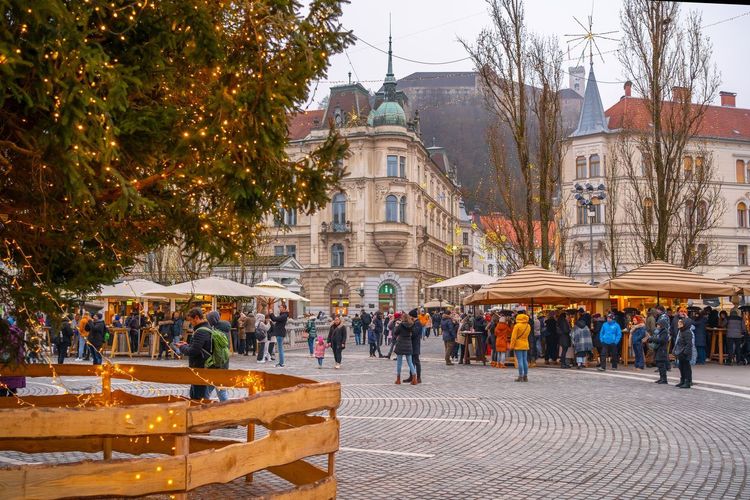
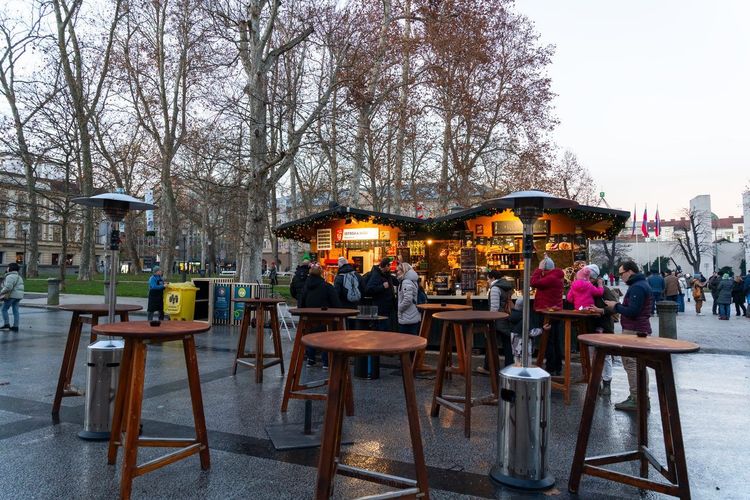
What sets Ljubljana apart from the big Christmas market capitals is its scale. No endless rows of containers or interminable queues: small wooden chalets, set up in late November and taken down in the first days of January, give the whole old town the look of a temporary set, a pop-up market that single-handedly creates the atmosphere of the whole season.
The music changes from street to street. An accordionist set up near the Triple Bridge, a choir rehearsing in front of the Franciscan church, and further on, the discreet crackle of the braziers where chestnuts roast. The smells mingle too: cinnamon, mulled wine, smoked wood and sometimes the wax of candles sold at the craft stalls.
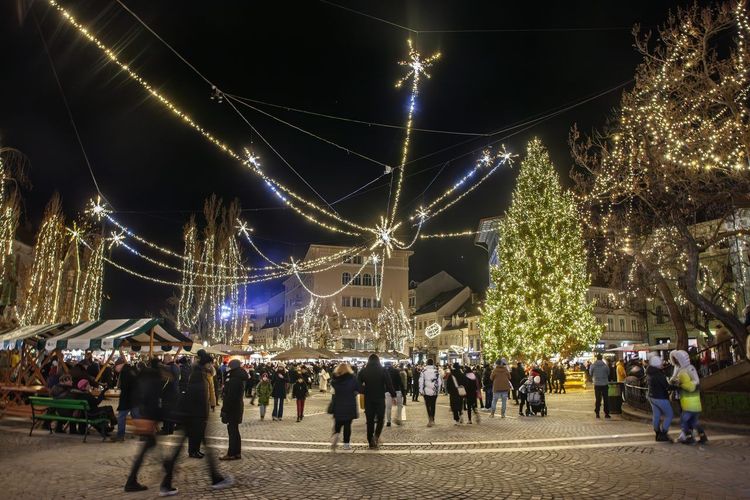
As for lighting, it remains understated compared to other Central European cities: white garlands rather than flashing structures, hung above the pedestrian streets and along the banks. This illuminated December looks less like a funfair than a city quietly dressing up for winter.
A few events punctuate the evenings: concerts on the squares, children's workshops near the ice rink, street performances. Nothing is over-organized: most of it happens as you wander, mulled wine in hand, among groups of friends who have simply come to spend the evening outdoors. You will quickly notice that the people of Ljubljana themselves make up most of the crowd on weekdays.
What to Eat and Drink at the Christmas Markets in Ljubljana
Mulled Wine and Roasted Chestnuts Along the River
Mulled wine (kuhano vino) remains the star drink, often served in reusable deposit mugs that you can keep as a souvenir or return for a refund. Local versions vary from stall to stall: some add orange and cinnamon, others a touch of honey, a flagship product of a country where beekeeping is part of the national identity.
A few meters away, roasted chestnuts are sold in paper cones along the embankments: hot chestnuts by the river that everyone spots from afar, by smell as much as by smoke. The most popular stalls are easy to guess: they are the ones with a line that persists even in the bitter cold.
To warm up differently, several good restaurants overlooking the river offer winter menus with a view of the lights. You will pay a little more than elsewhere in town, but the covered, heated terrace often justifies the expense when the wind picks up along the quays. Beer lovers will also find stalls serving Slovenian craft beer, a less sweet alternative to mulled wine. For children, almost all hot drink stalls offer hot chocolate or a non-alcoholic punch.
Slovenian Specialties to Try at the Stalls
On the sweet side, the must-try specialty remains potica, a rolled cake filled with walnuts, tarragon or poppy seeds, sold in individual slices at almost every pastry stall. You will also find štruklji (rolled dough with fresh cheese), sweet or savory, reheated on the spot on request.
The savory stalls rely on the Carniolan sausage (kranjska klobasa), grilled and served with mustard and horseradish. Along with mulled wine, it is the most ordered combination at the market, and probably the simplest for a standing meal between two stalls.
For an even sweeter break, look for medenjaki, small spiced honey cookies, and decorated gingerbread hearts (lect), a legacy of a craft tradition also found in Radovljica. Some stalls also sell forest honey in jars, an edible souvenir that keeps far better than a fridge magnet.
The flavors, traditions and activities of the market often blend together: a honey stall may offer a tasting, another a short beeswax candle-making demonstration. Nothing is set in stone, and it is by stopping at random that you will stumble on the most interesting finds.
Crafts and Christmas Shopping in Ljubljana
Slovenian Handicrafts to Bring Home
A selection of Slovenian handicrafts is concentrated mainly on Congress Square and around Prešeren Square. You will find Idrija lace, a skill inscribed in 2018 on UNESCO's Intangible Cultural Heritage list, sold as doilies or fine jewelry. Reproductions of panjske končnice, the painted panels that once adorned beehive fronts, are also among the country's most typical souvenirs.
For edible takeaways, look for jars of honey from different forests, Slovenian liqueurs and gins flavored with local berries, and small sachets of mulled wine spices, perfect for recreating the drink once you are home. Most of these souvenirs stay within a reasonable budget compared to other Central European markets. The blown-glass decorations are also worth a look at the best-stocked stalls.
The Small Shops of the Historic Center
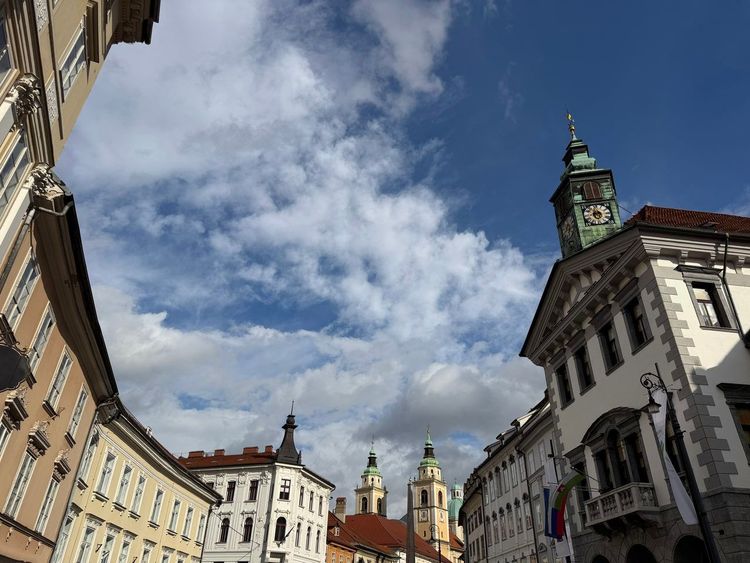
Beyond the temporary stalls, take time for Ljubljana's small shops: the historic center has a surprising number of independent addresses, open all year but especially lively in December. On Mestni trg, Stari trg and in the lanes climbing toward the castle, several concept stores sell local ceramics, illustrations by Slovenian designers or wool clothing.
It is also a chance to step off the market's beaten path and explore the inner courtyards of the center, often decorated too, but much calmer. Most of these shops close earlier than the stalls, usually around 7 or 8 p.m., so it is best to visit them in mid-afternoon before heading back down to the embankments for the evening.
If you are looking for a gift more personal than a stall souvenir, these shops are clearly the place to look, even if it means spending more time there than at the market itself.
Christmas Lights Not to Miss
A Stroll Through the Car-Free Old Town
A good part of Ljubljana's historic center has been pedestrianized since 2007, which completely changes the experience of the lights: you walk in the middle of the street without worrying about a car appearing between two stalls, and seeing the lights without cars almost becomes the thread of the evening. Garlands are strung from one facade to the other above the shopping streets, creating a kind of tunnel of light that leads from Prešeren Square to the foot of the castle.
Ljubljana's festive lights change theme every year and are officially switched on in late November: in 2025, the ceremony took place on Friday 28 November at 5 p.m. The framework stays the same: mostly white, a few golden touches, and hanging structures representing snowflakes or stars above the main intersections. It is one of the few city centers in Europe where you can look up at the decorations without watching where you step.
Views of the Lights from the Bridges and the River
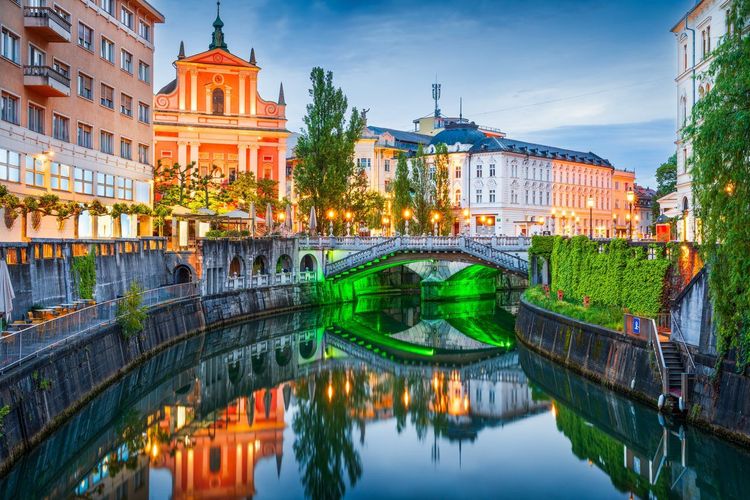
For an overview, climb onto one of the bridges spanning the Ljubljanica: the Triple Bridge offers a view of both illuminated banks, while the quieter Butchers' Bridge lets you photograph reflections in the water without the crowds of the main thoroughfares.
As for cruises, several boats offer a night river loop of about half an hour, which sums up the story of the lights quite well: a walk through town on one side, a river cruise on the other, two complementary ways to see the same decorations. If you prefer to walk, the Ryo audio guide runs along the illuminated Ljubljanica and the Triple Bridge, a guided loop to follow among the lights, with each facade explained just as you pass it.
For photographers, the best time remains the blue hour, around 4:30–5 p.m. in December, when the sky still holds a touch of deep blue behind the already lit garlands. Ten minutes later, the contrast disappears, even though the atmosphere on site stays just as pleasant.
Must-Sees Around the Markets: Ice Rink, Nativity Scene and Tivoli Park
The Giant Ice Rink and the Franciscan Church Nativity Scene
The big attraction of recent editions: an ice rink set up in the heart of the center, on Congress Square, in the middle of the "Ice Land" and its light sculptures. Skate rental is available on site, with calmer music during the day and a more festive mood in the evening. The quietest slots are mid-morning, before the afternoon families arrive.
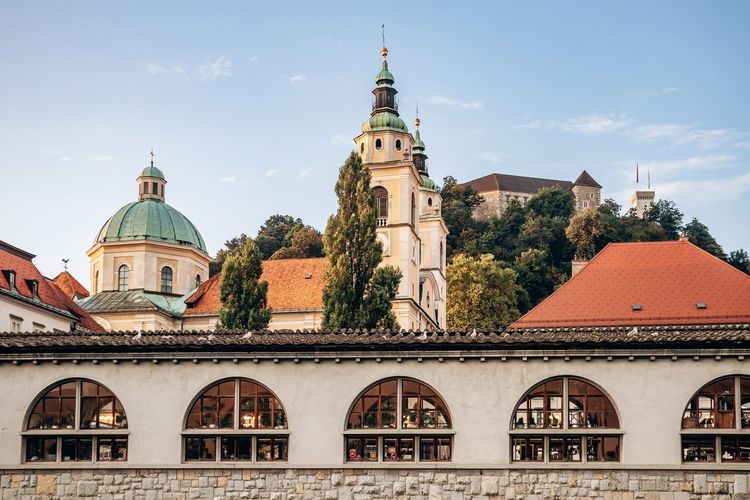
Just steps away, the Franciscan Church of the Annunciation, built between 1646 and 1660, sets up a splendid and highly detailed nativity scene near the altar every year. Inside, also look up at Francesco Robba's Baroque high altar and the frescoes by Matevž Langus. Entry is free, outside of services.
If you follow a guided route rather than a free visit, the Ryo audio guide to the historic center of Ljubljana devotes a stop to this pink church and the square it overlooks, just before reaching the neighboring ice rink. The sequence of rink then church works well at the end of the day: you skate after dark, then warm up for a few minutes in front of the nativity scene.
Tivoli Park Under the Snow
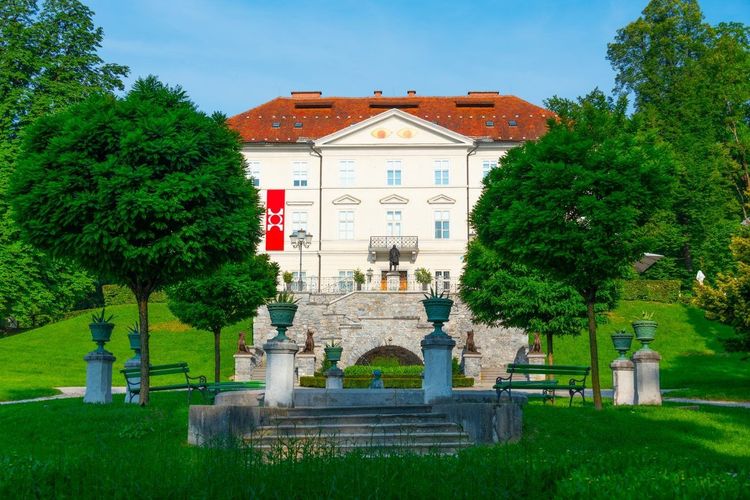
If it snows in Ljubljana, head to Tivoli Park (Park Tivoli, 1000 Ljubljana, rated 4.7/5 on Google from 17,505 reviews), the city's great green lung, about a fifteen-minute walk from the historic center. Unlike the markets, the place stays quiet even in December, making it a good option for a break away from the crowds at the stalls.
In winter, the paths lined with bare trees and the sometimes frozen ponds offer a sharp contrast with the bustle of downtown. The Jakopič Promenade, a central avenue designed by Plečnik, hosts open-air photo exhibitions all year round, and Tivoli Castle houses the International Centre of Graphic Arts.
Allow an hour on site if you simply want to walk to the castle and back, or extend the walk toward Rožnik Hill, above the park, where the Ljubljana zoo is also located.
Day Trips to Other Christmas Markets in Slovenia
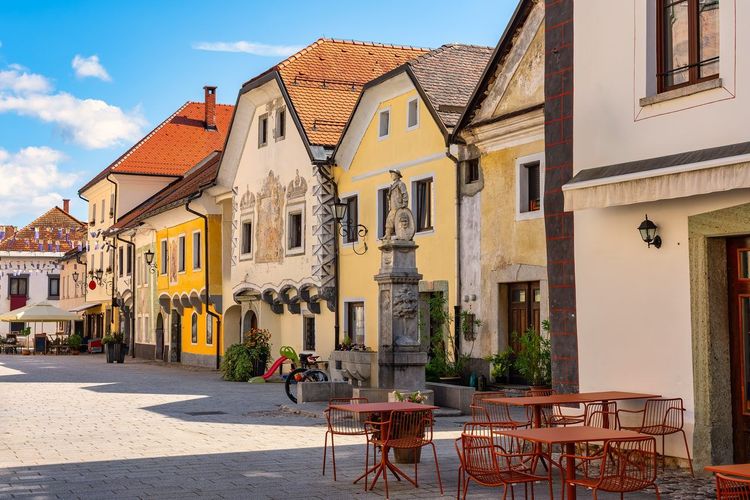
Radovljica and Maribor, a Festive December
About 45 minutes by road from Ljubljana (a little over an hour by train), Radovljica has a miniature old town, with its cobbled square lined with colorful houses. Its Christmas market is deliberately modest: a few stalls, the tradition of decorated gingerbread (lect) and a beekeeping museum, in a distinctly more provincial atmosphere than in the capital, a good summary of the festive December typical of small Slovenian towns.
Maribor, the country's second city, plays in another category: its festive Christmas market spreads across several squares in the center, with lights running down to the banks of the Drava. It is the day trip to choose if you want a livelier market than Radovljica's, without the crowds of the big capitals.
Both towns can be reached by train from Ljubljana's central station, from around ten euros one way. Radovljica fits easily into half a day; for Maribor, allow about 2 hours by train (1h52 on the fastest connections), so more of a full day. Other Christmas events in Slovenia round out the picture on a smaller scale, notably in Bled and Kranj, two very photogenic towns in winter.
Štanjel, the Stone Village and Its Secret Garden
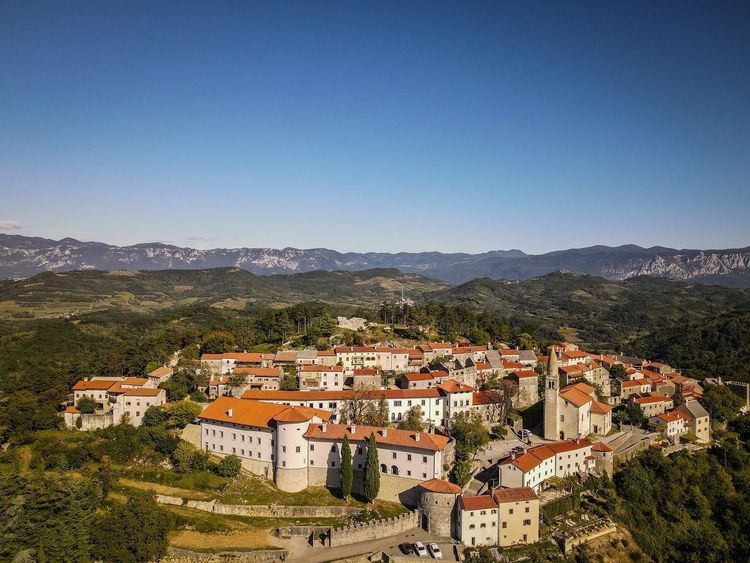
Farther southwest, about an hour's drive from Ljubljana, Štanjel (Štanjel 1, 6222 Štanjel, rated 4.7/5 on Google from 2,212 reviews) changes the register completely: this Karst village, built entirely of limestone, climbs around a castle. It has no big Christmas market, but its wintry, almost timeless atmosphere makes it a trip in its own right among the destinations near the capital.
The village's highlight is its secret garden, the Ferrari Garden, designed by architect Max Fabiani between the wars below the old fortifications. In winter, the bare terraces and gray stone give the place an almost mineral look, very different from the lit lanes of Ljubljana.
Štanjel does have a station on the historic Bohinj line, opened in 1906, but the trip from Ljubljana requires transfers: the car is more practical, making it more of an option for a second or third day. For more experiences in Slovenia around the capital, our Ryo article on the best activities around Ljubljana lists other half-day ideas. And on days without an excursion, the Ryo audio-guided tour lets you wrap up the historic center in half a day.
Ljubljana Compared with Other European Christmas Markets
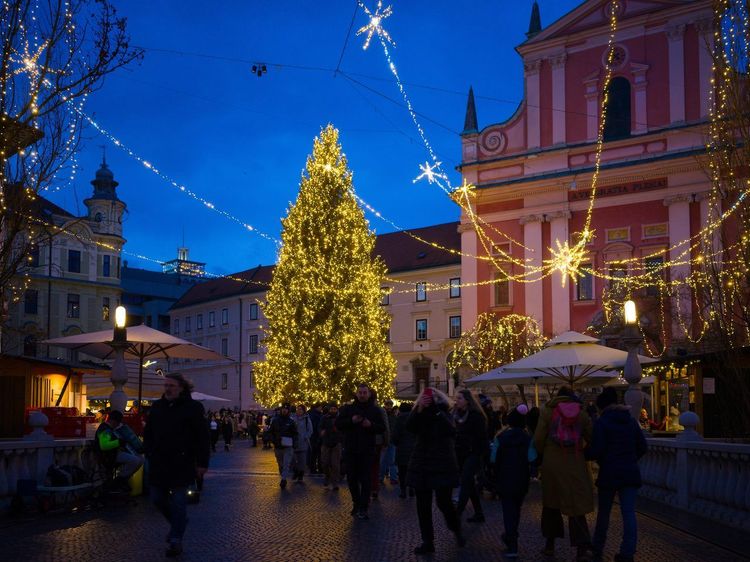
Compared with Strasbourg, Vienna or Kraków, Ljubljana clearly doesn't play in the same category in terms of size. That is precisely what makes it, for many visitors, one of the best Christmas markets in Europe: no hour-long wait for a glass of mulled wine, and a historic center compact enough to see everything in one evening.
The other difference is the river. Few Christmas markets in Central Europe are organized around a waterway as present as the Ljubljanica, which literally runs through the festivities. Between the embankments, the bridges and the colorful facades reflected in the water, the mood evokes a small northern Italian town more than a classic Bavarian market.
If you are looking for the most photogenic market in Central Europe, it is hard to do better for the ratio between the size of the city and the density of the decorations. If, on the other hand, you want the greatest number of stalls, Vienna, Strasbourg or even Zagreb's Advent, about two hours away by road, remain far ahead in volume.
Dates and Opening Hours of the 2026 Christmas Markets
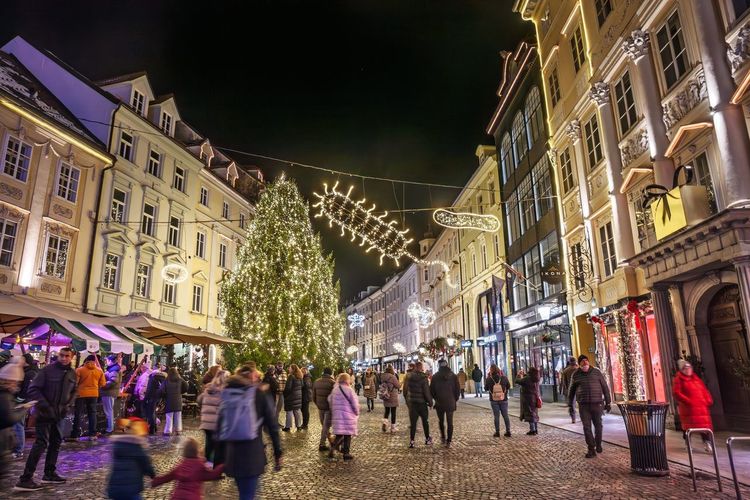
The Christmas markets in Ljubljana traditionally open on the last weekend of November. As a benchmark, the 2025 edition began on 29 November, the day after the lights were switched on, and ended on 5 January 2026. Expect a very similar schedule for the 2026–2027 season. The liveliest period remains the two to three weeks before Christmas.
During the last edition, Congress Square was open every day from 10 a.m. to 9 p.m., while the drink and food stalls stayed open until 11 p.m. On New Year's Eve, the city center stays up much later, with open-air concerts on the main squares.
These hours may vary slightly from year to year: check the exact dates of the 2026 season on the Ljubljana tourist office website before planning a trip around a specific date.
How to Get There and Where to Stay for the Christmas Markets
Getting There from Ljubljana Airport
Jože Pučnik Airport, the main point of entry, is about 25 kilometers north of the city center. Shuttles and public buses connect the airport to the bus station in around 45 minutes, for a fare far lower than a taxi, which runs around 40 to 50 euros depending on the time. For any practical information on site, the tourist information center near the Triple Bridge is the right place to contact.
If you are coming from Vienna or Zagreb, the train remains a comfortable option: allow about 6 hours from Vienna, with at least one direct daily connection, and a little over 2 hours from Zagreb. Ljubljana works well as a stop on a wider Central European itinerary, especially during the Christmas market season when several neighboring capitals hold their own festivities.
Once there, the historic center can be covered entirely on foot: the central station is about fifteen minutes' walk from Prešeren Square, and none of the sites mentioned in this guide (excursions aside) requires motorized transport.
Where to Stay Near the Historic Center
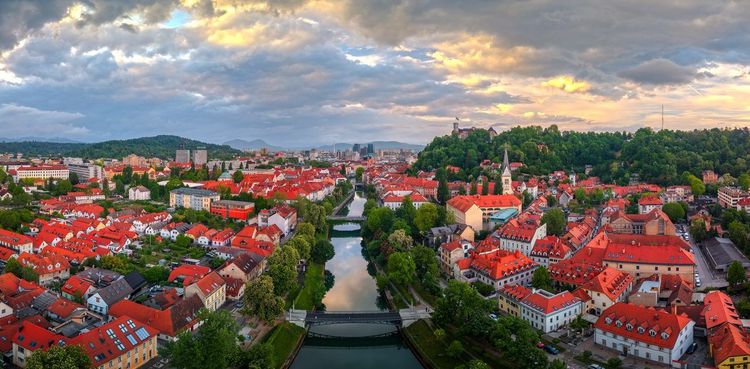
To make the most of the markets' nighttime atmosphere, it is best to stay in the historic center or just on its immediate edge, in the Center or Trnovo district. Prices remain much more affordable than in most Western European capitals at the same time of year.
Small boutique hotels set in historic buildings around Prešeren Square offer the advantage of walking back after an evening at the market, without depending on a last bus. To search for hotels and Airbnbs nearby, target listings on the lanes perpendicular to the river: they suit multi-day stays well, especially if you plan one or two excursions to Radovljica, Maribor or Štanjel.
Book several weeks ahead if possible: the Christmas market period is one of the most in-demand of the year in Ljubljana, and the best-located places, within ten minutes' walk of Prešeren Square, fill up quickly in early December. Even before booking, take a look at the Ryo audio-guided tour of Ljubljana: its route helps you gauge the distances between neighborhoods and choose a well-placed accommodation.
Practical Tips: Budget, Clothing and Crowds
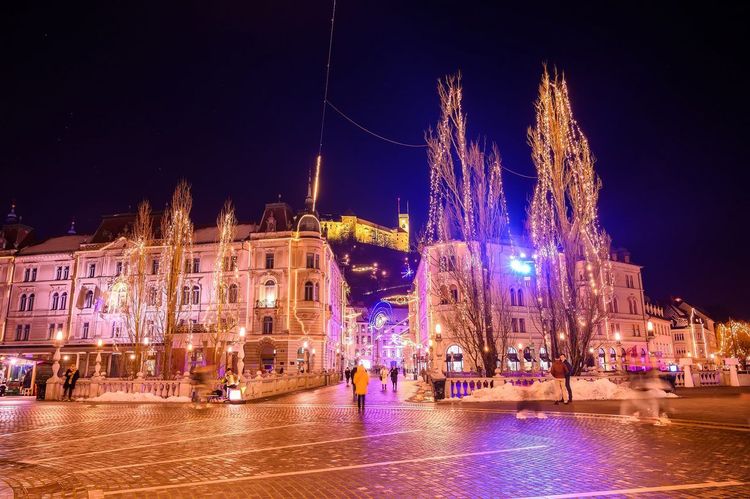
Budget-wise, a typical evening (mulled wine, one savory specialty, one pastry) generally costs between 10 and 15 euros per person, a reasonable price compared with other European capitals at the same time of year. The ice rink and river cruises are the only notable expenses beyond food, since access to the markets themselves is entirely free.
To know how to dress for the Christmas market, assume that December temperatures in Ljubljana generally hover between -2°C and 5°C, with frequent fog and a dampness you feel along the embankments. Bring waterproof shoes, as wet cobblestones can get slippery in the evening, and several layers rather than one big coat.
Also remember to keep a little cash: some small stalls don't accept cards, especially those run by individual producers.
To avoid the crowds, favor weekday visits before 6 p.m., or Sunday during the day. Weekend evenings, particularly Saturday, remain the busiest time around Prešeren Square and the Triple Bridge, especially in the two weeks before Christmas.



FAQ
When do the Christmas markets in Ljubljana take place in 2026?
The Christmas markets in Ljubljana generally open on the last weekend of November and run until the very beginning of January. The 2025 edition ran from 29 November 2025 to 5 January 2026, with the lights switched on on 28 November. For 2026, expect a similar schedule and check the dates on the tourist office website a few weeks before you travel.
Is Ljubljana worth visiting over the holidays?
Yes, and it is even one of the best times to discover the city: the pedestrian historic center turns into a winter wonderland without ever becoming overcrowded, unlike many neighboring capitals. Between the lights, the ice rink, the Franciscan church nativity scene and possible excursions to Radovljica or Maribor, two to three days are enough for a complete stay.
What is Slovenia like at Christmas?
Slovenia offers a more understated Christmas atmosphere than its Austrian or German neighbors: fewer large-scale displays and more small, human-sized decorated towns, from Ljubljana to Radovljica via Maribor. The Alpine regions are often snow-covered, in contrast to the capital, which is more often damp and misty than white.
Where is the most beautiful Christmas market in Europe?
There is no single answer, but Ljubljana regularly ranks among the most photogenic Christmas markets in Europe thanks to its river, colorful facades and compact scale. Strasbourg and Vienna are bigger and better known, but Ljubljana stands out for its reasonable crowds and a setting few capitals can claim.
How much time should I plan for visiting the Christmas markets in Ljubljana?
One evening is enough to see the essentials: Prešeren Square, Congress Square and the embankments around the Triple Bridge. To also enjoy the ice rink, Tivoli Park and a day trip to Radovljica or Maribor, plan on two to three full days.
Is the Ljubljana Christmas market free?
Access to the stalls and decorated streets is entirely free; only purchases (mulled wine, specialties, souvenirs) cost money. The ice rink and the night river cruises are the main paid activities to budget for on top of food and crafts.
What is the best time to avoid the crowds?
Aim for weekdays before 6 p.m., or early December, before the build-up of the last two weeks before Christmas. Avoid Saturday evening, the busiest time around Prešeren Square and the Triple Bridge.
All in all, the Christmas markets in Ljubljana deliver on their promise through their scale: a handful of squares and embankments linked together, compact enough to see everything on foot in one evening, yet rich enough to justify two or three days if you add a trip to Radovljica, Maribor or Štanjel.
To link the main stops without getting lost in the side streets, the Ryo audio-guided tour of Ljubljana takes you through Prešeren Square, Congress Square and the Triple Bridge, with the story of each place told as you walk rather than read on a sign.