© Shutterstock
 Votre guide Ryo
Visiting Salamanca with Family in 2026: Monuments, Scavenger Hunts, and Top Tips
Visiting Salamanca with family means accepting that kids will look up before even entering the cathedral: on the Puerta de Ramos, amid sculpted foliage, an astronaut has been watching passers-by since 1992, added during a restoration by a playful stonemason. This university city, eight centuries old and with its old town listed as a UNESCO World Heritage Site since 1988, lends itself surprisingly well to family holidays. A frog hidden on a façade, a little devil enjoying an ice cream, hundreds of shells to count, and squares wide enough for the little ones to run around in: every monument becomes a life-size scavenger hunt. The historic centre can be crossed on foot in around thirty minutes, without a single car journey. This guide covers the must-sees at child height (Plaza Mayor, cathedrals, university, Casa de las Conchas, Casa Lis), tips for keeping the pace with little legs, and ideas for day trips to Ávila, Ségovie, or León. To make sure you miss none of the sculpted façades, the Ryo audio guide of Salamanca accompanies your walk with commentary you can listen to at your own pace, without juggling a paper map.
The Must-Sees of the Historic Centre
Almost everything is concentrated between the main square and the river, less than fifteen minutes on foot. It is this compact layout that makes Salamanca so practical with children: no bus to wait for, no metro to decipher.
The Plaza Mayor, Heart of Salamanca Life
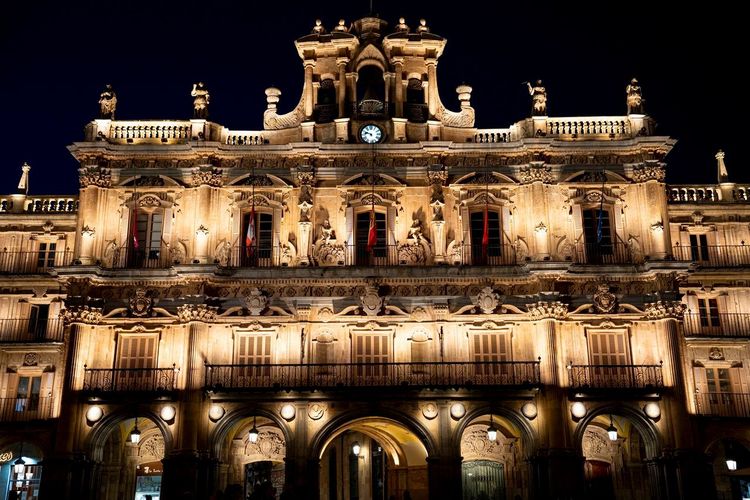
The Plaza Mayor (Plaza Mayor, 37002 Salamanca, rated 4.8/5 on Google with 45K reviews) sets the scene, and your children will likely stop there spontaneously to run from one end of the esplanade to the other before seeing a single monument. Begun in 1729 to plans by Alberto de Churriguera and completed in the mid-18th century, it ranks among the finest baroque squares in Spain, with its continuous arcades on all four sides and its sculpted medallions depicting kings and illustrious figures.
During the day, the square buzzes with terrace life; in the evening, when the golden Villamayor stone is illuminated, the atmosphere changes completely. Benches in the shade of the arcades, ice-cream stalls at every corner, an open car-free space: it makes an ideal base. Give it to the children as a landmark ("we'll meet under the town hall clock" always works).
A little game before moving on: ask the children to find the medallions of the kings of Spain, then those of Cervantes or Christopher Columbus. Some medallions have been left blank, ready for future figures, and children love imagining who will appear there one day.
Meal tip: eat early, around 12:30, rather than at the Spanish lunch hour of 2 pm. The terraces are less crowded and the service faster for impatient stomachs.
The Roman Bridge and the Banks of the Tormes
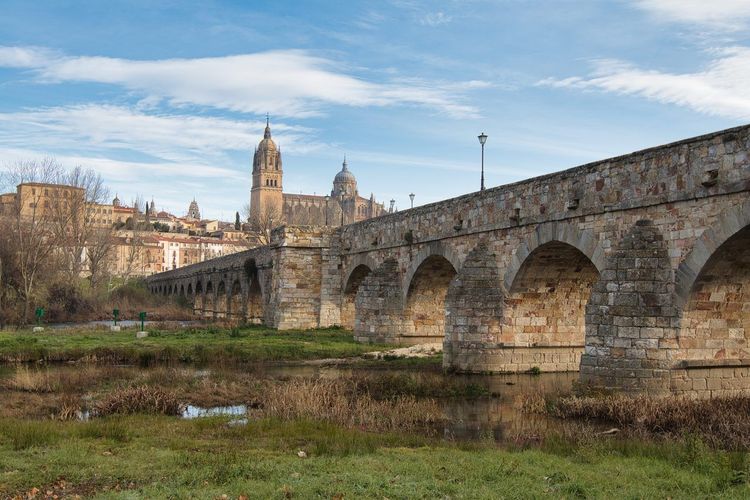
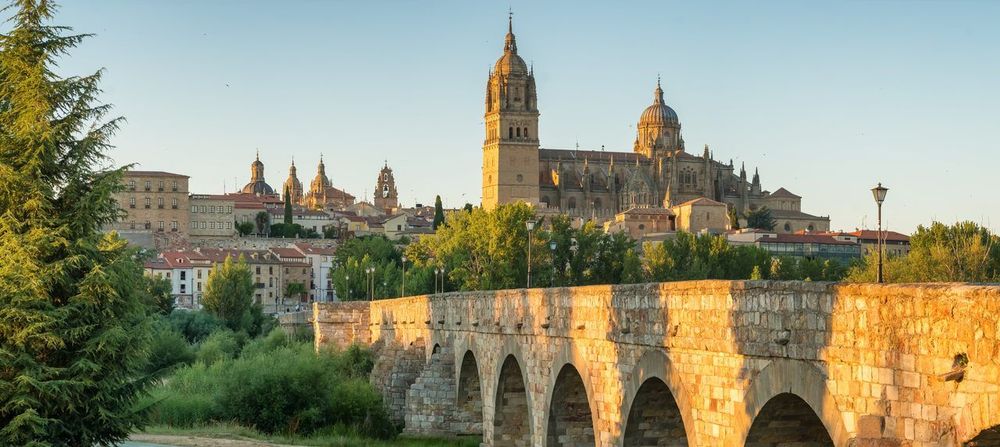
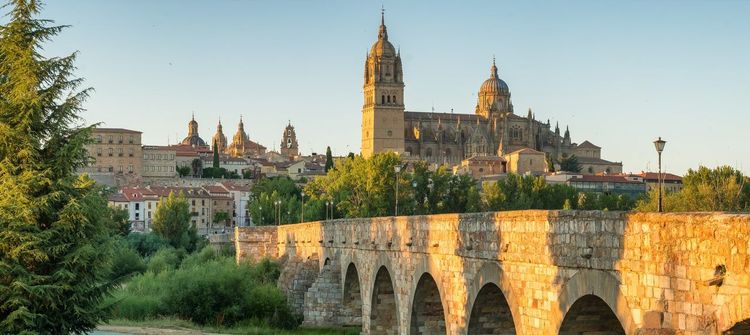
Further south, the Roman Bridge spans the Tormes on 26 arches, the first fifteen of which date back to Roman times. At the entrance to the bridge, a decapitated granite bull, the "verraco", awaits walkers. It is this bull that appears at the beginning of the Lazarillo de Tormes: the blind man invites young Lazaro to press his ear against the stone to hear a sound, then bangs his head against the bull. The anecdote, told on the spot, never fails to delight children aged 8 to 12.
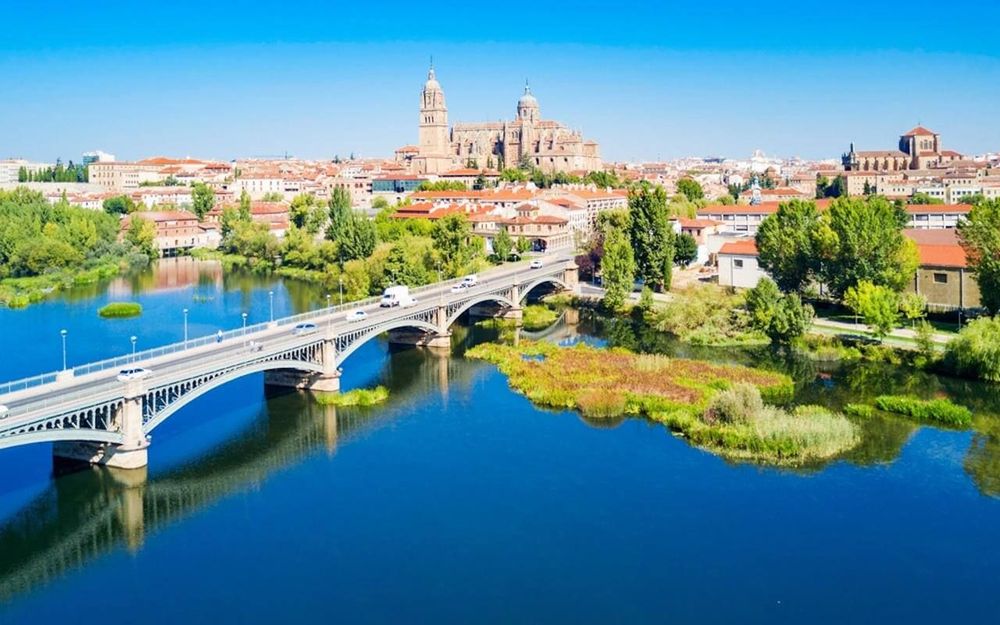
The riverside, laid out as a shaded promenade, offers the finest panoramic view of the old city and its two cathedrals. Let the children loose on the grass for twenty minutes or so between visits, picnic included if the weather allows.
The Ryo audio tour of Salamanca links the Plaza Mayor to the Roman Bridge, with the history of each spot to listen to as you walk.
The Cathedral of Salamanca and Its Hidden Astronaut
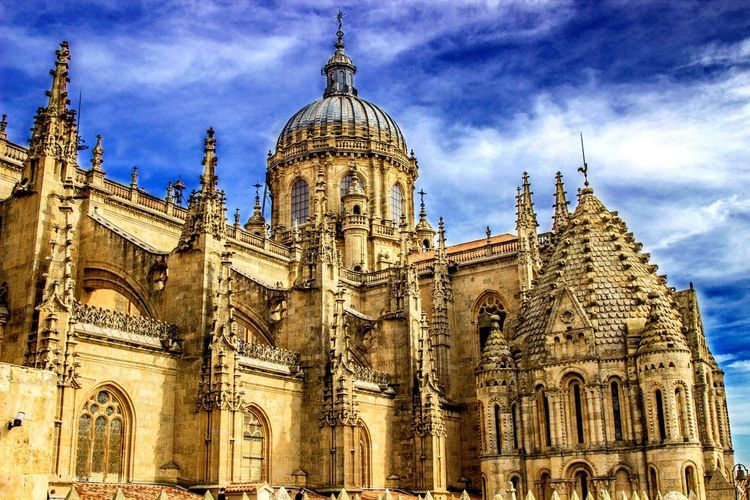
Two cathedrals side by side, separated by several centuries of construction: it is this double face, Romanesque on one side, Gothic and Baroque on the other, that surprises most.
The Catedral Nueva and the Catedral Vieja
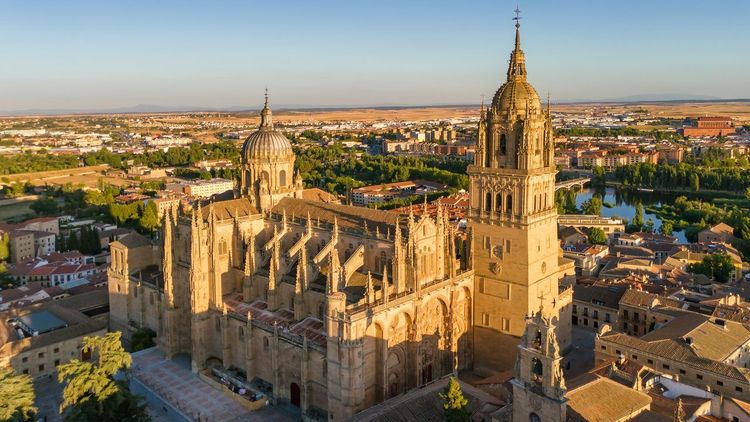
The Catedral Nueva (Plaza Juan XXIII, 37008 Salamanca, rated 4.7/5 on Google with 19,261 reviews), built between 1513 and 1733, blends late Gothic, Renaissance, and Baroque styles. Adjoining it, the Catedral Vieja, a 12th-century Romanesque church, is worth visiting for its silent cloister and its great altarpiece of 53 painted panels depicting the lives of Christ and the Virgin.
The hushed interior quickly bores younger visitors. The solution: the Ieronimus exhibition, which takes you up into the towers to the walkways and a panoramic terrace. Allow about an hour, stairs included. Children see the nave from above, the rooftops up close, and the city in 360°, enough to make them forget they are inside a church. Book in high season: weekend slots fill up fast.
Spotting the Astronaut and Other Unusual Details on the Façade
Head to the north façade, on the Puerta de Ramos side. In 1992, for the Las Edades del Hombre exhibition, this badly damaged doorway was restored under the direction of architect Jerónimo García de Quiñones. Stonemason Miguel Romero then perpetuated an old builders' tradition: slipping a motif from his own era into the decoration. He chose an astronaut in a spacesuit, floating among the scrollwork. Right beside it, a little devil enjoys an ice-cream cone with a grin, and you can also spot a lynx, a stork, and a small hare.
The astronaut is smaller than you might expect: bring binoculars or use your phone's zoom, and let the children search before giving them a clue. The Ryo audio guide tells the story of this restoration right in front of the doorway, a tale that holds the attention even of jaded teenagers.
The University of Salamanca and the Legend of the Frog
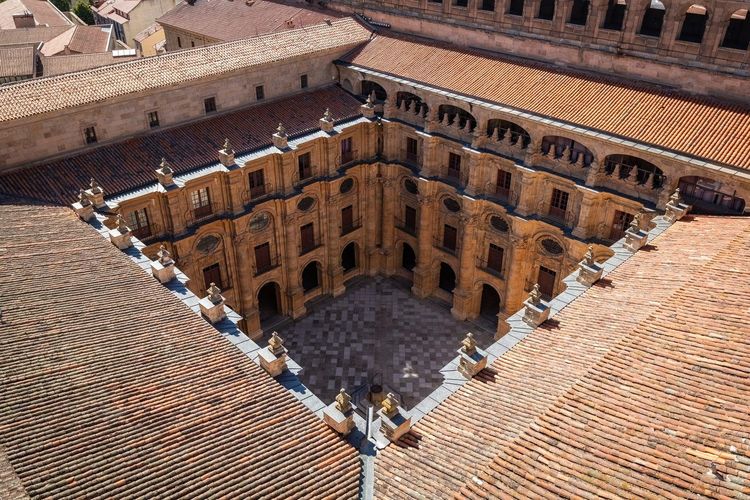
Founded in 1218, the University of Salamanca is the oldest still-active university in Spain, and its historic campus can be visited like an open-air museum.
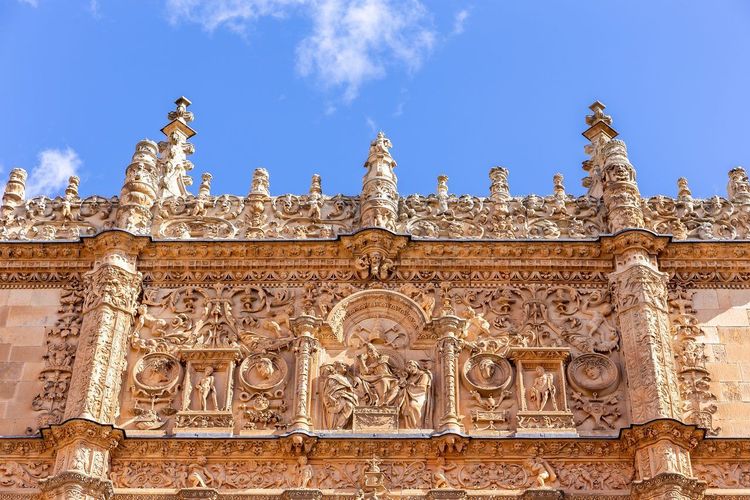
The Plateresque Façade and the Frog Game
The Escuelas Mayores façade, a lace-like Plateresque stone carving, hides a tiny frog perched on a skull. Clue for your children: look at the right pillar, at the level of the three death's heads; the one on the left bears the frog. Tradition promises exam success, or even marriage within the year, to whoever finds it unaided. The result: small groups are permanently stationed there, noses raised.
A stop on the Ryo audio guide dedicated to the university places you precisely in front of this façade so you can find the frog without searching at random for ten minutes. Once found, the shops on Calle Libreros sell it as a keyring and a soft toy, a ready-made souvenir.
The Historic Courtyards and Libraries
Inside (ticket around €10), the Escuelas Mayores open onto a Renaissance cloister lined with period classrooms, wooden benches and all. Show the children the lecture hall of Fray Luis de León, where the professor, imprisoned for five years by the Inquisition, is said to have resumed his class with a simple "As we were saying yesterday." The historic library, the oldest still in use in Europe, can be glimpsed through a glass door: nearly 2,800 manuscripts, 487 incunabula, and some 60,000 early printed works.
The visit rarely lasts more than 45 minutes, a format that suits children over 6. For younger ones, focus on the façade and its frog, leaving the interior to parents who take turns.
Casa de las Conchas and the Clerecía
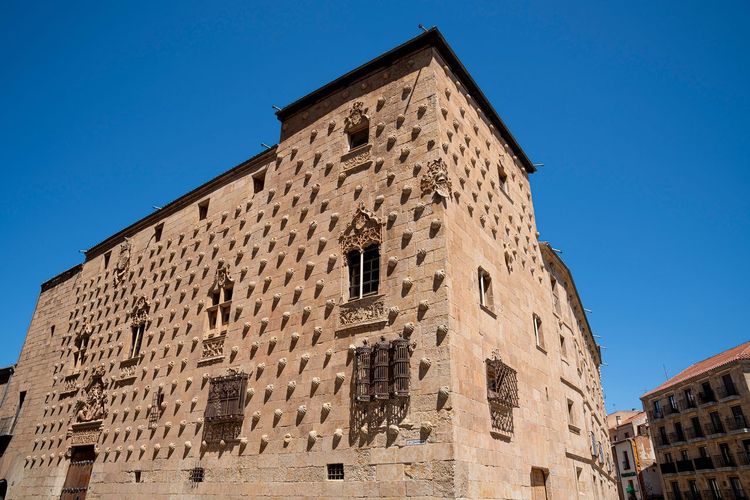
Two spectacular façades face each other on either side of Calle de la Compañía.
The Casa de las Conchas, Façade of a Thousand Shells
The Casa de las Conchas, a late-15th-century palace, owes its name to the roughly 300 scallop shells sculpted on its façade, the emblem of the Order of Santiago to which its owner, Rodrigo Arias Maldonado, belonged. Counting the shells, never arriving at the same total twice, rivals the frog hunt.
The inner courtyard and the public library housed in the building can be visited free of charge, a welcome cool break in summer.
Look up at the ground-floor windows: their wrought-iron grilles, among the finest in the city, are decorated with Gothic motifs that children readily compare to lacework. In the courtyard, the well and the two-storey galleries give a sense of life as a great lord at the end of the Middle Ages, with no display cases or rope barriers.
The Clerecía and Its View over the City
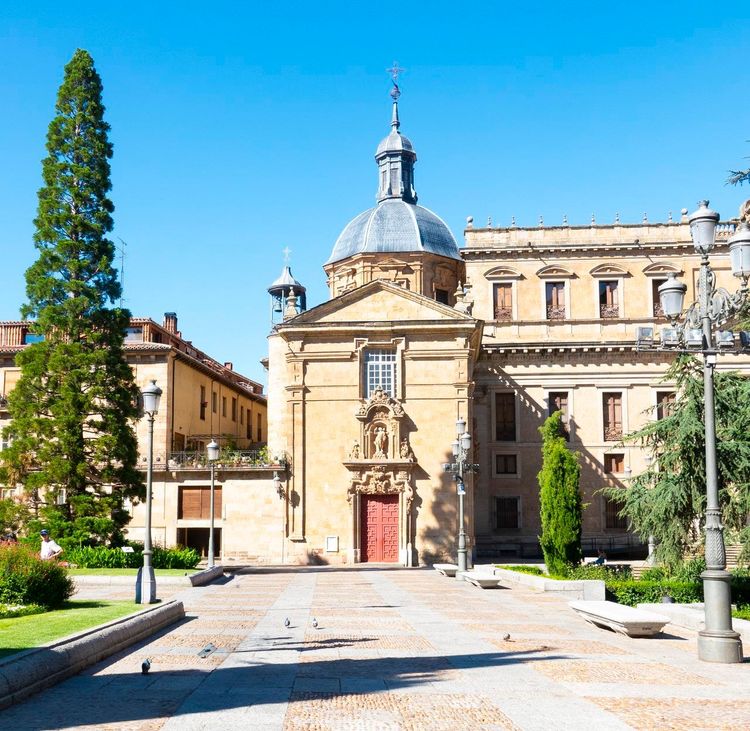
Opposite, the twin towers of the Clerecía (Calle Compañía 5, 37008 Salamanca, rated 4.6/5 on Google with 720 reviews), a former Jesuit college built in the 17th and 18th centuries, dominate the neighbourhood. The Scala Coeli visit (separate ticket) climbs to the top of the towers for a close-up view of the rooftops and the two cathedrals.
Save the climb for children who are not afraid of heights: narrow staircases and open-grid walkways. At sunset, the light on the golden stone makes the ascent worthwhile.
Casa Lis and the Palacio Anaya
A little off the Plaza Mayor–cathedral–university triangle, two addresses complete the visit without a significant detour.
The Art Nouveau and Art Deco Museum at the Casa Lis
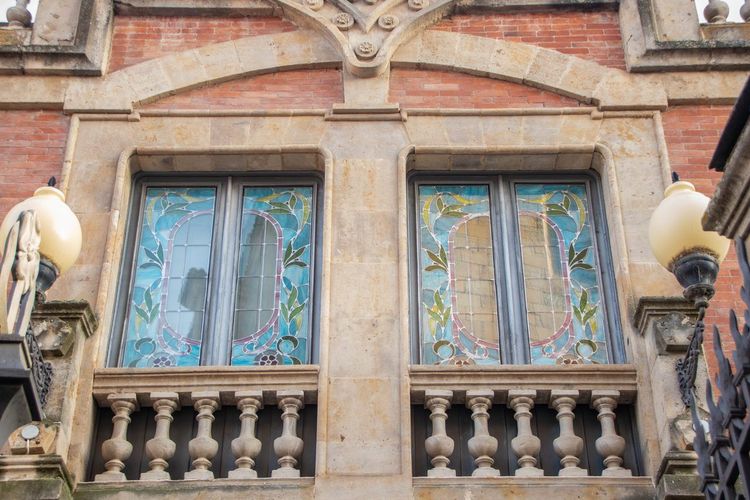
The Casa Lis (Calle Gibraltar 14, 37008 Salamanca, rated 4.5/5 on Google with 8,576 reviews), a Modernist villa built in 1905 for industrialist Miguel de Lis, houses the Art Nouveau and Art Deco museum of Salamanca. Its coloured glass roof, on the river side, is worth the visit alone, but it is above all the antique dolls, toys, and glass figurines that captivate younger visitors.
Good news for the budget: entry is free for under-14s, and free for everyone on Thursdays from 10 am to 1 pm (€7 otherwise). Tickets are sold on-site only; allow 45 minutes to an hour for the visit.
The Palacio Anaya, a Former Faculty at the Heart of Campus
Facing the cathedral, the Palacio Anaya, now the faculty of philology, boasts an 18th-century neoclassical façade and a monumental staircase visible from the entrance. The small tree-lined square in front of it offers one of the best photo angles of the Catedral Nueva, and a bench to rest for five minutes.
The Huerto de Calixto y Melibea and the Convent of San Esteban
After the succession of sculpted façades, here is a welcome breathing space before resuming the visit.
The Garden of Calixto y Melibea, the Green Break
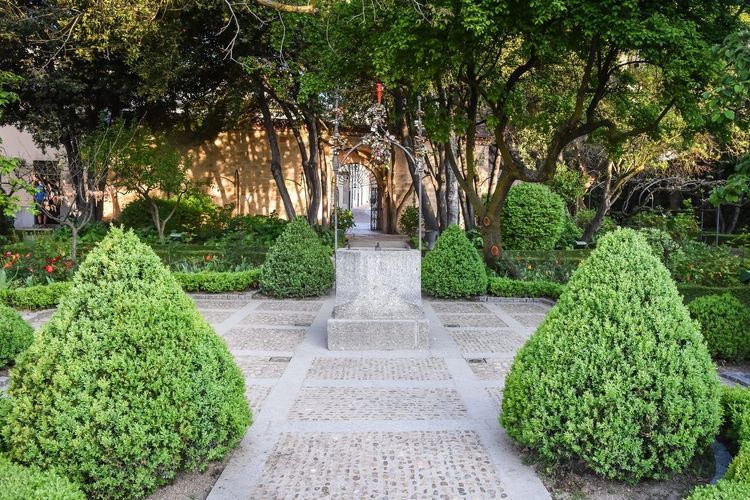
The Huerto de Calixto y Melibea (Calle Arcediano, 37008 Salamanca, rated 4.5/5 on Google with 13,719 reviews), a garden laid out on the former city wall, takes its name from the lovers in La Celestina, a late-15th-century work whose tradition places a scene here. Free to enter, it is one of the few green spaces in the historic centre where children can run freely. Lovers attach padlocks to the central well, a detail that amuses older children.
From the benches, the view reaches the Tormes and the Castilian countryside: perfect for an afternoon snack break.
The garden is small: twenty minutes are enough to walk around it. Take the opportunity to then follow the remains of the city wall to the Casa Lis, five minutes on foot heading down towards the river. The garden closes its gates in the evening, earlier in winter; aim for the late afternoon, when the low light gilds the cathedral below.
The Convent of San Esteban and the Palacio de la Salina
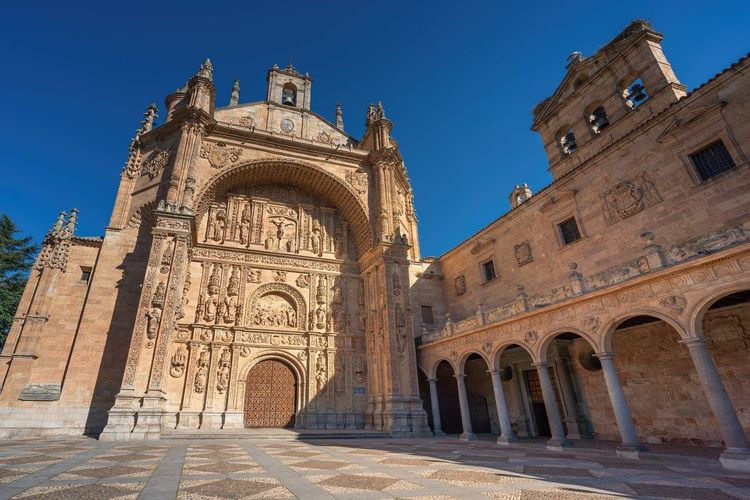
A few minutes away, the Plateresque façade of the convent of San Esteban rivals the university's in its delicacy. Inside the church, the Baroque altarpiece by José Benito de Churriguera (1692) dazzles with its gilding.
On the way back to the Plaza Mayor, the Palacio de la Salina, seat of the provincial government, conceals a Renaissance courtyard decorated with carved consoles of grimacing figures. Access is generally free during the day: a quick stop, no ticket needed.
Salamanca with Children: Activities and Tips
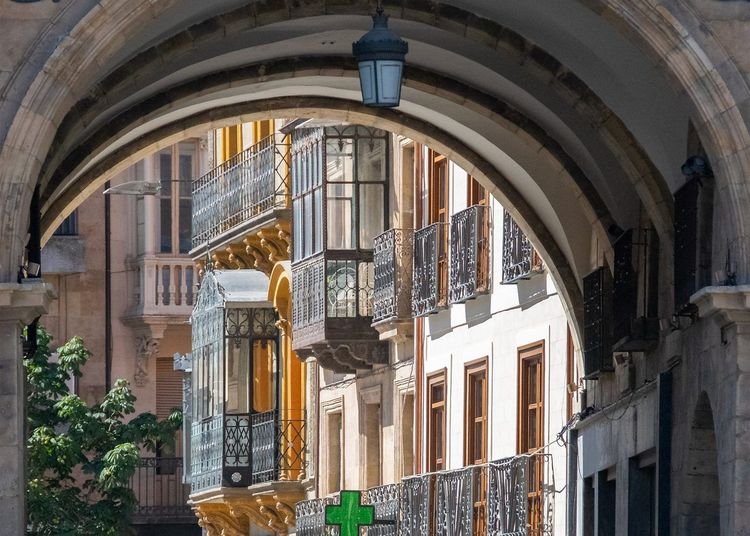
Beyond the monuments, Salamanca lends itself to a deliberately relaxed pace, where the hunt for sculpted details becomes the guiding thread of the stay.
Games and Hidden Details to Spot (Frog, Astronaut, Little Devil)
Turning the walk into a treasure hunt radically changes the experience for children aged 5 to 12. Prepare a list before you set off and tick things off as you go:
- the frog on the skull of the university façade;
- the astronaut and the little devil with an ice cream on the Puerta de Ramos;
- the lynx, the stork, and the hare on the same doorway;
- a shell on the Casa de las Conchas more worn than the others;
- the medallion of Cervantes on the Plaza Mayor;
- the stone bull at the entrance to the Roman Bridge.
Print out a sheet with the silhouettes to find: the prop keeps children busy during queues. A small reward at the end (ice cream, churros) keeps the troops motivated right to the last detail.
Activities and Breaks Suited to the Youngest
With very young children, split the visit into two half-days: morning for the Plaza Mayor and the cathedral, then a nap or hotel pool, followed by the late afternoon for the university and the Casa de las Conchas once the heat drops. The cobblestones, uneven in places, call for an all-terrain pushchair; a baby carrier remains more practical for the cathedral and Clerecía towers, which are off-limits to pushchairs.
Ice-cream stalls and churrerías line the route between the Plaza Mayor and the cathedral, handy for negotiating a break every 20 to 30 minutes. The Parque de la Alamedilla, to the east of the centre, adds playground equipment and a duck pond, and the banks of the Tormes offer lawns for a picnic.
Over two days, a good balance is to keep the first for the monumental core (Plaza Mayor, cathedrals, university, Conchas) and the second for the Casa Lis, the garden of Calixto y Melibea, San Esteban, and the bridge, with an evening on the illuminated Plaza Mayor.
Bear in mind the Spanish rhythm: many monuments close at lunchtime or in the early evening, and on Sunday afternoons some sites such as the Escuelas Mayores are only open in the morning. Group paid visits in the morning and save façades, visible at any hour, for the afternoon. Bring a water bottle: public fountains are rare in the centre and Castilian summers are dry. Finally, a university T-shirt or cap, sold in souvenir shops, is often more appreciated by children than yet another postcard.
The Ryo audio guide is followed on foot, stop by stop, with anecdotes and legends you can pause whenever a child asks for a snack, rather than following a guide pressed for time.
Where to Eat in Salamanca: Gastronomy and Top Addresses
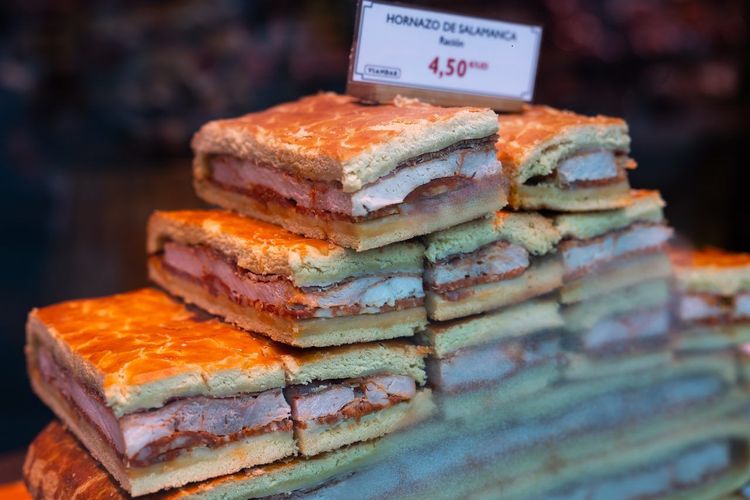
Castile-León cuisine relies on simple, generous produce, a format that reassures children who are not adventurous eaters.
Local Specialities to Try
The hornazo salmantino, a pie filled with chorizo, ham, and hard-boiled egg, is traditionally eaten during the "lunes de aguas", the Monday after Easter week, but can be found year-round in bakeries in the centre: an excellent on-the-go meal. The Iberian ham from Guijuelo, about fifty kilometres away, is enjoyed on tostas, as are the patatas meneás (or revolconas), a mashed potato dish with paprika and crispy lardons.
On the sweet side, thick hot chocolate served with churros is a reliable option at any time of day. Also try the chochos, small sugar-coated dough balls sold in pastry shops, which children devour.
Recommended Restaurants and Bars
On the Plaza Mayor, Mesón Cervantes occupies a first-floor space with a balcony overlooking the square: raciones to share, tostas, and a lively atmosphere, ideal for children who prefer to pick and graze.
A little further along, La Cocina de Toño (Gran Vía 20, 37001 Salamanca, rated 4.2/5 on Google with 427 reviews), on the Gran Vía, is known for its creative bar tapas and its quieter dining room. Arrive around 8 pm rather than 10 pm to find a table.
The streets Van Dyck and Rúa Mayor are home to other tapas bars where portions are ordered individually. Booking is not necessary on weekdays, but becomes advisable on Friday and Saturday evenings in high season.
Day Trips around Salamanca
Most guides stop at the city's gates. Yet this is one of its great strengths: its position at the heart of Castile allows you to venture out to several historic cities in a single day.
Ávila and Ségovie, Ramparts and a Castle in One Day
Ávila, about 1h15 by road, preserves a spectacular medieval enclosure: nearly 2.5 km of ramparts and 87 towers, several sections of which can be walked. The life-size "castle" effect never fails to impress. Ségovie, about 2 hours away, adds to its granite Roman aqueduct, standing without mortar for nearly two thousand years, the Alcázar, whose silhouette is said to have inspired Disney's Sleeping Beauty castle.
Each city deserves its own day; by setting off early, you can however combine the two, as Ávila is on the road to Ségovie.
In Ávila, the battlements are accessible through several gateways with a modest ticket and free entry for younger children; the longest stretch offers a view of the cathedral-fortress, itself integrated into the ramparts. The yemas de Santa Teresa, small egg-yolk sweets, reward walkers. In Ségovie, the Alcázar can be visited with its armory and the tower of Juan II, whose roughly 150 steps lead to a view over the Castilian plain. Picnic on the lawns at the foot of the aqueduct, or try the roast suckling pig, a local speciality, if the children are willing.
León, Valladolid, and Other Cities of Castile
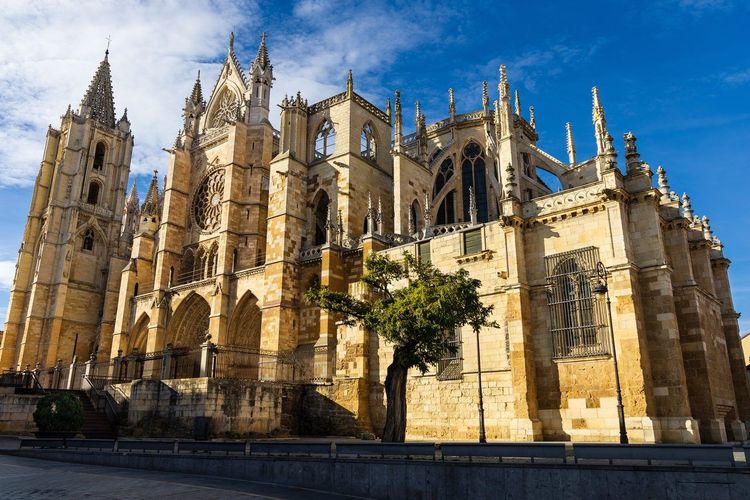
Further north, León, about 2 hours by road, is worth the detour for its Gothic cathedral and its roughly 1,800 m² of stained glass, which cast patches of colour on the floor in the late afternoon. Valladolid, the capital of Spain in the early 17th century, lends itself to a half-day excursion around its old town and its national sculpture museum.
Palencia and its cathedral nicknamed "the beautiful unknown", or Burgos and its UNESCO-listed cathedral, extend the list for longer stays. To the south, Béjar, a former textile town at the foot of the sierra of the same name, charms with its old town and the Renaissance garden of El Bosque; the thermal baths of Baños de Montemayor are nearby. Once the Ryo audio guide of the historic centre has been completed, a full day can easily be spent on one of these excursions, by regional train or rental car.
Practical Info: Getting to, Getting around, and Staying in Salamanca
Everything you need to check before booking, from the journey to your accommodation.
How to Get to Salamanca (Plane, Train, Car)
There is no direct flight between France and Salamanca: the easiest option is to fly to Madrid (about 2 hours from Paris), then take the train. From Madrid Chamartín station, Alvia or Avant trains reach Salamanca in about 1h30, far more comfortable with young children than the road. By car from Madrid, allow about 2h30 via the A-6 then the A-50.
As for formalities, Spain is part of the Schengen Area: a valid identity card or passport is sufficient for every traveller, children included (a minor travelling without their parents must also present a parental consent form). There is no time difference: Spain follows the same time zone as France all year round.
Getting around, Parking, and Sleeping
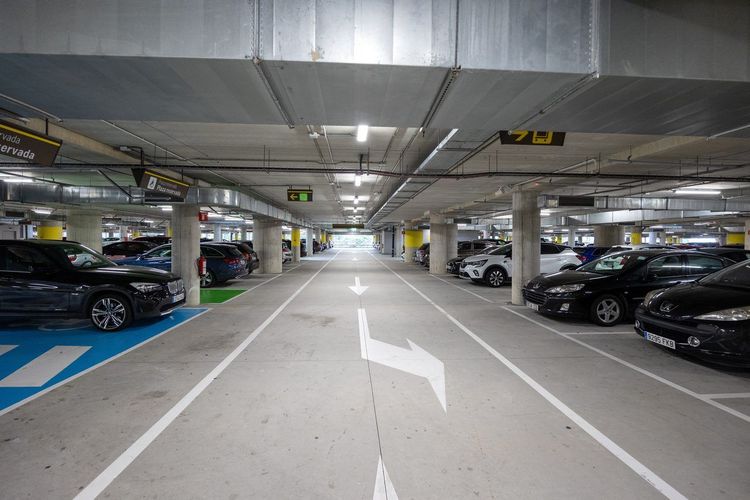
The largely pedestrianised historic centre can be explored entirely on foot; the car is only needed for day trips. For parking, several underground car parks border the centre, particularly around the Plaza de los Bandos and the Corte Inglés, simpler than on-street parking, which is scarce and paid during the day. Hotel parking, often at an extra charge, saves you searching every evening.
For accommodation, hotels located between the Plaza Mayor and the cathedral offer the best compromise: short walks for tired children and monuments accessible from the moment you wake up. Aparthotels with a kitchenette, increasingly common, allow you to prepare a light dinner without depending on Spanish restaurant hours, which are often too late for young children.
Outside festival weekends and graduation periods, prices remain reasonable compared to Madrid. Book well in advance, however, for Holy Week, whose processions draw large crowds, and for the September festivities around the 8th, when the city celebrates its patron saint with concerts and fireworks.
FAQ
How many days do you need to visit Salamanca with family?
Two full days are enough to cover the main highlights of the historic centre at a child-friendly pace, with regular breaks. If you add a day trip to Ávila or Ségovie, plan for three days instead.
How do you get to Salamanca with children?
The easiest option is to fly to Madrid, then reach Salamanca by train (about 1h30 from Chamartín) or by rental car (about 2h30). The train remains the most comfortable choice with young children.
Where can you park and stay in Salamanca?
The underground car parks around the Plaza de los Bandos and the Corte Inglés are the most convenient. For accommodation, a hotel or aparthotel between the Plaza Mayor and the cathedral keeps walking distances short.
What is the best time to visit Salamanca with children?
Spring (April to June) and early autumn (September–October) offer pleasant temperatures for walking all day, without the July–August heat, when the thermometer often exceeds 35 °C. The cold, dry Castilian winter is still doable with warm coats.
Is Salamanca suitable for pushchairs and young children?
The historic centre is generally accessible, but some cobbled streets call for an all-terrain pushchair. The main monuments are reachable on foot without significant elevation changes; only the tower climbs require a baby carrier.
What budget should you plan for a weekend in Salamanca for four?
For two adults and two children, generally budget between 350 and 600 euros for a weekend including accommodation, meals, and entrance tickets, not counting transport to Spain. Children often benefit from free or reduced admission, such as at the Casa Lis, which is free for under-14s.
Salamanca turns out to be better suited than you might imagine for a weekend with children: the compact centre avoids long journeys, and the sculpted details naturally turn the visit into a scavenger hunt. Between monuments, follow the course of the Tormes or settle on a bench at the Plaza Mayor to find a quieter pace. To connect the monuments effortlessly, the Ryo audio guide of Salamanca tells the legends that give the city its charm, pitched perfectly for children.