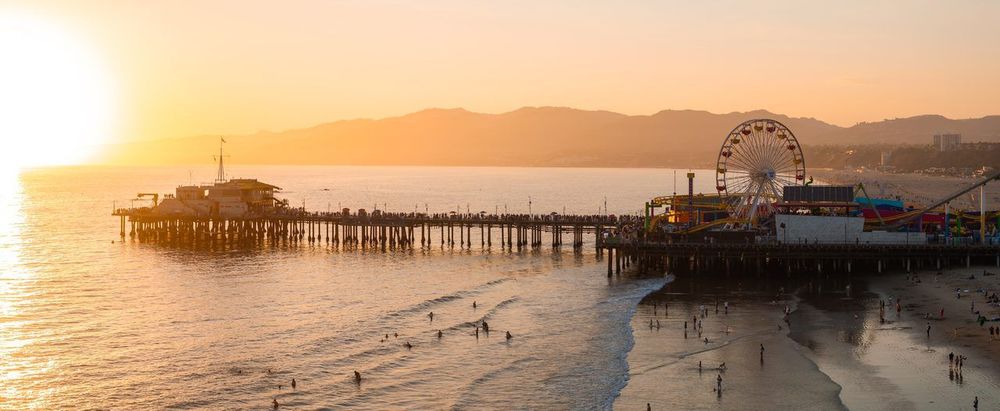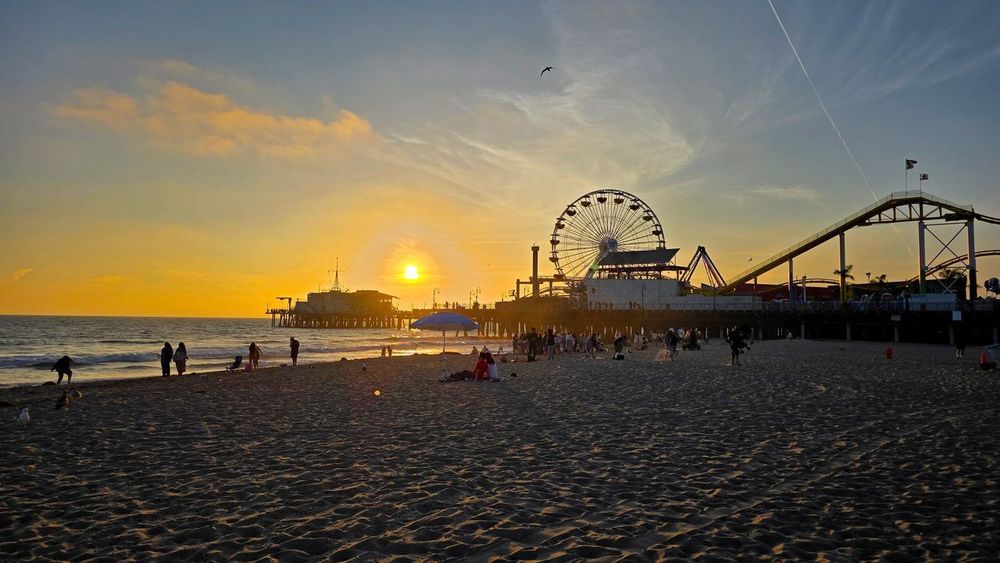
© Shutterstock
 Votre guide Ryo
Santa Monica for First-Time Visitors: A 2026 Orientation Guide
The first thing most newcomers notice about Santa Monica isn't the pier or the palm trees, it's the temperature swing: beach fog rolling off the Pacific at 9am, gone by noon, with a 15-degree jump that catches shorts-and-flip-flops tourists off guard almost every single day. If you're building a Santa Monica for first time visitors itinerary, that detail matters more than any ranked list of attractions, because it shapes what you pack, when you walk the pier, and when you duck into a museum instead.
A few things tend to surprise people who've only seen the postcard version: a 1909 pier that was built to carry a sewer pipe and nearly got demolished in the 1970s, a stretch of beach where outdoor bodybuilding culture took off in the 1930s, a farmers market that chefs from across LA raid before most tourists are awake, and a park built over what used to be parking lots barely a decade ago. This guide works through the landmarks, the neighborhoods, the food, and the logistics in roughly the order you'd actually encounter them on a first visit, starting right where most people start: at the base of the pier, where Ryo's audio-guided tour of Santa Monica also begins.
Santa Monica Pier and Pacific Park
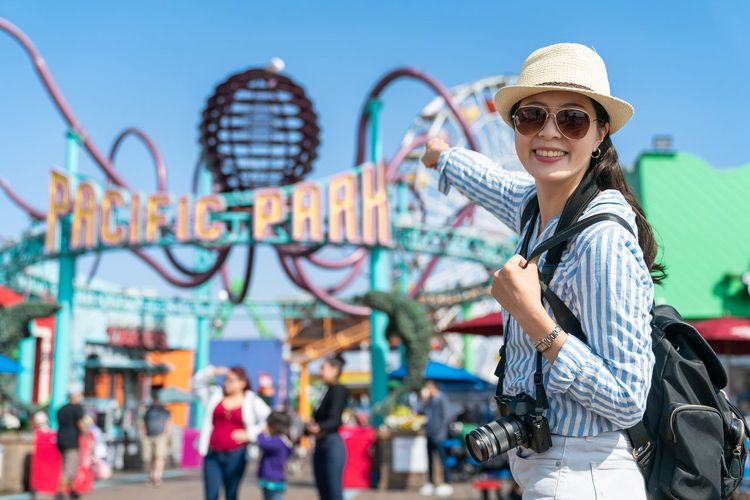
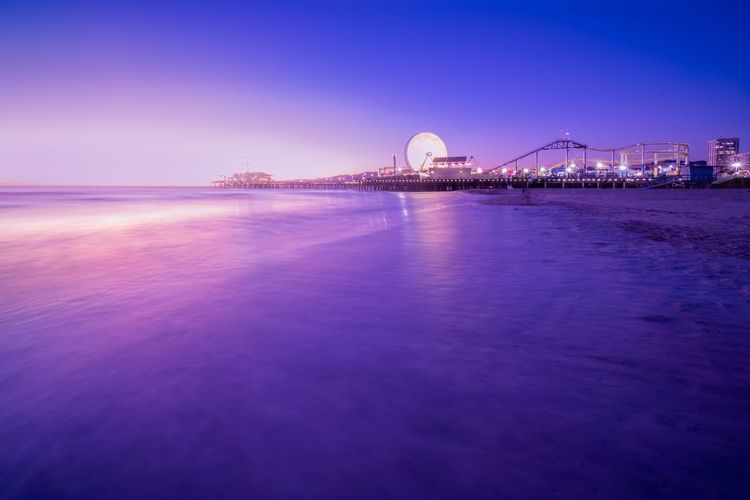
Most visitors arrive at the Santa Monica Pier) expecting a photo op and leave three hours later wondering where the afternoon went. Opened in 1909 as the first concrete pier on the West Coast, it has survived storms, decay and a serious 1970s plan to replace it, and today it's less a single attraction than a small town suspended over the Pacific: a historic carousel, a solar-powered Ferris wheel, a small aquarium tucked beneath the deck, and a line of bait shops and fishermen that have outlasted every trend that swept through Los Angeles since the 1950s.
Walk the length of the pier slowly rather than beelining to Pacific Park (380 Santa Monica Pier, Santa Monica, CA 90401, rated 4.6/5 on Google (15 490 avis)), the amusement park that occupies the ocean end of the structure. The nine-story Pacific Wheel is the headline ride, and it's one of the only solar-powered Ferris wheels in the world, but the small-scale coaster and midway games are worth the detour even if you skip the big-ticket rides. An unlimited wristband runs the cost up quickly if you're traveling with kids, so check whether single-ride tickets make more sense for your group before committing.
The pier's history deserves more than a glance. It began as a municipal utility pier, built to carry a sewage pipe past the surf line rather than for any romantic reason, before the amusement pier bolted onto it in the 1910s turned it into an entertainment landmark. The 1916 Looff Hippodrome, which still houses the carousel today, went through decades of disrepair before a citizens' campaign in the 1970s saved both the building and the pier from redevelopment. If you only read one plaque on the pier, read that one.
In summer, the Santa Monica Pier Corporation stages the Twilight Concert Series on Thursday evenings, a tradition running since the 1980s, though the format and dates shift from year to year, so check the schedule before you plan your visit. For first-time visitors, the pier is also the natural starting point for exploring the rest of the city: Ryo's audio guide to Santa Monica opens right here, with early stops covering the construction and the near-demolition before the route climbs toward the bluffs and loops back through downtown, so you're listening to the history instead of squinting at a plaque. Explore the full Santa Monica route before you set out, or just start walking and press play.
Come at sunset if you can manage the timing. The Ferris wheel lights up against a darkening sky, the day-trippers thin out, and the view back toward the Palisades bluffs is considerably better than the midday version everyone photographs.
Santa Monica State Beach and the Original Muscle Beach
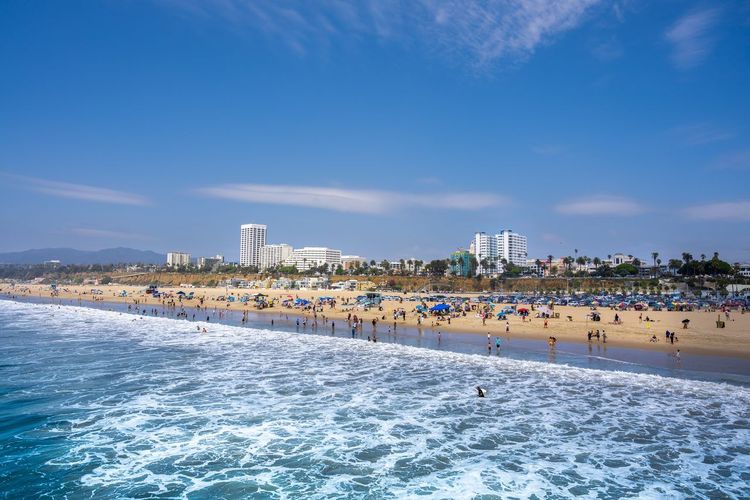
Santa Monica State Beach) stretches for roughly three and a half miles of flat, wide sand on either side of the pier, and it's free, which puts it at odds with almost everything else priced for tourists in this part of Los Angeles. Lifeguard towers are staffed year-round on the busiest stretches, and the sand is broad enough that even on a packed July weekend, you can usually find room if you're willing to walk ten minutes north or south of the pier.
Just south of the pier, the Original Muscle Beach (1800 Ocean Front Walk, Santa Monica, CA 90405, rated 4.6/5 on Google (1 878 avis)) marks the spot where outdoor gymnastics and bodybuilding culture took off in the 1930s, long before Venice's version, farther down the boardwalk, became the more famous name. The rings and outdoor equipment are open to the public, and on weekend mornings you'll find gymnasts and calisthenics regulars swinging on the same kind of apparatus that trained some of the sport's earliest stars.
Bring water shoes or expect hot sand by midday; the beach has almost no natural shade past 11am, and the walk from the parking lots to the water can feel longer than it looks on a map. Beach volleyball courts line several stretches of sand, free to use on a first-come basis, and the Marvin Braude bike path runs the entire length if you'd rather skip the sand altogether and ride.
Palisades Park and the Ocean Avenue Bluffs
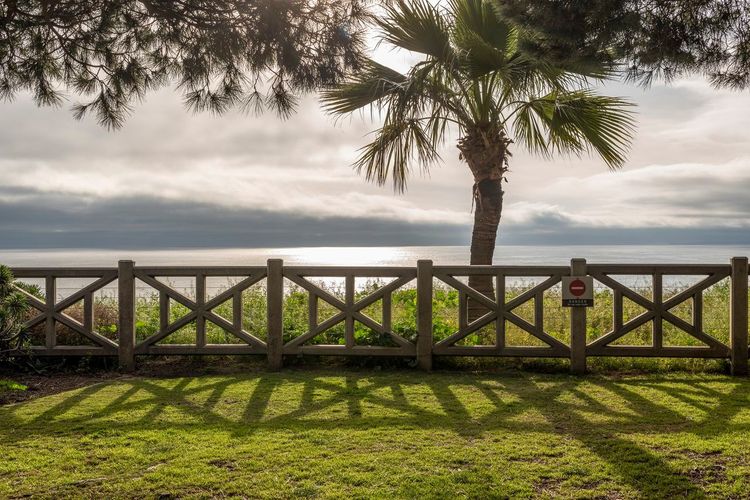
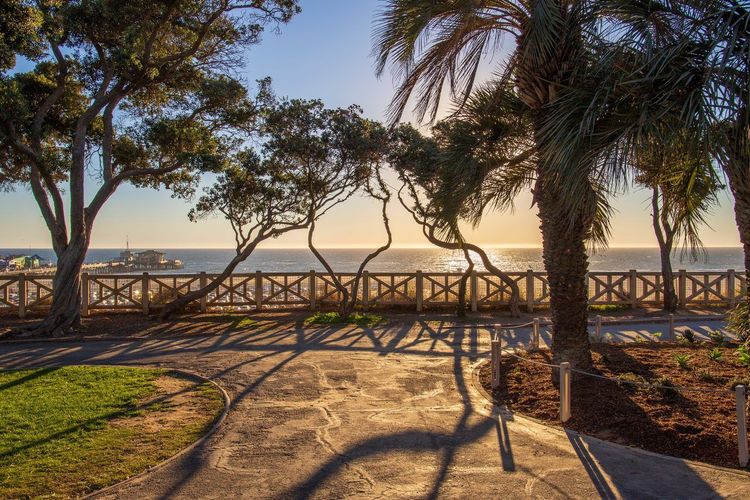
Palisades Park (Ocean Ave, Santa Monica, CA 90401, rated 4.7/5 on Google (8 161 avis)) runs along the clifftop above the beach for about a mile and a half, and it's the kind of place locals use for a morning walk rather than a tourist destination, which is exactly its appeal. The views stretch from the pier to the Malibu hills on a clear day, and the park's palm trees silhouetted above the bluff have become almost as photographed as the pier itself.
A paved path runs the park's full length, popular with joggers and dog walkers from sunrise onward. Look for the Senior Recreation Center: inside sits a camera obscura first installed in 1899, a darkened room where a lens projects a live image of the coastline onto a round table, and it's one of the oddest free experiences in the city. Sunset is the busiest hour for photographers, but a weekday morning gives you the view without the crowd, and the breeze up on the bluff runs noticeably cooler than the beach below, so hold onto a layer even on a warm day.
Tongva Park and the Civic Center Area
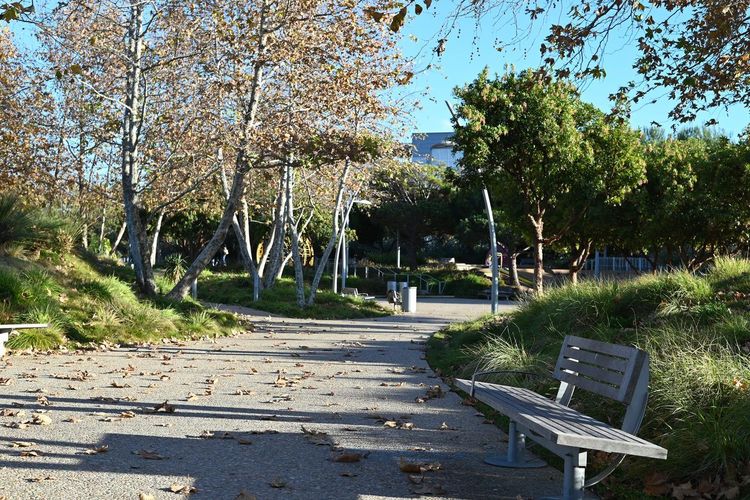
Tongva Park (1615 Ocean Ave, Santa Monica, CA 90401, rated 4.5/5 on Google (1 804 avis)), opened in 2013 on what used to be parking lots beside City Hall, is one of Santa Monica's newest green spaces and one of the few spots in the city designed specifically for lingering rather than passing through. Named for the Tongva people who lived in the region before European contact, it packs rolling hills, water features and shaded overlooks into a few acres, a short walk from both City Hall and the pier.
You won't find it in most quick-hit guides, which is part of why it's worth the detour: fewer crowds, good people-watching, and a playground that makes it a practical rest stop if your kids have had enough of the pier. The Civic Center around it, including City Hall's 1939 Streamline Moderne building, rewards a slow fifteen-minute wander.
Third Street Promenade and Santa Monica Place
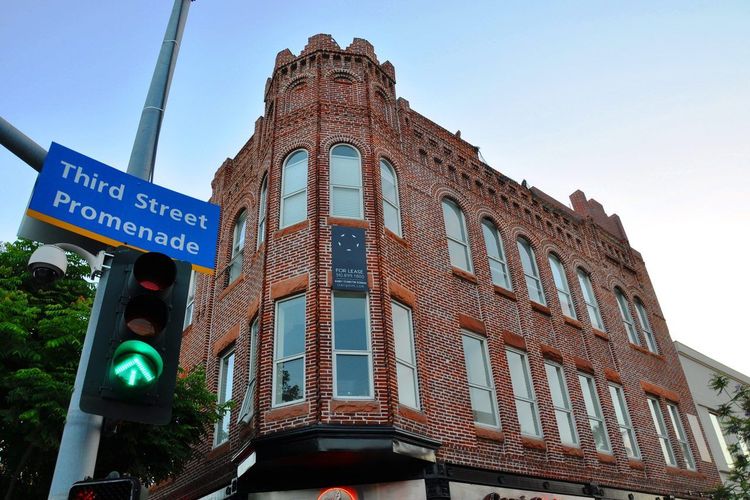
The Third Street Promenade) is the pedestrian-only strip most people mean when they say « downtown Santa Monica »: three blocks of shops, street performers and restaurants, closed to cars since 1965 and redesigned into its current form in 1989, with ivy-covered dinosaur topiary fountains standing guard along the way. Yes, they're meant to be odd, and yes, they work well as a meeting point for your group.
Street performance here is good by West Coast standards, and weekend evenings bring out musicians and magicians competing for sidewalk crowds. The shopping mix leans on national chains plus a handful of independent stores that have hung on through several rent cycles, and you'll notice some empty storefronts: downtown retail is still recovering from a rough few years.
At the promenade's southern end, Santa Monica Place (395 Santa Monica Place, Santa Monica, CA 90401, rated 4.5/5 on Google (15 086 avis)) is the open-air mall version of the same idea. It has been through a difficult stretch, with Bloomingdale's leaving in 2021 and Nordstrom in 2025, so treat it less as a shopping destination and more as a place to grab a casual bite on the upper-level dining deck, which still offers a glimpse of the ocean over the rooftops.
Parking is plentiful but not cheap; the public structures along 2nd and 4th streets offer the first 90 minutes free, which is rarely enough time if you're also eating. Part of the walking route of Ryo's audio-guided tour runs directly through here, pausing by the promenade and the old downtown storefronts before continuing toward the civic buildings, so this stretch doubles as a shopping break and a few minutes of local history in your headphones.
Santa Monica Farmers Market
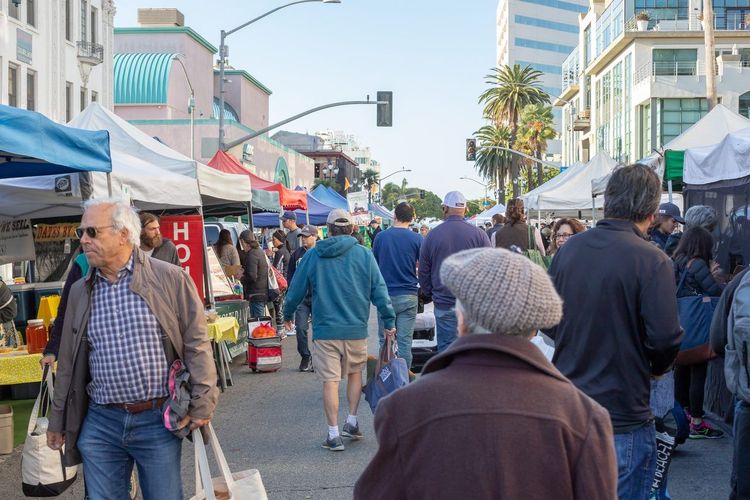
The Santa Monica Farmers Market (Arizona Ave and 2nd St, Santa Monica, CA 90401, rated 4.7/5 on Google (148 avis)) on Arizona Avenue runs Wednesday and Saturday mornings and has supplied some of LA's best-known restaurant kitchens for decades; on Wednesdays you'll often spot chefs loading crates in the first hour. Wednesday's market leans toward serious local-food shoppers, Saturday's is livelier, and a second Saturday market on Pico Boulevard plus a Sunday one on Main Street give you more chances if your dates don't line up.
Arrive before 10am if you want first pick of the stone fruit in summer or citrus in winter, and bring some cash for the smaller stalls. Even if you're not cooking, twenty minutes wandering the aisles gives you a better sense of Santa Monica's food culture than most restaurant meals will.
Exploring Santa Monica's Neighborhoods
Santa Monica is compact, around 8.4 square miles, but it splits into distinct neighborhoods that each feel like a slightly different city. Downtown, around the promenade and civic center, is dense and walkable. North of Wilshire Boulevard, the streets widen and quiet down considerably as you approach Montana Avenue (Montana Ave, Santa Monica, CA 90403), a boutique-lined strip that reads more like a wealthy residential village than a tourist corridor.
Independent shops and cafés that fill with strollers on weekday mornings line the main stretch. South of downtown, Main Street runs a different personality entirely, more beach-casual, with surf shops, bars and the Sunday farmers market. Ocean Park, the neighborhood behind Main Street, is where a lot of longtime residents actually live, away from the tourist density of the pier.
Figuring out which neighborhood to base yourself in, or at least budget an afternoon for, matters more than most first-timers realize, because Santa Monica rewards slow wandering over checklist sightseeing. If you'd rather not plan the route yourself, the Ryo audio-guided walk links several of these areas on foot, a reasonable way to get oriented on day one without renting a car or guessing which direction is downtown. See how the route connects the neighborhoods before you set out, then peel off whenever something catches your eye.
If you only have one afternoon to spare beyond downtown and the beach, Montana Avenue is the better use of it: smaller, easy to cover on foot, and a clearer sense of how residents actually live once the tourists head back to the pier.
Monuments, Museums and Street Art
Santa Monica's monuments and museums rarely make it onto quick-hit lists, which is a mistake, because the small museum scene punches above its size. The California Heritage Museum) occupies an 1894 house designed by architect Sumner P. Hunt, which originally stood on Ocean Avenue and was moved to Main Street in 1977 to save it from demolition. Exhibits rotate around California decorative arts, folk art and surf culture, and it's small enough to see properly in under an hour (it's open Wednesday to Sunday).
Nearby, mural hunting has become its own quiet activity. Main Street and the surrounding blocks carry a rotating set of large-scale murals, some commissioned through the city's public art program, others more spontaneous, and the mix changes often enough that locals walk the same streets twice.
The so-called Black and Pink Houses (Palisades Beach Rd, Santa Monica, CA 90401), two neighboring beachfront homes on Palisades Beach Road, one entirely black and one candy pink, went viral as a Reddit meme in 2015 (« Voldemort and Barbie are neighbors! ») and have been a photo stop ever since. They're private residences, so snap your picture from the beach path and keep moving.
Most of this costs little or nothing. Budget half a day to combine the museum, a mural walk and a coffee stop on Main Street, and you'll have covered a side of Santa Monica that most pier-focused itineraries skip entirely.
Where to Eat and Drink in Santa Monica
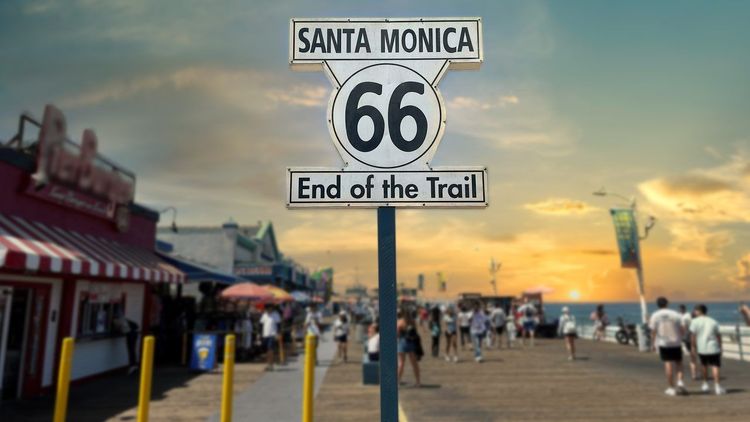
Where you eat in Santa Monica depends heavily on which part of the city you're standing in, and the gap between a tourist-trap seafood shack near the pier and a neighborhood spot three blocks inland is bigger than in most coastal towns.
For breakfast by the beach, skip the first place you see on the boardwalk; pier-adjacent cafés tend to charge resort prices for average coffee. Head instead to Bread + Butter on Main Street, a shoebox-sized bakery run by a team from Tasmania next to the retro Sea Shore Motel, where the pastries and focaccia-style pan pizzas often sell out before 10am.
For a proper sit-down lunch or dinner, Rustic Canyon) on Wilshire Boulevard has built its reputation on seasonal, produce-driven Californian cooking, much of it sourced from the farmers market a few blocks away, with a wine list that leans toward small producers. A few doors down Second Street from the promenade, Elephante Beach House) is the rooftop pick, with a Mediterranean-leaning menu and sunset views; book ahead, since walk-ins rarely get the good seats on weekends.
Craving tapas? Xuntos) serves Galician-style Spanish food downtown: vermouth cocktails, Basque cider, garlicky gambas and empanada gallega in a homey two-story space that works well for a group.
And if your trip calls for one special-occasion dinner, Seline (3110 Main St, Santa Monica, CA 90405, rated 4.7/5 on Google (83 avis)) on Main Street is the splurge: chef Dave Beran, formerly of Chicago's Alinea, runs a 38-seat dining room built around a long seasonal tasting menu that has earned Michelin recognition. Expect to pay several hundred dollars per person and to reserve well ahead.
Happy hour culture runs strong along Ocean Avenue, where several beachfront hotel bars open their patios to non-guests in the late afternoon, and the people-watching from a terrace often beats the food. Reservations matter more than you'd expect for a beach town: the best-reviewed dinner spots book out a week or more ahead on summer weekends, so if a particular restaurant matters to your trip, book before you land. On a tighter budget, the farmers market prepared-food stalls and the casual counters downtown keep lunch cheap and still good.
Nightlife and Live Entertainment
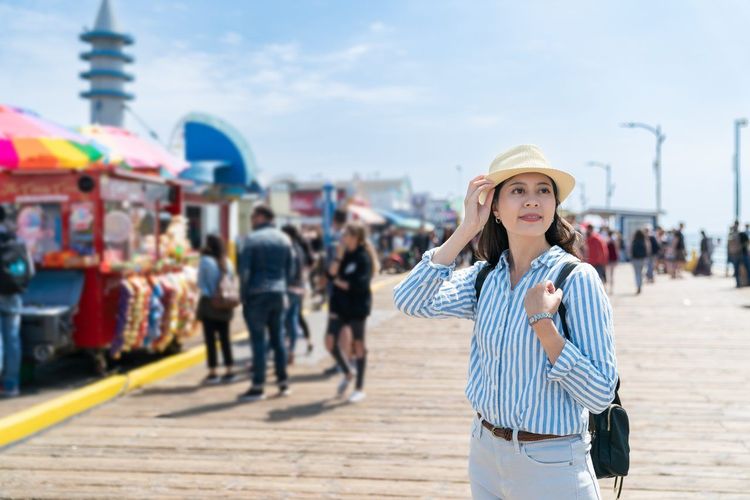
Santa Monica isn't a nightlife destination on the scale of Hollywood or downtown LA, and you're better off treating it that way: low-key rather than loud. Live shows tend to cluster around the pier and a handful of venues rather than a dedicated bar district.
In summer, the pier's Twilight Concert Series brings free outdoor shows on Thursday evenings, drawing a mixed crowd of out-of-towners and regulars who treat it as a weekly ritual. For something more intimate, Musique at La Monique, a French brasserie on Ocean Avenue, hosts live jazz every Wednesday from 7 to 9:30pm; book a dinner table and dress smart-casual.
Day and night, the pier stays lit and active later than most of the surrounding streets, which empty out noticeably once restaurants close around 10pm. If you want a real late-night scene, Santa Monica is a reasonable base for a short rideshare into Venice or West Hollywood, roughly 10 to 30 minutes away depending on traffic.
Where to Stay in Santa Monica
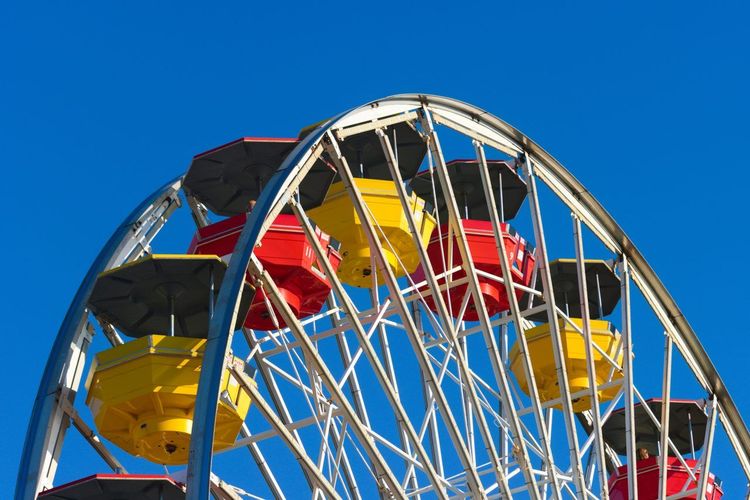
The best places to stay in Santa Monica fall into three practical categories: on the beach, downtown, or tucked into the quieter residential streets inland.
Beachfront hotels like Shutters on the Beach) and the Fairmont Miramar Hotel & Bungalows put you within walking distance of the pier and the sand, at a price premium that reflects exactly what you'd expect for an ocean view in coastal California.
Closer to the promenade, the art deco Georgian Hotel on Ocean Avenue offers a short walk to restaurants and the bluffs, usually at a slightly lower rate than the beachfront properties, with a few more minutes' walk to the actual sand.
Further inland, near 20th Street, the Ambrose Hotel (1255 20th St, Santa Monica, CA 90404, rated 4.4/5 on Google (522 avis)) sits in a residential pocket that's quieter at night and a quick bus ride from both downtown and Montana Avenue, a decent option if you'd rather sleep without beach-town noise.
Wherever you book, confirm whether parking is included. Several beachfront properties charge $50 or more per night for valet, which adds up fast over a multi-night stay.
Getting to and Around Santa Monica
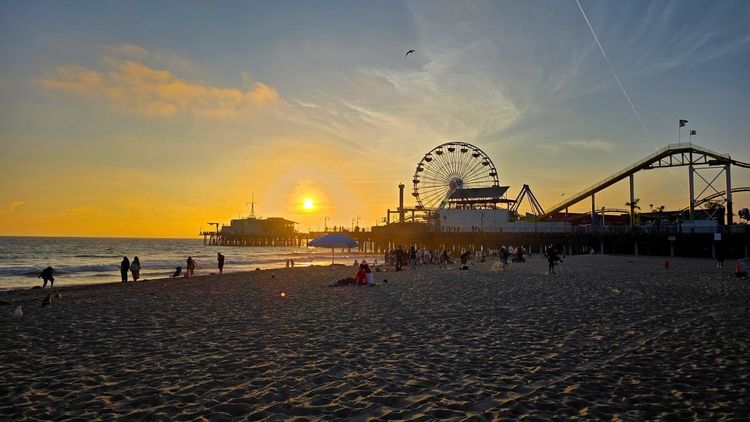
To get to Santa Monica, you have three realistic options: a rental car from LAX, about a 20 to 40 minute drive depending on traffic, which in Los Angeles means planning for the high end; the Metro E Line light rail, which runs from downtown LA to Downtown Santa Monica station, a few blocks from the pier; or a rideshare, reliable but often $40 to $60 from the airport at peak hours.
Once you're there, getting around Santa Monica rarely requires a car at all. The city is flat, compact and walkable, and most of what matters on a first trip sits within a 20-minute walk of the pier. For longer stretches, renting a bike is an easy call: the Marvin Braude bike path runs the length of the beach, and bike-share docks and e-bikes are scattered through downtown.
That's also how the Ryo audio-guided tour of Santa Monica is designed: an on-foot loop along the seafront and through downtown, with no driving and no parking required at any point, one less thing to plan on a first trip.
The Big Blue Bus, Santa Monica's own transit system, covers routes a bike can't easily reach, including connections to Venice, UCLA and West LA. A single ride costs $1.25 with a TAP card or mobile ticket ($1.50 cash), which makes it worth keeping as a backup even if you plan to walk most of the trip.
Parking, if you do drive, is the one real headache. Beach lots fill by mid-morning on summer weekends and charge by the hour or day, while street parking downtown is metered and strictly enforced. If you're staying more than a day or two, leave the car at the hotel.
Essential Tips for First-Time Visitors
A short planning checklist saves more time than any single attraction on this list.
Bring layers. The coastal microclimate here is real: mornings start cool and often foggy, locals call it « June gloom » even though it can show up well outside June, and temperatures can swing 15 degrees or more by early afternoon. A t-shirt that feels fine at 1pm will not feel fine at 9am near the water.
Budget matters more in Santa Monica than in most of Los Angeles. Parking, beachfront dining and hotel rooms all run at a premium; plan for noticeably higher costs here than in, say, Culver City or Pasadena for an equivalent meal or room.
When's the best time to visit Santa Monica? Late spring and fall, especially September and October, tend to offer the best balance: warm enough for the beach, without the marine layer that can blanket the coast in May and June or the dense crowds of July and August. Winter is mild, with daytime highs usually in the mid-60s°F, but it brings the only real chance of rain.
A few smaller, easily missed details:
- Some restaurants near the pier and promenade add an automatic service charge; check the bill before tipping again.
- Many residential streets near the beach are permit-only at certain hours; read the signage before you leave the car.
- Sunscreen is non-negotiable even on overcast days; the marine layer blocks heat, not UV.
- Beach wheelchairs can be borrowed for free near the pier, worth knowing if mobility is a concern for anyone in your group.
Crowds follow a predictable rhythm. Weekday mornings before 10am are close to empty even in peak season; weekend afternoons from noon to 4pm are the busiest window on the pier, the beach and the promenade combined. Shifting a pier visit to a Tuesday morning instead of a Saturday afternoon can mean the difference between an easy stroll and shuffling through a crowd three people deep.
First-timers also underestimate travel times once they leave the city. A map will tell you a destination is 15 minutes away, and in LA traffic that can mean anywhere from 10 to 40 minutes depending on the hour, so build slack into any day that involves driving.
Day Trip Ideas Near Santa Monica
If you have an extra day, two nearby excursions make a worthwhile detour without eating your whole itinerary.
The Getty Villa), about 20 minutes up the coast in Pacific Palisades, recreates a first-century Roman country house to display the Getty's collection of Greek, Roman and Etruscan antiquities, and the gardens and colonnades are as much the draw as what's inside. It closed after the January 2025 Palisades Fire and reopened in June 2025. Entry is free, but you need a timed reservation booked in advance, and it's closed on Tuesdays.
Inland, the Santa Monica Mountains National Recreation Area (26876 Mulholland Hwy, Calabasas, CA 91302, rated 4.7/5 on Google (3K reviews)) stretches across more than 150,000 acres of chaparral-covered ridgeline between the coast and the San Fernando Valley, with trailheads reachable in 20 to 40 minutes by car. Trails range from easy canyon walks to demanding ridge hikes with ocean views on a clear day. Parts of the range near Pacific Palisades and Topanga burned in 2025, so check current trail closures before you drive out.
Both pair naturally with a half-day in Santa Monica itself. Treating the Getty Villa as a morning stop and returning for a beach sunset is a realistic one-day combination, even without a rental car if you're comfortable with a rideshare both ways.



FAQ
What are some must-dos in Santa Monica?
Walking the full length of Santa Monica Pier and spending at least an hour on the beach near Original Muscle Beach are the two most consistently recommended stops for a first visit. The Third Street Promenade and Palisades Park round out a solid one-day list, along with a farmers market visit if your dates line up with Wednesday or Saturday.
Is it worth it to visit Santa Monica?
Yes, especially as a base for exploring the wider Los Angeles coastline. It's more compact and walkable than most of LA, which matters if you don't want to rent a car, and it sits close enough to Venice, the Getty Villa and the Santa Monica Mountains to anchor several day trips.
What are some hidden gems in Santa Monica?
Tongva Park, the camera obscura in Palisades Park and the California Heritage Museum all see a fraction of the pier's foot traffic. Montana Avenue, a few blocks north of the busier downtown core, is similarly overlooked by visitors who stick close to the beach.
What to do in Santa Monica for one day?
Start at the pier in the morning before crowds build, walk south along the beach toward Original Muscle Beach, head up to Palisades Park for the bluff views, then finish the afternoon on the Third Street Promenade with dinner nearby. It's a loop that covers most of the city's landmarks in about six to eight hours of walking.
How many days should you spend in Santa Monica?
One full day covers the essentials; two to three days lets you add the neighborhoods, a museum and at least one day trip to the Getty Villa or the Santa Monica Mountains. Our companion guide on spending three days in Santa Monica breaks that longer version down day by day.
Is Santa Monica walkable without a car?
Mostly, yes, within the city itself. The pier, beach, promenade, Tongva Park and Palisades Park all sit within a 20-minute walk of each other, and a bike or the Big Blue Bus closes most of the remaining gaps. A car or rideshare becomes more useful for day trips outside the city, like the Getty Villa or the Santa Monica Mountains.
What is Santa Monica best known for?
Its pier, principally, and the beach beneath it, but the city's identity runs deeper than the postcard: it's also where Muscle Beach launched outdoor fitness culture, a longtime hub for LA's farm-to-table movement through its farmers markets, and one of the most walkable, bike-friendly small cities on the California coast.
First-time visitors who treat Santa Monica as a single afternoon stop usually leave wishing they'd budgeted more time. It is, in many ways, three trips stacked on top of each other: a beach town built around its pier, a food and shopping district a few blocks inland, and a gateway to day trips up the coast and into the mountains that most tourists never factor into their LA itinerary.
If you're not sure where to start, the pier is still the right answer, and letting Ryo's full audio-guided tour of Santa Monica carry you from there through downtown and up to the bluffs is a reasonable way to see most of what's covered in this guide in a single, unhurried walk, narrated rather than Googled block by block.