
Créé par Romane, le 17 nov. 2026
Votre guide Ryo
Los Angeles, United States
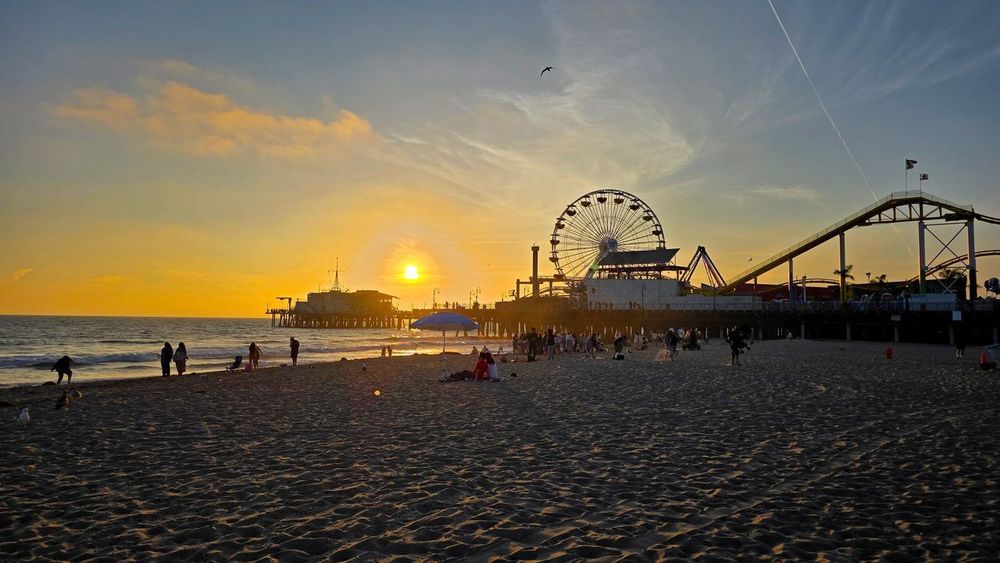
Heading to the Santa Monica Pier
Parcours audioguidé pour visiter Santa Monica en 1 jour
This tour of Santa Monica invites you to discover one of Los Angeles’ most iconic coastal neighborhoods, featuring its bustling beach, historic pier, and palm-lined avenues. Along the way, explore the landmarks that shaped its seaside identity, from its beginnings as a popular resort town to its modern Californian vibe. A simple and immersive way to wander through Santa Monica and soak up its atmosphere at your own pace.
Quand partir à Santa Monica ?
Jan.
14°
6
Feb.
14°
6
March
15°
5
April
16°
3
May
18°
1
June
19°
0
July
21°
0
Aug.
21°
0
Sept.
21°
1
Oct.
20°
2
Nov.
18°
3
Dec.
16°
5
Los Angeles enjoys a mild and sunny Mediterranean climate almost all year round, with hot, dry summers and pleasant winters that are rarely cold. Temperatures generally range between 15 and 25 °C, with some variation depending on proximity to the ocean or the hills, and occasional rain mainly between January and March. The best times to visit Los Angeles are spring, from April to June, and fall, from September to November, when the weather is ideal, the days are bright and tourist crowds are more moderate. Summer is very popular but also busier and sometimes stifling inland, while winter remains a good option for enjoying the city with fewer visitors. From November onward, however, the days are often cloudier and noticeably shorter, with sunset around 5 pm.
Départ conseillé
No need to worry about where to begin! Our tours are designed as a loop, so you can jump in wherever you are. The navigation system and audioguide will automatically adjust to your location. However, if you happen to be nearby, we do have a preferred starting point: in front of Route 66 End of the Trail on Santa Monica Pier.
Parking à proximité
Santa Monica Beach Parking : 15 Colorado Ave
In Santa Monica, several parking options make it easy to find a spot depending on the area you want to visit. Along the beach and near the Santa Monica Pier, seafront parking lots offer the most direct access to the ocean. Closer to downtown, large public parking structures located near Third Street Promenade and the main shopping streets are often more convenient for a longer visit, with reasonable rates and sometimes a short period of free parking at the beginning. Street parking is also available in some areas, but spaces are more limited and regulated, especially during the day and on weekends.
À savoir
The Santa Monica Pier and the beach are freely accessible year-round, but the area gets very busy between late morning and sunset, particularly on weekends and during the summer. Arriving early in the morning or later in the afternoon allows you to enjoy a calmer atmosphere and more pleasant light.
As is often the case in Los Angeles, the climate is generally mild throughout the year, but it can feel cooler and windier near the ocean, even in the middle of summer, so bringing an extra layer is often useful.
Découvrez 14 lieux d'intérêt pour visiter Santa Monica





What to see in Santa Monica on your 1h30 tour?
This 4 km loop takes about an hour and a half and links 13 sights. From the Route 66 sign on the pier, it crosses Santa Monica Pier and its amusement park, follows Ocean Avenue to Tongva Park and City Hall, then reaches Santa Monica Place and the Third Street Promenade. It ends at Palisades Park, by the Santa Monica statue, then on the beach. With the Ryo app in your ears, every facade, tale or view tells its own story, at your own pace.
Information checked in October 2026 and subject to change.
1 - Route 66 End of the Trail
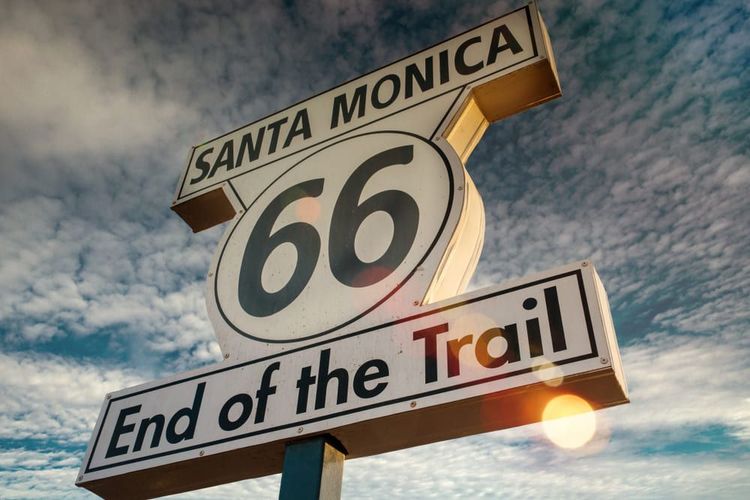
This retro sign, installed in 2009, marks the symbolic end of the legendary Route 66. Created in 1926, it linked Chicago to California across nearly 4,000 kilometres and eight states, before being extended here in 1936. Nicknamed the Mother Road for all the small towns it kept alive, it lost its official status as highways expanded, yet 85% of its path still exists. A song, TV shows and the film Cars have kept its legend alive to this day.
Free entry
2 - Santa Monica Pier
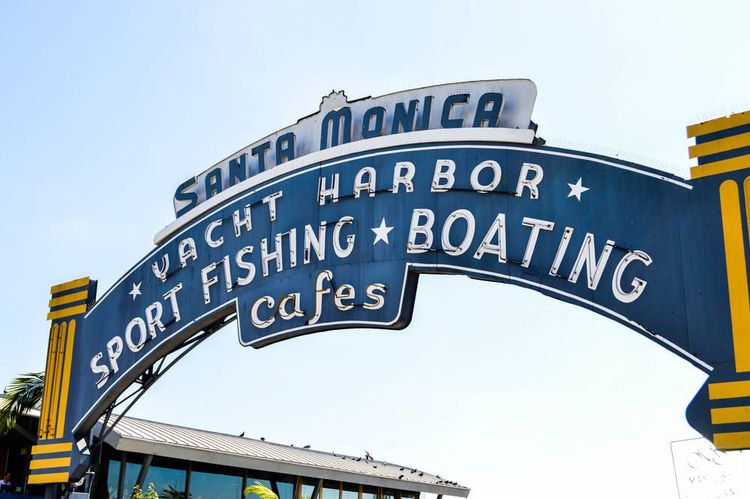
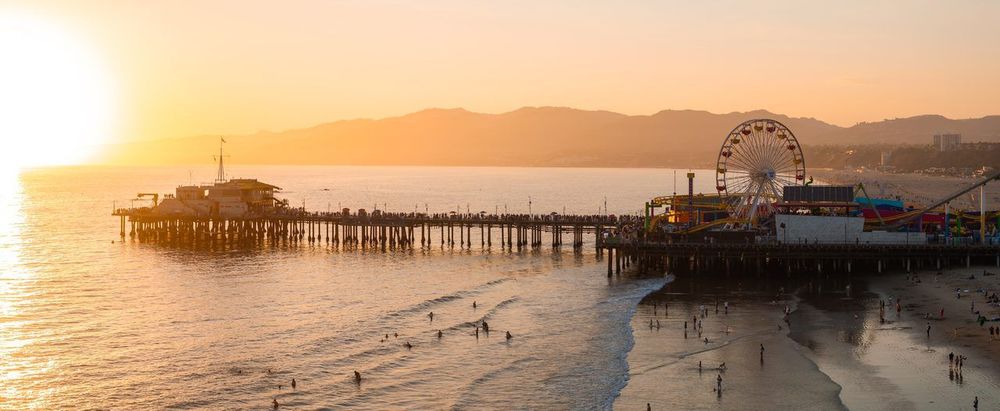
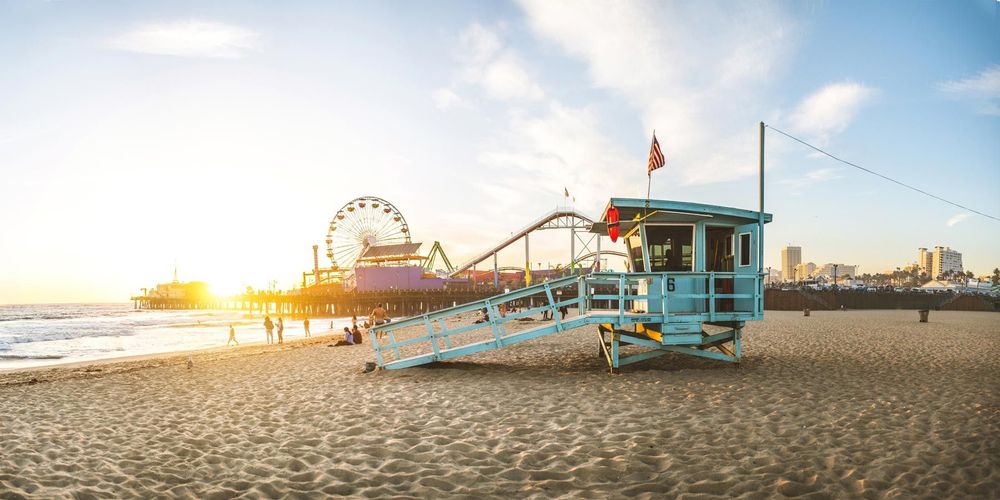
This pier, stretching over 500 metres, opened in 1909 for sanitary purposes and became a leisure spot from 1916 with the addition of a second pier. Its golden age, in the 1920s, brought a carousel and the largest dance hall on the West Coast. Threatened with demolition in the 1970s, it was saved by residents' mobilisation and listed as a historic site, then rebuilt after the 1983 storms. Shops, restaurants and an aquarium now keep alive a festive mood that has become a film icon.
Free entry · Best late in the day
3 - Pacific Ocean Viewpoint
From the end of the pier, the Pacific Ocean stretches out of sight, giving an immediate sense of space. Here you can watch waves breaking beneath the piles, gulls gliding overhead, and sometimes, far out, the shape of a dolphin. On one side lies the full length of Santa Monica Pier, on the other the beach running towards Malibu and Venice Beach. It is one of the best spots to watch the sun go down over the water.
Free entry · Best late in the day
4 - Pacific Park
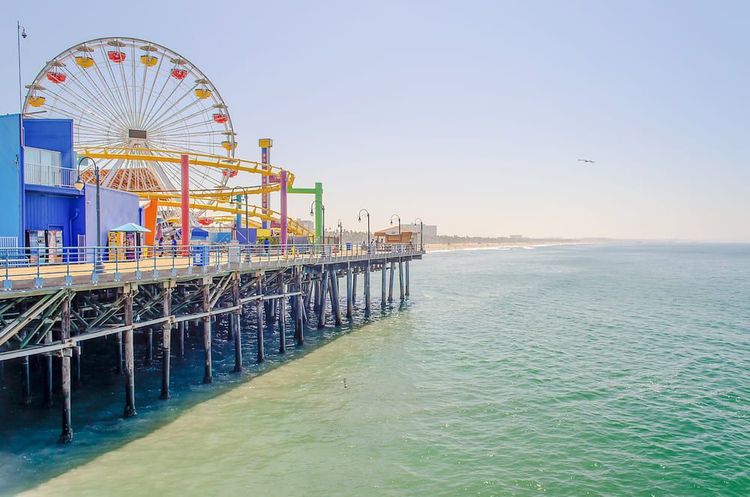
Set right on the pier, facing the ocean, this amusement park revived in 1996 a tradition of entertainment over a century old on this spot. Admission is free, with each ride paid separately. Its Ferris wheel, now a symbol of Santa Monica, was the very first anywhere powered entirely by sunlight; thousands of LED lights illuminate the pier after dark, delighting visitors who come to ride roller coasters above the waves.
Paid entry (about $40) · Best in the evening
5 - Looff Hippodrome Carousel
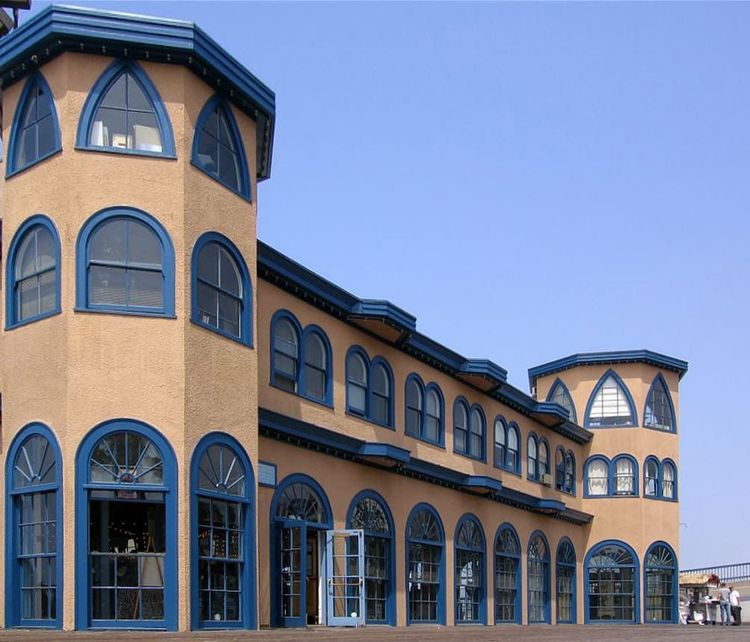
The building housing this historic carousel, built in an eclectic style, was raised in 1916 and listed as a national historic landmark, just like the ride itself. The one on view today dates from 1922 and was made by the Philadelphia Toboggan Company: it features 44 hand-carved wooden horses, plus a rabbit, a goat and two sleighs for the less adventurous. Entry to the building is free; only a ride on the carousel requires buying a single ticket.
Paid entry
6 - Ocean Avenue
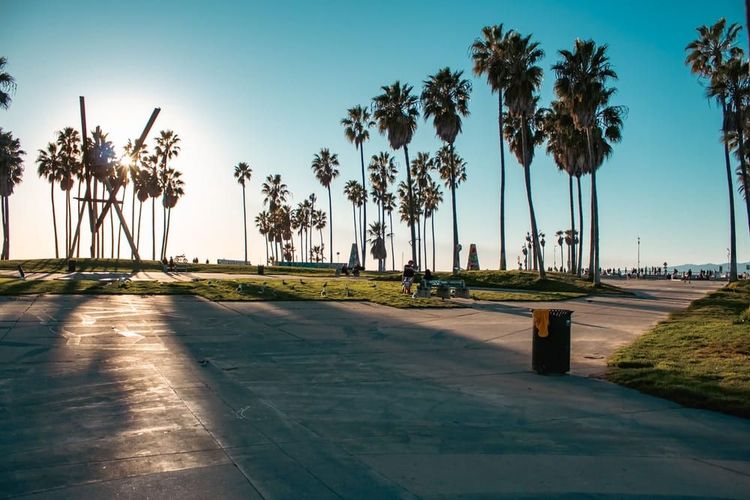
This avenue, running along the seafront, leads about 3 kilometres south to Venice Beach, known for its free-spirited, artistic vibe. A little further inland hide the Venice Canals: in the early 20th century, developer Abbot Kinney had canals dug to recreate an American Venice, complete with gondola rides. Many have since vanished under asphalt, but a few, now restored, still line small waterside houses.
Free entry
7 - Tongva Park
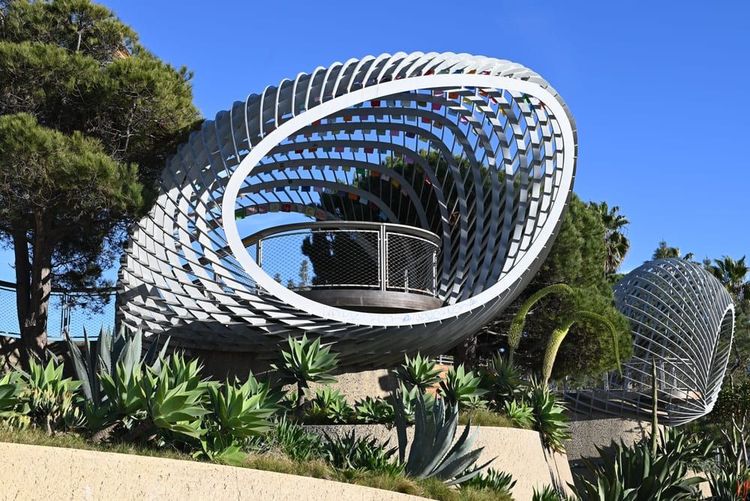
This landscaped park, opened in 2013 on the former site of a parking lot and the RAND Corporation headquarters, honours, through its name, the Tongva people, the original inhabitants of the Los Angeles basin. Funded with public money, the project turned two hectares of asphalt into artificial hills covered with more than 30,000 plants, including fig trees already growing on site. Steel pavilions and sculptural weather vanes sensitive to the wind complete a design built to be sustainable, with recycled water and permeable ground.
Free entry
8 - Santa Monica City Hall
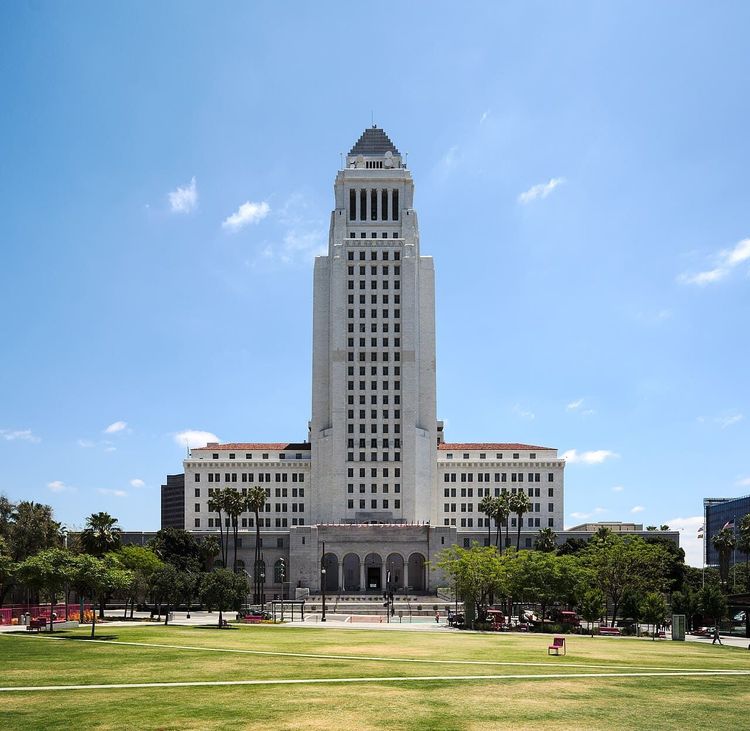
Built between 1938 and 1939, in the depths of the Great Depression, this building was largely funded by the federal New Deal. Its style, known as Classical Moderne, blends clean lines, Art Deco touches and a nautical flavour. Inside, carefully crafted tiling and murals trace the region's history. Right behind it stands an extension opened in 2020, a model of sustainable design that produces more energy than it consumes through solar panels and collects rainwater.
Free entry
9 - Santa Monica Place
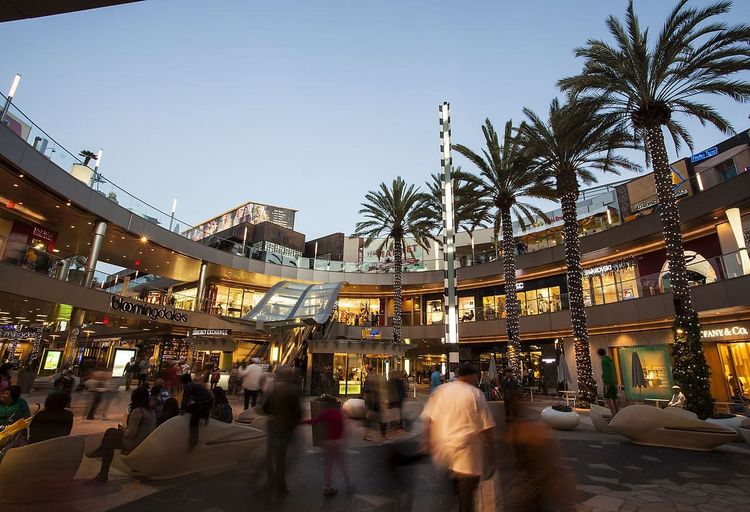
This open-air shopping centre was designed in 1980 by Frank Gehry, still far from the worldwide fame that Bilbao's Guggenheim Museum would later bring him. Originally enclosed over three levels, it used to cut off circulation between the promenade and the ocean; completely rethought between 2008 and 2010, it lost its roof to become a bright space connected to the city. Today it holds shops, restaurants and terraces with views over the ocean and mountains, in a building certified for its environmental performance.
Free entry
10 - AMC Broadway
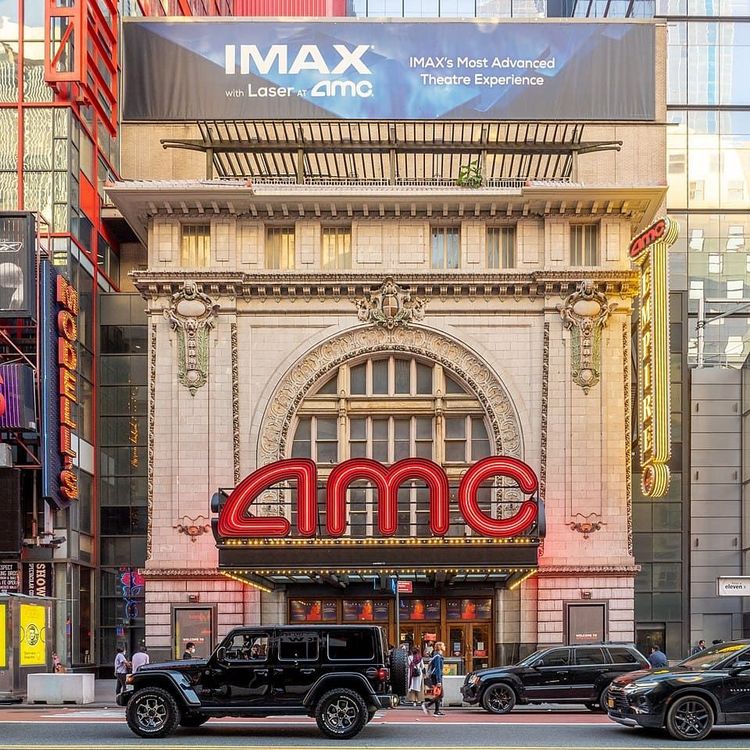
For nearly 90 years, a cinema stood on this spot along the Third Street Promenade. The story started in 1934, when the Elmiro Theatre opened its doors, a 900-seat hall in Streamline Moderne style, where admission then cost just a few cents. Turned into a four-screen multiplex in the 1980s behind its preserved historic facade, then renovated in 2015 with reclining seats, the AMC Broadway screened its last film in September 2024, closing nearly nine decades of showings.
Free entry
11 - 3rd Street Promenade
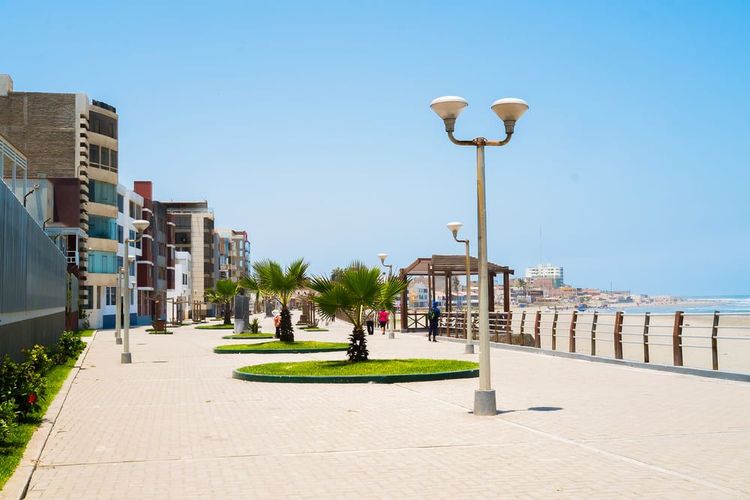
Though this shopping street dates back to the late 19th century, it took its current form in the 1960s, when the city closed it to cars to compete with suburban shopping malls. After a period of decline, it was fully renovated and reopened in 1989 under its current name, with trees, fountains and artworks. Its dinosaur-shaped fountains have become an emblem, and the street remains one of the liveliest spots in town.
Free entry · Best in the evening
12 - Statue of Santa Monica
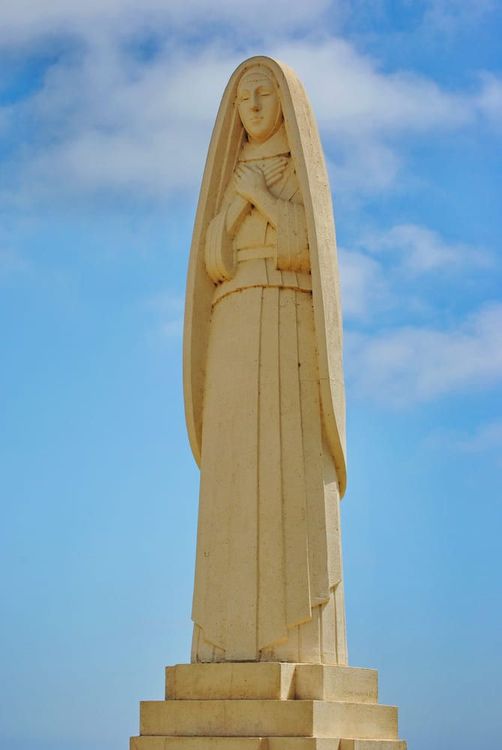
This statue of Saint Monica, patron saint of the city, was unveiled on 4 May 1935, during an arts project funded by the federal government. The work of sculptor Eugene Morahan, carved in pale concrete with geometric lines typical of Art Deco, it rests on a heart-shaped mound, symbolising the maternal love binding Monica to her son, the future Saint Augustine. The city is said to owe its name to a local spring that reminded a Spanish priest of the saint's tears, back in 1769.
Free entry · Best late in the day
13 - Santa Monica Beach
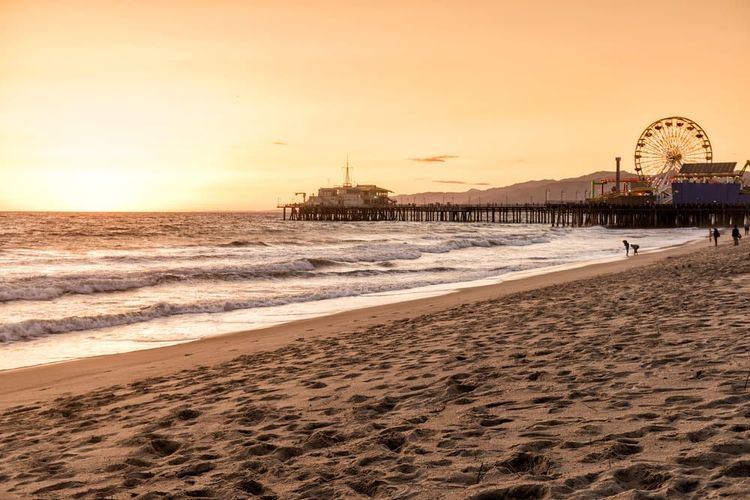
This beach, stretching for several kilometres between Will Rogers State Beach to the north and Venice Beach to the south, is not entirely natural: the once rockier coastline received huge quantities of sand throughout the 20th century to build up beach tourism. Some stretches are now left wild, with small dunes and native plants that protect the shore from erosion. Swimming, cycling, beach volleyball and the legendary Muscle Beach sum up the sun-soaked image of California life here.
Free entry · Best late in the day
What to do in Santa Monica in 2 or 3 days?
The audio-guided loop takes about 1.5 hours, covering 4 km and 13 stops: enough for a morning or an early afternoon, from the pier to the beach. With 2 or 3 days in town, Santa Monica opens up further, between the waterfront and the neighborhoods nearby.
The next day, head south along the waterfront: the path follows the beach to Venice Beach, about 3 km away, where the boardwalk and the outdoor sports scene feel like a different world. Heading back north, downtown's shopping streets round out the day, between boutiques and sidewalk cafés.
Day three leaves the city behind for a whole day along the Pacific Coast Highway, a scenic drive that many newcomers never get around to. The full three-day plan, with good addresses along the way, is laid out in our 3-day Santa Monica itinerary.
Which neighbourhoods does the tour cross?
As a loop, the route links several sides of Santa Monica, from the historic pier to downtown's shopping streets.
The first five stops stay on the pier and its immediate surroundings, between the Route 66 sign, Santa Monica Pier and the Pacific Park amusement park (stops 1 to 5).
The route then reaches the waterfront along Ocean Avenue, passing close to Tongva Park and City Hall (stops 6 to 8), before turning inland toward the shopping core, between Santa Monica Place and the Third Street Promenade (stops 9 to 11).
The loop ends on the bluffs of Palisades Park, near the statue of Santa Monica, then drops down to the beach to meet the ocean again (stops 12 and 13).
How much does it cost to visit Santa Monica?
Thirteen stops make up the route, and none of them charges an entry fee: the pier, the parks, City Hall, the shopping streets and the beach are all open to wander freely.
Two stops offer paid activities once you're there: the rides at Pacific Park, where a pass runs around $40, and a ride on the Looff Hippodrome carousel, sold per ticket.
Information checked in October 2026 and subject to change.
Where to stop for a bite along the tour?
The route crosses a few spots where you can stop for a coffee or a meal, especially toward the end, downtown.
On the pier (stop 2), restaurants and food stands sit alongside the rides and the aquarium tucked underneath. Downtown, the open-air terraces at Santa Monica Place (stop 9) and the spots lining the Third Street Promenade (stop 11) offer another option, from a quick bite to a longer lunch.
What should you know before visiting Santa Monica?
The pier and beach area gets very busy between late morning and sunset, especially on weekends and in summer.
Coming early in the morning or later in the afternoon means a calmer mood and softer light. Even in high summer, the air stays cool and sometimes windy near the ocean, so an extra layer is rarely wasted.
As in other heavily visited spots around Los Angeles, petty theft is not unheard of in Santa Monica and nearby tourist areas, or on crowded transit: it's worth keeping belongings in sight and leaving nothing visible inside a rental car.
What to see around Santa Monica?
Santa Monica pairs well with a trip into the wider city, especially toward the historic heart of Los Angeles.
24 km away, Los Angeles offers a route built around its own past: lively plazas, old buildings and backstreets full of memory, tracing the Spanish and Mexican influences that shaped today's metropolis.
Le plein d'inspirations
Explorez le monde en totale liberté, à pied au cœur des villes ou au fil des routes. Nos guides audios transforment chaque destination en une découverte culturelle immersive et unique.
FAQ for visiting Santa Monica
What are the best romantic things to do in Santa Monica for a date or a couple's getaway?
Santa Monica has plenty of romantic ideas, and one of them is free: watching the sun set over the Pacific from Palisades Park, which has overlooked the ocean since 1892. After dark, the solar-powered Ferris wheel at Pacific Park on the pier lights up the bay.
You can also book a sunset sail from Marina del Rey, bike The Strand to the Venice canals, try beach yoga, or share a flat white at Caffe Luxxe followed by ice cream at Van Leeuwen. The ideas work for a two-hour coffee date as well as a full romantic weekend.
Ready to plan the perfect date? Discover all 29 ideas in our article Santa Monica for Two: 29 Romantic Things to Do.
What should first-time visitors see and know before exploring Santa Monica?
Start at the 1909 pier and Pacific Park, then follow the beach to the Original Muscle Beach, where outdoor bodybuilding took off in the 1930s. Palisades Park offers coastal views and a camera obscura from 1899, while Tongva Park and the Third Street Promenade round out downtown.
The Wednesday and Saturday farmers market draws chefs from across Los Angeles. Pack an extra layer: morning fog burns off by noon, with a swing of about 15 degrees. Montana Avenue shows how locals live.
For a detailed route with neighborhoods, addresses and practical tips, read our orientation guide for first-time visitors.
Vos commentaires, idées et suggestions
Aucun avis pour le moment