© Shutterstock
 Votre guide Ryo
The Atomium in Brussels: History, Interior, and Visiting in 2026
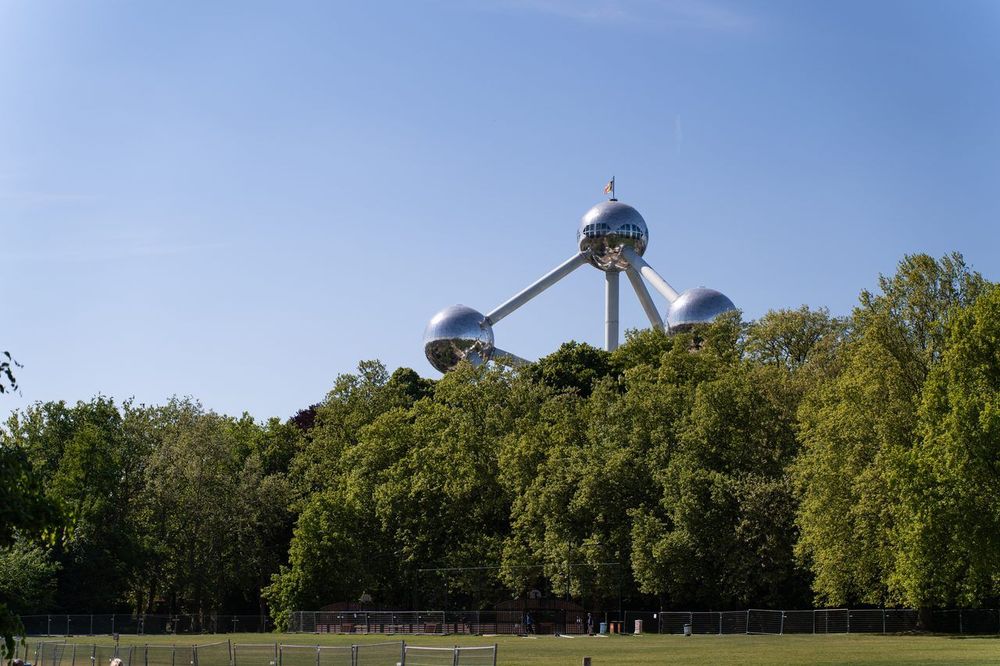
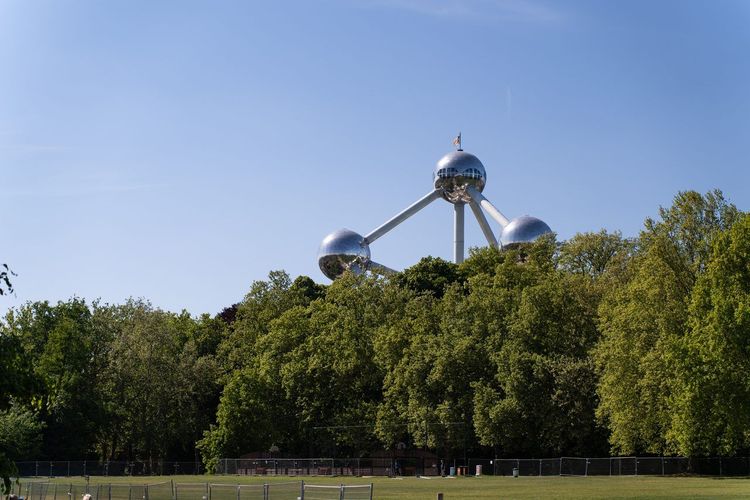
The Atomium in Brussels rises 102 metres tall above the Heysel plateau since 1958, and it continues to astonish everyone who sees it for the first time. Designed as a temporary sculpture for the World's Fair, it has become one of the most recognisable monuments in Europe — an architectural object as much as a manifesto of post-war optimism. Nine steel spheres linked together, a panoramic elevator, exhibitions on 1950s design: the interior is just as worth the visit as the exterior silhouette that cuts across the Brussels sky. To explore the Belgian capital further, the Ryo audio-guided tour of Brussels places the Atomium within the city's historical fabric, from the grand boulevards to the Cinquantenaire museums.
A few figures that set the tone: a structure reproducing an iron crystal magnified 165 billion times, a restaurant sphere suspended at 92 metres, 6,000 stainless steel panels fitted during the 2004–2006 renovation, and the Laeken neighbourhood full of surprises within walking distance. Whether you are visiting as a family, as a couple or solo, here is everything you need to know to plan your visit to the Atomium in Brussels.
The Atomium at a Glance
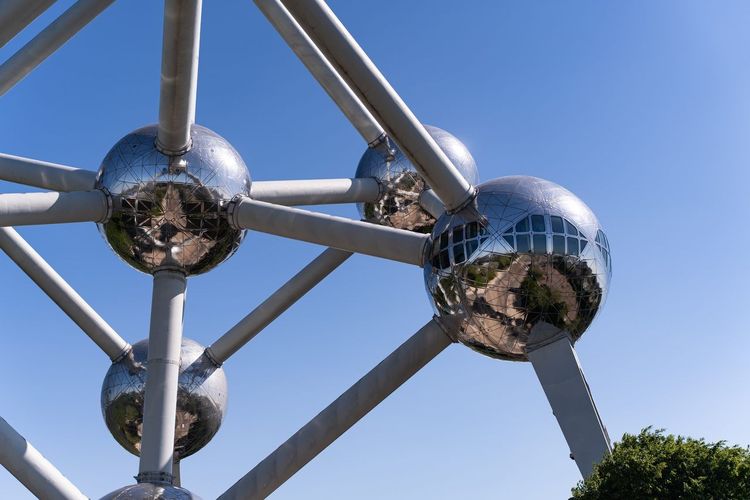
Height: 102 metres. Nine spheres of 18 metres in diameter, arranged according to the structure of an iron crystal lattice. Five of them are open to visitors; the others house offices, technical spaces or rooms reserved for private events.
Each sphere is connected to its neighbours by inclined tubes measuring 3.3 metres in diameter, inside which escalators and visitor corridors run. The central elevator, housed in the vertical tube, propels visitors up to the top sphere in 23 seconds. The entire structure weighs 2,400 tonnes and rests on four main pillars anchored in the Heysel ground.
The Birth of a Monument: the History of the Atomium
In 1954, André Waterkeyn, an engineer at the Federation of Belgian Steel Industries, put forward a radical idea to represent Belgium at the 1958 World's Fair: to reproduce at a monumental scale the atomic structure of iron, the metal that had rebuilt Europe after the war. Architects André and Jean Polak took charge of the structural design and interior spaces. Construction began in 1956.
At its inauguration on 17 April 1958, the Atomium (Square de l'Atomium, 1020 Laeken, rated 4.4/5 on Google with 111,481 reviews) opened its doors as part of Expo 58, the first World's Fair of the post-war era. In six months, the site welcomed 41 million visitors. The structure was meant to be temporary, with demolition planned after the exhibition. The people of Brussels decided otherwise: in 1959, the authorities granted a twenty-year reprieve. In 1979, it was extended again. In 1991, the Atomium was officially listed as an exceptional heritage monument of the Brussels-Capital Region.
The major transformation took place between 2004 and 2006. The 3,000 oxidised aluminium discs that had covered the spheres were replaced by 6,000 brushed stainless steel panels, giving the building its current silvery sheen. The interior spaces were redesigned, and a spectacular night-time lighting system was installed. Since then, the Atomium has been managed by the Atomium asbl foundation, which has developed an ambitious cultural programme centred on design, art and science.
What is striking in retrospect: the Atomium encapsulates the Brussels of 1958 — a capital that carried the hopes of a reunified Europe, confident in scientific and industrial progress. The Heysel, the plateau north of the city chosen to host the Expo, still retains that singular atmosphere, slightly removed from the rest of the city.
Architecture: Decoding the Structure
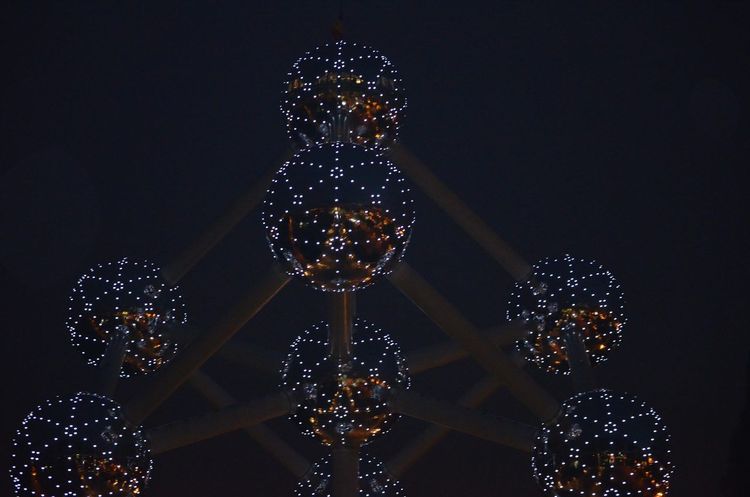
Representing an iron crystal magnified 165 billion times: that is the founding principle. In a solid iron crystal, atoms are arranged in what is called a "body-centred cubic" structure — eight atoms at the corners of a cube, one atom at the centre. The Atomium reproduces this geometry exactly: eight spheres at the angles, one central sphere.
The nine spheres are connected by 20 tubes, six of which contain galleries or escalators open to visitors. The entire network is tilted at 45° to the ground — an angle chosen to avoid static frontal symmetry and to give an impression of lightness. Each sphere weighs approximately 250 tonnes. The entire structure, founded on four main pillars, totals 2,400 tonnes of steel.
The feat is all the more impressive given the era of construction: no computers in 1956, only logarithm tables and engineers at the drawing board. Nearly seventy years later, the structure shows no major deformation. The stainless steel panels have improved corrosion resistance, but the load-bearing geometry remains intact — a mark of excellence for the Belgian engineers of the time.
One of the Atomium's visual peculiarities: depending on the angle of observation, the structure appears to change shape. Seen from the front, it resembles a cube balanced on one edge. Seen from the side, the tubes seem to intersect in a complex dance. This visual ambiguity is entirely intentional: Waterkeyn wanted an object that intrigues as much as it signifies.
What to Do Inside the Atomium
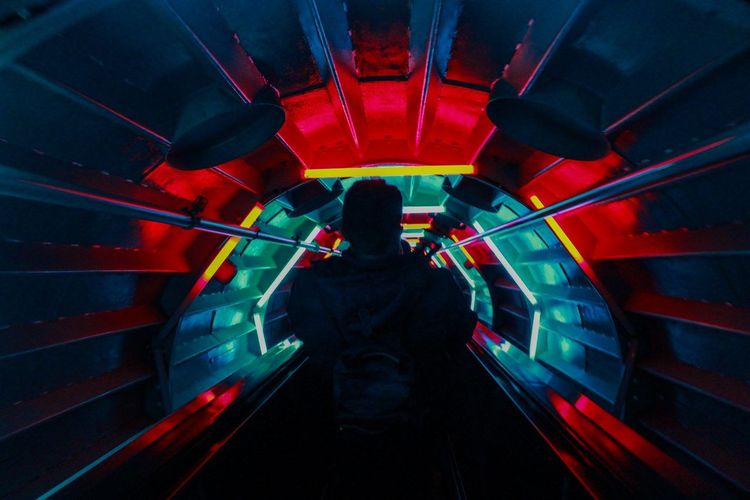
The interior is a succession of circular spaces — each sphere measuring 18 metres in diameter — connected by gently sloping escalators inside the inclined tubes. The physical experience of the place is, in itself, quite singular: riding an escalator inside a tube tilted at 45°, looking out through oval portholes onto the metal structure, feeling the sense of height build gradually before even reaching the top.
The standard visit takes the central elevator up to the top sphere, then descends sphere by sphere via the escalators. Allow 1h30 to 2 hours for a complete tour without rushing.
In the intermediate spheres, temporary exhibitions on design and architecture from the 1950s–1970s punctuate the visit. In 2026, the programme includes a retrospective on everyday objects that transformed European interiors during the Trente Glorieuses.
Another sphere houses the Atomium Kids section, designed for families with children. Interactive play spaces, science workshops, an immersive world on astronomy and space exploration: it is one of the most vibrant areas of the visit.
A permanent exhibition on the history of Expo 58 rounds out the tour: period photographs, scale models, posters, everyday objects placed in their political and social context. It is the most documentarily rich room, and often the least crowded, as visitors rush towards the view from the top.
The tubes themselves deserve attention. The oval portholes cut into the walls allow you to see the structure from the inside — the crossing beams and neighbouring spheres. Take time to look through the portholes; it is a perspective on architecture that few monuments in the world can offer. A few discreet technical information panels are placed along the route for those who want to understand how the whole thing stays standing.
The Exhibitions: Design, History, and Contemporary Art
The Atomium programmes around ten exhibitions a year, built around three themes: post-war industrial design, the history of the 1958 World's Fair, and contemporary art with a marked interest in digital media and immersive installations.
The permanent exhibition on Expo 58 is unmissable. It traces the political and cultural ambitions of the event — a bipolar world, the Cold War as backdrop, the Soviet Union and the United States competing through giant pavilions — and the way Brussels imposed a modernist style that influenced European architecture and design for two decades.
Temporary exhibitions generally run for three to six months. In 2025–2026, the Atomium presented a retrospective on Expo 58 posters and a sound installation exploring the relationship between design and urban space. The detailed programme is published on the official website; it is worth checking before your visit if a particular exhibition interests you.
Good to know: some exhibition spaces may be temporarily closed for installation between shows. Check the programme status when booking your tickets.
The Top Sphere: Panorama at 92 Metres
The top sphere reaches 92 metres above the ground. From there, the view takes in Brussels in all its breadth: the Heysel plateau with the Stade Roi Baudouin and the Palais du Centenaire, the dense city stretching to the south-east, and on clear days the Brabant hillsides closing off the horizon.
The top sphere houses the Atomium's panoramic restaurant — contemporary Belgian cuisine, glazed terrace, reservation essential for lunch and dinner in high season. But the observation area is accessible to all visitors, included in the standard entry ticket.
The late-afternoon light, between 4 pm and 6 pm in summer, is particularly beautiful from the top: raking across the steel and the rooftops of Brussels, it creates striking contrasts. If you can choose your time, this is the best slot for photographs.
The Illuminated Atomium: a Different Monument at Night
After dark, the Atomium changes character entirely. The lighting system installed during the 2006 renovation transforms the spheres into silver lanterns: 40,000 LEDs wired inside the tubes and across the surface of the spheres cast a cool light that reflects off the stainless steel. The effect is particularly powerful from the forecourt on summer evenings after 9 pm, once the daytime crowds have thinned.
The Atomium is not open for night-time visits, but the building remains illuminated until around midnight. An evening walk past the forecourt, or from the neighbouring Mini-Europe, is one of the most memorable sights Brussels has to offer. In summer, night-time events — concerts, projection mapping, cultural late nights — are regularly organised around the site.
Visiting the Atomium with Family
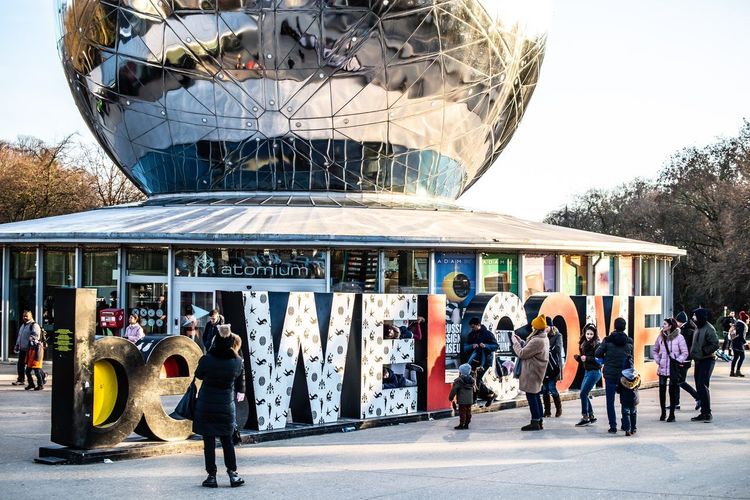
The Atomium in Brussels is particularly well suited to children from age 6 onwards. The physical dimension of the visit — the inclined tubes, the high-speed elevator, the portholes overlooking the structure — naturally creates an atmosphere of exploration that appeals to young visitors.
The Atomium Kids section offers in 2026 an immersive world on astronomy and space exploration, with science workshops on weekends and during school holidays. Activities are regularly organised to make the visit lively and interactive.
On the practical side: pushchairs are accepted at the entrance but are impractical in the narrow tubes; a baby carrier is recommended for children under 3. Lockers and cloakrooms are available on level -1. The ground-floor brasserie, accessible without a ticket, offers a family-friendly menu. To extend the day, the Atomium + Mini-Europe combination is naturally designed with families in mind: allow a full day to do everything comfortably. And if you head back into the centre, our Brussels audio-guided tour unfolds the Grand-Place and the royal galleries over 6.2 km.
2026 Prices and Skip-the-Line Tickets

Prices in effect for 2026:
- Adult (18–64): €17
- Senior (65 and over): €15
- Student (with valid student card): €9
- Child (taller than 1.15 m and up to 17 years): €9
- Child under 1.15 m: free
- Atomium + Mini-Europe combination (adult): around €30
Good to know: the entry ticket to the Atomium in Brussels also includes access to the Design Museum Brussels, the Belgian and international design museum located right opposite on the Heysel plateau. This is an often-overlooked added value — two visits for the price of one, provided you keep some time free in your day. Combined tickets with Mini-Europe, the Planetarium and Belgian Beer World are also available at the ticket office and online. The standard ticket remains valid between 10 am and 5:30 pm.
Buying online on the Atomium's official website is strongly recommended during Belgian and French school holidays, and in July and August, when queues at the ticket office regularly exceed one hour. The online ticket includes skip-the-line entry.
Discounts are available for groups of 15 or more, holders of the Brussels Card and students with a valid card. The Brussels Card (available for 24, 48 or 72 hours) covers entry to the Atomium and around forty other Brussels museums and attractions — a worthwhile option if you are planning an intensive visit to the capital.
Opening Hours and Best Times to Visit
The Atomium is open 365 days a year, including Belgian public holidays.
- Standard hours: 10:00 am–6:00 pm (last entry and ticket office close at 5:30 pm)
- July–August: 9:30 am–7:00 pm
The best window to avoid crowds: weekday mornings between 10 am and 11:30 am, outside school holidays. At weekends, the top sphere is packed between noon and 3 pm. In winter (November to February), visitor numbers drop sharply — you can walk through the tubes almost alone on some weekdays. The winter light on the stainless steel has a particular quality that summer light simply does not match.
How to Get to the Atomium
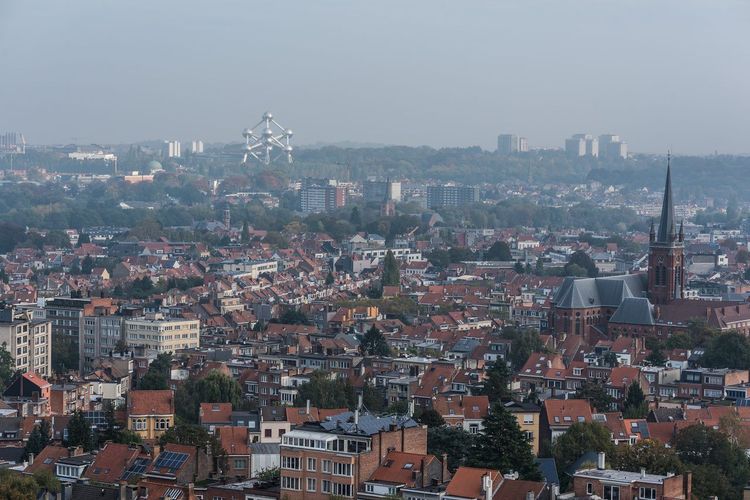
By metro: line 6, direction Roi Baudouin, stop Heysel/Heizel, a few minutes' walk from the monument. From the Gare Centrale or De Brouckère, allow 20 minutes. This is the fastest and most reliable route.
By tram: line 7 connects the Gare du Midi to the Heysel (stop: Heysel) in around 30 minutes.
By car: several paid car parks surround the Heysel, including an underground car park directly beneath the site. In high season, public transport remains the more practical option.
By bike: a network of cycle paths connects the centre of Brussels to the Heysel via the canal and the Molenbeek neighbourhood. Villo! stations (self-service bikes) can be found near the Heysel. Allow around 35 minutes from the Grand-Place.
The exact address of the Atomium is Square de l'Atomium, 1020 Laeken, the municipality of Laeken, part of the city of Brussels.
Nearby: Mini-Europe and the Laeken Estate
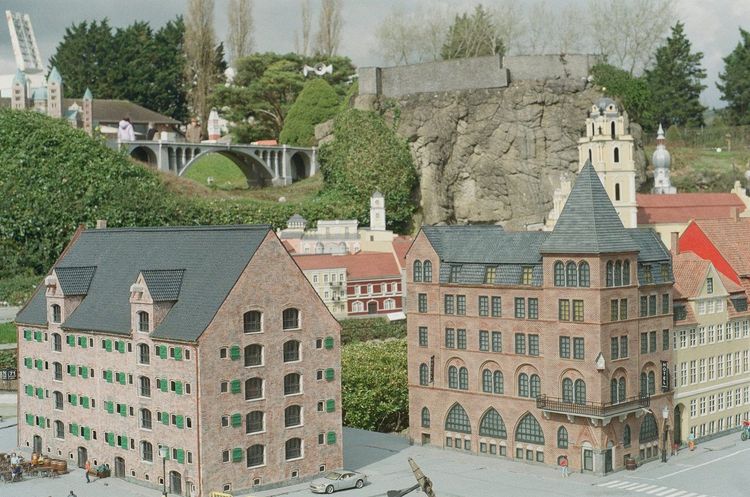
The Heysel neighbourhood brings together several sites within immediate walking distance. With good organisation, you can combine two or three attractions in a single day without feeling rushed.
Mini-Europe is the 1:25 scale model park bringing together the iconic monuments of the European Union. From the Eiffel Tower to the Sagrada Família, via the Budapest Parliament and the Kinderdijk windmills, the roughly 350 scale models are remarkably detailed. The park is large — allow 2 to 3 hours to see it in full. The combined Atomium + Mini-Europe ticket is available directly at the ticket office.
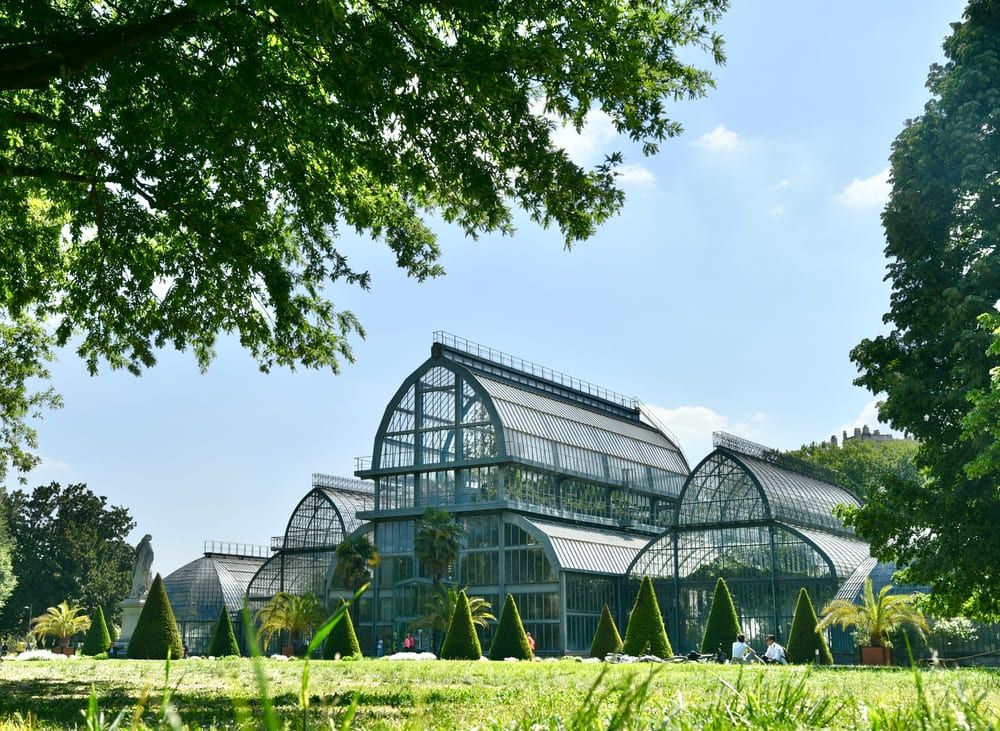
About 15 minutes on foot to the south-east, the Domaine royal de Laeken conceals one of Brussels' best-kept secrets: the Serres royales de Laeken (Avenue du Parc Royal, 1020 Laeken, rated 4.4/5 on Google with 910 reviews). These vast glass and wrought-iron greenhouses, built in the 19th century for the Belgian royal family, open to the public for a few days each year, usually in April–May. Inside: century-old camellias, giant palms, cascading fuchsias across several storeys. A botanical spectacle that few tourists have the chance to see.
To continue exploring Brussels well beyond the Heysel, the Ryo app guides you through 25 audio stops in historic Brussels — a great way to follow a day on the Heysel plateau with an immersion in the city itself. For museums, the article 8 Museums to Visit During Your Stay in Brussels offers a selection of the best museum addresses, from the Royal Museum of Fine Arts to the Royal Museums of Art and History. And to venture even further afield, the guide on day trips from Brussels lists the best destinations reachable in a day from the capital.
Where to Eat near the Atomium
On-site dining comes down to two options. The panoramic restaurant in the top sphere — contemporary Belgian cuisine, sweeping views over Brussels, reservation essential for lunch and dinner in high season — and the ground-floor brasserie, accessible without an entry ticket, with a simple menu: sandwiches, waffles, soups, hot drinks. Ideal for a break before or after your visit.
Outside the site, the Heysel area offers few good dining options. For a proper meal, the wisest choice is to head back to the centre: the metro drops you in 20 minutes at Sainte-Catherine, the neighbourhood of fishmongers and mussels-and-chips restaurants par excellence. Good restaurants can also be found around the Parvis de Saint-Gilles and in the shopping streets of Ixelles.
For an immersion in Belgian culinary specialities — carbonnade, waterzooi, stoemp, speculoos — the article Top 10 Culinary Specialities in Brussels is a good starting point.
FAQ
How much does admission to the Atomium in Brussels cost in 2026?
The adult ticket price is €17 in 2026, and €15 for seniors aged 65 and over. Young visitors taller than 1.15 m and up to 17 years old, as well as students, pay €9; children under 1.15 m enter free. The ticket also includes access to the neighbouring Design Museum Brussels. The Atomium + Mini-Europe combination comes to around €30 per adult. Buying online on the official website helps you avoid the ticket queue, which is particularly long in July and August.
Can you go up to the top of the Atomium?
Yes. The top sphere, at 92 metres above the ground, is accessible to all visitors via the central elevator. It houses a panoramic restaurant (reservation required) and a free observation area included in the standard ticket. The elevator ride takes 23 seconds from the entry level.
How long does it take to visit the Atomium?
Allow 1h30 to 2 hours for a complete tour through all accessible spheres and the main exhibitions. If you have lunch at the top-sphere restaurant or explore a temporary exhibition in detail, plan for 2h30 to 3 hours instead. For a full day including Mini-Europe, count on 5 to 6 hours in total.
Is the Atomium open every day?
The Atomium is open 365 days a year, including Belgian public holidays. Standard opening hours are 10 am–6 pm (last entry at 5:30 pm). In July and August, the site opens at 9:30 am and closes at 7 pm. There is no weekly closing day.
When was the Atomium built?
The Atomium was built between 1956 and 1958 for the Brussels World's Fair (Expo 58). Designed by engineer André Waterkeyn, it represents an iron crystal magnified 165 billion times — a tribute to the Belgian steel industry and the scientific optimism of the post-war era. Originally temporary, it was preserved at the request of Brussels residents and then listed as an exceptional heritage monument of the Brussels-Capital Region in 1991.
Is the Atomium suitable for children?
Yes, particularly from age 6. The Atomium Kids section features interactive spaces on astronomy and science, with workshops on weekends and during school holidays. Children under 1.15 m enter free. Pushchairs are accepted but impractical in the narrow tubes; a baby carrier is preferable for very young children.
Conclusion
The Atomium in Brussels is a monument that withstands the test of time precisely because it resembles nothing else. Neither an ordinary museum, nor a simple viewpoint, nor an abstract sculpture: it combines registers without being confined to any single one. A well-organised visit — on a weekday if possible, ticket bought online, arriving at opening time — gives you the space to appreciate the exhibitions, the views and the physical experience of the tubes without being overwhelmed by the crowds.
To continue discovering the Belgian capital beyond the Heysel, the Ryo audio guide to Brussels takes you through 26 stops along a 6.2 km route through the historic city. This audio-guided tour is a natural way to round off a day at the Heysel with an immersion in the Brussels of grand boulevards and royal museums.
À lire également