© Shutterstock
 Votre guide Ryo
Visiting Ghent Without a Car in 2026: The Complete Guide on Foot, by Bike and by Train
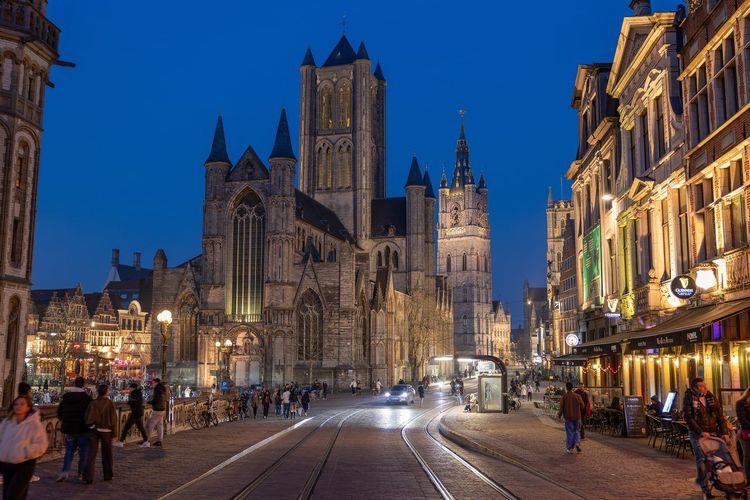
The first thing you notice when leaving Gent-Sint-Pieters station is the silence of engines. No honking, no lines of cars: in Ghent, the historic centre has turned its back on vehicles for years, and that is precisely what makes the city so pleasant to explore at walking pace. Visiting Ghent without a car is therefore not a constraint but a no-brainer: the Belfry, Saint Bavo's Cathedral and the Graslei quays are all within ten minutes' walk of one another. You will discover a medieval castle surrounded by a moat, the baroque gate of the former fish market, a futuristic library set on the banks of the Scheldt, and cobbled lanes where the local sweet is still sold in paper cones. This guide also gives you a sample one-day itinerary, a user guide to the CityCard and easy day trips by train. To soak up this geography without rushing, the Ryo audio-guided tour of Ghent offers a common thread through these neighbourhoods, headphones on and without ever consulting a map.
How to Get to Ghent and Get Around Without a Car
Arriving in Ghent by Train from France and Belgium
Ghent is 30 to 50 minutes from Brussels depending on the train, and a little over two hours from Paris: Eurostar (the former Thalys) to Brussels-Midi, then a connection on an IC train. From Lille, allow about 1h30 with a change at Kortrijk; from Lyon or Marseille, the journey generally goes via Paris or Lille, taking a full day but never touching a steering wheel.
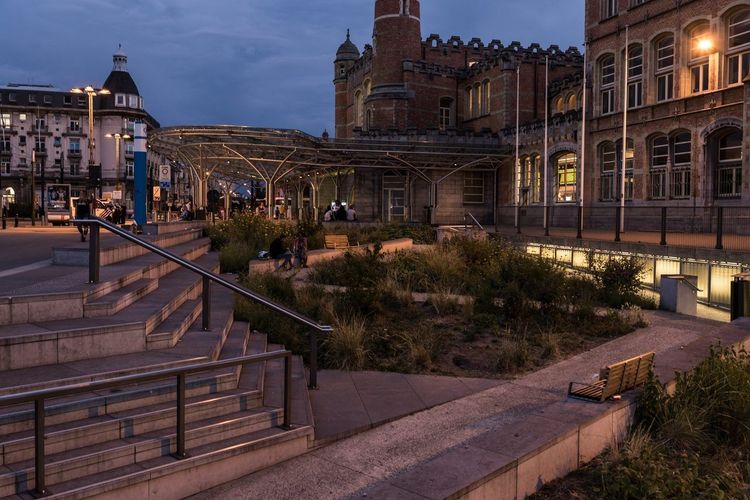
The Gent-Sint-Pieters station (Koningin Maria Hendrikaplein, 9000 Gent, rated 4/5 on Google from 11,696 reviews) receives several trains an hour from Brussels, making it one of the best-connected railway hubs in Belgium.
Avoid the car from the moment you arrive: the station is about 2 km from the historic centre, a distance covered in around ten minutes by tram (line 1, departing right in front of the station, direction Korenmarkt) or in twenty-five minutes on foot along avenues lined with grand townhouses. Many travellers choose to walk on arrival to get the measure of the city before even reaching the Belfry.
If you arrive with heavy luggage or late in the evening, a taxi costs around 12 to 15 euros to the centre, a reasonable option compared with renting a vehicle for three days of sightseeing. Renting a car is in fact the least sensible option: the historic centre is largely closed to private traffic, parking there is scarce and expensive, and no major site requires a vehicle.
For travellers who prefer a guided introduction, walking tours leave regularly from the centre, in French and English depending on the season. They generally last two hours and cover the essentials of the monumental centre, a complementary alternative to exploring independently.
Getting Around Town: On Foot, by Bike, by Bus and by Boat
Once there, forget the idea of getting around on four wheels. Since the traffic plan of April 2017, the historic heart of Ghent forms a vast pedestrian and restricted-traffic zone: only authorised residents, deliveries and public transport may enter, and cameras fine cars that venture in without permission. In practice, the Belfry, the Graslei quays and the Castle of the Counts are visited on foot or by bike.
On foot, allow about 25 minutes to cross the historic centre from end to end, from the Castle of the Counts to the De Krook library. This is a city that lets you wander without a fixed itinerary: you will probably change your mind three times along the way, and that is precisely the appeal of walking here.
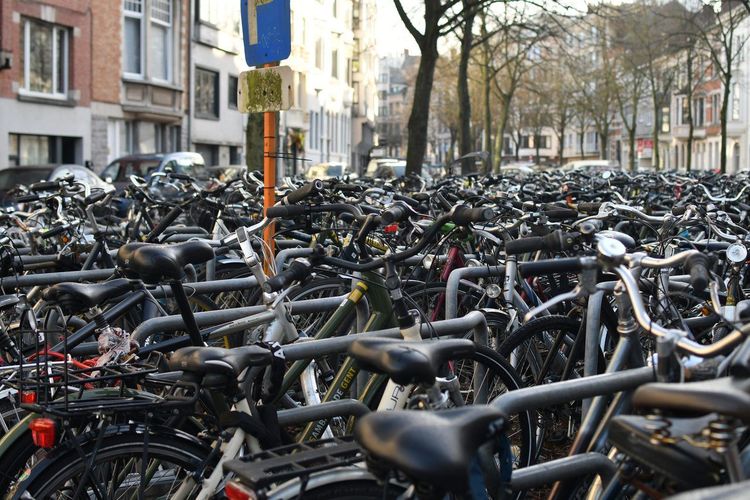
Cycling, for its part, is almost a local institution: Ghent is one of the most bike-friendly cities in Belgium, and the Blue-bike network lets you rent a bike directly at the station for a few euros a day, after registering online. Several private rental companies also offer electric bikes near the centre, handy for reaching more outlying neighbourhoods in ten minutes.
For longer journeys or rainy days, De Lijn buses and trams cover the whole city with a ticket valid for one hour, cheaper when bought via the mobile app or by SMS than on board.
In fine weather, water taxis also run on the Leie and the Lieve, a pleasant way to reach a neighbourhood without setting foot on tarmac again. If you still insist on coming by car from France, be aware that Ghent has applied a low-emission zone since 2020 that excludes the most polluting vehicles, with automatic fines. Park-and-ride car parks (P+R) on the outskirts let you leave your vehicle on arrival and continue by tram, but most visitors who try the train-plus-walking combination once do not go back to the car for their next stays.
The Belfry, Saint Bavo's Cathedral and Saint Nicholas' Church: The Monumental Trio of the Historic Centre
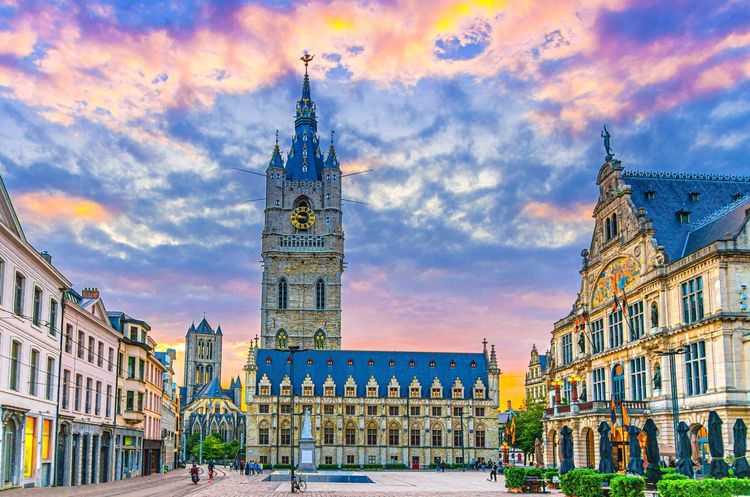
The Belfry and the Cloth Hall, a Panoramic View of the City
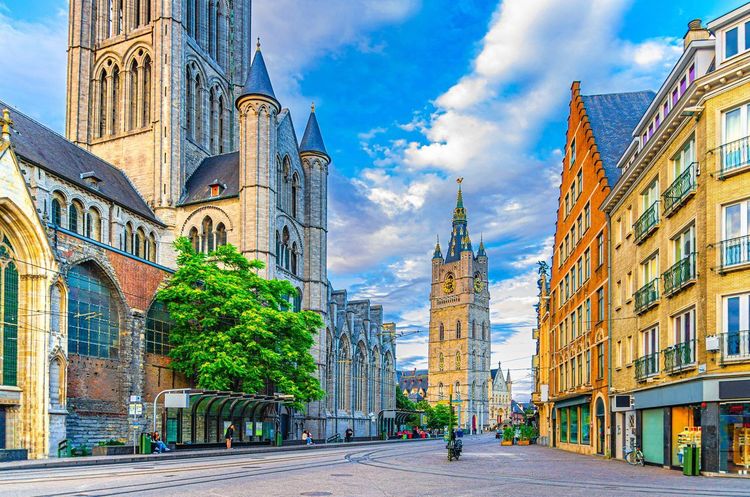
It is impossible to visit Ghent while ignoring its most recognisable silhouette. The Belfry of Ghent has dominated the city centre since the 14th century, rising 91 metres and crowned by a golden dragon, the symbolic guardian of the city's charters and privileges, once kept in a fortified room in the tower.
A lift followed by a few flights of steps leads to the panoramic galleries: from there, you can take in at a single glance the towers of the cathedral, of Saint Nicholas and, further away, the roofs of the Castle of the Counts. Allow about 45 minutes for the full visit, and aim to arrive in late morning on a weekday to avoid the crowds of school groups.
Right next to the belfry, the Cloth Hall (Lakenhalle), built in the 15th century, is a reminder that in the Middle Ages Ghent was one of the richest cities in Europe thanks to the textile trade. It is, incidentally, through it that you enter the belfry today. The building was used to inspect and trade woollen cloth, an activity that literally financed the rest of the historic centre.
The Ryo audio-guided tour of Ghent links these three monuments within a few hundred metres, with stops that explain on the spot why the dragon became the emblem of the city and what the charter room actually protected.
Saint Bavo's Cathedral and Saint Nicholas' Church, Two Neighbouring Jewels
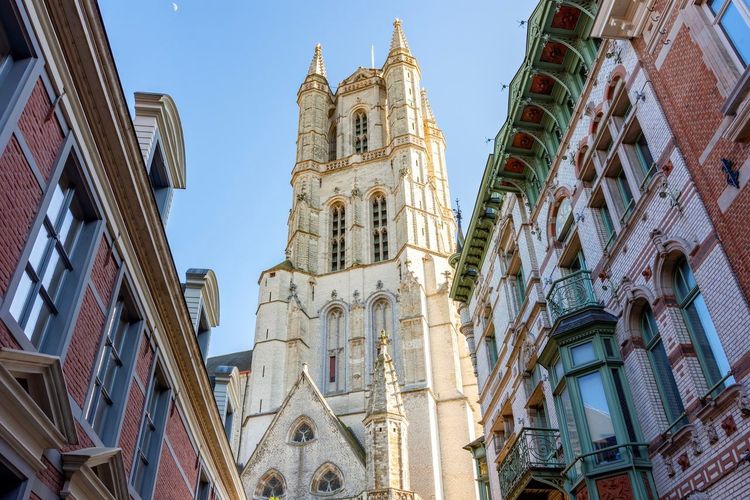
A few steps away, Saint Bavo's Cathedral (Sint-Baafskathedraal) houses one of the most coveted works in the history of art: The Ghent Altarpiece (Adoration of the Mystic Lamb) by the Van Eyck brothers, a polyptych completed in 1432, stolen several times, carried off by the Nazis during the Second World War, and still missing its Just Judges panel, vanished since 1934.
Entry to the cathedral is free, but the altarpiece is viewed in a paid visitor space, with an augmented-reality experience; book online in high season if you can. The crypt, beneath the Gothic choir, preserves Romanesque sections among the oldest in the building.
Continuing westward, Saint Nicholas' Church (Cataloniëstraat, 9000 Gent, rated 4.6/5 on Google from 2,966 reviews) (Sint-Niklaaskerk) stands out for its blue Tournai stone, typical of the Scheldt Gothic style found only in this part of Flanders. Less visited than its two neighbours, it offers a quieter atmosphere, ideal for a break after the bustle of the Belfry.
These three buildings can be visited in a morning, without taking any transport between stops. Keep an eye on the clock: the belfry's carillon, with several dozen bells, plays regularly during the day, and carillon concerts are given on certain days, a sound show that echoes across all the neighbouring squares. Between visits, pause on Sint-Baafsplein, in front of the Royal Dutch Theatre (NTGent), to watch the ballet of cyclists crossing the square without ever slowing down: it is the best summary of the car-free city you will see all day.
The Castle of the Counts (Gravensteen) and the Old Port of the Vismijn
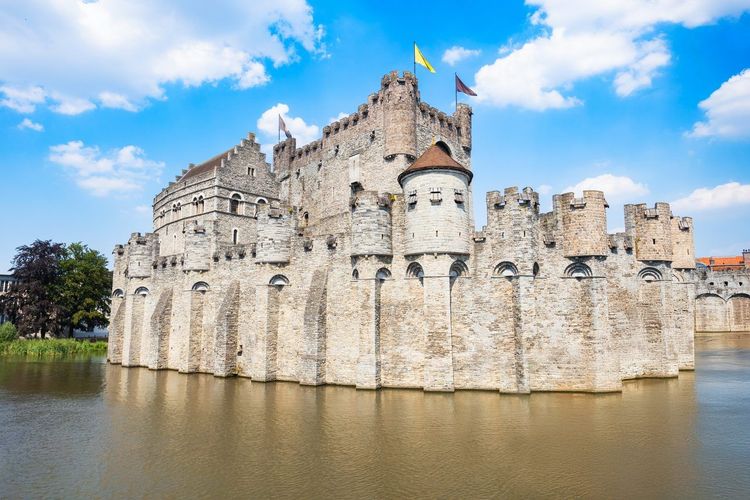
The Castle of the Counts and the Former Fish Market (Vismijn)
Set on the banks of the Lieve like a fortress fallen out of the Middle Ages, the Castle of the Counts (Gravensteen) was built from 1180 by Count Philip of Alsace, partly inspired by the Crusader fortresses he had seen in the Holy Land. Its crenellated towers make it one of the few urban castles of this scale still standing in Northern Europe.
The interior takes about an hour to visit, with an audio guide included in the ticket that details, in an often humorous tone, the successive uses of the building: comital residence, then court, prison, mint and even cotton mill in the 19th century. Don't miss the armoury or the small collection of torture instruments, a reminder of the site's judicial past. Then climb up to the wall walk for an unexpected view over the rooftops of Patershol, just behind.
Just opposite, on the other side of Sint-Veerleplein, the Oude Vismijn (former fish market) is a reminder that Ghent lived off the water. Its baroque gate of 1689, sculpted with a Neptune holding his golden trident, opened onto the city's oldest market; behind it today are the Visit Gent tourist office, in a glass pavilion, and a brasserie. Stop by at the start of your visit to pick up a map of the cycle paths and the boat timetables.
The Moat and Saint Michael's Bridge, the Best Viewpoint over the City
The Castle of the Counts is surrounded by a moat fed by the Lieve, which once made it a formidable obstacle for anyone attempting a siege. For photographers, the best angle is from the opposite bank in the early evening, when the light grazes the stones.
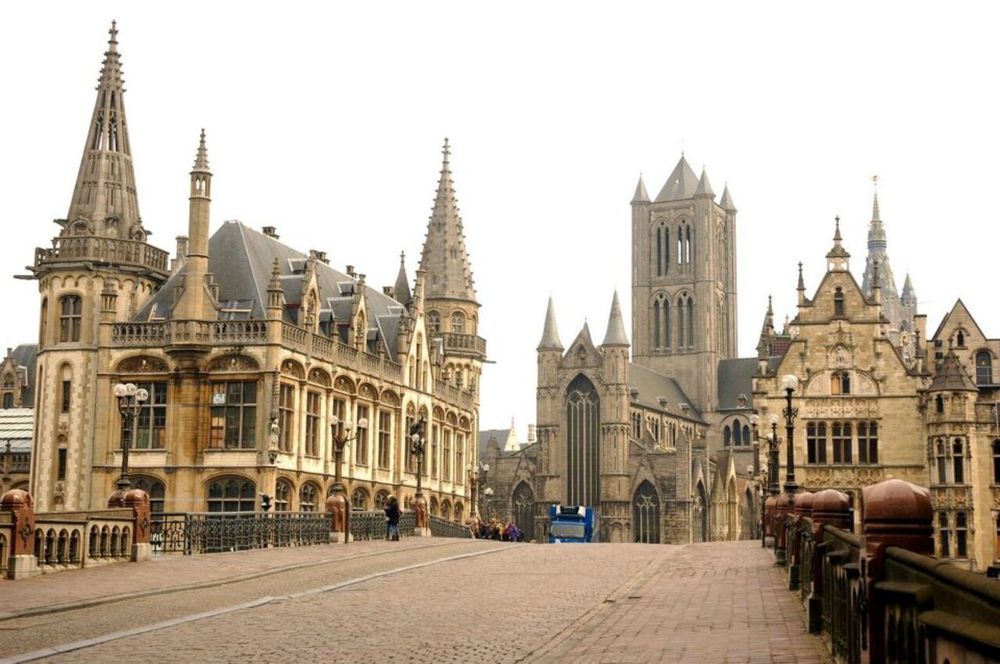
The Saint Michael's Bridge (Sint-Michielshelling, 9000 Gent, rated 4.8/5 on Google from 4,909 reviews) (Sint-Michielsbrug), about ten minutes' walk to the south, offers arguably the most complete panorama of Ghent: the spires of Saint Nicholas, the belfry and the cathedral lined up like a postcard, with Graslei and Korenlei at your feet. This is where most local guides stop their groups, and for good reason.
This bridge is also one of the stops of the Ryo audio guide, where an anecdote about the Counts of Flanders gives a whole new dimension to the view in front of you. Come in the late afternoon: the golden light on the Graslei façades is well worth the few minutes' wait to find a spot at the parapet.
The Graslei-Korenlei Quays and the Medieval Patershol District
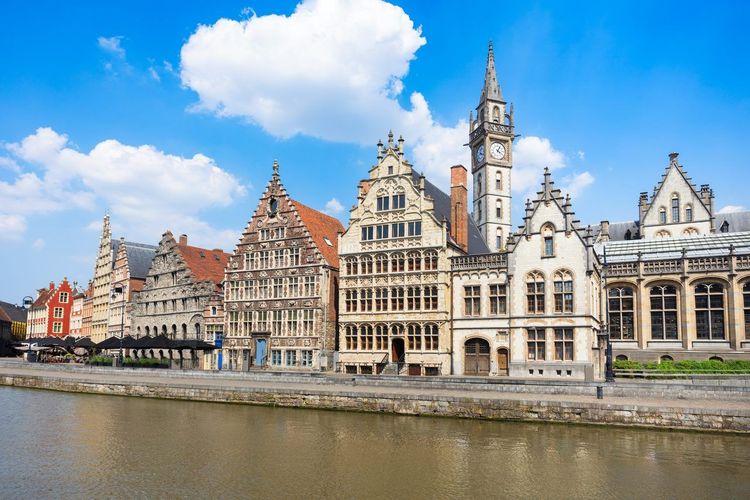
Graslei and Korenlei, the Most Beautiful Façades in Ghent on the Banks of the Leie
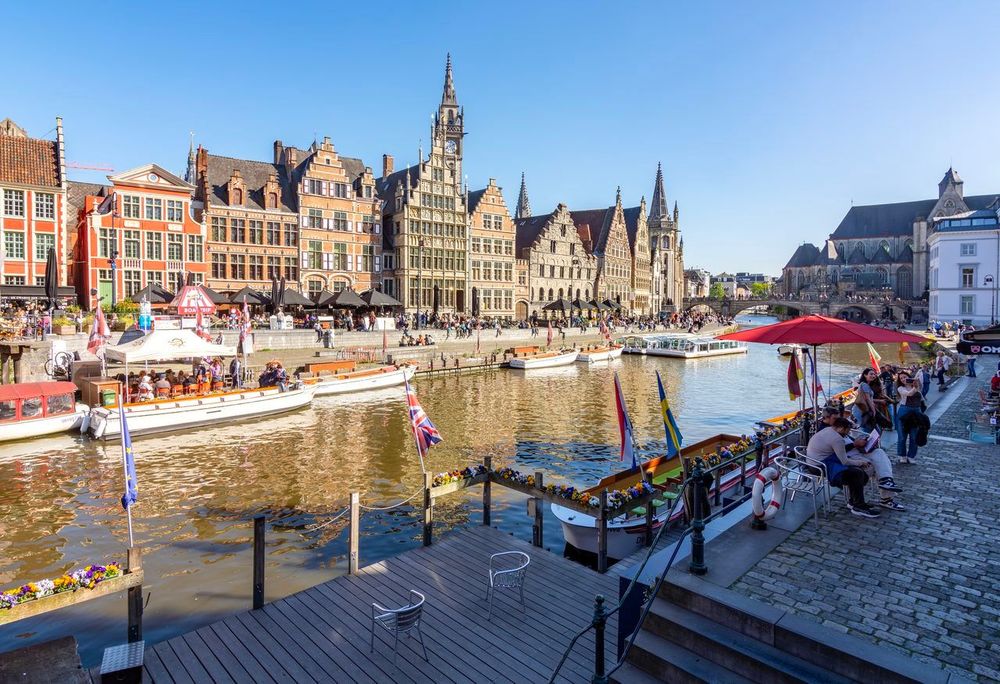
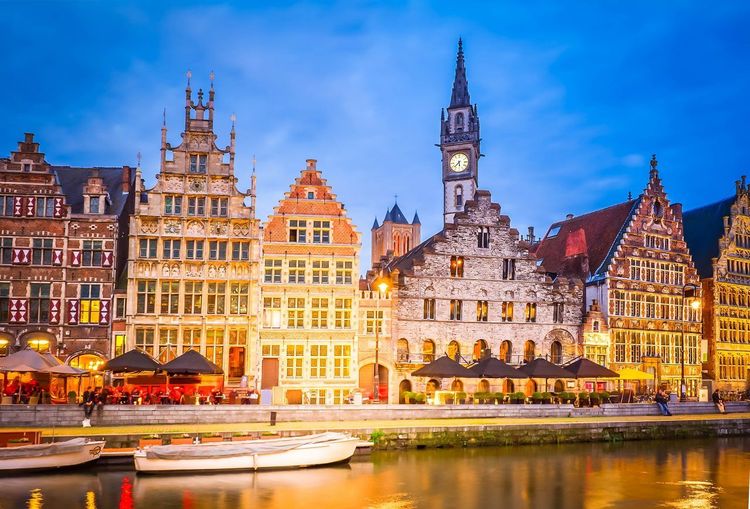
If there is one image that sums up Ghent, it is this one: a row of gabled façades reflected in the calm water of the Leie at sunset. These are the quays of Graslei and Korenlei, facing each other across the river, the former medieval port where merchant and boatmen guilds made the city's fortune.
On the Graslei side, look for the Guild House of the Free Boatmen, whose Brabantine Gothic sandstone façade bears the date 1531, then the Guild House of the Grain Measurers with its baroque gable of 1698. Between the two, the Romanesque Spijker warehouse, around 1200, is a reminder that grain has passed through here since the 13th century. Each façade corresponds to a trade, a true professional directory carved in stone.
Opposite, Korenlei lines up plainer but equally charming façades, and it is from this side that you will take the best photos, the setting sun striking the Graslei gables head-on. As soon as the wind drops, the water creates an almost perfect mirror effect.
During the day, the quays fill with terraces and queues for the boats. In the evening, once the groups have left, the atmosphere becomes distinctly more local. If you keep only one visual memory of Ghent, make it this one: come back at dusk, when the façades light up one by one along the water.
Patershol, Cobbled Lanes, Street Art and Great Places to Eat
Heading up towards the Castle of the Counts, you switch in a few metres into another Ghent. Patershol (Patershol, 9000 Gent, rated 4.6/5 on Google from 890 reviews) is a maze of cobbled lanes so narrow that two bikes can barely pass each other, a former district of craftsmen, tanners and later working-class families. The name is said to come from the passage (hol) that led to the Carmelite convent, the fathers (paters) who settled here in the Middle Ages.
Run-down and then threatened with demolition in the 1970s, the district was saved by its residents and renovated from the 1980s; restaurateurs followed, and Patershol today concentrates some of the most sought-after tables in the city, in low-ceilinged houses. At weekends, book several days ahead; on weekdays, it is often still possible to find a table by turning up around 7 pm.
For street art, head five minutes away to the Werregarenstraat, nicknamed the graffiti street. Since 1995, the city has allowed spray paint on every wall: the alley changes its look almost every week, and you will often see an artist at work. Other large murals are scattered around the city, notably around the Dampoort district.
Then take the time to get lost in Patershol before heading back out towards Saint Michael's Bridge: it is a district to be savoured by instinct, and that is exactly where the Ryo audio-guided tour of Ghent shifts gear after the classic photo of the quays.
Green and Offbeat Walks and Rides: Beguinages, the De Krook Library and the Banks of the Leie
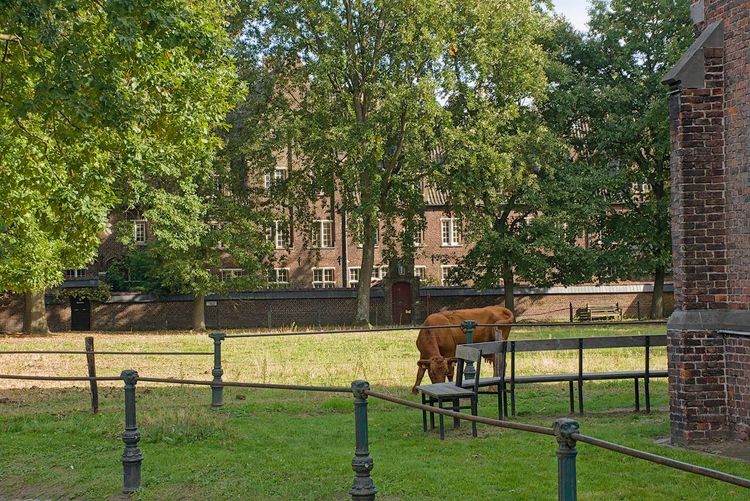
The Great Beguinage and Its Secret Gardens
Far from the bustle of the monumental centre, Ghent hides several beguinages, those small walled towns where lay women, the beguines, lived in community from the 13th century. The most spectacular, the Great Beguinage (Groot Begijnhof) of Sint-Amandsberg, built between 1873 and 1876 to replace the former Saint Elisabeth beguinage in the centre, is the only Neo-Gothic beguinage in Flanders: brick cottages, a church, convents and lanes spread around vast lawns.
Listed as a UNESCO World Heritage Site in 1998 among the thirteen Flemish beguinages, it can be reached in about fifteen minutes by bike from the centre, or by De Lijn bus. Few hurried visitors venture that far, making it one of the most peaceful corners of the city.
If you prefer to stay on foot, the Small Beguinage (Klein Begijnhof), southeast of the historic centre and also UNESCO-listed, offers a more intimate experience: 17th-century gabled houses around a large tree-planted meadow. The last beguines have gone, but the houses are still lived in, so keep your voice down.
The De Krook Library and the Bike Ride Along the Leie
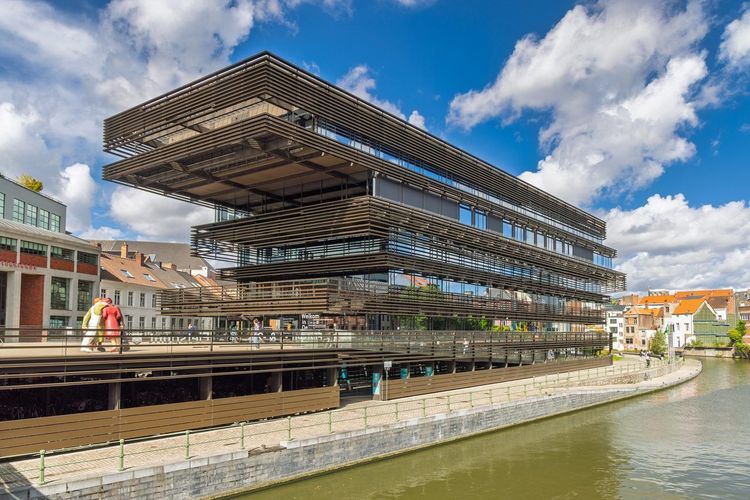
At the aesthetic opposite of the beguinages, the De Krook library (Miriam Makebaplein 1, 9000 Gent, rated 4.5/5 on Google from 813 reviews) displays resolutely contemporary architecture, designed by the Catalan firm RCR Arquitectes with the Ghent-based office Coussée & Goris. Opened on 10 March 2017, it takes its name from the bend (krook) in the Scheldt on which it sits. Inside are large open floors, free workspaces open to everyone, and glass walls looking onto the water.
Head up to the upper floors: the view over the Scheldt and the neighbourhood rooftops is nothing like the belfry's panoramas, but it shows a more contemporary Ghent.
The building is part of a district entirely redesigned around the water: pedestrian and cycle footbridges, pontoons where you can sit with your feet over the Scheldt, and a few minutes away the Vrijdagmarkt and the covered market. On weekdays, you will mostly meet students and locals who come to work, making it a good observatory of local life, far from the Belfry queues. Take the opportunity to settle in for a moment with a coffee before setting off again, on foot or in the saddle.
For a ride along the water, hop on a bike and follow the Leie to the southwest, then the Coupure canal, lined with trees and elegant townhouses: it is one of the Ghent locals' favourite outings for an hour or two, away from the crowds. The most energetic will push on to the Citadelpark and the S.M.A.K. contemporary art museum, twenty minutes' walk from the station.
A Sample One-Day Itinerary in Ghent Without a Car
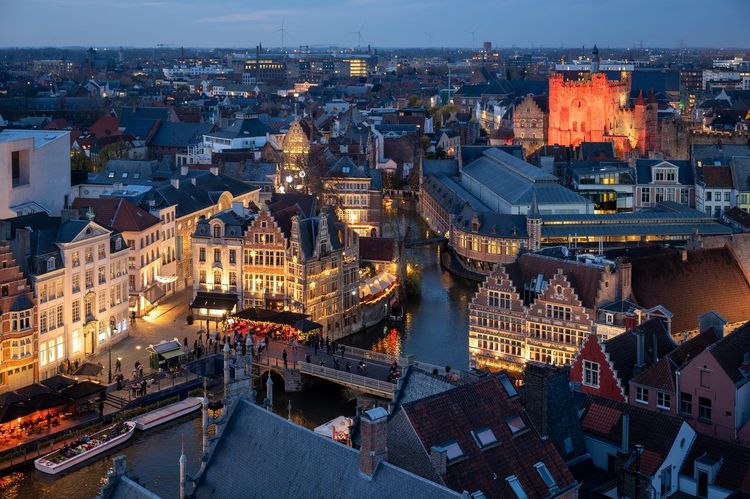
Only have one day? Here is a tried-and-tested sequence, entirely on foot, of about 6 km.
- 9:30 am: arrive at Gent-Sint-Pieters, tram 1 to Korenmarkt.
- 10 am: Saint Bavo's Cathedral and the Ghent Altarpiece, before the crowds.
- 11:15 am: climb the Belfry, then Saint Nicholas' Church.
- 12:30 pm: quick lunch and a photo from Saint Michael's Bridge.
- 2 pm: 40-minute boat trip departing from Graslei.
- 3 pm: Castle of the Counts, then a stop at the Werregarenstraat.
- 5 pm: Patershol, aperitif and dinner on site.
- 9 pm: back to the illuminated Graslei quays.
This programme roughly follows the route of the Ryo audio-guided tour: if you start it at the cathedral, the audio stops trigger as you walk and spare you from juggling with a map. With two or three days, add the beguinages, De Krook and a half-day by bike; our guide to visiting Ghent in 3 days details this longer version.
On the Water, at the Table and for the Night: Boat Trip, Local Sweets, Where to Eat and Sleep Without a Car
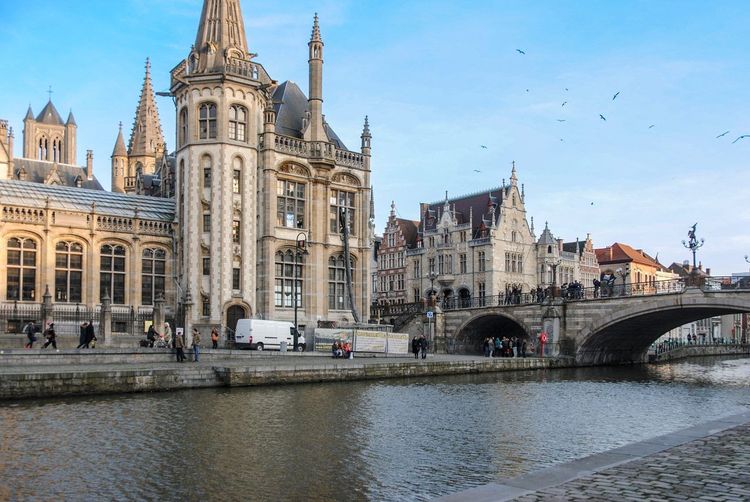
A Boat Trip on the Leie, Without Moving a Leg
After several hours of walking, here is a radically different way to see Ghent: seated, on the water. Several companies offer boat trips on the Leie, departing from Graslei and Korenlei, for about 40 minutes of sailing with commentary in several languages.
The route passes under Saint Michael's Bridge, heads up towards the Castle of the Counts along the Lieve, a perspective no land viewpoint offers, then emerges into more residential districts. Departures are frequent from April to October, less frequent in winter.
It is also the simplest option for people with reduced mobility or families with young children: you see the essentials of the centre seated, without a vehicle. And if you have already walked with the Ryo audio guide, the boat becomes a complement rather than a repeat, the same façades taking on different proportions when seen from the water.
The Cuberdon and Local Sweets
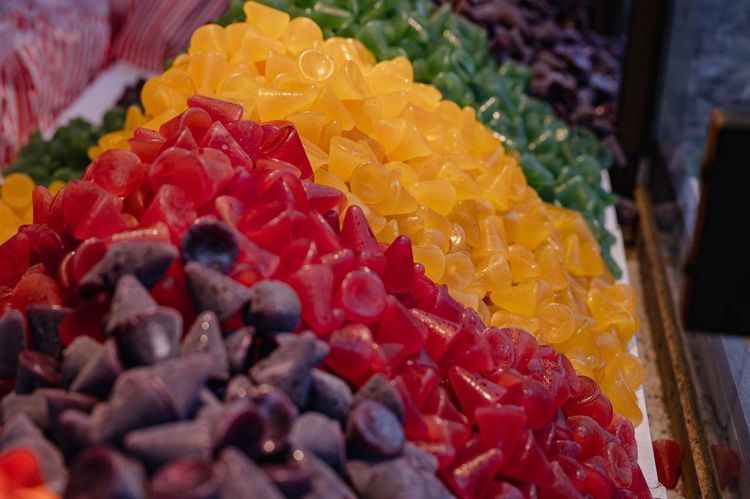
You can't leave Ghent without tasting a cuberdon, this purple raspberry-flavoured cone, crunchy outside and almost liquid inside, which Ghent locals call neuzeke (little nose). On the Groentenmarkt, two street vendors set up face to face even fought it out in court for years: the famous "cuberdon war", which still amuses the whole city.
You can also find them in the confectioners of the centre, sold by weight in a paper cone. Don't keep them too long: the syrupy heart crystallises after a few weeks.
Another curiosity is the beer Gruut, brewed without hops using a medieval herb mixture, gruit, by an urban brewery opened in 2009 on the waterfront. And for something savoury, try the waterzooi, a creamy chicken or fish stew born here.
If your stay coincides with the Ghent Festivities (Gentse Feesten), ten days in July when the whole city turns into an open-air stage, expect a dense crowd, but also a musical and culinary atmosphere unique in the year.
Where to Eat, Have a Drink and Sleep Within Walking Distance of the Centre
For the evening meal, Patershol remains the safest bet. The surroundings of Graslei and Korenlei offer more terraces with a view, often at the price of a higher bill for more standard cooking.
For a drink, the Vrijdagmarkt and the cafés around Korenmarkt attract a mixed crowd, while the Overpoortstraat, near the university, concentrates the student bars: with some 80,000 students, Ghent stays lively even on weekdays.
For accommodation, sleep in or just around the historic centre to do everything on foot, even late at night. Hotels in the centre have higher rates, but the gain in time and peace of mind more than compensates over two or three nights. Those on tight budgets will find youth hostels a stone's throw from Graslei; near the station, prices drop, with a direct tram to the centre.
To explore the culinary side further, see the Ryo ranking of the best culinary specialities of Ghent. Sleeping, dining or getting back after a boat trip: in Ghent, everything is ten to twenty minutes on foot.
The CityCard Gent: Museums, Tram and Boat in a Single Pass
If you plan to chain several visits together, the CityCard Gent is the ideal ally for a car-free stay. It costs 49 euros for 48 hours and 55 euros for 72 hours, and gives access to the main monuments and museums (Belfry, Castle of the Counts, the Ghent Altarpiece, S.M.A.K., MSK…), a boat trip, one day of bike rental and all De Lijn buses and trams in the city. You can get it at the Vismijn tourist office or online.
Is it worth it? As soon as you visit three or four paid sites and take the tram from the station, yes. For a single day centred on walking, it's better to pay individually. Also remember to activate it at the right time: the clock starts at first use, so begin with a morning visit to make the most of the hours you've paid for.
Day Trips by Train from Ghent
Ghent also makes an excellent base for exploring without a car. Bruges is about 25 minutes away by direct train, Antwerp less than an hour, Brussels 30 to 50 minutes; the Belgian coast (Ostend) is a little over an hour away. With several departures an hour, there's no need to book: buy your ticket on the SNCB app and leave whenever you like. For families, our guide to visiting Ghent with children gives more ideas for easy outings.
In Bruges, the whole centre can also be visited on foot from the station, twenty minutes' walk from the Markt. In Antwerp, the central station is itself a monument, and the cathedral district can be reached by tram or in a quarter of an hour's walk along the Meir, a pedestrian shopping street. For a day at the seaside, the Ostend train drops you a few minutes from the beach, and the coast tram then runs along the entire Belgian coastline, from De Panne to Knokke. Just one rule for these escapades: get back before the last evening train, generally around 11 pm on weekdays, and check the Sunday timetable, which is often reduced.
Ghent Without a Car with Family or Reduced Mobility
Good news if you are travelling with a pushchair or wheelchair: the pedestrianisation of the centre makes Ghent much more comfortable than most medieval cities. The large squares (Korenmarkt, Sint-Baafsplein, Vrijdagmarkt) are wide and open, and the De Lijn trams serving the centre are largely low-floor. Cobblestones, however, remain everywhere, especially in Patershol and around the Castle of the Counts: plan on an all-terrain pushchair rather than a lightweight stroller.
Visit Gent also publishes an accessibility brochure detailing an adapted walk through the historic centre, available from the Vismijn tourist office. As for monuments, the Belfry has a lift to the panoramic floors, which is not the case for the Castle of the Counts, whose narrow staircases limit access.
With children, go for short formats: the boat trip, the castle's humorous audio guide, a break in a park and a cuberdon as a reward. The cargo bike, very common in Ghent, can also be rented by the day to carry the little ones.
What Budget for a Stay in Ghent Without a Car?
Giving up the car lightens the bill considerably. The train from Paris costs from a few dozen euros to over a hundred depending on the booking date: booking early makes all the difference. On site, a tram ticket costs a few euros, Blue-bike rental remains modest, and most sites can be reached on foot for free.
The main expenses remain accommodation, noticeably more expensive in the historic centre than around the station, and monument entry fees, which the CityCard lets you bundle together. Also allow a small budget for the boat trip, unless it is included in your pass. By comparison, a stay by car would add fuel, tolls and above all parking, rarely below several dozen euros a day in the city-centre car parks. The maths is quickly done.



FAQ
How long does it take to visit Ghent without a car?
Allow two full days to see the essentials of the historic centre on foot (Belfry, cathedral, Castle of the Counts, Graslei quays, Patershol), and three days if you want to add the beguinages, the De Krook library and a relaxed bike ride.
Can you visit the centre of Ghent entirely on foot?
Yes: the historic centre is about 1.5 km across, and all the major sites are within twenty minutes' walk of one another. A bike is still useful for more outlying areas such as the Great Beguinage.
How do you get to Ghent without a car from Brussels or Lille?
From Brussels, a direct train links Brussels-Midi or Brussels-Central to Gent-Sint-Pieters in 30 to 50 minutes. From Lille, allow about 1h30 with a change at Kortrijk; from Paris, take the Eurostar to Brussels then an IC train, a little over two hours in total.
Do you need to rent a bike to visit Ghent?
Not essential for the historic centre, which is very easy to explore on foot. A bike becomes useful for reaching outlying neighbourhoods or riding along the Coupure, and the Blue-bike network at the station makes renting quick.
Ghent or Bruges: which one should you visit without a car?
Both are easy to visit without a car and are only 25 minutes apart by train. Bruges, more compact and more touristy, suits a single day; Ghent, livelier and less crowded with visitors, deserves two to three days.
What is the best time to visit Ghent without a car?
Spring and early autumn offer the best compromise between pleasant weather and reasonable crowds. July, during the Ghent Festivities, is electric but packed; winter, being quieter, lets you enjoy the museums without queues.
Is the centre of Ghent closed to cars?
Not entirely, but heavily restricted: since 2017, a limited-traffic zone covers most of the historic centre, reserved for residents, deliveries and public transport, with camera enforcement. A visitor never needs to bring a personal vehicle in.
Conclusion
Visiting Ghent without a car therefore requires no special organisation: a train, a pair of comfortable shoes and, if the mood takes you, a rental bike are enough to cover everything most memorable about the city, from the Belfry to the Graslei quays via the lanes of Patershol. It is a human-scale city, designed for walking centuries before the invention of the automobile.
And to chain together the must-sees without pulling out your phone to find your way, let yourself be guided by the Ryo audio-guided tour of Ghent: the right stories in the right place, at your own pace, with no car in sight.
À lire également