© Shutterstock
 Votre guide Ryo
The Beautiful Villages of the Alpilles: 8 Must-See Stops During Your 2026 Stay
The Alpilles massif fits within a 25-kilometre-long rectangle. That's small, and that's precisely why it concentrates a density of medieval villages, olive groves and ancient sites that few French regions can match. Roman ruins at the foot of a hilltop castle, a Romanesque-Byzantine chapel isolated among the garrigue, a windmill that inspired one of the most widely read books of the 19th century: the beautiful villages of the Alpilles offer more than a Provençal postcard — each one tells a different layer of this history. The Ryo app accompanies travellers who want to go beyond the shop fronts and café terraces to understand what they are looking at.
This guide covers 8 villages in the massif selected for their heritage interest, their character and their complementarity: the unmissable ones such as Les Baux-de-Provence and Saint-Rémy-de-Provence, the insiders' favourites such as Eygalières and Aureille, the olive oil capitals such as Mouriès and Maussane, and lesser-known yet equally charming stops such as Fontvieille, Le Paradou and Eyguières. For each village, you will find the must-see sites, practical opening hours, useful addresses and tips for avoiding the busiest summer crowds. Competing guides on this subject offer quick lists with little context; this guide goes further.
Les Baux-de-Provence
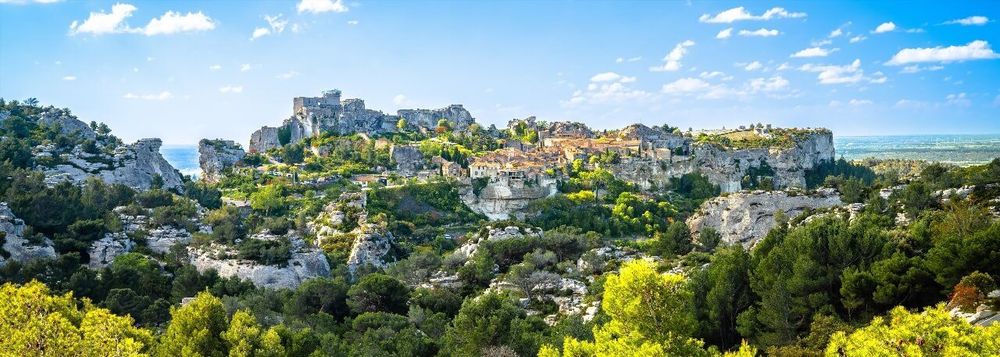
There is something improbable about the silhouette of Les Baux-de-Provence: a ruined medieval castle that seems to have grown directly from the limestone rock, with an entire village clinging below it on a ridge at 245 metres above sea level. Located 20 kilometres south of Arles, the village attracts more than one million visitors per year, making it one of the most visited sites in Provence — a figure that demands careful timing, but also speaks to the extraordinary power of the place.
The Citadelle des Baux, built from the 10th century onwards and partly dismantled in 1632 on the orders of Richelieu, dominates the Val d'Enfer from its rocky spur. Access is via the medieval village through a series of cobbled lanes lined with Renaissance mansions and art galleries. Allow 2 to 3 hours to explore the village and the citadel at a leisurely pace: the view from the ramparts over the olive groves and limestone ridges is worth the visit on its own. The site is open year-round from 9am, with last entry 1 hour 30 minutes before closing.
A few minutes' walk away, the Carrières de Lumières occupy former limestone quarries converted into an immersive exhibition space. Monumental projections cover the walls and floor across thousands of square metres, with a thematic programme that changes every year. The visit lasts around 35 minutes and suits all ages, and is particularly striking for children.
The Moulin du Calanquet (Route de Saint-Rémy, 13520 Les Baux-de-Provence, rated 4.6/5 on Google from 344 reviews), at the foot of the massif on the road towards Maussane, produces an AOC Vallée des Baux olive oil regarded as one of the finest in Provence. The shop is open for direct sales and offers free tastings — a good address for bringing home something authentic.
Practical tips: arrive before 10am or after 4pm in July and August to avoid tour buses. The main car park (paid) is located below the village; allow 15 minutes for the uphill walk. The medieval village itself is entirely pedestrianised.
Saint-Rémy-de-Provence
Saint-Rémy-de-Provence is not a hilltop village but a small plains town at the foot of the Plateau des Antiques, and that is precisely what sets it apart from the others. Its markets, its grand townhouses and its connections with Van Gogh make it a gastronomic and cultural destination in its own right within the Alpilles. The town is best visited over a full day to combine the historic centre, the ancient sites and the monastery.
The historic centre deserves an hour of unhurried wandering. The mossy fountains, century-old plane trees and antique shops lining the boulevard Gambetta create a typically Provençal atmosphere without the museum-like quality of some neighbouring villages. The Wednesday morning market takes over the Place de la République and its surroundings, offering the best selection of local producers in the area.
One kilometre south of the centre, the Site de Glanum reveals an ancient town dating from the 2nd century BC. Along the roadside, the Roman Triumphal Arch and the Mausolée des Jules, collectively known as "les Antiques", are freely accessible from the D5 roadside. The excavated site extends behind them (paid entry, closed on Mondays) with remains of temples, baths and houses.
The Monastère Saint-Paul-de-Mausole (Avenue Edgar Leroy, 13210 Saint-Rémy-de-Provence, rated 4.5/5 on Google from 1,710 reviews), 500 metres from les Antiques, is the psychiatric institution where Vincent Van Gogh stayed from May 1889 to May 1890. During that time he produced nearly 150 paintings, including The Starry Night. The 12th-century Romanesque cloister is open to visitors, with a trail retracing the painter's year through reproductions installed at the very spots where he painted his canvases.
Saint-Rémy is also the ideal base for exploring the surrounding villages: Les Baux at 9 km, Eygalières at 10 km and Maussane at 11 km. The town offers the widest range of accommodation in the massif, from charming farmhouses to luxury hotels.
Eygalières
Eygalières is the village that insiders name first when asked for their favourite in the Alpilles. Less spectacular than Les Baux, less lively than Saint-Rémy, it compensates with an intact authenticity that has fascinated artists and second-home buyers for decades. Property prices here are among the highest in the Bouches-du-Rhône, a sign that something irreplaceable is to be found.
The village spreads across a hill at 200 metres above sea level with narrow streets winding between stone houses and enclosed gardens. The 15th-century Clock Tower marks the summit, offering an open view over the Crau plain and the massif. Access is free; the path leading up from the central square takes about ten minutes.
The Chapelle Saint-Sixte (Route de la Chapelle Saint-Sixte, 13810 Eygalières, rated 4.4/5 on Google from 7 reviews), isolated on a rocky spur one kilometre from the village, is one of the symbols of the Alpilles. Built in the 11th century on the site of a Gallo-Roman temple, it is surrounded by olive trees and cypresses in a silence that photographers from around the world come to capture. The road leading to it (D24B) passes several olive estates offering direct sales.
Eygalières is also home to the Mas de la Brune, a jewel of Renaissance architecture built in 1572 and listed as a historic monument. The residence, now a private property closed to visitors, can be admired from the outside for its mullioned windows and carved ornamentation. If you use our Ryo audio guide to explore Provence, Eygalières fits perfectly into a loop departing from Saint-Rémy: the two villages are 10 kilometres apart, connected by a country road that follows the limestone hills. The village is also home to several acclaimed gastronomic restaurants — reservations are essential in high season — and a Sunday morning market.
Maussane-les-Alpilles
Between Les Baux and Mouriès, Maussane-les-Alpilles sits at the geographical heart of the AOC Vallée des Baux-de-Provence olive oil production zone. The village has lived to the rhythm of this culture for centuries, and this identity is felt in every shop and every restaurant in the centre.
The Coopérative Oléicole de Maussane (Place de l'Église, 13520 Maussane-les-Alpilles, rated 4.5/5 on Google from 276 reviews) (the Moulin Cornille) is the village's flagship institution. Having become a cooperative in 1924, it brings together several hundred producers and makes an olive oil recognised in European gastronomic circles, available for direct purchase at prices significantly lower than specialist shops in the region. Visits are free and open outside the milling season (November–December), when harvest lorries fill the courtyard.
The village centre is compact and pleasant to explore on foot. The Place de la Fontaine and its century-old plane trees form the heart of daily life: cafés, a handful of restaurants serving straightforward Provençal cuisine, and the Sunday morning market where local producers gather. The atmosphere is less touristy than Les Baux or Saint-Rémy — a quality in itself.
Maussane is also a good starting point for hikes in the massif. The trail towards the Crête des Alpilles (GR6) departs from the village and climbs into the limestone ridges in approximately 2h30 round trip with 380 metres of elevation gain.
Mouriès
Mouriès proudly claims the title of "olive capital" of the Alpilles. With nearly 80,000 olive trees within its communal territory, it is the leading olive-growing municipality in France — not an honorary title, but a reality confirmed the moment you step outside the centre.
The Moulin Coopératif de Mouriès (Avenue Louis Jalabert, 13890 Mouriès, rated 4.5/5 on Google from 466 reviews) processes the harvest of more than 400 local producers. During the Fête de l'Olive in October, the village organises tastings, mill tours and harvest-themed events that make this weekend one of the most popular in the massif.
The centre of Mouriès is less picturesque than its neighbours but more genuine in its daily life. The waymarked paths around the village allow you to walk through the harmas, these terraced olive groves inherited from medieval peasant farming techniques. The village also gives access to the Vallon de la Péïra, a narrow limestone gorge that opens into the massif to the north and can be walked in just under an hour.
Fontvieille
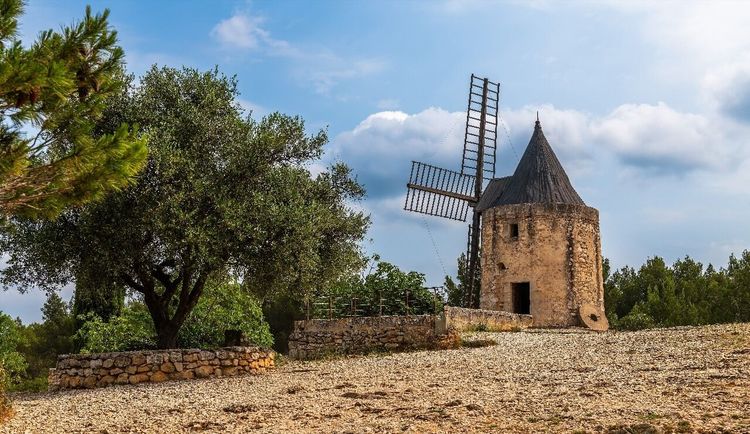
Fontvieille owes its fame to Alphonse Daudet and his Letters from My Windmill (1869), even though the author probably never actually lived in the mill that now bears his name. This anecdote does nothing to diminish the appeal of the place: the Moulin de Daudet, perched on a hill at the entrance to the village, offers an exceptional panorama over the Alpilles and the Crau plain that many more famous sites cannot match.
At the foot of the mill, the Musée Alphonse Daudet is housed in a 19th-century country house. It traces the life and work of the author with manuscripts and original editions illustrated by Gustave Doré. Open year-round except Tuesdays in low season; allow 45 minutes for the visit.
Fontvieille is also the gateway to the Aqueducs de Barbegal (Route de Barbegal D33, 13990 Fontvieille, rated 4.4/5 on Google from 1,800 reviews), 3 kilometres north of the village along the D33. This 2nd-century AD archaeological site is one of the best-preserved watermill complexes in the Roman Empire: 16 wheels arranged in cascade along two parallel channels cut into the rock. Access is free via a country path, with no attendant or sophisticated signage. Sturdy footwear is recommended for the rocky terrain.
The village itself is worth an hour's quiet stroll, with its old limestone houses and its church square free from any particular tourist bustle.
Aureille
Aureille remains one of the best-kept secrets in the massif. This village of around 1,500 inhabitants nestled beneath the limestone cliffs of the eastern Alpilles does not appear in any mainstream tourist guide, which is precisely what contributes to its charm. The ruins of the medieval castle (the Castelas) at the top of the hill, the mossy fountain in the centre and the terraced gardens create an atmosphere that more heavily promoted villages have sometimes lost over the decades.
The climb to the ruined castle takes about twenty minutes on foot from the central square. The view from the crumbling ramparts stretches as far as the Camargue lagoons on a clear day. The path is waymarked but unpaved — walking shoes are recommended, especially in warm weather as the exposure to the sun is total.
Aureille is also the starting point for several trails in the eastern section of the massif, which sees significantly less foot traffic than the areas around Les Baux or Eygalières. Our Ryo app provides historical information on the medieval villages of this territory for those who want to understand the architecture and history of the Alpilles' fortified settlements.
Le Paradou
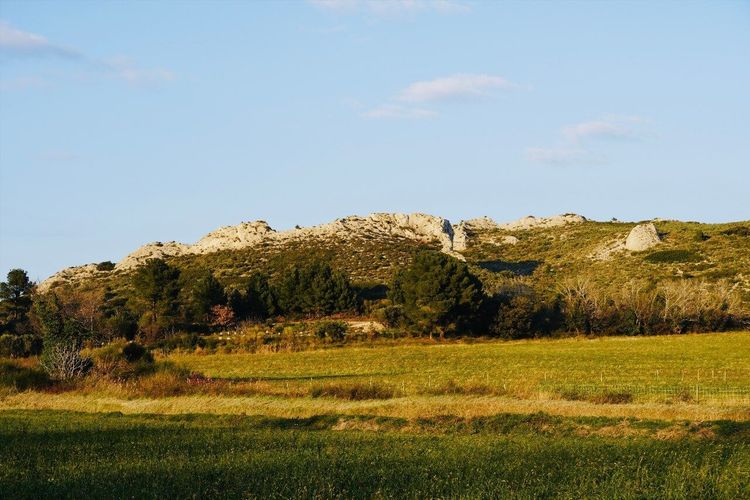
Le Paradou lies 3 kilometres from Les Baux-de-Provence and is light years away from its tourist crowds. This hamlet of the commune of Maussane lives to the rhythm of the orchards and olive groves that surround it, with a quiet main street and a handful of local shops. It is exactly the kind of place that slips past the guidebooks but that travellers discover and never regret.
The hamlet has no major monument, and that is precisely its appeal: you come for the light, the olive groves and the tranquillity that busier villages have lost. A short stroll through the lanes is enough to take in the atmosphere before heading back to Maussane or Les Baux, both just a few minutes away.
Le Paradou is also worth a stop for its restaurant: the Bistrot du Paradou has been an institution since the 1970s, with a single daily menu written on a chalkboard and a substantial Provençal wine cellar. Booking is essential from spring onwards. Arles, close by, unfolds 2,000 years of history across 19 audio-guided stops.
Eyguières
On the boundary between the Alpilles and the Crau plain, Eyguières blends Provençal heritage with wide open spaces. On the heights overlooking the village, ancient windmills still stand, remnants of a once-thriving milling industry in the region.
A few kilometres away, the Castellas de Roquemartine raises its spectacular ruins on a rocky spur. This medieval fortress (12th–13th century), also known as the Château de la Reine Jeanne, was abandoned at the beginning of the 17th century. The view from the site extends over the Crau plain and the lower Durance valley. Access is on foot via a waymarked path.
Eyguières is less visited than the villages at the heart of the Alpilles, making it an ideal stop for those who want to avoid the crowds while remaining in the Provençal atmosphere of the massif.
Planning Your Stay in the Alpilles
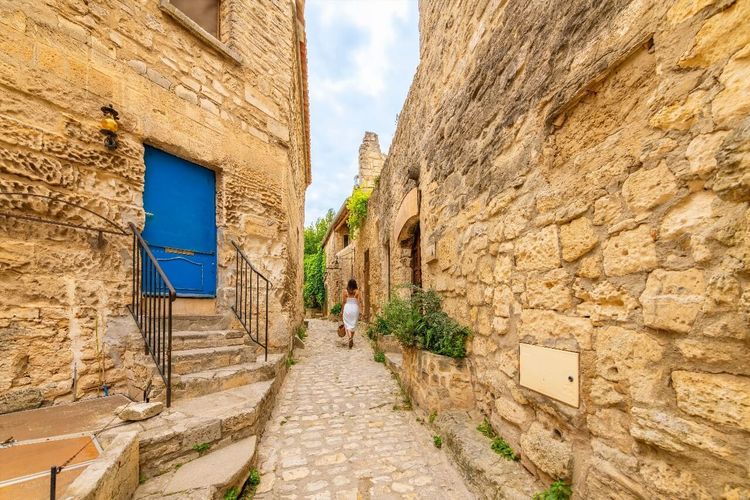
The Alpilles are ideally visited over 3 to 5 days to cover the main villages without rushing. The massif is compact (25 km from east to west) but the narrow country roads call for an unhurried pace — opt for a standard-sized vehicle rather than a people carrier or motorhome, which struggle on certain stretches.
Where to stay: Saint-Rémy-de-Provence offers the widest range of accommodation — boutique hotels, seasonal farmhouse rentals, and upscale campsites. Les Baux-de-Provence features luxury properties in exceptional settings. For a more moderate budget, rural gîtes around Maussane and Mouriès offer excellent value for money with the advantage of a central position within the massif.
Admission costs: the Citadelle des Baux costs €10 per adult (2026 price), the Carrières de Lumières €16.50, and the Site de Glanum €8. The villages themselves are free to enter, and hiking in the massif is free of charge.
To extend your exploration to other wine and heritage regions of France, our Ryo guide to the must-see villages of France will give you useful points of comparison. If you are considering extending your stay to the Périgord, our Ryo selection of villages in the Dordogne lists 13 essential stops in that region.
Getting Around the Alpilles
A car remains the most practical way to move between the villages of the massif. Public transport is limited: seasonal bus services connect Arles, Saint-Rémy and Les Baux in summer, but with very infrequent departures outside July and August.
Cycling is a realistic option for visitors based in Saint-Rémy. Eygalières (10 km), Maussane (11 km) and Les Baux (9 km) are reachable via quiet roads outside the summer months. Electric-assist bicycles are available for hire in Saint-Rémy — a pleasant solution outside the peak summer season. Hiking also allows you to reach certain villages by crossing the massif. The GR6 traverses the Alpilles from east to west and passes close to several villages. Allow a full day to walk the full length, with resupply points at Maussane and Saint-Rémy.
When to Visit the Alpilles
Spring (April–June): the best period in the calendar. Almond trees are in blossom from February, the vegetation is green, temperatures are pleasant (15–25 °C) and crowds are still manageable. Summer (July–August): peak visitor numbers, intense heat (up to 38 °C) and villages packed in the morning. If you visit in summer, opt for early starts before 9am and midday breaks in cafés or in the shade.
Autumn (September–November): an underrated period that deserves more recognition. The Provençal light in September is exceptional, the grape and olive harvests bring the villages to life, and crowds thin rapidly after mid-September. The markets regain their local character.
Winter (December–March): the Alpilles have real character in winter with their bare ridges and silent villages. Some sites close or reduce their opening hours, but the atmosphere of tourist-free villages is unique for those who know how to appreciate it.
FAQ
What are the most beautiful villages in the Alpilles?
Les Baux-de-Provence, Saint-Rémy-de-Provence and Eygalières are the three essential references in the massif, cited by nearly all specialist guides. Maussane-les-Alpilles and Mouriès round out the picture for lovers of olive oil and Provençal gastronomy. Fontvieille, Aureille and Le Paradou attract those seeking authenticity away from the main tourist circuits.
Can you visit the Alpilles without a car?
It is possible but restrictive. Seasonal shuttles connect the main villages from Arles and Avignon in July and August. Outside this period, cycling from Saint-Rémy remains the best alternative to a car for reaching Les Baux, Eygalières and Maussane. Electric-assist bicycles are available for hire in Saint-Rémy.
How long does it take to visit the Alpilles?
Three days allow you to cover the main villages without rushing: one day for Les Baux-de-Provence and Fontvieille, one day for Saint-Rémy-de-Provence and its ancient surroundings, one day for Eygalières, Maussane and Mouriès. Five days allow you to include hikes in the massif and discover secondary villages such as Aureille and Eyguières.
Is Les Baux-de-Provence the most visited village in the Alpilles?
Yes, with more than one million visitors per year, Les Baux-de-Provence is by far the most frequented site in the massif. To avoid the crowds in high season, opt for the early morning hours (before 10am) or late afternoon (after 4pm), as well as weekdays outside French school holidays.
Are there hiking trails from the villages in the massif?
The GR6 crosses the massif from east to west and allows you to connect several villages on foot. Local trails also depart from Saint-Rémy (via les Antiques), from Maussane (towards the Crête des Alpilles), from Aureille (towards the ruined castle) and from Eyguières (towards the windmills and the Castellas de Roquemartine). Most trails are waymarked but demanding in summer due to the heat and lack of shade.
Where can you buy olive oil in the Alpilles?
The Coopérative Oléicole de Maussane and the Moulin Coopératif de Mouriès offer direct sales at producer prices, with no middleman. The Moulin du Calanquet in Les Baux-de-Provence offers a more artisanal production with on-site tasting. The markets in Saint-Rémy (Wednesday morning) and Maussane (Sunday morning) also allow you to buy directly from local producers.
Conclusion
The Alpilles form one of the most remarkable concentrations of historic villages in France within such a small area. From the dramatic verticality of Les Baux to the preserved tranquillity of Aureille, from the Van Gogh atmosphere of Saint-Rémy to the seemingly endless olive groves of Mouriès and Maussane, each village offers a different facet of a Provence unlike anywhere else.
To prepare your stay and enrich your discoveries on the ground, the Ryo app offers audio guides designed for independent exploration of built and natural heritage. Discover our Ryo overview of the villages of France to extend your exploration well beyond the Alpilles. With Ryo, every ruin, every chapel and every windmill in the massif tells you its story at your own pace.
À lire également