© Shutterstock
 Votre guide Ryo
Visiting the Arles Amphitheatre in 2026: History, Architecture and Practical Tips
Visiting the Arles Amphitheatre means sitting on tiers already occupied by Romans in the 1st century, in Provence's only amphitheatre that has never stopped welcoming audiences. Every summer, thousands of spectators take their seats there for a Camargue race or a concert, in the very place where gladiatorial combat once took place. Few ancient monuments in Europe have retained such a living function. To get a sense of the place before entering, the audio-guided tour of Arles traces this transition between ancient spectacle and Provençal art de vivre, a useful thread to avoid getting lost in the explanations.
Beneath the same limestone arcades converge an amphitheatre designed for more than 20,000 spectators, a UNESCO World Heritage listing obtained as early as 1981, underground galleries once used by wild animals and gladiators, and a contemporary use combining Camargue races, ferias and open-air concerts. This guide details the monument's architecture, its uses through the centuries, current admission prices and opening hours, the best time to visit, how to get there, and other ancient treasures accessible within a few minutes' walk.
The Arles Amphitheatre: a Roman Amphitheatre 2,000 Years Old
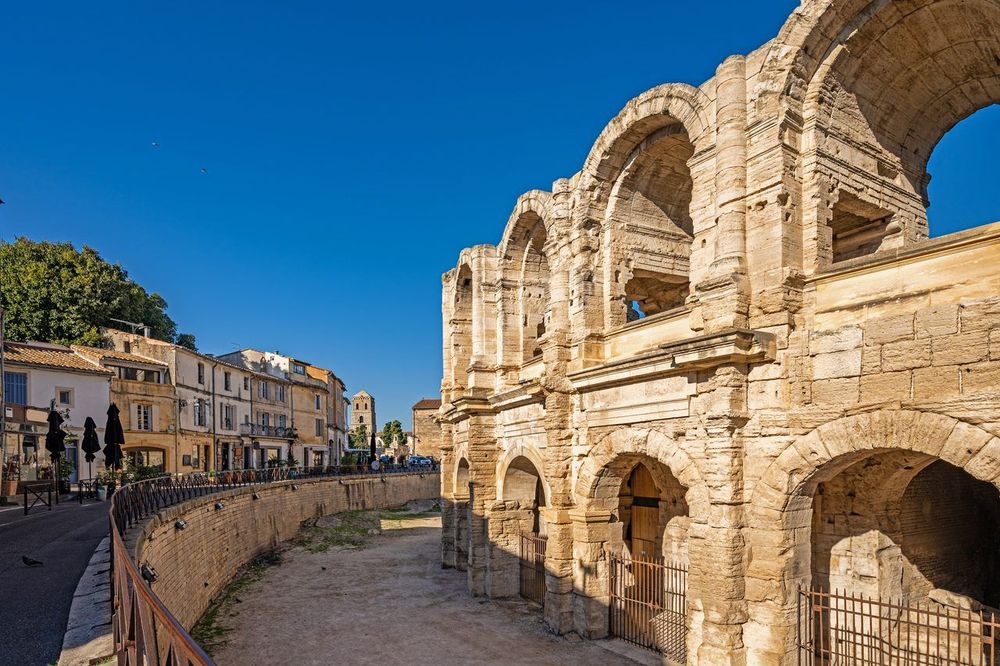
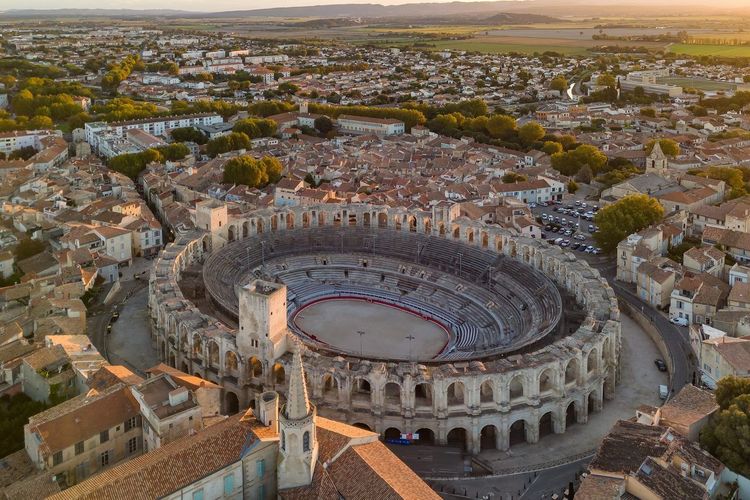
The Arles Amphitheatre (Rond-Point des Arènes, 13200 Arles, rated 4.4/5 on Google from 18,476 reviews) occupies the highest point in the city, a choice that is no accident: the Romans systematically positioned their great public buildings on elevated ground, visible from the Rhône and the approach roads.
An Amphitheatre Built in the 1st Century AD
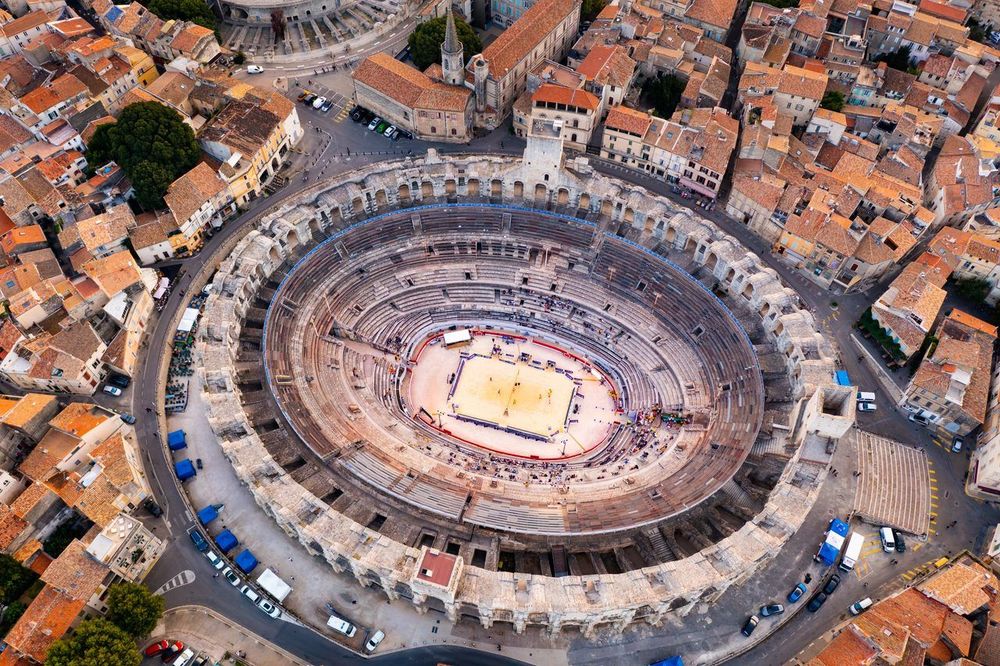
Construction began around 90 AD, under the Flavians, at a time when Arelate (the ancient name for Arles) rivalled Nîmes and Marseille as a strategic river port of Roman Gaul. The building measures 136 metres long by 107 metres wide, with a façade height reaching 21 metres over two levels of arcades, a third level having probably existed before disappearing over the centuries.
Contrary to popular belief, the amphitheatre was never truly abandoned: in the Middle Ages, it became a genuine urban fortress, with watchtowers and more than 200 houses built within the enclosure itself, along with two chapels. It would take until the 19th century and a clearance campaign launched in 1825, led notably by Arles architect Auguste Véran and supported by Prosper Mérimée, for the monument to regain its ancient appearance.
A Monument Listed as a UNESCO World Heritage Site
In 1981, the amphitheatre joined the UNESCO World Heritage List as part of the ensemble "Arles, Roman and Romanesque Monuments". This listing recognises a state of preservation considered exceptional for an amphitheatre of this size: the original load-bearing structure, the barrel vaults and a large portion of the exterior façade have survived the centuries without major reconstruction, unlike comparable monuments elsewhere in Europe.
This level of preservation is partly explained by the building's defensive reuse in the Middle Ages: by transforming it into a citadel, the people of Arles paradoxically protected it from the destruction and stone-robbing that levelled so many other ancient structures.
The Architecture of the Amphitheatre: Façade, Tiers and Arena
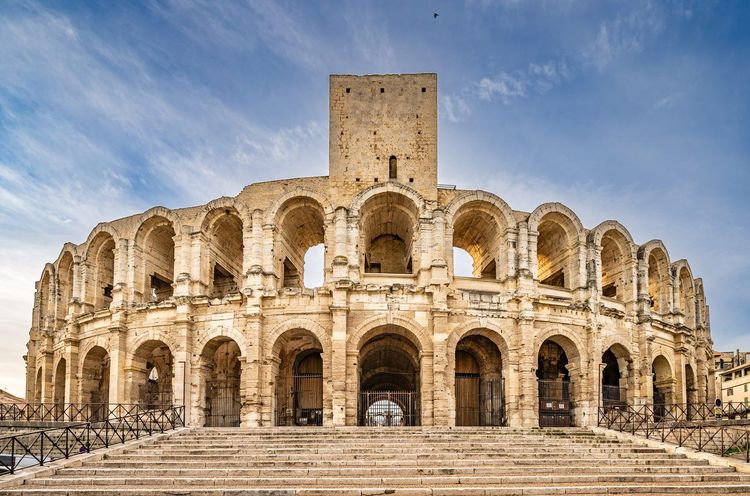
The Exterior Façade and Its Stone Arcades
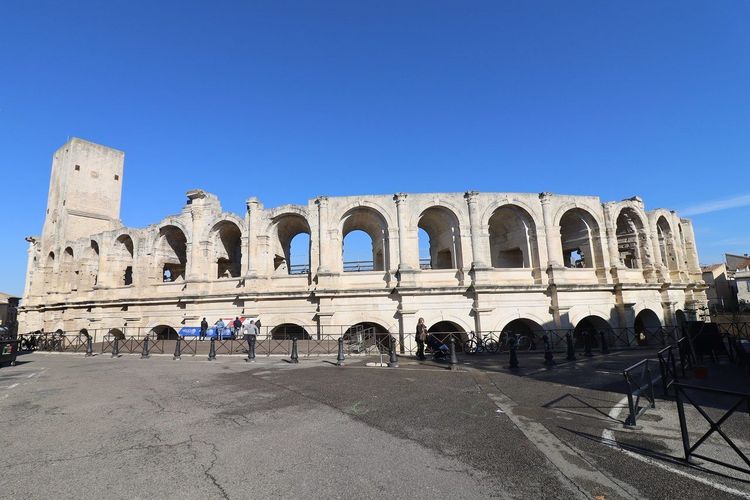
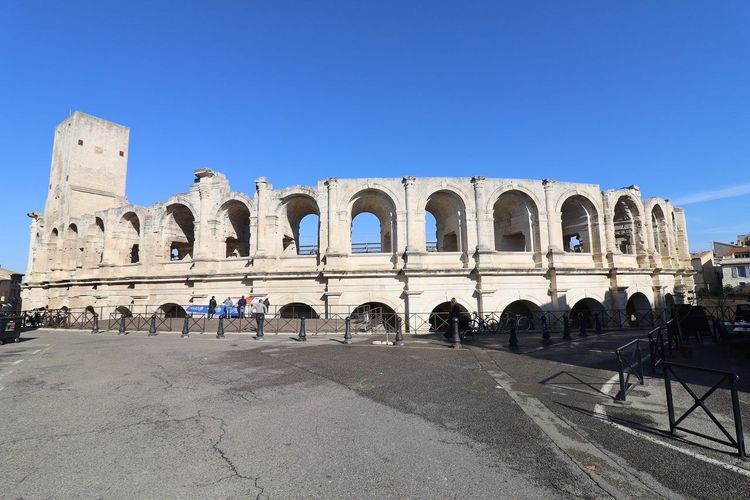
The façade of the Arles Amphitheatre first strikes you with its sobriety: unlike the Roman Colosseum, there are no decorative columns, no superfluous sculpted ornaments. The architects favoured a functional architecture, hewn from limestone quarried at the nearby quarries of Fontvieille, about fifteen kilometres from the city.
Each level features 60 identical arcades, a regular rhythm that organised the flow of thousands of spectators to their seats without bottlenecks at the entrances. This system of numbered access points, carved directly into the stone in certain places, surprisingly foreshadows the circulation layouts of modern stadiums. The three medieval towers that survive today, added during the fortification of the site, deliberately break this ancient symmetry and tell by themselves a thousand additional years of history.
If you look closely at the stone, you will notice differences in colour and block size: these betray the successive restoration campaigns, from the 19th century to the most recent interventions carried out by the Historic Monuments authority.
The Tiers and the Central Ellipse
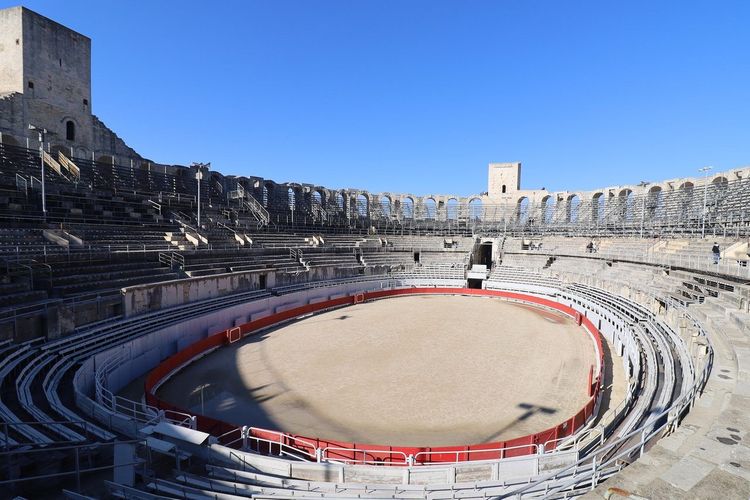
The amphitheatre's ellipse is organised into distinct zones inherited from the Roman social hierarchy: the tiers closest to the arena, reserved for notables and magistrates, an intermediate zone for citizens, and the highest seats for the rest of the population. This cavea arrangement, a term found in all Roman amphitheatres, allowed more than 20,000 people to be accommodated at the height of its ancient use, compared to approximately 12,000 places today for safety reasons.
The current tiers, restored to meet contemporary standards, faithfully follow the original layout. It is from the upper levels that the view over the terracotta rooftops of Arles and, on a clear day, over the foothills of the Alpilles, is most spectacular. Many visitors head straight for the arena floor without climbing to the top: yet this is one of the best viewpoints in the city, included in the admission ticket.
The Arena and the Underground Galleries
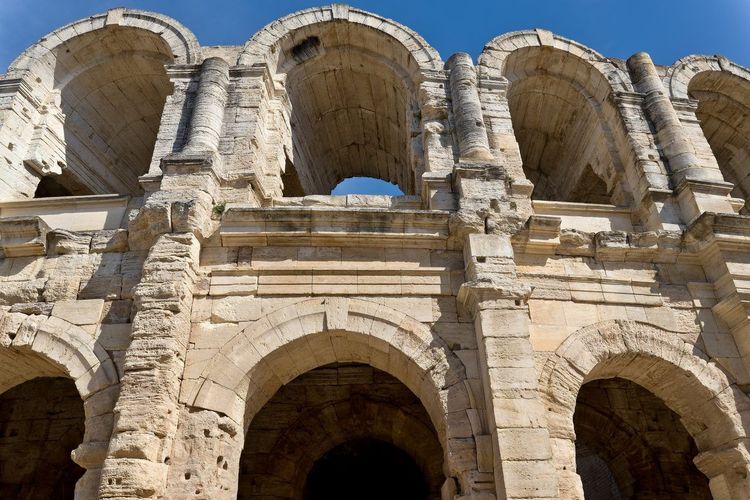
At the centre, the arena itself extends approximately 69 metres long by 39 metres wide, a sand surface that once hosted gladiatorial combat and wild animal hunts, before becoming over the centuries the stage for the Camargue races we know today.
Below the sand level and behind the tiers, a network of vaulted galleries and corridors, partly accessible during the visit, allowed the circulation of spectators as well as show equipment. These passageways, cool even in the height of summer, give a fairly precise idea of the logistics deployed by the Romans to organise mass spectacles nearly two thousand years ago.
A Living Performance Venue Since Antiquity
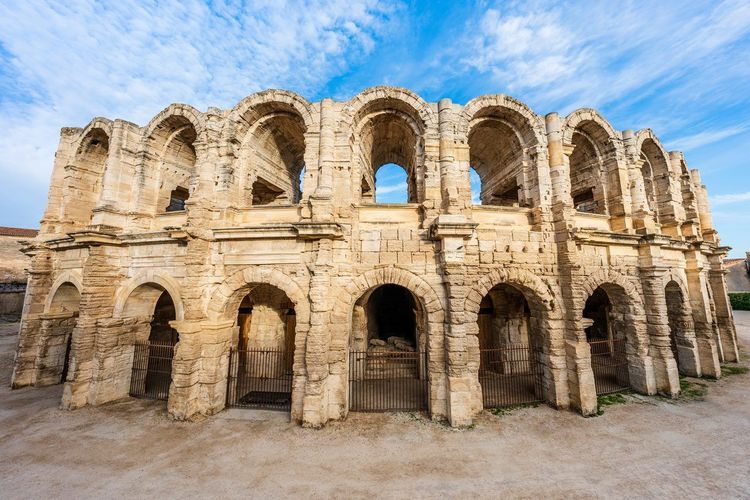
Camargue Races and Bullfights
Since the 19th century, the amphitheatre has hosted the course camarguaise, a Provençal tradition in which young raseteurs attempt to remove a rosette attached to a bull's horns without ever harming it: it is a local sporting discipline, distinct from bullfighting. The ferias, for their part, also include corridas, a more controversial practice but one still deeply embedded in the local calendar and strongly tied to the identity of part of the Arles population.
These events take place mainly from April to September, with particular intensity during the major ferias. If the subject interests you, it is worth checking the programme in advance: dates vary each year and certain performances sell out several weeks ahead.
Ferias and Major Popular Events
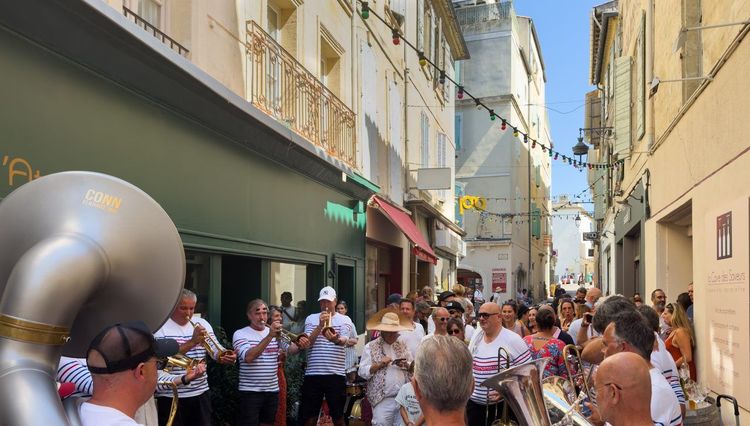
Two major ferias mark the Arles calendar: the Easter feria in spring and the Rice feria in September, inherited from the rice-growing tradition of the Camargue. For those few days, the entire city shifts into a non-stop festive atmosphere, with bodegas, street entertainment and crowds that multiply the city's usual population several times over.
These gatherings, unique in their scale in the south of France, temporarily transform the amphitheatre into the beating heart of the city, a role it has occupied without interruption since antiquity. Good to know: on days of major bullfighting events, the monument is not open for daytime visits, as access is reserved for ticket holders.
Concerts and Contemporary Performances
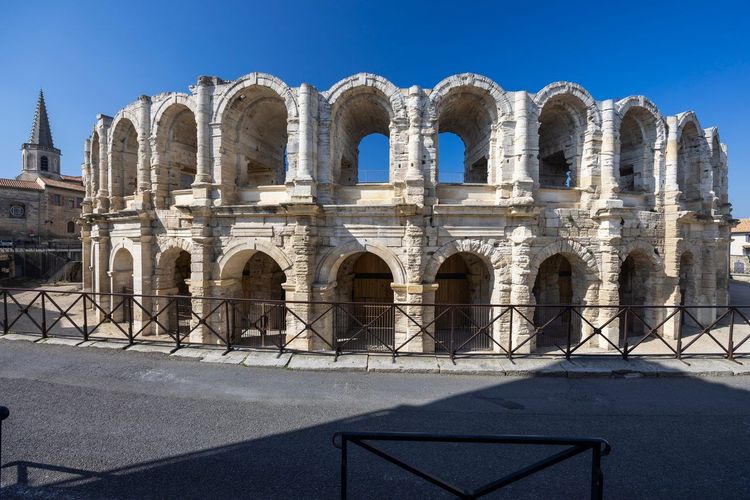
Outside bullfighting events, the amphitheatre regularly hosts open-air concerts and performances during the warmer months. The site's natural acoustics, originally designed to carry sound to the furthest tiers, continue to attract artists and organisers two thousand years after its construction.
Attending a concert in these stone tiers, beneath a Provençal sky that shifts to orange then violet at dusk, remains a rare enough experience to be worth mentioning: few performance venues in the world offer a setting so laden with history.
The Soul of Arles Among Ancient Stones
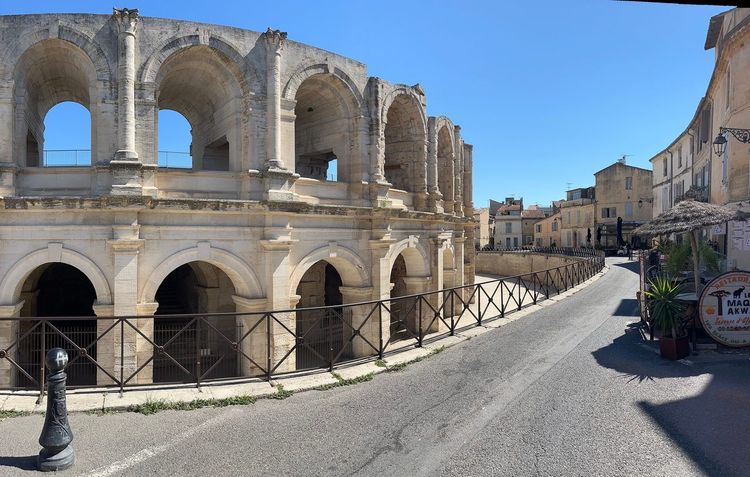
You could visit the amphitheatre as a hurried observer, tick the box and move on. That would be to miss the essential: this monument continues to beat to the rhythm of the city around it. The cobbled lanes that wind all around it, the café terraces set in the shade of old stones, the Provençal shutters in faded colours — all of this composes a coherent whole in which antiquity does not feel like a museum.
This continuity, rare for a monument of such age, owes much to the fact that the people of Arles have never stopped living with the amphitheatre rather than alongside it. You will come across residents cutting past the site at a brisk pace to reach the Saturday market, one of the largest in Provence, just as their ancestors did centuries ago. To grasp this living dimension of Arles' heritage, the Arles audio-guided tour offers a route that connects the ancient monuments to the daily life still rooted in the historic centre.
Other Ancient Treasures to Discover Near the Amphitheatre
The Ancient Theatre and the Forum Cryptoporticos
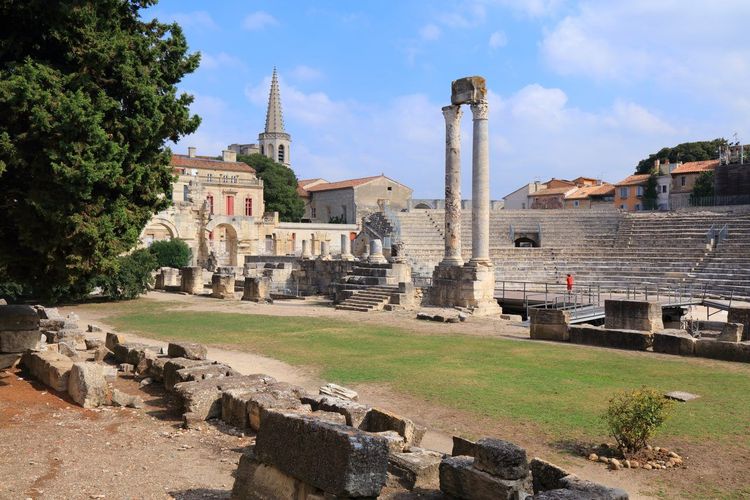
Five minutes' walk from the amphitheatre, the ancient theatre of Arles, built a century earlier during the reign of Augustus, ideally complements the visit. Less well preserved than the amphitheatre, it nonetheless retains two iconic columns, nicknamed the "two widows", which rank among the most photographed images in the city.
Heading back down towards the historic centre, the Forum cryptoporticos offer a radically different experience: these U-shaped underground galleries, built in the 1st century BC to support the Roman forum's square, can be visited today by the light of subdued illumination, in a welcome coolness during Provence's heatwaves.
Not far away, the more discreet remains of the Baths of Constantine, on the banks of the Rhône, bear witness to another aspect of Roman life: this 4th-century public baths complex, though incomplete, hints at the scale of the thermal facilities available to the ancient city.
The Saint-Trophime Cloister and the Vincent Van Gogh Foundation
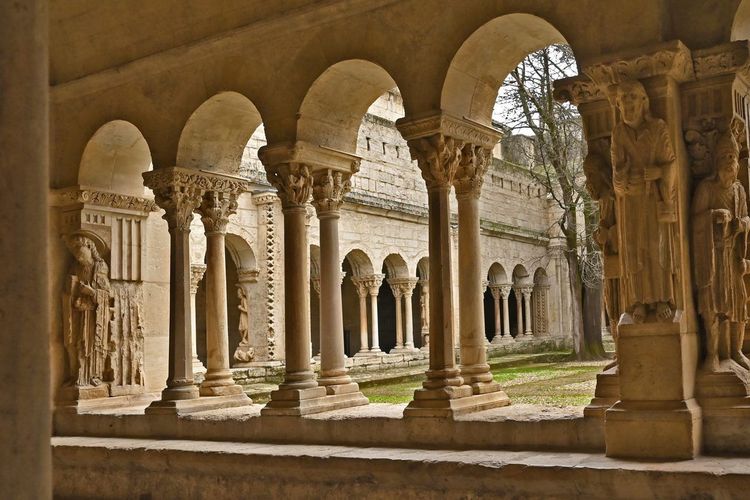
On the Place de la République, the Saint-Trophime cloister shifts into an entirely different architectural register: this Romanesque and Gothic ensemble, whose oldest galleries date back to the 12th century, rewards a closer look at its sculpted columns and the portal of the adjacent church, also listed as a UNESCO World Heritage Site.
A few streets away, the Vincent Van Gogh Foundation (35 Rue du Dr Fanton, 13200 Arles, rated 3.9/5 on Google from 2,796 reviews) closes the historical loop of the city with a more recent angle: dedicated to the painter who lived and worked in Arles for more than a year, it regularly brings together contemporary works inspired by his time there, a dialogue that works surprisingly well alongside the ancient atmosphere of the rest of the city.
Tickets, Prices and Opening Hours
The full admission price for the Arles Amphitheatre is around 9 to 10 euros per adult, with a reduced rate of approximately 8 euros for students and large families upon presentation of proof. Admission is free for those under 18, and free entry also exists for job seekers and people with disabilities. The ticket gives access to all levels open to the public, including the tiers.
If you plan to visit several of Arles' ancient monuments, the monuments pass sold by the city remains the most economical option: it bundles access to the amphitheatre, the ancient theatre, the cryptoporticos, the Baths of Constantine and the Saint-Trophime cloister for around twenty euros, and pays for itself from three sites visited. It can be purchased directly at the ticket desk of the first monument you visit.
Opening hours vary by season: the site opens around 9am throughout the year, with closing times ranging from 7pm or 7:30pm in high summer to 5pm in low season, from November to February. The monument remains closed on days of major bullfighting events, for obvious safety reasons, as well as on 1 January, 1 May and 25 December. To avoid the crowds, opt for a visit early in the morning at opening time, or in the late afternoon: the raking light on the limestone is far more photogenic than at midday. Since prices and hours are revised each year, a quick check on the Arles tourist office website before you leave will save any unpleasant surprises.
When to Visit the Arles Amphitheatre: Season, Crowds and Light
The monument is open year-round, but the experience changes entirely depending on the time of year. Between mid-June and the end of August, the limestone radiates the heat stored throughout the day and the tiers, without a single patch of shade, become uncomfortably hot between 1pm and 4pm. It is better to aim for opening time around 9am, or the last hour before closing, with a water bottle and a hat in your bag.
Spring remains the most comfortable window. In April and May, temperatures hover around 20 degrees, the Provençal light is already clear without being overwhelming, and visitor numbers have not yet reached July levels. Be aware, however, of the Easter weekend: the feria mobilises the entire city and the amphitheatre is not open for independent visits at that time.
September and October offer the best compromise for those wishing to photograph the arcades. The low-angled late-afternoon sun deepens the relief of the stone and gives the façade ochre tones that midday light completely flattens. The Rice feria in September concentrates the activity into just a few days: the rest of the month returns to an almost provincial calm.
Winter has its devotees. From November to February, you can have the tiers almost to yourself, with the added bonus of a mistral that sweeps the sky clear and delivers rare visibility towards the Alpilles from the upper levels. Simply bring adequate layers: nothing breaks the wind in an open ellipse, and this is also the season when opening hours are shortest. The quieter winter season also pairs well with Arles' audio-guided tour, with no queues to slow the pace.
How to Get to the Arles Amphitheatre
By train, Arles station is about fifteen minutes' walk from the amphitheatre, a distance easily manageable for those without heavy luggage. TER connections from Avignon (approximately 20 minutes) or Marseille (around one hour) are frequent and avoid the parking headache in the city centre.
By car, allow approximately one hour from Marseille via the A54, or 45 minutes from Avignon. Since the historic centre of Arles is largely pedestrianised and traffic is restricted, it is better to park in one of the peripheral car parks, such as Les Lices or the one near the station, then complete the journey on foot: ten to fifteen minutes is sufficient from most of them.
Once in the centre, everything is naturally done on foot. The amphitheatre is just a few minutes from the ancient theatre and from the Place du Forum, right in the heart of a compact historic centre that can be explored without difficulty in half a day.
Practical Tips for Planning Your Visit
Allow approximately 45 minutes to 1 hour for a complete visit of the amphitheatre, including climbing to the upper levels to enjoy the panorama. If you combine the visit with the ancient theatre and the cryptoporticos, plan for half a day so as not to rush anything.
In terms of accessibility, the site has undergone gradual improvements: the arena level is accessible to visitors with reduced mobility, but the upper floors, reached by irregular stone staircases, remain difficult to access by wheelchair. It is best to check directly at the reception desk on the day to find out what facilities are available and any assistance that may be offered.
With children, the amphitheatre works particularly well: the spectacular scale of the place, its somewhat mysterious galleries and the stories about gladiators easily capture attention, where other ancient monuments can seem more austere to younger visitors. This is precisely the kind of visit for which the Ryo audio guide comes into its own: rather than reading information panels, you follow a commented route that puts each stone in context, with anecdotes designed to keep both young and old engaged. Our app works offline once downloaded, a practical detail in a monument where mobile reception is poor between the thick stone walls.
One last useful tip: wear appropriate footwear. The tiers and galleries alternate between stone polished by centuries of use and uneven ground, a combination poorly suited to smooth soles or heels.
What Else to See Around Arles: The Camargue and the Alpilles

Arles serves as a natural gateway to two Provençal territories with radically different atmospheres. About twenty minutes to the south lies the Camargue, with its flamingo-pink lagoons, rice paddies and famous semi-wild white horses: our guide to visiting the Camargue and its must-sees details the best observation points, while those looking for more immersive experiences will find in our article on horse riding in the Camargue plenty of ways to extend their stay in the open air.
In the opposite direction, to the north-east, the Alpilles unfold a landscape of limestone hills and perched villages that rival Tuscany. Our selection of the most beautiful villages of the Alpilles naturally complements an Arles-centred trip, for those with an extra day or two to spare.

FAQ
How Can I Visit the Arles Amphitheatre?
Access is through the main entrance, on the Rond-Point des Arènes side. A single entry ticket or a monuments pass allows you to explore the levels open to the public freely, with information panels or an audio guide as a supplement. Guided tours are also offered during certain periods.
What Is the Admission Price for the Arles Amphitheatre?
The full price is around 9 to 10 euros, with a reduced rate of approximately 8 euros for students and large families. Admission is free for those under 18. The monuments pass, at around twenty euros, becomes better value from three sites visited.
What Are the Opening Hours of the Arles Amphitheatre?
The monument generally opens around 9am, closing between 5pm in low season and 7:30pm in high summer. Opening hours may be modified or visits suspended during major bullfighting events.
How Much Time Should I Allow for Visiting the Amphitheatre?
A complete visit, including the tiers, takes approximately 45 minutes to 1 hour. Allow half a day if you add the ancient theatre and the Forum cryptoporticos.
Is the Arles Amphitheatre Accessible to People with Reduced Mobility?
The arena level is accessible by wheelchair, but the upper tiers, reached by stone staircases, remain difficult to access. It is advisable to check with the reception desk on the day of your visit.
Can I Attend a Show at the Arles Amphitheatre?
Yes, the monument hosts Camargue races, ferias and, during the summer season, open-air concerts from April to September. Dates vary each year and certain events sell out in advance.
How Do I Get to the Arles Amphitheatre from the Train Station?
Allow about fifteen minutes on foot from Arles station, via a direct route through the historic centre. No bus is needed, as the city centre remains compact.
Visiting the Arles Amphitheatre: Key Takeaways
At the end of this journey through two thousand years of history, the Arles Amphitheatre leaves a rare impression: that of a monument that has never truly retired. An hour is enough to take it all in, but between the ancient remains of the centre, the Provençal atmosphere of the surrounding lanes, and the gateway to the Camargue and the Alpilles, the city more than deserves more than a quick photo stop.
To plan your visit without missing any of the details that make the site so rewarding, the audio-guided tour of Arles remains the most effective complement to this reading: a way of turning a visit into a commented stroll, at your own pace and guided by your own curiosity.
À lire également