© Shutterstock
 Votre guide Ryo
History of Besançon: From Vesontio to the Vauban Citadel (2026)
Vesontio, a natural stronghold nestled in a bend of the Doubs, took less than two thousand years to become the city we know today, yet each century left a visible layer in the stone. To understand the history of Besançon is to travel back along a river of dates: Caesar's legions halting before the Sequani oppidum in 58 BC, the Roman arch still crossing the Grande Rue twenty centuries later, the siege of 1674 that brought the city into the kingdom of France, and the watchmaking workshop that transformed a garrison town into an industrial capital of time.
Along the way, less expected scenes appear: a cradle in which Victor Hugo was born in 1802, a citadel built by Vauban that would serve in turn as a fortress, a zoo, and a place of tragic remembrance, and two brothers, the Lumières, who would go on to invent cinema just a few streets away. The Ryo audio-guided tour of Besançon already brings part of this story to life as you walk through the lanes of the historic centre, but this guide unfolds the entire timeline, from the first prehistoric settlements along the Doubs to the green, university city of today.
Origins: Prehistory and the First Inhabitants of the Doubs
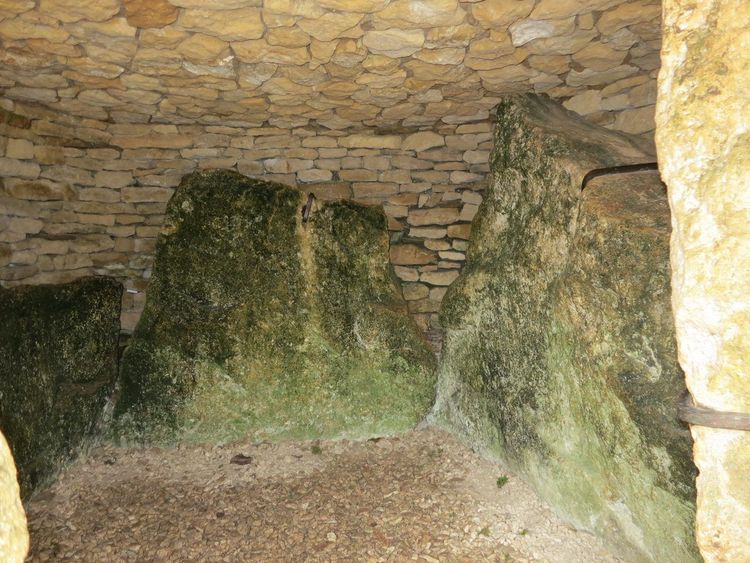
The bend of the Doubs attracted human settlement long before any city was founded there. Remains from the Middle Palaeolithic have been found in the caves that pierce the limestone hills surrounding the site, proof that groups of hunter-gatherers already occupied the valley tens of thousands of years ago. The banks of the Doubs, rich in game and water sources, offered ideal hunting ground, while rocky overhangs served as natural shelters. By the Iron Age, the Gaulish people of the Sequani had established a lasting presence on the rocky spur of Mont Saint-Étienne, protected on three sides by the river — a defensive choice so obvious that it would dictate the urban layout of the city for two thousand years.
This first Sequani settlement was far from an isolated hamlet. Vesontio quickly became one of the most important strongholds of the eastern Gaulish confederation, wealthy enough to attract Rome's attention at a time when the Republic was seeking to secure its frontier against Germanic peoples. It is thus from Prehistory that the main thread of the entire history of Besançon takes shape: a geography that both protects and confines, imposing at every era the same logic of a fortress.
Vesontio: the Gaulish City That Became a Roman Capital
It was Julius Caesar himself who gave Besançon its first written mention. In his Commentaries on the Gallic War, he describes Vesontio as the most considerable oppidum of the Sequani, endowed with near-impregnable natural fortifications thanks to the meander of the Doubs. In 58 BC, Caesar stopped there to confront the Germanic chieftain Ariovistus, an episode that almost ended in disaster when his own soldiers, terrified by tales of Germanic warriors, threatened to refuse combat. The Roman general had to harangue his troops to restore their morale, a moment historians regularly cite as one of the psychological turning points of the conquest of Gaul.
Once the region was pacified, Vesontio entered the Roman orbit and transformed within two centuries into a true provincial capital. The city received a theatre capable of holding several thousand spectators, the remains of which can still be observed at square Castan, a forum, baths fed by an aqueduct more than seven kilometres long carrying water from the springs at Arcier, and a grid of orthogonal streets that still partly shapes the layout of the modern city centre.
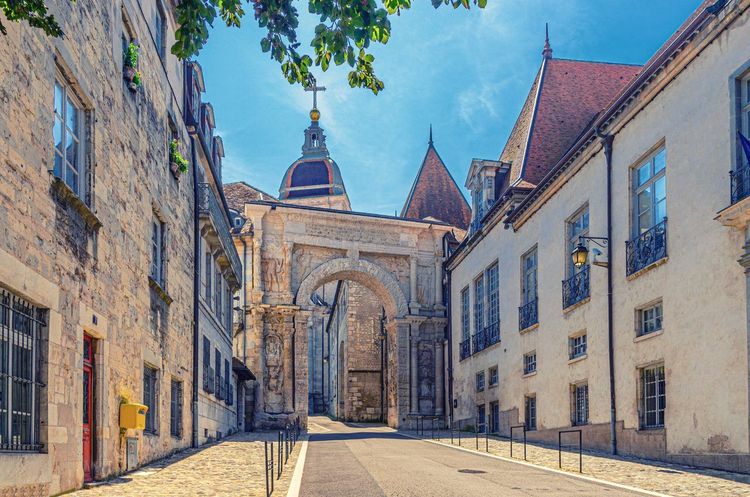
The most spectacular Roman monument survives elsewhere, however: the Porte Noire, a triumphal arch erected around 175 AD to celebrate the victories of Emperor Marcus Aurelius, still spans the Grande Rue. Blackened by smoke and centuries, sculpted with battle scenes and mythological motifs, it remains the largest Roman arch in Gaul after that of Orange. To pass beneath this arch today is to literally follow the same axis as Roman legionaries eighteen centuries ago.
At its peak, under the Antonines, the city probably counted several thousand inhabitants and shone as a commercial hub on the route linking Italy to the Rhine. The decline of the Western Roman Empire eventually affected it as it did the rest of Gaul. The invasions of the 3rd century pushed inhabitants back behind tighter ramparts, cutting off the ancient city from much of its former extent — a withdrawal that already foreshadowed the fortified city Vauban would envision thirteen centuries later.
This transition from the ancient world to the early Middle Ages can also be read in the urban fabric traced by the sub-tour Une histoire de temps, one of the chapters of Besançon's Ryo audio-guided tour that precisely follows the archaeological layers of the Grande Rue, from Antiquity to the watchmaking industry of the 19th century.
The Middle Ages: an Episcopal City between Rival Powers
After the fall of Rome, the region passed under Burgundian then Frankish rule, before experiencing a classic feudal fragmentation. The Bishop of Besançon, and then the Archbishop from the 11th century onwards, accumulated considerable temporal power, managing both spiritual affairs and a large part of the city's administration. This dual role created lasting tensions with the merchant bourgeoisie, which was growing wealthy through river trade and fairs and was demanding greater autonomy.
The conflict reached its peak in 1290, when the Germanic Emperor Rudolph of Habsburg recognised Besançon as a free imperial city. This status, unique in the region, allowed the city to govern itself through a body of elected magistrates, while remaining nominally attached to the Holy Roman Empire rather than to the neighbouring kingdom of France or the County of Burgundy. This situation as a semi-independent enclave would last nearly four centuries and forge a distinct Bisontine identity, oriented towards Germanic and Swiss commercial networks rather than towards Paris. It also explains why the history of Besançon long followed a trajectory out of step with that of the neighbouring kingdom.
On the religious front, this period saw the construction and enlargement of Saint-Jean Cathedral (2 Rue de la Convention, 25000 Besançon, rated 4.5/5 on Google with 638 reviews), whose oldest parts date back to the 12th century, even though the current building blends several construction campaigns up to the Renaissance. The monument today houses a 19th-century astronomical clock, a late addition that nonetheless makes it one of the symbols of the relationship the city would later develop with the measurement of time.
Like many medieval cities, Besançon also went through dark periods: recurring plague epidemics from the 14th century, devastating fires, and famines. These crises did not prevent the trade guilds from structuring a dense economic life — tanning, cloth, and the salt trade at the forefront — laying the foundations for the prosperity the city would display during the Renaissance.
Coat of Arms and Mottoes: Reading Bisontine Identity
Few cities tell their past so eloquently through their coat of arms. The arms of Besançon combine the black eagle of the Holy Roman Empire on a golden background with two columns that directly recall the Roman remains of the Porte Noire and the memory of Hercules, the mythical protector of cities. This blazon alone encapsulates two key moments in Bisontine history: the ancient Roman legacy and the attachment to the Germanic Empire obtained at the end of the 13th century.
The Latin motto "Utinam", which can be translated as "Would to God" or "May it be so", traditionally accompanies these arms and expresses the wish for prosperity of a merchant city proud of its autonomy. A second formula, "Deo et Caesari fidelis perpetuo" ("Faithful to God and to the Emperor forever"), sums up the balancing act of a free city that remained loyal to the Empire while constantly negotiating its independence. Spotting these symbols on the façades and fountains of the old centre is another way of reading the history of Besançon, engraved in stone rather than in books.
Spanish Franche-Comté: Renaissance and Bisontine Influence
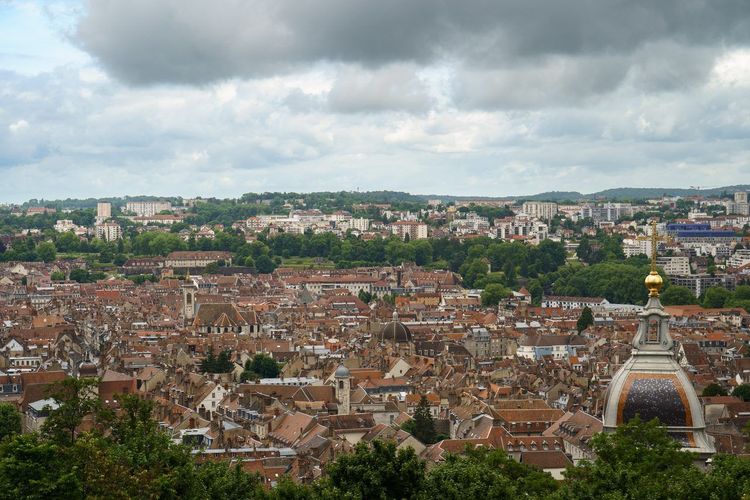
In 1477, the death of Charles the Bold brought the County of Burgundy — of which Besançon remained an independent but economically linked enclave — under Habsburg rule through the marriage of Mary of Burgundy. A century later, under Charles V and then the kings of Spain, Franche-Comté became a Spanish possession while the city itself retained its special status as a free city. This institutional paradox did not prevent Besançon from experiencing one of its golden ages.
The Perrenot de Granvelle family embodied this moment. Nicolas Perrenot, born near Besançon, became chancellor to Charles V, and his son Antoine, the future Cardinal de Granvelle, began constructing the Palais Granvelle from 1534, a jewel of the Comtois Renaissance with its arcaded courtyard and richly decorated apartments. An influential diplomat in the service of the Habsburgs, Antoine de Granvelle also transformed his hometown into a crossroads for intellectual and artistic exchange with Italy and Flanders. It was also during this period that Besançon obtained the right to mint coins and to host major exchange fairs, which attracted Italian bankers and Flemish merchants. The palace today houses the Musée du Temps, which traces the history of Bisontine watchmaking — a fitting shortcut between two golden ages of the city.
This Spanish prosperity came to an abrupt end the following century, when Louis XIV decided that Franche-Comté must become French.
1674: Louis XIV's Siege and the Annexation to France
Louis XIV's France had long coveted Franche-Comté, as much for strategic reasons as to erase a territorial anomaly at the heart of the kingdom. A first lightning campaign in 1668 allowed French troops to seize the province within a few weeks, but the Treaty of Aix-la-Chapelle compelled Louis XIV to return it to Spain the same year.
The king returned in 1674, this time with the intention of keeping his conquests. He personally led the siege of Besançon, supported by the military engineer Sébastien Le Prestre de Vauban, who was tasked with breaching the city's defences in record time. After several weeks of trenches and bombardments, the city capitulated in May 1674, with the citadel falling a few days later. Unlike the previous episode, this annexation proved permanent: the Treaties of Nijmegen, signed in 1678 and 1679, confirmed the annexation of the entire Franche-Comté to the kingdom of France.
Besançon then lost its former status as a free city, but gained in return the rank of provincial capital, wrested from Dole which had held that role under Spanish rule. This turning point of 1674 is arguably the most decisive hinge in the entire history of Besançon: in less than ten years, the city went from an imperial enclave oriented towards the Germanic world to a French stronghold facing Paris. The king entrusted Vauban with the task of transforming the conquered city into an impregnable military lock against any potential reconquest.
Vauban and the Citadel: a Sentinel City
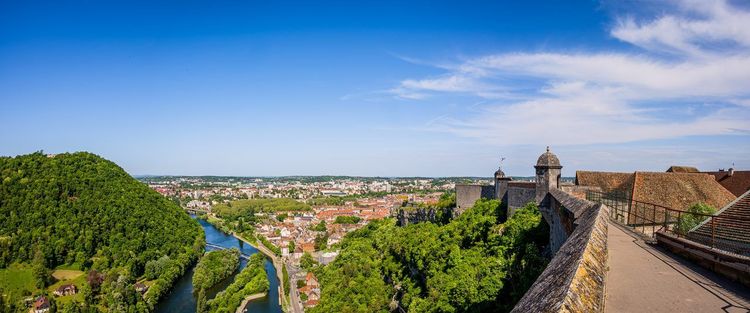
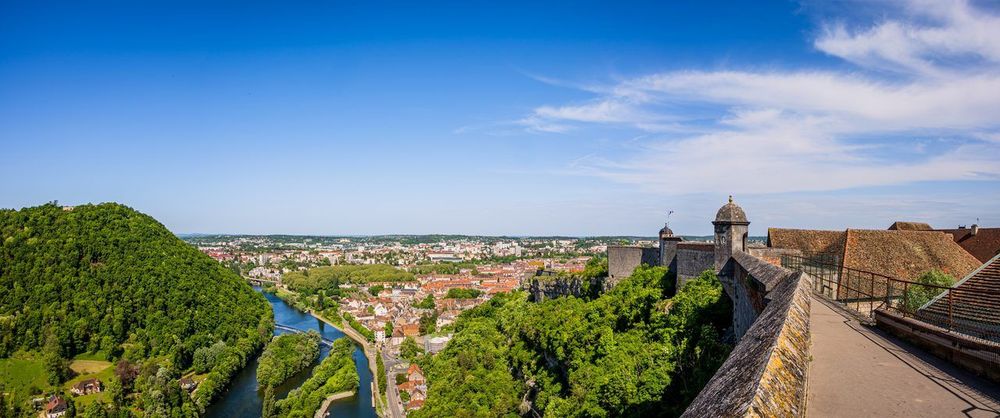
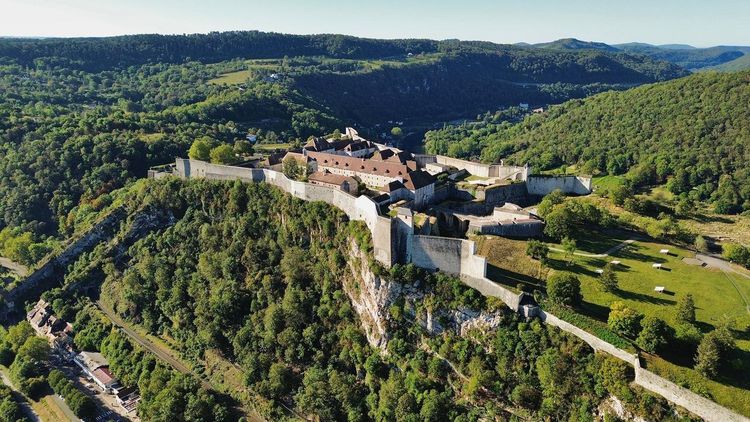
As early as 1668, Vauban drew up plans for a fortress to occupy the summit of Mont Saint-Étienne, exactly where the Sequani and then the Romans had already identified the defensive advantage of the site. The work, carried out from 1668 to 1711 with some interruptions, resulted in the Citadel of Besançon (99 Rue des Fusillés de la Résistance, 25000 Besançon, rated 4.5/5 on Google with 8,936 reviews), an ensemble of bastions, curtain walls, and barracks that dominates the entire bend of the Doubs and completes a defensive system that also encompasses Fort Griffon and the city ramparts.
The structure still impresses by its dimensions: nearly eleven hectares of fortifications, walls several dozen metres high, and a sheer drop down to the river. Vauban, who returned several times to supervise the construction, considered Besançon one of his best-protected positions, making full use of a terrain that nature had already half-fortified. Yet this citadel was not confined to a frozen military role. A garrison for more than two centuries, it lived through every major French crisis — the Revolution, the Napoleonic wars, both 20th-century world conflicts — before undergoing a gradual conversion into a cultural site from the 1950s onwards. It now houses several museums, including a zoological space, a natural history museum, and a museum dedicated to the Resistance and Deportation, whose tragic history will be detailed later in this guide.
The scale and coherence of the work earned it UNESCO World Heritage status in 2008, as part of a network of twelve fortified sites designed by Vauban across France. Few French cities can boast a Grand Siècle defensive system as complete as this, from the city ramparts to the hilltop. Walking the rampart paths also offers one of the broadest panoramas over the old town and the Doubs valley.
This gradual conversion — from a tool of war to a place of memory and culture — neatly encapsulates the trajectory of Besançon itself over the following centuries: a city that systematically transforms its inheritances rather than erasing them.
The 18th Century: a Parliamentary and Academic City
The annexation to France permanently transformed the administrative organisation of the province. In 1676, the Parliament of Franche-Comté, previously based in Dole, was transferred to Besançon, definitively consecrating its role as regional capital. The city now hosted the intendancy, the courts of justice, and a royal administration that settled into new private mansions built throughout the 18th century.
This century also saw the emergence of a structured intellectual life: the Academy of Sciences, Letters and Arts of Besançon was founded in 1752, bringing together scholars and notables around the scientific and literary concerns typical of the Age of Enlightenment. The great parliamentary families built vast townhouses whose classical façades still adorn several streets of the historic centre today, offering a striking architectural contrast with the medieval towers and ancient remains mentioned earlier. You will notice, walking along the Grande Rue, just how closely these successive layers — Roman, medieval, classical — coexist within just a few hundred metres. It is this rare superposition that makes the Grande Rue an open-air condensation of the history of Besançon, where one moves from a Roman arch to an Enlightenment mansion in just a few steps, a contrast that Ryo's A Matter of Time audio-guided tour brings to life along that same street.
The French Revolution in Besançon
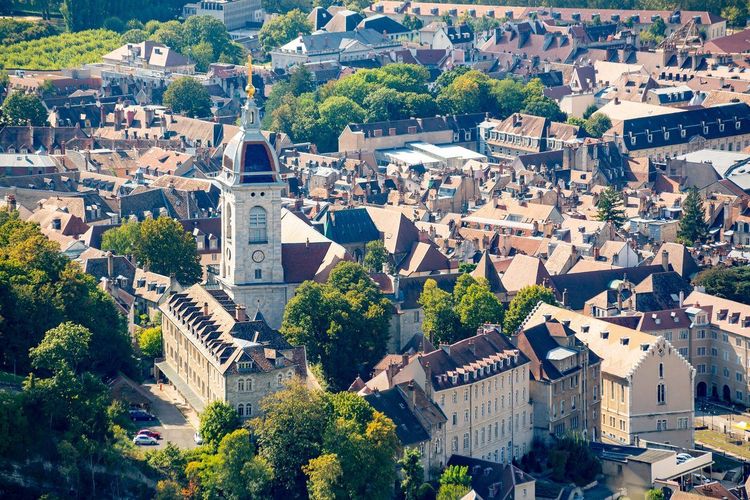
The Revolution reshuffled the administrative cards of the entire province. In 1790, the Doubs department was created, with Besançon as its natural capital, extending the role of regional capital it had acquired a century earlier. The city experienced its share of active Jacobin clubs, nationalised ecclesiastical properties, and revolutionary tribunals — Saint-Jean Cathedral was even temporarily requisitioned for secular use during the most radical period.
These turbulent years ultimately left few monumental traces compared to previous centuries, but they established an administrative framework — that of the department — which still structures the current organisation of the Bisontine region. It was also in this moment of refoundation, in 1793, that the city's economic future was paradoxically set in motion, with the arrival of the first Swiss watchmakers described in the following section.
The Golden Age of Bisontine Watchmaking
If Besançon is today associated with the measurement of time, it owes this to a specific episode at the end of the 18th century. In 1793, driven by revolutionary authorities eager to develop a strategic industry, Swiss watchmaker Laurent Mégevand settled in Besançon with several dozen companions to found a watchmaking manufactory. The venture took lasting root: less than a century later, the city concentrated the bulk of French watchmaking production.
This specialisation was organised around a very particular model known as établissage, in which multiple family workshops each manufactured a single component of the movement before final assembly. The National School of Watchmaking, founded in 1862, trained generations of technicians and consolidated the city's international reputation. In 1867, Emmanuel Lipmann founded what would become the Lip manufactory, whose name would remain associated with French industrial history long after the sector's decline. The city even acquired, in 1885, a chronometric observatory tasked with controlling and certifying the precision of watches, a hallmark that long filled local manufacturers with pride.
The peak came in the first decades of the 20th century, when tens of thousands of Bisontins lived directly or indirectly from watchmaking. The quartz crisis of the 1970s dealt a fatal blow to this artisanal model, but the most resounding episode remains the self-managed strike at Lip in 1973: faced with the announced closure of the factory, the workers occupied the premises, resumed production and sales under the famous slogan "Lip, c'est possible" ("Lip, it's possible"), a social movement that reached far beyond the borders of Franche-Comté and lastingly marked the history of French trade unionism.
Today, this watchmaking heritage can be explored at the Musée du Temps housed in the Palais Granvelle already mentioned, as well as in several converted workshops. If you want to extend this dive into the city's industrial past beyond reading, our Ryo article on the top 6 things to do in Besançon lists the best ways to discover this heritage on the ground.
Industrial Besançon: Textiles, Mechanics, and the Labour Movement
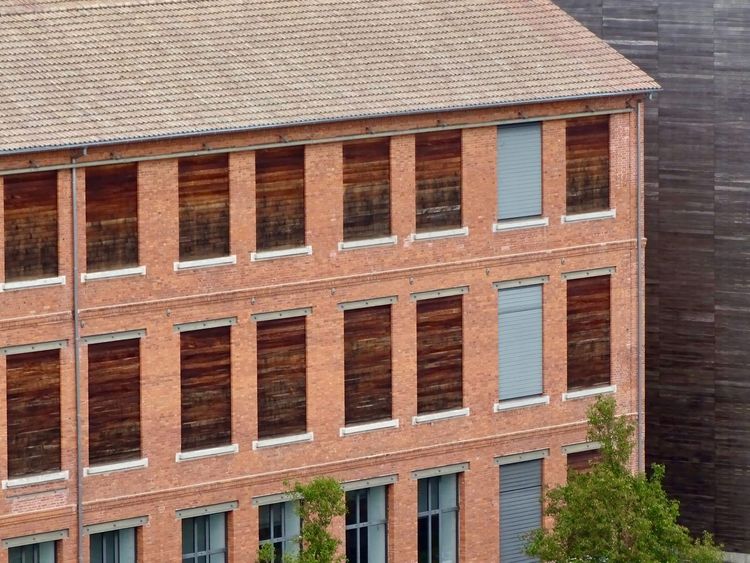
Watchmaking was not the only industry to shape the city in the 19th and 20th centuries. The textile sector also experienced significant growth, driven notably by the Comptoir de l'industrie cotonnière and then by the production of rayon, a synthetic fibre that employed hundreds of workers in several factories in the metropolitan area from the 1900s onwards.
This industrialisation transformed the city's social geography. Working-class neighbourhoods developed around the factories, particularly in the Battant area, while housing estates built for families employed in the manufactories sprang up on the outskirts. This concentration of workers nourished a dense trade union network, which found its most spectacular expression in the Lip conflict of the 1970s already mentioned, but which was in reality rooted in decades of earlier social struggles tied to working conditions in textiles and precision mechanics.
In the 20th century, the Bisontine industrial landscape diversified further with the establishment of chemical and mechanical factories, extending a local tradition of technical expertise inherited directly from the watchmaking workshops. This continuity — from watch gears to contemporary microtechnology — is one of the most distinctive threads running through the history of Besançon.
The Two World Wars: Occupation and Resistance
World War I mobilised Besançon primarily as a garrison city, with the citadel and surrounding barracks serving as assembly and training points for troops sent to the front. The city remained relatively spared from direct fighting, which was centred further north, but paid a heavy human toll like the rest of the country.
World War II, however, left a deep mark on local memory. Besançon was occupied by German troops from June 1940. The citadel, a military symbol since Vauban, became a place of detention and execution used by the occupier: more than a hundred resistance fighters and hostages were shot there between 1940 and 1944, a figure that explains the name of the street that borders the monument today — the rue des Fusillés de la Résistance, already mentioned in the addresses of sites visited earlier in this guide. The city also housed, from 1940 onwards, one of the very first internment camps in the occupied territory, set up in the Vauban barracks and intended for British nationals, a long-overlooked episode of this period.
The city was finally liberated on 8 September 1944 by French and American troops, as part of the Allied advance moving up from Provence following the landing of the previous month. Today, a museum dedicated to the Resistance and Deportation, housed within the citadel itself, perpetuates the memory of this period, with a display that places the Bisontine experience in the broader context of the Occupation in France.
This dark page of local history stands in sharp contrast to the peaceful, green image the city projects today, but it partly explains the particular attachment Bisontins have to their citadel, perceived less as a tourist monument than as a living place of memory.
Contemporary Besançon: University, World Heritage, and Green City
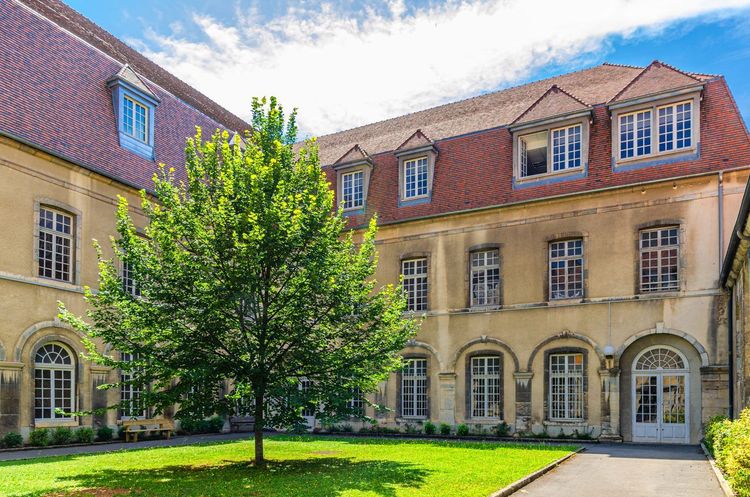
The post-war period set Besançon on a gradual path of transition towards higher education, research, and services, in parallel with the slow decline of traditional watchmaking. The University of Franche-Comté, whose roots go back to an early foundation in the 15th century that was several times interrupted and re-established, underwent major expansion during the 20th century and today makes the city a leading regional university hub, with a recognised specialisation in microtechnologies — a direct heir to the watchmaking expertise.
The inscription of the citadel on the UNESCO World Heritage List in 2008 officially marked this shift from a fortress city to an open-air museum city. Besançon has also cultivated for several decades an image as a green city, regularly recognised for its preserved natural spaces along the Doubs and its early environmental policies — a reputation that stands in contrast to its past as a closed military city. The city was in fact one of the first in France to establish protected green spaces in the late 19th century, and its wooded hills are now an integral part of its urban landscape.
The arrival of the Rhine-Rhône high-speed rail line in 2011 finally brought Besançon to within approximately two hours of Paris by train, facilitating short-break tourism that the city's rich heritage more than justifies. This new accessibility gave a boost to visitor numbers, driven by a dense history of Besançon that is legible in every neighbourhood. For those wishing to broaden their exploration beyond the city's boundaries, our Ryo article on the 14 must-sees of the Doubs naturally extends this immersion in the region.
Bisontine Figures and Memory
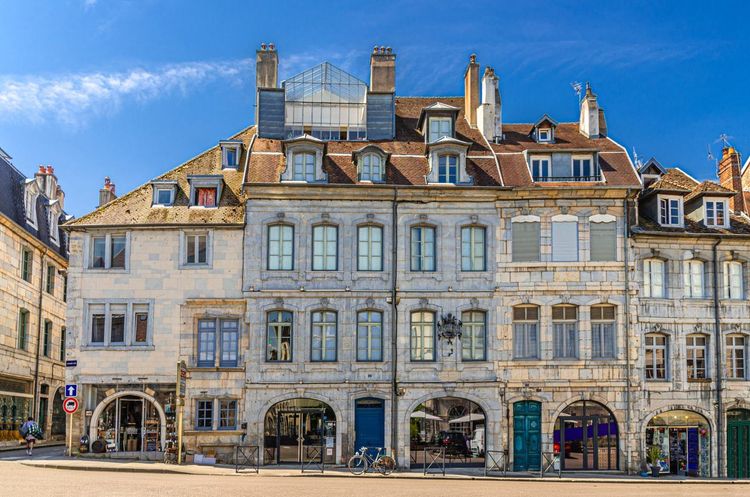
Besançon has been the birthplace of several figures who far exceed the regional sphere. Victor Hugo, born in 1802 in a house on the Grande Rue still visible today, opens one of his poems with the famous line "Ce siècle avait deux ans" ("This century was two years old"), explicitly recalling his hometown, which he describes as an "old Spanish city". The utopian philosopher Charles Fourier, theorist of the phalansteries, was also born in Besançon in 1772, while the brothers Auguste and Louis Lumière, pioneers of cinematography, were both born in the city before their family moved to Lyon, where they would develop their inventions.
The list goes on: the poet Tristan Bernard and the writer Colette left their mark there in passing, and the birthplace of Victor Hugo, converted into a museum, can be visited today on place Victor-Hugo, steps away from that of the Lumière brothers. This concentration of major figures within a few hundred metres makes the Grande Rue a veritable open-air pantheon, where literary and scientific memory overlays the archaeological strata.
For those wishing to explore this chronology beyond a single article, historian Claude Fohlen remains an essential reference: his work on the history of Besançon, the fruit of decades of academic research, continues to be the authoritative source for researchers and informed enthusiasts wishing to cross-reference the archaeological, administrative, and industrial sources discussed throughout this guide.
FAQ
When did Besançon become French?
Besançon officially became French in 1674, following the second siege led by Louis XIV with the support of Vauban. The annexation of the entire Franche-Comté to the kingdom was subsequently confirmed by the Treaties of Nijmegen in 1678 and 1679, ending several centuries of special status under Spanish and then imperial administration.
Why is Besançon nicknamed the capital of watchmaking?
This reputation dates back to 1793, when Swiss watchmaker Laurent Mégevand set up a manufactory in the city with the support of the revolutionary authorities. The Bisontine watchmaking industry experienced continuous growth until the 20th century, structured around small family workshops and a specialist school founded in 1862.
Who founded Besançon?
The city has no single identified founder: it developed from a Sequani Gaulish oppidum on the defensive site of Mont Saint-Étienne, before Rome made it a major provincial city under the name Vesontio, first mentioned by Julius Caesar in 58 BC.
What is the connection between Besançon and Victor Hugo?
Victor Hugo was born in Besançon in 1802, in a house on the Grande Rue that still stands today. The writer explicitly evokes his hometown in several of his works, helping to anchor Besançon in the French literary memory of the 19th century.
Why is the citadel of Besançon listed as a UNESCO World Heritage Site?
The citadel, designed by Vauban between 1668 and 1711, belongs to the network of twelve Vauban fortifications collectively inscribed on the UNESCO World Heritage List in 2008, recognised for the coherence and scale of their defensive system dating from the reign of Louis XIV.
Where does the name Vesontio come from?
Vesontio is the Gaulish and later Roman name of the city, first mentioned by Julius Caesar in his Commentaries on the Gallic War. Its exact origin remains debated by linguists, but the term most likely refers to the fortified site established in the bend of the Doubs occupied by the Sequani.
What role did Besançon play during World War II?
Occupied by Germany from June 1940, Besançon saw its citadel transformed into a place of detention and execution: more than a hundred resistance fighters were shot there before the liberation of the city on 8 September 1944. A Museum of the Resistance and Deportation perpetuates this memory today within the fortress itself.
From Vesontio to the Vauban citadel, the history of Besançon is contained within that same bend of the Doubs that first protected the Sequani, then the Roman legionaries, then the kings of France. Each century added its own layer without ever truly erasing the previous one, so that a simple walk along the Grande Rue crosses two thousand years in just a few hundred metres, from the Roman Porte Noire to the watchmaking workshops of the 19th century.
To discover this story directly on the ground, rather than simply through reading, the Ryo audio-guided tour of Besançon connects most of the places mentioned here, from the ancient amphitheatre to the citadel, via the Palais Granvelle and the lanes of the former watchmaking quarter.