© Shutterstock
 Votre guide Ryo
Vieux-Lille: Complete Guide to the Historic District in 2026
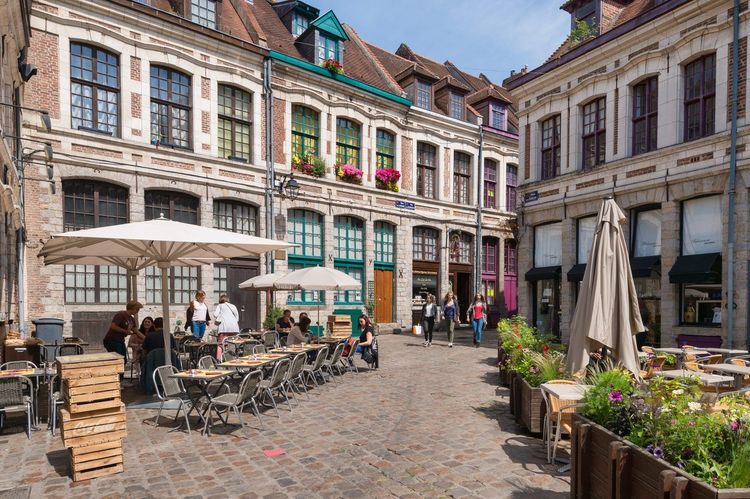
The Vieux-Lille district, in Lille, hides beneath its rain-slicked cobblestones and ochre brick façades an open-air library of five centuries of Flemish history. This compact neighbourhood, wedged between the Grand'Place and the old ramparts, can be crossed in twenty minutes on foot yet deserves a full day of wandering. To make sure you miss none of the details on its façades, the Ryo audio tour of Lille comments on a large part of this area directly from your smartphone, while you gaze up at the scrolled gable ends.
In the pages that follow, you will encounter a 17th-century merchants' exchange turned impromptu reading room, a shopping street several centuries old, a cathedral whose translucent marble façade was only completed in 1999, and a patisserie founded in 1761 where people still queue for a filled waffle. The Vieux-Lille district, in Lille, is worth exploring for its Flemish architecture as much as for its gastronomy, its canals and its independent boutiques. Here is how to approach it, street by street, leaving nothing out.
A Brief History: How Vieux-Lille Came to Be
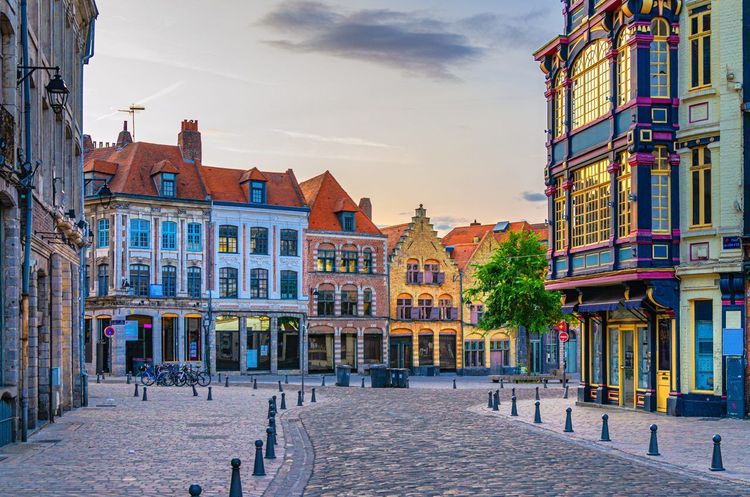
Vieux-Lille has not always carried this affectionate name. Until the 19th century, it was simply Lille — the entire city, huddled behind its fortifications. The settlement developed from the 11th century around a river island on the Deûle, from which its probable name derives ('l'Isle'), before becoming in the 17th century a thriving trading post under Spanish rule, then French rule after the 1667 siege led by Louis XIV and Vauban.
This dual guardianship — Flemish in custom and French in administration — shaped the architectural identity that we admire today: red brick façades punctuated by white stone, stepped gable ends, and carved decorations in limestone imported by waterway. Brick, a cheap local material, was used to build the walls, while white stone, being rarer, was reserved for window surrounds and ornamental details. This chromatic contrast, found on almost every historic façade in the district, has become the true visual signature of Vieux-Lille. When the city expanded in the 19th century with the cutting of wide boulevards, the old merchant centre was deliberately preserved, almost frozen in time, which explains why it forms such a densely heritage-rich enclave within barely a square kilometre.
The 1960s and 1970s, however, nearly proved fatal: urban renewal programmes planned to demolish entire blocks deemed uninhabitable. It was the mobilisation of residents and heritage conservation associations that reversed the trend, leading to a protected area designation that froze its historic boundaries. The following decades saw the gradual rehabilitation of buildings, the pedestrianisation of several streets, and the arrival of independent shops that breathed new life into façades long left to decay. The district you visit today thus owes as much to its merchant past as to this belated heritage revival. Keep that in mind as you stroll: every restored building represents a battle won against demolition, and it is this that gives Vieux-Lille the rare coherence that few French historic centres have managed to preserve so completely.
The Grand'Place, the Beating Heart of the District
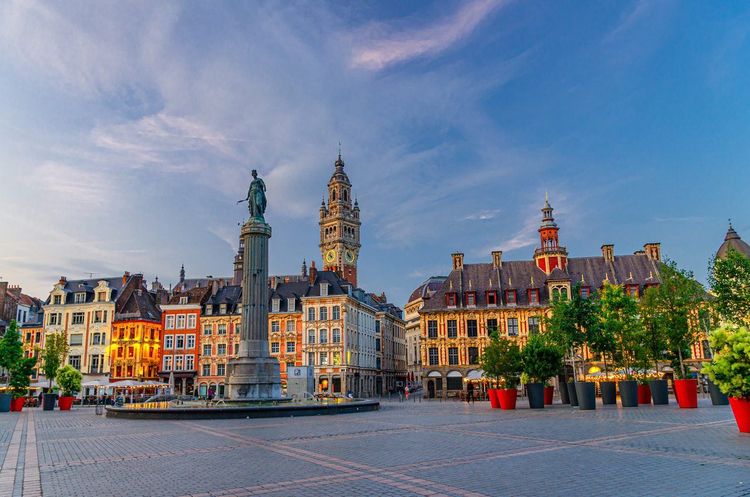
Officially named place du Général-de-Gaulle (9 Rue Princesse, 59800 Lille, rated 4.5/5 on Google with 1,961 reviews) (Place du Général-de-Gaulle, 59800 Lille, rated 4.7/5 on Google with 25K reviews) since 1944, everyone in Lille still calls it the Grand'Place. It is the natural starting point for any visit to Vieux-Lille, and the one spot where you can take in the district's architectural diversity at a single glance: Flemish gabled façades, the Art Deco building of the Furet du Nord bookshop, and the column of the Goddess erected in 1845 to commemorate the city's resistance during the Austrian siege of 1792.
The place du Général-de-Gaulle draws a year-round crowd of hurrying locals and students settled on the terraces. On Friday and Saturday evenings, the terraces spill well out onto the cobblestones, an atmosphere that contrasts sharply with the quiet of Sunday mornings, when only a few joggers cross the empty square.
You will also notice the Grand Garde, a 17th-century former military guardhouse that now houses the Théâtre du Nord, recognisable by its white stone classical façade. Directly opposite, the sculpted pediments of the Furet du Nord are a reminder that this bookshop, one of the largest in France, has occupied the premises since 1936. Take a moment to sit on the steps of the column: it is from here that you can best make out the roofline alignment, with its ogee dormers characteristic of the Northern Flemish style. Then look up at the Voix du Nord building, whose stepped gable crowned with three gilded statues closes off the north side of the square: this 1936 building, despite its antique appearance, is in fact a neo-Flemish pastiche, proof that the style continued to inspire builders long after the 18th century.
The Vieille Bourse, the Most Beautiful Covered Square in the North
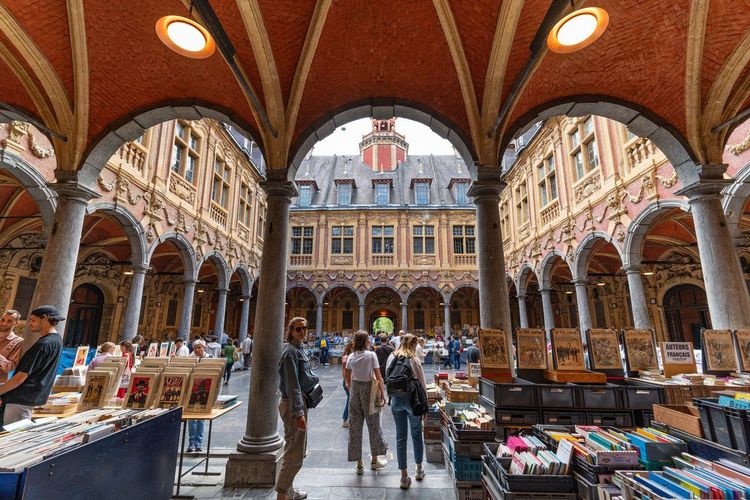
A stone's throw from the Grand'Place, separated from it by a single block of buildings, stands the Vieille Bourse. Built between 1652 and 1653 by architect Julien Destrée on the commission of Lille's merchants, it brings together twenty-four identical houses around an arcaded inner courtyard, each adorned with different sculptures representing the commercial activities of the era: cornucopias, fruit garlands, grotesque masks.
What strikes you on pushing open the gates is the contemporary use of the space. The courtyard hosts a daily market of antiquarian and second-hand books, where booksellers and collectors chat among yellowed postcards. In the afternoons, chess players settle around improvised tables, sometimes for hours, with no one seeming in any hurry to leave. You also regularly encounter itinerant florists and, in the evenings, street musicians taking advantage of the unique acoustics of the enclosed courtyard. On fine days, tango dancers even take over the courtyard on certain weekday evenings, turning this merchant monument into an open-air dance floor.
If you were to visit only one monument in Vieux-Lille, it would be this one: it concentrates in a single place the city's merchant history, its most elaborate Flemish architecture, and a neighbourhood life that has never been interrupted in four centuries. Allow about twenty minutes to walk all the way around, longer if you stop at the booksellers. A small tip: enter through one of the four doorways, walk around the gallery, then exit on the side facing the place du Théâtre to take in the perspective of the opera house and the belfry of the Chamber of Commerce, whose carillon marks the hours of the district.
Rue de la Monnaie, the Oldest Street in Lille
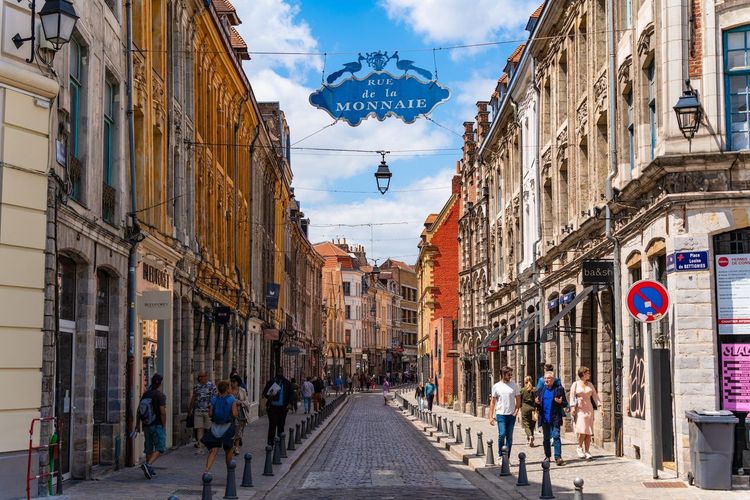
The rue de la Monnaie (Rue de la Monnaie, 59800 Lille, rated 4.6/5 on Google with 3K reviews) takes its name from the coin-minting workshop that operated here in the Middle Ages. It is today the best-preserved street in the district, an almost unbroken row of 17th- and 18th-century Flemish houses, with their scrolled gable ends and carved carriage gates.
Walking up the street from the Grand'Place, slow down at number 32: the façade still bears the trace of an old merchant coat of arms, barely visible beneath several layers of stripped paint. Also look out for the mascarons — sculpted faces above the doorways — believed to ward off bad luck and, originally, to indicate the trade or status of the owner. A little further on, the street opens onto the Hospice Comtesse, founded in 1237 by Countess Jeanne de Constantinople to care for the city's sick. The present building, largely rebuilt after a fire in the 15th century, retains a remarkable vaulted sick ward and a Gothic cellar, now converted into a museum of local history. Its planted inner courtyard and its room lined with Delft tiles are among the most photographed interiors in the district.
This street illustrates well why the Ryo Lille audio tour devotes so many audio segments to this precise area, linking the Grand Place to the Hospice Comtesse: every façade tells the story of a vanished use, every carriage gate conceals an inner courtyard you would never suspect from the street. The businesses occupying the ground floors today — art galleries, ceramicists' workshops, linen boutiques — maintain this continuity between the merchant past and contemporary life without ever turning the street into a frozen stage set.
Notre-Dame-de-la-Treille, the Cathedral Left Unfinished for Nearly 145 Years
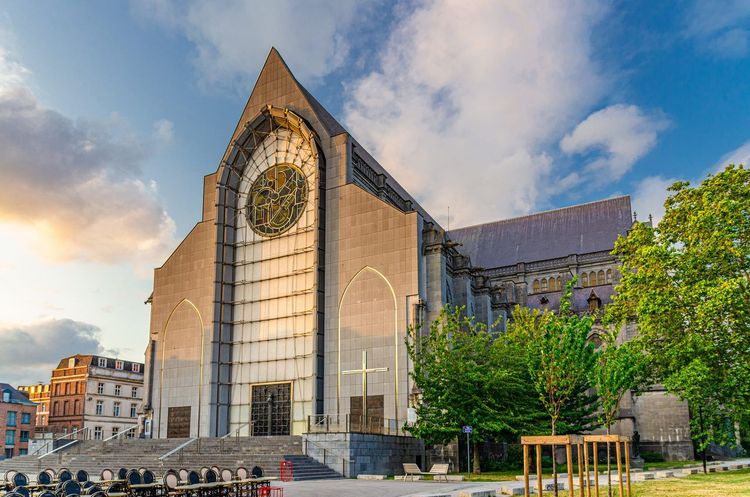
Begun in 1854 to a conventional neo-Gothic design, the cathédrale Notre-Dame-de-la-Treille (Place Gilleson, 59800 Lille, rated 4.4/5 on Google with 7,089 reviews) remained an open-air construction site for nearly a century and a half, due to insufficient funding to complete its main façade. It was not until 1999 — approximately one hundred and forty-five years after the laying of the first stone — that it received its definitive façade: an immense panel of translucent marble that allows a soft, shifting light to filter through depending on the time of day. This facing of Carrara marble, cut into slabs so thin they become translucent, takes on spectacular orange hues at sunset when viewed from inside.
The interior, more conventional in style, houses a statue of the Virgin of the Treille, the object of a long-standing local pilgrimage that gave the building its name. You can enter free of charge during the day: take the opportunity to observe the striking contrast between the neo-Gothic nave in dark stone and the light-drenched contemporary façade — more than a century of architecture in dialogue without ever quite resembling each other. To catch the full effect of the translucent marble, come in the late afternoon, when the raking light strikes the facing head on. The forecourt, recently redesigned, has become a popular thoroughfare for local residents, with its shaded benches.
Rue Esquermoise and the District's Shopping Streets
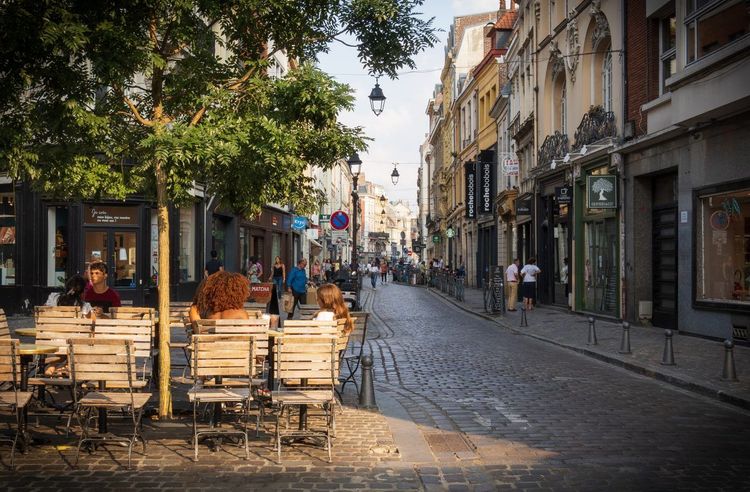
If the rue de la Monnaie concentrates heritage, rue Esquermoise concentrates commerce. This artery connects the Grand'Place directly to the rest of Vieux-Lille and lines up fashion boutiques, concept stores and historic establishments along its entire length.
The most photographed shop window remains that of Méert, a patisserie founded in 1761 and famous for its waffle filled with Madagascar vanilla cream — a recipe that General de Gaulle himself reportedly had delivered to Paris. The interior, listed as a historic monument, has kept its 19th-century gilded woodwork and mirror décor: a tearoom adjoins the shop, if you want to taste the famous waffle on the spot rather than take it away.
Around this historic address cluster more recent establishments: local fashion concept stores, wine merchants specialising in northern beers, contemporary ceramics workshops. You will also find, by venturing into the perpendicular streets (rue Basse, rue des Chats-Bossus — whose name always intrigues visitors), the windows of designers who have set up shop recently, a sign that the district continues to attract independent retail activity despite property pressure. It is there, in these cobbled alleyways away from the main thoroughfares, that shopping is most rewarding: fewer national chains, more workshop-boutiques run by the very people who make what they sell.
The Birthplace of General de Gaulle and the Notables' Quarter
A few streets from the Grand'Place, rue Princesse is home to the house where Charles de Gaulle was born on 22 November 1890. The bourgeois townhouse, typical of the grand residences of 19th-century Lille high society, has been converted into a museum tracing the future general's childhood within a family of Catholic, conservative notables. The visit, short but carefully curated, presents personal objects, the infant's christening gown and a scenography that places the man within his original social context.
This part of Vieux-Lille, more residential in character, stands in contrast to the commercial bustle of rue Esquermoise. The façades here are more restrained, the inner courtyards more spacious: this was historically the neighbourhood where the great industrial families of the Lille textile trade settled. Strolling along rue Princesse or rue Royale gives a sense of how strikingly Vieux-Lille blends, within a few hundred metres, an almost provincial residential intimacy with the tourist activity of the historic centre. Push on to rue Royale and its 18th-century private mansions, lined up as far as the church of Sainte-Catherine, to see the district's most aristocratic face.
Cafés, Estaminets and the Best Food Addresses
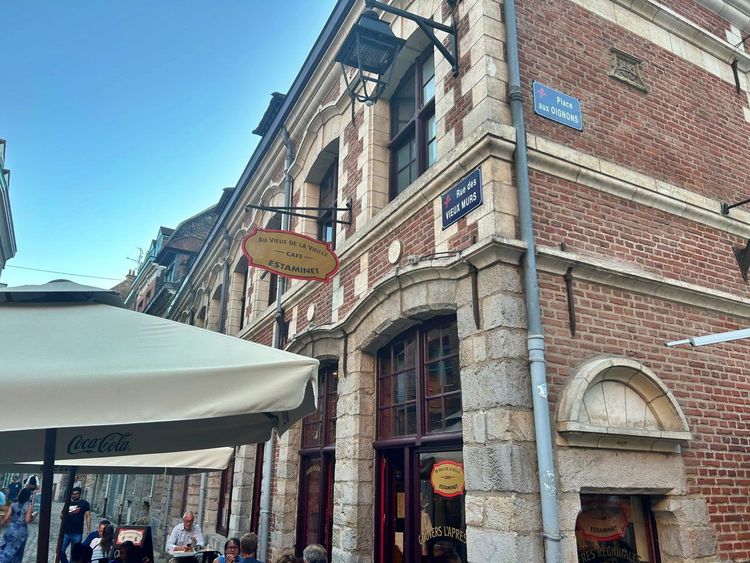
Vieux-Lille has one of the highest densities of estaminets and restaurants per square metre in the entire region. The word 'estaminet' itself comes from the local dialect and refers to those popular Flemish cafés where beer, board games and hearty brasserie dishes were served: carbonnade flamande, welsh, potjevleesch.
Some establishments have survived the decades without changing their décor: checked tablecloths, cast-iron stoves, collections of plates on the walls. Others have opened recently on a more contemporary register — bistronomy kitchens or natural wine bars — proof that the district does not live on Flemish folklore alone. For a quick lunch, the rue de Gand is home to many of the most popular tables, often fully booked by 12:30 at weekends. On the drinks side, do not leave without trying a local bière de garde or a chicory coffee, the other emblematic beverage of the North, served in most traditional estaminets.
If the district's gastronomy interests you in detail, our guide to Lille's culinary specialities lists the dishes you absolutely must try and the addresses that do them best. Simply keep one rule in mind before choosing your table: the more a shopfront displays photos of dishes in the window, the more likely it is to be targeting passing trade rather than neighbourhood regulars. Trust the daily blackboard instead — it is generally a more reliable indicator of the cooking actually being done.
The Vieux-Lille Market and Everyday Neighbourhood Life
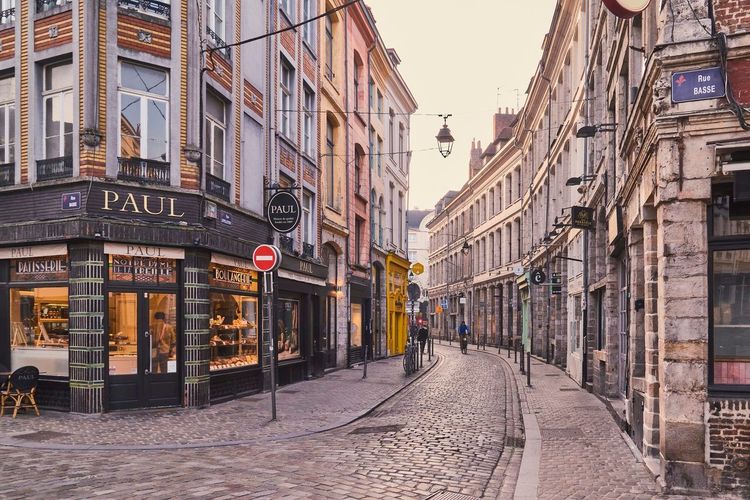
Beyond the major monuments, Vieux-Lille is also lived at the rhythm of its small markets and food shops. Several streets are home to greengrocers, cheesemongers and wine merchants who supply the neighbourhood's residents through short supply chains — a fairly affluent population that nonetheless remains attached to a local way of life despite the tourist pressure.
At weekends, certain squares host antique dealers and local producers, with a distinctly more peaceful atmosphere than the large Wazemmes market a little further south. It is also an opportunity to observe Vieux-Lille from a less museum-like angle: shopping trolleys, pavement conversations, children coming out of the neighbourhood school. And if your visit falls in early September, be aware that the famous braderie de Lille — one of the largest flea markets in Europe — invades every street in the area for an entire weekend. Our article on things to do in Lille and its surroundings lists further opportunities to step off the most tourist-trodden paths if you are spending several days in the city.
Canals, the Quai du Wault and the District's Other Face
What is often forgotten is that Vieux-Lille is also a city of water. The Deûle, canalised since the Middle Ages, runs along the western edge of the district, and the quai du Wault (Quai du Wault, 59800 Lille, rated 4.5/5 on Google with 1K reviews) offers one of the most pleasant walks in the area, with its moored barges and waterside cafés.
This waterfront was for a long time a port and industrial zone, before gradually being converted into a leisure and promenade area from the 2000s onwards. At the end of the day, the terraces set up on the barges attract a more local clientele than the historic centre, with a noticeably more relaxed atmosphere. Nearby, the Citadelle de Lille, a star-shaped fortress built by Vauban from 1667 and nicknamed 'the queen of citadels', completes this green and fluvial breathing space on the edge of the historic district. Around it stretches a vast wooded park — the city's green lung — where locals and visitors come to run, picnic or take children to the small free zoo. If you have time, our guide to visiting the Citadelle de Lille park details the best walking routes through this vast green space.
Hidden Courtyards and an Unusual Walk off the Beaten Track
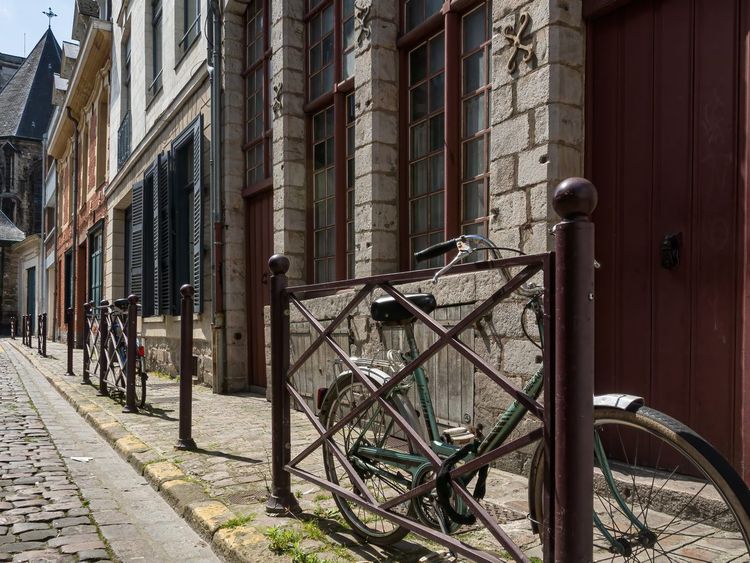
Vieux-Lille is not limited to its main thoroughfares. A good part of its charm hides behind anonymous carriage gates, in cobbled courtyards you can only guess at by looking up towards a half-open archway.
Some of these courtyards now house artists' studios or community gardens, invisible from the street. Take the time to wander without a fixed itinerary through the small streets perpendicular to the rue de la Monnaie: it is often there, away from visitor groups, that you stumble upon the district's most surprising details — discreet gargoyles, forgotten commemorative plaques, vestiges of fortifications absorbed into a residential wall. Pay attention to the street names themselves, often delightful: rue des Trois-Mollettes, rue des Vieux-Murs, rue au Péterinck. Each preserves the memory of a trade, a place name or a medieval anecdote, and reads like a clue about the past of the plot you are walking through. A fun game if you are visiting the Vieux-Lille district with family: ask children to spot, from one street to the next, as many mascarons and dates carved in stone as possible — often perched at the top of the gable ends. Do not leave without having looked up at least once in every street: it is up high, on the gable ends and cornices, that the district guards its finest secrets — ornate weather vanes, wrought-iron wall anchors and niches that sometimes still shelter a statuette of a patron saint.
Where to Stay in Vieux-Lille
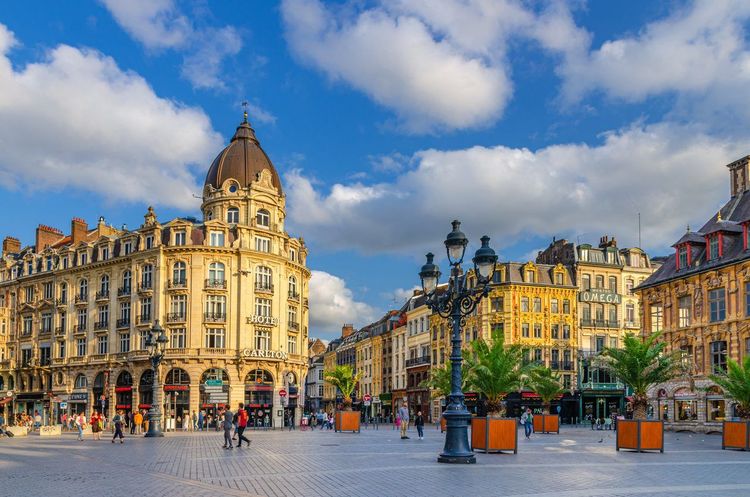
Staying in Vieux-Lille means accepting slightly higher prices in exchange for immediate access to the heritage, as well as relative quiet once the shops have closed. The district is home to several guesthouses installed in former Flemish townhouses, with generously proportioned rooms and exposed beams.
Chain hotels, by contrast, tend to be found on the immediate outskirts of the district, around the Lille-Flandres station, a ten-minute walk away. This compromise often makes it possible to save on room rates while remaining within walking distance of the Grand'Place. If you are travelling as a family or for several nights, check parking availability nearby: the majority of streets in Vieux-Lille are pedestrianised or have very limited parking, which makes access by private car complicated. A useful reference point: booking on the rue de la Monnaie or rue Basse side places you right at the heart of the district, while an address near the quai du Wault will offer more peace and quiet in the evenings. Be aware that on-street parking is virtually non-existent in the Vieux-Lille district: it is better to aim for one of the underground car parks on the immediate outskirts, such as the Nouveau Siècle or Grand'Place car parks, and then walk to your accommodation with your luggage.
Getting Around and Practical Information
Vieux-Lille is visited almost exclusively on foot, as the streets are narrow and often cobbled. The Rihour metro station on line 1 drops you a short walk from the Grand'Place and remains the most practical access point from the rest of the city. From the Lille-Flandres and Lille-Europe stations, allow about ten minutes on foot to reach the heart of the district.
Allow half a day for a first visit focused on the Grand'Place, the Vieille Bourse and the rue de la Monnaie, and a full day if you want to include the canals and the Citadelle. Most outdoor monuments are free to visit; only certain museums, such as the Hospice Comtesse, charge a modest entrance fee. Wear comfortable shoes: the uneven cobblestones, often slippery in the rain, make high heels inadvisable. In terms of seasons, Vieux-Lille changes atmosphere dramatically throughout the year. Autumn, with its rain-wet cobblestones reflecting the light of shop windows, is probably the most photogenic time. Winter transforms the streets around the cathedral into a setting for one of the most popular Christmas markets in northern France, while spring and summer bring out terraces and open courtyards. If you want to avoid the crowds, aim for early on a weekday morning: you will have the Vieille Bourse and the rue de la Monnaie almost to yourself, before the groups and weekend strollers arrive. Many visitors complement their time here with the Ryo app and its Lille audio-guided tour, which helps identify the most interesting façades without needing to look up information elsewhere. To find out about one-off events (the braderie, Christmas markets, open-air concerts), our dedicated page on events in Lille lists the not-to-be-missed dates according to the season of your visit.



FAQ
Where exactly is the Vieux-Lille district located?
Vieux-Lille occupies the historic centre of the city, to the north of the current Grand'Place. It is roughly bounded by the rue de la Monnaie and the Hospice Comtesse to the east, boulevard Carnot and the train station to the south-east, and the Deûle river with the quai du Wault to the west, covering an area of approximately one square kilometre.
How much time should I allow to visit Vieux-Lille?
Half a day is enough to take in the Grand'Place, the Vieille Bourse and the rue de la Monnaie. Allow a full day if you want to add the canals, the Citadelle and a lunch break at one of the neighbourhood's estaminets.
Is Vieux-Lille accessible by metro?
Yes, the Rihour station (line 1) is just a few minutes' walk from the Grand'Place. The Gare-Lille-Flandres and République-Beaux-Arts stations provide access from the other ends of the district, five to ten minutes on foot.
What are the best places to eat in Vieux-Lille?
The rue de Gand is home to the majority of the most acclaimed restaurants, ranging from traditional estaminets to more contemporary dining spots. Book ahead at weekends, especially for lunch, as the small dining rooms fill up quickly. For a sweet treat, the waffle from Méert on rue Esquermoise is an absolute must.
Is visiting Vieux-Lille free?
Strolling through the streets, the Grand'Place and the Vieille Bourse is entirely free. Only certain museums, such as the Hospice Comtesse or the birthplace of General de Gaulle, charge a modest entrance fee.
What is the difference between Vieux-Lille and Lille city centre?
The city centre refers to the broader commercial area around the train station and the Euralille district. Vieux-Lille is an older and more compact sector, focused on the Flemish heritage of the 17th and 18th centuries.
From the Grand'Place to the banks of the Deûle, Vieux-Lille packs into a remarkably small area a density of heritage that few French neighbourhoods can match. You can walk through it in a rushed morning or linger for several days, changing cafés every lunchtime and streets every afternoon, without ever truly exhausting its details.
If you want a first guided introduction before losing yourself in the back streets on your own, the Ryo audio tour of Lille is the simplest way to place each façade — from the Grand Place to the Hospice Comtesse — in its historical context, without having to consult a paper guidebook between shop windows.
À lire également