© Shutterstock
 Votre guide Ryo
What to Do Around Montpellier: 15 Day Trips Within Driving Distance in 2026
Montpellier is 30 minutes from the sea, 45 minutes from a village listed among France's Most Beautiful, and less than an hour from a Roman aqueduct built without mortar that has stood for two millennia. Asking what to do around Montpellier means choosing from a concentration of remarkable sites that few cities of this size in France can line up within such a tight radius: limestone gorges, medieval citadels, lakes ringed by volcanic red earth, fishing towns with their jousting tournaments and their tielles. Before leaving the city, the Ryo audio tour of Montpellier covers the medieval Écusson and its contemporary squares in 1h30 — ideal for grounding your weekend before heading out to explore the surrounding area.
The fifteen day trips that follow all lie within an 80 km radius of the city centre. They span very different registers: a village whose entire population would fit inside a local cinema, a cave where aragonite crystals seem to belong to another planet, a medieval citadel founded by Saint Louis with flamingos on the salt marshes within easy sight, a peninsula accessible only on foot between two lagoons. Listed without arbitrary ranking, each traveller will build their own itinerary according to the mood of the moment and the weather of the day.
1. Saint-Guilhem-le-Désert, the Village at the End of the Gorges
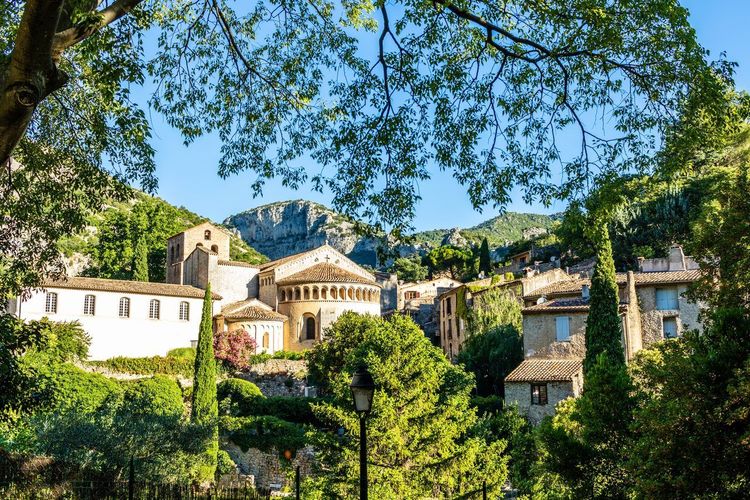
The main street of Saint-Guilhem-le-Désert is barely two metres wide. Around 250 people live here year-round, and several hundred thousand visitors pour through between April and October. This contrast between the village's modesty and the scale of its renown comes down to one date: 804 AD, when Guilhem de Gellone, Charlemagne's cousin and a warrior turned hermit, laid the first stone of the abbey that would bear his name in the Hérault gorges.
The Abbaye de Gellone (1 Rue du Bout du Monde, 34150 Saint-Guilhem-le-Désert, rated 4.6/5 on Google from 1,982 reviews), inscribed on the UNESCO World Heritage List as part of the Routes of Santiago de Compostela, is centred on a cloister of absolute serenity. What few visitors know: half of the original columns are now in the United States, bought up in the 19th century by a New York art dealer and today displayed at the Met Cloisters in Manhattan. Visiting the partial cloister that remains on site takes on an entirely different dimension once you know this story, and explains why certain arcades appear interrupted for no apparent reason.
From the village, two waymarked hikes allow you to escape the tourist crowds. The first follows the Verdus stream to a enclosed natural cirque, a limestone hollow of strange stillness (1h30 round trip, path shaded by holm oaks). The second climbs to the Château du Géant, a ruined medieval fortress perched on a limestone cliff at 327 metres altitude: the view over the confluence of the Verdus and the Hérault justifies every metre of elevation gained. Wear closed shoes even in summer — the limestone rock stays slippery on the way down, especially after a brief garrigue shower.
The village itself deserves a leisurely wander: its lanes wind up and down in tight curves between golden-stone houses, wisteria and open-air café terraces. The place de la Liberté, in front of the abbey, is the natural gathering point late in the morning. Local bakeries sell fouaces (Provençal brioche breads) and tapenade to take away for a picnic by the Hérault downstream.
Saint-Guilhem-le-Désert is 45 km from Montpellier (about 50 minutes via the D32 through Gignac). Leave early: the village is saturated by 11am in high season, and the parking spaces available at 9am are scarce two hours later. The tourist office hands out free detailed hiking maps. The Grotte de Clamouse is 2 km further down the valley — a full day in the Hérault gorges is easily built around these two sites.
2. The Grotte de Clamouse, Another World at 17°C
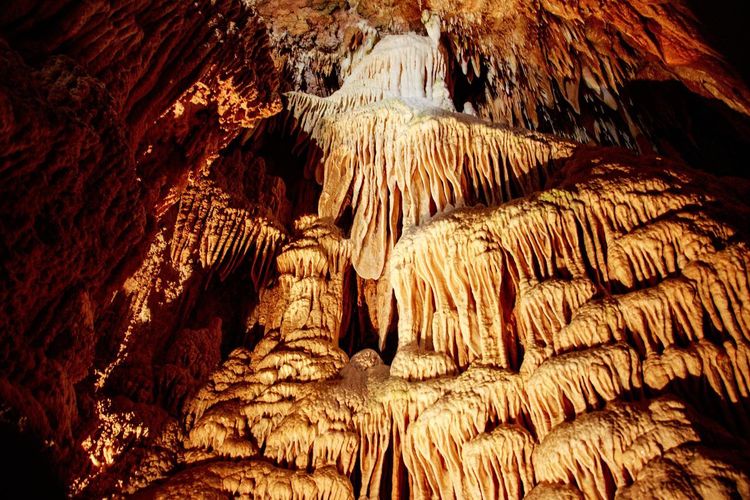
Two kilometres separate Saint-Guilhem-le-Désert from the entrance to the Grotte de Clamouse (Route de Saint-Guilhem, 34150 Saint-Jean-de-Fos, rated 4.7/5 on Google from 7,542 reviews). The transition is striking: from a village bathed in light to a constant 17°C and absolute darkness pierced by the guided tour's lighting. Discovered in 1945 during an exceptional drought, when cavers squeezed through a dried-up resurgence, the cave contains nearly 1.5 km of developed galleries open to the general public.
The scientific interest of Clamouse lies in its formations. The dolomitic limestone of this area produces aragonite crystals of an almost surreal whiteness: translucent soda-straw stalactites, cave discs, helictites that grow in seemingly random directions driven by internal air currents. Several chambers display a mineralogical variety that speleologists rank among the richest in Western Europe.
The tour lasts 1h15 and is accessible to children from age 4; pushchairs are impossible due to stairs — bring a baby carrier. Booking is recommended in summer via the official website. Adult admission: around €12. The cool interior makes it a particularly welcome excursion in the height of summer, when the garrigue outside is at 38°C.
3. The Pic Saint-Loup, 658 Metres Above the Garrigue
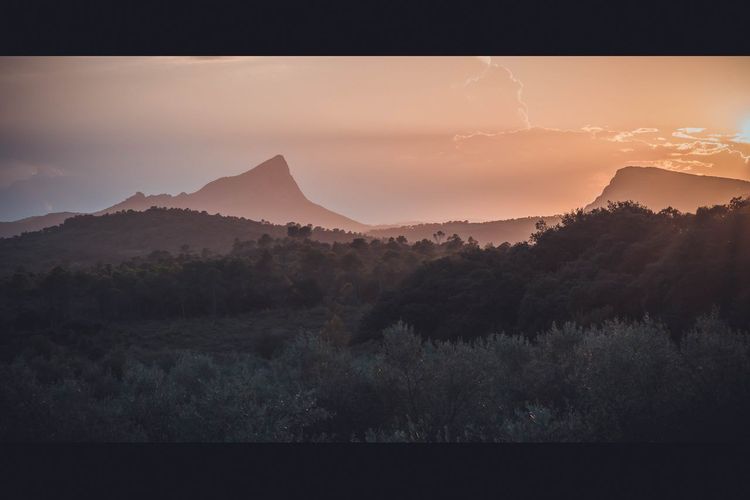
Just 25 km north of Montpellier (30 minutes via the D986), the Pic Saint-Loup is the visual landmark of the entire Hérault garrigue. Its triangular silhouette stands out against the sky from the rooftops of the city on clear days. The ascent from the Col de Cazevielle car park takes 2 hours one way with an elevation gain of 430 metres: an effort within reach of regular walkers, but demanding in strong summer heat.
The summit panorama sweeps across the Hérault plains to the Mediterranean, the Cévennes to the north and the Pyrenees in a sustained mistral. The ridge faces the Hortus, a vertical cliff wall that closes the cirque to the south, and the two peaks define a wine-growing territory of its own. The AOC Pic Saint-Loup, recognised for its reds based on syrah and grenache, counts several estates that open their cellars on weekdays. A glass of local red after the hike, in the shade of a vine-covered terrace in Valflaunès or Saint-Mathieu-de-Tréviers: hard to think of a better way to end a morning on the garrigue.
To plan your ascent, the Ryo hiking guide to the Pic Saint-Loup details the route variations, recommended timings by season and the wine estates worth stopping at on the way back.
4. Aigues-Mortes, the Medieval Citadel at the Edge of the Salt Marshes
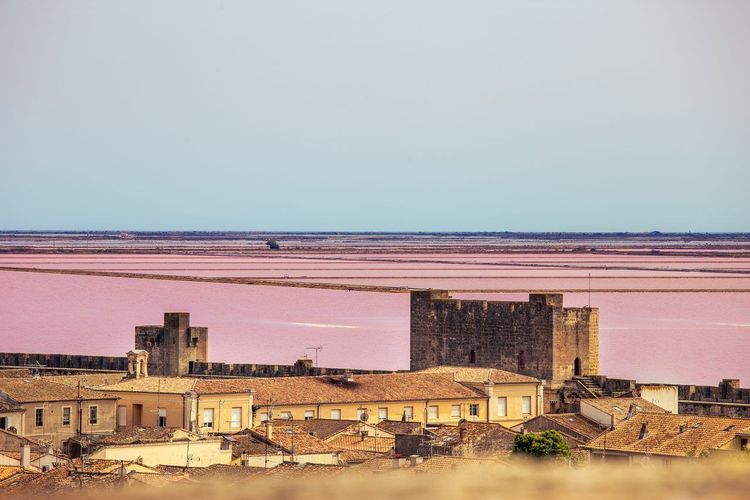
Aigues-Mortes is one of the rare French towns whose medieval layout has survived almost entirely intact. The ring of towers and ramparts laid out by Saint Louis's engineers from 1240 onwards still encircles the town centre along 1,650 metres of perimeter. From the Tour de Constance (Chemin de la Poudrière, 30220 Aigues-Mortes, rated 4.6/5 on Google from 3,661 reviews), a cylinder 40 metres tall erected in 1248, the view plunges over the salt pans to the east and the Étang des Launes to the west, with flamingos moving in pink clusters depending on the season and the water levels in the basins.
The town was the departure port for Saint Louis's crusades to the Holy Land: 1248, then 1270 — two major naval expeditions from this strategic embarkation point on the Gulf of Lion. The sea has since retreated, leaving the citadel encircled by lagoons and salt marshes. This paradoxical distance from the coast — for what was once a military port — is precisely what preserved the ramparts for eight centuries: with no obvious commercial value, they were never demolished to build warehouses.
Walk the rampart path to follow the 1,650 metres of unbroken walls (€8 adults, free for under-26s). Below, the Camargue salt flats still produce sea salt using methods close to those of the Middle Ages: solar evaporation in successive basins, hand-harvesting for fleur de sel. The Salins du Midi cooperative sells its production on site at prices below those in city shops — bags of Aigues-Mortes fleur de sel make excellent souvenirs.
The main pedestrian street is packed with restaurants serving local specialities: téllines (small clams fished from the lagoons), Bouzigues oysters, brandade de morue. For a less touristy experience, the tables around the Tour de la Mèche on the northern edge of town attract more of a local crowd. The terrace of the Café de Bouziques on the place Saint-Louis is a solid option for watching the life of the medieval centre without overpaying. Aigues-Mortes is 30 km from Montpellier (45 minutes via the D979 or the A9 depending on traffic).
5. Sète, the City That Smells of Salt and Tielles
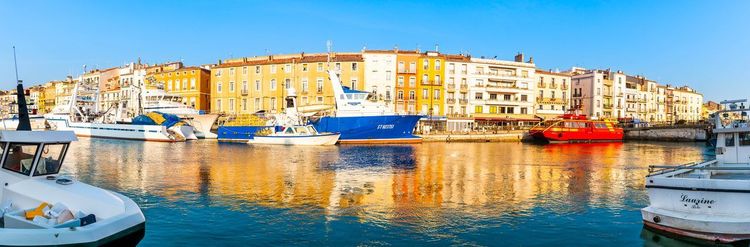
Sète is not a seaside resort. It is a working city built on a lido between the Étang de Thau and the Mediterranean, with an active fishing harbour, shipyards and oyster farmers harvesting at dawn. It is also the birthplace of Georges Brassens (1921–1981) and Paul Valéry (1871–1945) — two ways of looking at a city that has always faced the sea without being daunted by it.
Along the outer harbour quays, the city lives to the rhythm of its boats: a fish auction early in the morning, oyster bars until evening, trawlers heading out in mid-afternoon with their crates of sea bream and red mullet. The tielle sétoise, a spiced octopus-and-tomato pie of Neapolitan and Spanish origin, made in Sète for several generations, can be found in bakeries throughout the centre for €6–7 each. A classic beach picnic staple. Nautical jousting animates the canals several times a year: two jousters standing on boats try to knock each other into the water with a lance; the Saint Louis tournament in August is the most popular.
The Mont Saint-Clair rises to 183 metres and dominates the city with its terracotta-roofed houses. The climb on foot from the centre takes 25 minutes and offers a 360° view from the chapel terrace: the Étang de Thau and its oyster beds on one side, the Corniche beach and the sea on the other. A singular geography, very different from the other coastal towns of the Languedoc, that gives Sète an almost island-like character.
The Musée Paul Valéry (rue Descartes) is housed in a Belle Époque building with a direct view over the marine cemetery that the poet immortalised. Permanent collections are free on the first Sunday of the month. Sète is 30 km from Montpellier (35 minutes via the A9 or the RN112).
6. The Lac du Salagou, Volcanic Red Earth and a Submerged Village
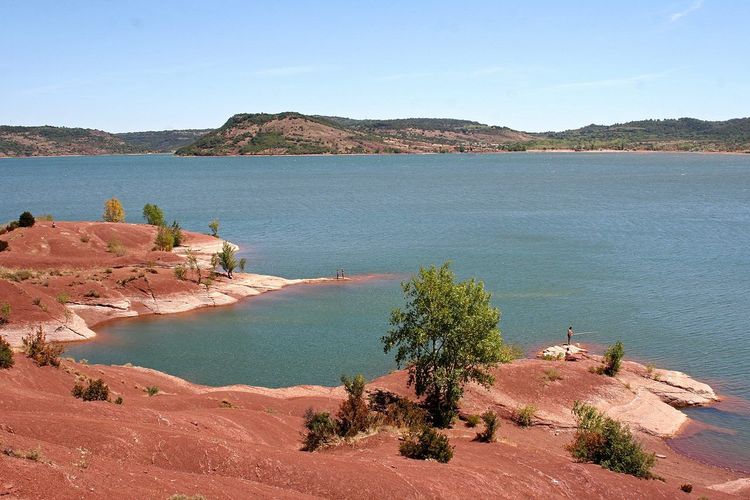
The Lac du Salagou (Route du Lac, 34800 Celles, rated 4.8/5 on Google from 4,600 reviews) looks like nowhere else in mainland France. The soil surrounding it is red — a deep brick red shading towards burgundy — because it is made of ruffes, iron-oxide sedimentary rocks formed 250 million years ago. This Languedoc canyon landscape is reflected in the 700 hectares of an artificial lake created in 1969 by the construction of a dam on the Salagou river.
Beneath the waters of the lake lie the ruins of the village of Celles, whose residents were relocated before the reservoir was filled. During severe droughts, the walls re-emerge: the church bell tower, stone façades, streets — a ghost village that reappears according to the level of the lake. This reality makes a walk around the Salagou uncommonly photogenic in dry periods.
Swimming is free from the shores and the water stays cool even in high summer. A circular trail of 26 km loops the entire lake on foot (7–8 hours); shorter circuits start from the villages of Liausson and Octon for manageable half-day outings. Kayak hire is available at Clermont-l'Hérault, 12 km away. The Salagou is 50 km from Montpellier (45 min via the A750).
7. The Cathédrale de Maguelone, between Sky, Sea and Lagoons
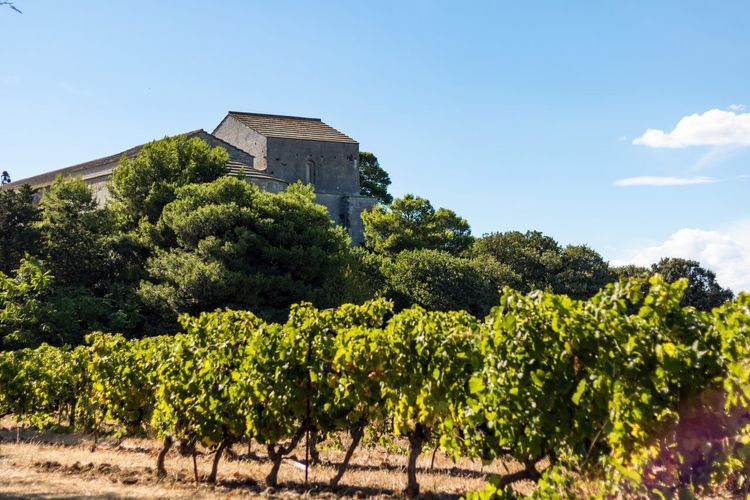
Access to the Cathédrale de Maguelone (Presqu'île de Maguelone, 34750 Villeneuve-lès-Maguelone, rated 4.5/5 on Google from 3,471 reviews) is unique in the Hérault: you must walk or cycle 2 km along a track running between the Étang de Pierre Blanche and the sea to reach this Romanesque building. No road serves the peninsula. Founded in the 5th century, destroyed and rebuilt several times, the current cathedral dates from the 11th–12th century and served as the seat of a bishop until 1536.
The warm limestone, the Romanesque apses and the building's position — on a tongue of land between two stretches of water — make it one of the most singular sites in the Hérault. The access path is itself remarkable: the lagoon on the left, the dunes on the right, and ahead the Romanesque façade gradually revealing itself with each step. A short and peaceful excursion, particularly beautiful outside the July–August peak. The cathedral is 20 km from Montpellier (25 min). Parking is available at the end of the road at Villeneuve-lès-Maguelone.
8. The Pont du Diable and the Hérault Gorges
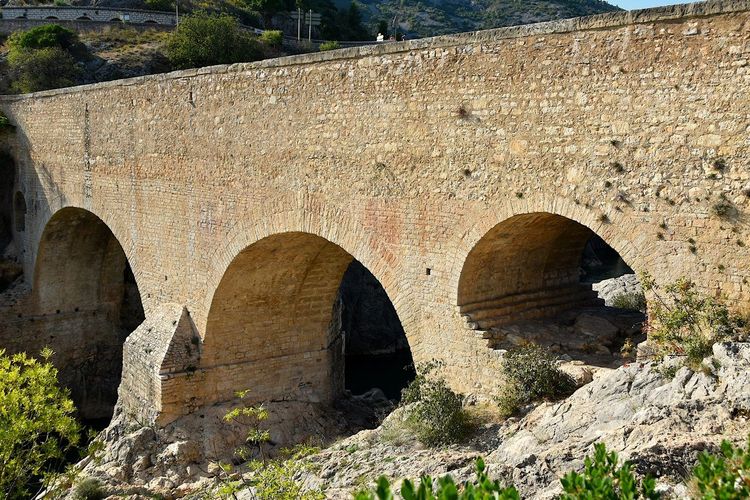
The Pont du Diable is the best-preserved medieval bridge in the Languedoc. Built between 1025 and 1031 by the monks of the Abbaye de Gellone, it spans the Hérault with a 25-metre arch rising 8 metres above the water. Listed as a UNESCO World Heritage site as part of the Routes of Santiago de Compostela, it was the obligatory crossing point for pilgrims making their way through the Languedoc towards Compostela.
Downstream, the Hérault gorges form one of the most beautiful waterways in the region. In summer, swimming beneath the bridge has been a local tradition for generations: the water descends from the Cévennes and stays noticeably cooler than the sea. Several natural beaches border the river between Aniane and Gignac, reached via footpaths off the D4. The particular light of the gorges — white limestone walls, translucent emerald-green water — is very different from that of the nearby coast.
To plan the visit in detail, the Ryo guide to the Pont du Diable in the Hérault gorges lists the best swimming spots, canyon-edge hiking routes and good addresses in Aniane. The bridge is 45 km from Montpellier (50 min), and naturally combines with Saint-Guilhem and the Grotte de Clamouse for a packed day in the gorges.
9. The Réserve Naturelle de Méjean, Flamingos Within Binocular Range
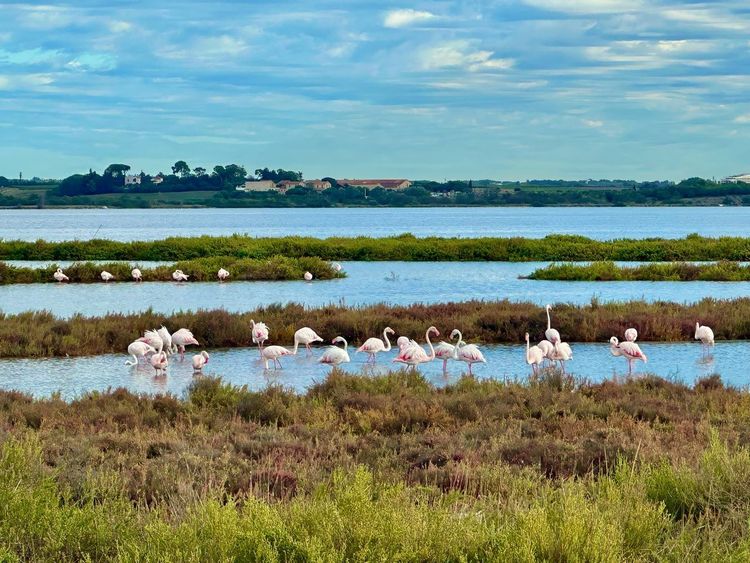
Just 20 km from Montpellier, the Réserve naturelle nationale de l'étang de Méjean is one of the finest birdwatching sites in Occitanie accessible without any particular physical effort. Between the Étang de Méjean, the Étang de l'Or and the lidos that separate them from the sea, this wetland hosts flamingos year-round — numbers varying by season — as well as grey herons, little egrets, common terns and, during migration, many passing northern species.
The main access point is from Mauguio, 15 km east of Montpellier. The nature trail starts from the Capoulière car park and follows the reedbeds for 3.5 km round trip. An observation tower allows you to spot birds from an elevated position. Binoculars are strongly recommended. The reserve is managed by the Tour du Valat; entry is free, no booking required. Best light for observing and photographing the flamingos: early morning or late afternoon, when the sun sits low over the lagoons. Back in the city, our audio walking tour picks up the thread in the Écusson and carries on to the Peyrou promenade.
10. Sauve, the Medieval Gem of the Garrigue
Sauve nestles in a meander of the Vidourle river 40 km from Montpellier (40 min). This village of 1,500 inhabitants, awarded the 'Village de caractère' and 'Ville et Métiers d'Art' labels, brings together stepped alleyways, dry-stone houses and the remains of an 11th-century castle. Its most unexpected speciality: micocoulier forks, wooden pitchforks crafted here since the Middle Ages and exported across the Mediterranean for viticulture. The Friday morning market brings together craftspeople and local producers around the central square.
11. The Pont du Gard, the Roman Aqueduct That Defies the Millennia
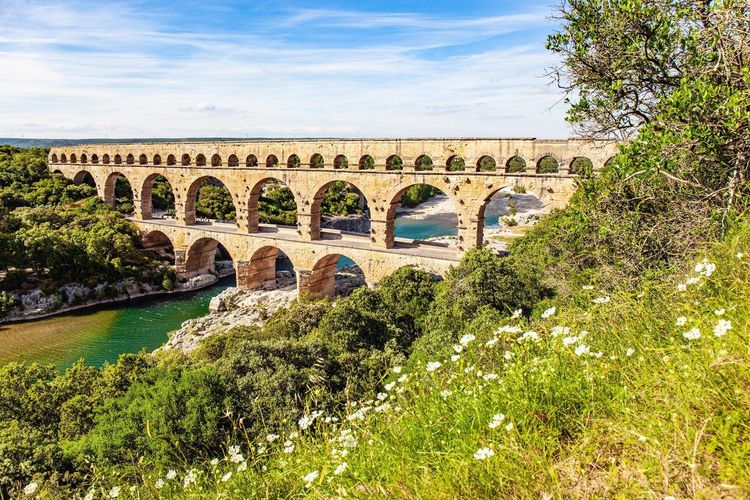
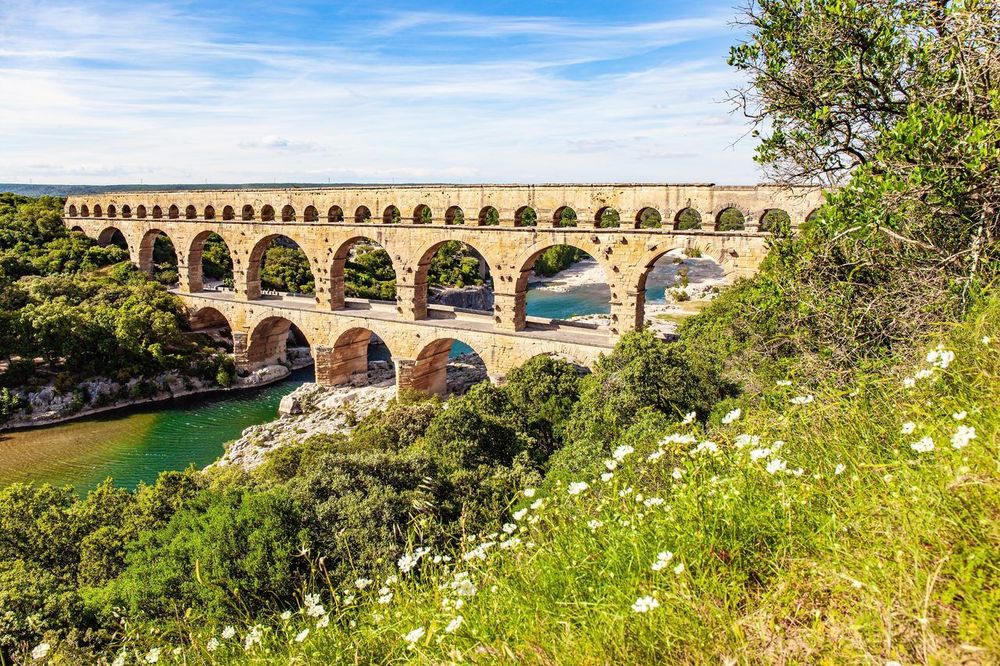
The Pont du Gard (400 Route du Pont du Gard, 30210 Vers-Pont-du-Gard, rated 4.6/5 on Google from 37,404 reviews) is in a category of its own. Built in the 1st century AD to supply water to the Roman city of Nîmes, it carried 40,000 cubic metres of water daily across 50 km using a gradient of just 0.04% — a drop of 17 metres over 50 kilometres. The technical feat is all the more breathtaking given that there is no mortar between the stones of the upper level: only the precision of the cutting and the balance of the loads.
Standing 49 metres tall and 275 metres long, the structure consists of three tiers of superimposed arches. It has been inscribed on the UNESCO World Heritage List since 1985 and remains the only Roman aqueduct to have preserved all three levels intact — an absolute rarity in the Mediterranean world. Site admission costs €8.50 per car (parking included); the bridge itself is free to visit once inside the site.
The on-site museum traces the construction of the aqueduct with a scale model and digital animations. One room explains the lifting technique: the bridge's stones, some weighing up to 6 tonnes, were raised without mechanical cranes, by teams of workers operating capstan winches on temporary platforms. In summer, swimming in the Gardon beneath the arches is the site's most popular activity — the clear, cool river water contrasts pleasantly with the sun-bleached stone. Arrive before 9:30am in July–August: crowds surge between 11am and 4pm and car parks fill quickly. A complete visit (bridge + museum) takes 2 to 3 hours.
To go further in exploring the Hérault and Gard garrigue, the Ryo guide to the most beautiful hikes in the Hérault covers routes from the Gardon gorges to the limestone plateaux of the Séranne. The Pont du Gard is 45 km from Montpellier (40 min via the A9 then the D981). It pairs naturally with Nîmes, 20 km further on, for a full day immersed in antiquity.
12. La Grande-Motte, the Seaside Pyramids of the 20th Century
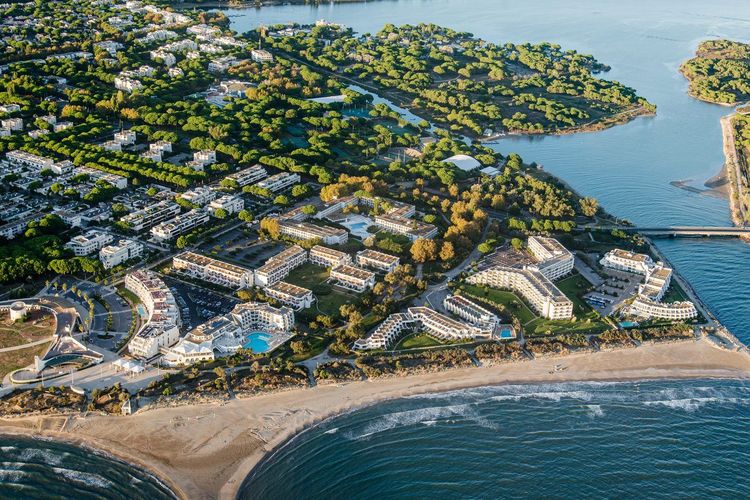
La Grande-Motte (Place du 1er Octobre, 34280 La Grande-Motte) is one of France's most atypical seaside resorts. Built from scratch from 1967 on marshland and designed by architect Jean Balladur as a coherent whole: stepped concrete pyramids evoking Babylonian ziggurats, white geometric volumes, green spaces integrated into the urban fabric. In 2010, the resort was awarded the 'Patrimoine du XXe siècle' label — a rare distinction for a contemporary architectural ensemble still lived in and fully in use.
La Grande-Motte's beaches stretch for 7 km of fine sand, well organised and well served. The marina accommodates sailing boats and catamarans, with full-day sea trips offered by several local operators. The resort's architecture is worth the trip on its own: strolling among the pyramids at dawn, with the raking light casting shadows across the stepped façades, is a strange and memorable experience. The town is 25 km from Montpellier (25 min via the D66 or the D21).
13. The Grotte des Demoiselles, the Underground Cathedral of the Séranne
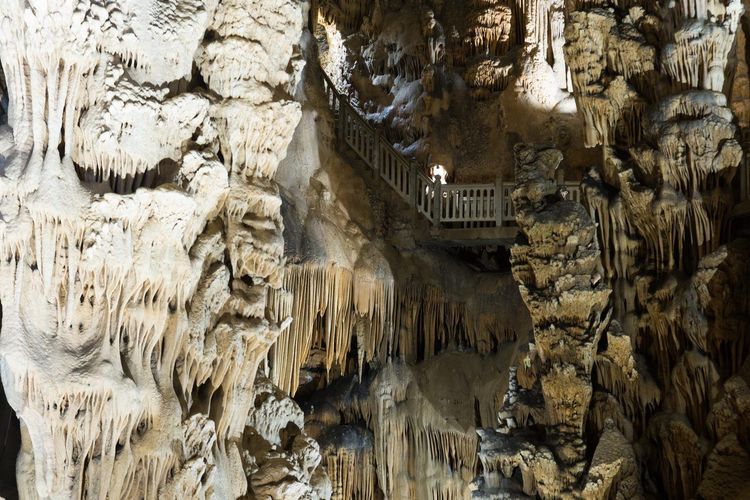
Some 65 km from Montpellier (1 hour via the D986), the Grotte des Demoiselles (Route des Grottes, 34190 Saint-Bauzille-de-Putois, rated 4.7/5 on Google from 3,093 reviews) is one of the most spectacular caves in the south of France. A funicular carries visitors to the entrance on the cliff face at 250 metres altitude. The main chamber — 120 metres long and 50 metres high — is filled with stalactite and stalagmite columns several dozen metres tall. Discovered by cavers in 1770 and developed for visitors in the 19th century. Visit duration: 1 hour. Booking strongly recommended in summer.
14. Palavas-les-Flots, the Beach Town of the Montpellier Locals
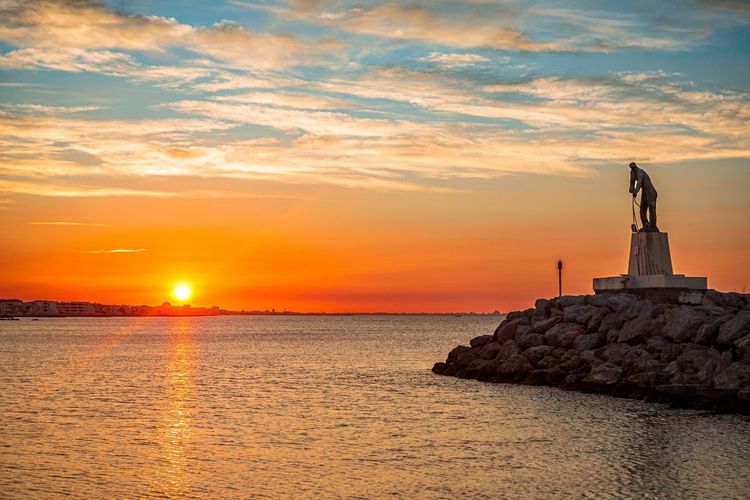
Just 12 km from Montpellier (15 minutes by car, direct tram line 3), Palavas-les-Flots (Avenue de la Méditerranée, 34250 Palavas-les-Flots, rated 4.5/5 on Google from 4,758 reviews) is the city's historic seaside resort — the place where several generations of Montpellier residents learned to swim and fish. The canal that cuts the town in two is home to local fishing boats. Sandy beaches run along 4 km of coastline; seafront restaurants serve garlic-sautéed tellines, lagoon mussels and fish from the morning auction. Out of season, Palavas settles back into the peaceful rhythm of a small coastal village.
15. Nîmes, the 'French Rome' 40 Kilometres Away
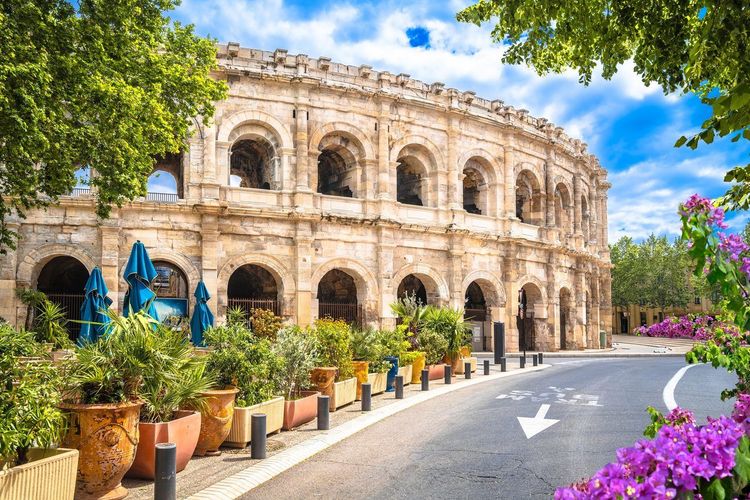
Nîmes is the most natural urban day trip from Montpellier. At 40 km (35 minutes via the A9), the Gard prefecture lines up Roman monuments with a density hard to match anywhere else in France: the Arènes de Nîmes, built in the 2nd century AD, could hold 24,000 spectators and are considered the best-preserved in the western Roman world — more structurally complete than the Colosseum in Rome. The Maison Carrée (1st century BC) is the most intact Roman temple in Western Europe outside the eastern Mediterranean.
The Jardins de la Fontaine conceal the remains of the Temple de Diane within an 18th-century formal park — one of the rare French gardens to incorporate authentic Roman ruins into its design. A detail few visitors know: the fabric denim, the cloth 'de Nîmes', was manufactured here as early as the 16th century and exported to America, where it eventually gave its name and material to jeans. The Carré d'Art museum (Norman Foster architecture, directly facing the Maison Carrée) displays a collection tracing the major artistic movements of the 1960s–2000s: a striking confrontation between antiquity and modernity on the same square.
Practical note: the Arènes still host bullfights twice a year (the Easter Feria and the Feria des Vendanges) and concerts throughout the summer. The pass Monuments Romains (€22 adults) covers entry to the Arènes, the Maison Carrée and the Jardins de la Fontaine. Allow a full day for the city's highlights, or two days if you add the Pont du Gard 20 km away and the Gard garrigue.
FAQ
What is the most beautiful day trip around Montpellier?
It's hard to single out one destination. Saint-Guilhem-le-Désert charms with its medieval village and UNESCO abbey tucked into the gorges, the Pont du Gard with the perfection of its Roman engineering, Sète with its unpretentious seafaring character. For a short excursion with maximum impact, the Pic Saint-Loup (30 minutes by car, 2 hours of hiking) offers the best effort-to-panorama ratio of anywhere around Montpellier.
What day trip can you do around Montpellier with kids?
Lac du Salagou (free swimming, unusual red-earth landscape), the Grotte de Clamouse (accessible from age 4, wonderfully cool in summer) and Aigues-Mortes (walk the rampart walls, taste tielles on the spot) are the most family-friendly options. Palavas-les-Flots remains the quickest solution — 15 minutes by car or direct tram — for a beach afternoon with no planning required.
What can you do around Montpellier when it rains?
The Grotte de Clamouse and the Grotte des Demoiselles are sheltered by definition. The Arènes de Nîmes with its integrated museum, the Musée Paul Valéry in Sète and the Carré d'Art in Nîmes are all good indoor cultural alternatives. The Cathédrale de Maguelone is also worth visiting under clouds — the grey light brings out the warm stone of the Romanesque apses in a way that full sunshine simply cannot.
Which beautiful villages can you visit around Montpellier?
Saint-Guilhem-le-Désert (one of France's Most Beautiful Villages, 45 km) and Sauve (40 km, awarded the 'Village de caractère' label) are the two benchmarks of the region. Villeneuvette, a 17th-century manufacturing village 50 km from Montpellier, and Aniane, a wine-growing village at the gateway to the Hérault gorges, round out the picture for lovers of authentic rural architecture. Most can be combined easily in a single day.
Can you visit Aigues-Mortes in half a day from Montpellier?
Yes. The rampart walkway takes 1h30 to complete, and the Tour de Constance requires an additional 45 minutes — half a day is enough for the essentials. A full day allows you to add the salt flats, a boat trip on the Camargue lagoons and lunch on the main square. The distance from Montpellier (30 km, 45 min) makes a morning round trip entirely feasible.
Are there guided tours of the area around Montpellier?
Several local agencies offer organised excursions from Montpellier to Aigues-Mortes, the Hérault gorges and the Pont du Gard. To explore Montpellier itself at your own pace, the Ryo audio guide of la Surdouée covers 19 audio stops through the city's historic and contemporary neighbourhoods — the medieval Écusson, Antigone, the place de la Comédie — from your smartphone, with no set schedule.
The area around Montpellier packs a diversity that few French cities of this size can offer within such a tight radius: crystal-lined caves, medieval citadels founded by crusader kings, mortar-free Roman aqueducts, lakes with ruby-red shores, fishing towns with living traditions. The question isn't what to do, but in what order — and according to the mood of the moment.
To ground your stay in the city before or after your day trips, our Montpellier audio walking tour guides you through the medieval Écusson and its contemporary squares in 1h30: 21 audio stops, 3.5 km, at your own pace. Download the Ryo app before you leave — it works offline, which comes in handy in the gorges and beneath the limestone cliffs of the Hérault garrigue.
À lire également