© Shutterstock
 Votre guide Ryo
Visiting Montpellier in 3 Days: Complete Itinerary 2026
Under the arcades of the Place de la Comédie, locals still call it "the Egg" — the white-paved ellipse concentrates the city's energy all on its own. Visiting Montpellier in 3 days is precisely that: stepping from a medieval alley into a neoclassical building completed in 1988, then from a tram decorated by Christian Lacroix to a beach reachable in twenty minutes by bike. A few facts always surprise first-time visitors: a botanical garden planted under Henri IV in 1593, the oldest still active in France; a museum housing one of the richest Courbet collections outside Ornans; an 18th-century aqueduct that still feeds a monumental fountain; and salt lagoons where oysters are still harvested by hand, less than an hour from the centre. The Ryo audio guide of Montpellier accompanies this discovery neighbourhood by neighbourhood, from the historic Écusson to the contemporary lines of Antigone and the wild shores of the Mediterranean. Three days are enough to feel this striking contrast, provided you follow an itinerary that respects the city's geography rather than zigzagging from one point to another.
Day 1: The Écusson and the Historic Heart of Montpellier
Start at the centre, on foot, headphones on if you are following the Ryo audio guide of Montpellier: the Écusson takes its name from its shield-like shape and can be explored entirely in a relaxed half-day. Allow a lunch break in the middle of the programme — the distances are short but the detours are many.
Place de la Comédie and the Esplanade Charles-de-Gaulle
The Place de la Comédie opens the show. Built in the 18th century on the site of a former convent, it owes its nickname to the Opéra Comédie that borders it, and its oval silhouette to a 19th-century redesign. At its centre stands the Fontaine des Trois Grâces, a copy of the one sculpted by Étienne d'Antoine in 1790.
From there, the Esplanade Charles-de-Gaulle extends the square for nearly 300 metres of century-old plane trees. It is both a promenade and a hub of local life: pétanque players in the late afternoon, churro vendors at weekends, and at the far end, the Corum congress centre, which hosts some of the city's major festivals.
If you are an early riser, stop by the Halles Castellane just before heading into the Écusson. This covered market opens at the crack of dawn and lets you grab a strong coffee among charcuterie stalls and seafood stands, far from the tourist bustle that sets in later in the morning.
The Medieval Lanes of the Écusson and Its Mansions
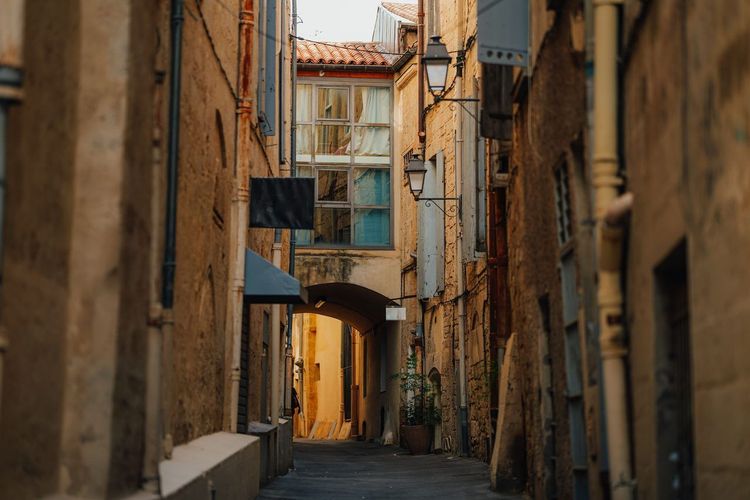
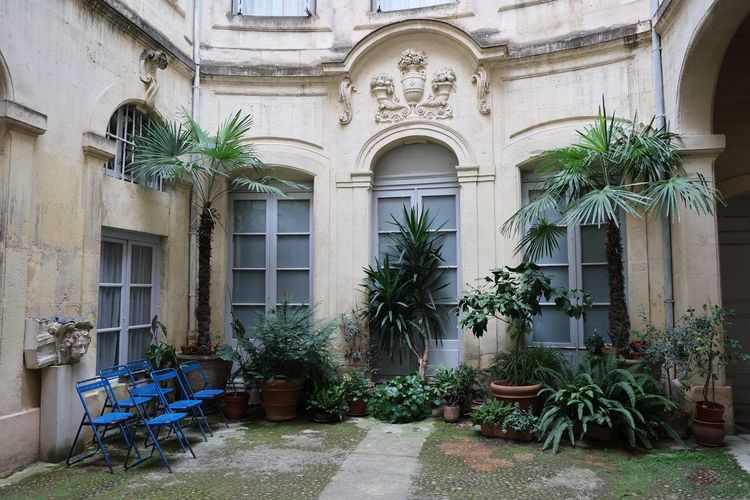
Venture next into the network of cobbled lanes that make up old Montpellier. The rue de l'Ancien Courrier and the rue du Bras de Fer are lined with independent shops and 17th-century façades, while inner courtyards conceal some thirty mansions built by the parliamentary bourgeoisie of the 17th and 18th centuries.
The Cathédrale Saint-Pierre, with its massive porch flanked by two cylindrical turrets, contrasts with the scale of the rest of the neighbourhood. Its defensive façade is a reminder that it also served as a fortress-cathedral during the Wars of Religion.
Just behind it, the Faculty of Medicine claims the title of oldest medical school in the world still in operation, its first statutes dating back to 1220. The lecture halls cannot be visited without a reservation, but the façade and the adjacent medicinal plant garden are worth a five-minute detour.
You will also come across the Hôtel de Varennes, which houses the Musée du Vieux Montpellier: free entry, modest rooms, but one of the rare chances to step inside one of these mansions without a reservation or entrance fee. Allow twenty minutes, no more.
Musée Fabre and the Terrace Scene in the Evening
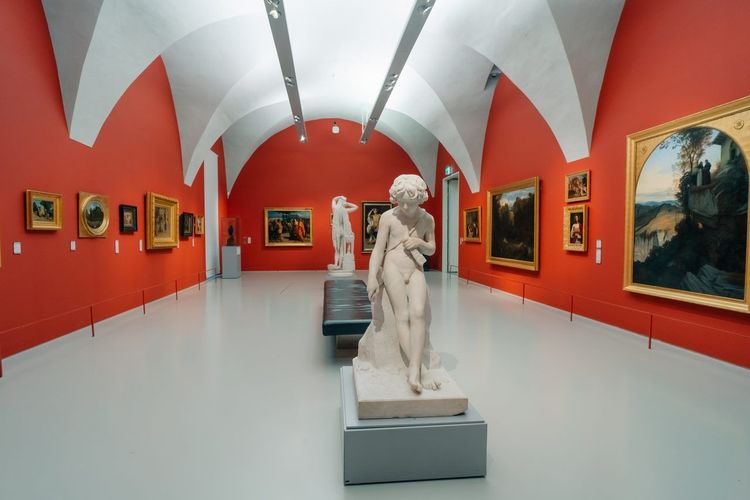
Heading out towards the northern edge of the Écusson, the Musée Fabre (39 Boulevard Bonne Nouvelle, 34000 Montpellier, rated 4.5/5 on Google from 4,713 reviews) occupies a fully renovated former Jesuit college. Its collections rank among the richest in France outside Paris: one of the most comprehensive sets of Courbet works outside Ornans, rooms dedicated to Frédéric Bazille — a Montpellier native and fellow traveller of the Impressionists — and an entire space born from Pierre Soulages' donations. Budget around ten euros for entry and a good hour and a half to take in the essentials.
As evening falls, the Écusson changes pace. The terraces of the place Saint-Roch and the Plan Cabanes fill up from 6 pm, and several rooftop bars atop the centre's hotels offer views over the pink rooftiles all the way to the Cévennes foothills on a clear day. This is when Montpellier reveals its reputation as a student city: one of the youngest populations in France, with nearly one in five residents enrolled in higher education.
This city invites strolling by day and by night alike, and that is probably what sets it apart most from other cities in the south. At midday, the Écusson lives in the shade of its narrow lanes, whose medieval layout naturally blocks out the sun; at dusk, the façades of the Opéra Comédie, the cathedral, and the Peyrou are lit up and the squares change their crowd. The rue de la Loge and the rue Foch stay lively late, the Plan Cabanes keeps its working-class neighbourhood feel, and the esplanade Charles-de-Gaulle becomes a nocturnal promenade all the way to the Corum. Do the same loop after dinner: you will not feel as if you are retracing your steps. Ryo's audio-guided tour of Montpellier follows this very loop between the Écusson, Place de la Comédie and the Opéra Comédie, equally rewarding by day or by night.
Do not stop at the first bar you come across. The streets running perpendicular to the rue Foch often hide quieter spots, away from the main flow.
Day 2: Antigone, Port Marianne, and the Peyrou — the Other Face of Montpellier
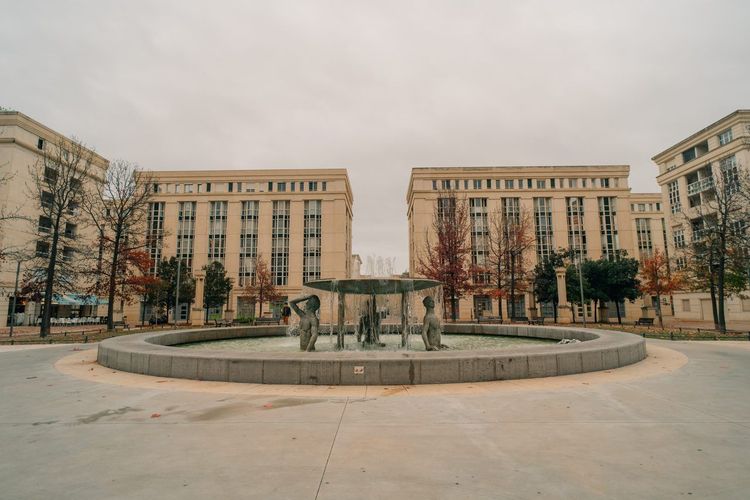
After the medieval stonework, a radical change of scenery. The second day explores the Montpellier that was built from the 1980s onwards, when the city bet on contemporary architecture to triple its population in forty years.
The Antigone District: a Neoclassical Architectural Journey
Designed by Catalan architect Ricardo Bofill from 1979 onwards, the Antigone district stretches along an axis of nearly one kilometre from the Place de la Comédie to the banks of the Lez. Giant columns, triangular pediments, and prefabricated concrete façades compose a setting that borrows from the classical vocabulary while fully embracing its modernity of materials.
The Place du Nombre d'Or takes its name from Bofill's geometric layout, derived from the golden ratio beloved by Renaissance architects. A little further along, the Place du Millénaire closes the perspective with an immense round arch. Many visitors are surprised to learn that these buildings contain social housing and ordinary offices: Antigone is not a film set, it is a lived-in neighbourhood.
Walk the axis lengthways rather than crossing it: it is by moving straight ahead that Bofill's perspective makes full sense, colonnade after colonnade.
Port Marianne and the Banks of the Lez
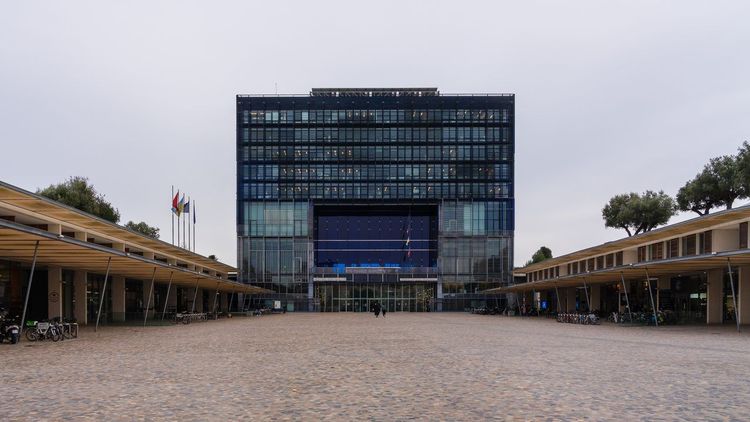
The Antigone axis opens out onto Port Marianne, a business and leisure district built along the Lez. The City Hall, a dark cube designed by Jean Nouvel completed in 2011, stands out with its sharp geometry and vertical shafts of light.
Following the river downstream, you reach the Odysseum district: the Galilée planetarium, the Mare Nostrum aquarium, an ice rink, and a retail zone make up a leisure complex rather removed from the rest of the trip, best saved for a family outing. The pedestrian path along the Lez, shaded and almost completely flat, is also the starting point of the cycling greenway that leads all the way to the sea — you will take it on day 3.
The Peyrou Promenade and Its Views over the Surrounding Landscape
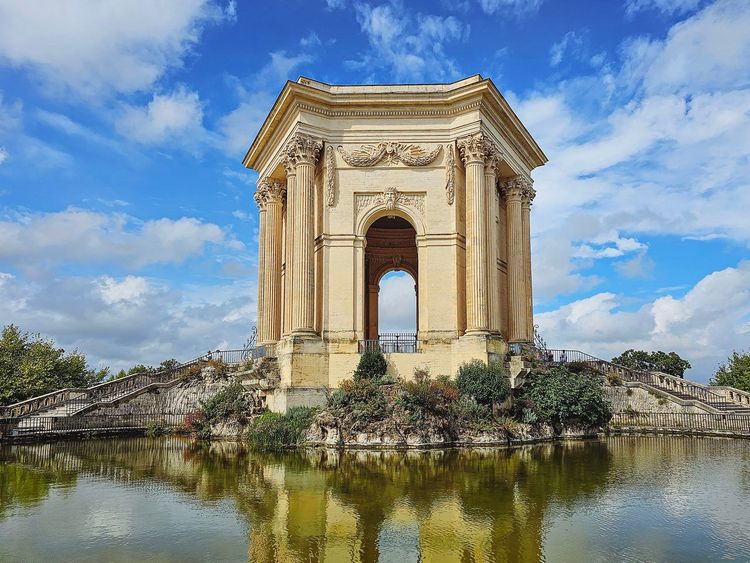
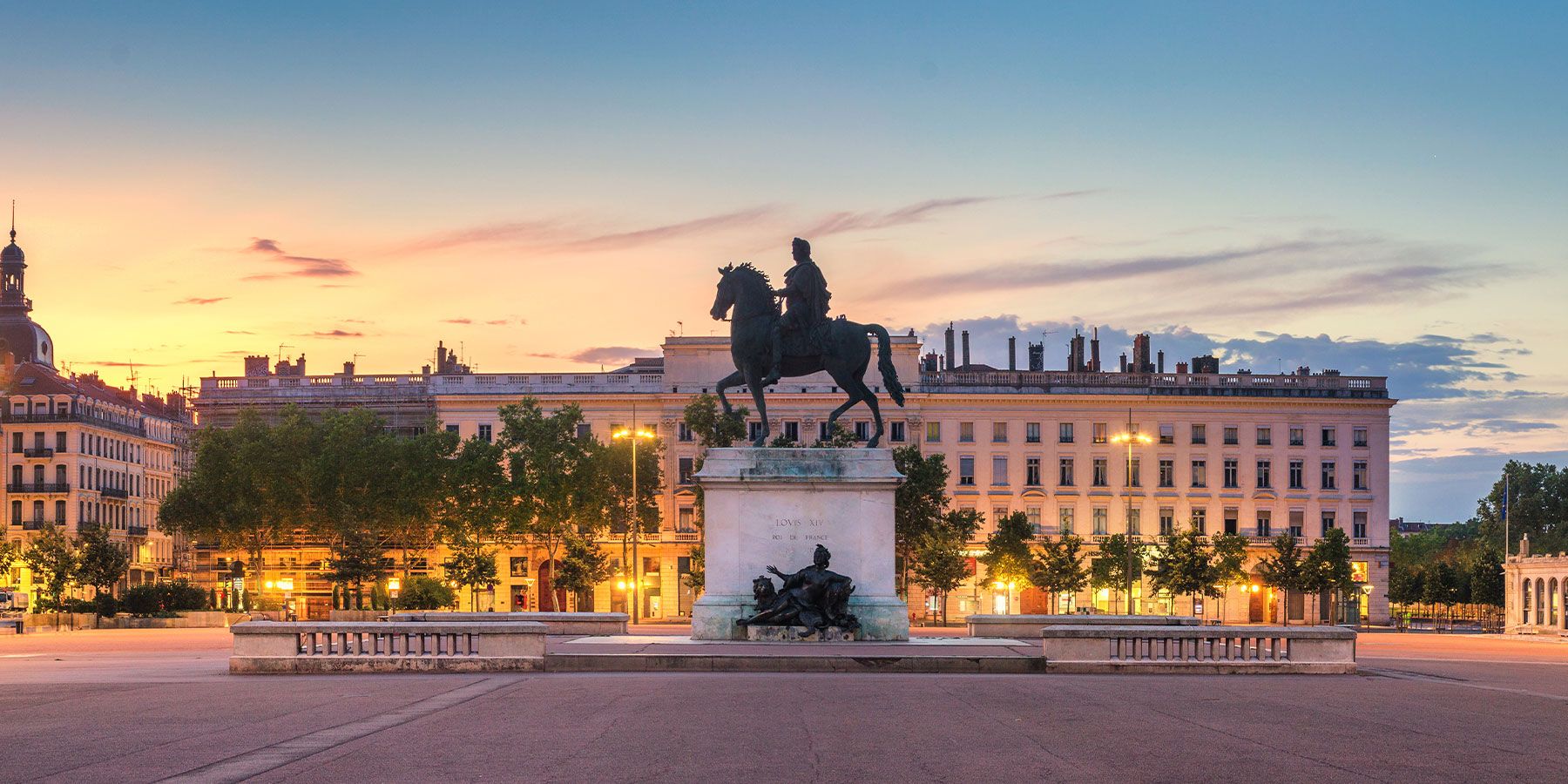
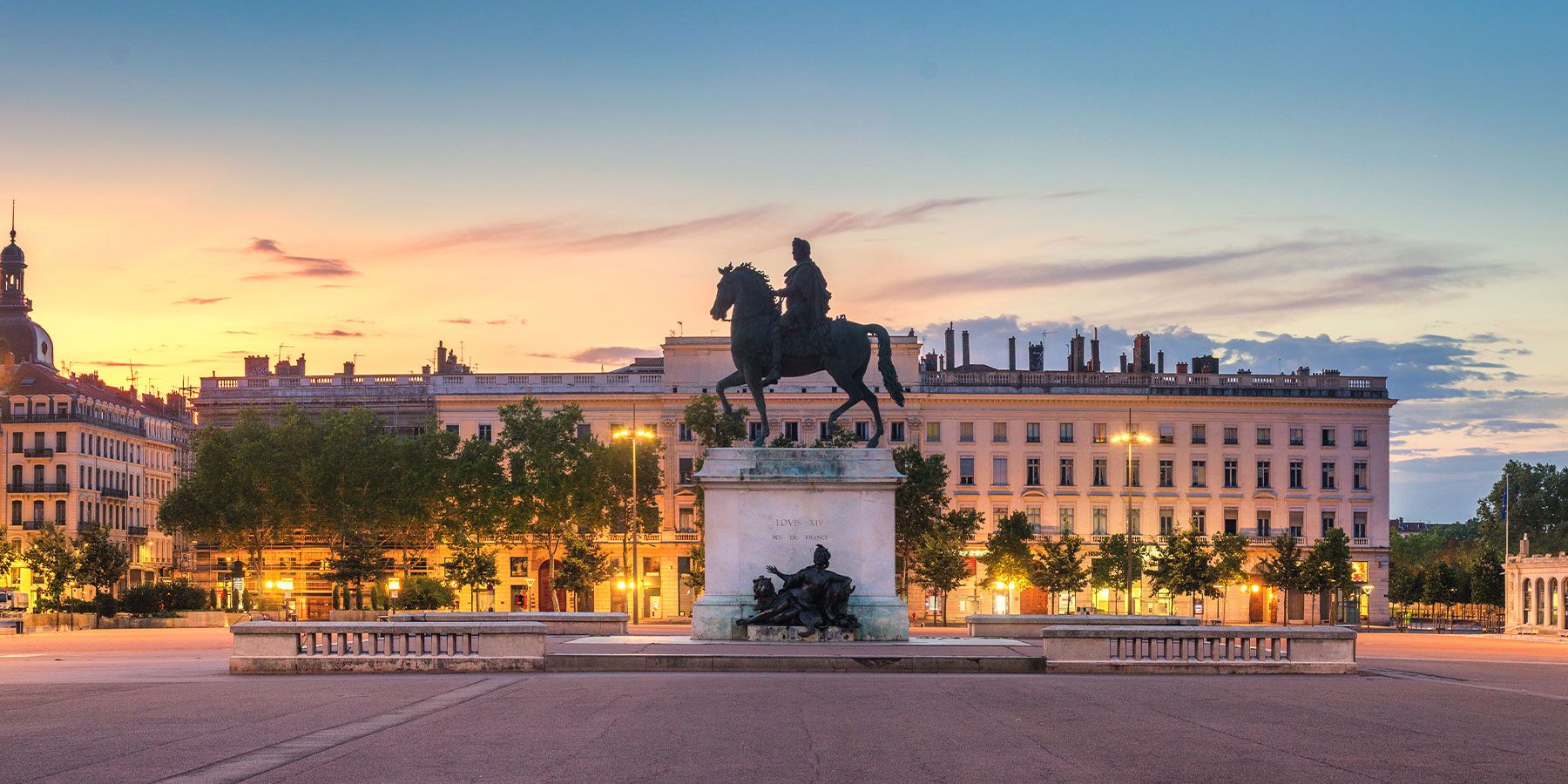
Head back towards the centre to end the day on the heights. The Promenade du Peyrou, laid out from 1689 onwards, offers the widest urban panorama in Montpellier from its raised esplanade. An equestrian statue of Louis XIV stands there, flanked by a double row of square-trimmed plane trees.
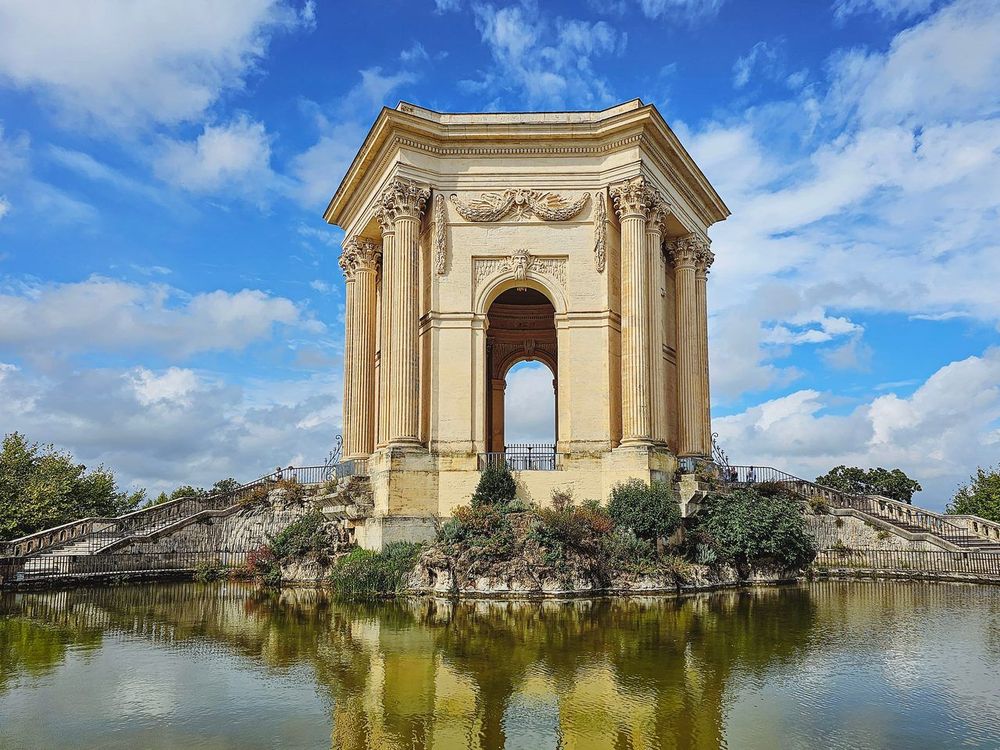
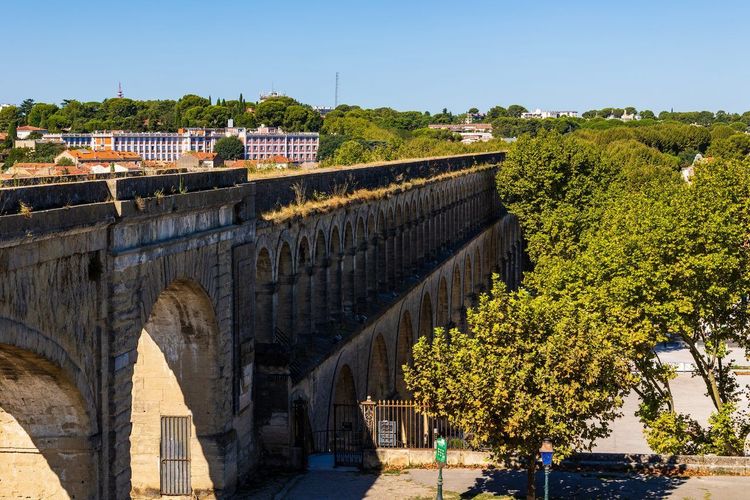
At one end stands the Arc de Triomphe, erected at the end of the 17th century to celebrate the victories of the same king, and at the other end the octagonal Château d'Eau marking the arrival of the Aqueduc Saint-Clément. Stretching 880 metres across two tiers of arches, this 18th-century aqueduct once supplied the city with water drawn from the source of the Lez, fourteen kilometres away.
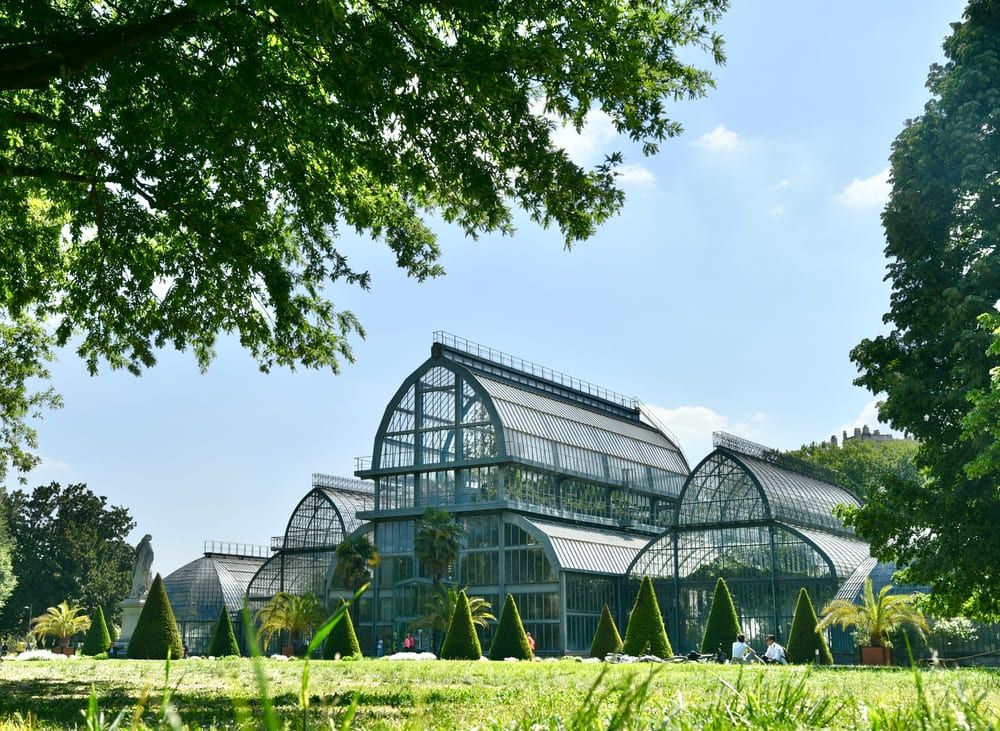
On a clear day, the view reaches as far as the Cévennes to the north and sometimes the sea to the south: come if possible an hour before sunset, when the low light rakes across the whole ensemble and local joggers give way to photographers. To extend the break in a greener setting, the Jardin des Plantes de Montpellier (163 Rue Auguste Broussonnet, 34090 Montpellier, rated 4.4/5 on Google from 7,912 reviews), just nearby, is the oldest botanical garden in France still in operation, planted in 1593 on the orders of Henri IV to train the future doctors of the Faculty. Entry is free, and our Ryo article on gardens and parks to relax in Montpellier details other green spots in the city for a breather between visits.
Day 3: Escape to the Sea, the Lagoons, and the Hinterland
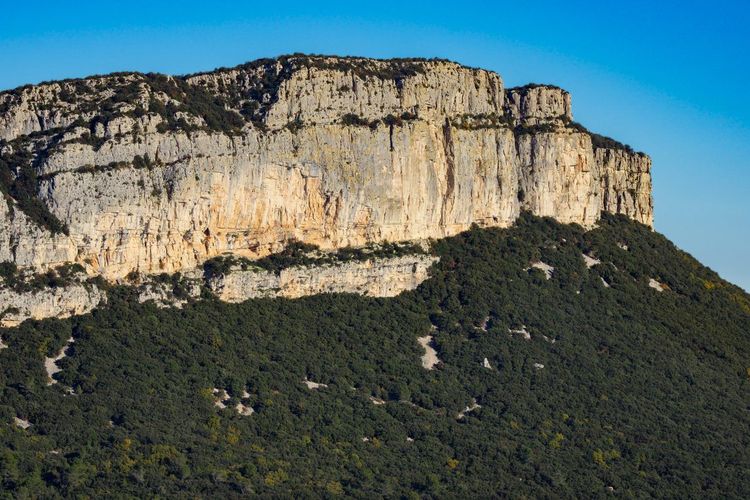
Montpellier has this particular quality: it is neither quite a seaside city nor quite an inland one. The Mediterranean is less than 20 minutes away by car, and the first foothills of the garrigue start just ten minutes in the other direction. On the third day, you will have to choose — or do both if you set off early.
Beaches and Lagoons around Montpellier
Palavas-les-Flots, 12 kilometres from the centre, remains the easiest resort to reach. Its stilt houses lined along the canal and its miniature lighthouse make for a setting quite different from the straight beaches further east. You can get there by bus from the centre, but the most pleasant way is the cycling greenway that follows the Lez for nearly 15 kilometres from Port Marianne: about an hour of easy pedalling, doable all year round, away from traffic.
Further east, La Grande Motte strikes visitors with its white concrete pyramids imagined by architect Jean Balladur in the 1960s, designed to evoke Mayan cities from the sea. It is one of the rare examples of 20th-century seaside urbanism entirely conceived as a coherent architectural project, now listed as Heritage of the 20th Century.
Between the two resorts stretches the étang de l'Or, a shallow lagoon where flamingos and herons gather, visible from several dedicated observation points. In fine weather, several beaches offer access to beach clubs with sun loungers and table service directly on the sand — a concept detailed in our Ryo selection of the best beaches around Montpellier as well as our Ryo guide to the best beach clubs around Montpellier. Book your sun lounger the evening before in July and August — spots go fast in the morning.
Vineyards and Garrigue of the Montpellier Hinterland
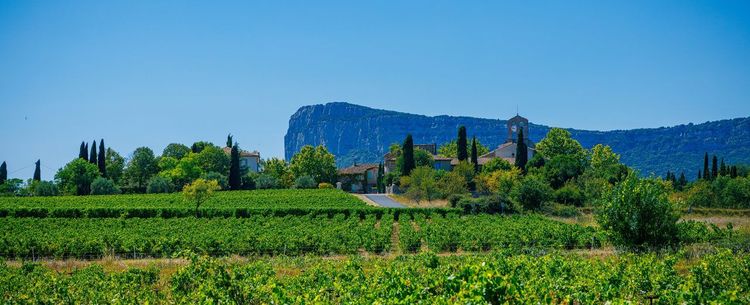
If you prefer the inland route, head north towards the Pic Saint-Loup, a limestone ridge rising 658 metres that dominates the entire surrounding wine landscape. The Pic Saint-Loup appellation, one of the most acclaimed in Languedoc, produces powerful reds on soils of pebbles and limestone, best tasted directly at the estates that open their cellars to visitors.
The garrigue blanketing the surrounding hills releases a characteristic scent of thyme and rosemary in summer, when the heat bursts open the essential oils of the low-growing plants. Hilltop villages such as Saint-Mathieu-de-Tréviers, or the remains of the Castries aqueduct built in the 17th century to supply the château, punctuate a route that can be explored by car or by bike for the more seasoned cyclist.
Allow about two and a half hours return for the ascent of Pic Saint-Loup if you fancy the hike. The well-marked trail climbs steeply near the top but rewards you with a 360-degree view over the plain, the sea, and, on a clear day, Mont Ventoux.
One More Day? Excursions and Ideas to Extend Your Stay
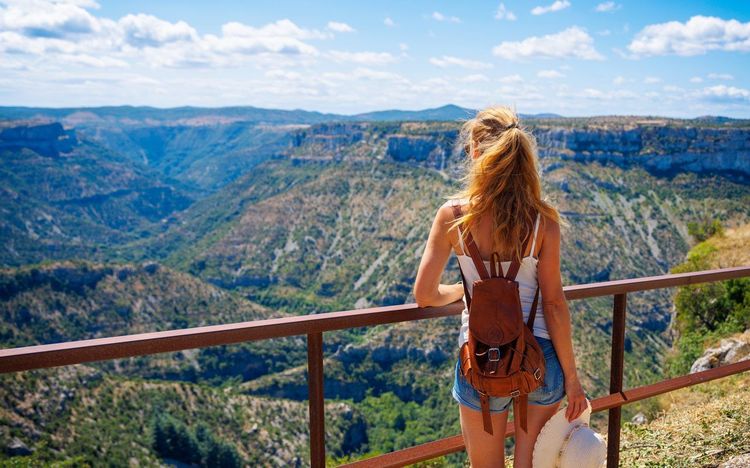
Three days cover the essentials, but Montpellier also works very well as a base for day trips over four or five days. Several major sites in the Hérault and the Gard are reachable in under an hour.
Sète, about thirty minutes away by train, surprises those who have never been: canals threading through the city, traditional water jousting tournaments, a morning fish market, and the marine cemetery where poet Paul Valéry rests, overlooking the Mediterranean. The tielle sétoise, a pastry stuffed with spiced octopus, is worth the detour on its own.
Saint-Guilhem-le-Désert, listed among the most beautiful villages in France and inscribed on the UNESCO World Heritage List as part of the pilgrimage routes to Santiago de Compostela, nestles in the Hérault gorges three quarters of an hour's drive away. The Pont du Diable, a Romanesque and vertiginous bridge, marks the entrance to the gorges.
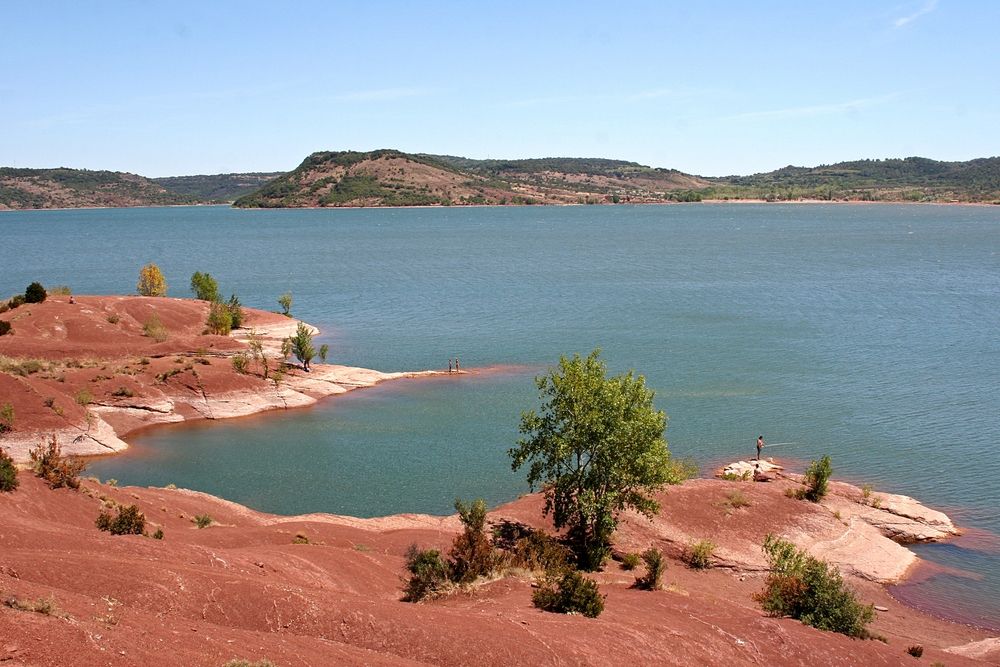
The Salagou lake (Lac du Salagou, 34700 Clermont-l'Hérault, rated 4.7/5 on Google from 3,861 reviews), an hour to the north-west, offers an almost Martian landscape: red ruffe soils, basalt flows, and a seven-hundred-hectare reservoir where swimming, paddleboarding, and cycling are all freely permitted. Our Ryo article on the Salagou lake details the best viewpoints.
For hiking enthusiasts who did not have time on day 3, the Ryo guide to hiking Pic Saint-Loup offers a complete itinerary, and our Ryo article on excursions around Montpellier lists further ideas, from the Pont du Gard to the arenas of Nîmes, both reachable by direct train from the Saint-Roch station.
Where to Stay in Montpellier during Your Visit
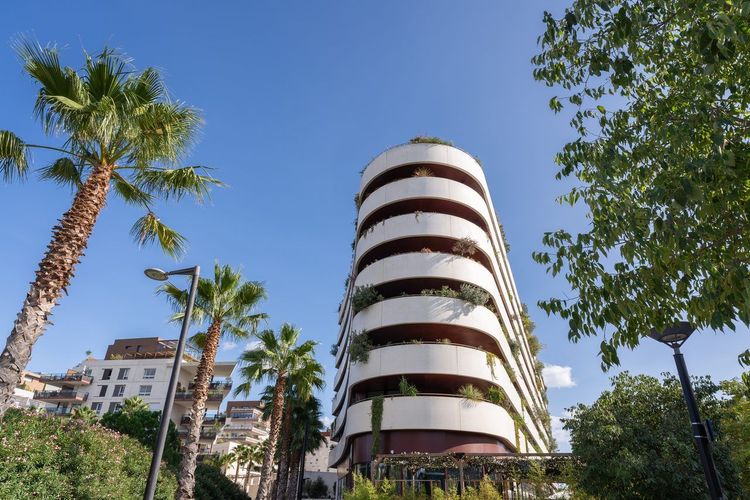
The choice of neighbourhood matters more than the hotel's star rating when it comes to making the most of three days in Montpellier.
Staying in the Écusson or Antigone to Explore on Foot
The Écusson, entirely pedestrianised, remains the safe bet for those who want to do everything on foot: most of the day 1 sites are within ten minutes' walk of a central accommodation. Rates here are logically higher, driven by the recent conversion of several mansions into boutique addresses.
Antigone is a worthwhile alternative for travellers who prioritise modern comfort: newer buildings, more accessible parking, and a direct tram link to the rest of the city. It is also the chance to sleep within the very architecture you will have walked through the day before.
The Ryo tour Say Hello to the Gifted One takes its title from the nickname Montpellier has earned thanks to its student youth and economic dynamism: a good introduction to choosing your neighbourhood with full knowledge before booking.
Quieter Options on the Outskirts
In the Port Marianne and Odysseum area, newer accommodation appeals to families and business travellers: a quiet neighbourhood in the evenings, well connected by tram, and close to the Arena Sud de France for concerts and sporting events.
Residential neighbourhoods such as Les Beaux-Arts or Boutonnet, north of the Écusson, offer an interesting balance between tranquillity and proximity, fifteen minutes on foot from the centre. They suit stays that begin or end with an early morning train departure, as the Saint-Roch station is within walking distance from both areas.
How to Get to Montpellier
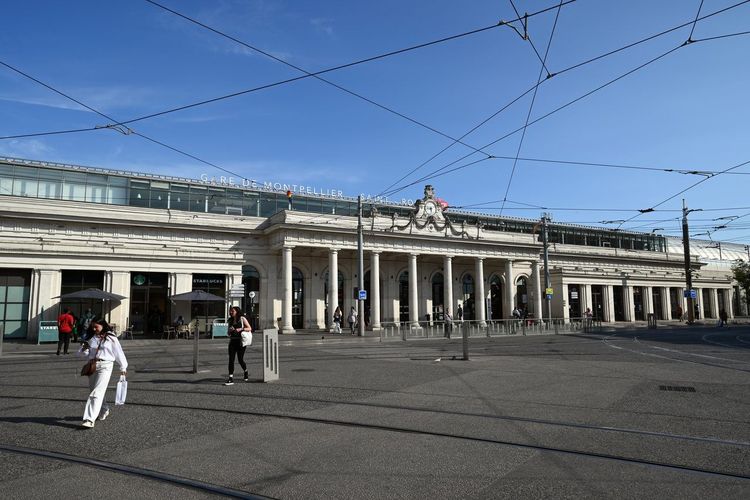
The Montpellier Saint-Roch station (Place Auguste Gibert, 34000 Montpellier, rated 3.7/5 on Google from 1,849 reviews), right in the city centre, receives direct high-speed trains from Paris in just over three hours and from Lyon in under two hours. Connections to Perpignan and Spain also pass through this station, which has the advantage of being within walking distance of the Écusson. A second station, Montpellier Sud de France, located to the east of the city and connected to the centre by tram, serves some high-speed trains: check which one appears on your ticket before booking your accommodation.
The Montpellier-Méditerranée airport, about ten kilometres to the south-east, serves several French and European cities via low-cost airlines. A shuttle connects the airport to the city centre in about twenty minutes; allow double the time by combined tram and bus if you are travelling light and prefer to save a few euros.
By car, Montpellier sits directly on the A9 motorway, between Nîmes and Béziers. Park-and-ride facilities on the outskirts, connected to the tram, spare you from driving into the city centre, where traffic is dense and parking is limited. From the station, regional TER trains reach Sète, Nîmes, or Avignon in under an hour — making it easy to organise a fourth-day excursion without ever renting a car.
How to Get around Montpellier without a Car
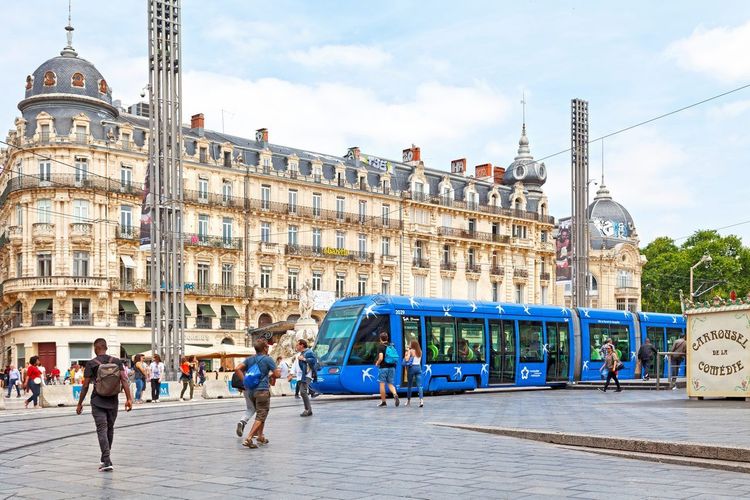
Montpellier has made the absence of a car almost a tourist selling point. The TaM network has five tram lines since the opening of line 5 at the end of 2025, with carriages designed by Montpellier-born couturier Christian Lacroix on lines 3 and 4 — underwater worlds on one side, a golden heritage décor on the other — while the blue swallows of line 1 and the flowers of line 2 were created by Élisabeth Garouste and Mattia Bonetti. Since late 2023, public transport has been free for residents of the metropolitan area; visitors purchase a standard ticket, individually or as a day pass, which becomes significantly better value from the third journey onwards.
For shorter trips or leisurely rides, the Vélomagg bike-share service effectively complements the network, with stations spread across the entire centre and into the outer neighbourhoods. Our Ryo article on cycling routes around Montpellier lists several itineraries, including the greenway to the sea mentioned on day 3.
The historic centre, entirely pedestrianised, is easy to cover on foot: from one end of the Écusson to the other rarely takes more than twenty minutes' walk. If you arrive by car, leave the vehicle in one of the park-and-ride facilities on the outskirts, whose flat rate includes tram journeys for all car occupants — the most economical and least stressful solution. For three full days without a car, the tram, walking, and Vélomagg cover the entire itinerary, sea trip included.
What to Eat in Montpellier
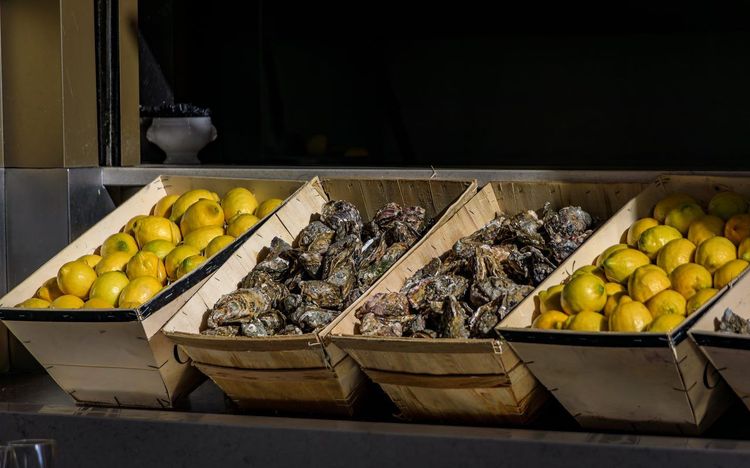
Montpellier's cuisine draws heavily on the resources of the nearby coast. Bouzigues oysters, farmed in the étang de Thau half an hour's drive away, appear on most seafood menus in the city, often paired with a glass of Picpoul de Pinet, a dry white wine produced on the same shores.
Among slow-cooked dishes, the brasucade de moules — mussels cooked over a fire of vine shoots — and the petits pâtés de Pézenas, a curious sweet-and-savoury pastry filled with spiced lamb inherited from the Indian cooks of Lord Clive in the 18th century, are both worth trying at least once. On the sweeter side, the grisettes de Montpellier, small honey sweets flavoured with liquorice, can still be found in a handful of confectionery shops in the centre and make a more original souvenir than a fridge magnet.
For quick meals, the Halles Laissac and the Halles Castellane offer a varied range of small producers and street food, more affordable than the restaurants in the centre. The Arceaux market, set up beneath the arches of the aqueduct several mornings a week, has a distinctly local feel, with Hérault producers and vendors of sheep's cheese from the Causses. Montpellier has also built a solid reputation for weekend brunch, driven by its student population: our Ryo top of the best brunches in Montpellier lists the addresses that hold up under the Sunday rush. To explore the local food scene further, our Ryo article on the culinary specialities of Montpellier details the great classics of the Languedoc table.
Budget, Best Time to Visit, and Practical Tips for Montpellier
Montpellier's Mediterranean climate allows a visit at almost any time of year, but two windows stand out clearly. Spring, from April to June, brings mild temperatures and a still low light, ideal for walking without suffering from the heat. September and October extend this clemency while emptying the city of its summer crowds.
Summer remains intense: temperatures regularly exceed 32 degrees in July and August, and the city centre, very mineral in character, retains the heat well into the evening. In return, it is the season of major festivals and long evenings on terraces.
Budget-wise, allow around 60 to 80 euros per day per person on a budget (hostel, markets, public transport), 120 to 180 euros on a mid-range basis with a three-star hotel and a few restaurants, and above 220 euros for a comfortable stay including a private excursion into the hinterland. The Musée Fabre entry at around ten euros and free access to most gardens and promenades allow you to put together a rich programme without breaking the bank.
Two details can make or break a stay's comfort. First, the wind — dry tramontane or humid sea breeze — which can quickly cool spring evenings: pack an extra layer even in April. Second, the crowds, concentrated around the May bank holidays and festival weekends, when Écusson hotels sell out several weeks in advance. Shifting your stay by just one week is often enough to find normal rates and breathable terraces.
Events and Festivals Not to Miss in Montpellier
Montpellier maintains a rich cultural life all year round, an aspect that most travel guides treat far too briefly. In spring, the Comédie du Livre turns the centre into an enormous open-air bookshop, with author events spanning several days, while the Arabesques festival, devoted to Arab world music and arts, takes over the domaine d'O.
June brings the Printemps des Comédiens, dedicated to theatre and contemporary forms in the park of the domaine d'O, followed by the start of Montpellier Danse, one of the oldest contemporary dance festivals in Europe, which runs into July.
Summer continues with the Radio France Occitanie Montpellier festival, devoted to classical and operatic music, and the Estivales de Montpellier — free nocturnal markets where Hérault producers and winemakers set up every week on the esplanade Charles-de-Gaulle. In autumn, the Internationales de la Guitare and the Cinemed international Mediterranean film festival round off what is an almost uninterrupted programme. Our Ryo article on events in Montpellier lists exact dates, which vary slightly each year: a quick check before booking can save you from arriving during the city's most congested weekend — or, conversely, from missing the event that would have given your stay its real flavour.
FAQ
How many days do you need to visit Montpellier?
Three days are enough to cover the Écusson, Antigone, and a side trip to the sea or the hinterland without rushing. In two days, focus on the historic centre and Antigone and skip the coast. With four or five days, add Sète, the Salagou lake, or a hike up Pic Saint-Loup.
Can you visit Montpellier without a car?
Yes, easily. The city centre is entirely walkable, the tram serves the outer neighbourhoods, and the cycling greenway connects the city to the sea in under an hour. Only some villages in the hinterland are more conveniently reached by car or organised tour.
What is the best time to visit Montpellier?
Spring (April to June) and early autumn (September–October) offer the best balance between mild weather and manageable crowds. Summer draws more visitors and higher temperatures, offset by a very packed festival programme.
Where should you stay in Montpellier to explore on foot?
The Écusson remains the most practical choice for getting everywhere on foot, followed by Antigone for a compromise between modern comfort and proximity to the centre. More peripheral neighbourhoods such as Port Marianne are better suited to families or travellers with a car.
What budget should you plan for 3 days in Montpellier?
Between 60 and 80 euros per day per person on a budget, and 120 to 180 euros on a mid-range basis, accommodation included. The main cultural attractions are affordable, with several free sites such as the Peyrou or the Jardin des Plantes.
How do you get to the sea from Montpellier?
Palavas-les-Flots is about twenty minutes away by bus or car, and just under an hour along the cycling greenway that follows the Lez from Port Marianne. La Grande Motte, further east, takes around 25 minutes by road.
After these three days, it is hard to sum up Montpellier in a single image — the city piles on the contrasts, from medieval lanes and neoclassical colonnades to wild lagoons. It is precisely this variety of scenery within such a compact area that makes it stand out among the cities of southern France. To continue the experience neighbourhood by neighbourhood with headphones on, the Ryo audio guide of Montpellier is the simplest complement to this itinerary, whether you stay three days or decide, once there, to extend the pleasure.
À lire également