© Shutterstock
 Votre guide Ryo
Walking in Sète 2026: Mont Saint-Clair, Canals and Tour of the Bassin de Thau
Sète stands between two bodies of water — the Mediterranean on one side, the Étang de Thau on the other — draped across the slopes of Mont Saint-Clair like a setting you can only truly understand on foot. The climb to the summit, the tour of the canals, the Sète–Marseillan walk along the Lido: each route tells a different side of the city's story. It is sometimes called the Venice of the Languedoc, but the real postcard has to be earned — you need to climb a side staircase, follow a canal that smells of salt and grilled fish, before you understand why Paul Valéry chose to be buried here, facing the sea.
This guide brings together the routes that truly matter: the quick ascent of Mont Saint-Clair for a 360-degree panorama, a stroll through the canals and fishermen's houses of la Pointe Courte, the Lido promenade between fine sandy beaches, a food break at the covered market, then the grand tour of the Étang de Thau through Bouzigues, Mèze and Balaruc, before pushing on to the Gardiole and Moure massifs, along the Canal du Midi by bike or on a day trip to the Cirque de Mourèze. Sète on foot can be wrapped up in a packed half-day; allow a long weekend to explore the entire Bassin de Thau. You will also find, further down, distances, durations, parking options and the best season for each route. If you are extending your stay towards Montpellier, less than 30 minutes away by train, the Ryo audio-guided tour of Montpellier takes over with its own tour of the historic city centre.
Mont Saint-Clair: the Essential Panoramic Walk in Sète
At 175 metres above sea level, Mont Saint-Clair is the hill that shaped the entire history of Sète: without it, there would be no sheltered port, no city built between the lagoon and the sea. It is also, without question, the best walk for understanding the geography of the site in under an hour. From the town centre, several routes lead up to the summit: steep stairways cutting through gardens clinging to the hillside, or gentler streets for those who prefer to save their legs. Allow 30 to 45 minutes for the climb from the port — a reasonable effort even for those not used to walking.
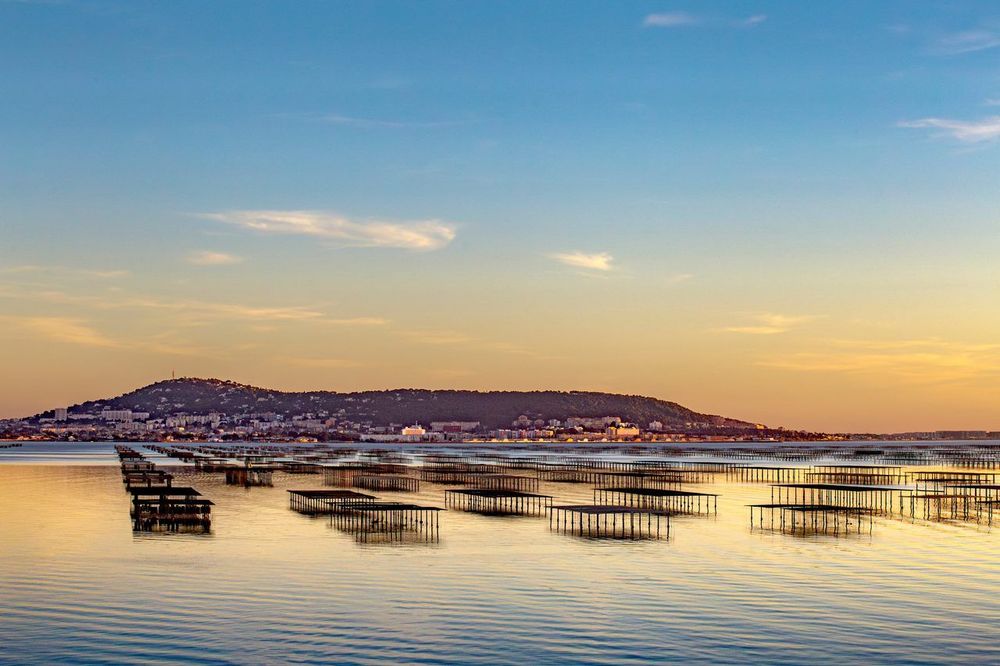
At the top, the orientation table reveals a view of Sète from above that few coastal towns can match: on one side the Étang de Thau and its oyster beds glittering in the distance, on the other the Mediterranean stretching to the horizon, and on a clear day the silhouette of the Pyrenees drawn across the skyline. The chapel of Notre-Dame de la Salette, built in the 19th century in the wake of the Marian apparition at La Salette in 1846, marks the highest point and remains a local pilgrimage site as much as a photogenic vantage point. Its interior, entirely covered in frescoes painted in the 1950s, often surprises visitors who came only for the view.
On the western slope, the Pierres Blanches state forest opens up a second option — greener and far less busy. Its waymarked paths wind through Aleppo pines and kermes oaks over about three kilometres of loop, with a purpose-built viewpoint looking directly down over the Bassin de Thau. This is the best choice in intense heat: the shade is almost continuous, which is not the case on the staircases of the town-side slope.
Halfway up, the cimetière marin (Rue Denoyez, 34200 Sète, rated 4.6/5 on Google from 104 reviews) is worth a stop, and not only because of its name. This is where Paul Valéry, a native of Sète, lies buried; his eponymous poem made this place famous far beyond the city — the Saint-Charles cemetery was officially renamed the 'cimetière marin' after the poet's death in 1945. The terraced graves, oriented towards the open sea, give the site a particular atmosphere, almost suspended between two horizons. Wear sturdy shoes: the ground is uneven in places and shade is scarce in the height of summer.
If you can only do one walk in Sète, this is the one. It combines easily with a visit to the upper quarter by descending via a different path, which means you avoid retracing your steps on the same staircase. The best time to make the climb is early morning or late afternoon, when the raking light over the Étang de Thau completely transforms the landscape. One local tip: descend via the Rue du Chemin de la Corniche rather than the stairways — you'll enjoy an unbroken view of the sea for almost the entire return journey.
A Tour of the Picturesque Neighbourhoods: la Pointe Courte, the Upper Quarter and the Canals
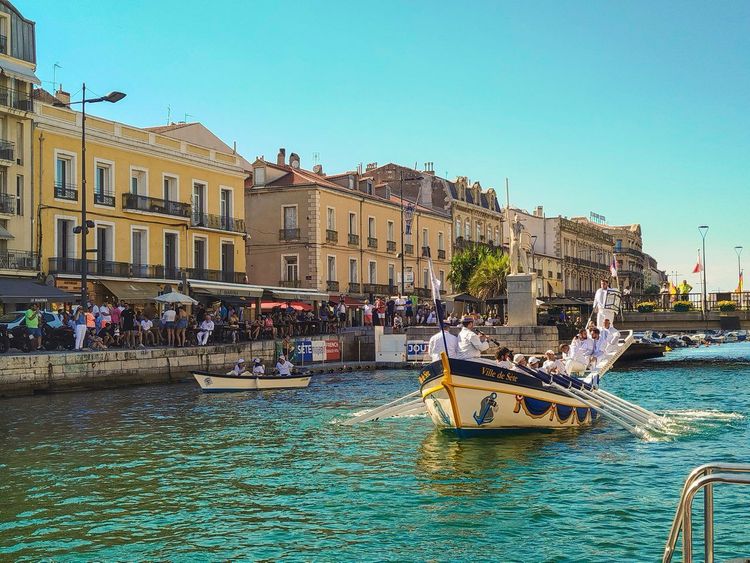
Exploring Sète on foot means, above all, exploring a city of canals. The Canal Royal, which cuts through the centre from one end to the other, gives the entire urban walk its backbone: colourful quaysides, summer jousting tournaments and fishing boats moored side by side set the tone from the very first steps. The architecture lining the quays — tall, narrow facades — dates from the great era of maritime trade in the 19th century, when the port exported Languedoc wines throughout the Mediterranean.
Start at the môle Saint-Louis (Môle Saint-Louis, 34200 Sète), the city's ground zero: this is the breakwater whose first stone was laid by Louis XIV in 1666, the official birth certificate of the port. The walk along the môle, barely more than a kilometre there and back, offers the best vantage point over the entrance to the channel and the trawlers returning in the late afternoon, often escorted by seagulls.
La Pointe Courte (Quai du Général Durand, 34200 Sète, rated 4.7/5 on Google from 2,653 reviews) is the neighbourhood that surprises passing visitors the most. This small fishing village, wedged between the canal and the Étang de Thau, has kept its tiny alleyways, its low brightly coloured houses and its nets drying in front of doorways. Agnès Varda shot her first film here in 1954, and the place has changed little since: you can still feel that fishermen's life suspended between two worlds — the sea and the lagoon. Walk slowly and speak softly; you are among residents, not on a film set.
Heading up towards the upper quarter, the atmosphere changes entirely. The streets narrow, climb, and reveal fleeting views over terracotta rooftops and the lagoon below. It is one of the most endearing parts of Sète, with its working-class houses inherited from Italian immigration, its steep stairways and its improvised viewpoints between two bends. Take time to get deliberately lost — it is often in these detours that the finest perspectives appear.
The théâtre de la Mer, set up within the old Fort Saint-Pierre that once guarded the port, rounds off this urban loop. Its stage facing the Mediterranean hosts the city's major festivals each summer, but the spot is equally worth a visit out of season for the view from the ramparts. This neighbourhood alone concentrates several centuries of maritime history — fortifications, navigation canals and working-class housing all in one place. Allow a good two hours to cover the whole area at a leisurely pace, stopping regularly on the bridges to watch the comings and goings of boats and, if the timing is right, the opening of a swing bridge to let a sailing boat through.
To discover more of the city, our article what to do in Sète details further addresses and activities to complement this walk through the historic neighbourhoods.
The Lido Promenade and Sète's Iconic Beaches
The Lido promenade runs along a narrow strip of land between the Étang de Thau and the Mediterranean, linking Sète to Marseillan-Plage over nearly twelve kilometres. It is one of the most complete walks on the Hérault coast, suitable for walking, cycling or rollerblading on a dedicated path that hugs the shoreline without ever straying from it.
On the sea side, several beaches dot the route and allow you to break up the walk according to the mood of the moment. The plage de la Corniche (Boulevard Camille Blanc, 34200 Sète, rated 4.5/5 on Google from 441 reviews) is the closest to the town centre, lined with restaurants and lively from the first warm days of the year. Further along come the Lazaret beach, the Fontaine beach and then the long stretches of sand at Villeroy — wilder and noticeably quieter once you move away from the car access points.
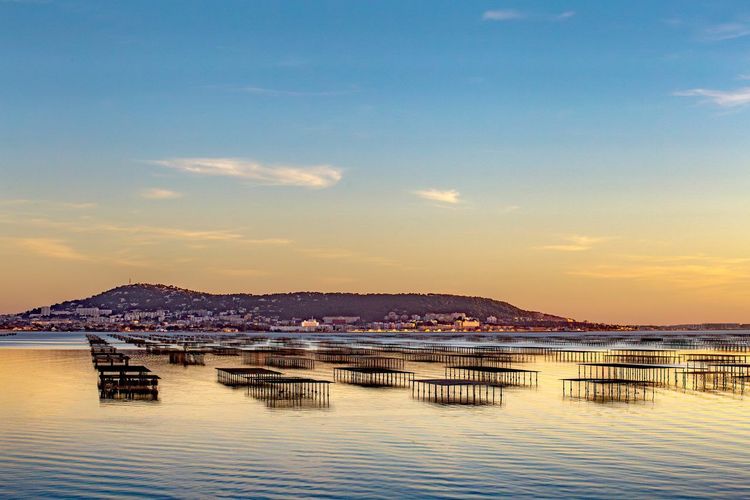
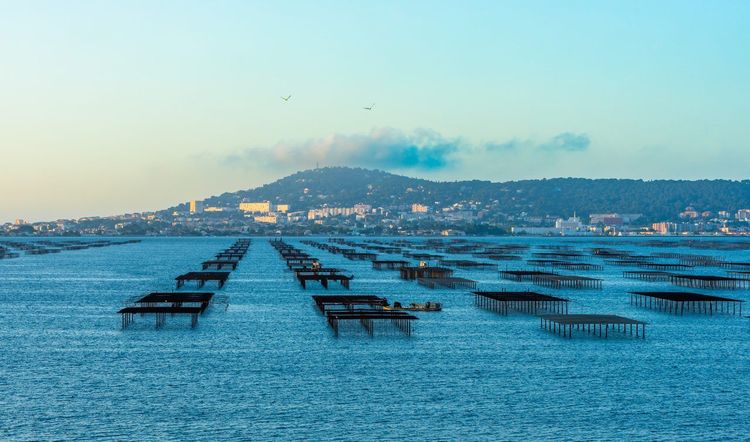
On the lagoon side, the view changes completely: you can make out the oyster beds striping the surface of the water, and in the distance the massifs framing the Bassin de Thau. This alternation of landscapes — the sea on one side, the calm of the lagoon on the other — is what gives the Sète–Marseillan walk its charm. Swimming and cycling remain the most popular activities in Sète along this stretch of coastline. Cyclists often use it to reach Marseillan without ever leaving the waterfront, a real advantage for families looking for a flat, safe route.
One practical detail that makes all the difference: the Lido has been extensively redesigned over the past twenty years to combat erosion, with the road set back and the dune ridge rebuilt. As a result, the path is now separated from traffic for most of its length and crosses protected dunes where walking off-track is prohibited. Stay on the designated paths — the vegetation holding the sand in place is fragile.
In high season, it is better to set off early: the coastal car parks fill up quickly and shade is scarce along this exposed strip. Autumn and spring offer far more pleasant conditions for covering the full route, with a particularly soft light over the lagoon in the late afternoon. In July and August, a shuttle bus serves the beaches from the town centre — the simplest solution for walking the promenade in one direction and returning without retracing your steps.
A Food Lover's Walk: Sète's Market Hall and Markets
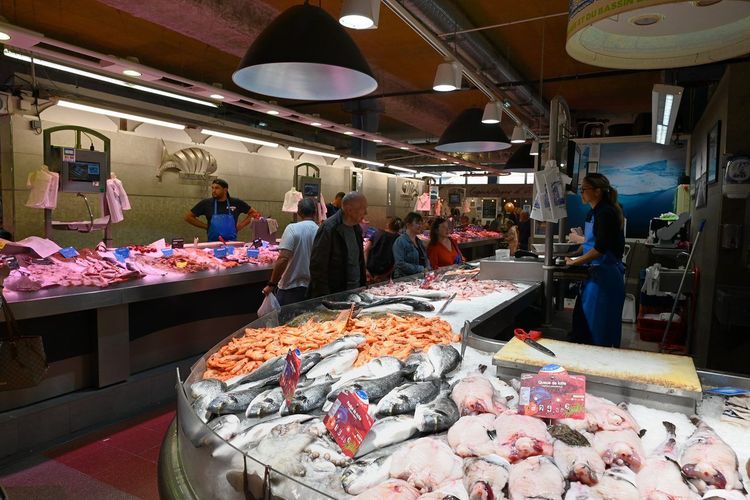
No walk in Sète is complete without a detour through the halles de Sète (Rue Gambetta, 34200 Sète, rated 4.5/5 on Google from 9,946 reviews), a covered market where the city's entire culinary identity is on display. Fishmongers, oyster farmers and greengrocers gather under the same glass roof in a loud, joyful atmosphere that is worth visiting even without any intention to buy. It is one of the few places in Sète open every morning of the week, including Sundays.
This is where you taste the tielle sétoise, the spiced octopus pie that is to Sète what socca is to Nice, and the oysters from the Étang de Thau, eaten standing at the counter with a glass of Picpoul de Pinet. Regulars come early, before the tourist crowds fill the aisles. On Wednesday and Friday mornings, the market spills outside into the surrounding streets, almost doubling the area available for browsing. Set aside a good hour and leave with enough to picnic on the quays of the Canal Royal, just a short walk away.
The Tour of the Étang de Thau: Bouzigues, Mèze and the Oyster Villages
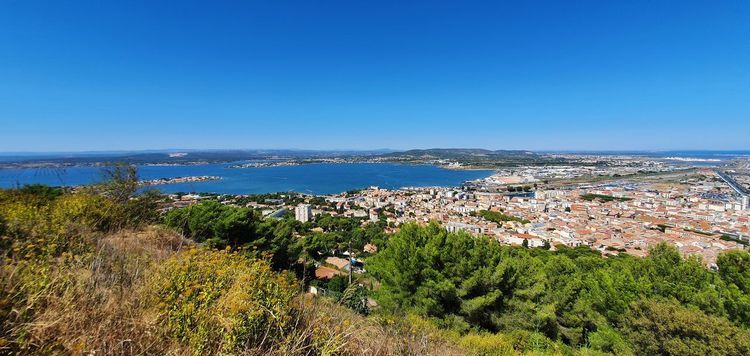
The Étang de Thau is the largest lagoon in Occitanie, with nearly 7,500 hectares of brackish water squeezed between the sandy Lido coastline and the Gardiole hills. It is the beating heart of all local shellfish farming: oysters and mussels have been cultivated here since the early 20th century on suspended tables that structure the entire landscape. Walking or cycling around this lagoon means passing through a series of villages that all depend, to varying degrees, on this oyster-farming activity.
Bouzigues is probably the best-known village on the lagoon, its name having become synonymous with oysters for many visitors. The small harbour is packed with tasting huts where oysters are eaten at wooden tables with your feet almost in the water. The musée de l'étang de Thau, set on the waterfront, tells the story of local shellfish farming through tools, scale models and explanations accessible to the whole family. Allow an hour for the visit, and if you are travelling with children, ask for the discovery booklet at the entrance.
Mèze, a few kilometres further on, has a slightly different feel: a larger village with a genuine historic centre to explore in addition to the waterfront, and a well-regarded market several times a week. The walk is pleasant in summer and winter alike, between shaded lanes and quiet quays where fishermen still mend their nets. On the edge of the village, the Bagnas estate and nature reserve — a protected wetland — offers a nature option for birdwatching enthusiasts.
On the other side of the lagoon, Balaruc-les-Bains (Avenue Charcot, 34540 Balaruc-les-Bains, rated 4.2/5 on Google from 4,219 reviews) plays a different card — that of its thermal spa. This spa resort, the most visited in France, also borders the lagoon and offers a pleasant walk along its landscaped waterfront, dotted with gardens and shaded rest areas. Right next door, Balaruc-le-Vieux has preserved a typical circular medieval village core — a circulade organised around its church, with quiet lanes that feel a world away from the bustle of its neighbouring resort.
A practical tip if you are attempting the full loop in a single day: aim to leave Sète early in the morning, save Bouzigues for lunch, and plan to reach Mèze in the late afternoon, when the low light over the lagoon produces the most beautiful colours. On paper, the Sète–Bouzigues walk is only about fifteen kilometres along the northern shore; the full loop around the lagoon, however, is around sixty kilometres by bike. The audio-guided tour of Montpellier is less than half an hour's drive from Mèze — a worthwhile option if you want to pair a day by the lagoon with an urban escape.
Nature Hikes around Sète: Massifs and Lagoons
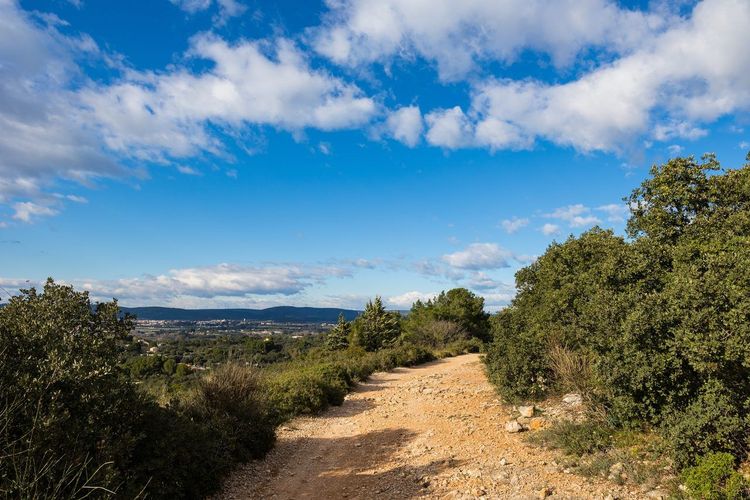
Behind the coastal postcard, Sète is surrounded by a hinterland of garrigue scrubland and secondary lagoons that is attracting a growing number of hikers. The massif de la Gardiole, stretching from Frontignan to Vic-la-Gardiole and peaking at around 230 metres, offers a dense network of waymarked trails through pines and holm oaks, with surprising viewpoints over the entire coastline. The finest hiking destination here is without doubt the abbaye Saint-Félix de Montceau — a Benedictine ruin perched above Gigean, less than an hour's walk from the site car park. The massif de la Moure, more discreet and less frequented, completes this range of hills on the side of Montbazin and Villeveyrac, with generally shorter routes that are perfect for a half-day outing.
On the lagoon side, the étang de Vic and the étang du Méjean, located between Villeneuve-lès-Maguelone and Frontignan, form a protected area rich in migratory birds. The paths running alongside them are flat, accessible to all the family, and particularly recommended in spring and autumn for birdwatching. You will encounter flamingos, herons and sometimes school groups on educational outings — a sign that this remains a protected space rather than a tourist thoroughfare. A pair of binoculars completely transforms the experience, especially towards the end of the day when the colonies gather.
The bois des Aresquiers, wedged between the étang d'Ingril and the sea near Frontignan, offers a shaded walk that is quite rare along this largely open coastline. The pine forest leads directly to wild beaches, making it a popular route for combining cool woodland walking with a swim at the end. The main path covers about six kilometres there and back, with no difficulty, and lends itself well to a late-afternoon outing.
Further inland, the source de l'Avy, on the edge of the massif de la Gardiole near Gigean, feeds a small green valley that stands in sharp contrast to the surrounding garrigue — a short, cool walking destination, much appreciated in summer. The pic de Vissou, which towers over the Cabrières vineyards at just under 500 metres, requires a proper full-day outing, roughly an hour's drive from Sète. The final stretch of the climb is steep, but it rewards you with a panorama taking in the Salagou, the wine-growing plain and, on a clear day, the Bassin de Thau all the way to the sea.
These hikes combine well if you have a vehicle: massif de la Gardiole in the morning, étang de Vic or du Méjean for a quiet picnic, then back via the bois des Aresquiers in the late afternoon. Wear closed-toe shoes whatever route you choose — the terrain is stony and can be slippery after rain. Also keep an eye on prefectural orders: access to the Hérault massifs may be restricted or even closed in summer during periods of high fire risk.
Cycling Routes: the Canal du Midi and the Tour of the Étang de Thau
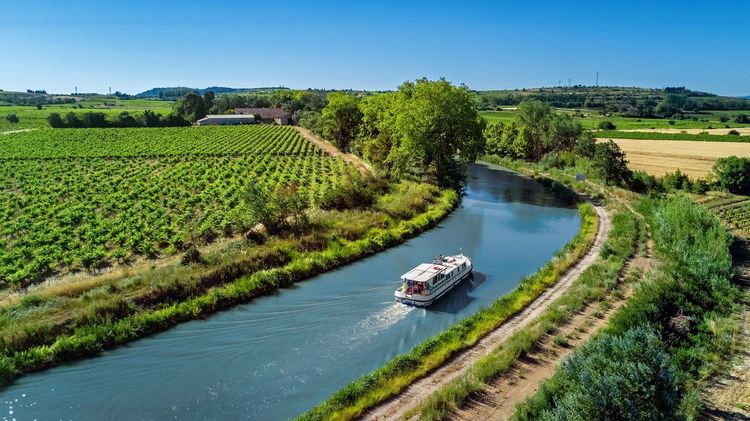
The area around Sète is particularly well suited to cycling, thanks to a network of greenways running alongside both the coastline and the Canal du Midi. The latter, a UNESCO World Heritage Site since 1996, links Toulouse to the Étang de Thau, which it reaches at Marseillan via the round lock and the Phare des Onglous. Its towpath — flat and shaded by plane trees — remains one of the most pleasant routes in the area when the heat becomes overwhelming elsewhere.
The tour of the Étang de Thau by bike is the most requested route in the region. Allow around 60 kilometres to complete the full loop, passing through Sète, Balaruc, Bouzigues, Mèze and Marseillan, with an overall flat profile that makes it accessible to intermediate cyclists. Most sections follow greenways separated from traffic — a real advantage for family cycling without stress. Sète is also crossed by the La Méditerranée à Vélo itinerary, the cycle route following the coast from west to east, making it easy to slot a stage into a longer journey.
For those not travelling with their own bike, several rental shops are based in Sète and the villages around the lagoon. The offer ranges from standard bikes and hybrid bikes to electric bikes, the latter being strongly recommended if you plan to tackle the slopes of Mont Saint-Clair or complete the full lagoon loop in a single day. Prices generally run to around fifteen euros a day for a standard bike and double that for an electric model, with half-day rates and flexible return points. Booking a few days in advance in high season avoids unpleasant surprises, as demand surges from the first sunny weekends of the year.
Among the best routes to consider from Sète: the Sète–Marseillan ride along the Lido, a short 25-kilometre round trip for a half-day; the full Étang de Thau loop for a whole day; or a section of the Canal du Midi towards Agde for those who prefer the shade of plane trees to the exposed coastline. Bring plenty of water — refuelling points are scarce once you leave the villages behind. Back in town, our audio-guided tour, The Gifted City, is ready to take over on foot in Montpellier.
Sète's Cultural Side: Brassens, Valéry, Street Art and Jousting
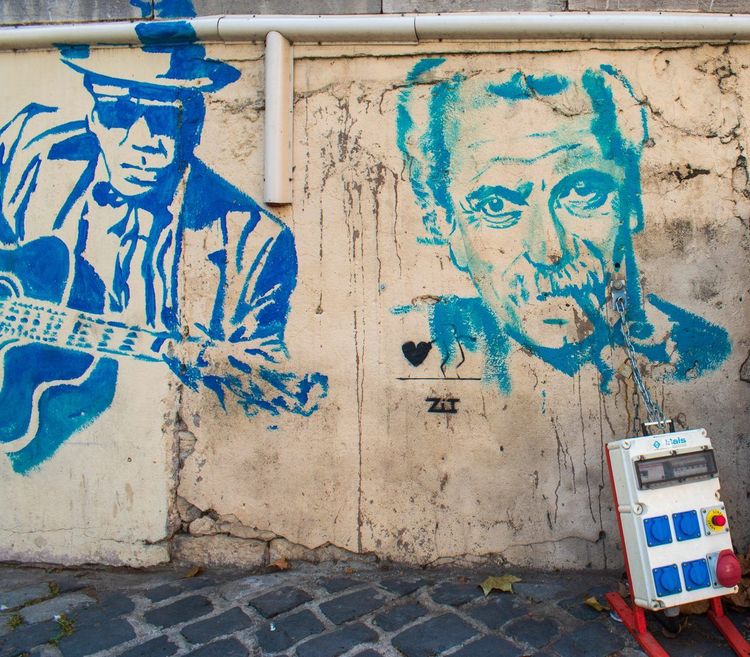
A walk through Sète that ignored its artists would miss the point entirely. The city was the birthplace of Paul Valéry and Georges Brassens, and it has turned this double heritage into a genuine cultural trail, easy to weave into an urban walk. The espace Georges Brassens, at the foot of Mont Saint-Clair, traces the singer's life through an audio tour with his songs as the guiding thread; his grave lies a few hundred metres away, in the Le Py cemetery — the one he called the cemetery of the poor.
Higher up, the musée Paul Valéry overlooks the cimetière marin and combines painting collections, a Valéry archive and temporary exhibitions, with a terrace that is worth the visit on its own. Below, facing the canal, the musée international des arts modestes (23 Quai Maréchal de Lattre de Tassigny, 34200 Sète, rated 4.3/5 on Google from 1,086 reviews), created in 2000 by Sète-born artist Hervé Di Rosa, displays popular objects and repurposed everyday items in a joyfully un-solemn setting. It is a museum in Sète open year-round — ideal on windy days when walking outside becomes unpleasant.
Outside, the city has also transformed itself into an open-air gallery: facades painted by international artists punctuate the centre and the upper quarter, among the most photogenic neighbourhoods in Sète — a legacy of the street art festival that takes over Sète every summer. Spotting these murals on foot is a good excuse to venture beyond the tourist streets.
Finally, if you visit in late August, you will encounter the Saint-Louis water jousting tournament, a tradition dating back to the inauguration of the port in 1666. Two boats, two jousters in white, drums and a canal packed with onlookers: this is the moment when the city tells its story best — and the only time when walking along the quays becomes a contact sport.
Day Trips: Mont Saint-Loup, the Cirque de Mourèze and Lac du Salagou
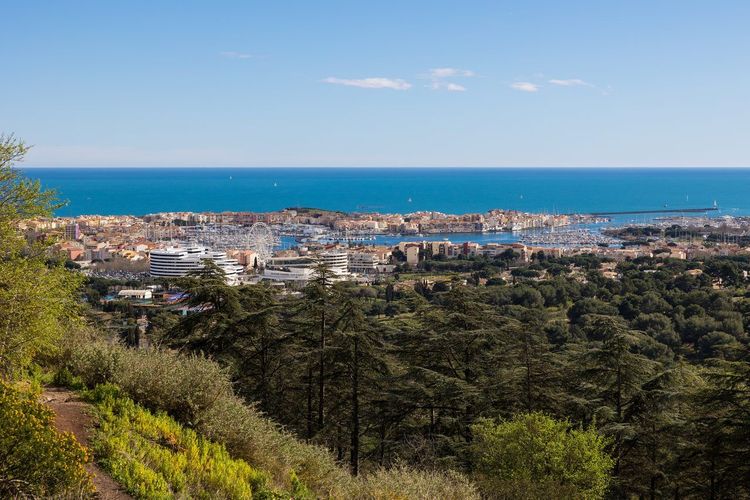
None of the guides dedicated to Sète really venture beyond the Bassin de Thau, which is a shame given how worthwhile the day trips accessible from the city truly are. Mont Saint-Loup, about twenty minutes' drive towards Agde, is an extinct volcano that dominates the entire surrounding coastline. The climb is short — under thirty minutes — for a panorama that takes in Cap d'Agde, the mouth of the Hérault river and, on a clear day, a good stretch of the coastline all the way to Sète. This is also what explains the black stone of Agde's buildings: the volcanic basalt served as a construction material for centuries.
Further inland, the Cirque de Mourèze offers a complete change of scenery: this dolomite chaos of tortured rock formations, sculpted by erosion over millions of years, resembles a lunar landscape set down in the middle of the Hérault garrigue. Allow an hour's drive from Sète and two to three hours on site to explore the paths winding between the rocks, with a short loop accessible to children and a longer variant towards the viewpoint.
A few kilometres away, the Lac du Salagou (Route du Lac, 34700 Celles, rated 4.7/5 on Google from 4,200 reviews) completes this excursion with its waters ringed by ruffes — those red soils that give the site the look of a Martian landscape. This artificial lake, filled in the late 1960s, is equally enjoyable on foot or by bike. Mont Liausson, which towers above it at just over 500 metres, offers the finest overall view of the red banks and the blue water, while the lac des Olivettes, more discreet on the Vailhan side, provides a quieter alternative for those escaping the summer crowds.
The more adventurous can also look into a long-distance gravel route linking Millau to Lac du Salagou — an ambitious itinerary crossing the Larzac landscapes before descending towards the lagoon. A serious undertaking, best reserved for those with several days available and a bike suited to unpaved tracks.
Villages to Discover around the Bassin de Thau
Beyond the main stops, several smaller villages are worth a quick visit for anyone taking the time to explore the full Bassin de Thau. Frontignan, known for its muscat wine, has a compact historic centre around its fortified church and a broad beach that naturally extends the Lido eastwards. Most of the local wineries can be visited with a simple reservation — a welcome break after a hike in the Gardiole.
Poussan retains a medieval village core with its stone lanes and a lively weekly market, far from the tourist bustle of the coast. Gigean, nestled at the foot of the massif de la Gardiole, serves as a starting point both for the source de l'Avy mentioned above and for the climb to the abbaye Saint-Félix de Montceau, one of the finest viewpoints in the area.
Vic-la-Gardiole provides direct access to the étangs de Vic and du Méjean — a practical base for birdwatching enthusiasts — and preserves a 12th-century fortified church that is a reminder of how exposed this coastline was to maritime raids. Montbazin, a little further inland, appeals through its tranquillity and its preserved garrigue landscapes on the foothills of the massif de la Moure.
Villeveyrac is home to the abbaye de Valmagne (Route de Villeveyrac, 34560 Villeveyrac, rated 4.5/5 on Google from 3,088 reviews), a Cistercian complex founded in the 12th century and nicknamed 'the cathedral of the vines' ever since its enormous oak vats were installed in the nave to store wine. The visit naturally ends with a tasting, and the medieval garden deserves a few extra minutes.
Finally, Mireval, on the road between Sète and Montpellier, rounds off this village tour with its own muscat vineyards and the quiet atmosphere of a wine-growing town. None of these villages requires more than an hour to visit: the idea is to string them together over a half-day, by car or by bike, rather than dedicating a separate outing to each one.
Practical Information: When to Go, Where to Park and How to Plan Your Walk
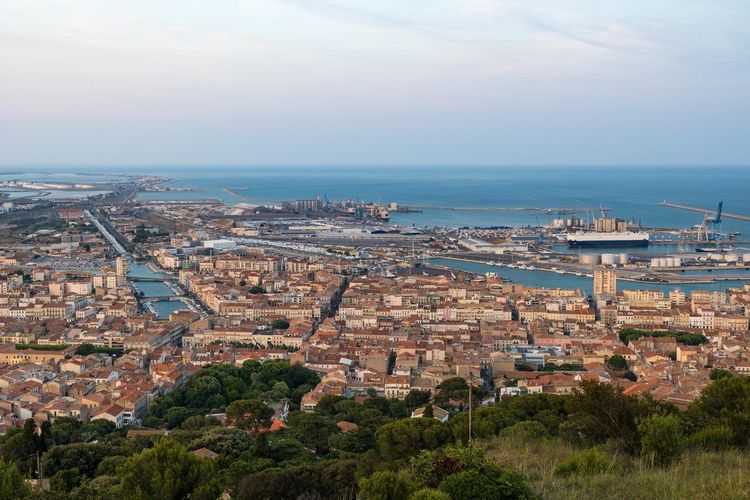
The best time to walk in Sète is spring and early autumn: mild temperatures, pleasant light for photos and crowds that are noticeably more manageable than in the height of summer. July and August are still viable, provided you set off early in the morning to avoid the heat on exposed paths such as Mont Saint-Clair or the Lido promenade. Winter has its devotees: the canals are quiet, the oyster huts are ticking over at a slower pace but still serving, and the low light over the lagoon is the most beautiful of the year.
For parking, several car parks exist in the town centre and near the port, but they fill up quickly in high season. For the Mont Saint-Clair climb, it is better to park in the residential streets lower down the hill rather than searching for a space at the summit, which is often full. The tourist office on the Quai d'Alger, open in Sète year-round, also distributes maps of the Bassin de Thau trails. Arriving in Sète without a car is perfectly feasible: the city is served by the rail line linking Montpellier to Béziers and Narbonne, and the station is a quarter of an hour's walk from the Canal Royal.
The city is part of Sète Agglopôle Méditerranée, the urban community that groups together the municipalities of the Bassin de Thau and coordinates, among other things, the upkeep of the cycle greenways and the summer beach shuttles. To plan a full day around activities in Sète, allow half a day for the town centre and Mont Saint-Clair, a full day for the Étang de Thau bike loop, and an additional day if you add a trip to Mourèze or the Salagou. One final useful habit: check the wind forecast before you set off — the tramontane can make the Lido promenade genuinely unpleasant even in bright sunshine.
FAQ
How long does it take to walk around Sète?
Allow around three hours to combine Mont Saint-Clair, the canals, la Pointe Courte and a stop at the covered market. Add an hour if you extend the walk to the Lido promenade, making it a full half-day outing.
What is the most beautiful walk in Sète?
The climb up Mont Saint-Clair is the benchmark, offering a panoramic view over the Étang de Thau and the Mediterranean. For a more authentic experience, walking through the narrow lanes of la Pointe Courte provides a different kind of immersion — more intimate and far less photographed.
Can you cycle around the Étang de Thau?
Yes, the full route covers around 60 kilometres on largely flat paths that are often separated from traffic. Allow a full day with stops in Bouzigues and Mèze, or spread the ride over two days for a more relaxed pace.
Where can you park to walk around Sète?
Car parks in the town centre and near the port fill up quickly in high season, especially in July and August. For the Mont Saint-Clair walk, opt for the residential streets lower down the hill rather than trying to park right at the summit.
What is the best time of year to walk in Sète?
Spring and early autumn offer the best balance of pleasant weather and moderate crowds. Summer is still manageable if you set off early in the morning, especially for exposed walks such as the Lido or Mont Saint-Clair.
What walks in Sète are suitable for children?
The Lido promenade and the Bouzigues waterfront are the two safe bets: flat terrain, pushchair-friendly and swimming possible at the end. The Étang de Thau museum rounds off the outing nicely on windy days, as does the short, flat Sète–Frontignan cycle ride.
Can you walk to Sète from Montpellier?
No — the two cities are about thirty kilometres apart, which rules out a day walk between them. The train is the fastest option, with a journey of around 25 minutes that makes it easy to combine both destinations.
Sète suits every style of travel. On foot, it's a dense urban exploration that can be done in a few hours; by bike, it's the sixty-kilometre loop around the Étang de Thau; by car, the Cirque de Mourèze and Lac du Salagou are within a morning's reach. This variety of rhythms, rare in such a compact area, is why so many visitors leave feeling as though they have discovered several different regions in a single day.
If your itinerary takes you to Montpellier, the Montpellier tour naturally extends the experience with an audio-guided Ryo tour of the city's historic centre. And to plan your visit, our Ryo app and our article what to do in Sète bring together more ideas to complement this guide.
À lire également