© Shutterstock
 Votre guide Ryo
Vieux-Nice, the Historic District of Nice: 2026 Guide
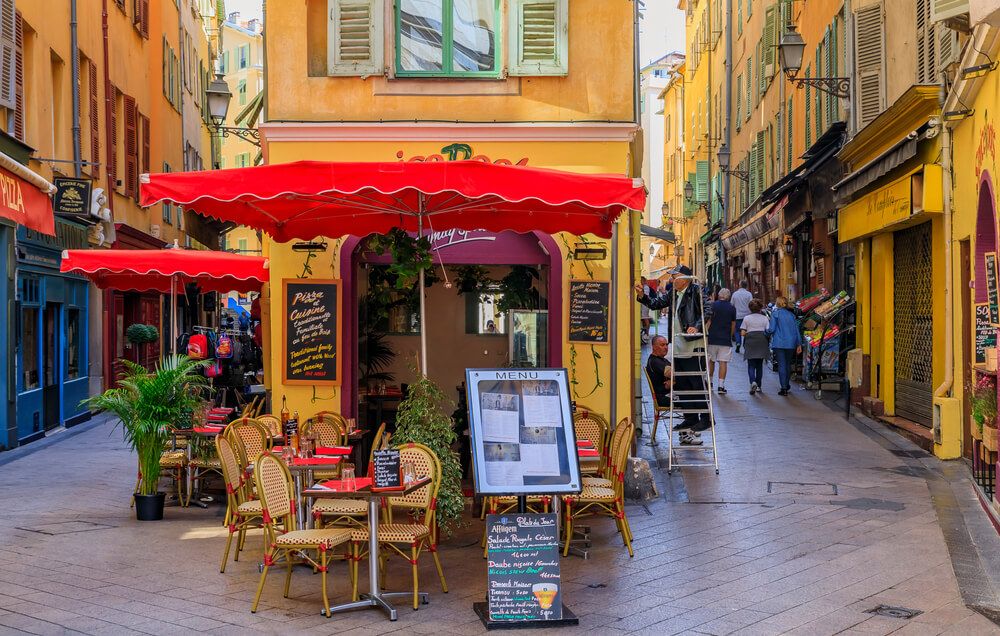
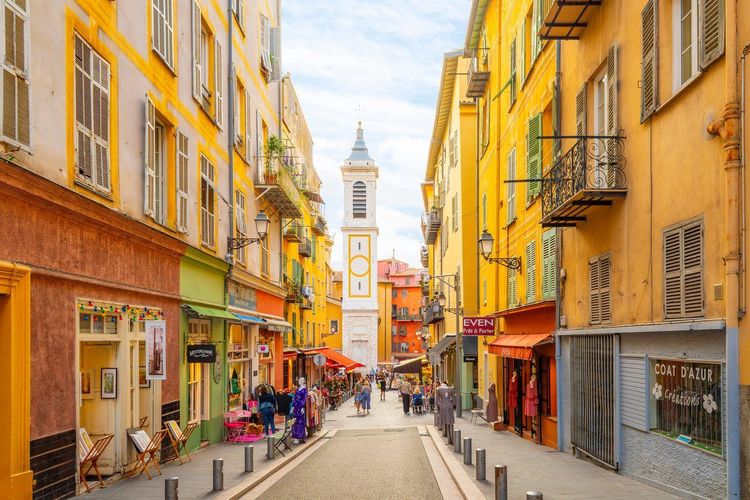
Turn a street corner and step from cool shade into a sun-drenched square: that is the signature of the Vieux-Nice district in Nice, this maze of alleyways that has preserved its 17th-century layout almost intact. The ochre and yellow façades press together along passages so narrow that the midday sun barely grazes the cobblestones for a few minutes a day, a phenomenon locals call their natural air conditioning. The Ryo audio-guided tour of Nice winds through this very labyrinth, between a century-old market and painted façades inherited from an earthquake.
This guide details what has made the district famous: a flower market established since 1861 on the Cours Saleya, a cathedral topped with glazed tiles visible from the neighbouring hill, a Château Hill overlooking the Baie des Anges at 92 metres above sea level, and addresses where socca is still eaten piping hot, wrapped in a scrap of paper. You will also encounter Genoese and Savoyard influences, legible on the signs and carved doorways, the result of a turbulent history that kept Vieux-Nice in Italian hands for centuries before its annexation to France.
History and Origins of Vieux-Nice
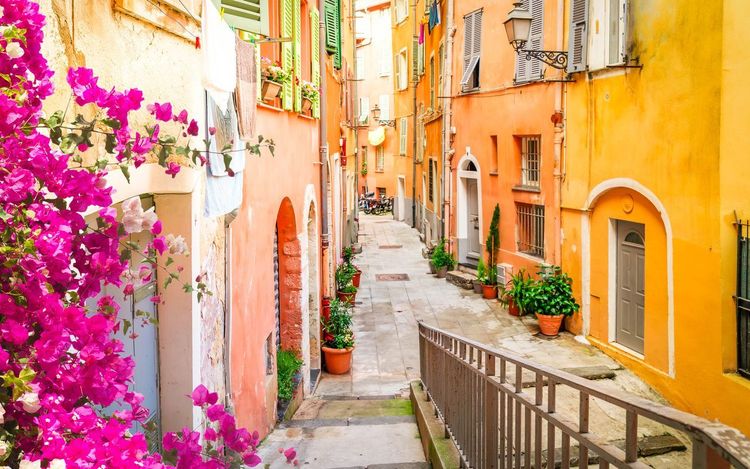
The core of Vieux-Nice dates back to the 11th century, when the population settled on the slopes of the Château Hill to protect itself from Saracen raids. The upper town flourished throughout the Middle Ages, fortified and sea-facing, before passing in 1388 into the orbit of the House of Savoy. This attachment lasted nearly five centuries and shaped the district's identity: its architecture, cuisine and even the Niçois dialect still bear the mark of this Italian parenthesis.
In 1543, the siege of Nice by the Franco-Ottoman forces of Barbarossa left its mark on local memory, with the legend of Catherine Ségurane evoking a washerwoman who supposedly repelled the assault single-handedly. But it was in 1706 that the district changed its face: Louis XIV, at war with Savoy, ordered the citadel crowning the hill to be razed. The stones of the demolished fortress were then used to fill in the moat separating the upper town from the seafront, creating the esplanade that would later become Cours Saleya.
The earthquake of 1887, felt throughout the region, damaged many of the district's façades. Rather than rebuilding like for like, the owners opted for trompe-l'œil painted décor — cornices, false ashlar, false balconies — giving the buildings the theatrical appearance we know today. This economical choice has become, a century and a half later, one of the most photographed visual signatures of Vieux-Nice.
The definitive annexation to France took place in 1860, following a plebiscite held under Napoleon III. The district nevertheless retained its original layout: narrow streets oriented east-west to shelter from the tramontane wind, and building heights calculated to maximise shade in summer. You will notice that most façades still display bottle-green shutters, a municipal regulation dating from that era that the city has maintained to this day.
This historical density explains why the Vieux-Nice district, despite covering less than one square kilometre, concentrates as many listed monuments as some much larger city centres.
Cours Saleya and the Flower Market
It is impossible to visit Vieux-Nice without stopping at Cours Saleya, the thoroughfare that replaced the moats of the former citadel. Every morning except Monday, the colourful stalls of the flower market are set up from 6 am, a tradition dating back to 1861 that makes Cours Saleya one of the oldest markets in Provence still in operation.
On Mondays, the florists give way to antique dealers and flea-market traders, who lay out second-hand furniture, vintage crockery and old postcards of Nice. The rest of the week, you will find stalls selling candied fruits, olives prepared on the spot and cut flowers at prices that remain, despite the tourist influx, gentler than in most major French cities.
At the eastern end of the Cours, the Chapelle de la Miséricorde deserves a raised glance: its 18th-century baroque façade conceals a richly gilded interior that many hurrying visitors overlook as they press on towards the sea.
Just behind, on place Saint-François (Place Saint-François, 06300 Nice, rated 4.4/5 on Google with 1.1K reviews), the fish market takes place every morning — less photogenic than the flower market but just as lively: the auctions can still be heard around 7 am, when fishermen unload their overnight catch directly onto the stalls.
Nearby, the Opéra de Nice, built in 1885 to plans by François Aune, conceals behind its discreet façade an Italian-style auditorium with more than 1,100 seats. Its programming remains affordable compared to Parisian venues, and its proximity to the market makes it a natural stop before continuing the tour of the district.
Cours Saleya is more than a backdrop: it is the economic heartbeat of Vieux-Nice, still sustaining several dozen independent traders today. You will encounter Nice residents doing their weekly shopping alongside restaurant chefs from the district who negotiate directly with producers early in the morning, before the first groups of visitors arrive.
Several market stalls sell freshly cooked socca, the chickpea-flour pancake that locals devour standing up, at aperitif time as readily as at breakfast. It is often here, rather than in a restaurant, that residents recommend tasting it for the first time. If you are looking for a quieter moment, come in the late afternoon: tourists desert Cours Saleya around 5 pm and the terraces regain a more local atmosphere, ideal for watching pétanque players settled under the neighbouring plane trees.
Cathédrale Sainte-Réparate and the Typical Alleyways
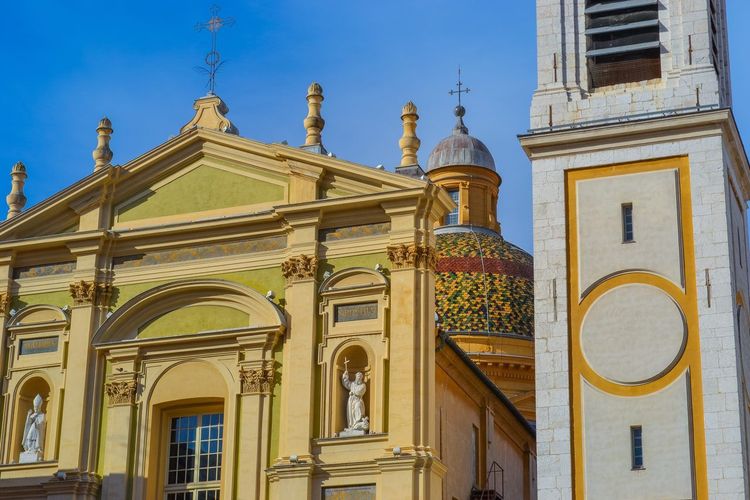
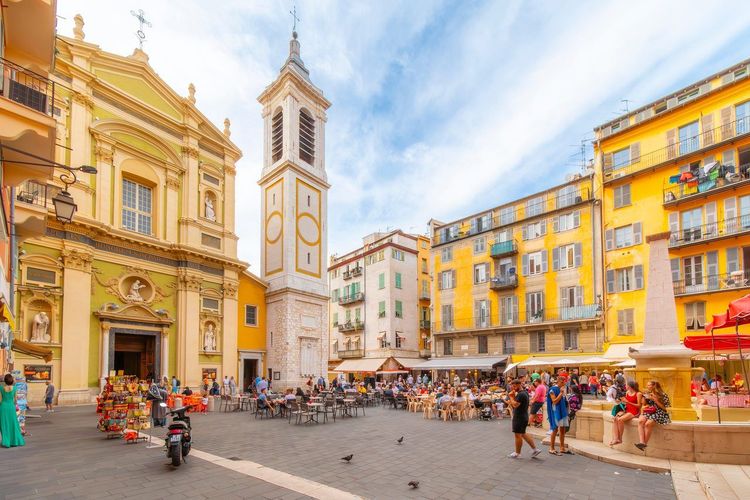
The Cathédrale Sainte-Réparate, completed in 1699, dominates place Rossetti with its dome covered in green and yellow glazed tiles, a typically Niçois decorative feature found on several other buildings in the district. Its baroque façade, restrained on the street side, conceals a far more flamboyant interior: gilded stucco, polychrome marble and a 19th-century organ that still resonates during services.
The surrounding place Rossetti is one of the few open spaces in Vieux-Nice, making it an easy landmark when you get lost in the grid of surrounding alleyways. In the evening, ice-cream parlour terraces multiply here, and it is not unusual to find a queue outside one of the district's historic establishments.
From the square, head down rue Droite (Rue Droite, 06300 Nice), the historic axis that already crossed the medieval town from north to south. Its name is misleading: it curves slightly, but remains one of the few streets wide enough to have housed the townhouses of Nice's noble families in the 17th and 18th centuries.
The adjacent alleyways, often barely two metres wide, bear names that tell the district's story: rue de la Poissonnerie, rue du Collet, rue de la Loge. Look up regularly: it is there, on lintels and cornices, that the oldest details are to be read, often ignored by visitors who keep their eyes on their phone to navigate.
Several craftsmen's shops occupy these vaulted ground floors today: santon makers, soap makers, dealers in old postcards. Many have kept the same premises for several generations, giving the district a commercial continuity that is rare in a historic centre as heavily visited as this one.
The architecture of these alleyways owes much to Genoese influence: buildings reaching up to six storeys, vivid colours inspired by Ligurian façades, occasional arcades that once allowed people to walk sheltered from the rain. This stylistic kinship with Genoa, barely 200 kilometres away by sea, is more keenly felt here than in any other district along the Côte d'Azur.
A tip that local guides often repeat: allow yourself to get deliberately lost in this network of alleyways for half an hour before seeking out a specific monument. Early in the morning, before the shops open, these same lanes offer a surprising silence, broken only by the sound of shutters being raised one by one. It is probably the best time to photograph place Rossetti and the cathedral without a single tourist in the frame.
The Château Hill and the Views over the Baie des Anges
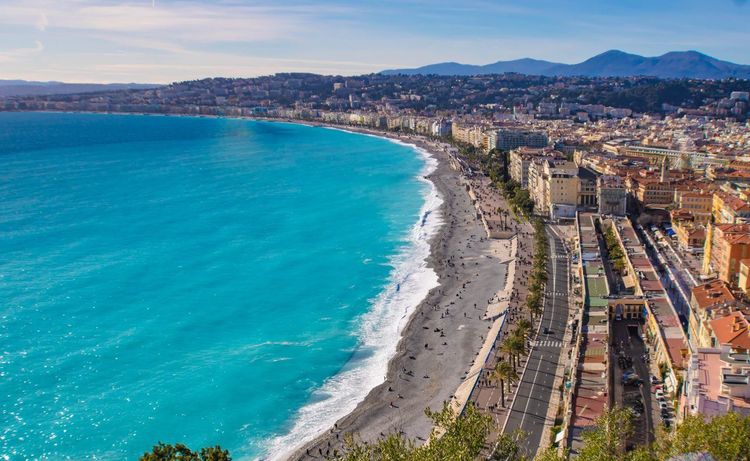
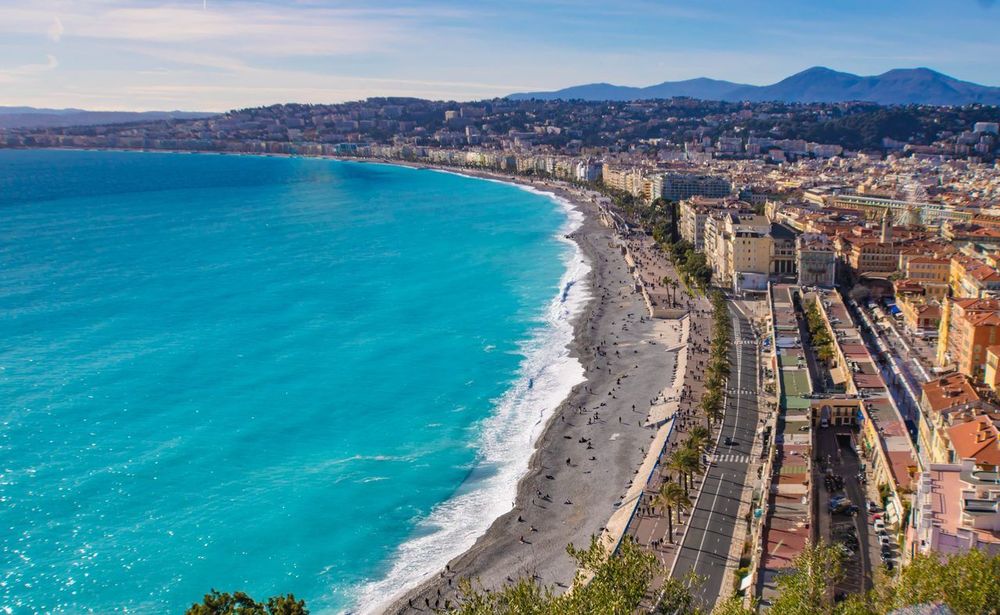
Before becoming a park, the Château Hill bore the citadel that had protected Nice since the Middle Ages, razed on the orders of Louis XIV in 1706. No visible trace of the fortress remains today, but the site retains its role as a natural viewpoint over the Baie des Anges, 92 metres above sea level.
The ascent can be made by several routes: the steps from rue Rossetti, the public lift located on quai des États-Unis, or a gentler path from the port. Allow about fifteen minutes on foot from Vieux-Nice, longer if you stop at every landing to photograph the view that progressively opens up over the pink-tiled rooftops of the district.
At the summit, an artificial waterfall installed in the 19th century cools the surrounding air, and several landscaped terraces allow you to observe both the port of Nice to the east and the Promenade des Anglais to the west — a 180-degree panorama that explains why the spot remains one of the most sought-after viewpoints in the city.
Below, on the port side, the Tour Bellanda marks the former southern bastion of the citadel. Rebuilt in the 19th century in a neo-medieval style, it now houses a cultural space and remains a visual landmark for orienting yourself between Vieux-Nice and the port.
The site also contains a 19th-century cemetery, with its monumental plots facing the sea, as well as the remains of a medieval cathedral uncovered by archaeological digs still visible behind railings. The Ryo audio walking tour of Nice devotes several stages of its route to this hill, with explanations that help you visualise the vanished city.
Sunset is the most popular time at the site, to the point that on some summer evenings the best spots are taken a good half-hour in advance. If you prefer to avoid the crowds, dawn offers an equally spectacular light over the bay, with the advantage of having the viewpoint almost to yourself. Bring water if you climb in the middle of a summer's day: shade is scarce on the final stretch of the ascent.
By descending on the port side rather than back through Vieux-Nice, you will pass through a different, more recent district where pleasure craft rub shoulders with former warehouses converted into restaurants. It is a simple way to extend the walk without retracing your steps.
Palais Lascaris and Baroque Heritage
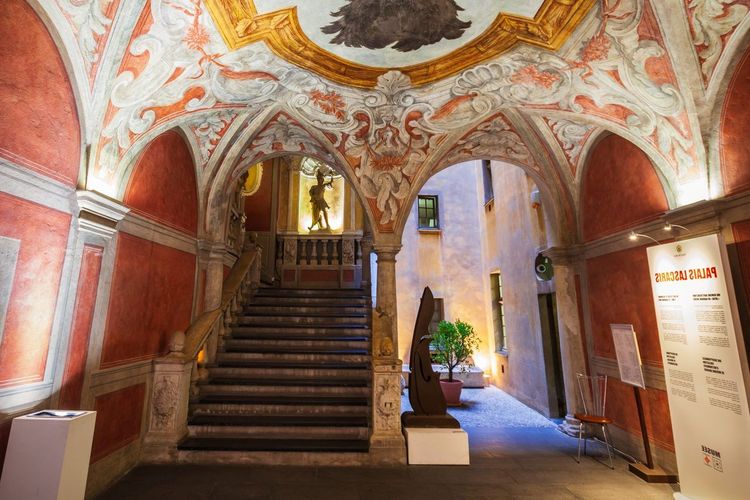
On rue Droite, the Palais Lascaris remains one of the best-preserved examples of Niçois baroque architecture. Built in the first half of the 17th century for a noble family close to the Dukes of Savoy, it has retained its grand staircase, its trompe-l'œil painted ceilings and its period furniture, now open to the public as a municipal museum.
The interior houses one of the most important collections of antique musical instruments in France, from harpsichords to violas da gamba, as well as a reconstructed 18th-century pharmacy with its original faience pots. A single ticket gives access to all of the city's municipal museums, making it an easy stop to incorporate into a walk through the district, even without having planned a specific cultural visit.
The palace is just one example among many of the dense religious and civic heritage of Vieux-Nice: around ten baroque chapels are concentrated within a perimeter of less than one square kilometre, vestiges of penitent confraternities that once shaped the social life of the district. If the subject interests you, the Ryo article on the museums of Nice offers a comprehensive overview of the collections to discover beyond Vieux-Nice alone.
Allow around thirty minutes for the visit to the palace, longer if you linger over the details of the grand staircase ceiling, considered one of the finest examples of baroque trompe-l'œil in the region.
Rue Pairolière and the Life of the District
Unlike Cours Saleya, rue Pairolière (Rue Pairolière, 06300 Nice) comes alive at residents' hours rather than visitors' hours. This commercial street, which takes its name from the coppersmiths who once worked there, concentrates bakeries, greengrocer's and delicatessens frequented daily by the district's residents.
This is where some of the oldest shops in Vieux-Nice are found, including several bakeries that still prepare fougasse niçoise, a local version flavoured with orange blossom. In the morning, the street rings with the sound of metal shutters being raised and successive deliveries, a working-neighbourhood atmosphere that contrasts with the more tourist-oriented streets a few hundred metres away.
As you head up towards place Saint-François, you will also pass several buildings whose inner courtyards conceal medieval wells, now sealed but still visible through carriage gates that are often left ajar. The contrast between the painted façades and these darker courtyards gives a fairly accurate sense of what Niçois housing was like before the gradual restoration of the district that began in the 1980s.
If the Ryo audio guide accompanies you through this stretch of the route, it points out several of these architectural details that are easily missed when walking fast. Take time to look at the shop fronts rather than passing them without stopping: several businesses still occupy their original shopfronts, with hand-painted lettering that sometimes dates back to the early 20th century.
Where to Eat: Niçois Specialities and Good Addresses
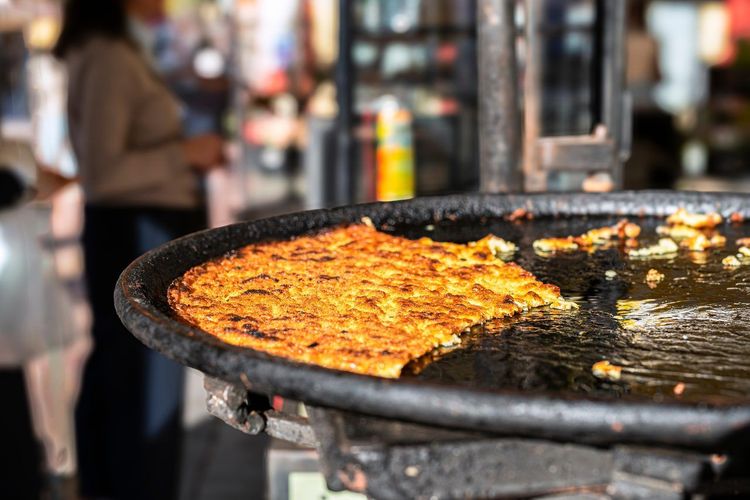
Vieux-Nice concentrates a large share of the addresses that have made Niçois cuisine famous, starting with socca, the chickpea-flour pancake baked in a wood-fired oven and served piping hot. At Lou Pilha Leva, a district institution, it is eaten standing up at high tables set out in the street, alongside other fried specialities such as courgette fritters and panisse.
Another classic of the Niçois table: pissaladière, a tart of caramelised onions, anchovies and black olives, not to be confused with pizza despite the visual resemblance. It is found at most bakeries in the district, often sold by the slice for a quick lunch between visits.
For a sit-down meal, La Merenda (4 Rue Raoul Bosio, 06300 Nice, rated 4.3/5 on Google with 957 reviews), on rue Raoul Bosio, remains a benchmark for petits farcis niçois and stockfish, that dried fish dish simmered slowly over a long time and requiring genuine patience in the kitchen. The address does not take reservations by phone: you must come in person to book your table, a habit that often surprises visitors but is part of the restaurant's folklore.
Salade niçoise also deserves a mention, if only to settle the debate: the traditional recipe excludes potatoes and green beans, contrary to the many versions served elsewhere in France. Tuna, anchovies, hard-boiled eggs, Niçois olives and raw broad beans form the base recognised by purists of the Niçois recipe.
For an impromptu market meal, head back to Cours Saleya: several stalls sell socca to take away, cheaper than in a restaurant, as well as candied fruits that keep well for the journey home. We go into more detail in the Ryo article on Niçois culinary specialities, useful if you want to put together a complete food-lover's itinerary.
On the drinks side, do not leave the district without trying a glass of Bellet wine, a little-known appellation produced on the hills above Nice, served in several wine bars in Vieux-Nice that have made it their speciality.
Expect to pay between 6 and 12 euros for a portion of socca or pissaladière eaten standing up, compared to 25 to 40 euros for a sit-down meal at one of the district's most reputable restaurants. The best addresses are often fully booked by 8 pm in summer: reserving at the end of the morning for the same evening remains the most effective approach.
Some dishes follow the calendar more than the menu: petits farcis are enjoyed mainly in the warmer months, when local courgettes and tomatoes are available, while soupe au pistou appears more towards the end of summer in restaurants that still cook according to what arrives from the neighbouring market, a good excuse to work up an appetite first on Nice's Ryo audio-guided tour.
Nightlife and Bars in Vieux-Nice
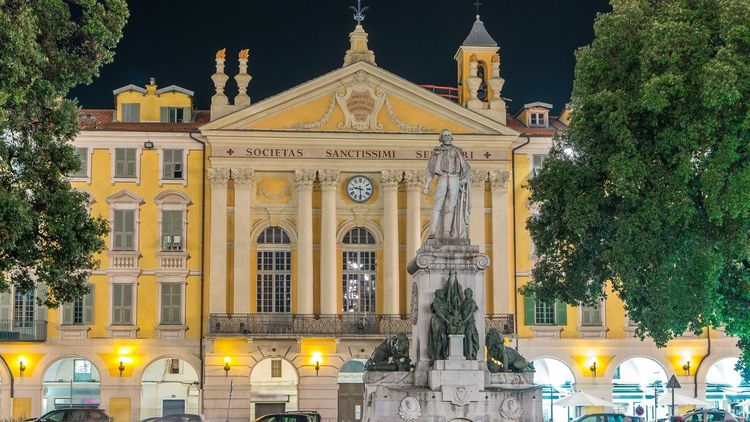
After 7 pm, Vieux-Nice changes pace. The food shops gradually pull down their shutters while bar terraces fill up, particularly around place Garibaldi, which is larger and more open than the interior squares of the district.
Rue de la Préfecture and rue Barillerie concentrate a good share of the district's wine bars and cocktail bars, often set up in former vaulted shops that stay cool even at the height of the season. The atmosphere remains broadly quiet on weekdays, livelier at weekends, without however reaching the intensity of the nightlife districts found in other coastal cities.
A useful tip if you are out late: the narrowest alleyways are poorly lit after midnight — it is better to stick to the main thoroughfares such as rue Droite or rue de la Préfecture when heading back, rather than cutting through the secondary lanes that even locals avoid at night.
In summer, several bars organise outdoor evenings with live music, a programme that changes each week and is worth checking in person rather than online, as the notices posted at venue entrances tend to be more up to date than their social media pages.
Shopping, Crafts and Markets
Beyond the food market, Vieux-Nice remains a good hunting ground for local shopping. Boutiques selling Marseille soap and artisan olive oil multiply around rue Saint-François-de-Paule, often run by producers who come directly from the surrounding hills.
On Mondays, when the florists of Cours Saleya give up their stalls, the flea market that sets up in their place attracts seasoned collectors as well as visitors in search of a more original souvenir than a fridge magnet. Antique crockery, last-century postcards and small pieces of furniture are haggled over, sometimes keenly, from the moment it opens.
For a more culinary souvenir, several delicatessens in the district offer olive oil from the neighbouring valley or Bellet wine in small formats, easy to slip into a suitcase. Expect to pay generally between 10 and 20 euros for a quality bottle of olive oil, a reasonable budget for a product that keeps well after you return home.
Practical Tips: Access, Parking, Best Time to Visit
Vieux-Nice is visited exclusively on foot: most streets are too narrow for a car and several are permanently pedestrianised. Tram line 1 serves two convenient stops, Opéra-Vieille Ville and Cathédrale-Vieille Ville, both less than five minutes' walk from the heart of the district.
If you come by car, the Papon car park, on the edge of the district, is the closest option, though its hourly rate rises quickly in high season. Many visitors prefer to park further away, near the port or the train station, and reach Vieux-Nice on foot or by tram to avoid the parking charges in the centre.
Allow half a day for a first complete tour of the district, longer if you add the climb to the Château Hill and a lunch break. A full day lets you combine the market, cultural visits and a slower exploration of the secondary alleyways, without feeling as though you are rushing from one point to another.
To extend your discovery beyond Vieux-Nice, the Ryo article on things to do in Nice and the surrounding area allows you to complement a visit to the historic district with other facets of the city, between the seafront and the surrounding hills.
Weather-wise, the district is accessible almost all year round thanks to its sheltered configuration, but summer means contending with heat that reflects strongly off the pale cobblestones between 1 pm and 4 pm. Wear enclosed, comfortable shoes: the uneven and sometimes slippery paving stones are unforgiving with smooth-soled sandals.
The district is also accessible for people with reduced mobility on its main thoroughfares, but some steep or irregularly paved alleyways may make it difficult to navigate with a wheelchair or pushchair. Check with the tourist office, located near the Promenade des Anglais, to find out the most accessible routes for your needs.
Vieux-Nice by Day, by Night, off Season
The face of the district changes radically depending on the hour. The morning belongs to the market and deliveries, midday to the visitors who flood the main alleyways, and the evening to the bars and restaurants that take over until late into the night.
Off season, between November and March, Vieux-Nice returns to a more local rhythm, with the exception of the Nice Carnival, which transforms the district and its surroundings for around fifteen days in February, with parades and flower battles dating back to 1873. You will find the full programme in the Ryo article on the Nice Carnival.
Spring and early autumn remain the most comfortable periods for exploring the district on foot, with moderate heat and still-manageable crowds. Summer is still possible, provided you accept the crowds and prioritise the beginning and end of the day for outdoor visits.
FAQ
Where exactly is Vieux-Nice located?
Vieux-Nice occupies the eastern part of the city centre, between the Château Hill, the Promenade des Anglais and avenue Jean Médecin. It forms a compact quadrilateral of less than one square kilometre, bounded on the sea side by the quai des États-Unis and on the city side by place Masséna and its gardens.
How much time should I allow to visit Vieux-Nice?
Half a day is enough for a first tour of the main points of interest: the cathedral, Cours Saleya and the Château Hill. A full day allows you to add the museums, a lunch break in the district and a slower exploration of the secondary lanes, without rushing from one point to another.
Is Vieux-Nice accessible by car?
No, the majority of streets are pedestrianised or too narrow for a car. Tram line 1, with the Opéra-Vieille Ville and Cathédrale-Vieille Ville stops, remains the most practical solution, complemented by the Papon car park for those who insist on coming by car.
What is the best time to visit Vieux-Nice?
Spring and early autumn offer the best compromise between pleasant weather and moderate crowds. February draws visitors for the carnival, but with dense crowds; summer remains manageable if you avoid the hottest hours, between 1 pm and 4 pm.
What should I eat in Vieux-Nice?
Socca, pissaladière, salade niçoise and petits farcis are among the district's emblematic specialities. The stalls at Cours Saleya and the bakeries on rue Pairolière let you taste them at a low price, without necessarily booking a table.
Is Vieux-Nice safe at night?
The main thoroughfares remain busy and broadly safe until late at night. The narrowest and least-lit alleyways warrant extra caution after midnight: it is better to stick to main streets such as rue Droite when moving around late.
What are the markets in Vieux-Nice and their opening hours?
The flower market on Cours Saleya takes place every morning except Monday, when it is replaced by a flea market. The fish market on place Saint-François also opens in the morning, with the busiest activity between 7 am and 9 am.
Conclusion
The Vieux-Nice district in Nice is hard to sum up in a single visit, as every alleyway conceals an architectural detail, a food address or a viewpoint found on no standard tourist map. Between the century-old market of Cours Saleya, the Cathédrale Sainte-Réparate and the Château Hill towering over the entire Baie des Anges, the district packs several centuries of Savoyard and French history into just a few hectares.
To explore this heritage without losing the thread between eras, the Ryo audio-guided tour of Nice offers a complete route linking these places to one another, with explanations that set each façade and each square in its historical context. The Ryo app lets you follow this circuit at your own pace, stopping as long as needed in front of a detail that would otherwise escape a quick pass.
Whether you come for a morning or a full day, keep some time to get deliberately lost in the secondary alleyways: it is often there, away from the busiest thoroughfares, that Vieux-Nice reveals its character most fully.
À lire également