© Shutterstock
 Votre guide Ryo
Canal Saint-Martin in Paris: Neighborhood Guide for 2026
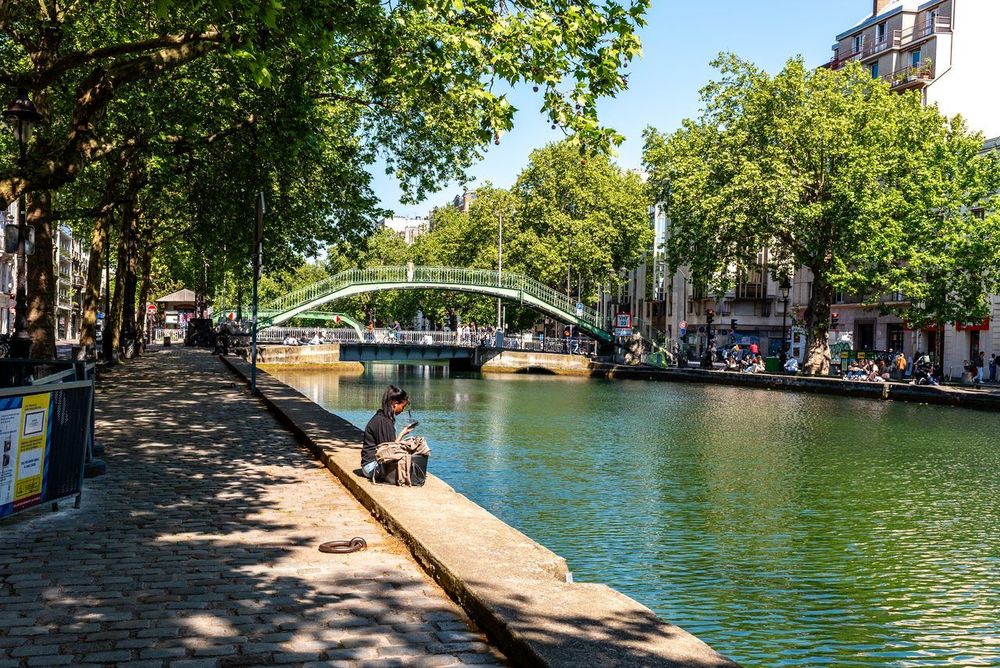
There's something strange about seeing Parisians sitting cross-legged on cobblestones, feet dangling above bottle-green water, in the Canal Saint-Martin neighborhood (Paris 10th arrondissement), while five hundred meters away the horns on the boulevard Voltaire never stop. And yet this is the scene that repeats itself every summer evening along this stretch of water, which has become one of the most photographed neighborhoods in the capital. The canal is not visited like a museum: you walk alongside it, cross it by nine bridges and footbridges, and discover it at the pace of a lock slowly filling with water.
Built on the orders of Napoleon I between 1802 and 1825 to supply Paris with drinking water, the canal today conceals two kilometers of underground vaulting beneath the boulevard Richard-Lenoir, nine locks that compensate for a twenty-five-meter drop between the Seine and the bassin de la Villette, and a swing bridge that local cyclists curse with remarkable consistency. You'll also find a floating cinema, a covered market from the 19th century, and the café that served as a set for the film Hôtel du Nord in 1938. This neighborhood guide follows the full route, from the bassin de l'Arsenal to the bassin de la Villette, taking in its natural wine bars, the vintage shops on the rue de Marseille, and the best spots for a Sunday picnic. Before you set off, the Ryo audio guide to Paris helps place this tenth arrondissement within the broader history of the capital, between working-class suburbs and villages absorbed by the city.
Canal Saint-Martin: A Neighborhood Born of Water
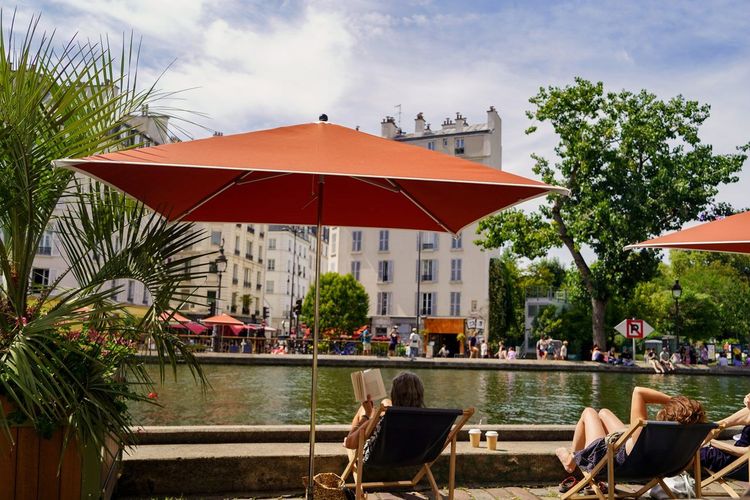
Construction on the canal began in 1802, under the Consulate, in response to a very concrete problem: Parisians were drinking Seine water laden with bacteria, and cholera epidemics were killing thousands. Engineer Pierre-Simon Girard conceived a canal 4.55 kilometers long, linking the bassin de la Villette, fed by the Ourcq, to the Seine via the bassin de l'Arsenal. Work stretched over twenty-three years, delayed by the Napoleonic wars and successive changes of regime, before an official inauguration in 1825 under Charles X.
Throughout the 19th century, the canal served primarily as a goods transport route: timber, plaster, coal, wine. The quays filled with warehouses and the neighborhood became a dense working-class suburb, far removed from the Haussmann boulevards. In 1860, Baron Haussmann had the southern section of the canal covered over to build the boulevard Richard-Lenoir, judging the open-air banks to be conducive to revolutionary barricades. It was this decision, almost anecdotal at the time, that gave the canal its current appearance: an underground section to the south, and an open-air section lined with plane trees to the north.
The general public truly discovered the canal in 2001, when Amélie Poulain skipped stones across its waters in the eponymous film. Before her, Marcel Carné had already shot a large part of Hôtel du Nord on the quays in 1938, without knowing that the café of the same name would one day become one of the most sought-after haunts in the 10th arrondissement. Since then, the neighborhood has changed its face: former workshops have become lofts, natural wine bars have replaced working-class bistros, but the water still flows at the same pace as two centuries ago.
If there is one thing to remember before you come: the canal is best discovered from south to north, going upstream, which also corresponds to the chronology of its construction. This is the order followed by this guide, from the bassin de l'Arsenal to the bassin de la Villette.
Where to Start the Walk: Bassin de l'Arsenal and Square Frédérick-Lemaître
The walk naturally begins at the Bastille, where the canal dips underground after passing through the bassin de l'Arsenal, a 180-berth marina tucked between the July Column and the viaduc des Arts. Live-aboard barges mingle with visiting sailing boats in a setting that stands in sharp contrast to the bustle of the square. It's a practical starting point: exit at Bastille metro, a few steps to reach the quays, and already the feeling of leaving Paris behind.
The bassin de l'Arsenal actually occupies the former moat of the Bastille fortifications, filled in and converted into a river port in the 19th century. This defensive past explains the basin's elongated, narrow shape, squeezed between two avenues, as well as the presence of the July Column a little further north, erected in memory of the revolutions of 1830 and 1848 rather than in any direct connection with the canal. Even today, some of the mooring rings visible on the quays date from that era, a discreet trace that few visitors notice as they pass.
From there, the canal disappears beneath the boulevard Richard-Lenoir for nearly two kilometers. There's no need to follow the underground route on foot; the walk continues at street level along the boulevard, bordered by an organic market on Sunday mornings and improvised sports pitches. Allow about twenty minutes of leisurely walking before the water reappears in the open air. This itinerary is easy to shorten or extend depending on the time available, without ever straying far from a metro station.
The boulevard that covers the canal also hosts, on Thursday and Sunday mornings, one of the largest food markets within Paris proper, with more than 100 stalls between the Bastille and the rue Amelot. Many visitors don't realize they are literally walking above the canal as they browse between the cheese stands and the rotisseries.
The canal resurfaces at the level of the square Frédérick-Lemaître (75011 Paris, rated 4.2/5 on Google from 310 reviews), a small sloping garden that overlooks the water's reappearance, between République and Oberkampf. It is one of the few points along the route where you can look down at the water from slightly above before descending back to the quays. The benches in the square are often claimed at lunchtime by local office workers, sandwich in hand.
A little-known curiosity: several discreet metal grilles, visible in the middle of the boulevard Richard-Lenoir, serve to ventilate the tunnel flowing just beneath. If you lean in close, you can sometimes hear the lapping of the water and the muffled sound of an invisible barge passing under your feet.
With children, this first stretch lends itself well to a break at the square before continuing: simple play equipment, shade from the trees, and an open view of the water slowly rising back up to street level. Two metro stations bracket this section, Bastille (lines 1, 5, 8) to the south and République (lines 3, 5, 8, 9, 11) to the north of the square, making it easy to continue the route or cut the walk short if it starts to rain.
The Underground Section and the Richard-Lenoir Vault
The covered section of the canal, between the Bastille and the square Frédérick-Lemaître, remains invisible from the surface yet has always fascinated the curious. The vault measures approximately two kilometers and its dressed-stone ceiling has barely changed since Haussmann's work. Few visitors know this, but the only way to discover this vault is from the water: only guided boat tours pass through the tunnel, lit up for the occasion, in a half-darkness that perfectly captures the atmosphere of the place.
Access to the tunnel is not open to the public under normal circumstances, except for visits organized periodically by the Paris city authorities or certain heritage associations, generally during the European Heritage Days in September. If you happen to be visiting at that time, it is worth checking the program: few cities offer the possibility of walking beneath a boulevard, beside an active canal, among the roots of the plane trees planted on the surface above.
For the rest of the year, the best way to get a sense of the underground route is to walk along the central reservation of the boulevard Richard-Lenoir, watching for the ventilation grilles and technical access hatches spaced roughly every two hundred meters. It is also an opportunity to cross one of eastern Paris's most lively markets without leaving the canal's axis.
Locks, Footbridges, and Cobblestones: The Rhythm of the Canal
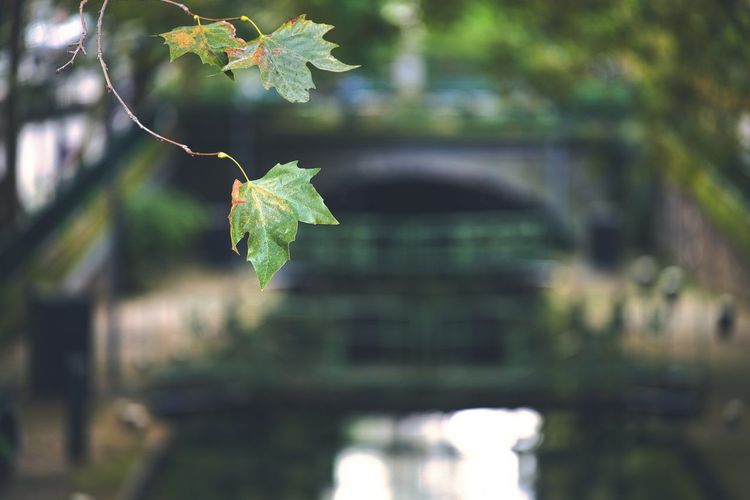
Past the square Frédérick-Lemaître, the canal regains its most familiar form: a straight line of water, framed by cobbled quays and spanned by cast-iron footbridges painted green. Nine locks punctuate the entire Parisian route, four of which lie on this northern stretch between République and the bassin de la Villette. Each one raises or lowers the water level by approximately two meters, a hydraulic mechanism still largely operating on its original principle.
The écluse du Temple, the first one you encounter heading north, is also the most photographed. The gates open several times a day to let through pleasure barges or Canauxrama cruise boats, and the spectacle invariably draws a crowd of onlookers seated on the stone steps that border the lock chamber.
Between the locks, it is the pedestrian footbridges that give the walk its structure. Seven of them allow you to cross the canal without using the large road bridges, each one offering a slightly different perspective on the quai de Valmy and the quai de Jemmapes. The passerelle Bichat (Rue Bichat, 75010 Paris, rated 4.5/5 on Google from 120 reviews), in particular, has become an informal meeting point in the evenings, where people lean on the railing waiting for friends.
A tip if you are walking with a pushchair or in heels: the cobblestones on the quai de Jemmapes are uneven in places, so it is better to stick to the asphalt pavement of the quai de Valmy on certain stretches.
Left Bank or Right Bank: Quai de Valmy vs. Quai de Jemmapes
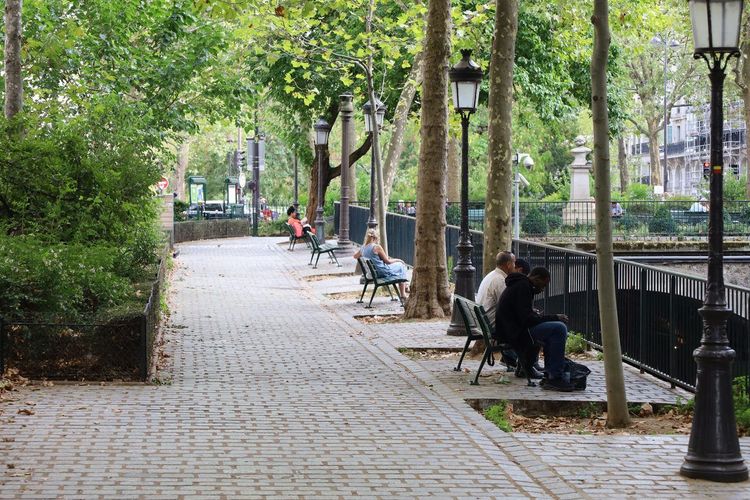
The canal has two banks, and they don't share quite the same personality. The quai de Valmy, on the western side, concentrates the majority of bars, restaurants, and shops: it is the lively bank, the one where you'll encounter the most people in the evenings. The quai de Jemmapes, on the eastern side, remains more residential and quieter, with a few notable addresses but above all long façades of older buildings and more shade in the afternoon thanks to its denser plane trees.
For a first visit, it's best to alternate: walk down one quay and come back along the other, crossing on one of the footbridges mentioned above. This lets you see the canal from both angles without retracing your steps past the same shop windows.
If you're looking for a quiet spot to read or picnic, the quai de Jemmapes statistically offers more free benches, particularly between the rue Bichat and the rue de Lancry. Conversely, on a Friday evening, there's no hesitation: head to the Valmy side, where terraces spill out onto the pavements until the local police gently remind everyone of the closing time. Property prices reflect this difference in character: apartments with a direct view onto the quai de Valmy change hands at a higher average price than those on the quai de Jemmapes, a gap that often surprises the neighborhood's own residents.
Bars and Restaurants by the Water
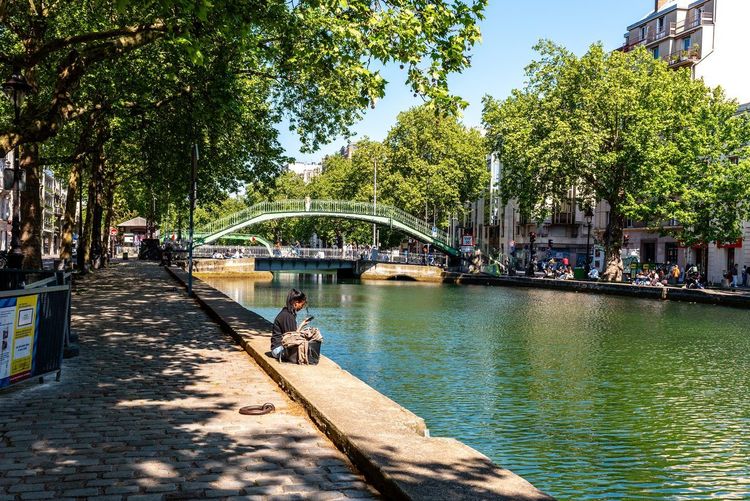
Over the past fifteen or so years, the canal has become one of the best spots in Paris for a drink on an informal terrace, literally sitting on the edge of the quay. It's impossible to cover everything, but a few addresses come up consistently in local recommendations.
Chez Prune, open since the 1990s, remains an institution on the quai de Valmy: large glass windows, unpretentious Parisian café atmosphere, and a clientele that mixes neighborhood regulars with passing visitors. It is often the first stop recommended to people discovering the neighborhood for the first time.
A little further north, Point Éphémère occupies a former industrial warehouse converted into a hybrid cultural venue: bar, concert hall, gallery, and artist residencies all under one roof. The musical program changes every week, often free on weekdays, and the terrace that opens directly onto the water remains one of the few places in the neighborhood where you can have a drink with your feet almost in the canal.
For a more relaxed dinner, the restaurant at the Hôtel du Nord offers classic French bistro cuisine in a setting that has preserved the spirit of Marcel Carné's film without becoming a frozen period piece. Booking is strongly advised at weekends, as the dining room is small and the view of the nearby lock is much in demand.
Further south, near Jacques-Bonsergent, Le Comptoir Général (80 Quai de Jemmapes, 75010 Paris, rated 4.2/5 on Google from 6,351 reviews) plays a completely different card: eclectic décor inspired by West Africa, creative cocktails, and a giant bric-à-brac atmosphere in a courtyard that always surprises visitors pushing open the door for the first time.
In recent years, a new wave of natural wine bars has settled on the quai de Valmy, driven by a clientele that has moved away from the neighborhood's traditional beer bars. The wine lists change with each delivery, with a stated preference for small producers from the Loire and Beaujolais, and a relaxed atmosphere where you snack standing up, glass in hand, chatting with the people next to you at the counter. On Sunday mornings, several addresses in the neighborhood offer brunches that draw a queue from ten o'clock, particularly in the streets running perpendicular to the canal where a few terrace tables allow you to have breakfast in the sun before heading to the quays for a walk.
These are just four addresses among several dozen that line the two quays. The rule that almost always holds here: if a terrace is packed on a Tuesday evening, it's probably worth the detour. For a broader overview of Paris's dining scene, the Ryo culinary specialties guide to Paris offers further suggestions beyond the 10th arrondissement alone.
Shopping, Concept Stores, and Vintage Shops in the 10th
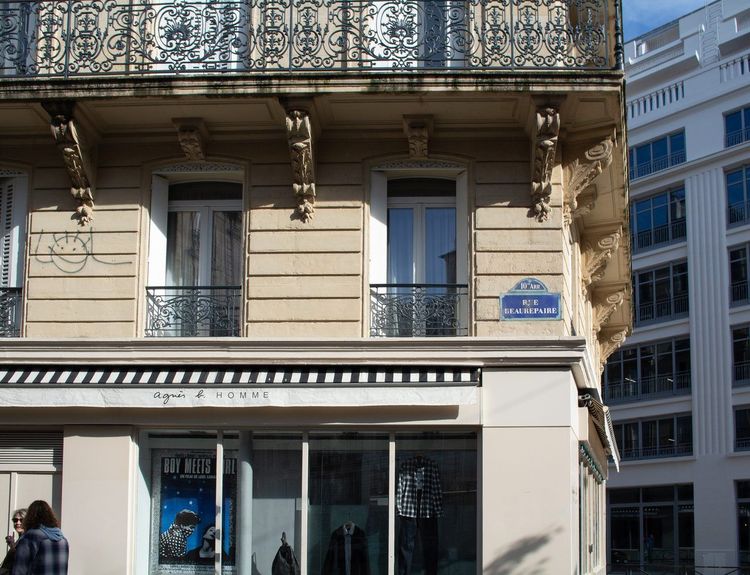
The neighborhood also has a shopping reputation, driven largely by the rue de Marseille and the rue Beaurepaire, two short but shop-dense streets full of independent boutiques. You'll find a mix of vintage clothing stores, emerging designers, and concept stores that change their signs every two or three years, a sign of a neighborhood that remains commercially fluid.
Antoine et Lili (95 Quai de Valmy, 75010 Paris, rated 4.2/5 on Google from 172 reviews), with its instantly recognizable colorful shopfront, remains one of the historic addresses on the quai de Valmy: brightly colored clothing and decorative objects in a bohemian spirit that did much to shape the neighborhood's image in the 2000s.
Vintage lovers will head to the rue de Marseille, where several second-hand shops offer a curated selection of pieces from the 1970s to the 1990s, at prices that remain reasonable compared to the nearby Marais. On Saturday afternoons, these streets are particularly lively, with a young clientele that often arrives from the Jacques-Bonsergent or République metro stations.
For more niche design, a number of galleries and designers' studios have set up around the rue Yves Toudic, mixing stationery and small local fashion collections. A few independent record shops and bookshops round out the offering, particularly around the rue de Lancry, where you can still find shops run by their founder for fifteen or twenty years, a long time for a neighborhood where signs change quickly. These addresses, less spectacular than the big vintage stores, are nonetheless worth seeking out for anyone looking for a genuinely local object rather than a standardized souvenir.
The Canal on Screen: Hôtel du Nord and Iconic Filming Locations
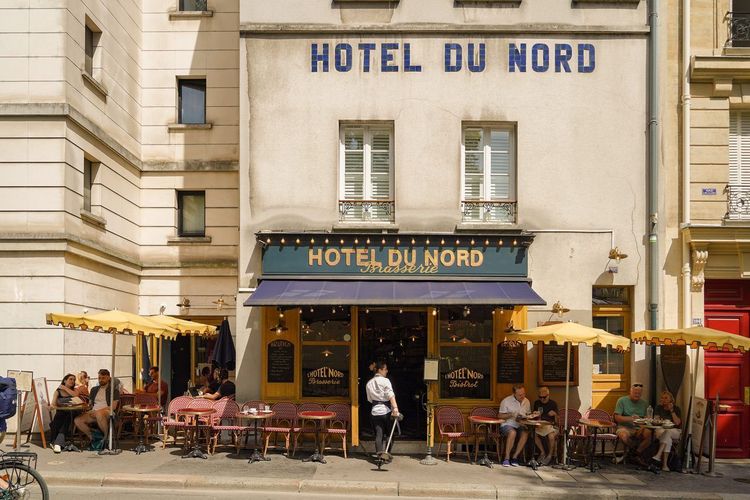
It's hard to talk about the canal without evoking its past as a film set. Hôtel du Nord, directed by Marcel Carné in 1938 with Arletty and Louis Jouvet, long fixed the popular image of the neighborhood in the public imagination, despite the fact that the film was largely shot in a studio, with real exterior locations appearing in only a handful of shots. The replica décor never prevented the real hotel from becoming a place of pilgrimage.
Sixty years later, Amélie reignited the general public's interest in the canal, with its stone-skipping scene on the quays becoming one of the most widely reproduced images in French cinema of the 2000s. The shoot permanently altered tourist footfall in the neighborhood, to the point that some guides still refer to an "Amélie effect" to explain the influx of foreign visitors who come to recreate the scene.
Other, lower-profile shoots have followed: television series, music videos, and advertisements making the most of the particular light that the water casts on the façades at the end of the day. If you come on a clear late afternoon, you will quickly understand why cinematographers are especially fond of this corner of Paris.
Toward the Bassin de la Villette and the Rotonde Stalingrad
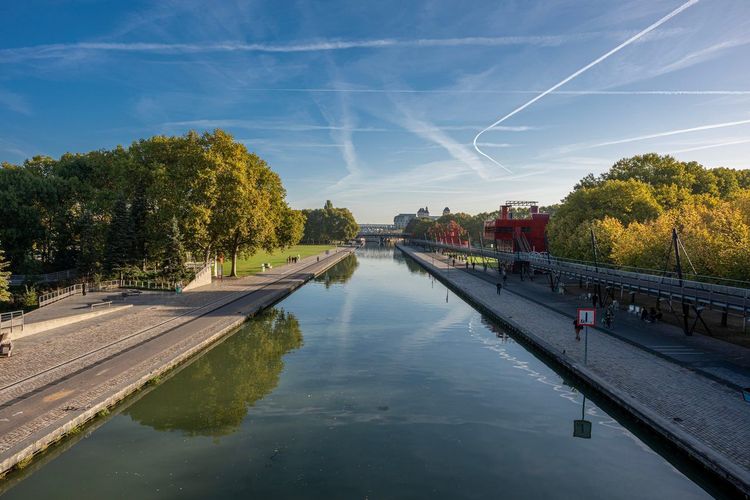
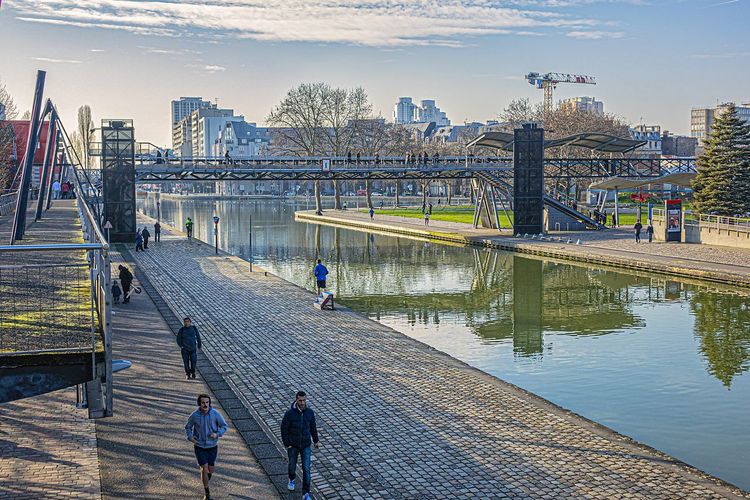
Past the last lock of the central section, the canal suddenly widens to form the bassin de la Villette, the largest artificial body of water within Paris proper at 700 meters long. The change of scale is striking: after the narrow walk between the quays of the 10th, you emerge onto a broad expanse of water where cruise boats, pedal boats, and Sunday-morning joggers all cross paths.
At the entrance to the basin stands the Rotonde Stalingrad, also known as the Rotonde de la Villette, one of the rare surviving examples of the toll barriers built by architect Claude Nicolas Ledoux at the end of the 18th century. The neoclassical building, long left derelict, has been restored and now houses a restaurant and a cultural space, restoring the full architectural significance of this junction that was once considered a blind spot of the neighborhood. It is not an isolated case: it belonged to a set of more than fifty barriers built by Ledoux all around Paris to collect tolls, of which only a handful survive today, including the one at the parc Monceau. Its preservation, almost miraculous given the destruction of the 19th century, makes it a rare testament to neoclassical Parisian architecture applied to a purpose as prosaic as tax collection.
On the basin's quays, the two cinemas MK2 Quai de Seine (14 Quai de la Seine, 75019 Paris, rated 4.3/5 on Google from 645 reviews) and MK2 Quai de Loire, built facing each other on opposite sides of the water, offer a free boat shuttle to filmgoers who want to move from one screen to the other without walking all the way around. It's one of the neighborhood's most surprising details for those who don't expect it.
The bassin de la Villette has its own well-established traditions too: impromptu pétanque games on the graveled quays, a water sports base for rowing and canoeing in summer, and a temporary beach installed every year as part of Paris Plages, with sun loungers and misting fans for heat-wave days. The quai de la Loire, on the eastern side, has also become a recognized street art spot, with several murals several meters high that change regularly as artist collectives take over the construction hoardings. Urban photography enthusiasts can easily spend an hour there without noticing the time pass.
Fed by the waters of the Ourcq since 1808, the basin maintains water quality good enough for swimming to be organized periodically during summer events supervised by the city authorities, a practice that would have been unthinkable even twenty years ago on this stretch. In the evening, the area around the basin and the Rotonde also hosts a bar and club scene that is more underground than that of the canal proper, a different atmosphere that attracts a younger, largely student crowd from the nearby universities.
For a family outing, the bassin de la Villette stretch lends itself particularly well to a half-day visit: children's activities on the quays, mobile ice cream sellers in summer, then a fifteen-minute walk to the Cité des sciences et de l'industrie to continue the visit indoors if the weather turns. Heading further northeast, the canal continues as the canal de l'Ourcq, in the direction of the parc de la Villette, while a branch heads off toward the canal Saint-Denis. These two extensions lie strictly outside the neighborhood but are worth mentioning for anyone who wants to continue walking beyond the basin.
Cruises and Cycling: Discovering the Canal a Different Way
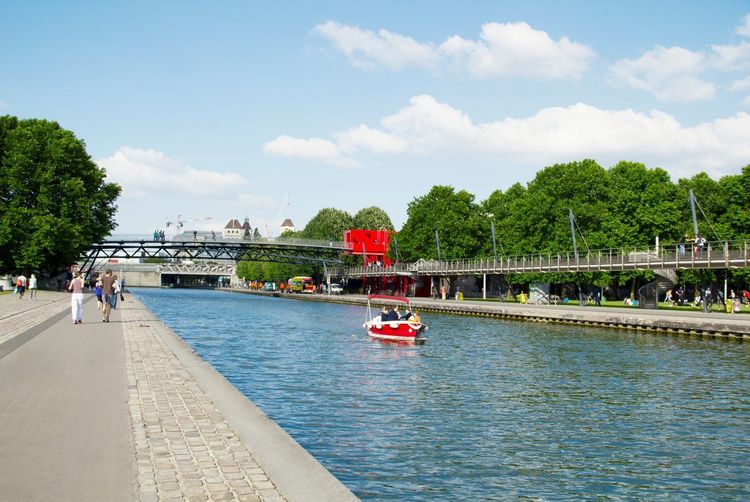
Walking is not the only way to discover the canal. The company Canauxrama (5 Bis Quai de la Loire, 75019 Paris, rated 4.3/5 on Google from 429 reviews), based beside the bassin de la Villette, offers two-and-a-half-hour cruises that travel the full route up to the port de l'Arsenal, passing through each lock and through the underground tunnel, lit up for the occasion. It's the only way to see the Richard-Lenoir vault from the inside without waiting for Heritage Days.
For a faster pace, cycling remains the best option: the quai de Valmy and quai de Jemmapes are broadly flat and largely protected from motor traffic, with Vélib' stations spaced roughly every three hundred meters. Allow about half an hour to cover the full route by bike, compared to nearly two hours on foot with regular stops.
A tip if you opt for the cruise: book in advance during the summer season, as weekend departures sell out several days ahead.
Markets and Flea Markets Around the Canal
Beyond the large market on the boulevard Richard-Lenoir already mentioned, the neighborhood has two other useful addresses for those who enjoy browsing between stalls. The marché couvert Saint-Martin, on the rue du Château d'Eau, occupies a 19th-century metal market hall and remains one of the least touristy covered markets in Paris, frequented above all by local residents for their everyday shopping.
A few hundred meters away, the marché Saint-Quentin (85 Bis Boulevard de Magenta, 75010 Paris, rated 4.5/5 on Google from 977 reviews), on the boulevard de Magenta, offers a more gastronomic range, with fishmongers and cheese sellers with a reputation that extends well beyond the 10th arrondissement.
In December, a small temporary Christmas market generally sets up near the marché couvert Saint-Martin, with a few wooden chalets selling mulled wine and artisan goods, a more modest but also more authentic alternative to the large Christmas markets in central Paris. Periodically, neighborhood flea markets also take over the quays themselves, particularly in spring and autumn, turning the cobblestones into a giant outdoor sale. Dates change from year to year: it's best to check the events calendar of the 10th arrondissement town hall before making a special trip, or to consult the Ryo events guide to Paris to spot this kind of one-off event.
A Sunday at the Canal: Pedestrian Banks and Picnics
For several years now, the Paris city authorities have been closing certain canal quays to motor traffic on Sundays as part of the Paris Respire initiative. The quai de Valmy becomes a long pedestrian and cycling ribbon, free of cars and scooters, which radically changes the neighborhood's atmosphere compared to a weekday.
It is the most popular time for residents to picnic: the neighborhood's grocery stores and wine shops sell cheese boards and bottles of natural wine from the morning, to be taken straight to the quay steps. By late afternoon, it is not uncommon to see dozens of groups lined up in succession over several hundred meters, an atmosphere that feels more like a festival than a simple urban stroll. Street vendors selling ice creams and crêpes also take advantage of the Sunday crowds, set up at regular intervals along the entire stretch between République and Jaurès. Some neighborhood residents admit to organizing their whole Sunday around this walk, from a morning coffee on a terrace to an improvised aperitif at the end of the day on the steps of a lock.
To enjoy Sunday without the peak crowds, it's best to arrive before noon, get settled, and then watch the numbers gradually build toward the end of the day. Families with children tend to prefer the square Frédérick-Lemaître or the area around the bassin de la Villette, where space is more generous than along the narrow quays of the central stretch.
How to Get There and Get Around the Neighborhood
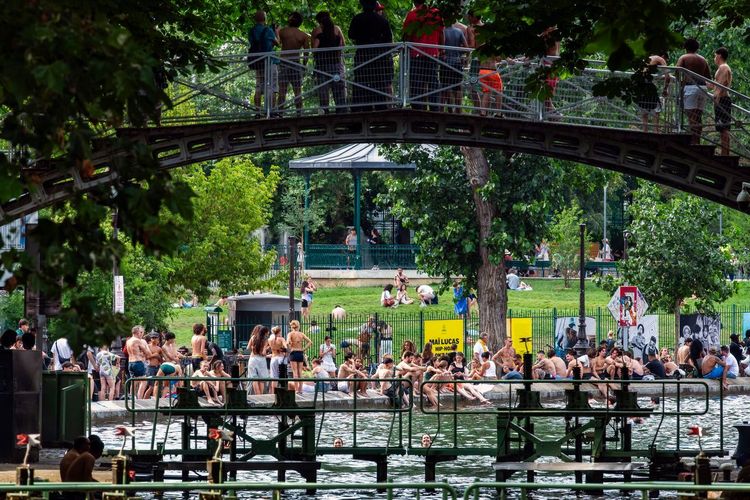
The canal neighborhood is served by several metro stations that allow you to join and leave the route at almost any point: République (lines 3, 5, 8, 9, 11), Jacques-Bonsergent (line 5), Goncourt (line 11), Colonel-Fabien (line 2), Jaurès (lines 2, 5, 7bis), and Stalingrad (lines 2, 5, 7). None of these stations is more than ten minutes on foot from the water. Having a rough mental map of the neighborhood helps avoid getting lost between the quays and the perpendicular streets, even though the canal's straight alignment makes navigation fairly intuitive.
By bus, lines 46, 54, and 75 run along part of the route. By bike or on foot, everything falls naturally into place along the quays, with no need to double back: simply choose a starting station and a finishing station based on the time available.
Where to Stay Near the Canal
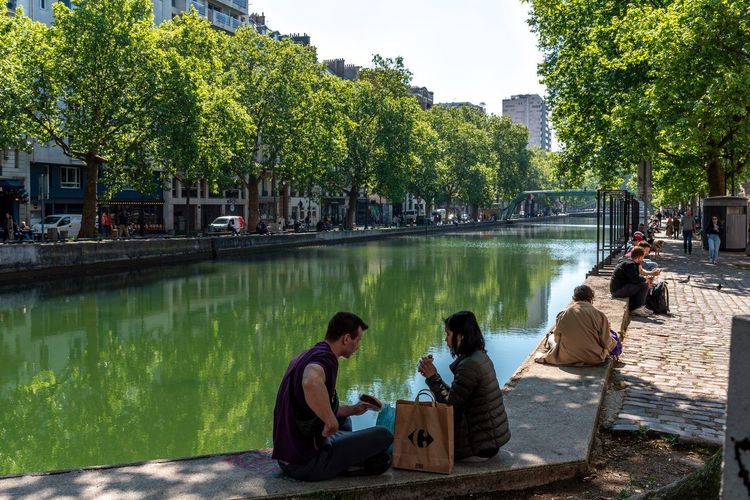
The 10th arrondissement offers a fairly wide range of accommodation, from hostel dormitories to charming barge hotels. Hotels located directly on the quai de Valmy or quai de Jemmapes often offer a water view that justifies a price premium, but the neighborhood's relative quiet at night more than compensates for the budget outlay.
For a more budget-friendly stay, hotels around the République or Jacques-Bonsergent stations remain within walking distance of the canal while charging rates closer to the Parisian average. Solo travelers or small groups will also find several well-rated youth hostels within a ten-minute walk of the quays. Several establishments have made the houseboat hotel concept their signature, with a handful of floating cabins moored directly on the bassin de la Villette, an original option for sleeping as close to the water as possible without sacrificing the comfort of a conventional room. Demand far exceeds the available supply, so it is best to book several weeks in advance for this type of accommodation.
One point to consider before booking: on summer nights, the festive atmosphere on the quays can generate street noise late in the evening, particularly on Fridays and Saturdays. Rooms facing a courtyard or a street perpendicular to the canal remain a safer choice for a good night's sleep, without losing the neighborhood's daytime atmosphere.
Safety and Homelessness: What to Know Before You Come
Like many working-class neighborhoods in northeast Paris, the canal's surroundings, particularly around Jaurès and Stalingrad, have a visible presence of homeless people, a subject regularly documented by local associations and the Paris city authorities. This does not make it a dangerous neighborhood in the strict sense: tourist and family footfall remains high throughout the day.
The precautions are the same common-sense ones that apply to any lively neighborhood in Paris: stay aware of your belongings in the evening crowds on the quays, avoid leaving a poorly locked bicycle unattended, and stick to well-lit streets after dark. During the day and in the evenings up to a reasonable hour, the canal remains one of the most pleasant neighborhoods in all of Paris for walking around on foot.
Going Further: Belleville and Père Lachaise Just Nearby
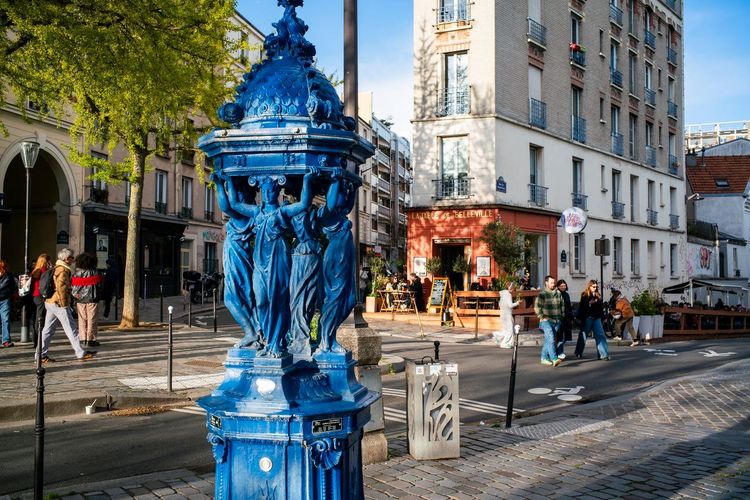
The canal is not an isolated neighborhood: it directly borders several areas that are worth a detour if time allows. Heading east, up the rue du Faubourg-du-Temple, a fifteen-minute walk brings you to Belleville, with its slopes, its popular Tuesday and Friday market, and one of the densest street art scenes in Paris.
To the southeast, the Père Lachaise cemetery is about twenty minutes on foot or two metro stops from République. It is not merely a cemetery: it is one of the largest green spaces within Paris proper, with its cobbled lanes, the graves of Chopin, Édith Piaf, and Jim Morrison, and an atmosphere that contrasts entirely with the bustle of the quays. For those who want to extend their discovery beyond the water, the Ryo Père Lachaise audio guide offers a dedicated audio tour of the site, with stories about the notable figures buried there.
A third extension, less well known to foreign visitors, leads to the parc des Buttes-Chaumont, about fifteen minutes on foot from the bassin de la Villette. With its artificial lake, its grotto, and its temple perched on a rocky outcrop, it is one of the most spectacular parks in Paris, laid out in the late 19th century on former gypsum quarries. The triangle formed by the canal, Belleville, and the Buttes-Chaumont maps out one of the best itineraries in eastern Paris for anyone who has two full days to spare.
These extensions make it possible to build a full day around the canal: a morning on the quays between the Bastille and République, lunch on the rue de Marseille or the rue Beaurepaire, then an afternoon devoted to Belleville, Père Lachaise, or the Buttes-Chaumont, depending on what you feel like. For those who prefer a more structured approach to discovering the neighborhood, the Ryo app offers audio-guided tours that place each location in its historical context, with anecdotes that go beyond what a simple tourist map can offer, like the ones about Jim Morrison's and Édith Piaf's graves at Père Lachaise.
FAQ
Where is Canal Saint-Martin located in Paris?
Canal Saint-Martin runs through the 10th, 11th, and 19th arrondissements of Paris, between the bassin de l'Arsenal near the Bastille and the bassin de la Villette, at the edge of the 19th. The most well-known and most photographed stretch lies between the République and Jaurès metro stations, along the quai de Valmy and quai de Jemmapes.
How Long Does It Take to Visit the Canal Neighborhood?
Allow about two hours to walk the main stretch between République and the bassin de la Villette, with regular stops along the way. For a more complete visit including a lunch break, some shopping, and a stop at the bassin de la Villette, plan for half a day, or even a full day if you add Belleville or Père Lachaise.
What Is the Best Time to Visit the Canal?
Spring and early autumn offer the best conditions, with pleasant light and terraces that are less crowded than in the height of summer. A Sunday morning, before the afternoon picnic crowds arrive, is also an excellent time to enjoy the pedestrianized quays in peace.
Is the Canal Neighborhood Safe?
Yes, generally speaking: it is a very busy neighborhood, both during the day and in the evening, frequented by families and tourists alike. As anywhere in Paris, normal vigilance is advisable at night and in quieter areas, particularly around Jaurès and Stalingrad where the presence of homeless people is more visible.
How Do I Get to the Canal by Metro?
The République, Jacques-Bonsergent, Goncourt, Colonel-Fabien, Jaurès, and Stalingrad stations all serve the neighborhood directly, each giving access to a different section. République remains the most central station from which to start a walk.
What Is There to Do at Canal Saint-Martin on a Sunday?
On Sundays, the quays are closed to traffic as part of the Paris Respire initiative, making it the ideal day for picnicking, cycling, or a simple stroll without the noise of cars. The market on the boulevard Richard-Lenoir, open on that day, rounds out the outing nicely.
Is the Neighborhood Suitable for Families with Children?
Absolutely, particularly around the square Frédérick-Lemaître and the bassin de la Villette, where there is more open space than along the narrow quays of the central stretch. Working locks generally fascinate younger visitors, and several playgrounds are located right beside the quays.
Which Are the Best Quays for Taking Photos?
The stretch between the écluse du Temple and the passerelle Bichat remains the most photogenic, with its cast-iron footbridges, cobblestones, and water reflections that shift with the light throughout the day. Early morning, before joggers and terrace crowds arrive, offers the clearest shots. In the late afternoon, the raking light on the façades of the quai de Jemmapes produces colors that are particularly sought after by photographers, professional and amateur alike.
Canal Saint-Martin captures, in its own way, a certain Parisian art de vivre: the ability to transform a two-century-old industrial infrastructure into a space for everyday life, without ever denying its working-class history. Whether you come for the locks, for a waterside terrace, or simply to recreate the scene from a cult film, the neighborhood lends itself to very different visiting rhythms, from a one-hour stroll to a full day extended toward Belleville or Père Lachaise.
This guide has followed the route from south to north, from the bassin de l'Arsenal to the bassin de la Villette, but there is nothing to stop you from approaching it the other way around, or from focusing on a single stretch depending on the time available. To place the neighborhood within the broader context of Parisian heritage, the Ryo audio guide to Paris remains a good starting point before setting off to walk along the water, earphones in and cobblestones underfoot.
À lire également