© Shutterstock
 Votre guide Ryo
Christmas Markets in Strasbourg 2026: the Complete Guide to Locations, Dates, and Must-Visit Spots
Beneath the decorations of place Kléber, the scent of mulled wine mingles with gingerbread long before the sun sets over the cathedral. The Christmas markets in Strasbourg have existed in this form since 1570, making it the oldest event of its kind in France, and one of the most visited in Europe. To get a feel for the historic center before diving into the crowds, the Ryo audio tour of Strasbourg charts a course between la Petite France and the cathedral, neighborhood by neighborhood, away from the usual tourist scripts.
This guide brings together everything you need to know to make the most of 2026: eight official markets spread across place Broglie, the cathedral, la Petite France, and the train station, including one entirely dedicated to local short-supply chains on place Louise-Weiss; real opening hours and the pitfalls of December 24th; a selection of specialties that goes well beyond mulled wine, right up to pan-fried foie gras served directly on a slice of gingerbread; and the nearby Alsatian villages, from Kilstett to Kaysersberg, where crowds are thinner without losing any of the magic.
Dates, Opening Hours, and Admission for the Strasbourg Christmas Market 2026
No need to spend twenty minutes trawling an official website for opening hours: here is what you need to know before you go.
Dates: the 2025 edition ran from November 26th to December 24th. For 2026, expect the same pattern: an opening in late November, around Friday the 27th, and a closing on Thursday, December 24th, spanning nearly four weeks aligned with the Advent season. Unlike other cities, Strasbourg does not extend its market between Christmas and New Year.
Opening Hours: expect a daily opening around 11am and a closing at around 9pm, including weekends. On December 24th, the last day, the chalets close earlier, in the late afternoon, to allow the city to transition into Christmas Eve. If you arrive on December 25th, you will find the lights still up, but no chalets open.
Admission: entry to the markets is entirely free, chalet by chalet, square by square. No ticket or reservation is needed to stroll between the cathedral and la Petite France. Only certain individual activities, such as the ice rink or some children's workshops, are paid for separately.
These dates remain indicative until the tourist office publishes the definitive calendar for the 2026 edition: it is wise to check the official schedule two to three weeks before your visit, especially if you are booking non-refundable accommodation. A tip that regulars often share: aim for opening hours, between 11am and 1pm on weekdays, to enjoy the aisles before the late-afternoon crowds arrive. Peak footfall is generally between 5pm and 7pm, when organized groups and locals leaving work converge at the same time.
The Must-See Christmas Markets in Strasbourg
Eight official markets are spread across the historic center and its surroundings, but they are far from identical. Some focus on high-end crafts, others on food or a lively local atmosphere. Here is how to group them by neighborhood to build a coherent itinerary rather than zigzagging without a plan.
The Cathedral and Place Kléber, the Historic Heart of the Market
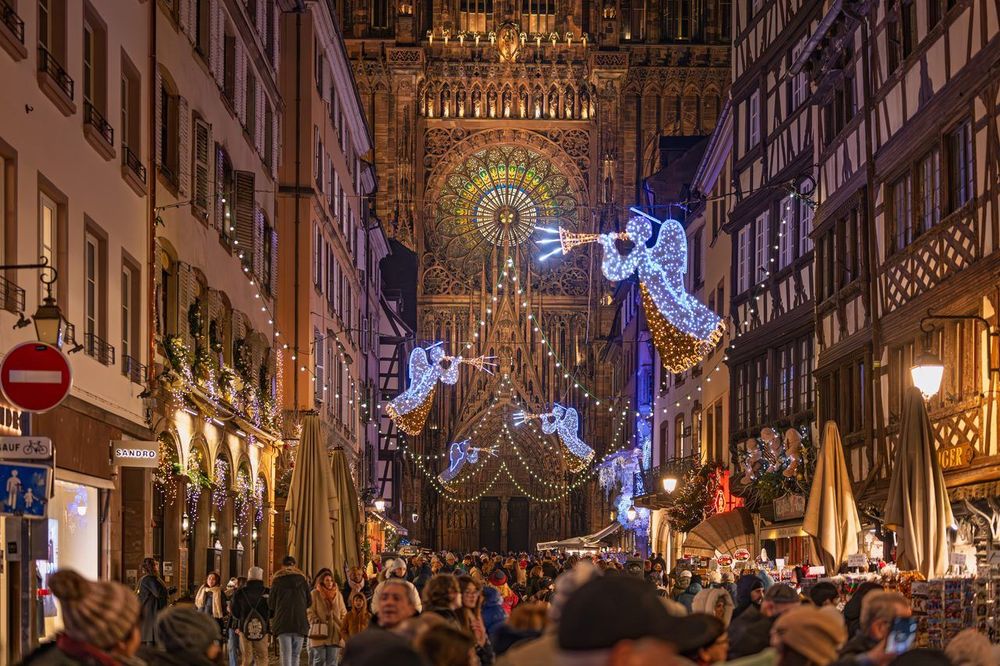
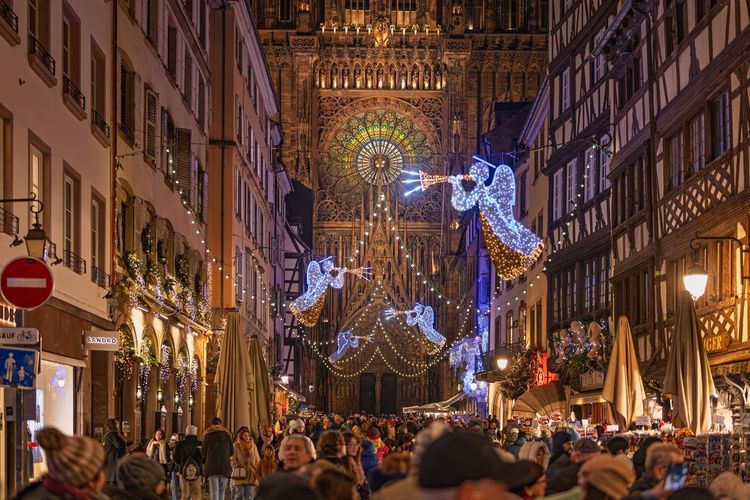
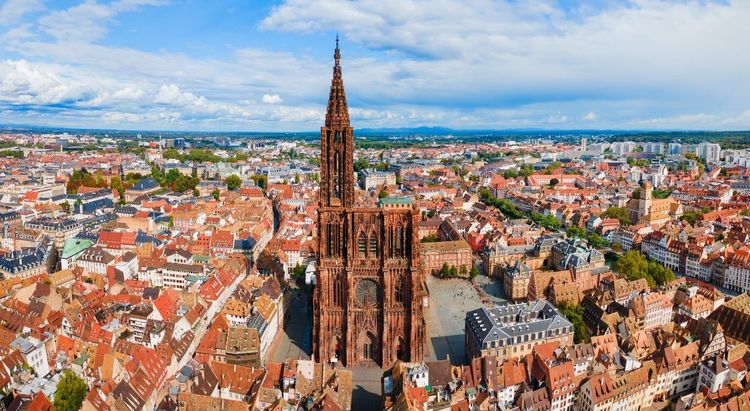
The cathédrale Notre-Dame of Strasbourg alone captures much of the atmosphere visitors come seeking: its rosy façade, lit up from nightfall, serves as the backdrop for the "Autour de la Cathédrale" market, which extends as far as place du Château. The historic Christkindelsmärik, meanwhile, has taken up residence a little further north, on place Broglie.
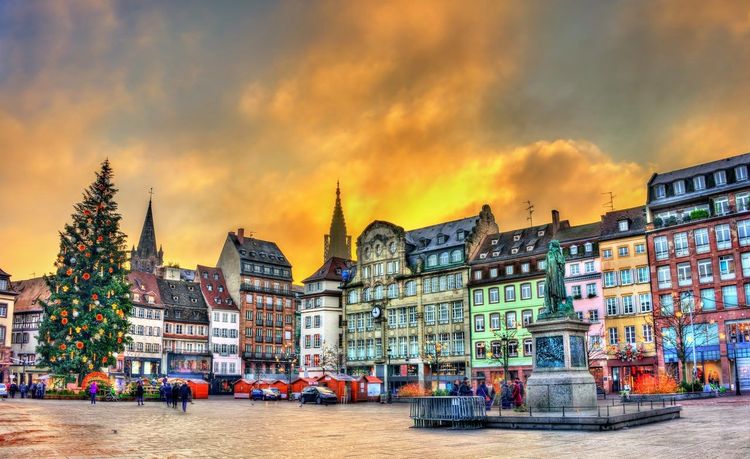
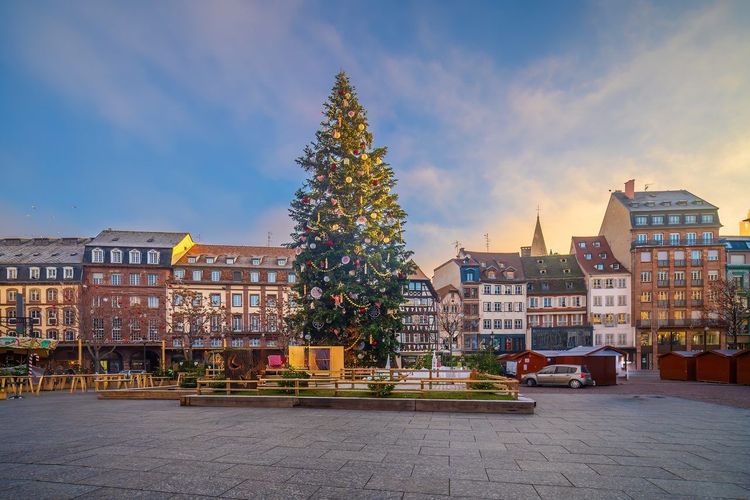
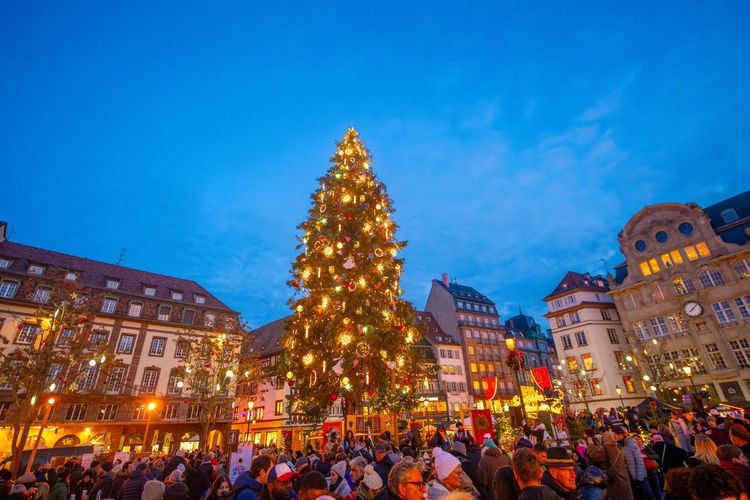
A few minutes' walk away, place Kléber hosts the Grand Sapin each year, a Norway spruce of 25 to 30 meters usually donated by a Vosges municipality or a regional forest. Beneath its branches, a market dedicated to decorations and local crafts occupies the entire perimeter of the square, with a stage hosting choirs and evening concerts.
You can visit both sites back to back in fifteen minutes on foot, cutting through rue des Grandes Arcades, itself lined with decorated shop windows that are worth a detour even outside the main chalet season.
La Petite France and Its Illuminated Quaysides
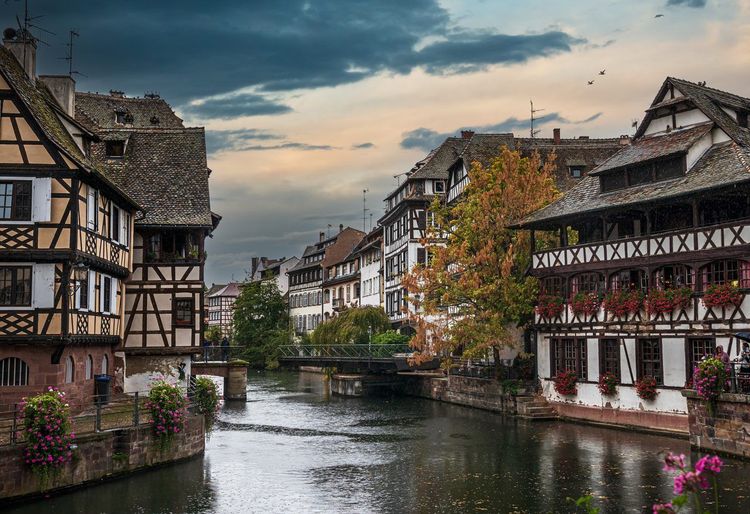
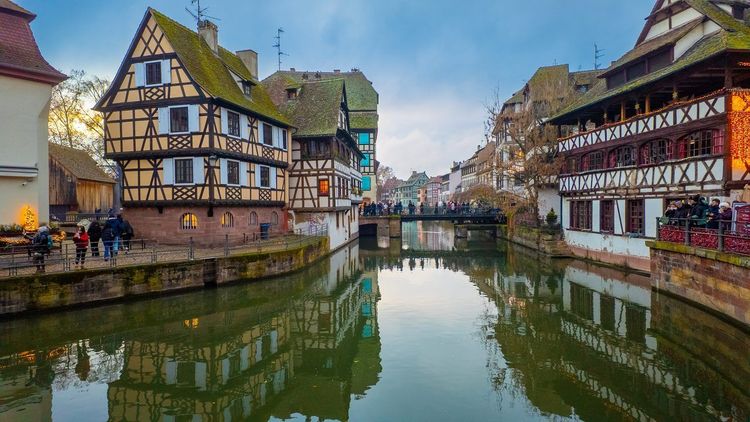
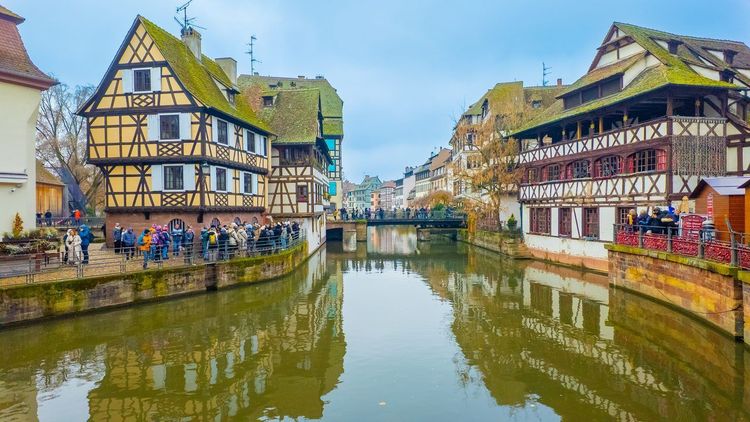
The Petite France neighborhood takes on a different character in December. The half-timbered houses lining the Ill are reflected in the water, doubled by strings of lights draped from one façade to the next above the cobbled lanes. The la Petite France market stretches between place Benjamin-Zix and place Saint-Thomas. If you are mainly looking to eat, the Quai des Délices, set up on the Rohan terrace and place du Marché-aux-Poissons along the Ill, focuses on gastronomy and hot drinks rather than crafts.
Unlike place Kléber, la Petite France is better explored at a slow pace: the lanes are narrow, often crowded in the late afternoon, and the best photographs are taken early in the morning or just after opening. The covered bridges, with their medieval towers, offer a sweeping view over the rooftops, sometimes snow-covered depending on the year.
The Irréductibles Petits Producteurs d'Alsace market sets up nearby, on place Louise-Weiss, highlighting regional short-supply chains rather than the generic stalls found elsewhere in the city.
The Carré d'Or and Place Broglie, Between Crafts and Independent Designers
The Carré d'Or neighborhood, a maze of shopping streets between the cathedral and place du Temple-Neuf, is home to independent designers' boutiques and local shops rather than major chains. The Carré d'Or market takes place on place du Temple-Neuf, focused more on handmade decorative objects than on fast food, and the traders in the surrounding streets compete with elaborately decorated façades.
The place Broglie, flanked by the Town Hall, hosts the Christkindelsmärik, the historic market that bears the Alsatian name of the tradition: it is the largest collection of chalets in the city, featuring decorations, toys, and bredele.
One detail few visitors anticipate: this area is noticeably less crowded than the cathedral or la Petite France in the late afternoon, making it a good option for families with young children who need a little space to breathe between stalls. The Opéra national du Rhin, situated at the corner of the square, sometimes extends the festive season with special performances, a good reason to combine a market visit with a cultural evening in one outing.
Place Grimmeissen and the OFF Market, the Other Face of Christmas
Less well known to tourist guides, place Grimmeissen (Place Grimmeissen, 67000 Strasbourg), near the train station, hosts the OFF market, a more recent event conceived as an alternative to the historic-center markets: young designers, local associations, and small producers hold stalls here at more accessible prices.
The atmosphere here is deliberately less institutional than on place Kléber. You are more likely to encounter locals than tourists, especially on weekdays, and the queues for a mulled wine are generally shorter than at the foot of the cathedral.
To connect these four areas without retracing your steps, the Ryo audio tour of Strasbourg, short version from la Petite France to Greater Europe takes you on foot through the cathedral, la Petite France, and the Carré d'Or, across 32 audio stops and around 2h40 of listening, at your own pace rather than in a group.
The History of France's Oldest Christmas Market
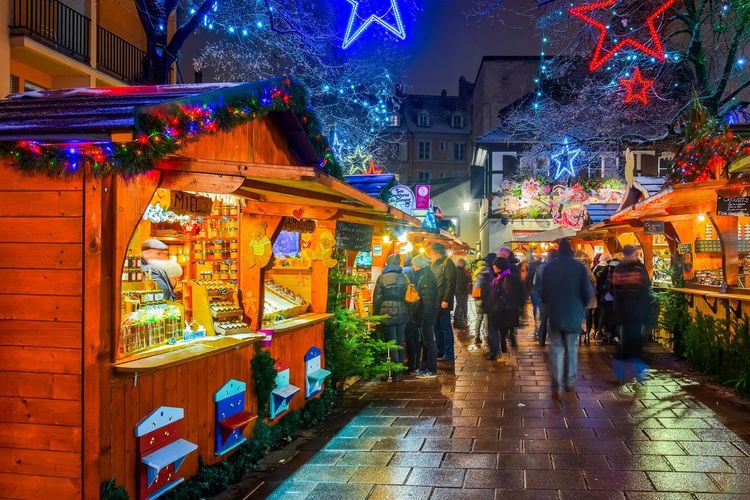
Strasbourg lays claim to the title of France's oldest Christmas market, and the archives broadly support this. The first mention of the Christkindelsmärik, literally the "market of the Christ Child," dates back to 1570. At the time, the city had just embraced the Protestant Reformation and was seeking to replace the Catholic celebrations of Saint Nicholas with a figure more in keeping with the new doctrine: the Christ Child himself, who was meant to bring gifts rather than a saintly intermediary.
For nearly two centuries, the market remained a modest affair, set up around the cathedral and limited to a handful of gingerbread and wooden toy stalls. It was not until the 19th century, with the rise of the railway and the arrival of visitors from across Alsace, that the event took on a broader dimension. Postcards from that era already show a place Kléber crowded with carriages and bundled-up passersby.
The Alsatian name has survived to this day, spelled variously as Christkindelsmärik or Christkindelsmarik depending on the source, and continues to coexist with the more general French term marché de Noël. This dual Franco-Alsatian identity partly explains why Strasbourg is so keen to distinguish its market from the dozens of others that have sprung up across France since the 1990s, often inspired by the Alsatian model without sharing its centuries-old heritage.
The post-war period changed everything. The city, rebuilt and repositioned as a European capital with the establishment of the Council of Europe and later the European Parliament, turned the Christmas market into a full-fledged tourist attraction, actively promoted internationally from the 1990s onward. The number of chalets grew from a few dozen to over three hundred, now spread across eight distinct markets throughout the city.
One emblematic year remains 1992, when Strasbourg officially received the title of "Christmas Capital," a designation it has defended ever since by emphasizing the diversity of its markets rather than their sheer size alone. It is no longer a single market, but a network of squares and streets that transforms the entire city center into a festive setting for nearly a month each winter. This heritage also explains why the market largely unfolds across the Grande Île, the historic center listed as a UNESCO World Heritage Site since 1988: the wooden chalets are set up in front of half-timbered façades that, in some cases, have witnessed the same five centuries as the market tradition itself.
Local Crafts and Independent Designers in the Spotlight
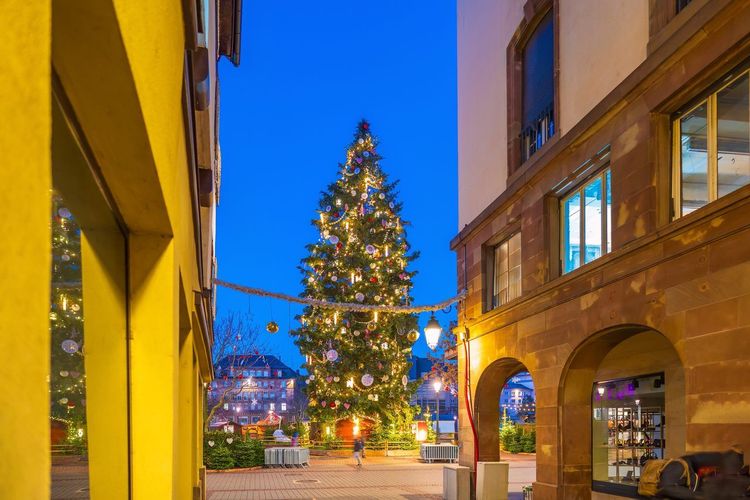
Long criticized for the standardization of certain stalls, often identical from one French Christmas market to the next, Strasbourg has tightened its selection criteria in recent years. The majority of exhibitors must now demonstrate local or regional production in order to secure a spot, which concretely changes what you find on the stalls.
Blown glass holds a special place in this offering: hand-decorated baubles, hanging ornaments, and figurines are produced by a handful of Alsatian workshops that work year-round for the Christmas season. Textiles follow a similar logic, with woven scarves and woolen hats that stand well apart from the generic imports found at less discerning markets.
The most selective chalets, particularly around the Carré d'Or, formalize this approach: each exhibitor presents a unique piece or a small series, never a bulk-imported product. You will come across ceramicists, illustrators selling their own greeting cards, and cabinet-makers specializing in traditional Alsatian wooden toys.
This move upmarket is also reflected in the pop-up shops. Several local brands open temporary stores during the festive period, in vacant premises in the historic center, to present capsule collections unavailable anywhere else during the year. It is a different way to experience the market: stepping into a heated space rather than standing in front of a chalet, with time to browse before buying.
A useful tip if you are looking for a gift rather than a generic souvenir: favor stalls that display the name of the workshop or producer, a practice that has become increasingly common since the organizers strengthened their checks on the origin of products sold.
The Illuminations and the Magic of Strasbourg's Streets
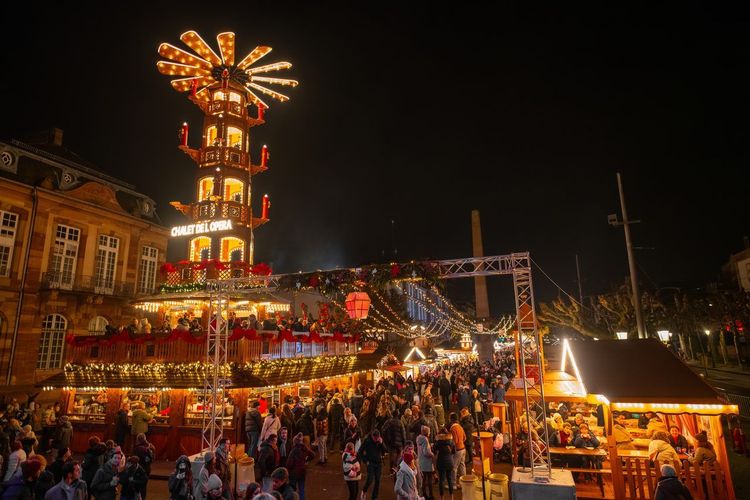
By day, the Strasbourg Christmas market looks like any other open-air market, lively but without any particular magic. Night changes everything. From 5pm in December, as natural light fades, the strings of lights draped above the pedestrian streets switch on all at once, turning entire thoroughfares into tunnels of light.
The cathedral façade, lit in color gradients that vary from one evening to the next, remains the most photographed focal point in the city. The main squares go for more theatrical installations: light arches, structures suspended above the shopping streets, and occasionally animated projections on certain historic buildings.
The Grand Sapin on place Kléber draws a great deal of attention in the evening on its own. Its decoration changes theme each year, and its progressive illumination, from trunk to treetop, regularly draws a crowd at the official lighting ceremony at the end of the day.
For photos, the best window is between 5:30pm and 6:30pm: night has fallen, the streets are still manageable before the peak crowd, and the contrast between the deep blue sky and the warm lights produces the best results. After 7pm, the density makes pedestrian movement more laborious in the narrowest streets of la Petite France.
Many visitors make do with a map to find the illuminated spots. The same Ryo audio tour works just as well after dark, when the half-timbered façades and the Grand Sapin light up, with historical anecdotes delivered directly to your ears rather than displayed on a sign that is hard to read in the dark.
Food Specialties to Try at the Markets
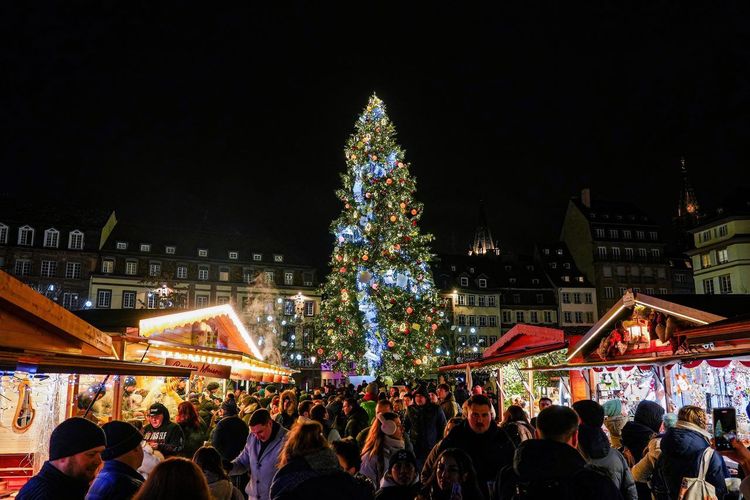
Reducing the Strasbourg Christmas market to mulled wine alone would mean missing the point entirely. Alsatian winter gastronomy is rich, often hearty, and deserves the time to sample several specialties rather than just one.
Mulled wine (Glühwein) remains the essential starting point: spiced with cinnamon, cloves, and orange, served in ceramic mugs that some visitors collect from one market to the next, with a small refundable deposit.
Bredele form another local institution: these small Christmas biscuits, made in dozens of family recipes, are sold by weight or in assortments at several specialist chalets. Every Alsatian family has its own recipe, often kept secret.
Gingerbread (Lebkuchen) also comes in many forms, from simple spiced biscuits to elaborate heart-shaped centerpieces sold as souvenirs as much as treats.
Flammekueche, a thin tart topped with crème fraîche, onions, and bacon, is eaten standing up, cut into portions — a classic that transcends all seasons but takes on a particular flavor when served piping hot on a cold day.
Foie gras, sometimes pan-fried and served on a slice of gingerbread directly at the counter, represents the most indulgent option at the market, best saved for a proper meal rather than a quick snack.
Männele, small brioche figures traditionally associated with Saint Nicholas Day in early December, are sold mainly during the first weeks of the market before giving way to other specialties.
French onion soup au gratin and hot munster cheese round out the offering for those seeking a warming meal rather than a sweet snack, particularly welcome on the coldest days.
Kougelhopf, a crown-shaped brioche flavored with raisins and almonds, can be found both on the sweet stalls and in city-center bakeries, in its sweet or savory version.
Finally, to accompany these treats, several stalls now offer alcohol-free versions of mulled wine, a recent development responding to growing demand from families and designated drivers. Vegetarian options have also multiplied in recent years: meat-free spätzle, vegetable soups, and vegetable flammekueche now appear on several menus, where the offering was once almost exclusively limited to cold cuts and cheese just a decade ago.
One practical tip before you dive in: most food chalets only accept card or contactless payments. Still, keep a few coins for the smallest stalls, which still favor cash, particularly in the peripheral markets that are less frequented than the cathedral area. To explore this list further and discover where to enjoy these dishes year-round, our article on the culinary specialties of Strasbourg details the best restaurants and winstubs in the city.
Events and Activities at the Christmas Market
Beyond the chalets, the Strasbourg Christmas market is accompanied by a program of events that goes well beyond simple commercial browsing. Concerts, temporary exhibitions, and themed trails punctuate the four weeks of festivities, with a schedule that varies from one week to the next. The detailed program, with precise times for each event, is generally published by the tourist office in early November, around three weeks before the market opens. It is better to consult the most recent version rather than relying on an article published the previous year, as times change from one edition to the next.
Walks and Cultural Visits Between the Markets
Several themed guided tours are organized specifically for the Christmas period, centered on the history of the Christkindelsmärik, the architecture of the Grande Île, or the Alsatian legends associated with winter. These walks, typically lasting an hour and a half to two hours, often depart from the tourist office near the cathedral.
The city's museums also embrace the season: several institutions, including the Musée alsacien and the Musée de l'Œuvre Notre-Dame, offer extended opening hours or special events during the end-of-year holidays, a way to discover another facet of Strasbourg's heritage away from the market crowds. On some evenings, the cathedral also hosts sacred music concerts or organ recitals, a program that changes each year and generally needs to be booked in advance given the limited number of seats.
The city's European dimension also finds its place in the program: "European Christmas" events showcase the traditions of several neighboring countries, with chalets or stalls dedicated to German, Austrian, and Nordic specialties, a nod to Strasbourg's role as the institutional capital of Europe.
If you prefer to avoid organized tours with fixed departure times, you can just as easily put together your own route on foot, linking the markets and stopping in front of the most decorated façades on rue Mercière or rue des Hallebardes, with no time constraints.
Christmas in Strasbourg's Neighborhoods
The historic center attracts most of the attention, but several outlying neighborhoods organize their own Christmas events, often more low-key and less frequented by passing visitors. The Krutenau, Robertsau, and Neudorf neighborhoods host neighborhood markets, Christmas flea markets, and community events, generally for a weekend rather than throughout the entire Advent period.
These events offer an interesting counterpoint to the bustle of the center: a more local atmosphere, often lower prices, and a chance to see how Strasbourg residents themselves experience the Christmas season outside the tourist flow.
The Ryo audio tour of Strasbourg allows you to walk between several of these neighborhoods, narrating the history of the streets you pass through between two markets — a practical way to explore without keeping your nose buried in a map. If your stay stretches to two or three days, these forays into the neighborhoods are well worth the detour to step outside the same postcard scenery repeated from one market to the next.
How to Get to the Strasbourg Christmas Market
Strasbourg is easy to navigate without a car once you are there, but getting into the city is worth planning in advance, especially during peak periods when city-center parking fills up by midday.
By Train
Strasbourg station, served by the TGV Est from Paris in just under two hours, remains the most comfortable way to reach the historic center. From the station, it is just fifteen to twenty minutes on foot to the cathedral, or five minutes by tram for those who would rather not carry their luggage all the way to the hotel.
During the Christmas market period, trains are often fully booked several weeks in advance on weekend slots, a detail many visitors discover too late. Booking as soon as tickets go on sale, typically three to four months before the travel date, remains the most effective way to avoid the highest fares.
By Car and Parking
Strasbourg has several park-and-ride facilities on the outskirts, connected to the center by tram, an option that is often faster than searching for a space in the historic core. City-center parking lots fill up quickly on December weekends, particularly between 11am and 3pm.
For those coming from far away or combining their visit with a trip to nearby Alsatian villages, renting a car remains an option worth considering, particularly if your stay exceeds two days and includes stops beyond the public transport network. Book in advance: local agencies see their availability drop sharply as the holidays approach.
Once parked, it is best to leave the vehicle and continue on foot or by tram: traffic in the historic center, largely pedestrianized during the market period, makes driving considerably more difficult.
By Tram and Public Transport
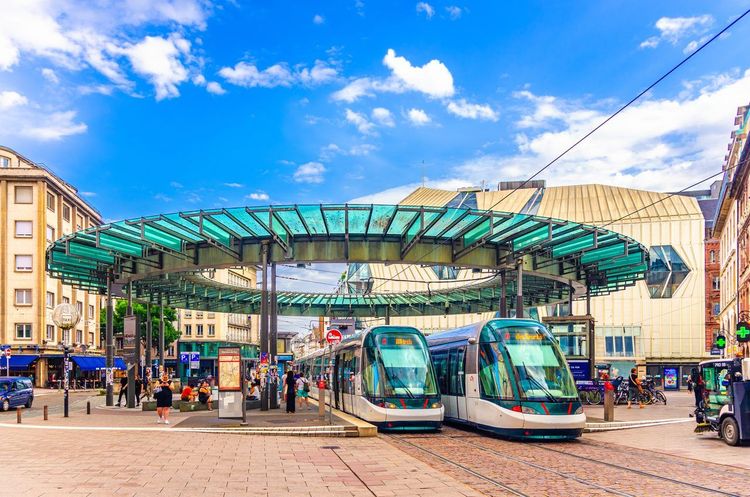
Strasbourg's tram network, one of the most extensive in France, efficiently connects all the markets from the park-and-ride facilities and the train station. The Langstross-Grand'Rue, Broglie, and Homme de Fer stops drop you directly at the main sites.
A day pass or multi-day pass, available from ticket machines or the dedicated app, generally works out cheaper than buying individual tickets if you plan several journeys. In the evening, trams run at a slightly reduced frequency after 9pm, something to bear in mind if you plan to head back late after an evening under the lights.
Christmas Markets to Discover Around Strasbourg
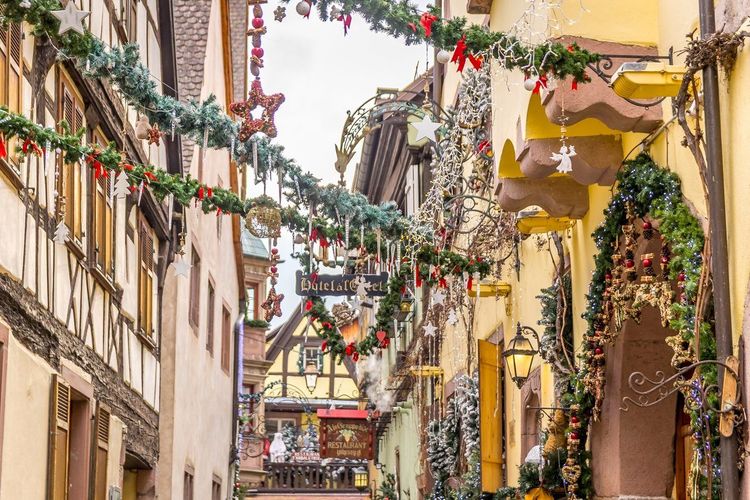
Venturing beyond the historic center is not a compromise — it is often the best way to experience a more authentic Alsatian Christmas, away from the tourist density of the Grande Île. Several nearby villages and towns organize their own markets, sometimes smaller but just as carefully curated, less than forty minutes away by road or train.
Alsatian Villages Not to Miss
Kilstett (Kilstett, 67840 Kilstett), about twenty minutes northeast of Strasbourg, hosts a more intimate Christmas market, driven by local associations rather than an institutional tourist organization. The atmosphere remains distinctly village-like, with stalls run by the residents themselves.
Obernai, around thirty minutes to the southwest, showcases its market square lined with half-timbered houses, a setting that rivals the center of Strasbourg but with a fraction of the footfall. The market here is more compact, making it particularly enjoyable for families.
Further south, along the wine route, Kaysersberg (Kaysersberg, 68240 Kaysersberg-Vignoble, rated 4.7/5 on Google with 9K reviews) and Ribeauvillé rank among the most photographed Alsatian villages at Christmas time, regularly listed among the most beautiful villages in France. The medieval market in Ribeauvillé and the market in Kaysersberg, at the foot of its castle ruins, are well worth a half-day trip from Strasbourg, especially combined with lunch at a local farm inn.
Most of these villages are reachable without a car: Obernai is accessible by regional train from Strasbourg station in about thirty minutes, and Ribeauvillé or Kaysersberg via Colmar then a bus connection, an option worth considering if you prefer to avoid driving after a long day of walking in the cold. To plan a full excursion, our article on the most beautiful villages to visit around Strasbourg details distances, journey times, and the best seasons to visit.
Themed Regional Markets
Some regional markets stand out for a specific theme rather than a general offering. The Sainte-Lucie market, organized around the Scandinavian tradition of light, showcases creators of illuminated objects and Nordic traditions, a decidedly different angle from the classic Alsatian markets.
The boatmen's Christmas market, set up along a regional waterway, celebrates river traditions and often offers rides on a decorated boat, a one-of-a-kind experience you will not find in the city center.
The Christmas market in the potters' village, held in Soufflenheim or Betschdorf depending on the edition, highlights the ceramic craftsmanship typical of northern Alsace, a specialty dating back several centuries that remains underrepresented at the Strasbourg markets themselves.
Finally, the Alsace Bossue market is built around open studios at local artisans and producers rather than rows of chalets, a format that lets you visit the workshops directly. These themed markets do not all run continuously over the same period as Strasbourg's: some are limited to one or two specific weekends in December, which means checking the exact dates before planning an excursion, to avoid finding everything closed on arrival.
If time is short and you want to combine everything, a shorter sub-route lets you cover the essentials of Strasbourg's historic center before heading out to explore the nearby Alsatian villages: the Ryo audio tour of Strasbourg, short version from la Petite France to Greater Europe wraps up in under two hours, leaving the afternoon free for the wine route.
Visiting the Christmas Market with Family, Children, or a Dog
The Strasbourg Christmas market is manageable with young children, provided you plan ahead for a few logistical details. Depending on the edition, a temporary ice rink is set up in the city during the holidays, with skate rental on site: a paid activity, but one of the most popular with families. Check its location in the year's program.
Several carousels, including the merry-go-round installed in the center, add to the offering. Unlike purely commercial markets, these children's activities run throughout the day, allowing you to take a break without waiting for a specific time slot.
To visit with young children without dealing with the late-afternoon crowds, aim for opening time, between 11am and 1pm on weekdays: the aisles are wider, pushchairs move more easily, and the food stalls have yet to build up a queue.
As for dogs, the rules on Strasbourg's public spaces are broadly relaxed: animals kept on a leash are generally tolerated in the streets and squares where the markets are held. Some food chalets, however, apply their own restrictions in the direct vicinity of food stalls, a rule that varies from one vendor to the next and is best checked on the spot rather than assumed.
One final tip for families: weekdays outside the Alsatian school holidays are noticeably quieter than December weekends, when the crowds can make the visit exhausting for the youngest children.
Practical Tips for Planning Your Visit
Crowds are the main factor to plan for before you go. The Strasbourg Christmas market attracts several million visitors over the course of the event, with marked peaks on December weekends and during the end-of-year school holidays. If your schedule allows, visiting on a weekday makes a dramatic difference to the experience.
In terms of clothing, Alsace in December typically sits between 0 and 8 degrees Celsius, with a humidity level that makes the cold feel more biting than a thermometer alone might suggest. Closed, waterproof shoes make a real difference after several hours of walking on sometimes damp cobblestones, and layering is more practical than a single heavy coat when moving between the heated interiors of shops and museums and the cold outdoors.
For payments, bank cards are now accepted at the vast majority of chalets, including for small amounts. Still, keep a few coins in cash for the peripheral markets or the most modest stalls, where a card reader is not always available.
On the subject of crowds, a useful benchmark: the first weekend after opening and the two weekends before Christmas see the highest footfall. Conversely, the first week of December outside the weekend, or weekday mornings up to mid-December, offer a noticeably more relaxed atmosphere while retaining the full range of decorations and events.
For visitors with reduced mobility or parents with pushchairs, some of the cobbled streets in la Petite France remain difficult to navigate: the large squares such as Kléber or Broglie, with their more even surfaces, offer a much more accessible route. One last practical point, often overlooked: the mobile network can become saturated in the densest areas during the late afternoon. Agreeing on a fixed meeting point with your group before splitting up saves a great deal of fruitless searching in the middle of the crowd.
Finally, remember to book your accommodation early: city-center hotels fill up weeks in advance for the most popular dates, and prices rise sharply as Christmas approaches.
Where to Stay During the Strasbourg Christmas Market
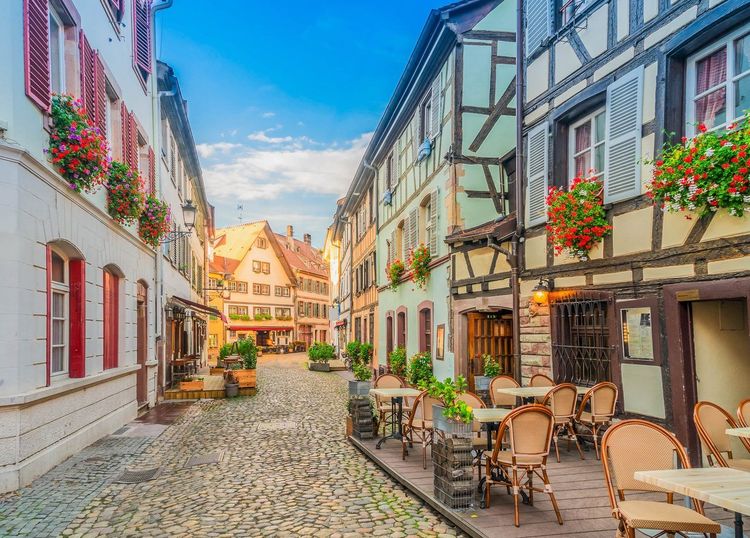
The choice of neighborhood where you sleep has a direct bearing on your market experience, far more than you might imagine before booking. The historic center, around the cathedral and la Petite France, puts everything within walking distance, often less than ten minutes from the main sites. It is the most comfortable option, but also the most sought-after, with rates that climb noticeably in December compared to the rest of the year.
Neighborhoods a little further out, such as the Krutenau or Neudorf, offer an interesting compromise: quick access to the center by tram, ten to fifteen minutes away, at rates noticeably lower than in the heart of the historic district. This is a sensible option for a stay of several days, where accommodation costs weigh more heavily than for a simple weekend break.
For visitors arriving by car, staying on the outskirts near a park-and-ride facility with a direct tram connection avoids the hassle of city-center parking while remaining within twenty minutes of the markets. This is often the most practical choice for families who prioritize space over immediate proximity.
Whatever neighborhood you choose, one principle holds true every year: book early. City-center rooms fill up from late summer for December weekends, and the best-located accommodation sells out months in advance during the busiest periods, particularly the two weekends before Christmas.
Some packages combine accommodation and city sightseeing in a single deal, practical for a short organized stay without juggling multiple separate bookings. They do not, however, replace a proper introduction to the historic center on foot: whatever hotel you choose, setting aside a first afternoon purely for walking, with no other objective than getting your bearings, remains the best way to enjoy the markets at your own pace afterward. The Ryo audio guide of Strasbourg lends itself well to this on arrival, to find your feet between the station, the cathedral, and la Petite France before heading into the markets proper.
Tips for an Eco-Responsible Stay in Strasbourg
The success of the Strasbourg Christmas market raises, as with many large-scale tourist events, the question of its environmental footprint. Several simple steps can help reduce your impact without sacrificing the experience.
The reusable cup deposit, now standard across all the markets for several editions, is the most visible gesture: every mulled wine or hot drink is served in a reusable cup, refunded on return at any stall, not necessarily the one where you bought it. There is no need to retrace your steps to get your deposit back.
Choosing public transport or the train over a private car remains the most effective way to reduce the carbon footprint of your trip, all the more so since the rail network serves the city center directly and the tram network covers all the market sites.
When shopping, opting for local craft and short-supply-chain stalls rather than the bulk-imported items still found at some markets directly supports the regional economy while reducing the distance products travel before reaching your hands.
Waste sorting, finally, has become much better organized in recent years: selective collection points are installed near the main markets, a notable improvement over older editions when generic bins still dominated. Walking rather than taking multiple short tram rides between nearby markets is a natural complement to this approach, especially since most of the historic-center sites are connected by less than fifteen minutes on foot.
FAQ
Which is the most beautiful Christmas market in Strasbourg?
There is no universal answer, but the cathedral market and the place Kléber market, with its Grand Sapin, remain the most frequently cited for their setting. The Christkindelsmärik on place Broglie is the most historic. For a less crowded atmosphere, the Carré d'Or market or the OFF market on place Grimmeissen appeal more to visitors who return year after year than to those discovering the city for the first time.
When Does the Strasbourg Christmas Market Start in 2026?
The Strasbourg Christmas market 2026 should open in late November, around Friday the 27th, closing on December 24th, as in 2025. These dates, aligned with the first Sunday of Advent, are yet to be confirmed on the official calendar published by the tourist office a few weeks before opening.
Is the Strasbourg Christmas Market Free?
Yes, access to all the chalets and squares is entirely free, with no ticket or reservation required. Only a few individual activities, such as the ice rink or certain children's workshops, are paid for separately.
How Much Time Should I Plan to Visit the Strasbourg Christmas Market?
Allow a full day to explore the main markets in the historic center at a leisurely pace, and ideally two to three days if you want to add a trip to the nearby Alsatian villages or enjoy the festive museums without rushing.
Where Can I Park to Visit the Strasbourg Christmas Market?
Park-and-ride facilities on the outskirts, connected to the center by tram, remain the most reliable option during peak periods. City-center parking lots fill up quickly on December weekends, particularly between 11am and 3pm.
Can You Visit the Strasbourg Christmas Market with a Dog?
Yes, dogs kept on a leash are generally tolerated in the streets and squares where the markets are held. Some food chalets, however, apply their own restrictions in the immediate vicinity of food stalls.
Are There Christmas Markets to Visit Around Strasbourg?
Yes, several neighboring towns and villages organize their own markets, from Kilstett to Obernai, and including Kaysersberg and Ribeauvillé along the wine route, often less than forty minutes away by road or train from the city center.
Strasbourg in December is a little more than a market: it is an entire city that reorganizes its squares, streets, and calendar around a tradition over four hundred and fifty years old. Between the cathedral, la Petite France, the Carré d'Or, and the nearby Alsatian villages, there is more than enough to fill several days without ever passing the same chalet twice.
To get your bearings from the moment you arrive, without relying solely on a paper map, our Ryo audio tour is a great starting point: 32 audio stops, around 2h40 of listening, and 6.6 km to cover between la Petite France and the European quarter, at your own pace, before or after your visit to the markets. It does not replace a free wander between the chalets, but it helps you understand what you are looking at, façade by façade.
À lire également