© Shutterstock
 Votre guide Ryo
16 Free Things to Do in Reykjavik in 2026: Churches, Northern Lights and Hot Baths
In Reykjavik, a coffee often costs as much as a meal elsewhere, yet the Icelandic capital offers plenty of experiences that cost nothing at all. You will find these free activities in Reykjavik mostly outdoors: while hurried visitors go on 150-euro excursions to the Golden Circle, locals know that the best of the city, its churches, parks and geothermal beaches, can be discovered on foot and without a ticket. The Ryo audio-guided tour of Reykjavik also traces a first itinerary through this compact center, linking several stops on this list without any booking. This selection takes you from the most photographed church in the country to pools heated by geothermal energy, with the northern lights along the way when the season allows.
On the program: a church whose facade imitates basalt columns, a boat sculpture that never sailed, a white house where a turning point of the Cold War took place, and a lighthouse you can only reach at low tide. Add the hot footbaths at Grótta, free walking tours with optional tips, the weekend flea market and the nights from September to April when the sky turns green: the city can easily be explored without opening your wallet, as long as you know where to look.
1. Admire Hallgrímskirkja Church, the Symbol of Reykjavik
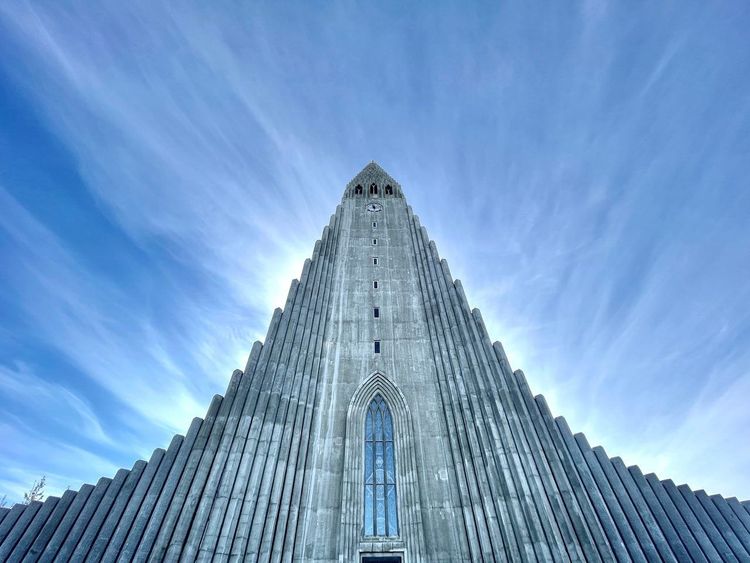
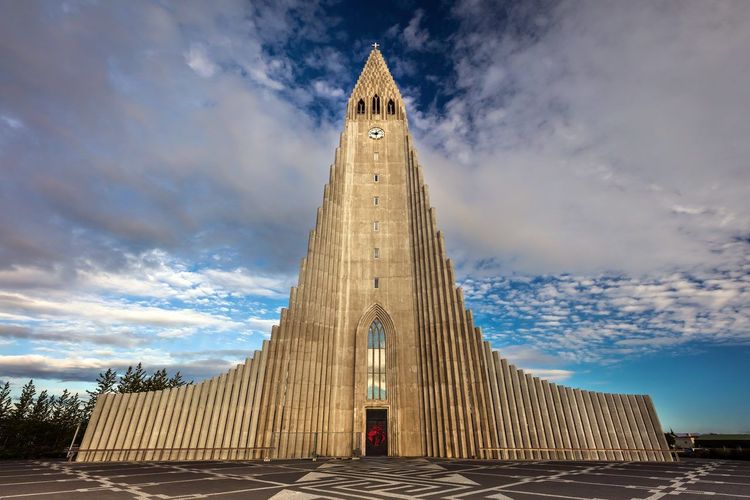
Hallgrímskirkja (Hallgrímstorg 1, 101 Reykjavik, rated 4.6/5 on Google from 29,401 reviews) towers over central Reykjavik at 74.5 meters, and you can admire it without spending anything, from the forecourt as well as from the nave. Architect Guðjón Samúelsson designed the concrete columns framing the facade to recall the basalt columns typical of the Icelandic landscape, a design choice visible as soon as you look up at the central tower.
Construction stretched over 41 years, from 1945 to 1986, and the result still divides Icelanders between national pride and Protestant austerity. The very plain interior can be visited freely during opening hours, with its large Klais organ of more than 5,000 pipes; only the climb up the tower, which offers an open view over the colorful rooftops and Faxaflói Bay, is paid (expect between 1,000 and 1,500 ISK depending on the season). In front of the building stands the statue of Leif Erikson, given by the United States in 1930 for the thousandth anniversary of the Icelandic parliament, well before the church itself was completed.
The name honors Hallgrímur Pétursson, a 17th-century pastor and poet whose Passion Hymns are still read every year during Lent. Its silhouette, visible from almost everywhere in the center, serves as a landmark when you get lost in the small streets of the 101 district. The street leading up to it, Skólavörðustígur, is painted in rainbow colors and offers a very photogenic view of the tower from the bottom of the slope.
In high season, the queue to climb the tower can exceed 30 minutes; in winter, you get in within minutes, and the view over a snow-covered city center is unmatched. This is where the Ryo audio-guided tour starts: the first stop tells the eventful story of the construction site, before leaving you free to extend your visit with the climb up the tower or not.
2. Stroll Along the Waterfront to the Sun Voyager (Sólfar)
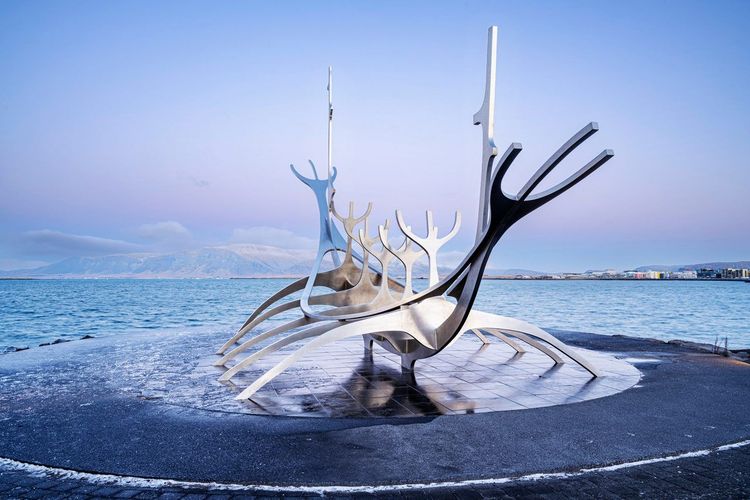
About fifteen minutes on foot downhill toward the bay, and the Sun Voyager (Sæbraut, 101 Reykjavik, rated 4.5/5 on Google from 10,565 reviews) (Sólfar) appears at the water's edge. This stainless steel sculpture set on granite slabs is the work of Jón Gunnar Árnason: born from a competition launched in 1986 for the city's bicentenary, it was unveiled on August 18, 1990, Reykjavik's birthday, a few months after the artist's death. Its silhouette evokes a Viking ship or a whale skeleton, but Árnason saw it as a "dream boat," an ode to the sun and the promise of unknown lands.
The Sæbraut promenade runs along the bay with Mount Esja as a backdrop, superb at sunset in winter or during the clear nights of June. You can continue to Harpa in a few minutes, or sit on the benches along the path to watch the fishing boats return to port. Along this walk, other open-air works line the route, including sculptures from the municipal collection, and information panels recall the maritime history of the bay. If you come early in the morning, you will have the sculpture almost to yourself, a rare luxury in summer when tour buses follow one another in front of it.
On the Ryo audio-guided tour, one stop pauses in front of the sculpture to decode its symbolism and the panorama it frames.
3. Discover the Lobby and Architecture of the Harpa Concert Hall
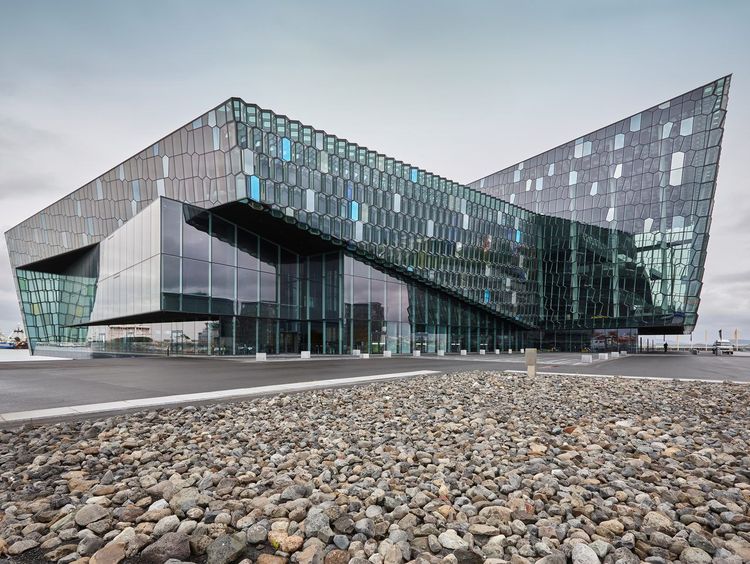
A few minutes' walk is enough to reach Harpa (Austurbakki 2, 101 Reykjavik, rated 4.6/5 on Google from 9,681 reviews), the concert hall and conference center that opened in 2011 on Reykjavik's harbor. Its honeycomb facade, designed by the Icelandic-Danish artist Ólafur Elíasson with Henning Larsen Architects, is inspired by the basalt columns found throughout the country. The project, launched before the 2008 financial crisis, nearly came to a halt when Icelandic banks collapsed; the state and the city eventually decided to finish it, and Harpa became a symbol of recovery.
Access to the main hall, the walkways and the temporary exhibitions on the ground floor is free, as are the shop and the café set under the glass roofs. Only concerts by the Iceland Symphony Orchestra, resident here, and guided tours of the main hall are paid. During the day, the glass panels change color depending on the position of the sun, a play of light that local photographers come to chase at all hours.
Go up to the top level open to the public: the view over the harbor and the mountains closing the bay easily rivals that of a panoramic bar. The Ryo audio guide dwells on the geological inspiration behind these facades and on how Elíasson transposed the crystalline structure of basalt into glass and steel, a detail most visitors miss when settling for an exterior photo.
4. Admire the Panorama from Perlan Hill
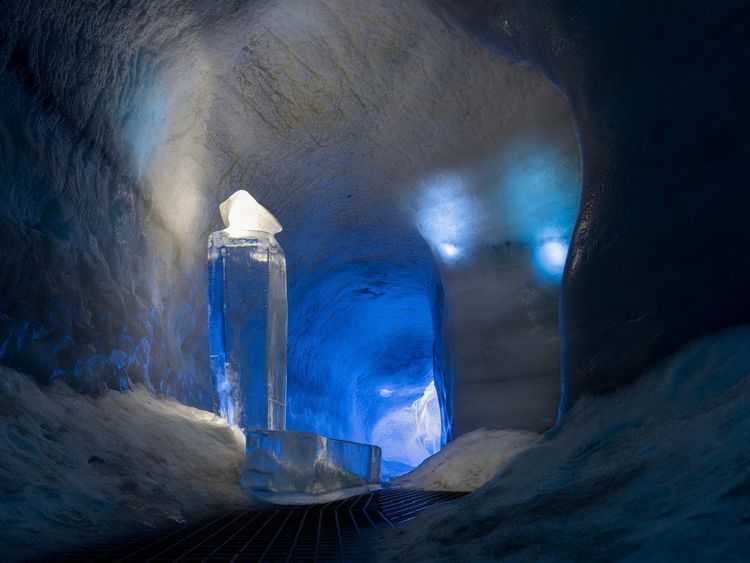
On the wooded hill of Öskjuhlíð, Perlan (Varmahlíð, 105 Reykjavik, rated 4.5/5 on Google from 11,629 reviews) rests on six geothermal hot water tanks topped with a glass dome, opened to the public on June 21, 1991. Four tanks still supply the city; the other two have been converted, one into a hundred-meter ice cave, the other into a planetarium.
Let's be precise about what is paid: the circular viewing deck and the exhibitions (ice cave, the Áróra planetarium dedicated to the northern lights, a replica of the Látrabjarg bird cliff) are included in the entrance ticket. However, nothing stops you from enjoying the surroundings of the building and the outdoor terraces at the foot of the dome, from where the view already reaches over the city center, the bay and, on clear days, Mount Esja and the Reykjanes peninsula.
Öskjuhlíð hill deserves a walking loop in its own right: its forest trails, planted from the 1950s, contrast with the usually bare landscape of the capital. You will come across remains of World War II bunkers, from when British and then American forces occupied the nearby airport, as well as an artificial hot spring. Away from the streetlights of the center, the hill is also among the spots cited for the northern lights, a topic detailed below.
5. Visit Höfði House, a Historic Cold War Site
Few visitors stop in front of Höfði House (Borgartún, 105 Reykjavik, rated 4.3/5 on Google from 1,390 reviews), a white wooden building constructed in 1909 by the sea, on the Borgartún side, and that is precisely what makes it a pleasant stop if you like places steeped in history without the crowds. Built for the French consul in Iceland, Jean-Paul Brillouin, it changed owners several times before returning to the city of Reykjavik.
Its name remains associated with the October 1986 summit between Ronald Reagan and Mikhail Gorbachev. The meeting ended without a signed agreement, but historians see it as a milestone toward the 1987 Intermediate-Range Nuclear Forces Treaty and, more broadly, toward the end of the Cold War. The building, still used for official receptions, cannot be visited: you can view it from the lawn, facing the bay, with Mount Esja in the background.
A persistent legend says the house is haunted by a "white lady," to the point that a British diplomat posted there in the 1950s reportedly asked to move out. True or not, the anecdote adds a note of mystery to this singular building amid office blocks. From the lawn, the seaside bike path takes you back to the Sun Voyager in twenty minutes.
Do you enjoy neighborhood atmospheres? Then head south along Borgartún: this office avenue, once nicknamed Iceland's "Wall Street," housed the headquarters of the banks before their collapse in 2008. The contrast between the small wooden house and these glass facades sums up the country's recent history rather well.
6. Recharge at the Reykjavík Botanic Garden (Grasagarður)
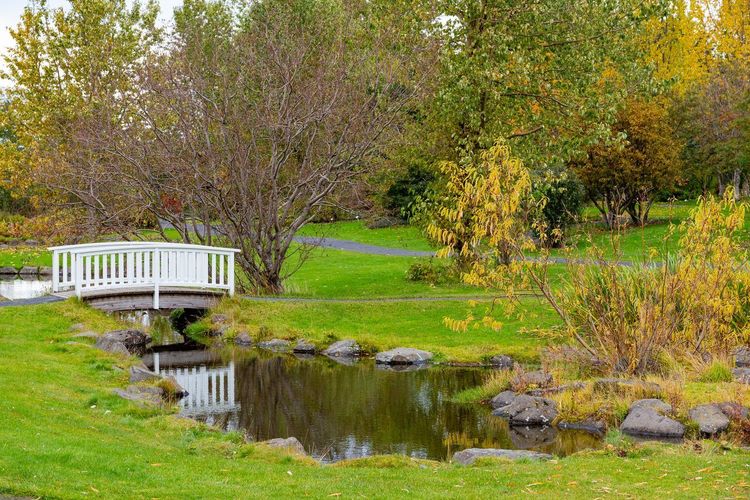
In Laugardalur park, east of the center, the Reykjavík Botanic Garden (Grasagarður (Laugardalur, 104 Reykjavik, rated 4.6/5 on Google from 869 reviews)) has been open without a ticket since its creation in 1961, for the city's 175th anniversary. Spread over about 8.5 hectares, it gathers more than 5,000 plant species arranged in eight collections, from native Icelandic flora to imported species able to withstand the subarctic climate.
The shaded paths, rare in a capital almost without tall trees, offer a real break between two visits, especially from June to August when the flower beds burst with color within a few weeks. The perennial collection, one of the richest in Northern Europe, appeals even to those who don't consider themselves gardeners. If you travel with a picnic, the lawns around the greenhouses are perfect for it. Plant labels often show the Icelandic name next to the Latin one: a little game to memorize a few words of the language, such as "birki" for birch, the only native tree to form real forests on the island. In autumn, dwarf birches and blueberry bushes turn red and gold, and the garden, almost deserted, takes on the look of a miniature moorland.
The garden is only one facet of the vast Laugardalur park, which also includes a family park and zoo, a swimming pool and a stadium: the section devoted to families comes back to it below.
7. Walk Around Lake Tjörnin and Austurvöllur Square
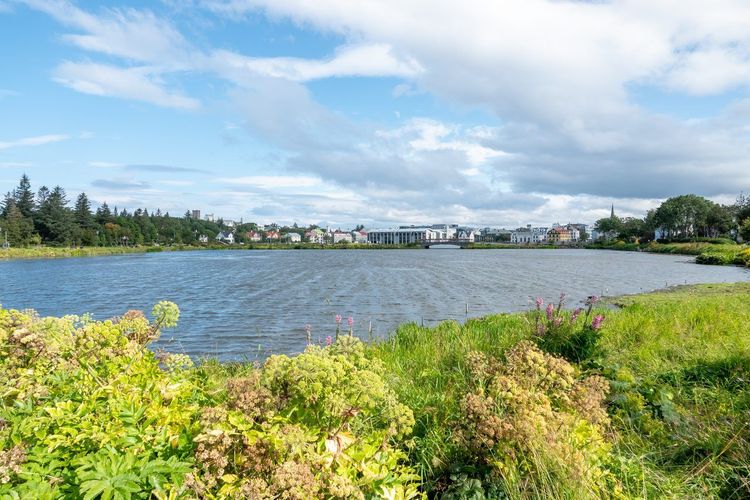
In the heart of the historic center, the small lake Tjörnin (Tjarnargata, 101 Reykjavik, rated 4.6/5 on Google from 2K reviews) hosts a bird population that is impressive for a capital: whooper swans, greylag geese, terns in summer and some forty species recorded over the seasons. The path around it, lined with colorful corrugated-iron houses, remains one of the locals' favorite walks. In winter, part of the lake freezes and turns into an improvised skating rink, while a hot-water-fed area stays open for the birds.
On the north shore stands the Ráðhús, the city hall built partly on stilts above the water, which houses a large relief map of Iceland open to the public free of charge. A few steps away, Austurvöllur square faces the Parliament, the Alþingi, heir to an assembly founded in 930 and often described as one of the oldest in the world, and the Lutheran cathedral Dómkirkjan, consecrated in 1796, far more modest but much older than Hallgrímskirkja. South of the lake, Hljómskálagarður park extends the stroll onto the grass.
You may feel like feeding the ducks: city signs ask you to avoid bread in spring and summer, as it attracts gulls that then prey on ducklings. The Ryo audio-guided tour runs along the banks of Tjörnin before stopping in front of the Parliament and the city hall, with a stop dedicated to the birds of the lake and their place in local folklore.
8. Go Street Art Hunting in the Colorful Laugavegur Area
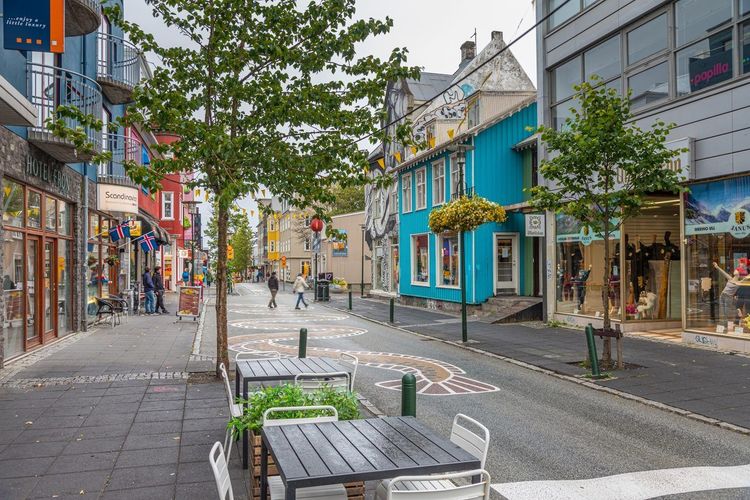
The shopping street Laugavegur (101 Reykjavik, rated 4.5/5 on Google from 4K reviews) and its surroundings concentrate a good part of the capital's street art, an ideal playground if you like spotting murals between shops. The street Skólavörðustígur, already mentioned for its rainbow markings at the foot of Hallgrímskirkja, is the natural starting point.
Several large facades on Laugavegur and the parallel street Hverfisgata were repainted during editions of the Wall Poetry festival, held alongside the Iceland Airwaves music festival: each mural responded to a song by an Icelandic band, resulting in giant portraits, abstract compositions and nods to Norse mythology. In the harbor district of Grandi, redeveloped around gastronomy and crafts, other maritime-themed murals decorate the former warehouses.
Also in Grandi, don't miss Þúfa, a spiral grassy mound eight meters high designed by artist Ólöf Nordal in 2013: a path leads you to the top, where a small hut is used for drying fish, with a stunning view over the harbor and Harpa. This freely accessible artwork remains surprisingly uncrowded.
A one-hour stroll zigzagging between Skólavörðustígur, Laugavegur, Hverfisgata and Grandi is enough to spot the essentials: you just need to look up above the shop windows. Choose early afternoon, when the low light brings out the colors. Several stops on the Ryo audio-guided tour point out some of these murals and introduce the local artists behind the best known ones.
9. Stop at Grótta Lighthouse and Its Hot Footbath
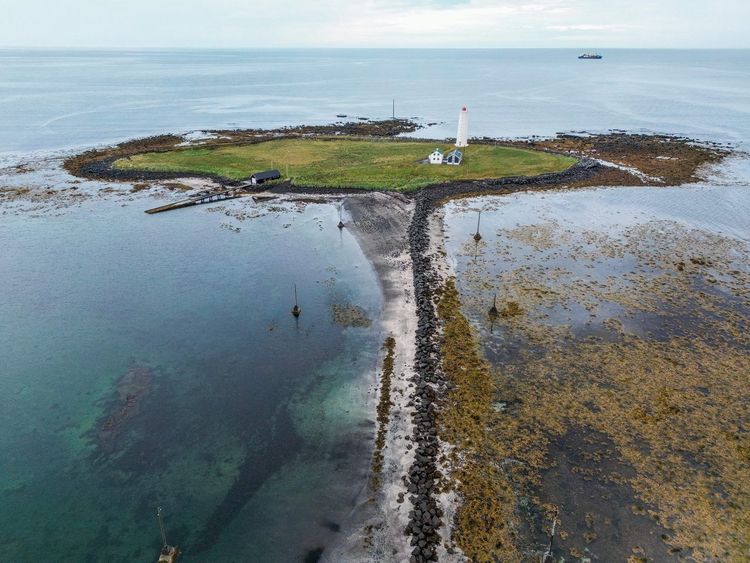
At the tip of the Seltjarnarnes peninsula, west of the center, the small Grótta Lighthouse (Seltjarnarnes, 170 Seltjarnarnes, rated 4.7/5 on Google from 2K reviews) can only be reached at low tide, when the causeway connecting it to the mainland emerges from the water. A first lighthouse was built here in 1897; the current tower dates from the mid-20th century. Be sure to check the tide times before setting out: the sea rises quickly and several walkers have already found themselves stranded on the islet.
Just before the point, a small basin fed with geothermal water lets you soak your feet for free: the Kvika footbath, carved by Ólöf Nordal into a rock, a very simple installation but much appreciated after a walk in the wind. The area is also a well-known spot for the northern lights in winter, far from the city lights, and a nesting site for Arctic terns: the islet is closed to the public from May 1 to mid-July to protect the nests.
The trip from the city center, on foot or by bike along the waterfront, takes about an hour: plan half a day if you intend to linger at the footbath or wait for nightfall for the auroras. The short version of the Ryo audio-guided tour of Reykjavik takes you all the way to this peninsula, with a listening point devoted to the Arctic terns that return every spring after migrating from Antarctica.
10. Enjoy Laugardalur Park with the Family
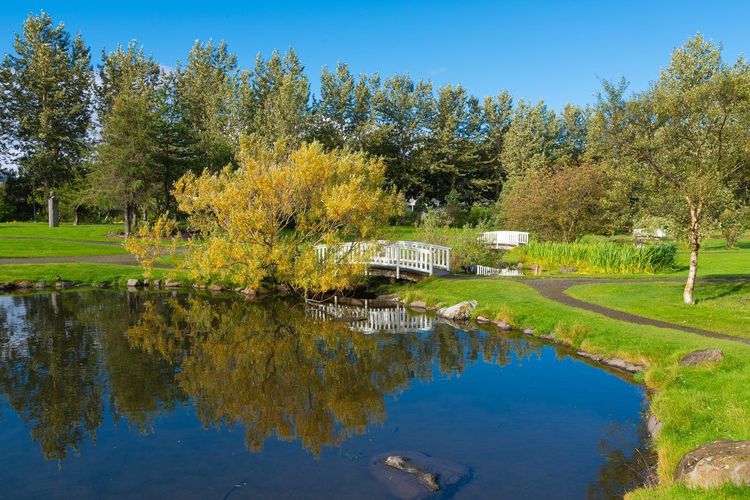
The Laugardalur park (Reykjavik, rated 4.6/5 on Google from 1K reviews) is one of Reykjavik's largest green spaces, and probably your best option if you are traveling with children. Its name means "the valley of hot springs": this is where local women once came to wash laundry in geothermal water, and the old, restored washing pools can still be visited along the path.
The Family Park and Zoo (Fjölskyldu- og húsdýragarðurinn), with its reindeer, seals, Icelandic horses and farm animals, charges a modest entrance fee, but most of the lawns, playgrounds and paths remain freely accessible. In winter, an indoor ice rink and the park's gentle slopes attract the neighborhood's sledders. You will also find the Botanic Garden described above, a few minutes from the playgrounds.
Right next door, the Laugardalslaug municipal pool naturally completes the visit: between games, a break in the heated pools offers a real change of pace, a subject detailed in the section on geothermal pools. For a full morning without major expense, Laugardalur remains one of the best plans in Reykjavik with family.
A tip if you are traveling with young children: public toilets are rare in the city, but pools, libraries and the Harpa lobby offer free access ones. The cafés in municipal libraries often have a play corner and children's books, a welcome solution on rainy days, which are frequent in Iceland even in midsummer.
11. Visit a Museum for Free
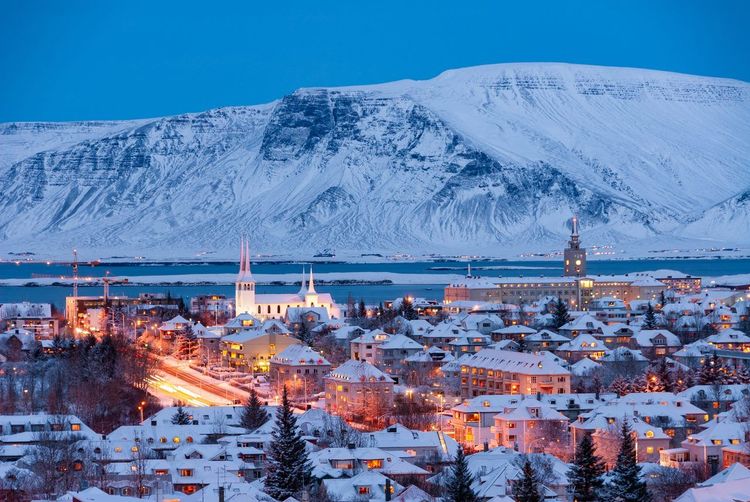
Most museums in Reykjavik charge an entrance fee, often a high one, but several annual events let you get in without paying. Culture Night (Menningarnótt), held every year in August around the city's birthday, opens a large share of cultural institutions for a day and an evening filled with outdoor concerts and fireworks. The Winter Lights Festival in February (Vetrarhátíð) also offers a Museum Night with free admission.
Some museums also open their doors during the national holiday on June 17, or apply free admission for children, or even for those under 18: conditions change regularly, so check each institution's website before heading out. The National Museum of Iceland (Suðurgata 41, 102 Reykjavik, rated 4.5/5 on Google from 4,187 reviews), which traces the country's history from the Viking settlement to independence in 1944, is often among the participants in these special days.
The rest of the year, several cultural venues can be enjoyed without a ticket:
- the sculpture garden of the Einar Jónsson Museum, right behind Hallgrímskirkja, where 26 of the sculptor's bronzes are displayed outdoors;
- the grounds of Ásmundarsafn, Ásmundur Sveinsson's domed house-studio in Laugardalur, surrounded by his monumental sculptures;
- the Grófin municipal library and the lobby of the Nordic House (Norræna húsið), designed by Alvar Aalto, which regularly host exhibitions and readings;
- the Klambratún park, at the foot of the Kjarvalsstaðir museum, for its setting and 1970s architecture.
If no special date falls during your stay, the Reykjavik City Card, which is paid, gives access to several museums and pools over 24, 48 or 72 hours: it pays for itself as soon as you do two or three visits in a day.
12. Join a Tip-Based Walking Tour (Free Walking Tour)
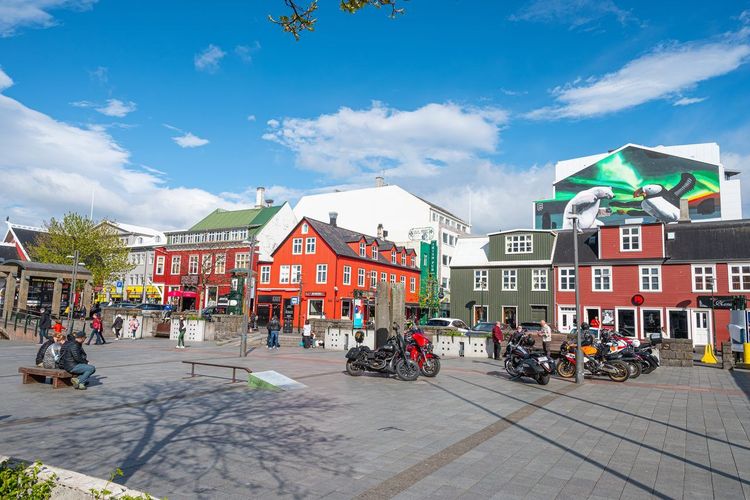
Several local companies run walking tours with optional tips, on the "pay what you want" principle: you pay at the end what you consider fair, depending on your satisfaction and your budget. Meeting points are in the heart of the historic center, usually on Ingólfstorg square (101 Reykjavik, rated 4.5/5 on Google from 1,154 reviews) or in front of the Parliament, on Austurvöllur square.
The tour, led by an Icelandic guide, lasts about two hours and covers the main outlines of the city's history: the settlement by Ingólfur Arnarson, the first settler according to tradition, gradual independence from Denmark, the 2008 banking crisis. You will mostly pick up details about daily life, elves, patronymic names or Icelandic humor, in exchange for a fixed schedule to follow and a sometimes large group in summer. Some companies also offer, on the same principle, themed tours devoted to legends, elf folklore or the city's history during World War II, most often in English.
If you prefer to go at your own pace rather than in a group, the alternative is to follow a self-guided route: the center is small enough that you never stay lost for very long, and most important buildings have explanatory plaques in English.
Online booking is still recommended to secure your spot. A tip of 2,000 to 3,000 ISK per person is considered fair if you enjoyed the tour, since it is the guide's only pay.
13. Watch the Northern Lights or the Midnight Sun Depending on the Season
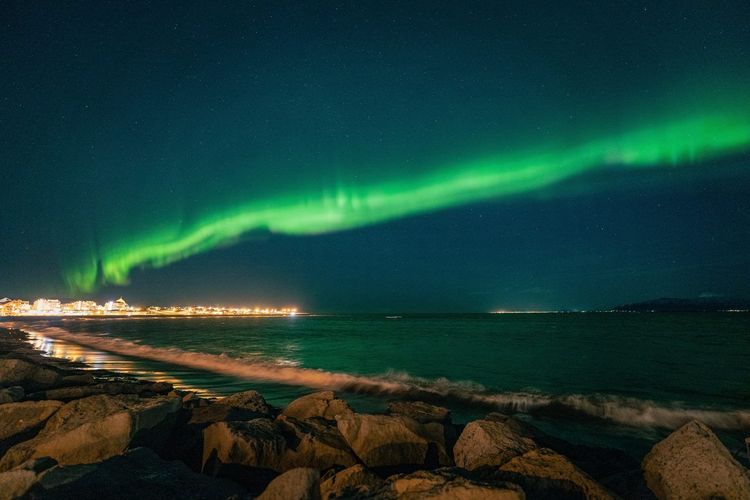
Depending on when you travel, Reykjavik's sky offers two radically opposite shows. From September to April, sufficiently dark and clear nights let you see the northern lights, provided you move at least a little away from the city-center lights and monitor solar activity and cloud cover through the forecasts of the Icelandic Meteorological Office (Veðurstofa Íslands), updated daily.
The most accessible spots without a car remain the peninsula of Grótta (Seltjarnarnes, 170 Seltjarnarnes, rated 4.7/5 on Google from 124 reviews) and the hill of Öskjuhlíð, below Perlan, both less than an hour's walk from the center. During strong activity, the city sometimes switches off street lighting in certain neighborhoods to make viewing easier. Viðey island, reachable by a paid ferry, offers an even darker sky; even without going there, you can see from the waterfront Yoko Ono's Imagine Peace Tower, a column of light lit every year from October 9 to December 8 in tribute to John Lennon. There is no guarantee with auroras: some nights stay silent despite a perfectly clear sky.
Conversely, around the June solstice, the midnight sun stretches the nights into a long golden twilight that never tips into darkness. It is the perfect time to extend walks toward the Sun Voyager or the banks of Tjörnin well after dinner, under a very photogenic low light. May and August offer a compromise: nights still bright, but dark enough in late August to hope for a few early auroras.
For the logistics of viewing, our dedicated article on watching the northern lights in Iceland details, spot by spot, the best options around the capital and elsewhere in the country.
14. Explore the Region's Landscapes and Hike Mount Esja
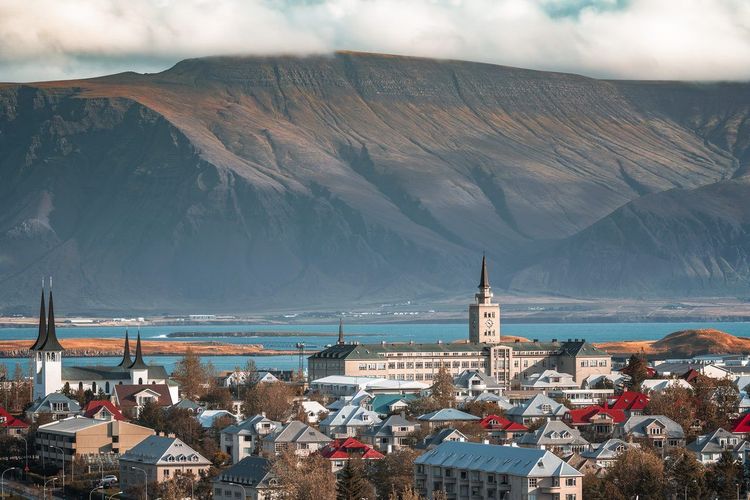
Reykjavik is one of the few capitals to offer a real mountain less than an hour by bus from its center. Mount Esja (Esjustígur, 116 Kjalarnes, rated 4.7/5 on Google from 402 reviews), whose highest point, Hábunga, reaches 914 meters, closes the bay to the north and serves as a visual landmark from almost every place mentioned in this article.
The most popular trail starts from the Mógilsá parking lot, about thirty minutes by car or by bus line 57 from the center. Most hikers stop at the large rock called Steinn, "the stone," after about 600 meters of elevation gain: allow three to four hours round trip, with good shoes, as the terrain quickly becomes wet and stony. The most experienced continue to the summit of Þverfellshorn (780 m) via a rocky passage equipped with chains. From the top, the view takes in the whole urban area, the Reykjanes peninsula and, on clear days, the Snæfellsjökull glacier on the horizon.
If the full hike doesn't tempt you, other landscapes are easily reached without a car: the urban valley of Elliðaárdalur, crossed by a salmon river in the middle of the city, or the forest trails of Öskjuhlíð near Perlan. If you rent a car, our article on the road trip in Iceland offers several day loops from Reykjavik, some of which follow the Golden Circle stops mentioned below.
15. Swim at the Nauthólsvík Geothermal Beach
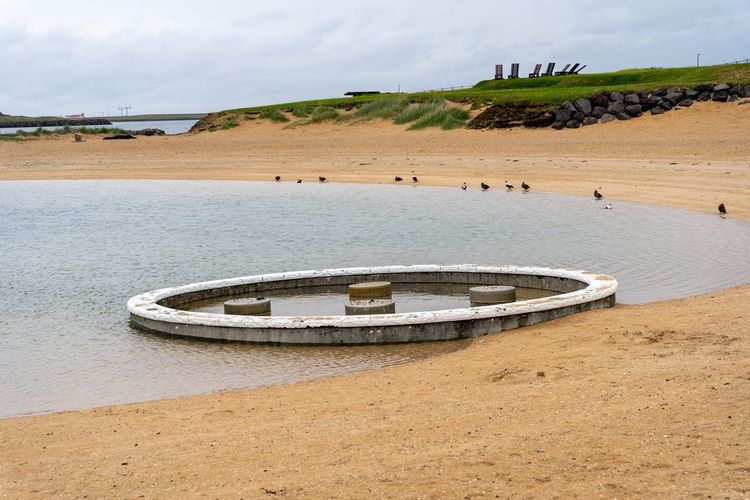
South of the city, at the foot of Öskjuhlíð, Nauthólsvík beach (102 Reykjavik, rated 4.5/5 on Google from 783 reviews) combines a cove of imported golden sand with a lagoon where seawater is warmed by geothermal water, reaching between 15 and 19 degrees in summer. Beyond the breakwater, the Atlantic water stays icy all year, which doesn't stop regulars from venturing in before dashing to the hot tub.
The beach itself is freely accessible. The hot tub, changing rooms and showers, however, carry a modest fee for part of the year, around 1,500 ISK for an adult, with entry remaining free for children under 9; hours are reduced out of season, so check the official website before coming. Even without swimming, you can sit on the sand and watch the members of the cold-water swimming clubs who come here in the middle of January.
Allow about forty minutes on foot from the center, following the coast, or a few minutes by bus from the university district. Along with the municipal pools, it is the most authentic way to taste Icelandic hot-bath culture without booking a high-end spa. Remember to bring sandals: the pebbles and sand quickly become icy outside the lagoon, and the rocks of the breakwater are slippery at high tide.
16. Try the Affordable Municipal Geothermal Pools
Let's be honest: the municipal geothermal pools are not free, but with an adult entrance fee of around 1,300 to 1,600 ISK, they remain the cheapest and most authentic experience in Reykjavik. Compared with the Blue Lagoon, whose entrance costs nearly ten times more, they are a bargain. Children pay a symbolic fee, or nothing at all for the youngest.
Laugardalslaug (Sundlaugavegur 30, 104 Reykjavik, rated 4.6/5 on Google from 2,241 reviews), the capital's largest pool, features an outdoor Olympic pool, slides, hot tubs at different temperatures, a cold plunge and a steam room, all open year-round despite the cold. In the very center, the historic pool Sundhöllin, designed by Guðjón Samúelsson (the architect of Hallgrímskirkja) and opened in 1937, gained an outdoor extension with hot tubs in 2017. Vesturbæjarlaug, in the west of the city, is the locals' hangout, ideal for listening in on the conversations in the "heitur pottur," a true Icelandic village gossip café.
One practical point to know: a soapy shower without a swimsuit is mandatory before entering the water, a strictly enforced rule that sometimes surprises unwarned visitors. Bring your own towel to avoid renting one on site, a small saving that, added up over several visits, ends up counting over a week.
Practical Info: Budget, Transport and Low-Cost Outings in Reykjavik
First piece of good news: almost all the places mentioned are within 30 minutes on foot of the historic center, the 101 postal district. Hallgrímskirkja, Harpa, Sun Voyager, Tjörnin and Laugavegur form a compact core that is easily covered in a day of walking; Grótta, Nauthólsvík, Perlan and Laugardalur take a little more time or a bus ride, but remain accessible without a rental car. On the weekend, make a detour to Kolaportið, the covered flea market of the old harbor: entry is free and you may even get to sample fermented shark or dried fish.
For evenings out, alcohol remains one of the heaviest expenses because of specific taxation. Did you know that strong beer was banned in Iceland until March 1, 1989? This "Bjórdagurinn" is still celebrated every year in bars, and the craft beer scene has exploded since. Most establishments in the center run a happy hour in the late afternoon, often between 4 pm and 7 pm, with sometimes spectacular discounts: it is the best time to try Icelandic microbrewery products at a reasonable price. For takeaway, the state-run chain Vínbúðin remains much cheaper than bars, as long as you respect its limited opening hours.
On the music side, the city lives to the rhythm of free concerts: during the Iceland Airwaves festival in early November, the "off-venue" program takes over bars, record shops and hostels with concerts open to all, and in summer, improvised stages liven up Ingólfstorg and the waterfront during Culture Night.
As for excursions, the must-see Golden Circle, which brings together Þingvellir National Park, the Geysir geothermal area and Gullfoss waterfall, can be covered without admission fees if you have a rental car or share a carpool: only certain parking lots, including the one at Þingvellir, and organized bus tours, often around a hundred euros per person, are paid. If you are planning a longer itinerary, our article on motorhome travel in Iceland details an economical alternative to a traditional rental.
Finally, for your daily trips, the Strætó bus network covers the city and its surroundings well at a reasonable fare compared with taxis, and shared bikes and scooters round out the offer in good weather. With hostel accommodation, simple meals prepared yourself (Bónus and Krónan supermarkets are the cheapest) and most of the activities on this list, a contained daily budget remains realistic.
Recommended Itinerary for a Day on Foot
If you only have one day, here is a logical sequence that limits backtracking. Start in the morning at Hallgrímskirkja, before the groups arrive, then walk down Skólavörðustígur and Laugavegur looking out for murals. Head to the waterfront for the Sun Voyager, follow the bay to Harpa, then take a lunch break at the old harbor or in Grandi, where Þúfa is located. In the afternoon, return toward Austurvöllur, the Parliament and Lake Tjörnin, before finishing, depending on your energy, with a swim in a municipal pool or a walk to Grótta for sunset.
Over two days, keep the second day for the east of the city: Höfði House in the morning, then Laugardalur park, its Botanic Garden and the Laugardalslaug pool. A third day can happily be devoted to Perlan, Öskjuhlíð hill and Nauthólsvík beach, or to hiking Mount Esja if the weather allows. Always keep a margin: in Iceland, wind and rain can change a plan within minutes, and most locals will tell you so with a fatalistic smile.



FAQ
How many days should I plan to visit Reykjavik for free?
Two to three days are enough to cover the essentials of the city center on foot: churches, sculptures, Lake Tjörnin and the Laugavegur area. Add a day if you want to hike Mount Esja or take a Golden Circle trip in a rental car.
What is the best time to see the northern lights in Reykjavik?
The season runs from September to April, during the longest and darkest nights. Your best chances come with clear skies and strong solar activity, which you can check with the official Icelandic forecasts updated daily.
Are Reykjavik's museums really free?
Most charge admission all year round, but Culture Night in August, Museum Night in February and the national holiday on June 17 offer occasional free entry. The Einar Jónsson sculpture garden can be visited without a ticket all year.
How can I get around Reykjavik without a car or a big transport budget?
The city center can be explored entirely on foot, as most sites on this list are within 30 minutes' walk of each other. For outlying neighborhoods, the Strætó bus network remains affordable, supplemented by shared bikes and scooters in good weather.
Can the Golden Circle be visited for free?
Mostly, yes: Þingvellir, Geysir and Gullfoss require no ticket if you go by car or carpool. Just budget for the paid parking at Þingvellir; bus tours charge for the transport and the guide.
What daily budget should I plan for an affordable stay in Reykjavik?
By combining a youth hostel with the activities on this list, a budget of 80 to 120 euros per person per day, excluding flights, is realistic for a city-focused stay.
Reykjavik turns out to be far more accessible than its reputation as an expensive city suggests, as long as you favor walking, parks and natural viewpoints over organized excursions. Between a church that imitates basalt, a lighthouse you reach at low tide and winter nights streaked with green auroras, most of the Icelandic experience can be enjoyed without spending a euro.
To link these places in a sensible order without spending hours planning, let the Ryo audio-guided tour of Reykjavik guide you: it tells, in audio and step by step, the story of the places you will pass anyway as you walk from one point of the center to the next.
À lire également