© Shutterstock
 Votre guide Ryo
Top 10 Irish Culinary Specialties to Absolutely Try in 2026
The best-known Irish specialty abroad is often reduced to stew or Guinness. That rather quickly forgets that Ireland is an island surrounded by some of the most fish-rich cold waters in Northern Europe, that its lush green pastures produce a butter whose creaminess is recognised well beyond its borders, and that its brewing and distilling tradition stretches back several centuries. Irish cuisine suffers from an austere reputation inherited from the Great Famine of 1845, which durably reshaped the country's eating habits. Behind this image lie Irish culinary specialties of rare sincerity, deeply rooted in the social history of the island. If you are planning a stay in Dublin or in the western counties, the Ryo app offers audio-guided tours of the neighbourhoods where these flavours are best discovered — between covered markets, century-old pubs and fine food shops.
Not to be missed on this tour of ten essentials: a full Irish breakfast with black and white puddings for under €12 in a Dublin café, a Dublin Coddle with its long working-class history that you will find virtually nowhere outside the capital, oysters from Galway Bay cultivated in waters ranked among the purest in Europe, and a glass of whiskey triple-distilled according to a tradition dating back to 1608. The ten specialties that follow cover every moment of the meal, from breakfast to the sweet treats you can take home.
1. The Full Irish Breakfast, the Essential Morning Ritual
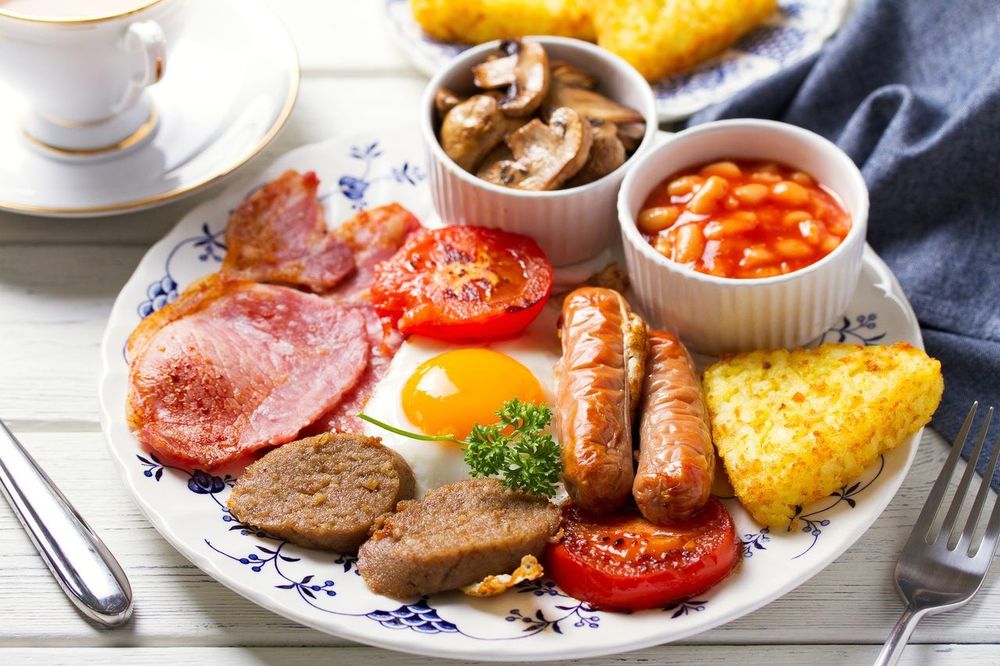
There is no half-measure with the full Irish breakfast. The plate arrives loaded: rashers (Irish back bacon, thicker and less smoked than continental bacon), pork sausages, scrambled or fried eggs, black pudding, white pudding, baked beans in tomato sauce, mushrooms sautéed in butter and grilled tomato. All accompanied by toast made from soda bread or white bread, and a mug of Barry's Tea served without delay.
The difference from an English breakfast is subtle but real. Irish sausages have a higher meat content and distinctive spices. The black pudding, made from pig's blood and oatmeal, is noticeably milder than its French counterpart, making it accessible even to palates unaccustomed to this type of charcuterie. As for white pudding, it uses the same base without the blood: almost identical texture, more delicate flavour, ivory colour.
In Irish hotels, breakfast is generally included in the room rate. For a more authentic experience, opt for a neighbourhood café or a pub open in the morning. Bewley's Oriental Cafes (78-79 Grafton Street, Dublin 2, rated 4.3/5 on Google from 6,008 reviews), on Grafton Street in Dublin, has been serving a full Irish since 1927 in a remarkable art deco setting with Harry Clarke stained glass windows and mahogany panelling. Expect to pay between €10 and €14 for a full breakfast with a hot drink.
A practical tip: if you are visiting Ireland for the first time, start by ordering a small breakfast without the two puddings to test the waters. Most establishments offer this à la carte version and readily adapt to special requests.
2. Irish Stew, Slowness as a Philosophy
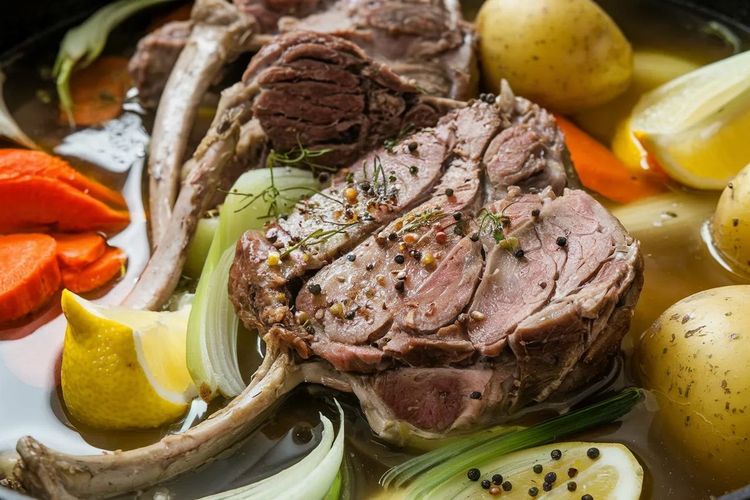
Irish stew is the most widely exported Irish specialty, and yet the easiest to get wrong when its fundamentals are not respected. The first of these: the meat must be lamb, not beef. The cuts used are the least noble — neck, shoulder, sometimes shank — because the slow cooking, between two and three hours over a gentle heat, is enough to tenderise them until they fall apart effortlessly with a fork.
The ingredient list comes down to five elements: lamb, floury potatoes, onions, carrots, stock. No complex aromatics, no wine to deglaze, no tomato paste. The simplicity is a deliberate choice. The potato plays a dual role: thickening the broth by partially dissolving, and serving as the main accompaniment to the dish in a single culinary gesture.
The Brazen Head (20 Lower Bridge Street, Dublin 8, rated 4.5/5 on Google from 21,328 reviews), founded in 1198 and considered Ireland's oldest pub, serves a stew whose recipe has not changed from generation to generation. The establishment is located a few minutes' walk from Dublin Castle, slightly off the most frequented tourist circuits — an ideal stop after a morning spent in the historic quarter. The classic accompaniment: soda bread to dip in the broth. Some pubs offer a side of colcannon, which makes the meal considerably heavier but is exactly what is needed after a day's walking in the Wicklow Mountains.
3. Soda Bread, the Everyday Loaf
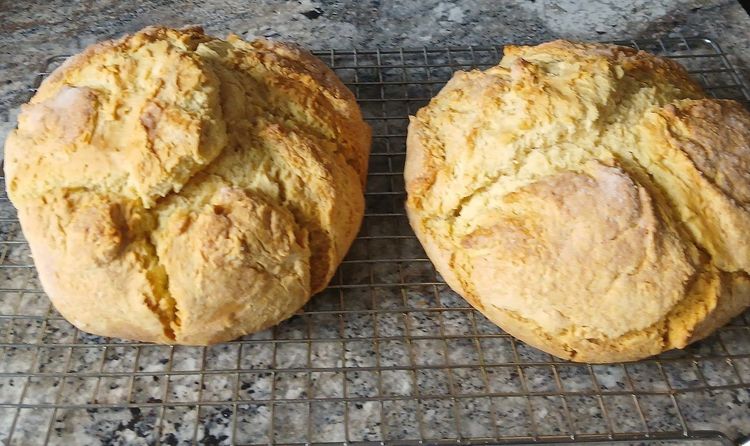
Traditional Irish bread needs no yeast. It is bicarbonate of soda reacting with buttermilk that makes the dough rise, producing a dense, slightly tangy crumb with a brown, compact crust. The cross scored on top — said to ward off evil spirits according to tradition — mainly serves to ensure the bread cooks through to the centre.
Two versions coexist: white soda bread (white flour, lighter) and brown soda bread (wholemeal flour, more rustic with a slight nutty flavour). Soda bread accompanies almost every Irish dish, from steaming stew to smoked salmon served at breakfast. Making it takes no more than 45 minutes, with no kneading or resting time required. It is without doubt the Irish specialty most consumed on a daily basis, present on every table across the island, from family meals to the neighbourhood bakery basket.
4. Black Pudding, the Artisan Charcuterie That Lives Up to Its Reputation
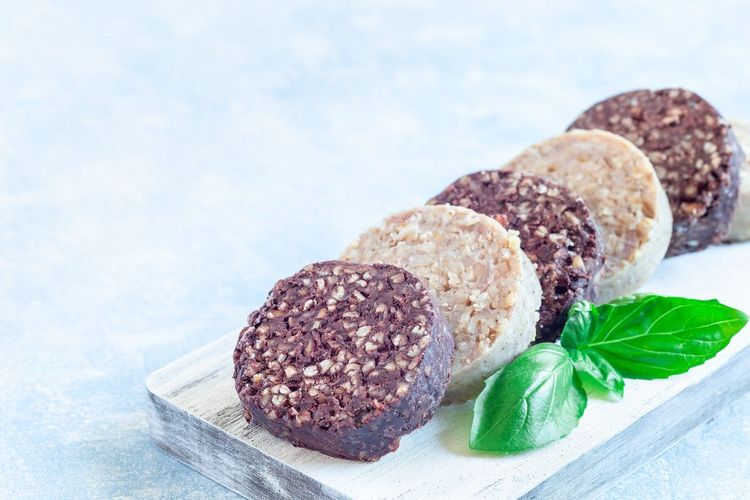
In France, black pudding is a respectable charcuterie but rarely the star of a meal. In Ireland, black pudding plays in a different league entirely. It is an integral part of the breakfast, features in the Dublin coddle, finds its way into salads at Dublin's fine dining restaurants, and is sold vacuum-packed as a gourmet souvenir. Its social standing is quite different.
The basic recipe is built on pig's blood, oatmeal, pork fat and salt. The addition of oats, specific to the Irish tradition, gives a slightly grainy texture that sets it apart from the creamier consistency of French or Spanish blood sausages. The brand Clonakilty, founded in County Cork, has become the national benchmark since the 1980s. Its products are distributed in all Irish supermarkets, but the artisan versions from county markets remain of superior quality.
White pudding is the bloodless variant, made from minced lard, oatmeal and mild spices. Its flavour is more delicate, its colour ivory. Both are served fried or grilled, in slices about one centimetre thick. If you wish to bring them back to France, check customs regulations: blood-based products are subject to sanitary restrictions on intra-European import, even when vacuum-packed.
5. Colcannon, the Peasant Mash That Became a National Comfort Food
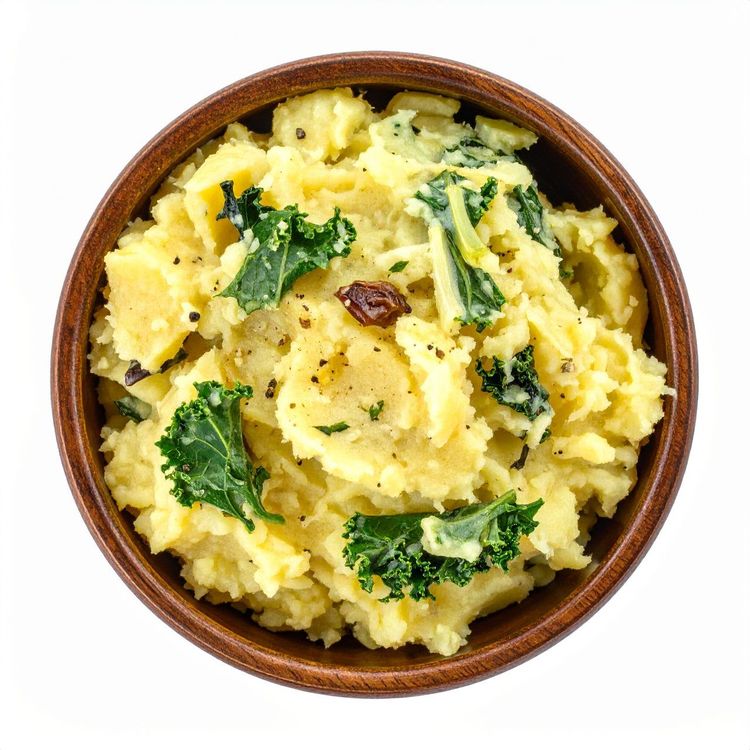
Colcannon is a mashed potato dish mixed with green cabbage or kale, enriched with generous amounts of butter, thick cream and chives or spring onions. The recipe is ancient — the earliest written mentions date back to the 18th century — and directly linked to the basic resources available to the Irish peasantry.
The dish remains strongly associated with Samhain, the Irish equivalent of All Saints' Day that precedes Halloween. Tradition had it that coins or a ring were hidden in the colcannon: whoever found the ring in their portion would be the next to marry. This folklore has faded from modern kitchens, but the dish remains a reliable staple in pubs that still serve traditional home cooking. The rich version uses up to 100 grams of butter for four people — not a diet dish, but exactly what is needed after a hike through Connemara.
6. Dublin Coddle, the Capital's Best-Kept Secret
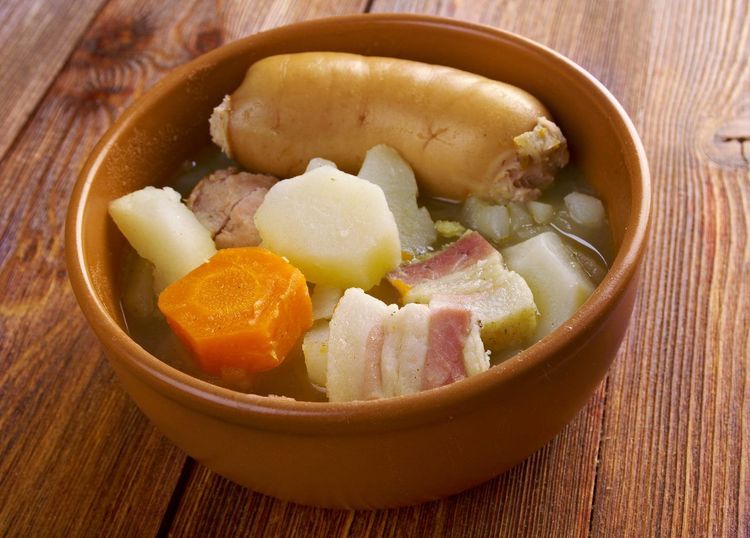
Coddle is perhaps the least internationally known Irish specialty and yet the most emblematic for Dubliners. It is a slow-cooked dish of sausages and thickly sliced bacon, simmered in a clear broth with potatoes and onions for many hours over a very low heat. The dish is pale in colour, the broth transparent — nothing that invites a photograph for social media. That is precisely what makes it endearing.
Historically, coddle was the Thursday evening dish in Catholic Dublin households. Friday being a day of abstinence from meat, coddle allowed the remaining charcuterie to be used up the evening before the religious prohibition. The tradition of cooking it on a Thursday persisted in the city for a long time, even after religious practices had relaxed considerably in the second half of the 20th century.
Jonathan Swift, author of Gulliver's Travels and Dean of St Patrick's Cathedral in Dublin, mentioned coddle in his writings in the early 18th century. James Joyce also alludes to it in his Dublin stories. This double literary reference makes it as much a cultural dish as a gastronomic one, which explains its particular place in the city's imagination.
The Old Storehouse (3 Crown Alley, Temple Bar, Dublin 2, rated 4.5/5 on Google from 9,171 reviews), a traditional pub in the Temple Bar quarter, is one of the rare establishments to offer coddle on the menu all year round. The preparation varies slightly from one kitchen to another — some add chopped parsley, others a little flour to thicken the broth — but the structure remains the same.
If you are exploring Dublin with the Ryo audio guide, the Temple Bar area and its cobbled lanes are one of the most dense zones of culinary and musical heritage in the capital. This is where the tradition of pub food resisted standardisation the longest.
7. Bacon and Cabbage, Simplicity Taken to Its Finest
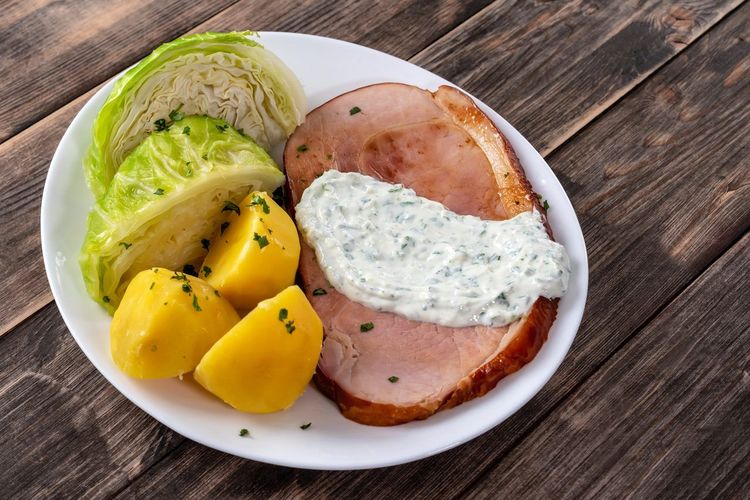
This dish bears no resemblance to anything you might know by the name 'bacon'. In Ireland, the term refers to back loin of pork, lightly cured and slowly boiled with green cabbage. The whole is finished with a creamy parsley sauce. No smokiness, no crispy fat — a long, gentle water-based cooking that yields white, tender meat.
This dish is often presented as the Irish national dish, ahead of stew itself. It is found in school canteens, popular restaurants and family kitchens across every region. Its main appeal lies in the quality of Irish pork, raised free-range on the island's pastures — the same pork that supplies artisan charcuteries like Clonakilty. Simple, hearty, without artifice. In Dublin, our 29-stop audio walking tour crosses the very neighbourhoods where pubs still serve it at lunchtime.
8. Irish Seafood, the Too-Often Overlooked Treasure
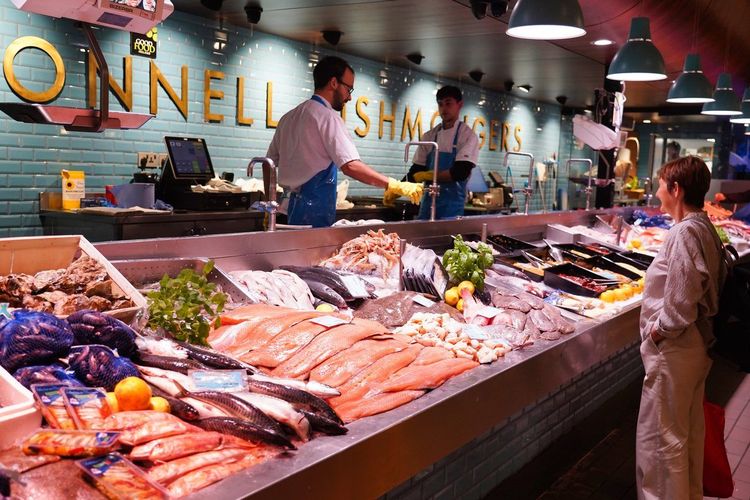
Ireland is an island. Yet its gastronomic reputation often overlooks its maritime resources. That is a mistake: the cold waters of the North Atlantic and the Irish Sea produce ingredients of remarkable quality, at prices that bear no comparison to those in France.
Galway Bay oysters are the most celebrated product. Cultivated in the clear waters of Clarinbridge and Kilcolgan, they are enjoyed plain with a glass of Guinness — an iconic pairing in Ireland. The Galway International Oyster Festival, held every year in September since 1954, is one of Europe's oldest food festivals. Moran's Oyster Cottage (The Weir, Kilcolgan, County Galway, rated 4.8/5 on Google from 3,119 reviews), in Kilcolgan in County Galway, is a legendary establishment: a traditional Irish thatched cottage beside a river, specialising in oysters and seafood for several generations.
Dublin Bay prawns (langoustines) live up to their reputation despite their misleading name — they are caught off the west coast, in the waters off Connemara and Kenmare Bay. Served simply poached with melted butter or in a thick bisque, they are one of the best reasons to stop in a fishing harbour. Irish smoked salmon, finally, is a classic of tasting platters: cold-smoked over oak or beech wood, it offers a silky texture and a pale colour very different from industrial Norwegian salmon. Producers from County Kerry and Donegal are the most highly regarded.
9. Irish Coffee and Irish Whiskey, the Island's Elixirs
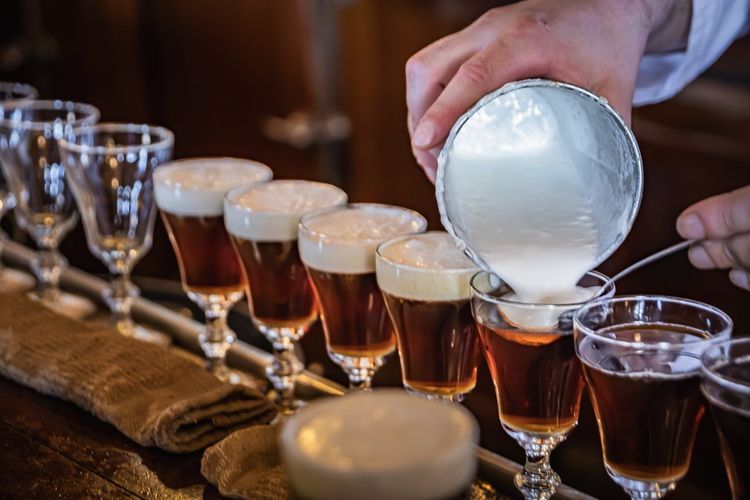
Let us start with a clarification: Irish Coffee is not a substitute alcoholic dessert. It is a precise invention, dated and localised. In 1943, chef Joe Sheridan at the Foynes Flying Boat Terminal, in County Limerick, devised this blend for American passengers stranded by an Atlantic storm: strong hot coffee, Irish whiskey, brown sugar and a layer of double cream floated on the surface. Sheridan's recipe has not changed since.
Its worldwide popularity is owed to an American journalist, Stanton Delaplane, who brought it to San Francisco in 1952 via the Buena Vista Café. Today, Irish Coffee appears on the menu of every self-respecting hotel, but the original version, with Sheridan's exact proportions, is properly executed in only a handful of establishments. The cream must not be whipped but 'floated' over an inverted spoon onto the hot coffee — dense, cold, unsweetened — to create the characteristic thermal contrast.
Irish whiskey deserves a paragraph of its own. Its spelling with an 'e' (whiskey) distinguishes it from Scotch (whisky). Triple distillation, versus the double distillation of most Scottish whiskies, gives it a smoother, less peaty character. The major names are Jameson (the world's best-selling Irish whiskey, distilled at Midleton in County Cork), Bushmills (whose distillery in County Antrim has been legally licensed to distil since 1608), Connemara (the only peated Irish whiskey, for lovers of smoky flavours) and Teeling (Dublin's craft distillery opened in 2015, the first new Dublin distillery in over 125 years, now a benchmark of the Irish new wave).
The Jameson Distillery Bow St. (Bow St., Smithfield, Dublin 7, rated 4.7/5 on Google from 6,431 reviews) in Dublin offers guided tours with comparative tastings — an informative and enjoyable way to learn to distinguish the different styles of Irish whiskey. Expect to pay between €20 and €25 for the standard tour with tasting included.
10. Irish Desserts and Sweet Treats Not to Be Missed
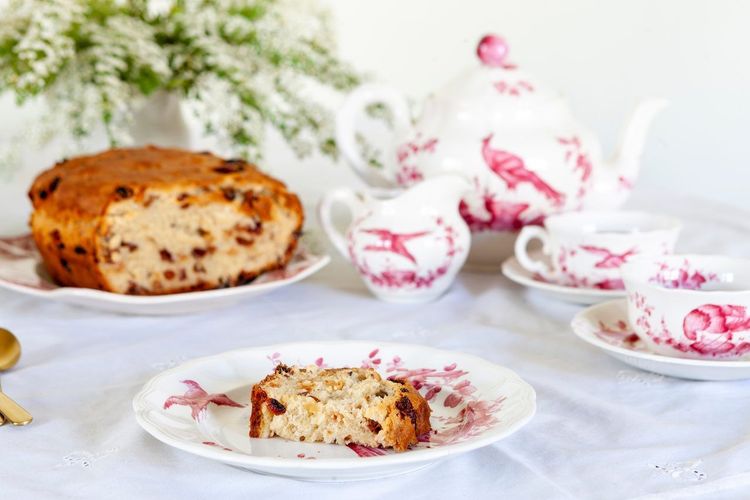
Irish sweet treats are less showy than French pastries, but they more than make up for it with their generosity. Barmbrack (báirín breac in Irish, meaning 'speckled bread') is a lightly sweetened bread studded with raisins and candied fruit, flavoured with the black tea in which they have soaked overnight. It is served toasted and buttered, like a dense brioche. Very much associated with Halloween, it traditionally conceals small objects — a coin, a button, a ring — each foretelling the fortune of the guest who finds them on their plate.
Apple Crumble is the quintessential hot dessert: tender apples beneath a crisp topping of flour, butter and sugar, served with a generous portion of custard. Apples from County Armagh, nicknamed the 'apple capital' of Ireland, provide a natural acidity that perfectly balances the sweetness of the crumble. It is the Irish sweet specialty most often found on pub menus, across all seasons.
For sweet souvenirs to bring home, biscuits by the brand Jacob's are a practical and lightweight option: Kimberleys (ginger marshmallow) and Mikados (raspberry marshmallow) are found in all Irish supermarkets for under €3 a packet and are virtually impossible to find in France. Barry's Tea, a staple in every Irish household, comes in several box sizes and travels very well.



FAQ
What is the most internationally known Irish specialty?
Irish stew (lamb stew with potatoes, onions and carrots) is the Irish specialty most recognised outside the island's borders. In Ireland itself, the full Irish breakfast is arguably the most commonly practised culinary ritual on a daily basis, both in homes and neighbourhood cafés. Both are considered emblematic of Irish country cooking.
What is Ireland's iconic drink?
Two drinks share this status: Guinness (a dark stout beer brewed in Dublin since 1759, recognisable by its creamy white head) and Irish whiskey (triple-distilled, smoother than Scotch). The Irish Coffee — whiskey, hot coffee, brown sugar and floating cream — is an Irish invention from 1943 that conquered the entire world in the decades that followed.
What culinary souvenirs should I bring back from Ireland?
The most practical options: Barry's Tea in a large box (unavailable in France), Jacob's biscuits (Kimberley and Mikado), a bottle of craft whiskey (Teeling, Green Spot, Writer's Tears). For charcuterie lovers, Clonakilty black pudding is available vacuum-packed and passes European health inspections without any issue. Artisan Irish jams and marmalades also make excellent light souvenirs.
Where can I eat authentic Irish specialties in Dublin?
Several addresses are well regarded without catering exclusively to tourists: The Brazen Head (Ireland's oldest pub, great for Irish stew), The Old Storehouse in Temple Bar (for Dublin Coddle), Bewley's Oriental Cafes on Grafton Street (for a full Irish breakfast in a historic setting). To avoid: restaurants directly on Dame Street or O'Connell Street, where prices are inflated and food is standardised for groups.
What is the difference between Irish black pudding and white pudding?
Black pudding is made with pig's blood, oatmeal, fat and spices. White pudding uses the same base without the blood — ivory in colour, milder in flavour and slightly less firm in texture. Both are served fried or grilled in slices as part of a full Irish breakfast. The artisan brand Clonakilty (County Cork) is the benchmark for both sausages throughout Ireland.
In Summary
Irish cuisine rewards those who take the trouble to venture beyond the most visible addresses. Dublin concentrates the majority of must-try dishes, but the coastal regions — Connemara, Kerry, Donegal — reveal even more authentic local produce at prices often lower than those in the capital. Every Irish specialty tells a chapter of the island's social history, from the survival dish of the peasantry to the ritual of the Sunday breakfast.
To discover this gastronomy on the ground, the audio-guided tours in the Ryo app cover several neighbourhoods of Dublin and include stops at the covered markets and historic pubs where these flavours are still being passed down. A different way to immerse yourself in an Irish cuisine that deserves far more than the austere reputation it is often given. Download Ryo before you leave and let each Irish specialty speak for itself in its own setting.
À lire également