© Shutterstock
 Votre guide Ryo
Visiting Amsterdam for the First Time: The Complete 2026 Guide
In Amsterdam, there are almost as many bikes as residents, and the real traffic battle is not between cars but between hurried cyclists and visitors looking at their phones instead of the bike lane. To visit Amsterdam for the first time without ending up stunned by a bike bell, it is best to know this before you even step out of the central station. The Ryo audio-guided tour of Amsterdam follows precisely this itinerary through the historic center, explaining when to lift your eyes from the map and when to keep them on the road.
Whether you have two days or four, the city is not visited in the same way: the Anne Frank House puts its tickets on sale six weeks in advance, the flower market has literally floated on a canal since the 19th century, and the red light district can be crossed very easily without ever stopping there. Shops do not necessarily open when you expect, the tourist tax climbs higher than elsewhere in Europe, and a poorly locked bike disappears in less than a night. This guide goes through these details one by one, from the Old Center to the customs rules for bringing back cheese.
The Old Center, Dam Square and the Iconic Canals
Dam Square, the Flower Market and the Historic Heart
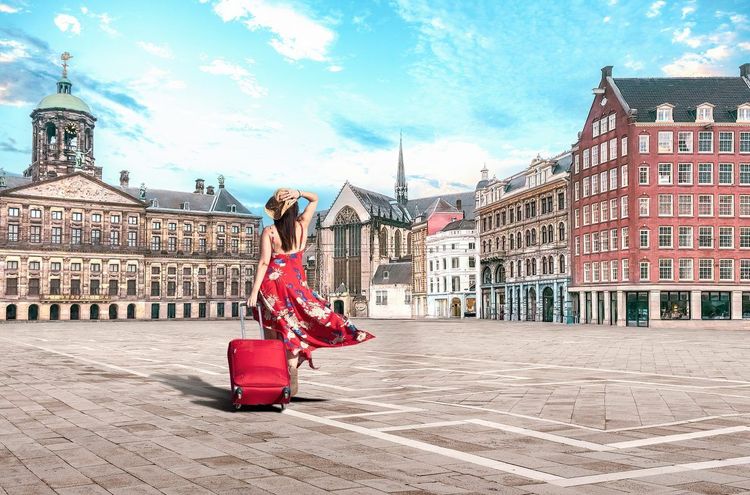
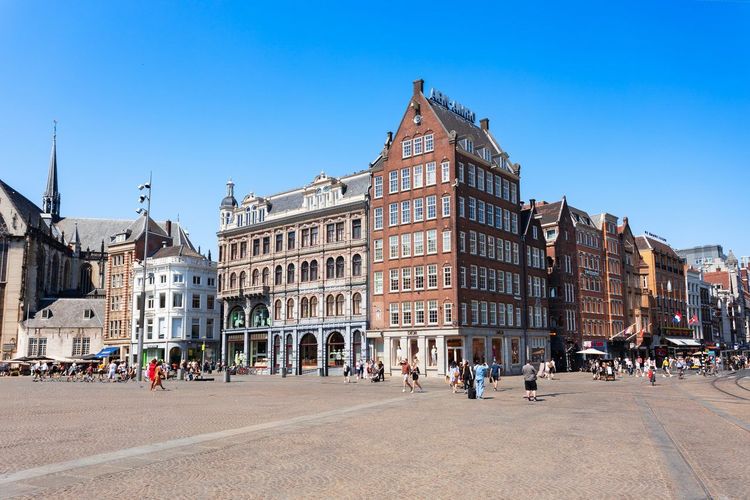
Almost every first visit to Amsterdam begins at the same square. Dam Square brings together the Royal Palace, the National Monument and a dense crowd of street musicians, herring vendors and rather fearless pigeons.
The city's name actually comes from this very spot: a dam built in the 13th century on the Amstel to protect the surrounding polders. The Royal Palace bordering the square long served as the city hall before becoming an official residence, now open to the public during certain periods of the year. Allow a good half hour on site before moving on, enough time to spot the terraces around the square and the alleys leading toward the Rokin.
Right next door, the Nieuwe Kerk (New Church) is no longer a regular place of worship but hosts temporary exhibitions and royal inauguration ceremonies. You do not have to go in to capture the atmosphere of the square, but the late Gothic façade is worth at least a glance in passing.
If you can choose your time, come before 10 a.m. Dam Square fills up quickly with organized groups in mid-morning, and the surrounding terraces become much less pleasant for watching the square in peace.
Ten minutes' walk up the Singel, the Bloemenmarkt (flower market) has stood since 1862 on pontoons moored to the canal, and likes to present itself as the world's only floating flower market. Tulip bulbs in blister packs, seeds, miniature windmills: this is where most visitors buy their souvenirs, provided you check further on in this article what you can actually bring home. The dominant smell is not always that of fresh flowers: the stalls of dried bulbs and garden seeds take up as much space as cut bouquets, especially outside the tourist season between November and February.
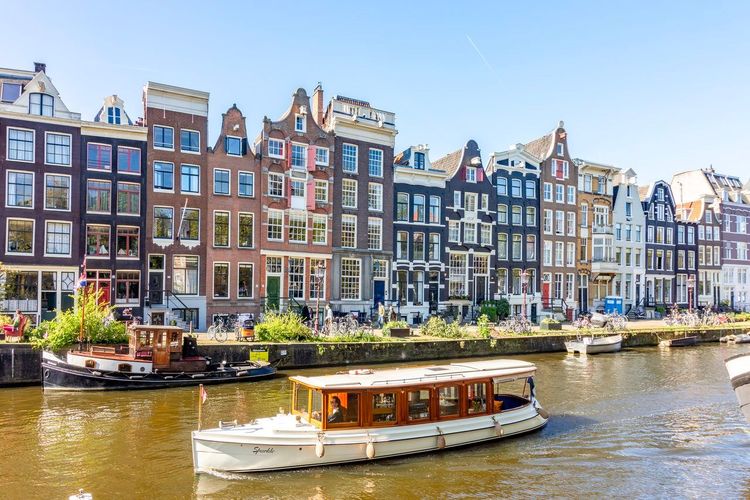
This sense of order that strikes you in the first hours on site is no accident. The concentric half-circle layout of the grachtengordel (the canal ring) was drawn in the 17th century around the old center, with gabled houses leaning slightly forward, designed to hoist furniture through the windows rather than up a too-narrow staircase. This narrowness is not just a matter of aesthetics: the property tax of the time was calculated on the width of the façade facing the canal, not on the depth of the building. As a result, the houses stretch back lengthwise, with staircases so steep that it is sometimes easier to pass a sofa through the window than through the door. Around the Rokin, big chain stores have replaced part of the historic food trade, but a few 19th-century façades remain among the modern shop windows.
A Boat Ride on the Canals
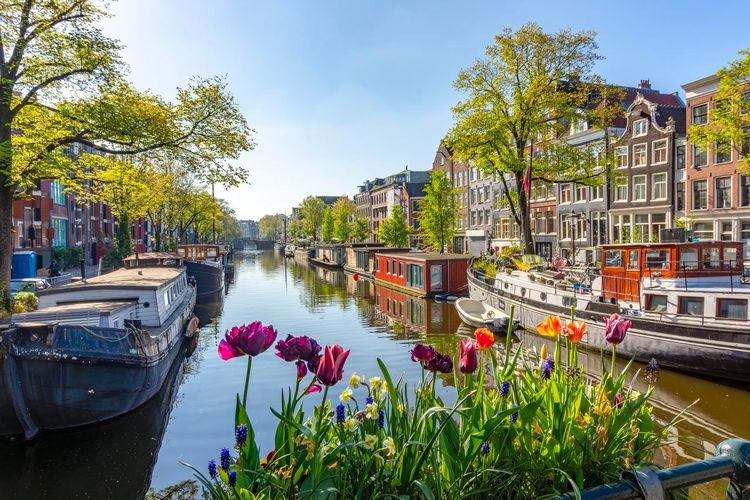
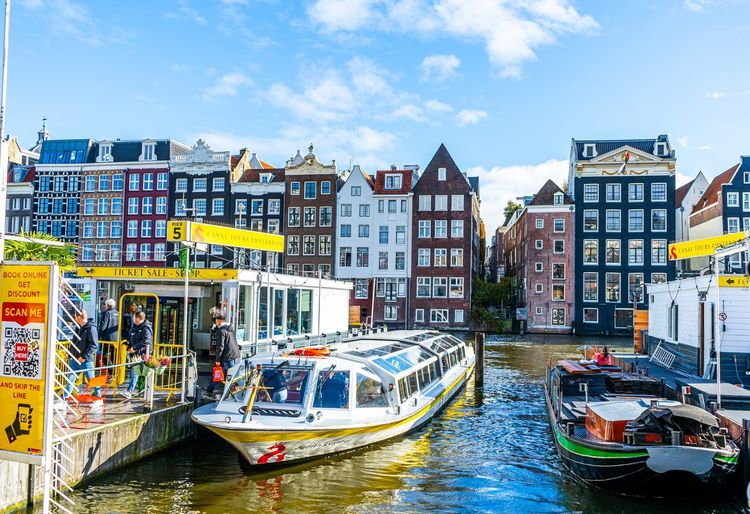
The 165 canals and more than 1,500 bridges of the historic center make Amsterdam first and foremost a city of water, and the canal ring has been a UNESCO World Heritage Site since 2010. For a first pass through the city, an hour on a boat remains the quickest way to understand how the Herengracht, the Keizersgracht and the Prinsengracht fit together, the three main canals that encircle the Old Center.
You can also follow these same canals on foot with the Ryo "At the Rhythm of the Canals" sub-tour, which tells the story of the bridges and merchants' houses as you walk rather than offering a generic commentary on architecture. It is a way to slow down after the obligatory stop at Dam Square, without needing to book a boat slot in advance.
For a more intimate format than a big tourist boat, some companies rent small electric boats that require no license, to pilot yourself for two hours. It is more expensive than a standard cruise ticket, but it lets you stop wherever you like, notably in front of the leaning houses of the Keizersgracht. In midsummer, it is better to book your slot the day before rather than the same morning: the early-evening departures, the most popular for the golden light on the water, are fully booked by early afternoon.
At the end of the day, the Magere Brug (Amstel, 1018 EM Amsterdam, rated 4.5/5 on Google from 7,054 reviews) (the skinny bridge) lights up with hundreds of bulbs over the Amstel, just behind the theater district. It is a good place to stop for a break before heading back to the center or continuing to the south of the city.
The Anne Frank House and the Major Museums
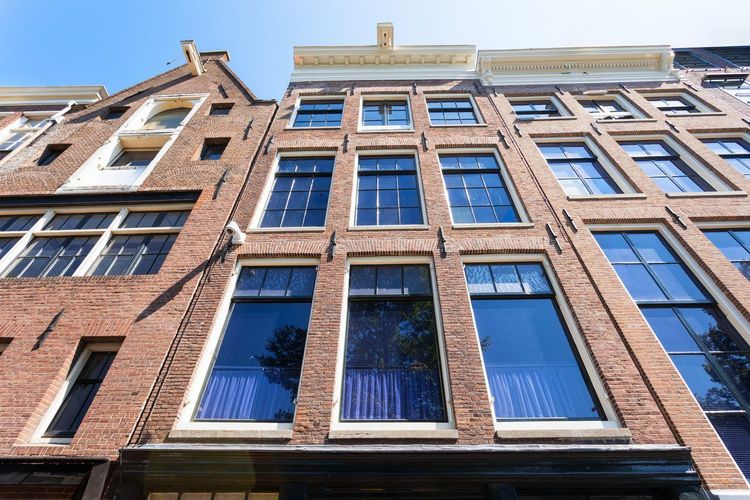
The Anne Frank House
The Anne Frank House, on the Prinsengracht, remains the most sought-after visit in the city and the one you need to organize before even booking your flight. All tickets go on sale every Tuesday at 10 a.m., for a visit six weeks later, only on the official website (16.50 euros for an adult). Without a booked ticket, there is no point queuing on site: there are no ticket sales at the door.
The visit lasts about an hour, backpacks are not allowed beyond a small size, and it is not possible to take photos inside the secret annex. Plan to arrive fifteen minutes before your slot: entry is done in waves and a significant delay can cost you your reservation. If everything is sold out for your dates, log in the following Tuesday at exactly 10 a.m.: the slots for the targeted week go within a few hours.
It is also one of the stops on the Ryo audio-guided tour, which pauses on the Prinsengracht and tells the story of the Frank family in a few minutes of listening, useful if your visiting slot is only later in the day.
Museumplein and the Must-See Museums
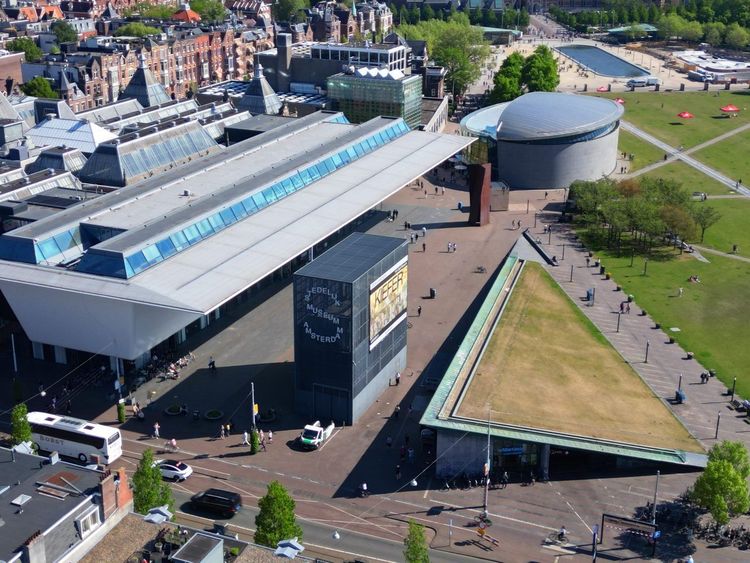
Museumplein, the large rectangular lawn south of the center, brings together three major museums within five minutes' walk of each other: the Rijksmuseum (the Dutch masters, including Rembrandt's The Night Watch), the Van Gogh Museum (Museumplein 6, 1071 DJ Amsterdam, rated 4.6/5 on Google from 109,977 reviews) (the largest collection of the artist's works in the world) and the Stedelijk Museum, dedicated to modern and contemporary art.
For a first visit, choosing a single museum per half-day is more than enough: visual fatigue sets in quickly in front of so many paintings. Dated and timed tickets are bought online, again several days in advance in high season, since morning slots go first. The Van Gogh Museum, in particular, no longer sells tickets without a time slot.
If you plan to string together two or three museums during your stay, calculate the price of a tourist pass before buying individual tickets: beyond three visits, the card often becomes the cheapest solution.
Vondelpark and the Neighborhoods for Strolling
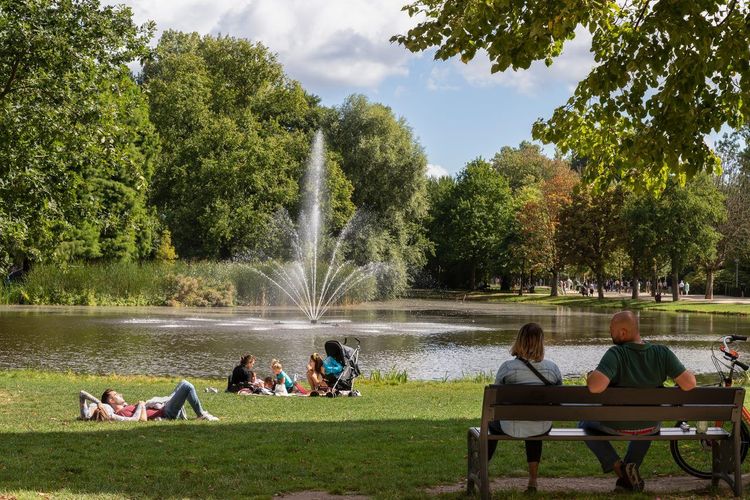
Vondelpark, the City's Green Lung
Vondelpark stretches over 47 hectares just behind Museumplein, with free entry all year round. In summer, a free open-air theater schedules concerts and shows, and the lawns fill with picnics at the first rays of sunshine.
It is also where locals come to run, rollerblade or simply read on a bench, away from the hustle of the center. After a morning of museums, it is a break that costs zero euros and gives you back energy for the afternoon.
Strolling Through the Quiet Neighborhoods of the Center
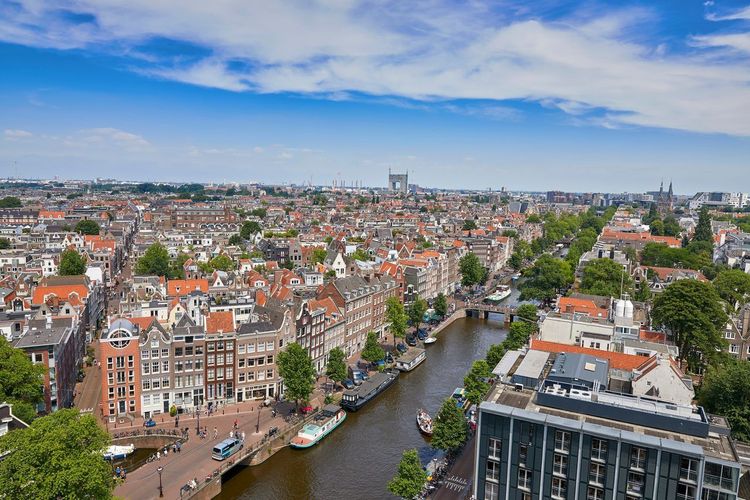
Between Dam Square and Vondelpark, several neighborhoods deserve a slower pace. The Jordaan, west of the center, lines up narrow streets, inner courtyards (hofjes) closed off by small discreet doors, and a concentration of independent boutiques rare in a European capital.
Hidden behind a discreet door a stone's throw from Dam Square, the Begijnhof (Begijnhof, 1012 WX Amsterdam, rated 4.5/5 on Google from 10,206 reviews) remains one of the quietest places in the center: an enclosed courtyard founded in the 14th century, lined with low houses and a chapel, where visitors speak in hushed voices out of respect for the women who still live there. Many visitors walk past the door without noticing it, which makes it a good counterpoint to the bustle of Dam Square five minutes away.
Further south, De Pijp revolves around the Albert Cuyp market, which bills itself as the largest daytime market in Europe: 260 stalls, Monday to Saturday from 9:30 a.m. to 5 p.m., among fishmongers, secondhand clothes and stands selling stroopwafels made on the spot. Note that it is closed on Sundays. This is the neighborhood to go to if you want to eat local without tourist prices.
Want to wander without consulting a map? The Ryo "At the Rhythm of the Canals" sub-tour crosses these calmer areas of the center, to be listened to while walking without rushing, a bit like strolling with no particular goal on a Sunday afternoon.
The Red Light District and Coffee Shops: What to Know
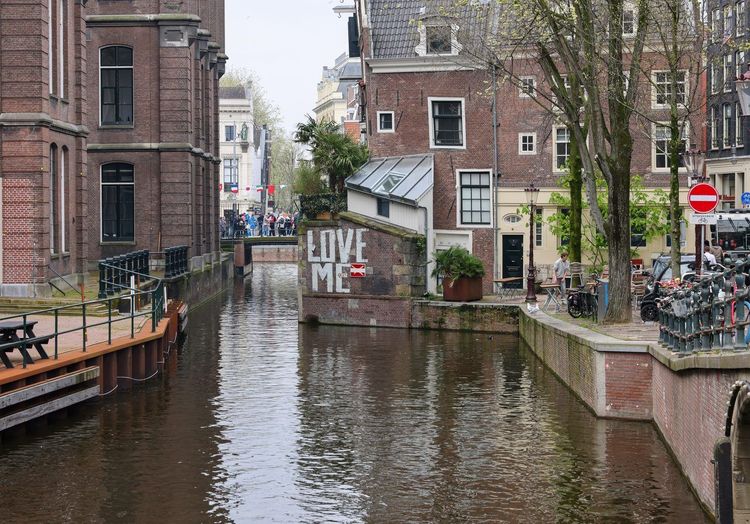
De Wallen (De Wallen, 1012 Amsterdam, rated 4.2/5 on Google from 6.5K reviews), the red light district, actually occupies one of the oldest areas of the city, built around two parallel canals east of Dam Square. Window prostitution is legal and regulated there, the ban on brothels having been lifted in the Netherlands in 2000. Photographing the windows or the people who work there is forbidden and frowned upon, a detail that many visitors overlook as they arrive with their phones already out. The neighborhood owes its name to the red neon lights framing the windows, visible from the street.
The neighborhood can be crossed without difficulty during the day, and remains passable early in the evening, at a normal pace, without stopping in front of the windows. The crowd density increases markedly after 10 p.m. on weekends, with its usual share of noisy groups: nothing alarming, but it is no longer the same neighborhood as in the late afternoon. The city has also restricted cannabis consumption on the street there and moved up the closing hours of bars and windows.
The coffee shops, meanwhile, are a category of establishment apart, distinct from regular cafés. The sale and consumption of cannabis there have been tolerated under license since the 1970s, restricted to those over 18 on presentation of ID. Smoking in the street in the heart of the red light district is forbidden, and alcohol is not served in these establishments.
If the subject interests you beyond simply walking through, several local guided tours address the social history of the neighborhood with a former sex worker as the speaker, a markedly more informative approach than mere tourist curiosity. These tours also need to be booked in advance, as demand regularly exceeds supply in high season.
By following the Ryo audio-guided tour, you skirt the edges of De Wallen without entering, with a narrative that looks back at the history of the neighborhood rather than making it an awkward subject. To go further, our dedicated article on Amsterdam's red light district details the rules to know before passing through.
How Many Days to Plan for a First Visit
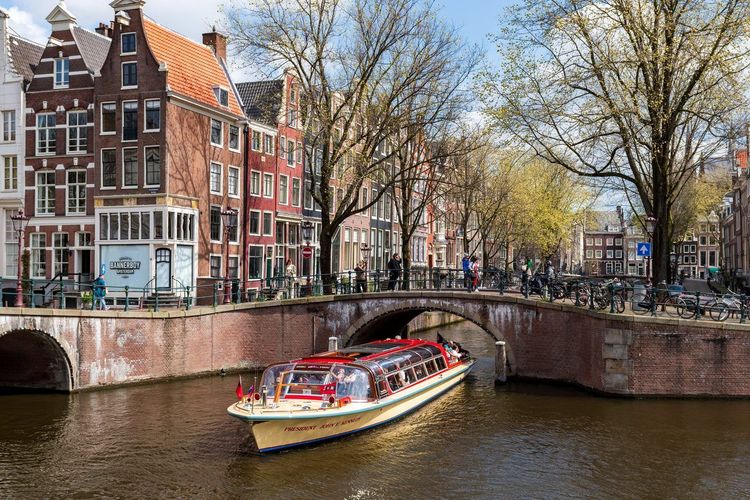
Two full days are enough to tick off the essentials at a brisk pace: Dam Square and the canals on the first day, the Anne Frank House and one museum on the second, accepting to sacrifice Vondelpark or a day trip. This is the format that comes up most often for a stopover from France or Belgium.
With three or four days, the program becomes much more comfortable: a half-day of strolling in the Jordaan, an afternoon in the park, and possibly a day trip to the tulip fields in spring or to the windmill villages north of the city. This format also leaves room for the unexpected, such as a rescheduled museum reservation or a downpour that changes the afternoon's plans.
A simple guideline before booking your tickets: aiming for four full days (counting travel separately) leaves real room to alternate must-see sights and leisurely wandering. Conversely, a two-day weekend format works very well if Amsterdam is part of a broader trip, for example combined with Brussels or Rotterdam. Travelers coming with children generally add an extra half-day of buffer: museums and queues are handled differently with a stroller or a child who tires after two hours of walking.
Whatever the number of days, note somewhere (phone or notebook) the opening hours of the places you want to see before leaving: contrary to a common belief, not everything is open continuously in Amsterdam, and some shops still close on Sunday mornings.
Getting Around Amsterdam: Bike, OV Card and Public Transport
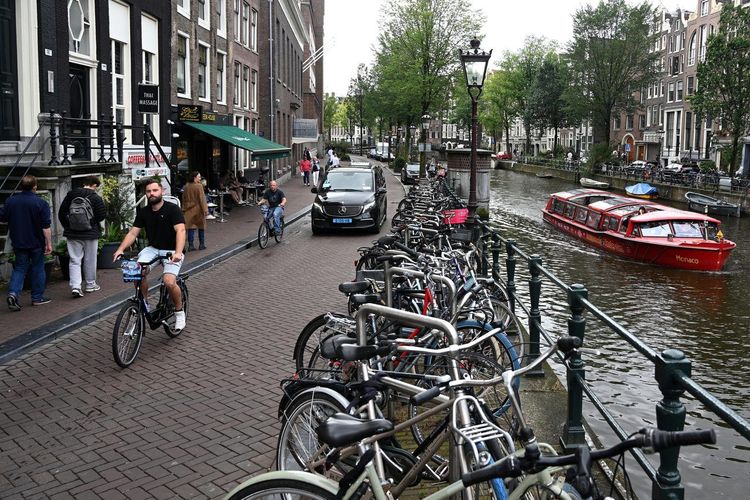
Renting a Bike Rather Than a Car
Amsterdam has almost as many bikes as residents, and this is not a figure of speech: there are several hundred thousand of them for just over 900,000 residents. Renting a car for a stay in the city is of almost no use, given the price of parking, the restricted traffic zones in the center and the general slowness of car traffic compared with the bike lanes.
A rental bike generally costs between 10 and 15 euros per day at rental shops in the center, often with a deposit on a bank card. Rental agencies are easy to find around the central station and in the Old Center, with classic old-style models, more comfortable for occasional use than sports bikes.
Lock your bike twice: once on the frame, once on the front wheel, ideally attached to a fixed point and not to another bike. Bike theft remains a common activity in the city, and rental shops charge the full replacement cost in case of disappearance, lock or no lock.
Once in the saddle, vigilance shifts: watch out for bike lanes, marked by red pavement or a painted strip on the ground, where pedestrians have no business. Most accidents involving tourists come from crossing a lane without looking both ways, as an Amsterdam cyclist will not brake for a distracted pedestrian.
Our article on cycling in Amsterdam helps you spot the safest routes for a first ride. And if you prefer to keep both hands free, the Ryo audio-guided tour is followed on foot, step by step, without pulling out a map at every intersection.
The OV Card and Public Transport

For the rest of your journeys, the OV-chipkaart works on all trams, buses, metros and even regional trains. You top it up at the station or via an app, and you must tap in at the start and out at the end of every trip, including on the tram, or face a penalty at inspection. Even simpler for a short stay: the OVpay system lets you tap directly with your contactless bank card or your phone, without buying a card beforehand.
How do you get there? From Paris, the direct train reaches Amsterdam Central Station in a little over three hours, which often makes it a simpler option than flying once transfers are counted. From Schiphol airport, the direct train to the central station takes about 15 to 20 minutes and costs far less than a taxi or ride-hailing service for a comparable trip. For many visitors, it is also the first glimpse of the Dutch rail system, renowned for the frequency of its departures.
One last free option to know about: the ferries that cross the IJ to the Noord district, useful both for reaching certain rooftop cafés and for getting an overview of the port from the water, without spending a cent.
Where to Stay in Amsterdam for a First Visit
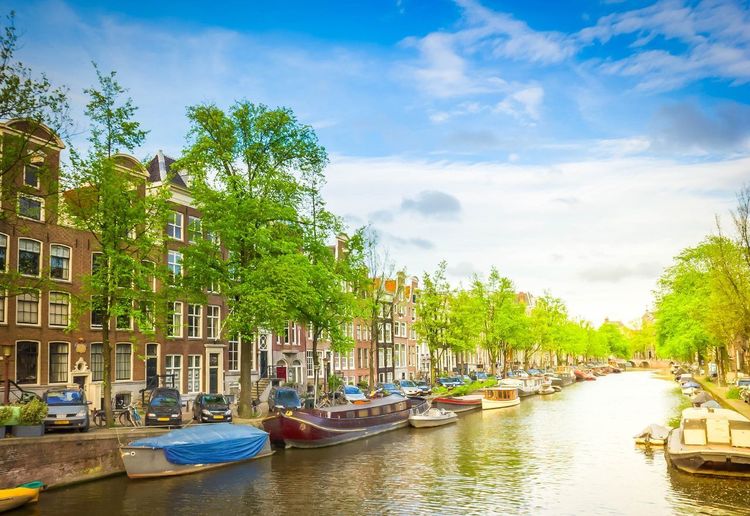
Book your accommodation and restaurants in advance, ideally several weeks before a stay in high season (April to September, and any festival period or international match). Each year the city receives a number of visitors far greater than its resident population, and well-located hotels fill up quickly.
Three areas come up most often for a first visit. The historic center, around Dam Square, puts everything within walking distance but also concentrates the nighttime noise and the highest prices. The Jordaan offers a pleasant compromise: still central, quieter in the evening, with the charm of a residential neighborhood. De Pijp, a bit further out but well connected by tram and metro, is noticeably cheaper for a comparable level of comfort.
A fourth neighborhood is worth mentioning for slightly longer stays: Oud-West, northwest of Vondelpark, combines residential buildings, a food hall and a reasonable distance on foot or by tram to the center. It is often the best value for an entire apartment rather than a hotel room.
Amsterdam applies one of the highest tourist taxes in Europe: since 2024, it represents 12.5% of the nightly rate excluding VAT, collected at the hotel or included in the displayed price depending on the platform. Factor it into your budget before comparing two addresses, because the difference displayed online does not always reflect the final amount paid on site.
For a family stay, choosing an apartment with a kitchenette makes a big difference to the meal budget over several days, as restaurant prices in the historic center climb quickly for a group of four. Whole-home rentals are also strictly regulated in the city, and are easier to find outside the Old Center.
Also check the cancellation policy before booking several months ahead: prices fluctuate strongly from one week to the next depending on events scheduled in the city (trade fairs, concerts, matches), and a flexible reservation sometimes lets you rebook a cheaper room a few weeks later. Between two equivalent addresses, the one closest to a direct tram stop to Centraal often saves precious time over the whole stay.
As for restaurants, the most popular addresses in the Jordaan and the center need booking too, particularly on Friday and Saturday evenings. An online reservation the day before is generally enough to avoid a 45-minute wait on the sidewalk.
Budget, Cash and Tipping
How much should you plan? The budget for a stay in Amsterdam varies enormously depending on the pace you choose: count on about fifty euros per day excluding accommodation for a budget version (markets, public transport, free museums or parks), double that for a comfortable level with one paid museum and one restaurant per day.
To give you an idea, a coffee costs on average around 3 to 4 euros, a draft beer between 5 and 6 euros, and adult admission to a major museum is around 20 to 25 euros. A full meal in a mid-range restaurant generally costs between 20 and 30 euros per person excluding drinks, and a standard canal cruise starts at around 18 to 20 euros for an hour. These benchmarks help you build a realistic budget before leaving, rather than discovering prices on site.
Carry a little cash, even though the Netherlands is among the most cashless societies in Europe. Bank cards or contactless payment cover nearly all businesses, and some establishments even refuse cash, but a few small market stalls or public toilets still accept only coins.
Contactless payment (card or phone) works almost everywhere, including for very small amounts like a takeaway coffee. American Express or Diners Club cards are often refused, whereas Visa and Mastercard pass without difficulty in tourist businesses. If you arrive without cash, ATMs are easy to find at the central station and around Dam Square; it is better to withdraw a decent sum at once than several small amounts, as fixed fees add up quickly.
Haggling is accepted in a specific setting: flea markets like Waterlooplein, not fixed-price shops or restaurants. In regular shops, offering a price different from the tag surprises more than it amuses.
Should I tip? Nothing is mandatory: service is already included in the bill. Rounding up the bill or leaving 5 to 10% for good service is appreciated in restaurants, without ever being expected as in North America.
Culture and Etiquette in the Netherlands
You may find your first exchanges a bit curt. The Dutch mentality sometimes surprises with its direct frankness: a remark that would seem abrupt elsewhere in Europe passes here as simple honesty, with no intent to hurt. English is spoken fluently throughout the country, including by most shopkeepers, which makes everyday exchanges much easier.
Cycling culture goes beyond a simple means of transport: it structures part of social relations. A pedestrian lingering on a bike lane will be reminded of the rules by ringing bells without ceremony, not out of hostility, but because giving way there is as automatic a reflex as respecting a queue elsewhere.
Be respectful of local rhythms as much as places: talking loudly on a tram early in the morning, or stopping in the middle of a bike lane to take a photo, annoys locals more than you might imagine. In shops and offices, queues are scrupulously respected, and cutting in front of someone, even by mistake, immediately provokes a direct remark.
Wearing orange is not an everyday reflex, but becomes almost a code of belonging during King's Day (April 27) or during national football team matches. Joining in for the occasion, even with a simple accessory, is generally enough to trigger a few smiles and spontaneous conversations in the street.
Practical Tips Before You Go: Weather, Safety and Customs
Weather and What to Pack
Amsterdam's oceanic climate does not make forecasting easy: a sunny morning can turn into a downpour in twenty minutes, carried by the wind coming up from the North Sea along the canals. Pack several layers of clothing rather than a single heavy coat, with a light waterproof jacket tucked in your bag in every season.
A standard umbrella rarely survives more than one gust along the canals: most locals have given up using one in favor of a hood or a technical jacket. Also bring a pair of quick-drying shoes, as rain sometimes shows up several times in the same day without warning.
Winter is rarely freezing (around 0 to 5°C) but damp and windy, which is felt more on a bike than on foot. Summer rarely exceeds 25°C, making it a pleasant destination even in peak season, unlike other European capitals that swelter in July. Between November and February, days shorten noticeably, with night sometimes falling as early as 4:30 p.m.: this does not prevent you from visiting the city, with the lights even adding a special atmosphere, but it reduces the window for outdoor visits.
Safety, Health and Customs Formalities
Watch out for pickpockets in the busiest areas: Dam Square, the central station and crowded trams in the center remain the classic hotspots. A bag worn in front rather than on the shoulder is enough to discourage most opportunistic attempts.
Be careful near the canals, especially at night: most quays have no guardrails, the water is colder than it looks, and the combination of a bike and a few too many drinks turns up every year in the local news.
Medical care in Amsterdam is of good standard but not free for foreign visitors: travel insurance, or the European Health Insurance Card for EU nationals, avoids unpleasant surprises. Pharmacies (apotheek) often close earlier than expected and rarely open on Sundays, so it is best to locate the one nearest your accommodation upon arrival. Also keep a digital copy of your important documents (passport, ID card, reservations) on your phone: if you lose a bag, it makes the process much easier.
As for customs, two questions come up constantly. Can I bring back tulip bulbs? Yes: within the European Union, no certificate is required for a quantity intended for personal use. To the United States or Canada, however, a phytosanitary certificate is mandatory, and the Bloemenmarkt vendors do offer certified bulbs for export. Can I bring back cheese from the Netherlands? For personal consumption and in reasonable quantity, it is no problem within the European Union; outside the EU, it is better to check the restrictions of your destination country before packing. The EU's indicative limits also apply to alcohol and tobacco: beyond a certain quantity, these purchases are presumed to be for commercial use.
One last point that regularly surprises first-time visitors: Amsterdam's shops are not open 24/7. Many only open at noon on Sundays, some supermarkets reduce their hours in the evening, and counting on a shop being open at midnight remains unrealistic apart from a few stores at the central station. Finally, keep in mind the European emergency number, 112, valid in the Netherlands as in the rest of the Union, for police, firefighters or an ambulance.



FAQ
How many days do you need to visit Amsterdam for the first time?
Two days cover the essentials at a brisk pace (Dam Square, canals, one museum, the Anne Frank House). Three to four days allow you to add Vondelpark, the quieter neighborhoods and a day trip.
Do you need to book the Anne Frank House in advance?
Yes, always. All tickets go on sale on Tuesdays at 10 a.m., six weeks before the visit date, online only. There is no ticket sales desk on site.
How do you get around Amsterdam without a car?
A rental bike and the tram, bus and metro network easily cover the needs of a stay. The OV-chipkaart or a simple contactless bank card (OVpay) lets you tap in on all public transport.
Should you tip in the Netherlands?
No, it is never mandatory since service is already included. Rounding up the bill or leaving 5 to 10% for good service is a appreciated gesture, but nothing more.
Can you bring back cheese or tulip bulbs from the Netherlands?
Within the EU, cheese and bulbs in reasonable quantities are not a problem. To the United States or Canada, bulbs require a phytosanitary certificate, which the flower market vendors provide.
What budget should you plan for a first stay in Amsterdam?
Plan on around 50 euros per day for a budget-friendly trip, and double that for a more comfortable pace including a museum and a restaurant meal every day, not counting accommodation or the tourist tax.
What is the best time to visit Amsterdam?
Spring (April-May, tulip season) and early autumn offer the best compromise between mild weather and still-reasonable crowds. Summer remains pleasant but is noticeably busier.
Amsterdam is hard to sum up in a list of things to see: it is a city best understood through its habits, by bike, between two canals, rather than through a checklist of monuments. Keeping a few simple habits in mind (tickets booked in advance, a double lock, a good pair of waterproof shoes) makes a big difference to the quality of a first stay, especially when your time on site is counted in days rather than weeks.
To turn these pointers into a concrete itinerary as soon as you leave the station, the Ryo audio-guided tour covers the essentials of this guide in audio form, step by step, so you can visit Amsterdam for the first time without pulling out your phone at every intersection.
À lire également